- Choose the platform, not only the brand: both Roborock and Ecovacs now sell roller-mop and rotating-pad systems with materially different dock and carpet behavior.
- Roborock offers a wide premium technology matrix; Ecovacs makes OZMO roller mopping and selected bagless OMNI stations central to its current range.
- Compare matched models, wash-path access, consumables, warranty channel and local repair support before comparing suction or stain-removal claims.
In this article 15 sections
Choose Roborock when you want a broad matrix of premium navigation, chassis, brush, mop and dock technologies. Choose Ecovacs when OZMO roller mopping, the DEEBOT ecosystem or a selected bagless OMNI station solves a specific ownership priority. Neither brand wins every home: the correct comparison is between matched robot-and-dock platforms, available parts and the local service channel.
Both companies sell multiple product generations, retailer bundles and regional suffixes at the same time. A discounted former flagship can sit beside a new midrange model. Record the complete model name, included dock and sales region before comparing specifications.
Roborock vs Ecovacs: The Short Answer
| Decision | Roborock | Ecovacs |
|---|---|---|
| Product range | Broad Saros, Qrevo and Q-series matrix | X-, T- and N-series DEEBOT ladder |
| Premium navigation | Retractable LDS or solid-state 3D sensing, depending on platform | Mini/dToF plus structured light, RGB and AIVI functions, depending on model |
| Mopping | Sonic flat pad, rotating pads and a newer roller platform | Rotating-pad history and a strong current OZMO roller direction |
| Carpet strategy | Mop lifting or detachment, brush/chassis lifting and roller shield by model | Mop lifting plus multi-component lift and dry-wet separation by model |
| Hair | DuoDivide or dual anti-tangle packages on selected models | ZeroTangle brush systems on selected models |
| Dock | Bagged auto-empty through full wash/dry/refill stations | Full OMNI stations plus bagless OmniCyclone on selected models |
| US warranty headline | One year for new products under current terms | 12 months for new products under current terms |
| Best fit | Buyers willing to compare a detailed feature matrix | Buyers prioritizing OZMO roller, DEEBOT app features or bagless dust handling |
This is a buying and ownership framework, not an independent cleaning test. Pa, airflow, hair, stain, edge and obstacle claims use different manufacturer methods.
Compare the Right Product Platforms
Roborock examples
- Saros 20: premium platform with StarSight Autonomous System 2.0, an adaptive chassis, dual spinning mops, component lifting and RockDock automation.
- Saros 20 Sonic: premium route built around sonic flat-pad mopping rather than the same mop layout as Saros 20.
- Qrevo Curv 2 Flow: roller-mop platform with continuous fresh-water feed, scraping, dirty-water collection, carpet shield and a multifunction dock.
- Qrevo and Q-series models: wide value-to-premium selection; edge reach, obstacle sensing, brush design, dock temperature and detergent functions vary by suffix.
Ecovacs examples
- DEEBOT T90 OMNI: OZMO Roller 3.0, AIVI 3D 4.0, Triple Lift and a full-service OMNI station.
- DEEBOT X12 OmniCyclone: OZMO Roller 3.0, FocusJet pre-treatment and a bagless cyclone station.
- X11 and X9 platforms: earlier premium roller-mop systems with different navigation, charging and station packages.
- T- and N-series models: accessible through premium roles; “OMNI” does not guarantee the same roller, camera, detergent or dock function.
Do not compare Saros 20 with T90 merely because both are new. First match budget, mop architecture, dock role, floor mix and required service.
Navigation and Obstacle Avoidance
Roborock uses more than one premium sensing philosophy. Some models use a retractable laser distance sensor to reduce height under furniture, while StarSight platforms use solid-state 3D sensing and cameras. Ecovacs combines Mini/dToF positioning with structured light, RGB cameras and AIVI recognition on selected DEEBOTs.
The buying questions are practical:
- Can the robot map reliably in darkness?
- Does it avoid low cables, socks, pet bowls and reflective chair bases?
- Will the top sensor clear the lowest sofa?
- Can it recover after furniture moves?
- Are room division, no-go zones and multi-floor maps easy to edit?
- What happens to maps and routines after an app or account change?
An object-recognition count is not proof of perfect avoidance. Small, transparent, dark or moving objects remain difficult. Homes with pet accidents or charging cables should still remove high-risk debris before unattended cleaning.
Roller Mopping vs Rotating Pads and Sonic Pads
This comparison is no longer “Roborock pads versus Ecovacs roller.” Both brands now span multiple architectures.
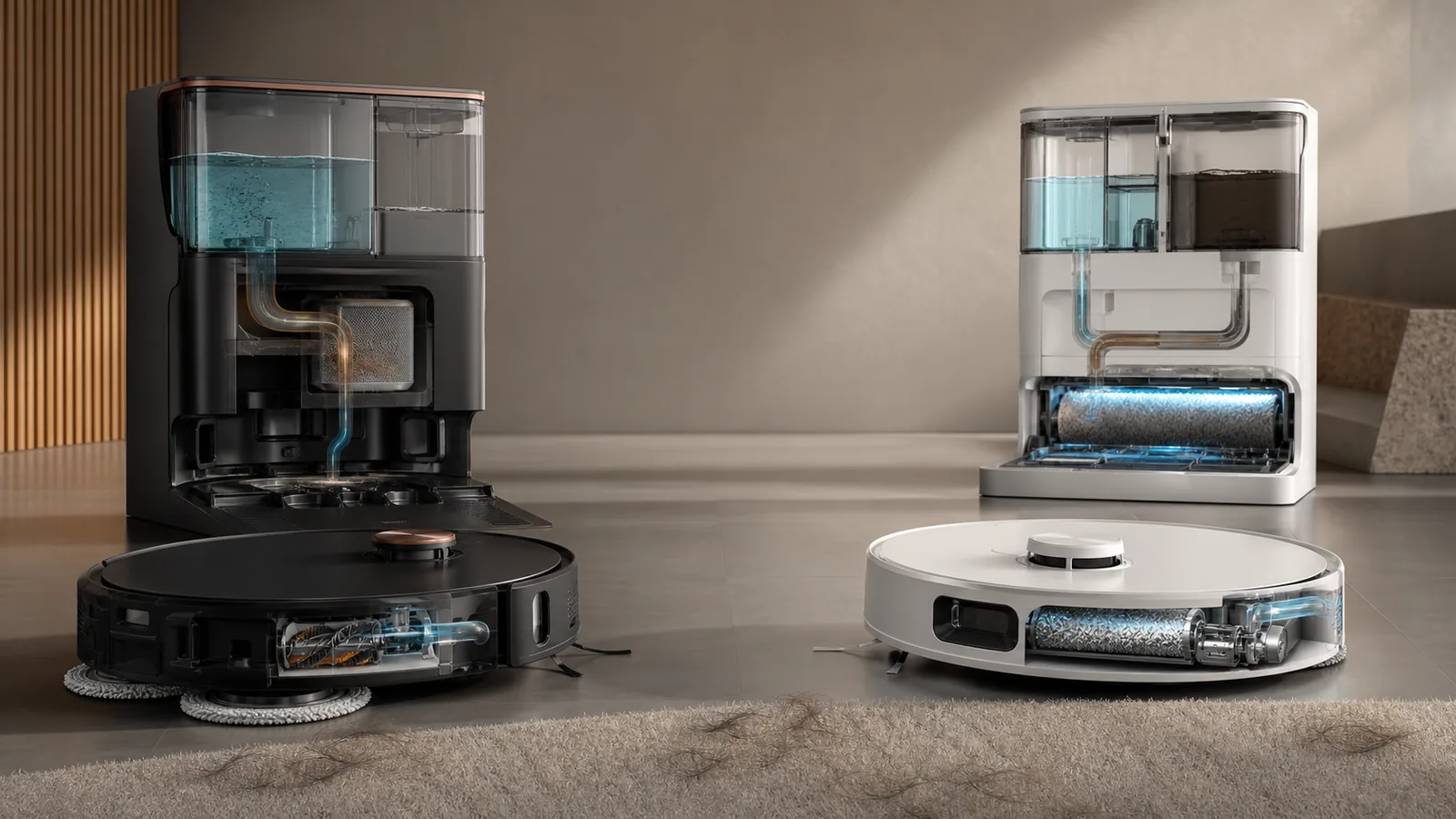
Roborock’s Qrevo Curv 2 Flow feeds clean water across a roller, uses a scraper to control moisture and collects wastewater during the pass. Ecovacs’ current OZMO Roller platforms follow the same broad refreshed-surface principle, with model-specific roller length, water delivery, edge extension and station wash systems.
Roborock also sells dual rotating-pad platforms and sonic flat-pad systems. Ecovacs retains pad-based models beside its roller range.
Roller advantages
- a continuously refreshed contact surface;
- direct dirty-water separation during the pass;
- strong directional scrubbing;
- potential to reduce re-spreading of dissolved soil.
Roller trade-offs
- the scraper, cover and water channel add cleaning points;
- hair and grit can collect behind the roller;
- wet rollers need effective washing and drying;
- replacement compatibility and price matter;
- carpet protection depends on lift and shield clearance.
Pad-system advantages
- mature, familiar architecture;
- simple removable pads;
- broad accessory availability on established platforms;
- visible scrubbing from spinning systems or consistent wiping from sonic pads.
Compare actual dried-stain removal, floor moisture, edge distance, wastewater recovery and wash-path access. Manufacturer rpm, pressure and stain percentages are not a common test.
Carpets and Dry-Wet Separation
A premium robot can lift several elements:
- mop pad or roller;
- main brush;
- side brush;
- chassis.
Roborock distributes these functions differently across Saros and Qrevo platforms. Ecovacs uses Triple Lift language on selected DEEBOTs to separate brushes and mop hardware according to the mess.
The goal is wider than carpet protection. Lifting brushes over a wet spill can reduce cross-contamination; lifting or shielding the mop can keep rugs drier; chassis lift can improve thick-carpet movement.
Measure the carpet pile and fringe. A stated lift height does not guarantee clearance on a soft, uneven rug. Use no-mop zones when the margin is small.
Pet Hair and Brush Architecture
Roborock’s selected premium models use DuoDivide or related anti-tangle main-brush designs with an anti-tangle side brush. Ecovacs promotes successive ZeroTangle systems that combine brush geometry, bristle angle and airflow.
Hair failures occur beyond the visible roller:
- side-brush hub;
- roller end caps and bearings;
- gear cavities;
- dustbin inlet;
- dock emptying tube;
- roller-mop scraper.
Test long human hair, soft pet undercoat and thread separately. A main roller can look clean while hair packs into an axle. Check whether end caps open, whether the complete brush or only a cartridge is sold, and whether the dock can empty a hair-filled bin without repeated blockage.
Edge and Corner Cleaning
Both brands use extendable side brushes and mop hardware on selected products. Roborock’s FlexiArm systems extend toward walls or corners; Ecovacs uses TruEdge functions with edge sensing and extending cleaning hardware.
Edge claims require context:
- straight baseboard or inside corner;
- table leg or irregular furniture base;
- dry crumbs or sticky residue;
- left- or right-side approach;
- clearance around the dock and room boundary.
An extending mop can improve wall-side coverage but adds an actuator and hinge that need cleaning. Retail demonstrations should show the mechanism retracting as well as extending.
Full-Service Docks
Both companies offer stations that can empty dust, wash and dry mop hardware, refill robot water and manage cleaning solution on selected models. Automation moves work to the dock; it does not eliminate it.
Owners still need to:
- fill clean water and empty wastewater;
- remove sludge from the wash tray;
- inspect seals and drains;
- replace bags or clean a cyclone chamber;
- clear the dust tube;
- clean dock filters and air paths;
- use approved detergent.
The structural difference is Ecovacs’ selected OmniCyclone bagless station. It avoids disposable dust bags, but the chamber, cyclone and filters require care and emptying can release dust. Most comparable full-service Roborock docks use bags, which can provide cleaner disposal but create a recurring consumable.
Before buying, open every removable panel. A high dock-temperature claim matters less if the wash tray, roller scraper or wastewater intake is difficult to reach.
App, Maps and Privacy
The Roborock app and ECOVACS HOME app provide maps, room cleaning, routines, carpet settings and device controls for compatible models. Voice, camera and agent functions vary.
Compare:
- map editing, backup and multi-floor behavior;
- account sharing;
- camera permissions and remote-view controls;
- cleaning-history retention;
- voice languages;
- third-party smart-home integration;
- firmware-support policy;
- behavior during internet outage.
Roborock states that its robot-vacuum security updates last at least two years. That policy is useful but is not a promise that every cloud feature or accessory will remain unchanged. Read both companies’ current privacy terms before enabling cameras or remote viewing. Reset maps and accounts on returns or retail demo units.
Consumables, Warranty and Support
Both current US standard policies give new products a one-year headline warranty. Roborock’s policy applies to qualifying products sold by the company and authorized channels and excludes normal wear, consumables, misuse and unauthorized service. Ecovacs’ US policy similarly covers new products for 12 months and excludes consumables, normal wear, incompatible third-party parts and unauthorized repairs.
Roborock also publishes a US repair and spare-parts policy. It says parts availability can vary by model, production year and inventory, and some components require authorized service. Ecovacs sells model-specific brushes, filters, mop rollers, solutions and kits through its accessories store.
Before purchase, confirm:
- authorized seller status;
- proof-of-purchase requirement;
- who pays repair shipping;
- whether the robot and dock can be serviced separately;
- current battery and wheel-module stock;
- mop roller or pad compatibility;
- turnaround time and replacement policy;
- support after a retailer-exclusive SKU is discontinued.
A one-year warranty with nearby repair and stocked parts can be more useful than optional longer coverage with an unclear service route.
Price and Total Cost of Ownership
Sale prices move too quickly to define the comparison. Use a three-year model:
`robot and dock + bags or cyclone-filter care + brushes + filters + mop hardware + detergent + battery allowance + repair shipping + downtime`
Then add household labor for water service, wastewater cleaning, hair removal, tray care and map recovery.
Roborock’s wide matrix can help a buyer match a precise need, but it increases suffix and compatibility complexity. Ecovacs’ current roller focus can make the premium proposition easier to explain, while roller, scraper and station maintenance still need budgeting.
Which Brand Fits?
Choose Roborock if:
- you want to choose among sonic, rotating-pad and roller platforms;
- low furniture, thresholds, carpet or edge mechanisms are major priorities;
- you are comfortable comparing detailed suffixes and dock packages;
- the local seller stocks the exact consumables and supports dock repair.
Choose Ecovacs if:
- OZMO roller mopping is the central cleaning priority;
- a selected bagless OMNI station solves a bag-supply concern;
- ECOVACS HOME, AIVI or YIKO functions fit the household;
- local DEEBOT accessories and service are stronger.
Delay purchase if:
- carpet height and thresholds are unmeasured;
- no seller can identify the correct roller, pad, bag or filter;
- the dock tray and wastewater path cannot be inspected;
- camera or cloud permissions are unacceptable;
- the product will be used commercially under a household warranty.
Retail and OEM Implications
Retailers should build the assortment by architecture:
- accessible auto-empty robot;
- rotating-pad full-dock model;
- roller-mop full-dock model;
- low-profile or high-mobility premium model;
- bagless-station alternative;
- matching consumable and service kits.
Demonstrate tank removal, wash-path access, brush end caps and app reset. These ownership tasks reduce more returns than another suction-number placard.
For product development and sourcing, see our robot vacuum OEM and ODM guide and robot vacuum manufacturing cost. For adjacent competitive context, read Roborock vs Dreame and Dreame vs Ecovacs.
FAQ
Is Roborock better than Ecovacs?
Roborock offers a wider premium technology matrix. Ecovacs has a strong current OZMO roller direction and selected bagless stations. The matched model, home and service channel decide.
Which is better for mopping?
Compare the exact roller, rotating-pad or sonic-pad system. Measure stain removal, wastewater recovery, floor moisture, carpet separation and maintenance access rather than relying on rpm or pressure alone.
Which is better for pet hair?
Both sell anti-tangle systems. Inspect end caps, side-brush hubs, the dust path and parts availability; hair claims are not directly comparable.
Are Ecovacs stations bagless?
Some OmniCyclone models are bagless. Many other Ecovacs stations use bags. Verify the exact dock package.
Which has the better US warranty?
The current standard headline is one year for both brands’ new products. Authorized seller, exclusions, shipping, parts and local service determine the practical value.
Can either robot replace manual floor washing?
They are strong maintenance cleaners, especially when run frequently. Heavy grease, grout, textured stone and large spills can still require manual cleaning.
Bottom Line
Roborock competes through platform breadth; Ecovacs competes through a focused roller-mop story and distinctive dock options. The durable decision comes from matching the mop architecture to the floor, opening the dock, pricing three years of parts and confirming the repair path—not from declaring one brand universally better.
Explore 2026 new models
From brand to model
Specifications, versions & buying considerations
Robot vacuumsECOVACS DEEBOT X12 OmniCyclone ↗Specifications, versions & buying considerations
Robot vacuumsECOVACS DEEBOT T90 PRO OMNI ↗Specifications, versions & buying considerations
Robot vacuumsRoborock Saros 20 Sonic ↗Specifications, versions & buying considerations
Robot vacuumsRoborock Saros 20 Flow ↗Specifications, versions & buying considerations
Robot vacuumsECOVACS DEEBOT X12S OmniCyclone ↗Specifications, versions & buying considerations
Robot vacuumsRoborock Qrevo Edge 3 Pro ↗Specifications, versions & buying considerations
Robot vacuumsRoborock Qrevo Curv 2 Flow ↗Specifications, versions & buying considerations
Robot vacuumsECOVACS DEEBOT T90S PRO OMNI ↗Specifications, versions & buying considerations
Robot vacuumsECOVACS DEEBOT T90 MAX PRO OMNI ↗Specifications, versions & buying considerations
Robot vacuumseufy Robot Vacuum Omni C28 ↗Specifications, versions & buying considerations
Robot vacuumsECOVACS DEEBOT T80S OMNI ↗Specifications, versions & buying considerations
Robot vacuumsShark PowerDetect UV Reveal RV3020XE ↗Specifications, versions & buying considerations