- There is no universal robot vacuum manufacturing cost: configuration, market, order stage and quotation boundary must be fixed first.
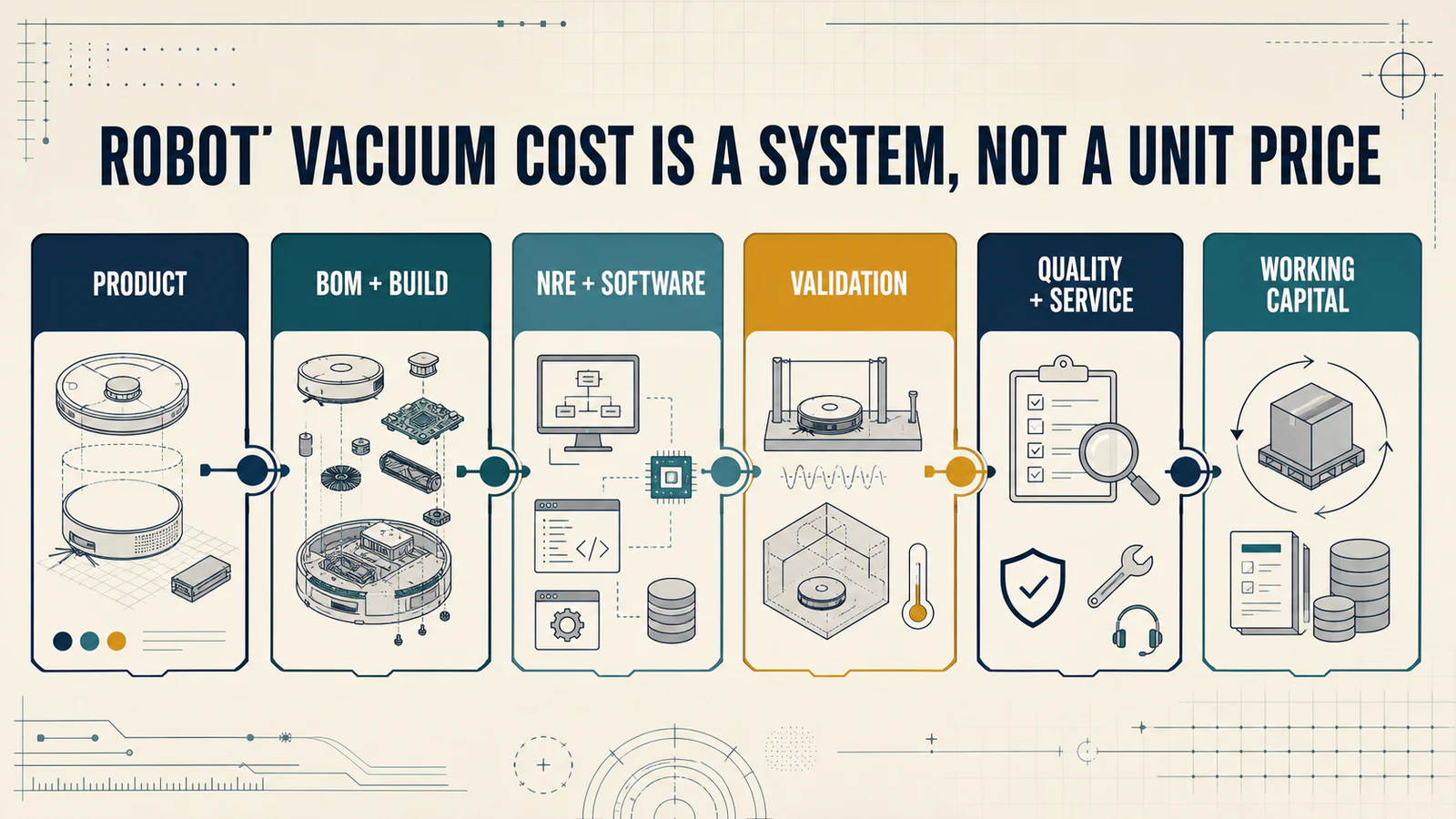
- A usable cost model separates recurring unit cost, one-time development cost, contingent quality and service cost, and working-capital requirements.
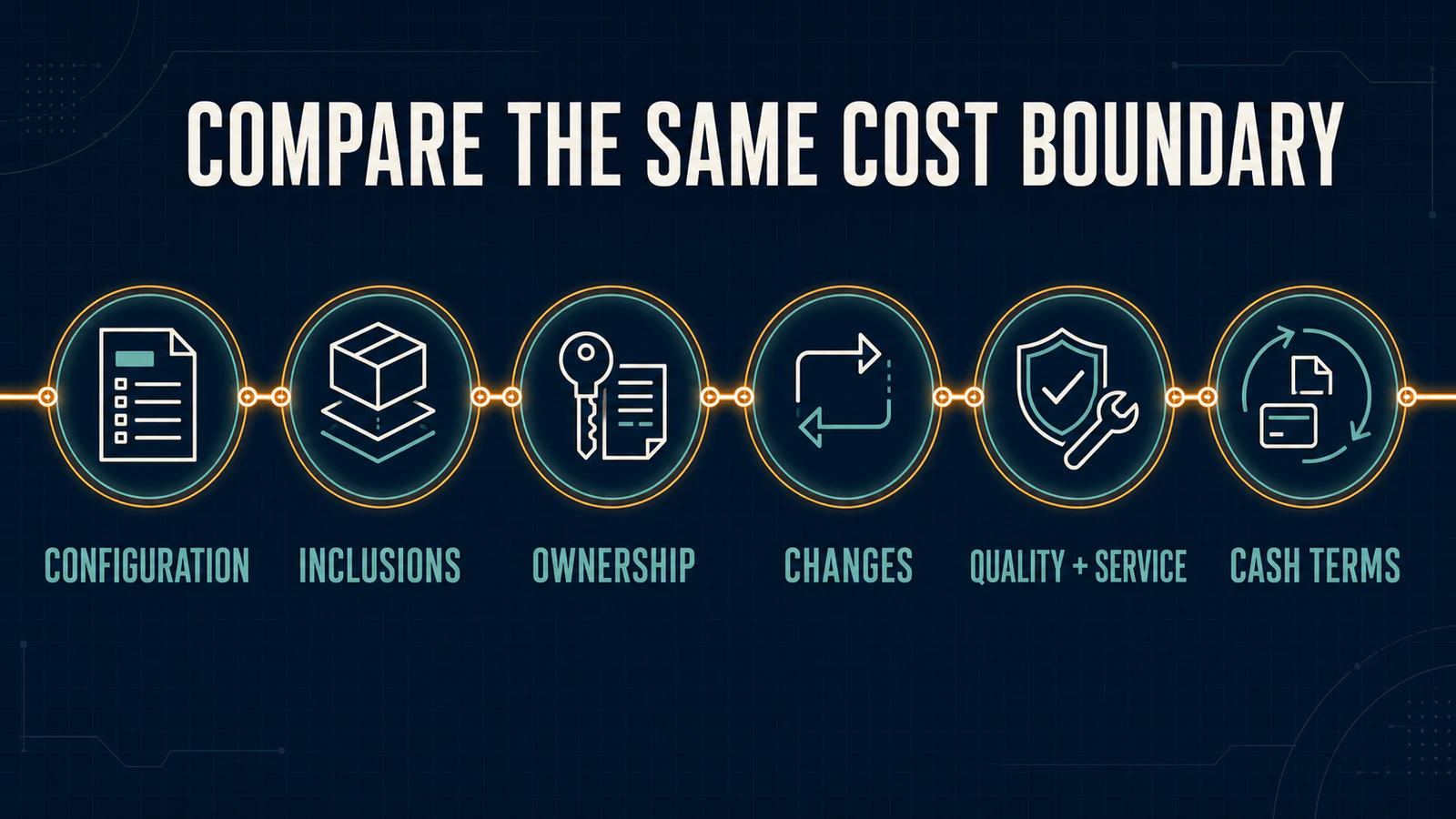
- Buyers should normalize supplier quotations by inclusions, ownership, change rules, quality responsibility, after-sales support and payment terms.
In this article 13 sections
There is no universal robot vacuum manufacturing cost. A credible estimate requires a fixed product configuration, target market, order stage, manufacturing model and quotation boundary. The cost is not only the bill of materials and assembly charge. It can also include tooling, engineering, firmware, app and cloud work, testing, certification, packaging, quality losses, spare parts, warranty preparation and the cash tied up before the buyer is paid.
The practical method is to separate four different questions: recurring unit cost, one-time development cost, contingent quality and service cost, and working-capital requirement. Only then can two supplier quotations be compared on the same basis.
Why a Universal Unit Cost Is Misleading
“Robot vacuum” describes a category, not a manufacturing specification.
A basic vacuum-only platform, a mopping model, a navigation-heavy premium robot and a product with a multifunction dock do not carry the same component, software, testing or service burden. The target market also changes the required radio configuration, labels, technical documentation, packaging and responsible-party structure.
Order stage matters as well. A catalog-based ODM project can reuse an existing platform. A customized version may need new cosmetic parts, packaging and firmware. A buyer-defined product can require new mechanical design, tooling, validation and software work. The first production order can carry costs that disappear from a mature repeat order, while a later engineering change can create new testing, scrap and inventory exposure.
Retail price is not a reliable shortcut. It includes channel margin, freight, duties, tax, marketing, promotions, returns and brand economics that are not factory manufacturing cost. Working backward from retail price produces an assumption, not a verified BOM.
Define the Cost Boundary Before Comparing Quotes
Before asking for a unit price, freeze the commercial and technical boundary.
| Boundary | What must be fixed | Why it changes the answer |
|---|---|---|
| Product configuration | Cleaning system, navigation, obstacle sensing, battery, charger, dock, wireless functions, accessories and packaging | Different configurations use different components, tests and assembly processes |
| Target market | Country or region, sales channel, launch date, label languages and responsible economic operator | Compliance, documentation, packaging and service obligations are market-specific |
| Order stage | Sample, engineering validation, pilot production, first mass order or repeat order | Tooling, NRE, validation, launch scrap and one-time setup may appear at different stages |
| Manufacturing model | In-house, contract manufacturing, OEM, ODM or joint development | Asset ownership, engineering control and supplier margin sit in different places |
| Commercial basis | Incoterm, currency, payment terms, quotation validity and tax treatment | Two identical factory prices can require different cash and logistics commitments |
| Included work | Tooling, testing, certification, software, packaging, inspection, spares and warranty support | “Included” is meaningful only when the deliverable and responsibility are named |
This boundary should be recorded in a controlled specification and quotation sheet. A supplier’s model name or sales description is not enough.
The Robot Vacuum Cost Stack
Product definition
Cost begins before a purchase order. The buyer must define what the product is expected to clean, how it navigates, which failures are unacceptable, what the dock does, which app functions are required and how the product will be serviced.
An unclear specification does not remove cost. It moves cost into repeated samples, late changes, disputed acceptance and market returns.
BOM and manufacturing conversion
The BOM can include the chassis, molded parts, drive system, cleaning motor, brush system, filtration, battery pack, charging system, power electronics, control boards, sensors, wireless module, tanks, pumps, dock components, fasteners and consumables. The exact list depends on configuration.
Manufacturing conversion is separate. It can include incoming inspection, subassembly, final assembly, firmware loading, calibration, functional testing, cosmetic inspection, packing and normal process loss.
A quotation should state whether the supplier controls the full component purchase or whether the buyer supplies designated parts. It should also identify alternates. A lower BOM based on an unapproved substitute is not the same product.
Tooling, fixtures and NRE
New housings, tanks, ducts, brush structures, dock parts and cosmetic panels can require molds. Assembly and test can require fixtures, gauges, programming tools and end-of-line equipment. NRE can cover industrial design, mechanical and electrical engineering, prototypes, firmware changes, test development and project management.
Payment does not prove ownership. The contract should identify:
- who owns each mold, fixture, drawing and test program;
- where the asset is stored and who maintains it;
- whether the supplier can use it for another customer;
- how engineering changes are approved and charged;
- whether the asset and its technical data can be transferred.
SharkNinja’s 2025 Form 10-K provides a useful public-company example: its third-party suppliers generally source components, while the company directly sources some components and pays for and owns certain tooling and equipment used by suppliers. The same filing treats molds and tooling as assets and warranty as a separate accrued obligation. It does not disclose the cost of one robot vacuum project, and its figures should not be used as a unit-cost proxy.
Firmware, app and cloud
A connected robot vacuum is a hardware-and-software product. The cost boundary can include embedded firmware, navigation software, mapping, app customization, account systems, device onboarding, over-the-air updates, cloud hosting, analytics, security maintenance and third-party licenses.
The quotation must distinguish launch work from ongoing operation. Buyers should ask who owns the source code, developer accounts, signing keys, cloud tenant, user data and update process. A low hardware quote can leave the buyer dependent on a separate software operator with unclear long-term fees or support.
The same issue applies to ODM platforms. Reusing a mature app and firmware stack can reduce initial development work, but the buyer needs written rights to use the platform, receive updates, access data and continue service if the supplier relationship ends.
How Configuration Changes the BOM and Risk
Product features change more than the component count.
| Configuration decision | Direct cost effect | Secondary effect |
|---|---|---|
| Vacuum-only or vacuum-and-mop | Water hardware, tanks, pumps, pads and control parts | Leakage, cleaning, odor and maintenance validation |
| Navigation and obstacle sensing | Sensor set, processing, calibration and mounting | Firmware complexity, test scenes, privacy and support |
| Simple charger or multifunction dock | Power, structure, airflow, water handling and consumables | Larger packaging, more failure modes and higher service burden |
| Battery and charging system | Cells, pack electronics, charger and thermal design | Runtime validation, transport documents, replacement policy and recall exposure |
| Wireless and app functions | Module, antenna, firmware and cloud integration | Radio authorization, cybersecurity, account support and updates |
| Accessory and packaging set | Brushes, filters, pads, tools, printed materials and carton structure | SKU complexity, packing labor, freight volume and replacement inventory |
The highest-cost component is not automatically the highest-risk component. A low-value seal, sensor mount or software dependency can create expensive field failures. Cost review therefore needs a failure-mode review, not only a spreadsheet.
Testing, Certification and Market Access
Certification cost cannot be estimated responsibly until the exact product, charger, battery, wireless configuration and target market are fixed.
The current IEC 60335-2-2:2026 safety standard covers automatic battery-operated cleaners and includes requirements relevant to remote operation, traction and brush motors, and docking stations. It is an important design and test reference, not a complete global market-access checklist.
For the United States, the FCC states that covered radio-frequency devices must meet the applicable technical requirements before importation or marketing. A connected robot may include both intentional and unintentional radiators. Using a certified radio module can simplify one part of the path, but the FCC’s module integration guidance still places conditions on the host product and OEM instructions.
For the European Union, official CE guidance states that a company that has a product made and sells it under its own name or brand is treated as the manufacturer and is responsible for the whole product. CE marking is not a generic certificate issued by one central EU body. The product needs the applicable conformity assessment, technical documentation and declaration for its actual configuration.
The EU General Product Safety Regulation has applied since December 13, 2024, and connected radio equipment has also faced the RED cybersecurity requirements in Delegated Regulation (EU) 2022/30 since August 1, 2025. Battery labeling and other duties under the EU Batteries Regulation phase in on their own timelines. The applicable set must be checked against the product, economic operator, enterprise and placing-on-market date.
Lithium battery transport is another boundary. The US Pipeline and Hazardous Materials Safety Administration explains that lithium battery designs offered for transport must pass the UN Manual of Tests and Criteria, subsection 38.3, and that a test summary must be available. The battery model in the report must match the production battery.
The commercial lesson is simple: do not buy “CE,” “FCC” or “UN 38.3” as a line item without a model list, configuration, applicant or responsible party, test scope, deliverables and change rule. Our broader guide to cleaning-appliance compliance and certification explains how to check document identity and final production components.
Quality, Yield, Rework and Change Control
Quoted unit cost often assumes a stable production process. A new project does not begin there.
Pilot builds can reveal molding, assembly, calibration, firmware, dock, battery, leakage, navigation or packaging problems. The direct effects include scrap, rework, additional inspection, line stoppage and retesting. The larger effect is schedule: a delayed launch can leave components, packaging and channel inventory committed to an outdated revision.
The manufacturing agreement should define:
- the approved BOM, drawings, firmware and golden sample;
- incoming, in-process and final acceptance criteria;
- how first-pass yield and rework are reported;
- who pays for supplier-caused and buyer-caused changes;
- which substitutions require written approval;
- how obsolete material is valued after a change;
- whether compliance review and retesting are required.
Cost-down proposals need the same control. A cheaper motor, battery, charger, board, radio module, plastic material or seal can change performance, safety, reliability or document coverage. Savings should be accepted only after the buyer sees the component change, validation result and compliance impact.
SharkNinja’s 2025 filing describes employees working with suppliers on production, quality and cost and inspection before products leave the factory. That is a reminder that outsourced assembly still requires a buyer-side quality system. For supplier evaluation beyond pricing, use How to Evaluate a Chinese Cleaning Appliance Supplier.
Spares, Warranty and Recall Readiness
Manufacturing cost does not end when the carton leaves the factory.
A robot vacuum program needs a service model for batteries, chargers, brushes, filters, tanks, pumps, wheels, sensors, docks and other replaceable assemblies. The buyer should decide which parts are customer-replaceable, which need a repair partner and which failures trigger a complete-unit replacement.
Warranty planning should identify the warrantor, claim approval process, diagnostic data, parts price, labor, freight, replacement stock and supplier recovery. A supplier credit is not useful if the brand must first fund customer refunds, reverse logistics and replacement inventory.
Recall readiness is a separate obligation. The product and component records should support traceability by production lot, battery, charger, firmware and key supplier. The contract should define access to test reports, complaint data, corrective action, affected inventory and field-remedy support.
These are contingent costs: they may not occur on every unit, but ignoring them does not make them zero. Our spare-parts and warranty guide covers the service questions in more detail.
Working Capital and the First Order
Working capital answers a different question from manufacturing cost: how much cash is committed, and for how long, before the buyer collects from the channel?
The cash cycle can begin with tooling and NRE, then move through deposits, long-lead components, work in process, finished goods, freight, customs, destination inventory and customer payment terms. A supplier can quote an attractive unit price while requiring the buyer to fund a large part of this cycle.
iRobot’s quarterly filing for the period ended June 28, 2025 explains that its contract manufacturers procure components and capacity against forecasts and that some unique designs, semi-finished goods and non-cancellable, non-returnable components cannot simply be cancelled when demand changes. This does not set a cost benchmark. It shows why forecast liability and inventory exit rules belong in the commercial model.
Before the first order, record:
- deposit and balance-payment triggers;
- title to raw material, work in process and finished goods;
- which components are non-cancellable or buyer-specific;
- forecast commitment and cancellation windows;
- responsibility for excess and obsolete inventory;
- shipment, customs and channel payment timing;
- currency and price-adjustment mechanism.
The first-order cash requirement should be modeled separately from gross margin. Otherwise a commercially profitable product can still create a funding problem.
In-House vs Contract Manufacturing vs OEM vs ODM
The labels describe different control patterns, but industry usage is inconsistent. Read the agreement and operating model.
| Model | Where cost usually sits | Main advantage | Main cost risk |
|---|---|---|---|
| In-house factory | Facility, equipment, people, systems, material, utilization and working capital sit with the owner | Direct manufacturing control | Fixed cost and underused capacity can be hidden when compared with a supplier quote |
| Contract manufacturing | Buyer defines more of the product or supply chain; manufacturer charges for procurement, conversion and service | Control with outsourced production | Buyer may retain tooling, component, forecast and inventory exposure |
| OEM | Buyer generally provides stronger product definition; factory manufactures to agreed requirements | Differentiation and specification control | NRE, validation and change management require capable buyer-side teams |
| ODM | Supplier provides an existing product platform with agreed customization | Faster launch and platform reuse | Platform overlap, software dependency, change limits and unclear long-term support |
| Joint development | Buyer and supplier divide product, engineering and investment responsibilities | Shared capability and deeper differentiation | Ownership and exit rights become complex if not written early |
For a fuller explanation of these models, see OEM vs ODM Cleaning Products. The cost article owns the quotation boundary; the OEM/ODM article owns the sourcing-model definitions.
How to Normalize Two Quotations
Do not place two headline unit prices side by side until every row below has an answer.
| Quotation line | Supplier A | Supplier B | Normalization question |
|---|---|---|---|
| Product revision | Record exact specification and sample | Record exact specification and sample | Are both suppliers quoting the same deliverable? |
| BOM and alternates | Included parts and approved substitutes | Included parts and approved substitutes | Are battery, charger, radio, dock and key components equivalent? |
| Manufacturing work | Assembly, programming, calibration, test and pack | Assembly, programming, calibration, test and pack | Are the same factory processes included? |
| Tooling and NRE | Price, deliverable, owner and transfer right | Price, deliverable, owner and transfer right | Is a lower upfront charge recovered elsewhere? |
| Software and cloud | Launch work, licenses, accounts and ongoing support | Launch work, licenses, accounts and ongoing support | Who controls the product after launch? |
| Compliance | Markets, models, applicant, reports and change rules | Markets, models, applicant, reports and change rules | Do the documents cover the production configuration? |
| Quality | Acceptance, rework, scrap and corrective action | Acceptance, rework, scrap and corrective action | Who pays when production does not meet the agreed standard? |
| Spares and warranty | Parts, service, credit and claim process | Parts, service, credit and claim process | Is after-sales support priced and operational? |
| Commercial terms | Incoterm, currency, payment, validity and forecast liability | Incoterm, currency, payment, validity and forecast liability | Which quote needs more cash or transfers more inventory risk? |
Supplier Due-Diligence Questions
Ask for evidence, not a yes-or-no assurance.
- Which exact product revision, BOM, firmware, app and dock does the quotation cover?
- Which processes and critical components are performed or controlled in-house?
- Which components can be substituted, and what written approval is required?
- Who owns the molds, fixtures, drawings, test programs, source code and accounts?
- What is included in NRE, and what work triggers a new charge?
- Which test reports and declarations cover the final battery, charger, wireless module and product model?
- How are pilot failures, production yield, rework, scrap and corrective actions reported?
- What forecast or non-cancellable material commitment does the buyer accept?
- What happens to inventory and compliance documents after an engineering change?
- Which spare parts remain available, who performs diagnosis and who approves warranty claims?
- What traceability exists for battery, charger, firmware, component lot and finished product?
- What can the buyer transfer if the relationship ends?
For identity, factory and category-capability checks, pair this list with WCB’s guide to sourcing robot vacuum cleaners from China.
Frequently Asked Questions
What is the average cost to manufacture a robot vacuum?
There is no reliable universal average. A useful estimate needs the exact cleaning system, navigation, sensing, battery, charger, dock, wireless functions, accessories, target market, order stage and commercial terms.
Is BOM cost the same as manufacturing cost?
No. BOM is the costed component list. Manufacturing conversion, tooling, NRE, software, testing, certification, quality loss, packaging, spares, warranty and working capital can sit outside it.
Is ODM always cheaper than OEM?
No. ODM can reduce initial engineering and tooling by reusing a platform, but the buyer can face weaker differentiation, software dependency, limited change rights or long-term support costs. OEM can require more upfront work while giving stronger control. The correct comparison is total cost and responsibility.
Does a supplier’s existing CE or FCC documentation remove certification cost?
Not automatically. The documents must match the final product, model, components, radio configuration, applicant or responsible party, market and production revision. Branding or technical changes can require updated documentation, evaluation or testing.
Who should pay for tooling?
That is a commercial decision. The contract should state who pays, who legally owns the asset, who can use it, who maintains it and whether it can be transferred. Tooling payment without ownership and transfer terms is incomplete.
Why is working capital separate from unit cost?
Unit cost measures what is assigned to the product. Working capital measures when cash is committed and recovered. Deposits, long-lead components, inventory, freight and channel payment terms can create a large cash need even when the unit economics look profitable.
What should buyers compare first?
Compare the product revision and cost boundary first. If two quotations do not cover the same product, work, ownership and risk, the lower headline price is not a valid comparison.
Final Decision
Robot vacuum manufacturing cost is a system, not a number.
Start with the product and market. Separate recurring unit cost from one-time development, contingent quality and service exposure, and working capital. Then normalize supplier quotations by configuration, inclusions, asset and software ownership, change rules, compliance scope, after-sales responsibility and payment terms.
That process will not produce a universal industry price. It will produce something more useful: a cost model that belongs to the product the buyer is actually preparing to launch.