In this article 13 sections
Choosing OEM or ODM determines how much product development your team must manage and what you depend on the supplier to maintain. For a cleaning appliance, the choice extends beyond the housing and logo to batteries, water systems, software and replacement parts.
This guide focuses on cleaning appliances and equipment. Chemical formulations and cleaning liquids need a different supplier assessment; the hardware examples below should not be used as a formulation-development checklist.
Quick Answer
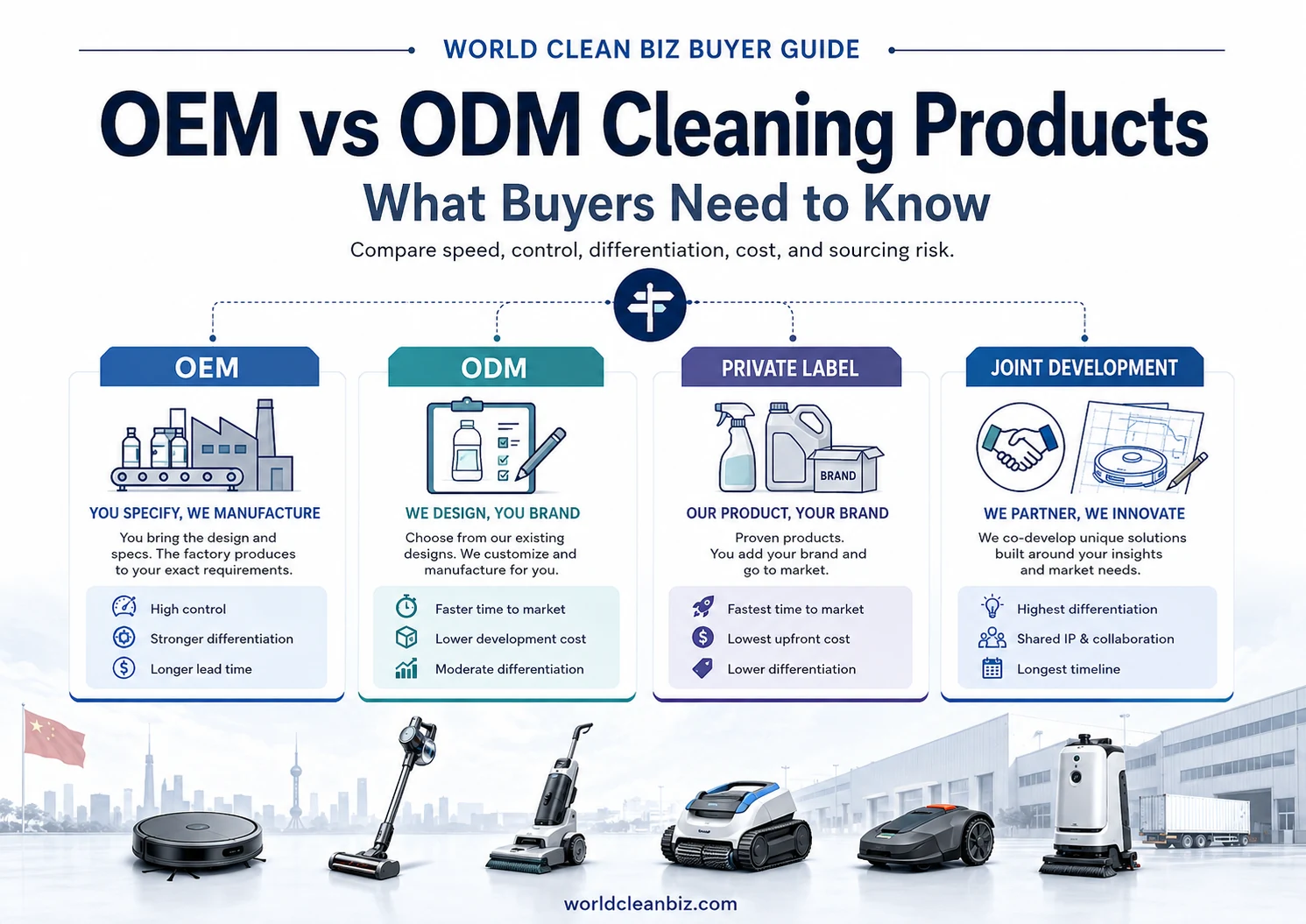
OEM means the buyer usually provides the design, specifications, or product requirements, and the manufacturer produces according to those requirements. ODM means the supplier already has an existing product design or platform, and the buyer customizes it for branding, features, packaging, or market positioning.
For cleaning product buyers, ODM is often faster, while OEM gives more control. Private label is the fastest but usually weakest for differentiation. Joint development is the best option for serious brands building long-term product advantage, but it requires more time, budget, and technical judgment.
If you are comparing cleaning product suppliers in China, World Clean Biz can help with sourcing support, supplier screening, and category evaluation before you choose a model.
OEM vs ODM Cleaning Products: Basic Difference
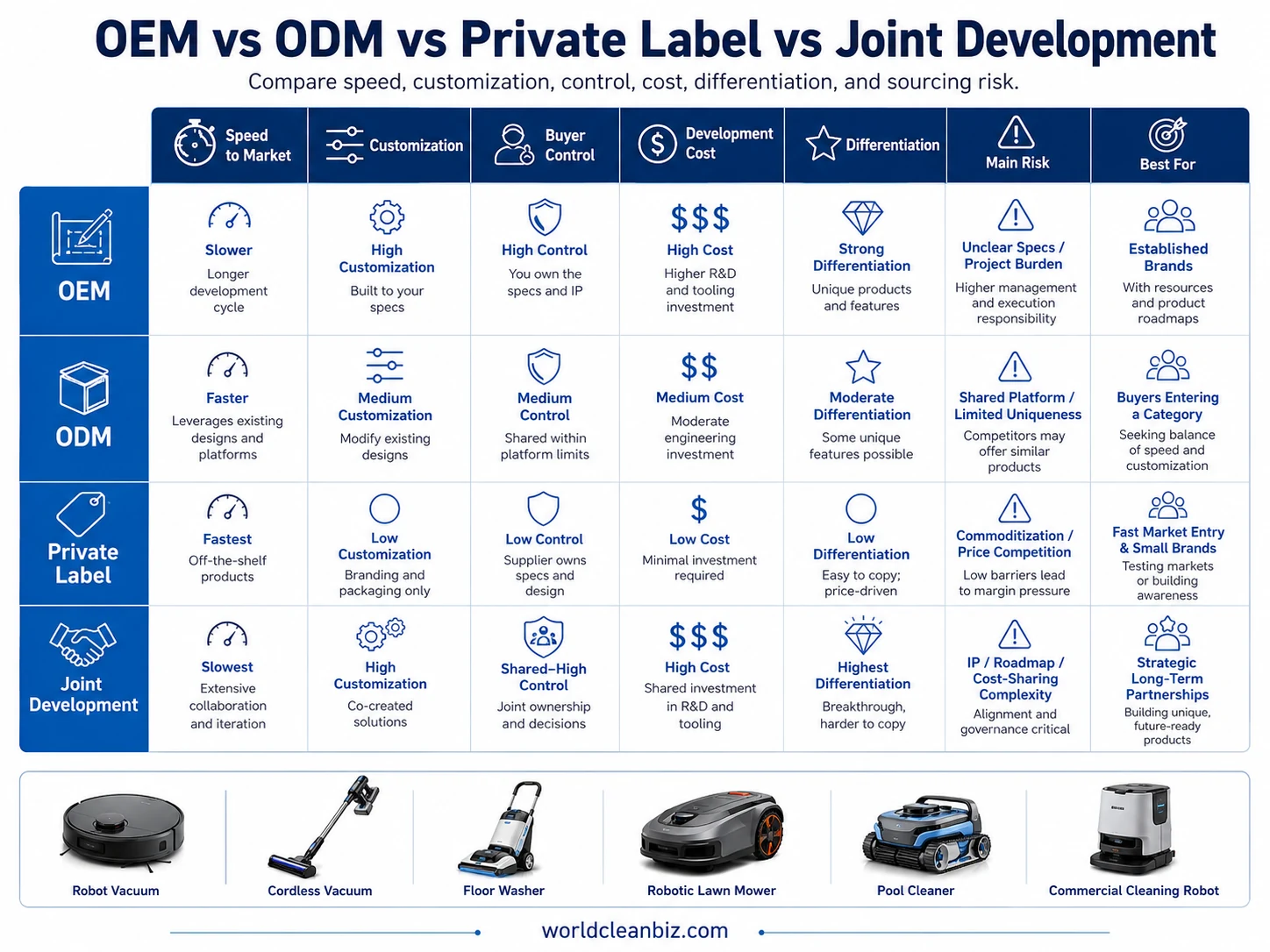
| Model | What It Means | Best For | Main Risk |
|---|---|---|---|
| OEM | Buyer controls design or specifications; supplier manufactures | Established brands with clear product requirements | Higher cost, longer timeline, buyer must manage product definition |
| ODM | Supplier has existing design or platform; buyer customizes | Buyers needing faster launch with moderate differentiation | Similar product may be sold to other buyers |
| Private Label | Buyer brands a ready-made product | Fast market testing, small brands, online sellers | Weak differentiation, price competition, limited control |
| Joint Development | Buyer and supplier co-develop a product platform | Serious brands building long-term product lines | Requires budget, testing, technical judgment, and close management |
In basic cleaning tools, the difference may be simple. But in smart cleaning appliances and cleaning robots, the sourcing model affects software, firmware, spare parts, product life cycle, warranty, and after-sales cost.
When OEM Makes Sense
OEM is useful when the buyer has a clear product concept, technical specification, target price, channel strategy, and quality standard.
For example, an established appliance brand may want a cordless vacuum with a specific motor system, battery pack, dust separation structure, filtration design, brush head, accessory set, and packaging. In that case, OEM gives the buyer stronger control.
OEM is also useful when the buyer wants to protect product differentiation. If the product has a unique design, special function, patented structure, or long-term brand strategy, relying on a standard ODM model may not be enough.
But OEM is not easy. The buyer must know what to ask for. If the buyer cannot define the product well, the factory may produce exactly what was requested—but the final product may still fail in the market.
OEM works best when the buyer has:
- Clear product positioning
- Technical specifications
- Target price and margin model
- Testing standards
- Quality-control process
- Packaging and manual requirements
- Compliance plan
- After-sales and spare parts strategy
Buyer implication: Choose OEM only if you can define the product clearly and manage the development process.
When ODM Makes Sense
ODM is often the practical choice for many cleaning product buyers.
In an ODM model, the supplier already has an existing product platform. The buyer can customize color, branding, accessories, packaging, features, software options, or price configuration. This can reduce development time and lower initial risk.
ODM is common in categories such as cordless vacuums, wet dry vacuums, floor washers, robot vacuums, robotic pool cleaners, and some commercial cleaning machines.
The benefit is speed. The buyer can test a category without building everything from zero.
The risk is sameness. If several buyers use the same ODM platform with only minor changes, the final products may compete mainly on price. This is especially risky on Amazon, marketplace channels, and low-end retail channels.
ODM works best when the buyer needs:
- Faster launch
- Lower development cost
- Existing product platform
- Moderate customization
- Supplier engineering support
- Lower initial MOQ
- Category testing before deeper investment
Buyer implication: ODM can be a good entry route, but buyers should check whether the platform is already widely sold to competitors.
Private Label: Fast but Weak
Private label is the simplest model. The buyer chooses a ready-made product, puts its own brand on it, and sells it with limited changes.
This can work for testing demand. It may also work in simple cleaning tools or low-risk accessories. But in cleaning appliances and robots, private label can be dangerous if the buyer does not understand product quality, warranty, spare parts, and market timing.
Private label products often have weak differentiation. When many sellers use the same product, buyers compete on price, reviews, listing quality, advertising, and promotion. If the product has problems, the brand still carries the customer complaints.
For categories such as robot vacuums, floor washers, robotic pool cleaners, robotic lawn mowers, and commercial cleaning robots, private label also creates service risk. The buyer may not control firmware updates, spare parts, repair support, or product improvements.
Private label is best for:
- Small market tests
- Low-risk products
- Simple cleaning tools
- Short-term online launches
- Buyers with limited development budget
Buyer implication: Private label may help you enter a category quickly, but it rarely builds a strong long-term cleaning product brand.
Joint Development: Best for Serious Brands
Joint development is the deepest model. The buyer and supplier develop a product together from concept to launch.
This may include product definition, industrial design, mechanical structure, motor system, battery platform, water system, navigation, app features, firmware, packaging, testing, and after-sales planning.
Joint development is especially important in complex categories:
- Robot vacuums
- Floor washers
- Robotic pool cleaners
- Robotic lawn mowers
- Commercial cleaning robots
- Premium cordless vacuums
These products are not only hardware. They involve software, sensors, water systems, battery safety, spare parts, user experience, and warranty risk.
Joint development gives the buyer stronger differentiation, but it requires commitment. The buyer needs product judgment, market insight, testing budget, and the ability to work closely with engineers.
Buyer implication: Joint development is not the fastest route, but it is often the strongest route for buyers who want long-term product advantage.
How the Right Model Changes by Category
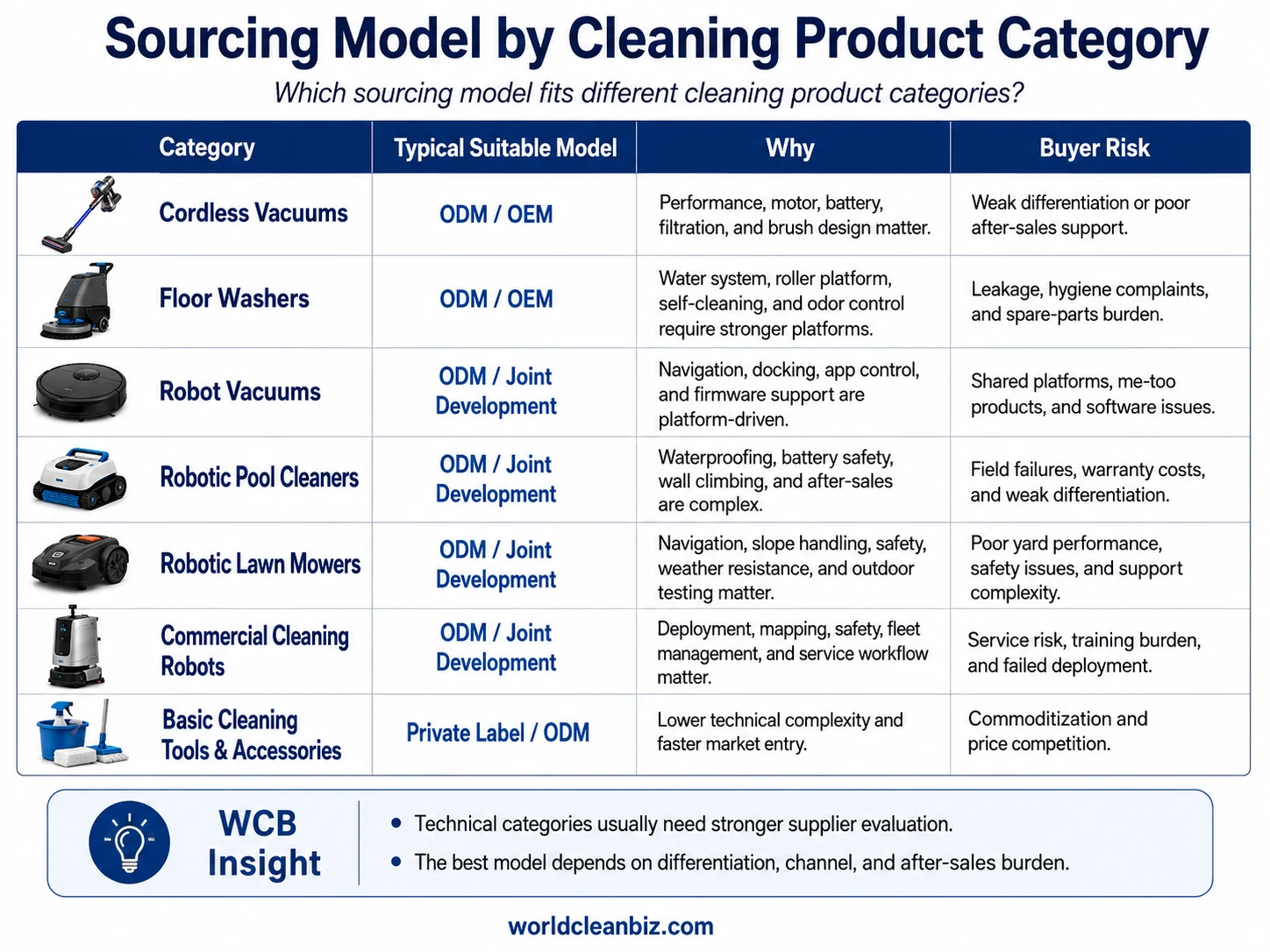
| Product Category | ODM Fit | OEM Fit | Joint Development Need | Key Buyer Risk |
|---|---|---|---|---|
| Cleaning tools and accessories | High | Medium | Low | Low differentiation |
| Cordless vacuums | High | High | Medium | Motor, battery, filtration, spare parts |
| Floor washers | Medium | High | High | Water leakage, odor, roller maintenance |
| Robot vacuums | Medium | High | High | Software, dock, firmware, after-sales |
| Robotic pool cleaners | Medium | High | High | Waterproofing, battery, pump, filtration |
| Robotic lawn mowers | Medium | High | High | Navigation, safety, outdoor reliability |
| Commercial cleaning robots | Low to Medium | High | High | Deployment, training, service support |
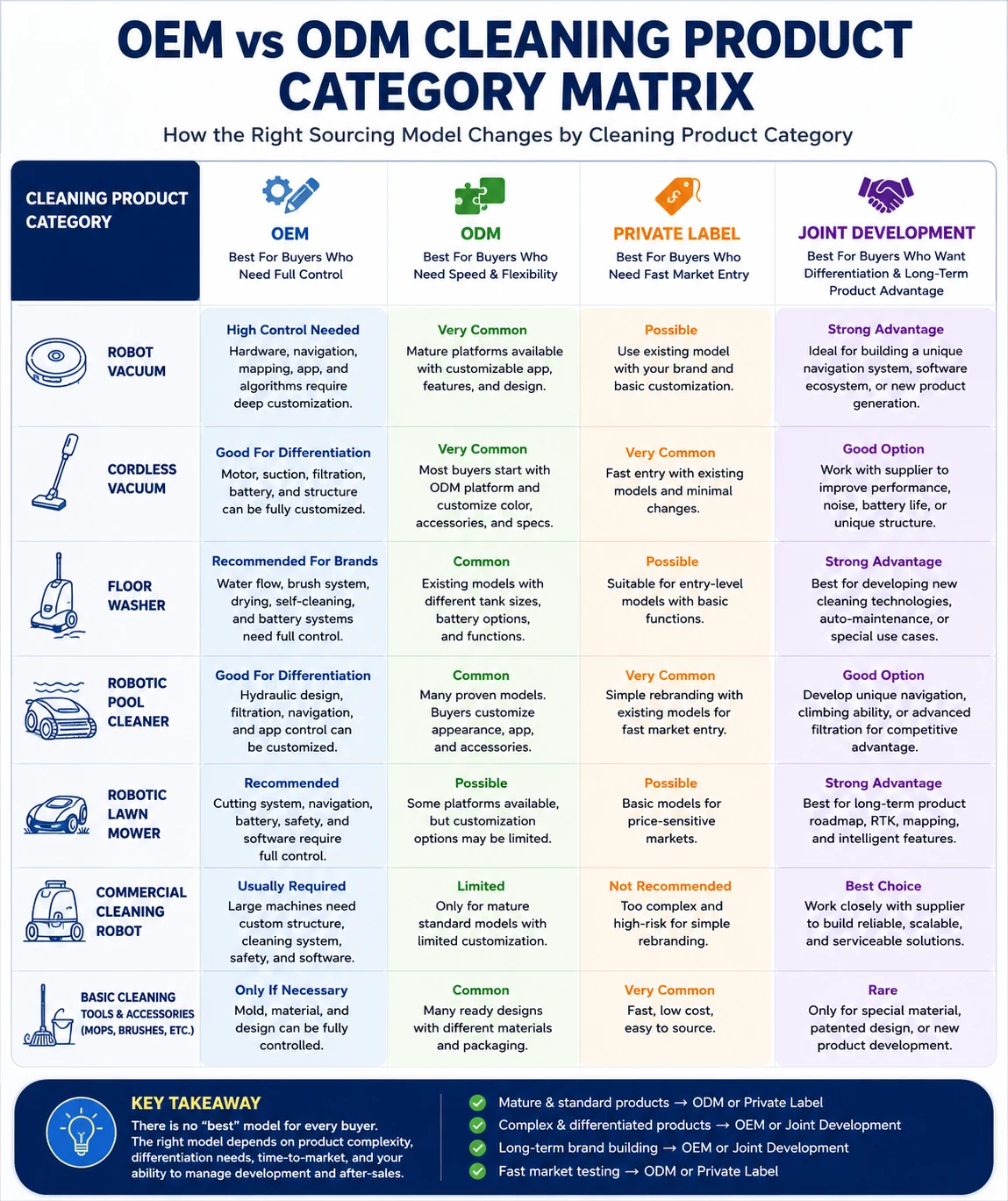
For simple products, ODM or private label may be enough. For complex cleaning appliances and robots, buyers should be more careful. The more complex the product, the more important product definition, engineering control, testing, and after-sales become.
Compare the Scope Before Comparing the Quote
OEM and ODM labels do not define every supplier's offer in the same way. Ask each candidate to separate the base product price from customization, tooling, testing, packaging and ongoing support. A lower unit price is difficult to interpret if one quotation excludes work included in another.
Before paying for development, ask for a written scope identifying who maintains the design files, tooling, firmware and app; what changes you can request; which services cost extra; and what happens to spare-part supply if the platform is discontinued. Treat these as questions to resolve with the supplier, rather than rights automatically granted by the terms OEM or ODM.
Use the category guide that matches your project: floor washer OEM/ODM, robotic lawn mower OEM/ODM, robot vacuum OEM/ODM, or spot cleaner OEM/ODM. For a floor-washer quotation, the manufacturing cost breakdown helps identify the configuration assumptions behind the price.
For pool-cleaner projects, first distinguish purchasing a finished brand from developing your own product. The Aiper buying guide supports product selection; the pool-cleaner OEM/ODM guide covers a development and sourcing project. A brand comparison alone does not establish OEM availability.
What Buyers Should Check Before Choosing OEM or ODM
Before choosing a sourcing model, buyers should answer several questions.
1. What is the target market?
A product for Amazon, Costco, Walmart, specialty dealers, distributors, commercial facilities, or DTC channels may require different design, packaging, warranty, and support.
2. What is the price segment?
Entry-level, mid-range, and premium products need different supplier capabilities.
3. How mature is the category?
In mature categories, generic ODM products may face heavy price competition. In emerging categories, speed may matter more.
4. What must be differentiated?
Differentiation may come from design, function, cleaning performance, software, accessories, service, or channel positioning.
5. What after-sales risks exist?
Floor washers may have odor and leakage risk. Robot vacuums may have software and dock issues. Pool robots may have waterproofing risk. Lawn robots may have navigation and safety risk.
6. Does the supplier control key parts?
Buyers should ask who controls motors, batteries, pumps, sensors, firmware, app support, water systems, and spare parts.
7. Can the buyer manage development?
OEM and joint development require stronger buyer-side project management.
8. What is the real total cost?
FOB price is only one part. Buyers should include tooling, testing, certification, packaging, warranty, spare parts, returns, and service.
Common Mistakes Buyers Make
Choosing OEM when they do not have clear specifications
Some buyers ask for OEM but cannot define the product. This often creates delays, confusion, and weak results.
Choosing ODM without checking product overlap
A supplier may sell the same platform to many buyers. If the product is not differentiated, the buyer may face price competition.
Using private label for complex products
Private label may be risky for products that require firmware, service, spare parts, or long-term technical support.
Only comparing FOB price
The cheapest supplier may create higher warranty cost, return risk, or quality problems.
Ignoring after-sales
For cleaning appliances, after-sales is not a small issue. It can decide whether the product is profitable.
Choosing a supplier before choosing a product direction
This is one of the biggest mistakes. Buyers should understand the category and product opportunity before selecting a supplier.
Assuming all “manufacturers” are real manufacturers
Some sellers are trading companies, brand owners, or platform operators. Buyers should verify factory identity and capability.
Ignoring market timing
A product that was attractive two years ago may now be too late, too common, or too weak for the current market.
The biggest mistake is not choosing OEM or ODM incorrectly. It is choosing the wrong product direction before the sourcing model is even decided.
WCB Market Note: OEM vs ODM Is Really a Product Strategy Decision
Many buyers treat OEM vs ODM as a purchasing question. World Clean Biz sees it differently.
OEM vs ODM is a product strategy decision.
If the buyer wants speed, ODM may be better. If the buyer wants control, OEM may be better. If the buyer wants a quick test, private label may work. If the buyer wants long-term advantage, joint development may be the right path.
But none of these models can fix a weak product direction.
Sourcing is not only about finding factories. It is about judging product timing, category direction, supplier capability, and after-sales risk together.
Buyer implication: Before choosing OEM or ODM, buyers should decide what kind of product they want to build, which market they want to serve, and what risks they are prepared to manage.
Buyer implication: Buyers should avoid choosing a sourcing model only because it is faster or cheaper; the model must match product complexity, channel requirements, and after-sales responsibility.
WCB View: In cleaning products, the safest sourcing model is not always the fastest one. The right model is the one that matches the buyer’s product ambition, supplier capability, and long-term service burden.
How World Clean Biz Helps Buyers
World Clean Biz helps overseas buyers understand product opportunities, supplier types, category direction, and China supply chain options before choosing suppliers.
For OEM and ODM cleaning products, this means looking beyond catalogs and price lists. Buyers need to understand which categories are still worth entering, which product platforms are becoming outdated, where differentiation still exists, and what supplier capability is required.
World Clean Biz supports buyers through product opportunity discovery, supplier screening, category intelligence, China supply chain connections, cleaning industry reports, and sourcing support.
Buyers can also read our guides on finding reliable cleaning product suppliers in China, robot vacuum sourcing, floor washer sourcing, cordless vacuum OEM sourcing, robotic lawn mower sourcing, and robotic pool cleaner sourcing.
To understand the platform and industry network behind this work, read more about World Clean Biz. For category research, explore our cleaning industry reports. If you follow China’s cleaning industry events and supplier ecosystem, you can also follow World Clean Expo updates.
Choosing between OEM, ODM, private label, or joint development for cleaning products? Contact World Clean Biz for sourcing support.
FAQ
What is the difference between OEM and ODM cleaning products?
OEM usually means the buyer provides the design, specifications, or product requirements, and the supplier manufactures the product. ODM means the supplier already has an existing product design or platform, and the buyer customizes it for branding, features, packaging, or market needs.
Is OEM better than ODM?
Not always. OEM gives more control but usually requires more time, money, and technical management. ODM is faster and often easier, but differentiation may be limited if the same platform is sold to many buyers.
Is private label the same as ODM?
No. Private label usually means the buyer brands a ready-made product with limited changes. ODM usually allows more customization because the supplier owns or develops the product platform.
Which model is best for cleaning product buyers?
It depends on the category and buyer goal. Private label may work for fast testing. ODM may work for faster launch with some customization. OEM may work for brands with clear specifications. Joint development is better for serious brands building long-term advantage.
What cleaning product categories are suitable for ODM?
ODM can work well for cordless vacuums, basic floor washers, cleaning tools, entry-level appliances, and some robot products. But buyers should check whether the platform is already widely used by competitors.
What cleaning product categories require more OEM or joint development?
Complex categories such as robot vacuums, robotic pool cleaners, robotic lawn mowers, commercial cleaning robots, and premium floor washers often require deeper control, stronger testing, and better after-sales planning.
What should buyers check before choosing an OEM or ODM supplier?
Buyers should check supplier identity, product experience, engineering capability, component control, test data, quality-control process, compliance readiness, spare parts, warranty support, and whether the supplier can scale production.
How can World Clean Biz help with OEM and ODM cleaning product sourcing?
World Clean Biz helps buyers evaluate product direction, sourcing model, supplier capability, category timing, and sourcing risks before supplier selection. If you are choosing between OEM, ODM, private label, or joint development, you can contact World Clean Biz for sourcing support.