In this article 11 sections
Quick Answer
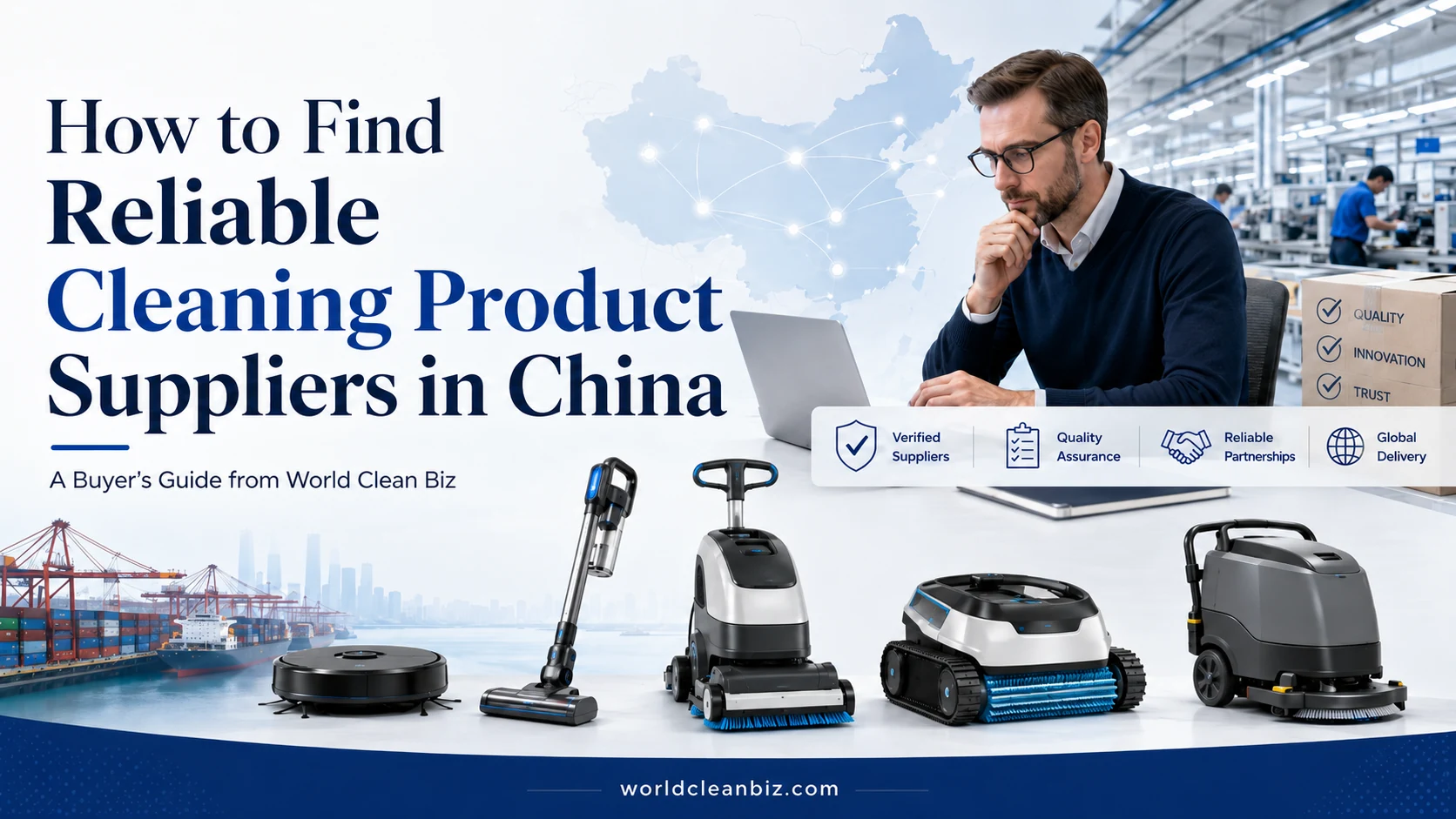
The best way to find reliable cleaning product suppliers in China is not to start with a supplier list. Start with the product opportunity.
Before choosing a factory, overseas buyers should understand:
- Which cleaning product category is growing
- What type of supplier is needed: OEM, ODM, private label, or joint development
- Which Chinese supply chain region fits the product
- Whether the supplier has engineering, export, compliance, and after-sales capability
- Whether the product still has market potential or is already crowded
China remains one of the world’s strongest sourcing bases for cleaning products, cleaning appliances, cleaning robots, and commercial cleaning equipment. But the challenge today is no longer simply finding factories.
Finding suppliers is easy.
Finding the right supplier for the right cleaning product opportunity is much harder.
If you need help identifying suitable suppliers and product directions, contact World Clean Biz sourcing support.
China is still one of the most important manufacturing bases for the global cleaning industry.
For overseas buyers, importers, distributors, Amazon sellers, private label brands, and sourcing managers, China offers a deep supply chain for household cleaning appliances, cleaning tools, robot vacuums, floor washers, robotic pool cleaners, robotic lawn mowers, and commercial cleaning equipment.
But sourcing has changed.
Ten years ago, many buyers mainly wanted to find a factory with a lower FOB price. Today, that approach is risky. Many Chinese cleaning product suppliers can quote quickly, make a sample, and provide basic export documents. That does not mean they are the right partner.
The real sourcing question is no longer:
Where can I find a cleaning product supplier in China?
The better question is:
Which supplier matches the product opportunity I want to build?
A mop supplier, a cordless vacuum factory, a robot vacuum manufacturer, and a robotic pool cleaner company are not the same kind of supplier. Their engineering depth, quality risk, compliance requirements, and after-sales burden are completely different.
That is why serious cleaning product sourcing in China should start with category judgment, not only factory search.
What Cleaning Products Can You Source from China?
China’s cleaning supply chain covers both simple cleaning tools and complex smart cleaning machines.
| Product Category | Typical Products | Supplier Capability Required | Buyer Risk Level |
|---|---|---|---|
| Cleaning tools and accessories | Mops, brushes, buckets, microfiber cloths, spray bottles, squeegees | Plastic parts, textile processing, packaging, cost control | Low to medium |
| Household cleaning appliances | Steam cleaners, mite removers, carpet cleaners, small floor care appliances | Motor systems, heating elements, plastic molding, electrical safety | Medium |
| Cordless vacuum cleaners | Stick vacuums, handheld vacuums, wet/dry vacuums | Motors, batteries, filtration, airflow design, noise control | Medium to high |
| Floor washers | Wet/dry floor washers, self-cleaning floor cleaners, hot-water or steam models | Water systems, pumps, rollers, dirty water tank design, odor control | High |
| Robot vacuums | AI robot vacuums, mop-washing robots, self-emptying dock systems | Navigation, sensors, software, app, dock engineering, after-sales support | High |
| Robotic pool cleaners | Cordless pool robots, wall-climbing cleaners, waterline cleaners | Waterproofing, motors, batteries, pool environment testing | High |
| Robotic lawn mowers | RTK mowers, vision mowers, boundary-wire mowers | Outdoor robotics, navigation, terrain adaptation, battery safety | Very high |
| Commercial cleaning equipment | Scrubber dryers, sweepers, extractors, commercial vacuums, cleaning robots | Durability, serviceability, parts supply, commercial compliance | High |
| Components | Motors, batteries, sensors, pumps, control boards, plastic parts | Engineering, component quality, stable supply | Depends on component |
For basic cleaning tools, sourcing is usually more price-driven. Buyers compare materials, packaging, MOQ, color options, and production capacity.
For cleaning appliances and robots, the process is very different. You need to evaluate motor systems, batteries, water systems, sensors, software, app control, docking stations, waterproofing, testing standards, and after-sales service.
This is why China cleaning product manufacturers cannot be judged only by factory size or product catalog. Category capability matters more.
A supplier that is good at mops may not understand floor washers. A vacuum cleaner factory may not be able to develop a reliable robot vacuum. A robotic pool cleaner supplier must understand waterproof design, batteries, motors, and long-term outdoor usage.
Before sourcing, define the product category clearly.
How to Evaluate a Cleaning Product Supplier
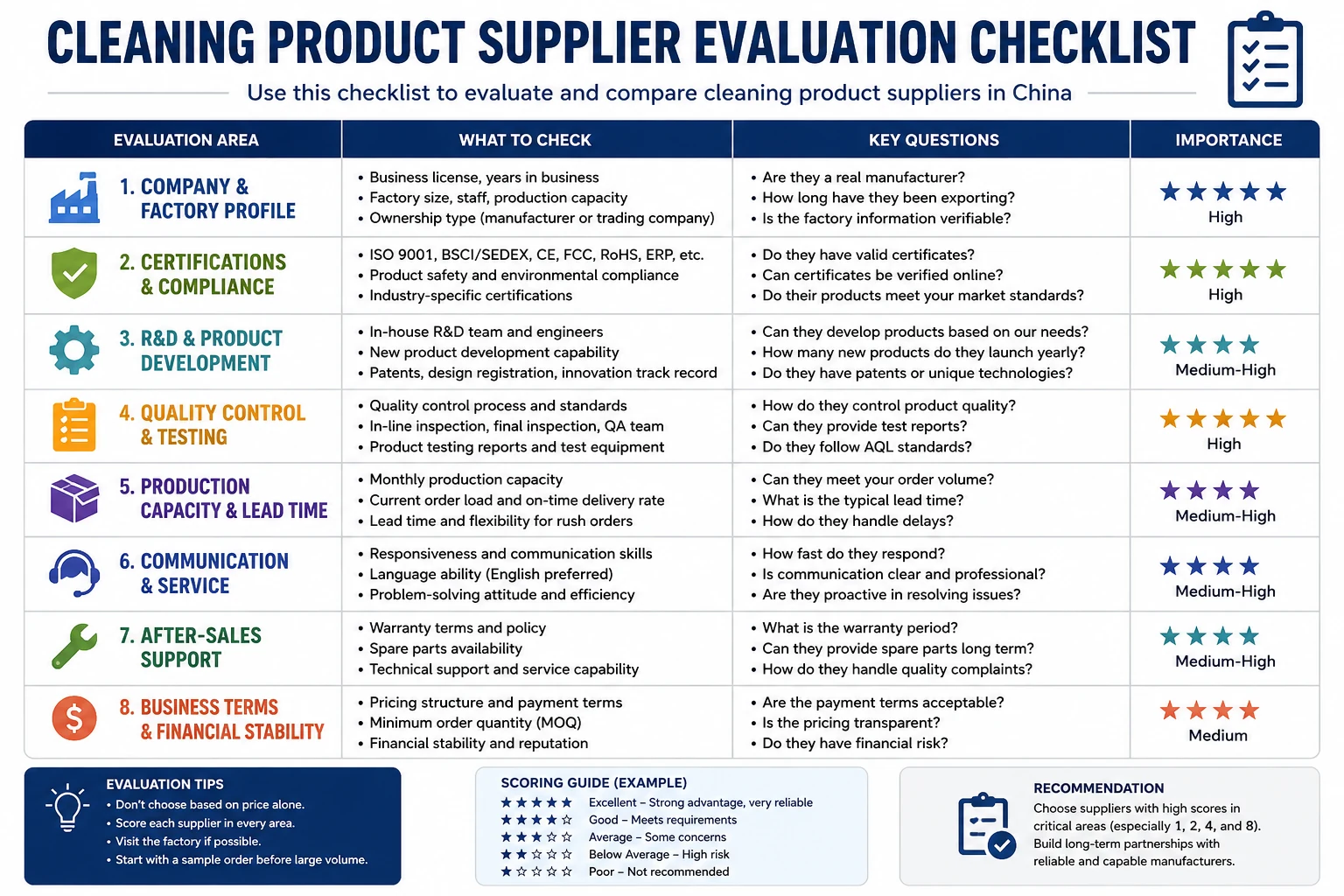
A reliable supplier is not just a factory with a good price.
Use this checklist before making a decision.
1. Product Category Focus
Does the supplier specialize in your category?
For cleaning appliances and robots, category focus is critical. A supplier that understands robot vacuums may not understand robotic pool cleaners. A floor washer supplier must understand water leakage, roller cleaning, dirty water tanks, pumps, odor control, and after-sales failure points.
2. Export Experience
Ask where the supplier has exported before.
A serious supplier should understand packaging, manuals, plugs, labeling, compliance, warranty expectations, and customer service requirements in your target market.
3. Certification and Compliance Readiness
For electrical and smart cleaning products, compliance is not optional.
Depending on the product and market, you may need CE, UKCA, FCC, UL, ETL, RoHS, REACH, battery transport documents, or other approvals.
For Europe, check the official guidance on CE marking requirements. For the US, connected devices may need to follow FCC equipment authorization rules.
4. R&D and Engineering Capability
Ask whether the supplier has real engineers or mainly sales staff.
For appliances and robots, check mechanical engineering, motor design, battery integration, firmware, app development, sensor integration, water system design, testing capability, and failure analysis.
5. Core Component Control
Who controls the motor, battery, pump, PCBA, sensor, algorithm, or software?
Some suppliers only assemble products. Others control key components or have close upstream partners. This affects cost, stability, lead time, and product improvement.
6. Quality Control Process
Ask for the full QC process.
For cleaning appliances, a basic final inspection is not enough. You need to understand aging tests, waterproof tests, drop tests, suction tests, battery tests, noise tests, cleaning performance tests, and long-term reliability checks.
7. After-Sales Support
After-sales risk is one of the most underestimated parts of cleaning product sourcing.
Ask:
- What is the warranty rate?
- What are the top failure reasons?
- Are spare parts available?
- Can products be repaired?
- How fast can replacement parts ship?
- Does the supplier provide technical troubleshooting?
A cheap product with high return rates is not cheap.
8. Production Capacity
Do not only ask for theoretical capacity.
Check actual production lines, peak season capacity, component availability, lead time, and whether quality remains stable when volume increases.
9. Sample Development Speed
Fast samples are useful, but not enough.
Use the sample stage to test the supplier’s engineering response, communication quality, and willingness to solve problems.
10. Communication Quality
Good communication does not mean fluent English only.
A good supplier can explain trade-offs, admit limitations, and help you understand technical risks. If every answer is “yes, no problem,” be careful.
For deeper category research before supplier selection, buyers can also review World Clean Biz industry reports.
Where Are China’s Cleaning Product Supply Chains Located?
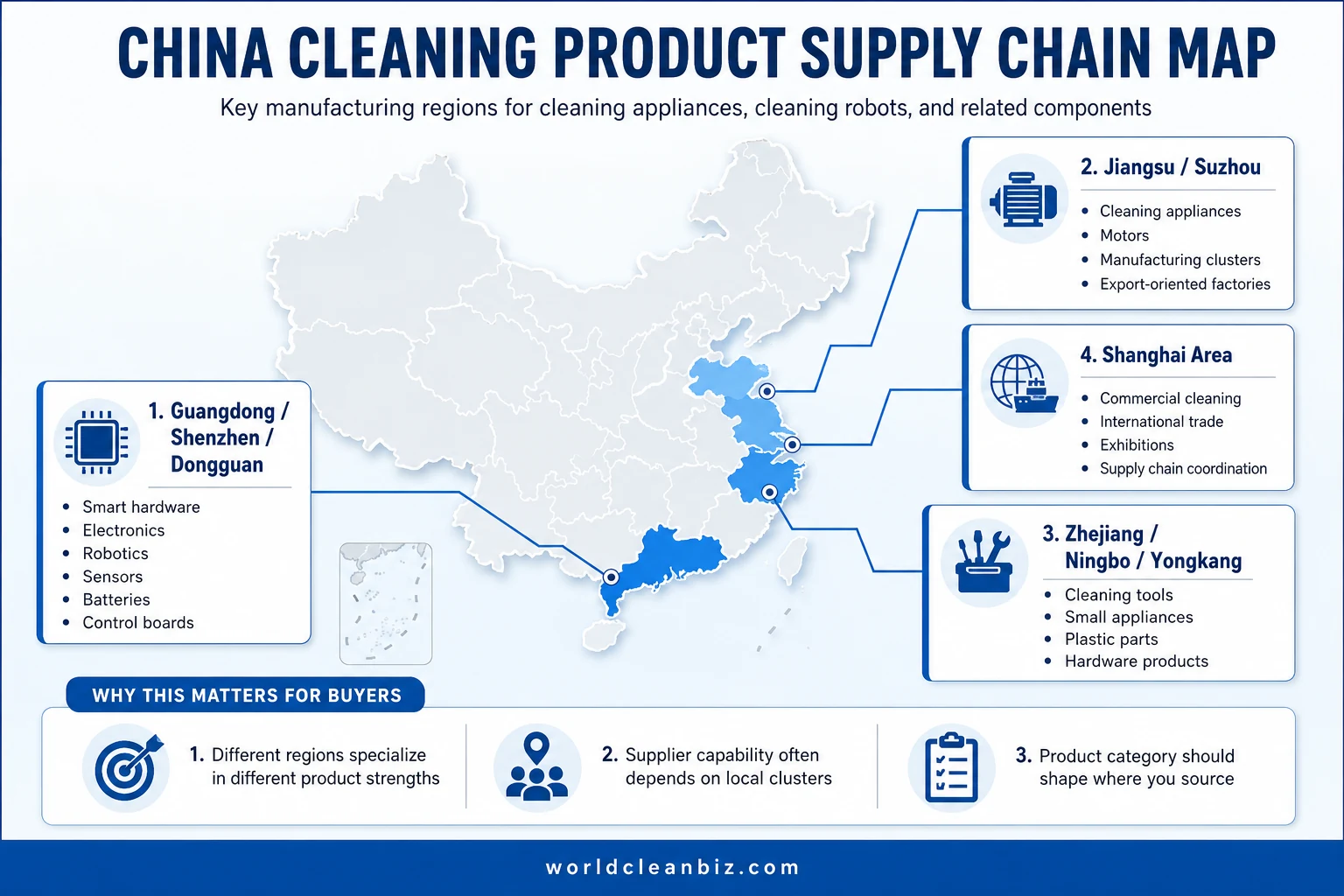
China’s cleaning product supply chain is not located in one city. Different regions have different strengths.
Guangdong / Shenzhen / Dongguan
Guangdong is strong in smart hardware, electronics, robotics, sensors, batteries, PCBA, control boards, and connected devices.
For robot vacuums, robotic pool cleaners, robotic lawn mowers, smart cleaning products, and app-connected appliances, Shenzhen and Dongguan are important regions.
This area is suitable for buyers looking for smart cleaning robots, sensor-based products, battery-powered devices, app-connected appliances, robotics hardware, and fast prototyping.
Jiangsu / Suzhou
Jiangsu, especially Suzhou and surrounding areas, has a strong cleaning appliance manufacturing base. Many factories here are experienced in vacuum cleaners, motors, floor care products, and export-oriented appliance manufacturing.
This region is important for buyers looking for cleaning appliance manufacturers China, especially in vacuum cleaners, floor washers, and related household cleaning appliances.
Zhejiang / Ningbo / Yongkang
Zhejiang is strong in cleaning tools, hardware products, small appliances, plastic parts, and export goods.
Ningbo and Yongkang are common sourcing regions for mops, brushes, buckets, spray products, plastic parts, hardware cleaning tools, and small household products.
This region is often suitable for high-volume, cost-sensitive products.
Shanghai Area
Shanghai is more of a trade, coordination, commercial cleaning, and exhibition hub than a pure manufacturing base.
Many international companies, trading companies, commercial cleaning suppliers, and industry events operate around Shanghai.
For buyers visiting China, Shanghai can be a useful starting point for commercial cleaning equipment, business meetings, and supply chain coordination. You can also follow World Clean Expo updates for China cleaning industry events and supplier discovery.
OEM, ODM, Private Label: Which Supplier Type Do You Need?
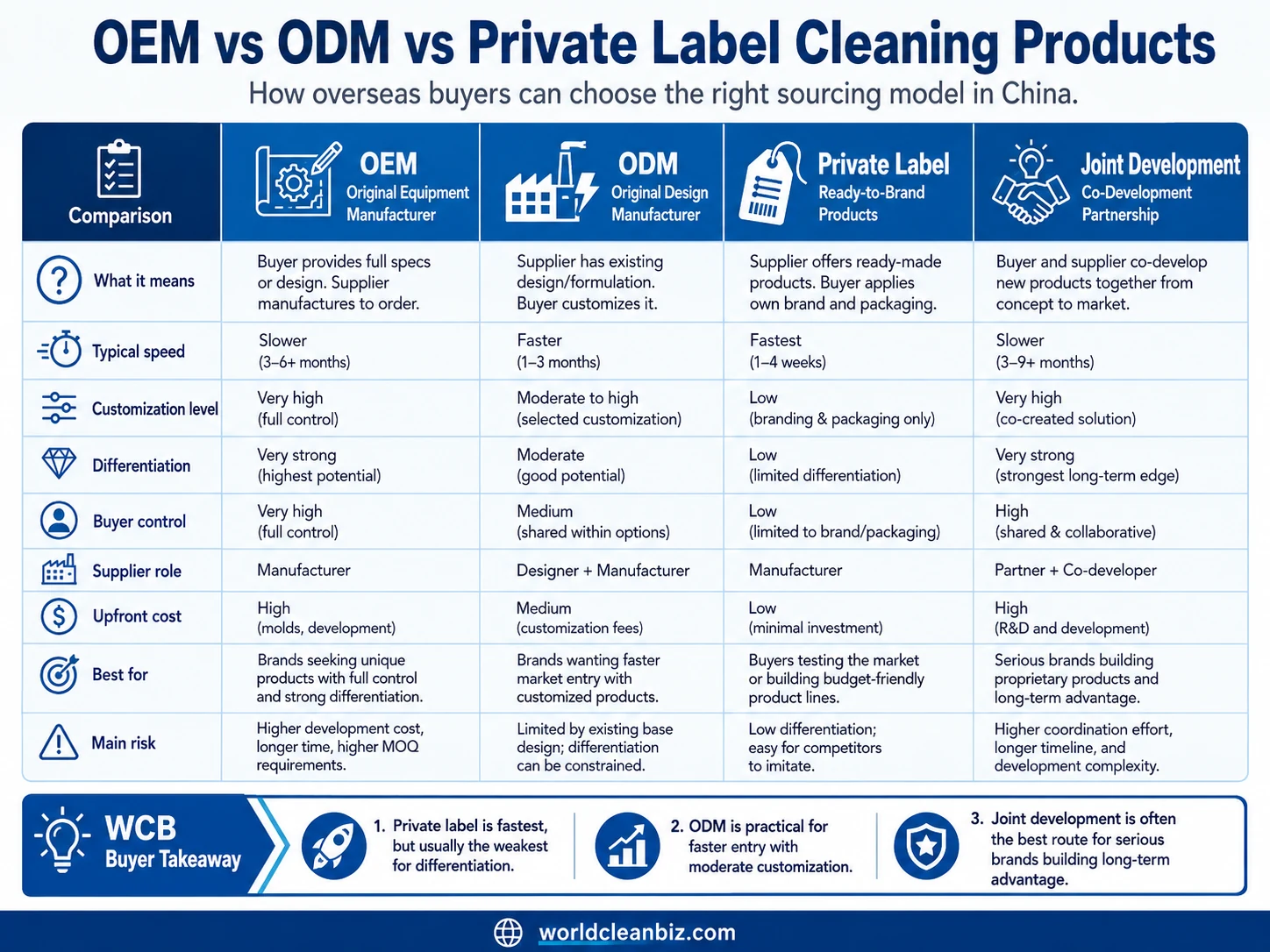
Before contacting suppliers, buyers should decide what cooperation model they actually need.
OEM
OEM means the supplier manufactures according to your design, specifications, tooling, or technical requirements.
This model is suitable when you already have product design, engineering documents, performance targets, branding, and market positioning.
OEM gives more control, but it requires the buyer to understand the product deeply.
ODM
ODM means the supplier already has an existing product platform that can be modified for your brand.
Many ODM cleaning appliance manufacturers in China offer ODM platforms for cordless vacuums, floor washers, robot vacuums, and robotic pool cleaners.
ODM is faster than OEM, but it can create similar products across many brands if customization is shallow.
Private Label
Private label is the fastest option. You choose an existing product, add your logo, change packaging, and place an order.
This works for some basic products, but it often creates weak differentiation. If many sellers buy the same product with different logos, price competition comes quickly.
Joint Development
Joint development means the buyer and supplier work together on product definition, engineering, tooling, performance, and long-term improvement.
For serious brands, this is often the best model.
It is slower, but it helps create real product differentiation.
The mistake many buyers make is choosing private label only because it is fast. Speed is useful, but if the product direction is wrong, speed only helps you enter the wrong market faster.
Common Mistakes Buyers Make When Sourcing Cleaning Products from China
This is where many sourcing projects fail.
The problem is often not that the buyer cannot find suppliers. The problem is that the buyer starts sourcing before understanding the product opportunity.
Mistake 1: Only Comparing FOB Prices
FOB price is easy to compare. Total business cost is harder.
For cleaning products, the real cost includes defect rate, returns, certification, spare parts, packaging, freight, duties, warehousing, customer support, and product lifecycle risk.
A supplier with the lowest quote may become the most expensive choice after returns and after-sales claims.
Mistake 2: Choosing Suppliers Only from Alibaba Listings
Alibaba can help you discover suppliers, especially for simple products. But it does not automatically show engineering capability, quality stability, category knowledge, or after-sales performance.
For complex products such as robot vacuums, floor washers, robotic pool cleaners, and commercial cleaning machines, online listings are only the first filter.
Mistake 3: Ignoring After-Sales Risk
Cleaning appliances have motors, batteries, pumps, water systems, sensors, moving parts, and software.
Failures are normal. What matters is whether the supplier can reduce them, explain them, and support you after shipment.
For floor washers, robotic pool cleaners, and robotic lawn mowers, after-sales cost can destroy profit.
Mistake 4: Treating Certification as Paperwork
Certification documents must match the exact product, model, components, and market.
A certificate from a similar model may not be enough. Buyers importing into the US should also understand customs responsibilities through official U.S. Customs and Border Protection importing guidance.
Mistake 5: Buying Last Year’s Hot Product
Many buyers enter a category too late.
When a product becomes popular on Amazon or TikTok, factories quickly copy it. By the time a new buyer places an order, the market may already be crowded.
This happens often in floor washers, cordless vacuums, robot vacuums, robotic pool cleaners, and small cleaning gadgets.
Mistake 6: Choosing a Factory Before Choosing a Direction
This is the biggest mistake.
The biggest mistake is not choosing the wrong supplier. It is choosing the wrong product direction before sourcing even begins.
A good supplier cannot save a weak product opportunity.
If the category is moving toward AI obstacle avoidance, and you source a basic navigation robot, you are already behind. If the pool cleaner market is moving toward cordless robotic systems, a simple suction product may not be enough. If lawn robots are moving from boundary wire to RTK and vision, an old model will be difficult to sell.
This is the core World Clean Biz view:
Sourcing is not only about finding factories. It is about judging product timing, category direction, supplier capability, and after-sales risk together.
A supplier list can help you start. But if you choose the wrong category, wrong product generation, or wrong supplier capability level, the sourcing project is already weak before the first sample arrives.
Why Cleaning Product Sourcing Is Becoming More Difficult
Cleaning product sourcing used to be factory-driven. Now it is category-driven.
Several shifts explain why.
Robot vacuums moved from basic navigation to AI obstacle avoidance, self-cleaning stations, mop washing, hot-water cleaning, auto dust collection, and full docking systems.
Robotic pool cleaners moved from simple suction and corded machines to cordless robots with batteries, wall cleaning, waterline cleaning, route planning, and app control.
Floor washers created a new wet-cleaning appliance category, combining suction, water circulation, roller brushes, self-cleaning, hot water, and sometimes steam.
Robotic lawn mowers are moving from boundary wire to RTK, vision, LiDAR, and multi-sensor systems.
Commercial cleaning is moving toward labor-saving equipment and automation, especially in markets with higher labor costs. Industry groups such as ISSA also reflect the growing professionalization of the cleaning sector.
This means buyers need to read the market earlier.
A supplier directory can tell you who makes a product. It cannot tell you whether that product is still worth sourcing.
WCB Market Note
China cleaning product sourcing is no longer just a factory search. In many categories, the easier part is finding suppliers; the harder part is judging whether the product opportunity is still worth entering. Robot vacuums, floor washers, robotic pool cleaners, robotic lawn mowers, and cordless vacuums show a similar pattern: once a category becomes visible, many suppliers can offer similar-looking products, but their engineering depth, component control, quality process, and after-sales capability can be very different.
For overseas buyers, supplier selection should start with category timing and product direction. A low FOB price is not useful if the product enters the market too late, lacks differentiation, or creates high warranty costs after launch. The better question is not only “Who can manufacture this?” but “Is this the right product, from the right supplier, at the right stage of the category?”
Buyer implication: Before shortlisting factories, buyers should define the target category, price band, sales channel, after-sales model, and product differentiation.
Buyer implication: Buyers should avoid choosing a supplier only from catalog photos or marketplace listings without checking engineering capability, quality control, and service risk.
WCB View: Sourcing is not only about finding factories; it is about judging product timing, category direction, supplier capability, and after-sales risk together.
Best Ways to Find Reliable Cleaning Product Suppliers in China
Finding reliable suppliers should be a process, not a random search.
Step 1: Define the Product Opportunity
Before looking for factories, define the category, target market, price point, product generation, and differentiation.
Are you sourcing a basic cleaning tool, a private label appliance, or a smart cleaning robot? The answer changes the supplier type you need.
Step 2: Build an Initial Supplier Pool
Use trade shows, sourcing partners, industry referrals, B2B platforms, export data, and existing supplier networks to build a first list.
Trade shows are useful for seeing products and meeting suppliers. Referrals often save time. Export data and marketplace research can show which products are moving. But none of these channels should be used alone.
Step 3: Screen by Category Capability
Remove suppliers that do not specialize in your category.
A supplier with a large catalog is not always stronger. For cleaning appliances and robots, focus matters more than product variety.
Step 4: Benchmark Products Before Visiting Factories
Buy competing products, compare specifications, read reviews, and if possible, do product teardown.
Look at motors, batteries, sensors, PCBA, water systems, plastic structure, docking design, filters, and repairability.
This helps you ask better questions and avoid being led by supplier sales pitches.
Step 5: Visit or Audit the Factory
If the product is complex or the order value is meaningful, visit the factory or arrange an audit.
Check production lines, testing labs, warehouse, R&D area, sample room, QC process, and after-sales parts management. Do not judge only by the showroom.
Step 6: Test Samples Like a Buyer, Not Like a Sourcing Agent
Do not only check appearance and packaging.
Test cleaning performance, noise, water leakage, battery endurance, user experience, reliability, and repairability. For robots and wet-cleaning products, test in real usage conditions.
Step 7: Compare Total Risk, Not Just Price
The best supplier is not always the cheapest.
Compare engineering capability, delivery reliability, compliance readiness, after-sales support, willingness to improve, and long-term category fit.
This is especially important for buyers looking for OEM cleaning products China, robot vacuums, floor washers, robotic pool cleaners, or commercial cleaning equipment.
How World Clean Biz Helps Buyers Find Better Opportunities
World Clean Biz helps overseas buyers understand what is changing inside the global cleaning industry before they choose suppliers.
We do not see sourcing as a simple factory search.
A buyer should not only ask:
- Who can make this product?
- Who has the lowest price?
- Who can ship fastest?
A better sourcing process asks:
- Is this category still growing?
- What product features are becoming standard?
- Which suppliers have real capability?
- Which supplier type fits my business model?
- What after-sales risks should I prepare for?
- What product direction gives me a chance to compete?
World Clean Biz helps buyers with product opportunity discovery, supplier screening, category intelligence, China supply chain connections, cleaning industry reports, and World Clean Expo updates.
If you are looking for cleaning product suppliers in China, start with the product opportunity, then choose the supplier.
For more category research, explore our cleaning industry reports. To understand the people and industry network behind this platform, read more about World Clean Biz. If you follow China’s cleaning industry events and supplier ecosystem, you can also follow World Clean Expo updates.
Sourcing cleaning appliances, cleaning robots, floor washers, pool cleaners, or commercial cleaning equipment from China? Contact World Clean Biz for sourcing support.
FAQ
Where can I find cleaning product suppliers in China?
You can find suppliers through trade shows, sourcing partners, industry referrals, factory visits, B2B platforms, export data, and existing supplier networks. For complex products, do not rely only on online directories.
What types of cleaning products can I source from China?
You can source cleaning tools, cordless vacuum cleaners, floor washers, robot vacuums, robotic pool cleaners, robotic lawn mowers, commercial cleaning equipment, accessories, and components such as motors, batteries, sensors, pumps, and control boards.
What is the difference between OEM and ODM cleaning product suppliers?
OEM suppliers manufacture according to your design or specification. ODM suppliers provide existing product platforms that can be customized. OEM gives more control, while ODM is usually faster. For serious brands, joint development may create better differentiation.
How do I know if a Chinese cleaning product supplier is reliable?
Check category focus, export experience, compliance readiness, engineering capability, core component control, quality process, after-sales support, production capacity, sample response, and communication quality.
What certifications do cleaning products need for the US or EU market?
It depends on the product. Electrical and smart cleaning products may need CE, UKCA, FCC, UL, ETL, RoHS, REACH, battery transport documents, or other market-specific approvals. Always verify certificates against the exact model and target market.
Should I buy from Alibaba or work with a sourcing partner?
Alibaba can be useful for supplier discovery, especially for simple products. For appliances, robots, and commercial cleaning equipment, a sourcing partner or category specialist can help reduce supplier risk and product direction risk.
What are the best cleaning product categories to source from China?
Strong categories include cordless vacuum cleaners, floor washers, robot vacuums, robotic pool cleaners, robotic lawn mowers, cleaning tools, and selected commercial cleaning equipment. The best category depends on your channel, market, price point, and after-sales capability.
How can World Clean Biz help with cleaning product sourcing?
World Clean Biz helps buyers understand cleaning product trends, identify product opportunities, screen Chinese suppliers, and connect with relevant manufacturers. The goal is not just to find factories, but to find the right product direction and supplier capability. If you need support, contact World Clean Biz for sourcing help.