- Choose the navigation and mechanical platform from the target lawns and service model—not from a feature list or a supplier demo.
- Separate platform reuse, industrial-design customization, firmware ownership, tooling, validation and market-access responsibilities before paying NRE.
- A credible supplier audit follows requirements through design, incoming parts, software releases, field validation, pilot yield, traceability, spare parts and corrective action.
In this article 17 sections
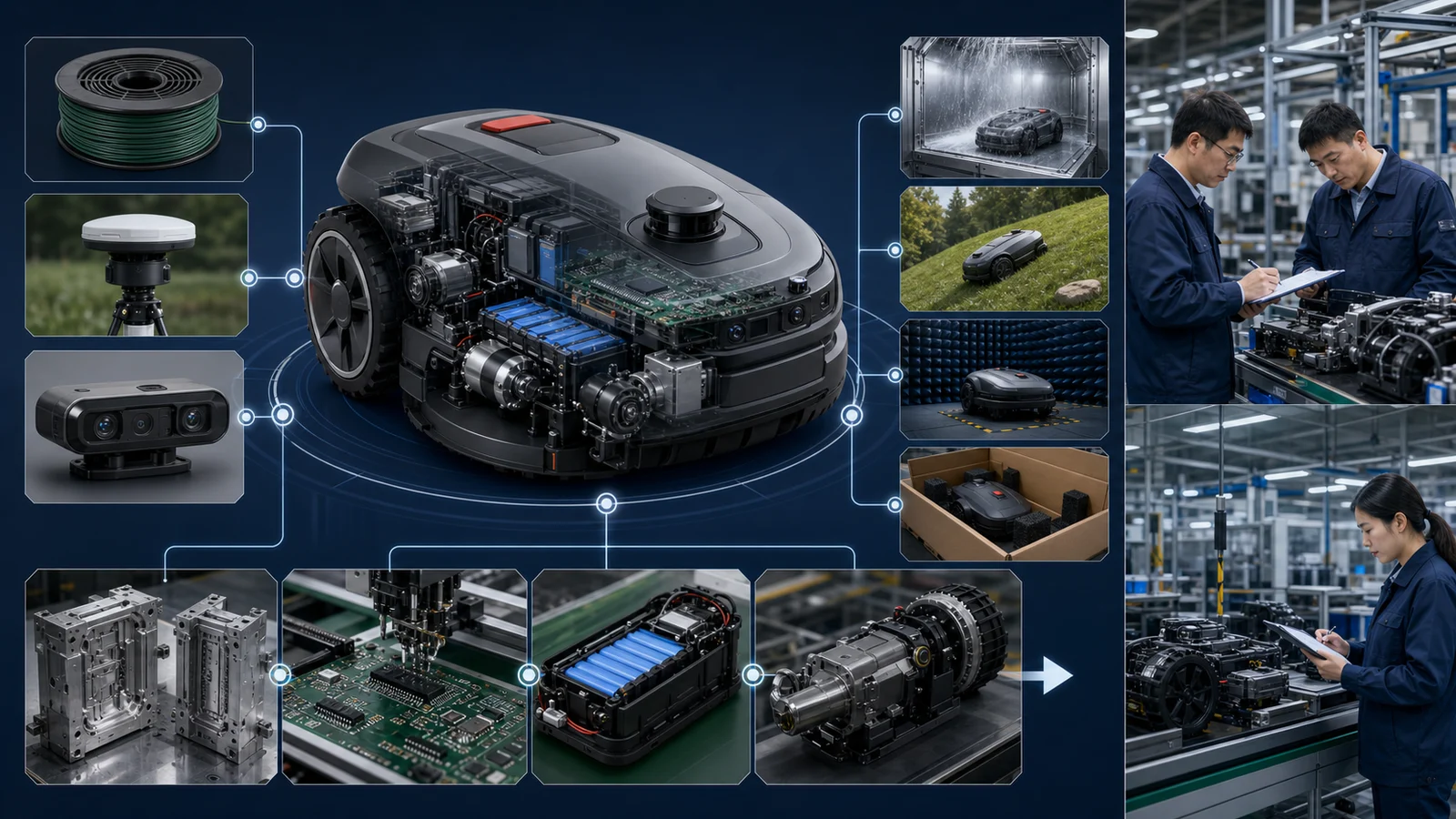
A robot lawn mower OEM/ODM project should begin with lawn conditions, safety responsibilities, navigation limits and after-sales economics—not a logo request. The fastest defensible route is usually a validated platform with controlled industrial-design, firmware, packaging and accessory changes. A deeper ODM program can create differentiation, but it also adds tooling, algorithm, validation, compliance and field-failure risk.
Before selecting a factory, define who owns the product requirement, navigation stack, app and cloud, production tooling, test data, market-access file, software updates, customer data, spare parts and recalls. If these responsibilities remain ambiguous, the importer can inherit a product it cannot diagnose, update or support.
OEM, ODM, Platform Licensing and In-House Development
The terms are often used loosely. Establish the commercial boundary in the contract.
| Development route | What the supplier usually provides | Buyer responsibility | Main risk |
|---|---|---|---|
| Private label / OEM | Existing product, approved configuration, branding and packaging | Market fit, channel, compliance role and service | Limited differentiation and configuration control |
| Light ODM | Existing platform with appearance, accessories and selected firmware changes | Requirements, change approval and validation | Cosmetic changes can trigger hidden mechanical or test effects |
| Deep ODM | Platform plus new tooling, sensors, functions or software | Product management, engineering decisions, staged validation and NRE | Schedule, algorithm maturity and field reliability |
| Platform or technology license | Navigation, control, reference station, app SDK or subsystem | System integration, product safety and lifecycle ownership | Integration gaps and dependency on the licensor |
| In-house platform | Buyer controls architecture and core IP; suppliers build modules or the product | Full engineering, test, compliance, quality and support | Highest resource requirement |
“OEM” does not mean the buyer can change any component. “ODM” does not guarantee exclusive intellectual property. List every reusable platform asset and every project-specific deliverable.
Define the Residential Use Case
A factory cannot quote a reliable mower from lawn area alone.
Create a product requirements document with:
- target mowing area and expected daily operating window;
- grass types, growth rate and cutting season;
- minimum and maximum cutting height;
- slope, cross-slope and traction requirement;
- narrow passages and isolated zones;
- tree canopy, walls and satellite obstruction;
- curbs, roots, holes, gravel and soft ground;
- ponds, pools, steps, roads and public boundaries;
- rain, temperature, UV and storage conditions;
- mower gate and charging-station constraints;
- acceptable uncut edge and manual-trimming burden;
- noise, theft and operating-hour requirements;
- target retail price, warranty and service route.
Build a lawn library, not one demonstration site. Include a simple open lawn, a tree-covered lawn, a house-shadowed lawn, a sloped lawn, a narrow-passage lawn and a risk-boundary lawn.
The requirements should state measurable pass criteria: coverage rate, interventions per 100 operating hours, docking success, boundary overshoot, slope recovery, cut consistency and maximum damage after defined impacts.
Choose the Navigation Architecture
Navigation is a system decision that affects hardware, installation, software, support and returns.
Boundary wire
A physical perimeter loop can provide a deterministic boundary and reduce dependence on satellite visibility. It requires wire, connectors, installation and repair.
Validate:
- loop detection and break diagnosis;
- signal performance beside metal fencing and power cables;
- guide-wire and docking behavior;
- driveway crossings;
- boundary offset and overshoot;
- recovery after a power loss;
- service tools for locating faults.
The product may have a lower electronics cost but a higher installation and dealer-service burden.
RTK and network RTK
RTK uses satellite positioning plus correction data. A local reference station, a network correction service or a hybrid implementation may be involved.
Define:
- reference-station inclusion and placement;
- sky-view requirement;
- radio or cellular link;
- correction-service territory and commercial term;
- behavior under trees and near walls;
- map creation and coordinate persistence;
- fallback after correction or network loss;
- relocation and account-transfer procedure.
Do not approve an RTK mower based on an open-sky demo. Test the failure edges.
LiDAR and vision
LiDAR or camera-led systems can reduce perimeter infrastructure and operate in some satellite-obstructed lawns. Performance can depend on lighting, rain, lens contamination, scene texture, moving objects and seasonal change.
Specify:
- sensing range and blind zones;
- night and backlight behavior;
- cleaning and calibration;
- low-texture grass boundary treatment;
- obstacle classification;
- processing latency;
- data stored or transmitted;
- safe state after sensor impairment.
Hybrid navigation
Hybrid platforms combine sources such as GNSS/RTK, cameras, LiDAR, inertial sensing, wheel odometry, radar or boundary signals.
The important question is not sensor count. It is the arbitration logic: which source controls position, when confidence is reduced, what triggers a stop, and how the event is logged.
Use the RTK vs LiDAR robot lawn mower guide to turn navigation labels into test conditions.
Chassis, Drive, Cutting and Outdoor Structure
The chassis must manage traction, impact, vibration, water, grass and service access.
Review:
- two-wheel, four-wheel or all-wheel drive;
- wheel diameter, tread, material and soil marking;
- ground clearance and underside snag points;
- center of gravity on slope and cross-slope;
- motor torque, gearbox noise and sealing;
- cutting width and number of blade discs;
- floating or fixed cutting deck;
- blade carrier, screws and replaceability;
- cutting-height mechanism and jam behavior;
- bump, lift, tilt and rollover sensing;
- housing fasteners, gasket compression and drainage;
- access to hair, grass and mud accumulation.
Do not treat a high slope number as a complete claim. Define dry and wet grass, approach direction, battery state, turn behavior and recovery.
The blade system must be reviewed with the applicable safety and risk-assessment route. IEC 60335-2-107 addresses safety requirements for robotic battery-powered rotary lawnmowers and their peripherals within its scope. It does not eliminate the need to determine the full market-specific standard set with a qualified laboratory.
Battery, Charging Station, Water and Thermal Management
The battery affects runtime, slope performance, transport, warranty and service.
Specify:
- cell manufacturer and exact cell model;
- pack capacity, voltage and usable state-of-charge window;
- battery-management-system protections;
- cycle and calendar-aging validation;
- low- and high-temperature charge behavior;
- pack sealing, venting and drainage;
- owner, dealer or depot replacement;
- charging contact design and corrosion test;
- dock alignment and failed-dock recovery;
- power-supply rating and outdoor installation;
- storage mode and winter instructions.
The mower, charging station and external power supply are separate risk objects. A supplier should provide drawings and test evidence for each relevant configuration.
Water testing must represent real exposure: rain, sprinklers, wet grass, puddle splash, cleaning mistakes, freeze-thaw where applicable and water retention after operation. An IP code, when applicable, is not a substitute for drainage, corrosion and aged-seal testing.
Thermal validation should include charging, sustained slope load, stalled cutting, high ambient temperature, sun exposure and degraded battery conditions.
Sensors, Geofencing and Anti-Theft
Safety and navigation sensors can include lift, tilt, bump, wheel current, inertial, rain, ultrasonic, radar, camera or ranging systems.
For each sensor, document:
- safety or performance purpose;
- diagnostic coverage;
- plausibility check;
- failure response;
- event log;
- production test;
- field-service method.
Electronic geofencing is useful only if the positioning confidence and map are trustworthy. Anti-theft features may include PIN, alarm, account binding, location reporting or cellular connectivity.
Define what works without the cloud, after subscription expiry, in a stolen-device reset attempt and during account transfer. Avoid claims such as “theft proof.”
App, Cloud, Maps, OTA and Data Responsibility
The mower is only one part of the product. The commercial system may include mobile apps, accounts, maps, correction services, notifications, cloud APIs and over-the-air updates.
The contract should assign:
- iOS and Android publisher accounts;
- app source code or escrow rights;
- SDK and open-source notices;
- cloud tenant and region;
- domain, certificates and API keys;
- map and user-data controller roles;
- retention and deletion;
- correction-service fees;
- vulnerability handling;
- OTA signing and rollback;
- update-support period;
- end-of-service migration;
- service access and audit logs.
An ODM-owned generic app can accelerate launch, but the buyer may have weak control over reviews, analytics, security response or end-of-life. A custom app creates more control and more ongoing engineering.
In the EU, the Cyber Resilience Act has staged dates. As of this article’s July 25, 2026 check, its incident and actively exploited vulnerability reporting obligations apply from September 11, 2026, while the regulation generally applies from December 11, 2027. Determine scope and transition duties with qualified counsel; design the vulnerability and update process before launch.
Tooling, Appearance and Customization Levels
Separate cosmetic work from structural development.
Low-change customization
- color, surface texture and logo;
- label and packaging;
- included blades, garage or installation accessories;
- app theme and language;
- approved parameter configuration.
This can be fast if the configuration already exists and the product file supports the target market.
Medium-change customization
- new top cover or bumper;
- wheel or tread;
- charging-station housing;
- cutting-height interface;
- selected sensor or connectivity module;
- firmware and app functions.
These changes can affect balance, water paths, RF, impact, thermal behavior and safety tests.
High-change development
- new chassis;
- drive or cutting system;
- navigation stack;
- battery pack;
- electronics;
- charging architecture;
- cloud platform.
This is a new product program even when it resembles the supplier’s existing mower.
For every tool, identify the owner, cavity count, steel, life, maintenance, storage, acceptance sample, modification rights and disposition after termination. Link payments to approved design and tool trials—not only calendar dates.
Safety, EMC, Battery Transport and Market Access
Do not ask a supplier, “Is it CE and FCC certified?” Ask for a market-access matrix for the exact configuration.
The matrix should identify:
- target country;
- responsible economic operator;
- product and radio functions;
- applicable legislation and standards;
- test configuration and software version;
- laboratory and report number;
- technical-file owner;
- labels, declarations and user instructions;
- battery transport documents;
- changes that require review or retest.
For the EU, the Radio Equipment Directive 2014/53/EU is relevant to products within its radio-equipment scope. The Machinery Regulation (EU) 2023/1230 has staged provisions and is set for general application from January 20, 2027. A 2026 project must plan the transition rather than copy an old declaration.
For U.S. radio functions, the FCC states that RF devices subject to equipment authorization must comply before importation or marketing. Determine the correct authorization route for the finished product and its transmitters; a module grant does not automatically close all host-product questions.
For lithium batteries, request the current UN 38.3 test summary for the exact cell and pack type. The UNECE Manual of Tests and Criteria defines the transport test framework and test-summary information.
Compliance is configuration-specific. A changed radio, antenna, enclosure, battery, charger, cable, firmware power setting or market label can require engineering review.
Prototype and Field-Validation Plan
Use staged gates.
Engineering prototypes
Confirm architecture, packaging, basic drive, cutting, sensing, charging and logging. Failures are expected; the objective is to expose them early.
Design-validation units
Use production-intent components and tools where possible. Test:
- blade-stop and safety functions;
- obstacle and boundary cases;
- wet and dry slope;
- narrow passage and docking;
- satellite and correction loss;
- sensor contamination;
- rain, water retention and corrosion;
- thermal load and charging;
- vibration, impact and transport;
- battery aging;
- app, account and OTA recovery;
- EMC and radio pre-compliance;
- noise and cut-quality targets.
Field fleet
Distribute units across the lawn library and climates. Log operating hours, interventions, fault codes, weather, software version, component lot and corrective action.
Track interventions per 100 hours and repeat failures by subsystem. A total operating-hour number without site difficulty and failure detail is weak evidence.
Pilot Yield and Outdoor Failure Modes
Pilot production should prove the process, not only produce sales samples.
Review:
- first-pass and final yield;
- top defects and rework hours;
- leak-test and safety-test results;
- battery and motor traceability;
- calibration and firmware-loading controls;
- end-of-line navigation and docking test;
- torque records for safety-critical fasteners;
- supplier-lot containment;
- cosmetic standard;
- packaging completeness;
- serial-number-to-software mapping.
Common outdoor failure families include water ingress, corroded contacts, cracked housings, gearbox noise, wheel slip, blade-disc damage, battery imbalance, dock misalignment, antenna installation error, map loss, update failure and intermittent sensor faults.
Require evidence that the corrective action changes the control plan, test or design—not only the failed unit.
Spare Parts, Diagnostic Tools and Dealer Service
The service system should be designed before mass production.
Define:
- recommended spare-parts list by installed base;
- battery, wheel, motor, blade disc, PCB, sensor, dock and power-supply availability;
- field-replaceable versus depot-only modules;
- diagnostic app and error-code manual;
- firmware restore and account-transfer process;
- sealed-module replacement instructions;
- repair labor times;
- packaging for battery and return transport;
- advance replacement and dead-on-arrival policy;
- warranty data feedback to engineering;
- minimum parts-support period.
A design with modular drive, battery and electronics can reduce repair time, but only when diagnostics, parts and authorization are available.
Supplier Audit Scorecard
Use a weighted audit tied to the project.
| Audit area | Suggested weight | Evidence |
|---|---|---|
| Platform and navigation ownership | 15% | Architecture, code/control boundary, roadmap, key-person depth |
| Safety and compliance engineering | 15% | Risk files, standards matrix, test reports, change review |
| Field validation and reliability | 15% | Lawn fleet, hours, failures, corrective actions, release criteria |
| Manufacturing and process control | 15% | Flow, work instructions, traceability, end-of-line tests, yield |
| Battery and critical suppliers | 10% | Cell/pack control, motor/gearbox quality, second sources |
| Software, app, cloud and cybersecurity | 10% | Release process, OTA signing, vulnerability response, service term |
| Quality system and change control | 10% | Incoming control, CAPA, engineering changes, lot containment |
| Service and spare parts | 5% | Parts list, diagnostics, repair route, warranty feedback |
| Commercial and financial fit | 5% | Capacity, MOQ, terms, IP, insurance and continuity |
Do not let a high factory-housekeeping score compensate for missing navigation ownership or field data.
The broader factory audit guide for cleaning-appliance suppliers provides the baseline controls; the mower audit must add outdoor, navigation and software evidence.
Cost, MOQ, NRE and Payment Gates
Compare the complete program:
- sample and engineering-unit cost;
- product unit price by volume;
- battery, dock, reference station and accessories;
- app and cloud setup;
- correction or cellular service;
- industrial design;
- mechanical, electronics and firmware engineering;
- tooling and fixtures;
- laboratory and certification;
- field validation fleet;
- packaging and manuals;
- spare parts and service tools;
- warranty reserve and replacements;
- freight, duty and inventory.
NRE should be broken into deliverables. Use payment gates such as:
- approved requirements and architecture;
- design review and prototype evidence;
- tool design and first trial;
- design-validation pass;
- compliance and field gate;
- pilot yield approval;
- mass-production release.
Avoid paying all tooling or software NRE before ownership, acceptance and remedy terms are documented.
The robot lawn mower manufacturing cost guide explains the hardware cost stack. The commercial quote must add development, service and risk.
Robot Lawn Mower OEM/ODM RFQ Template
Send each candidate the same structured request:
- Target countries, launch date and channel.
- Residential lawn library and measurable pass criteria.
- Mowing area, cut width, cut height, slope and noise target.
- Navigation architecture and fallback requirements.
- Boundary, obstacle, animal and public-area risk cases.
- Drive, wheel, cutting and chassis requirements.
- Battery, runtime, charging, storage and replacement.
- Rain, water, temperature, UV and corrosion environment.
- App, maps, account, cloud, OTA and data ownership.
- Anti-theft and connectivity service.
- Customization level and exclusive items.
- Existing platform IP, third-party licenses and project IP.
- Tool ownership, life, cavities and maintenance.
- Prototype, validation, field-fleet and pilot plan.
- Applicable legislation, standards and exact reports.
- UN 38.3 cell and pack test summary.
- Factory and critical-supplier locations.
- Capacity, lead time, first-pass yield and change control.
- Traceability, firmware control and end-of-line tests.
- Spare parts, diagnostics, warranty and repair route.
- MOQ, price breaks, NRE and payment gates.
- Sample configuration and quotation validity.
- References for comparable shipped programs.
- Known limitations and open risks.
Shortlist suppliers only after their answers are configuration-specific. Generic certificates, marketing slides and a demonstration video are not a development plan.
For market mapping, use robotic lawn mower manufacturers in China. For professional fleets, see the commercial robot mower supplier evaluation guide; commercial platforms have different duty, service and fleet requirements.
Final Sourcing Rule
The right supplier is not simply the factory with the lowest unit price or the most navigation labels.
Select the team that can connect a defined lawn requirement to architecture, risk control, production evidence, software ownership, field performance and service. Freeze that chain in the contract and validation plan before mass-production payment.
That is the difference between buying a mower sample and building a supportable robot lawn mower business.