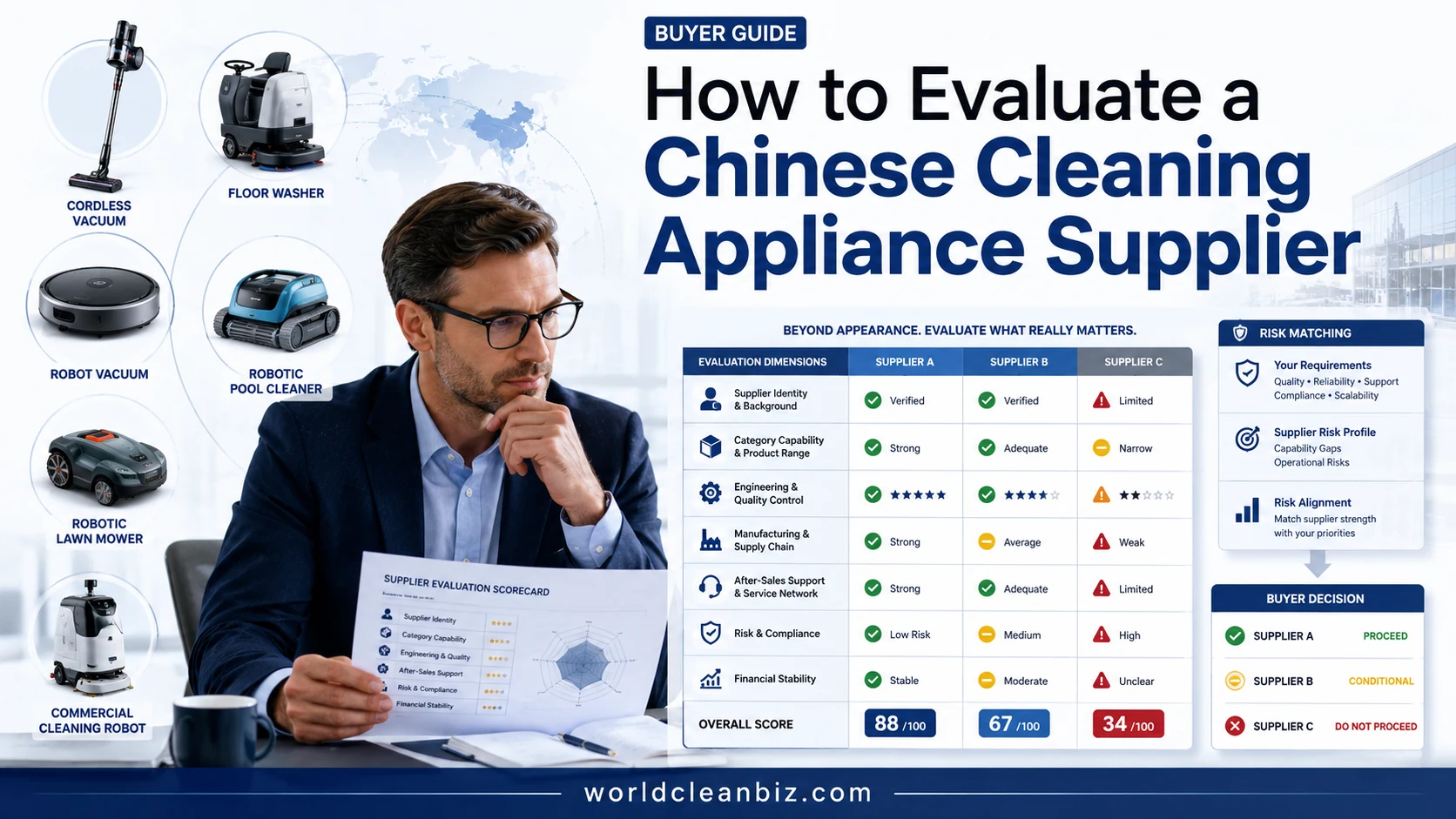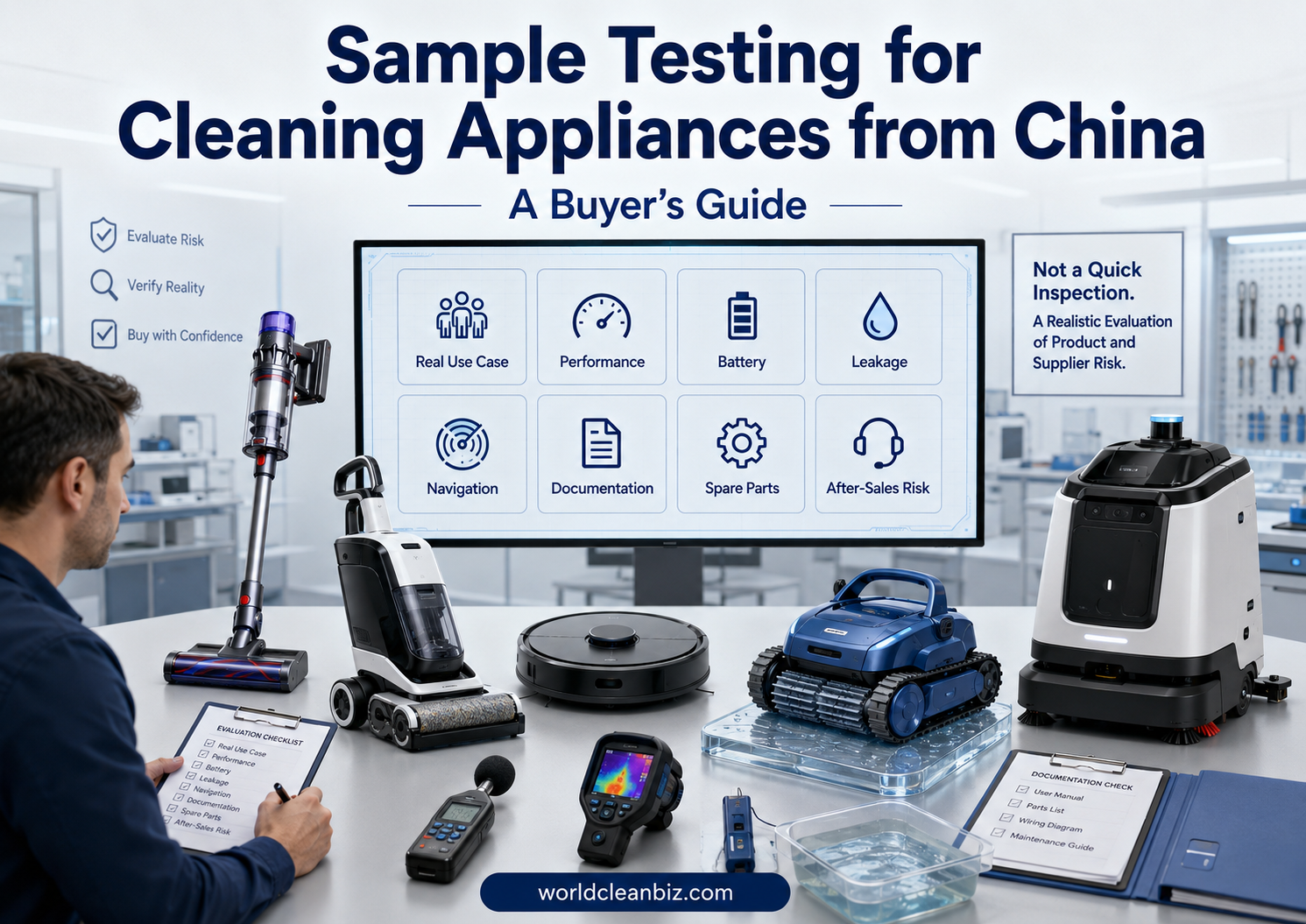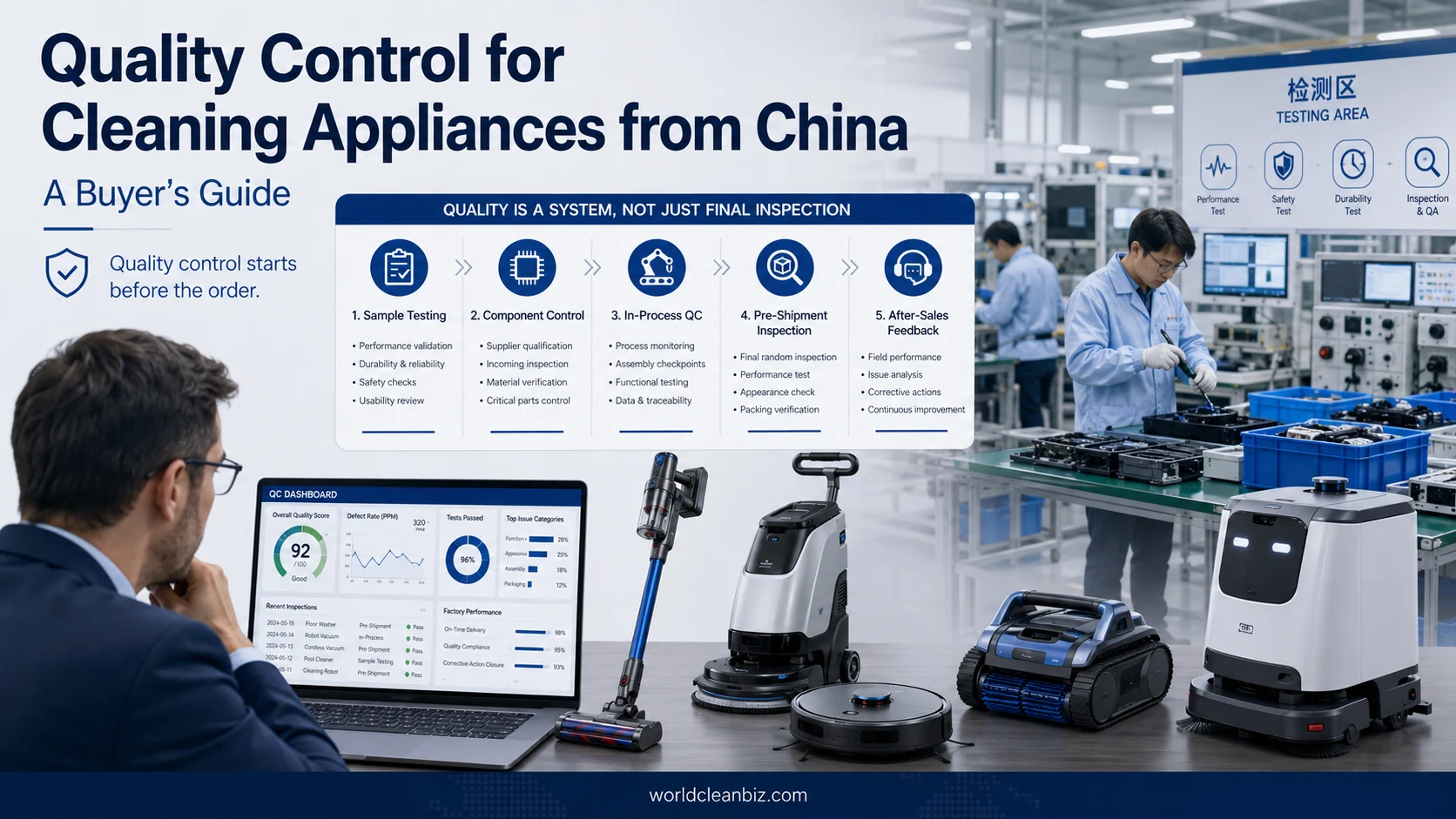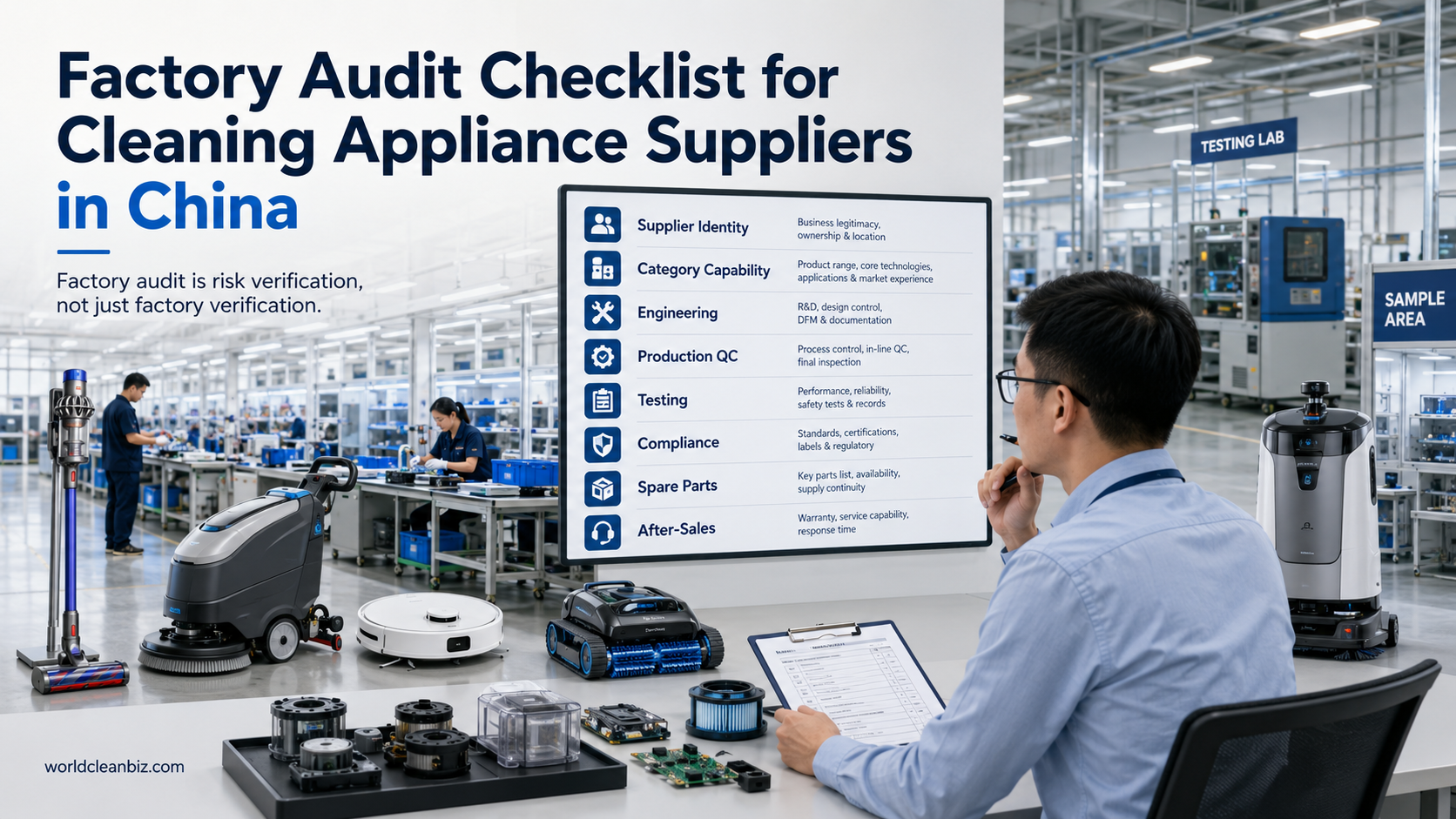
A factory audit for cleaning appliance suppliers in China should do more than confirm that a factory exists.
For overseas buyers, the real question is not only whether the supplier has a workshop, production lines, workers, and a business license. The real question is whether the supplier can control the product risks behind the category.
Cleaning appliances are not simple consumer goods. Cordless vacuums, floor washers, robot vacuums, robotic pool cleaners, robotic lawn mowers, commercial cleaning robots, and related cleaning products may involve motors, batteries, chargers, water systems, pumps, sensors, firmware, docking, filtration, sealing, spare parts, and warranty claims.
A clean showroom does not prove engineering depth. A large factory does not prove category capability. A good sample does not prove stable mass production.
A factory audit should help buyers answer one practical question:
Can this supplier produce, test, document, support, and improve the product I plan to sell?
Quick Answer
Buyers auditing cleaning appliance suppliers in China should check supplier identity, factory role, category experience, engineering capability, production process, component control, incoming material inspection, in-process quality control, testing equipment, sample-to-mass-production consistency, compliance readiness, spare parts support, warranty handling, and communication transparency.
Factory verification is only the first step. For cleaning appliances, the audit should also confirm whether the supplier understands category-specific risks such as suction, battery stability, leakage, docking, navigation, sealing, noise, heat, durability, spare parts, and after-sales feedback.
A factory audit should connect with supplier evaluation, sample testing, quality control, compliance review, MOQ planning, and spare parts strategy before buyers commit to mass production.
Why Factory Audits Matter More in Cleaning Appliances
A basic factory audit may be enough for simple products where the main risks are material, appearance, packaging, and workmanship.
Cleaning appliances need a deeper audit.
A cordless vacuum may fail because of weak airflow design, unstable battery performance, poor filtration, brush head issues, or noise. A floor washer may fail because of leakage, poor water recovery, roller odor, tank design, or drying problems. A robot vacuum may fail because of docking, mapping, obstacle avoidance, firmware, or app support. A robotic pool cleaner may fail because of waterproofing, sealing, pump performance, filtration, or battery issues.
These are not problems a buyer can judge from a showroom visit alone.
Factory audits matter because they reveal whether the supplier has the process, people, equipment, and habits needed to control those risks. The audit also helps buyers understand whether the supplier is a real manufacturer, an assembly plant, an ODM developer, a trading company, a brand owner, or a component specialist.
That distinction matters.
A supplier may look professional but rely heavily on outside modules, outsourced engineering, weak testing, or limited after-sales support. Another supplier may be smaller but stronger in one specific product category.
Factory size is not the same as category capability.
WCB Market Note
Factory audits are becoming more important in China cleaning appliance sourcing because buyers are sourcing more complex products with higher after-sales exposure. In the past, many buyers used factory audits mainly to verify whether a supplier was real. That is no longer enough. For cleaning appliances, the buyer must understand whether the supplier can control product-specific risks in motors, batteries, chargers, water systems, pumps, sealing, sensors, firmware, docking, navigation, durability, packaging, spare parts, and warranty handling.
Buyer implication: Buyers should audit the supplier’s category capability, not only its factory size, showroom, or production line appearance.
Buyer implication: Buyers should confirm whether approved samples, mass production components, testing process, and after-sales support are connected in one controllable system.
WCB view: In cleaning appliances, a factory audit is not only about verifying the factory. It is about verifying whether the supplier can control the product risk that buyers will inherit after shipment.
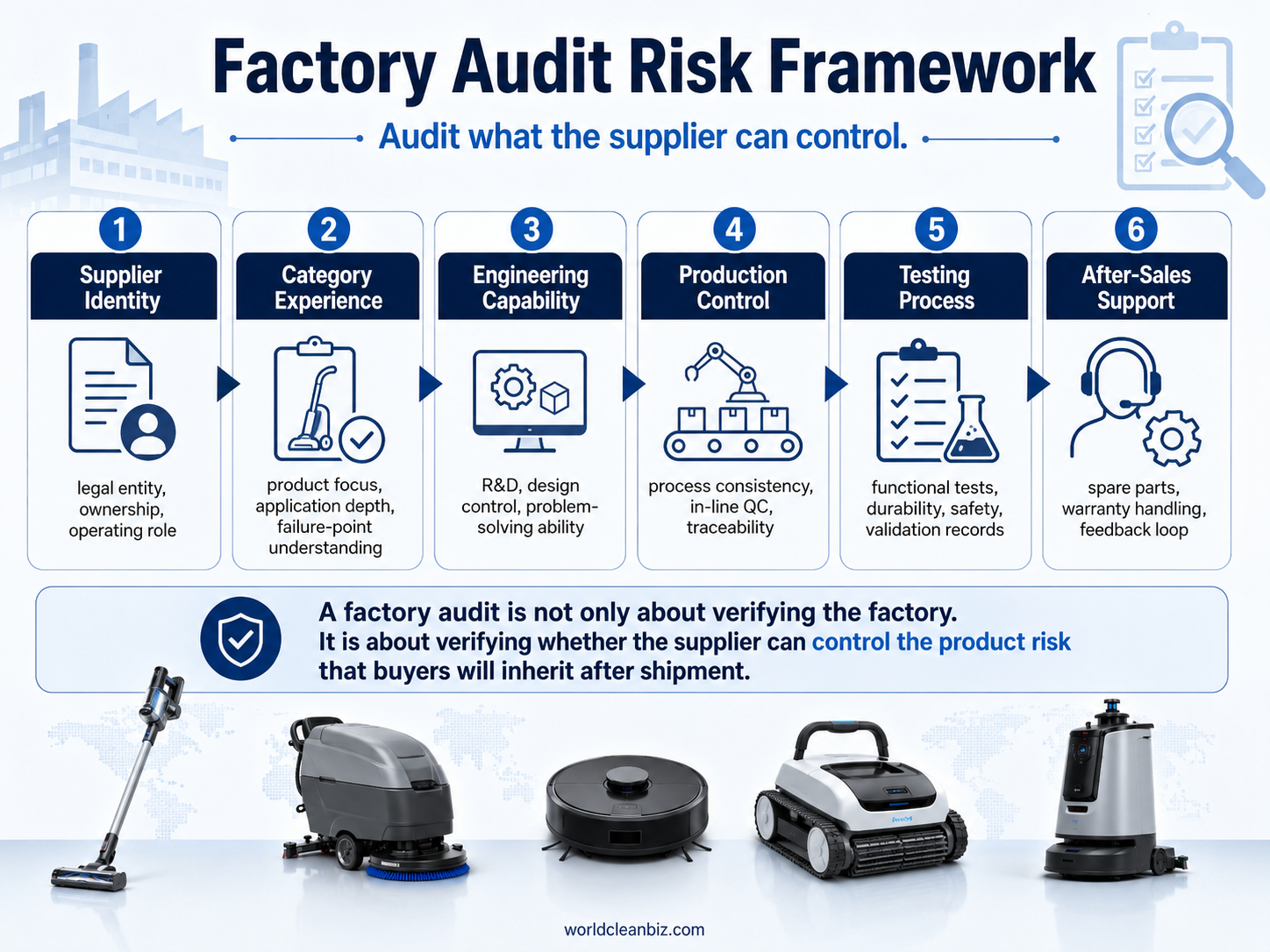
Factory Audit Is Not Just Factory Verification
Factory verification answers basic questions:
- Does the supplier exist?
- Is the address real?
- Is there a production site?
- Is the company licensed?
- Are there workers and equipment?
- Does the factory match the supplier’s claims?
These checks are necessary, but they are not enough.
A factory can be real and still be the wrong supplier.
It may not have experience in the buyer’s product category. It may assemble products but lack engineering capability. It may depend on outside suppliers for key components. It may pass a general audit but lack category-specific testing. It may have attractive samples but weak mass production consistency.
For cleaning appliance buyers, a factory audit should go deeper:
- What does this supplier actually control?
- What product categories does it understand?
- Which components does it source or make?
- What testing does it perform?
- How does it handle defects?
- Can it support spare parts and warranty claims?
- Can it explain known failure points?
- Can it support the buyer’s channel, market, and sourcing model?
This is why factory audits should not be isolated from the rest of sourcing. They should connect with quality control for cleaning appliances from China, compliance and certification review, MOQ and hidden cost analysis, and spare parts and warranty planning.
Step 1: Verify Supplier Identity and Factory Role
The first audit question is simple:
Who are you really dealing with?
Buyers should confirm whether the supplier is a factory, trading company, ODM supplier, brand owner, assembly plant, component supplier, or sourcing partner.
This matters because each supplier type controls different parts of the sourcing process.
A factory may control production but may not provide strong product strategy, export communication, small-buyer flexibility, or after-sales coordination. A trading company may provide communication and supplier coordination, but may not control engineering, components, or QC unless it has a strong process. An ODM supplier may have an existing product platform, but buyers need to check customization limits and product overlap.
Buyers should ask:
- What company owns the product design?
- Where is the product actually produced?
- Who controls engineering changes?
- Who controls quality inspection?
- Who owns the tooling or molds?
- Who provides after-sales parts?
- Who handles defect claims?
- Who appears on certificates, test reports, labels, and manuals?
A trading company is not automatically bad, and a factory is not automatically better. The key is transparency.
If the supplier cannot clearly explain its role, the buyer should slow down.
For a broader discussion, see our guide on factory vs trading company in China.
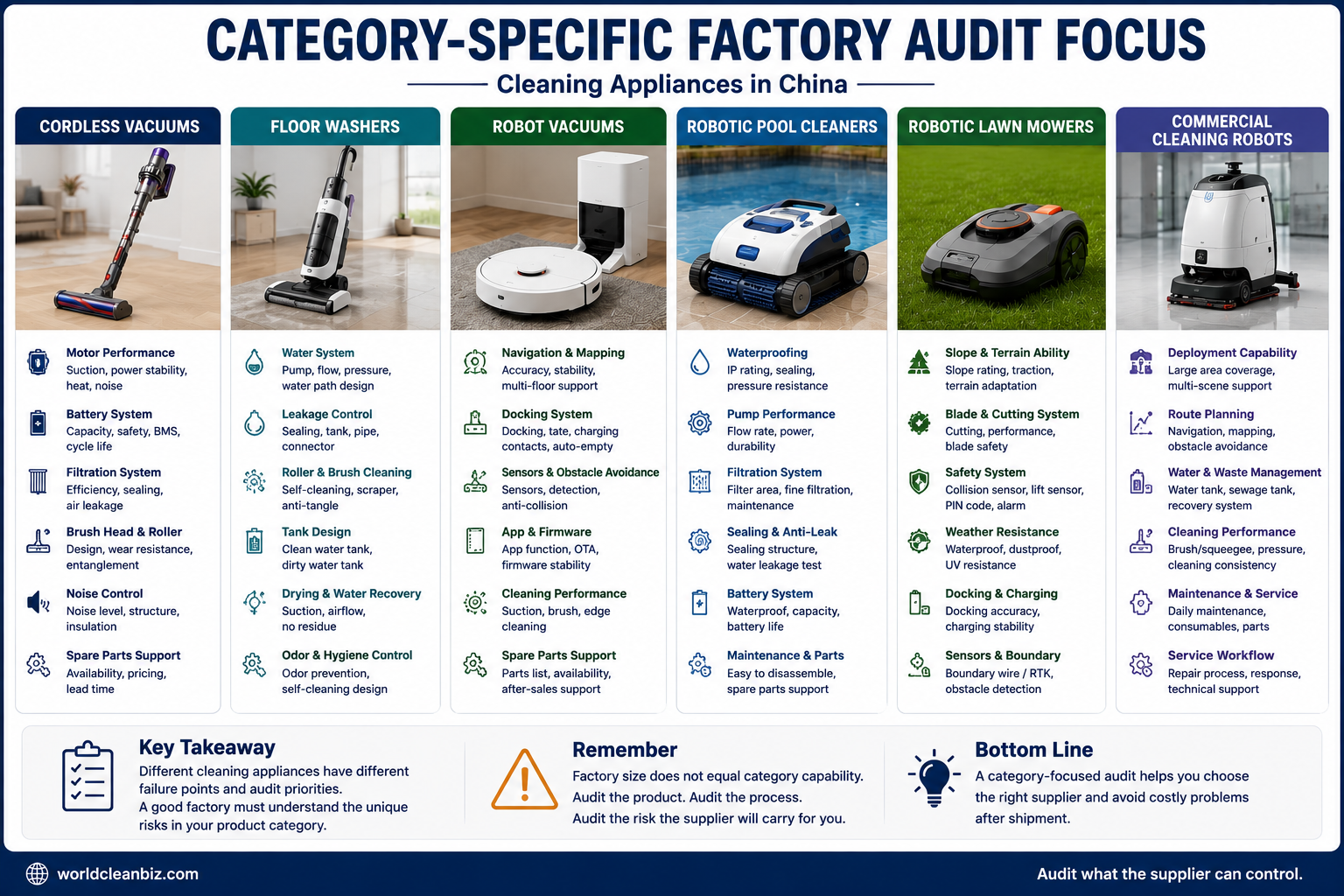
Step 2: Check Category Experience and Product Focus
A factory may be large, but that does not mean it is strong in the buyer’s category.
Cleaning appliance categories require different capabilities.
Cordless vacuums require attention to motors, airflow, batteries, filtration, brush heads, noise, and spare parts. See our guide on cordless vacuum cleaner OEM manufacturers in China.
Floor washers require water system design, leakage control, roller cleaning, tank design, drying, odor control, and maintenance planning. See our guide on floor washer manufacturers in China.
Robot vacuums require navigation, docking, sensors, app support, firmware, obstacle avoidance, mopping systems, and spare parts. See our guide on how to source robot vacuum cleaners from China.
Robotic pool cleaners require waterproofing, pump performance, filtration, sealing, battery safety, wall cleaning, and maintenance support. See our guide on robotic pool cleaner manufacturers in China.
Robotic lawn mowers require navigation, slope handling, blades, safety logic, weather resistance, docking, sensors, and outdoor durability. See our guide on robotic lawn mower manufacturers in China.
Commercial cleaning robots require deployment support, route coverage, water recovery, operator training, maintenance, fleet management, and service workflow. See our guide on commercial cleaning robot manufacturers in China.
The audit should confirm whether the factory has real experience in the relevant category, not only similar products in a showroom.
Buyers should ask the supplier to explain common failure points in the category. A serious supplier should be able to discuss what usually goes wrong, how it tests for those issues, and how it improves future production.
Step 3: Review Engineering and R&D Capability
Engineering capability matters because many cleaning appliance failures are built into design decisions.
A factory that only assembles parts may not be able to solve airflow problems, leakage problems, docking problems, noise problems, sealing issues, or firmware instability. It may be able to produce what exists, but not improve it.
Buyers should review whether the supplier has category-specific engineering support.
Key questions include:
- Who designs the product structure?
- Who selects motors, batteries, pumps, sensors, chargers, and control boards?
- Can the supplier explain product failure points?
- Can it modify the product if test results are weak?
- Can it support OEM or ODM changes without creating new risk?
- Does it keep engineering records, change logs, or testing feedback?
- How does it handle product improvement after customer complaints?
This is especially important for OEM and ODM projects. In OEM, the buyer may control more specifications, but the supplier still needs manufacturing and engineering discipline. In ODM, the supplier’s existing platform may speed up launch, but buyers need to understand how mature and differentiated that platform is.
For more detail, see our guide on OEM vs ODM cleaning products.
Step 4: Check Production Lines and Process Control
A factory audit should review how products move through production.
Buyers do not need to become manufacturing engineers, but they should understand whether the process is organized, repeatable, and controlled.
Check:
- How materials enter production
- Whether key components are checked before assembly
- How workstations are organized
- Whether operators follow work instructions
- Whether there are in-process checks
- How defective units are separated
- Whether rework is recorded
- Whether finished goods are tested before packing
- Whether production records can be traced by batch
For cleaning appliances, sample-to-mass-production consistency is critical. A sample may use one set of components, but mass production may use different parts if the buyer does not control specifications.
Buyers should confirm whether motors, batteries, chargers, pumps, filters, sensors, PCBs, docks, seals, tanks, and other critical parts in mass production match the approved sample.
The factory should have a clear process for handling changes. If the supplier changes components without buyer approval, the buyer may face performance, compliance, or warranty problems later.
Step 5: Review Key Component Control
Key components often decide product performance and after-sales risk.
Buyers should identify which components are critical for the product category and ask how the factory controls them.
Examples include:
- Motors
- Batteries
- Chargers and adapters
- Pumps
- Water tanks
- Brush rollers
- Filters
- Sensors
- PCBs and control boards
- Wireless modules
- Charging docks
- Seals and gaskets
- Wheels, tracks, or blades
- Category-specific accessories
The audit should check whether the supplier has approved component suppliers, incoming material checks, component traceability, and backup sourcing plans.
Buyers should also ask what happens if a component changes. Does the supplier retest the product? Does it inform the buyer? Does it update documentation? Does it review compliance impact?
This connects directly with sample testing. A good sample means little if mass production uses different critical components.
Step 6: Inspect Testing Equipment and Quality-Control Process
A serious cleaning appliance supplier should have category-relevant testing, not only basic appearance inspection.
The exact tests depend on the product type, but buyers should look for evidence that the factory can test functional performance, safety-related behavior, durability, packaging, and user-critical features.
Relevant testing may include:
- Suction or airflow checks
- Runtime and charging checks
- Battery and charger checks
- Noise and heat checks
- Water leakage checks
- Pump and water recovery checks
- Brush roller and floor contact checks
- Filtration and dust leakage checks
- Docking and charging checks
- Navigation or sensor checks
- Sealing or waterproofing checks where relevant
- Aging or durability checks
- Packaging drop or transport checks
The buyer should not only look at equipment. The buyer should ask how often tests are performed, what records are kept, what happens when results fail, and whether test results are tied to specific production batches.
A factory with equipment but no testing discipline still creates risk.
A factory without category-specific testing may not discover problems until the buyer’s customers do.
Step 7: Check Compliance and Documentation Readiness
Compliance readiness should be part of the audit.
This does not mean the factory can guarantee compliance in every market. Requirements depend on product type, configuration, charger, battery, wireless module, label, manual, and destination market. Buyers should verify final requirements with qualified compliance partners or testing labs.
But the supplier should be able to provide organized documents and explain what documents apply to the exact model.
Buyers should review:
- Test reports and certificates
- Whether documents match the exact product model
- Charger and adapter documentation
- Battery documentation
- Wireless module documentation where relevant
- Labels and warning information
- User manuals
- Packaging information
- Brand or private label changes
- ODM customization impact
- Document ownership and responsibility
A supplier saying “we have certificates” is not enough. Buyers should check whether those documents cover the actual product and target market.
For more detail, see our guide on compliance and certification for cleaning appliances from China.
Step 8: Review Spare Parts, Warranty, and After-Sales Support
A factory audit should include after-sales support.
Many buyers forget this because they focus on production and shipment. But cleaning appliance risk continues after the product is sold.
Buyers should ask:
- Does the supplier provide a spare parts list?
- Which parts are consumables?
- Which parts are repair parts?
- Are parts available for discontinued models?
- Are there MOQ requirements for spare parts?
- How are defect claims handled?
- Who pays for replacement parts or shipping?
- How does the supplier investigate repeated defects?
- Does after-sales feedback influence QC or product changes?
Spare parts may include filters, brush rollers, batteries, chargers, water tanks, pumps, motors, sensors, docks, seals, blades, wheels, accessories, and consumables.
A factory that can ship finished goods but cannot support parts and warranty may create hidden cost for the buyer.
For more detail, see our guide on spare parts and warranty for cleaning appliances from China.
Step 9: Evaluate Communication, Transparency, and Problem-Solving
Factory audits are not only about equipment and documents.
They also reveal how the supplier communicates.
A good supplier should be able to explain its strengths and limitations clearly. It should not hide factory role, component sourcing, product limitations, testing gaps, or after-sales responsibilities.
Buyers should pay attention to how the supplier responds when asked difficult questions.
Does it answer directly? Does it provide records? Does it explain trade-offs? Does it admit known risks? Does it propose practical solutions? Does it avoid vague claims?
Communication matters because sourcing is not a one-time transaction. Product changes, sample issues, production delays, QC problems, compliance documents, spare parts, and warranty claims all require communication.
A supplier that communicates well before the order but becomes vague when problems appear is a risk.
Transparency is part of supplier capability.
Factory Audit Checklist for Cleaning Appliance Buyers
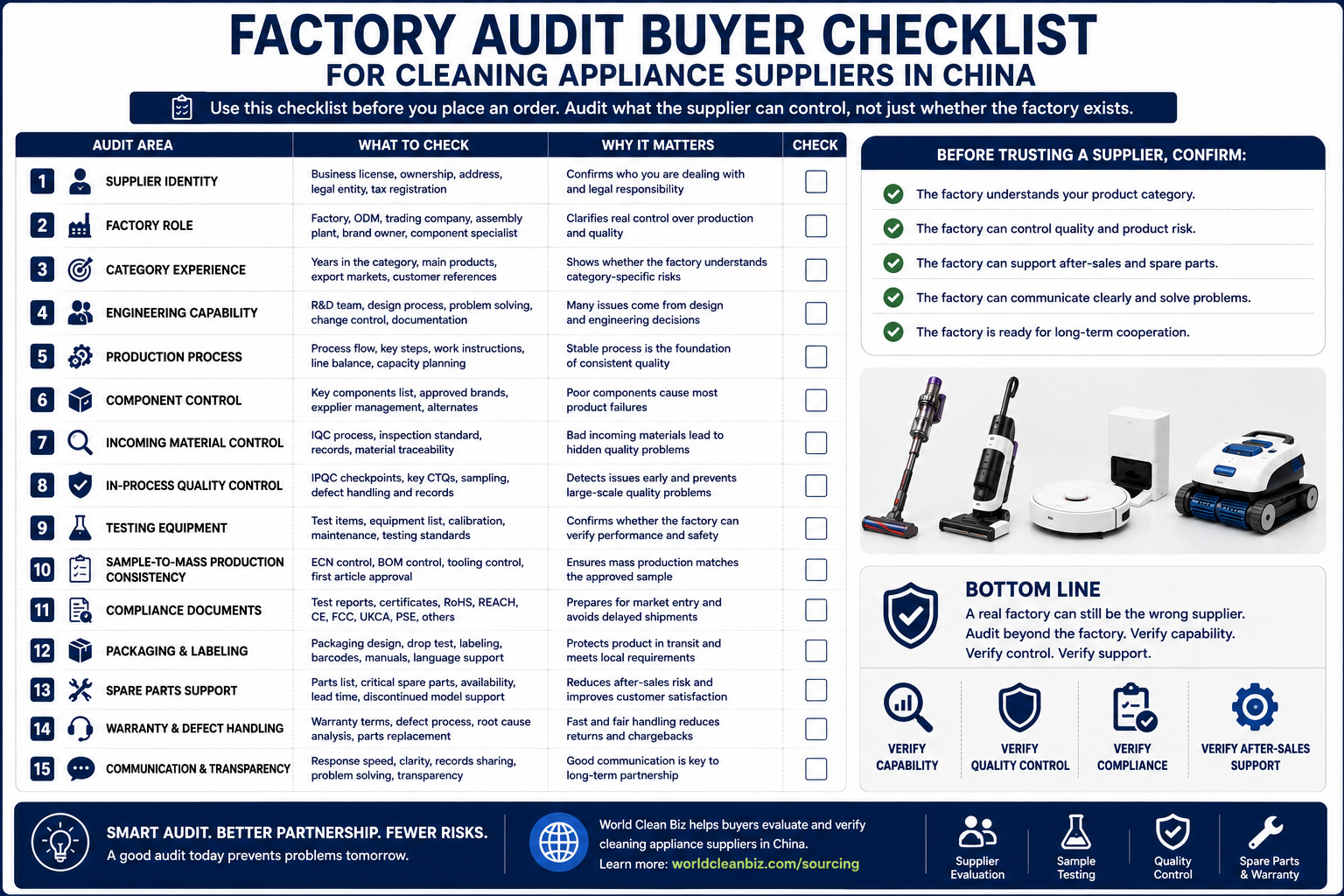
| Audit Area | What to Check | Why It Matters | Buyer Risk If Ignored |
|---|---|---|---|
| Supplier identity | Business identity, ownership, address, legal role | Confirms who the buyer is actually dealing with | Buyer works with an unclear or misrepresented supplier |
| Factory role | Factory, ODM, trading company, assembly plant, component supplier | Shows what the supplier really controls | Buyer assumes factory control that does not exist |
| Category experience | Relevant cleaning appliance experience and product focus | Factory size does not prove category capability | Supplier cannot handle category-specific failure points |
| Engineering capability | Product design, component selection, problem solving, change control | Many failures come from design and engineering gaps | Supplier cannot improve or fix product issues |
| Production process | Production flow, work instructions, batch tracking, rework records | Shows whether mass production is controlled | Approved sample quality cannot be repeated |
| Component control | Motors, batteries, chargers, pumps, sensors, docks, seals, filters | Critical components shape performance and warranty risk | Component changes create quality or compliance problems |
| Incoming material control | Inspection of key parts before assembly | Prevents defective components entering production | Problems appear late or after shipment |
| In-process QC | Checks during assembly and production | Catches defects before final inspection | Defects accumulate until shipment |
| Testing equipment | Category-relevant functional, durability, safety, and packaging tests | Confirms whether factory can detect real product issues | Weak products pass basic inspection |
| Sample-to-mass-production consistency | Whether mass production matches approved sample components and specs | Protects approved performance and documentation | Buyer receives products different from sample |
| Compliance documents | Reports, certificates, labels, manuals, charger, battery, wireless module documents | Compliance depends on exact product and market | Shipment, listing, or market-access problems |
| Packaging and labeling | Packaging strength, labels, warnings, manuals, barcode, brand details | Packaging and labeling affect channel acceptance | Damage, relabeling, platform issues, or customer confusion |
| Spare parts support | Parts list, consumables, repair parts, availability period | Cleaning appliances need service support after sale | Buyer cannot handle replacement needs |
| Warranty and defect handling | Claim process, evidence, responsibility, response time, root-cause review | Warranty cost affects real sourcing cost | Buyer absorbs claims without supplier support |
| Communication and transparency | Direct answers, records, problem-solving attitude | Sourcing problems require supplier cooperation | Small issues become unresolved disputes |
Common Factory Audit Mistakes Buyers Make
1. Auditing only whether the factory exists
Factory verification is necessary, but it is not enough. Buyers also need to verify whether the supplier can control the product risks behind the category.
2. Overvaluing factory size
A large factory may still be weak in a specific cleaning appliance category. A smaller supplier may be stronger if it has deeper category focus and testing capability.
3. Trusting the showroom too much
Showrooms are designed to look professional. They do not prove engineering capability, production control, testing depth, or after-sales support.
4. Ignoring supplier role
Buyers often assume they are dealing with a factory when the supplier may be a trading company, brand owner, assembly plant, or ODM developer. The role must be clear.
5. Not checking sample-to-production consistency
A good sample does not guarantee mass production quality. Buyers should confirm whether key components and specifications will remain the same.
6. Treating compliance documents as paperwork
Certificates and reports should match the exact product, configuration, charger, battery, wireless module, label, manual, and target market where relevant.
7. Ignoring spare parts and warranty
Factory audits often focus on production and forget after-sales. For cleaning appliances, parts and warranty support can decide the real cost after shipment.
8. Not connecting audit results with sourcing decisions
An audit should affect supplier selection, sample testing, QC planning, MOQ decisions, and after-sales planning. If the audit does not influence decisions, it becomes paperwork.
How World Clean Biz Helps Buyers Verify Cleaning Appliance Suppliers
World Clean Biz does not treat factory audits as simple factory verification.
For cleaning appliances, a supplier must be evaluated through product category fit, engineering strength, component control, testing process, compliance readiness, sample testing results, spare parts support, warranty responsibility, and China supply chain options.
A factory that looks real may still be the wrong supplier for the buyer’s product, channel, price band, and after-sales model.
World Clean Biz helps buyers evaluate:
- Supplier identity and factory role
- Product category fit
- Engineering and R&D capability
- Production and QC process
- Key component control
- Sample testing results
- Compliance readiness
- Spare parts and warranty support
- OEM, ODM, and private label fit
- China supply chain options
For broader sourcing context, buyers can also read our guide on how to find reliable cleaning product suppliers in China, explore WCB cleaning industry reports, learn more about World Clean Biz, or follow World Clean Expo updates.
Verifying cleaning appliance suppliers, OEM factories, ODM suppliers, or private label partners in China? Contact World Clean Biz for sourcing support.
FAQ
What is a factory audit for cleaning appliance suppliers in China?
A factory audit is a structured review of a supplier’s identity, production capability, engineering support, quality-control process, testing equipment, component control, compliance readiness, spare parts support, and communication transparency.
For cleaning appliances, the audit should not only confirm whether the factory exists. It should verify whether the supplier can control category-specific product risk.
Is factory verification enough before placing an order?
No. Factory verification confirms that the supplier exists and has a real operating location. It does not prove that the supplier can produce reliable cleaning appliances at scale.
Buyers also need to review category experience, engineering capability, component control, testing process, mass production consistency, compliance documents, and after-sales support.
What should buyers check during a cleaning appliance factory audit?
Buyers should check supplier identity, factory role, product category experience, engineering support, production process, key component control, incoming material inspection, in-process QC, testing equipment, compliance documentation, spare parts, warranty handling, and communication quality.
The exact checklist should depend on the product category and target market.
Should I audit a factory before ordering samples or before mass production?
Buyers can do both, depending on risk.
Before samples, a basic verification can help confirm whether the supplier is worth evaluating. Before mass production, a deeper audit should confirm whether the supplier can repeat sample quality, control components, test correctly, and support after-sales needs.
How is a factory audit different for OEM and ODM suppliers?
For OEM suppliers, buyers should focus on whether the factory can follow specifications, control components, protect consistency, and manage production changes.
For ODM suppliers, buyers should also check the maturity of the existing product platform, customization limits, product overlap with competitors, documentation coverage, and spare parts support.
Can a trading company pass a factory audit?
A trading company is not a factory, so buyers should not audit it as if it owns production. But buyers can still evaluate whether the trading company adds real control through supplier coordination, QC follow-up, documentation management, communication, and after-sales support.
Buyers should also verify the actual production factory behind the trading company.
Should buyers use a third-party audit company in China?
A third-party audit company can help verify factory existence, basic process, documents, and production conditions. This can be useful, especially when buyers cannot visit in person.
However, cleaning appliance buyers should also make sure the audit covers category-specific risks, not only general factory conditions. Product knowledge still matters.
Can World Clean Biz help buyers verify cleaning appliance suppliers?
Yes. World Clean Biz helps buyers evaluate supplier identity, factory capability, product category fit, engineering strength, quality-control process, sample testing results, compliance readiness, spare parts support, and China supply chain options before placing orders.
If you are comparing cleaning appliance suppliers in China, contact World Clean Biz for sourcing support.