In this article 16 sections
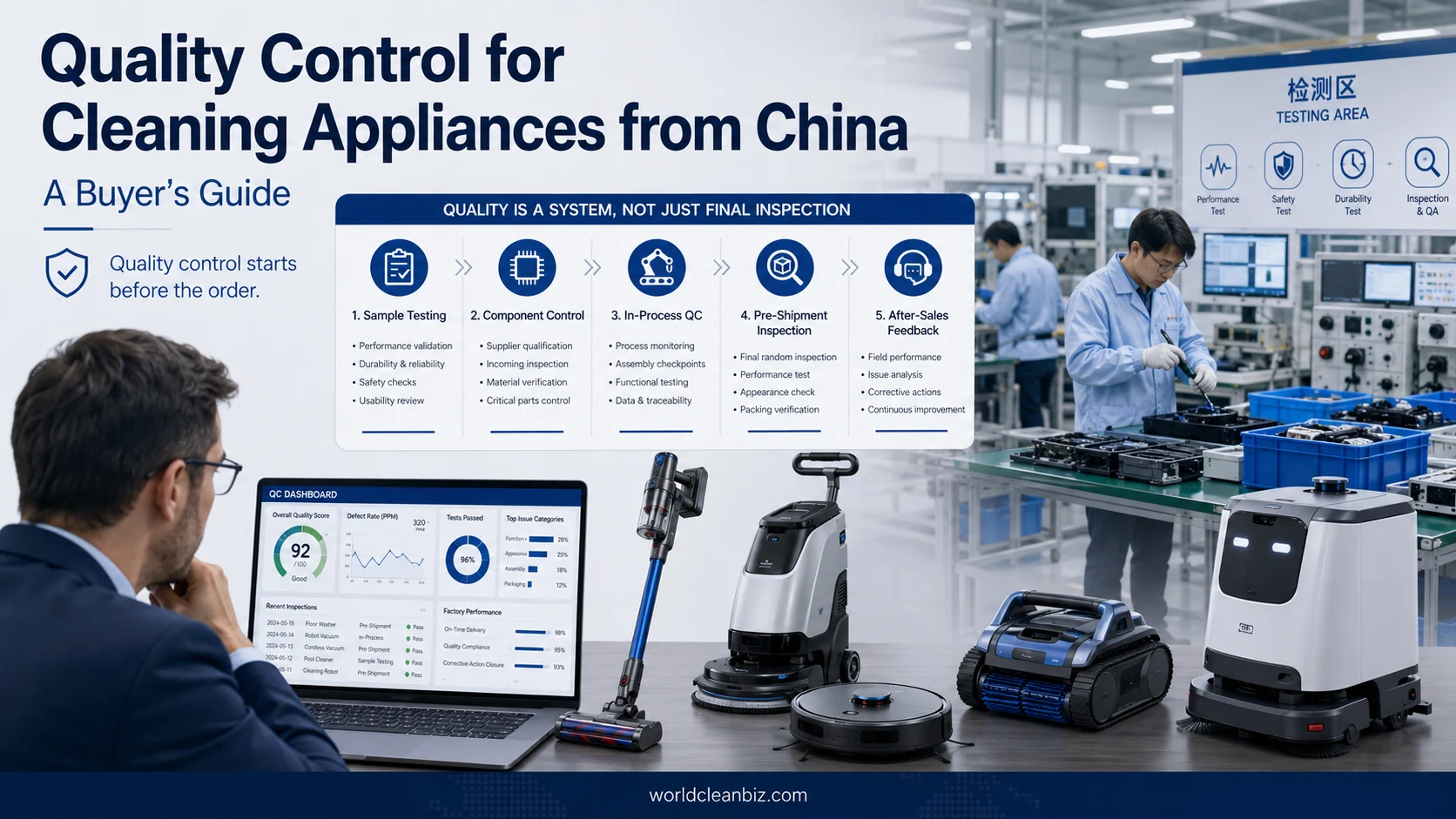
Quality control for cleaning appliances from China should not start when the goods are ready for shipment.
By that point, many problems are already built into the product.
A weak motor choice, unstable battery pack, poor water sealing, immature firmware, weak docking design, bad filtration, unclear spare parts policy, or missing test process cannot be fully fixed by a final inspection report.
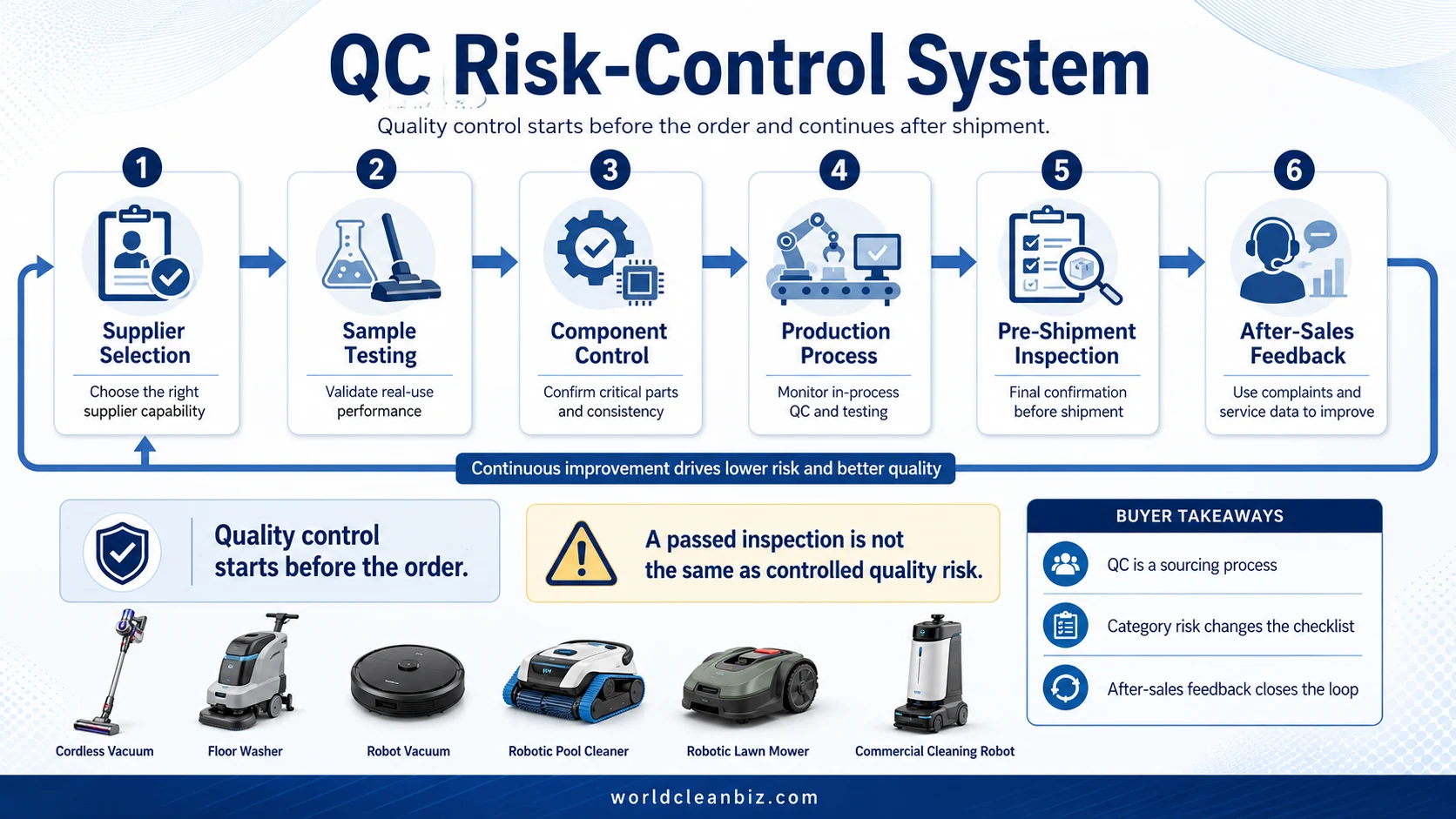
For cleaning appliances, quality control should start before supplier selection and sample approval. It should continue through product risk definition, sample testing, component review, production control, pre-shipment inspection, packaging checks, and after-sales feedback.
This matters because cleaning appliances are not simple products. Cordless vacuums, floor washers, robot vacuums, robotic pool cleaners, robotic lawn mowers, and commercial cleaning robots all carry category-specific risks such as motor, battery, water system, navigation, sealing, software, spare parts, and after-sales issues.
The core question is not only:
Did the factory ship what we ordered?
The better question is:
Did we control the right product risks before the order was placed?
Quick Answer
Quality control for cleaning appliances from China means checking product risk, supplier capability, sample performance, key components, production process, functional testing, packaging, labeling, compliance readiness, pre-shipment inspection, spare parts, and warranty feedback.
Pre-shipment inspection is important, but it is not enough. Final inspection can catch visible defects, missing accessories, packaging issues, and basic functional problems. It cannot fully fix weak design, poor component choices, immature product platforms, missing testing, or unclear after-sales responsibility.
Buyers sourcing cleaning appliances from China should define quality criteria before ordering samples, test products under real-use conditions, check key components before mass production, confirm in-process QC, and use after-sales feedback to understand real failure patterns.
If you are still choosing suppliers, start with our guide on how to evaluate a Chinese cleaning appliance supplier. If you are still building your supplier base, read our guide on how to find reliable cleaning product suppliers in China.
Why Quality Control Matters More in Cleaning Appliances
Cleaning appliances carry more quality risk than simple cleaning tools.
A mop, brush, bucket, cloth, or spray bottle still needs material and packaging checks, but the failure modes are usually limited. A cleaning appliance has more moving parts, electrical systems, user safety concerns, performance expectations, and after-sales risk.
Product failures may come from weak suction, battery degradation, leakage, docking failure, app instability, firmware issues, filtration problems, poor sealing, overheating, noise, or spare parts shortages. Some problems appear during sample testing. Others only appear after repeated customer use.
This is why cleaning appliance buyers should not rely only on catalog claims, factory photos, or a simple pre-shipment inspection. Quality control must be category-specific.
A good sample does not guarantee stable mass production. A supplier may prepare a strong sample for approval but fail to repeat the same performance across full production. Components may change. Testing may be incomplete. Workers may not follow the same process. Packaging may not protect the product well enough. Warranty responsibility may be unclear.
The cheapest supplier is often not the lowest-cost supplier if quality failures create returns, rework, replacement parts, poor reviews, distributor complaints, and brand damage.
WCB Market Note
Quality control is becoming more important in China cleaning appliance sourcing because products are becoming more complex and buyers are carrying more post-sale responsibility. In the past, many buyers treated QC as a final inspection task: check quantity, appearance, packaging, accessories, and basic function before shipment. That approach is no longer enough for cleaning appliances. Product failures can come from supplier selection, immature product design, weak component choices, poor sample testing, missing production controls, compliance gaps, or after-sales assumptions.
Buyer implication: Buyers should define product risk and quality criteria before sample approval, not after mass production begins.
Buyer implication: Buyers should evaluate category-specific failure points, not only general factory quality systems or inspection checklists.
WCB view: In cleaning appliances, a passed inspection does not always mean the buyer has controlled the real quality risk. Quality control is not only an inspection task. It is a risk-control system that connects supplier selection, sample testing, component control, production process, compliance readiness, and after-sales feedback.
Quality Control Should Start Before Final Inspection
Pre-shipment inspection is useful. Buyers should still check quantity, appearance, packaging, labels, accessories, function, and shipment readiness before goods leave the factory.
But final inspection has limits.
It can find visible problems. It can confirm whether the product matches agreed specifications. It can detect missing accessories, poor packaging, obvious functional failures, and some workmanship defects.
It cannot fully solve problems that were created earlier.
If the motor is underpowered, final inspection cannot redesign the product. If the battery pack is unstable, final inspection may not reveal long-term failure. If the water tank leaks after repeated use, a short inspection may miss it. If firmware is unstable, a basic power-on test may not catch it. If spare parts are unavailable, inspection will not protect the buyer from future service problems.
Quality control should begin before the supplier is selected and before samples are approved.
Buyers should first define the product risk, target market, sales channel, compliance requirements, expected warranty model, and real user conditions. Then they should choose suppliers and inspection methods based on those risks.
For buyers comparing supplier structures, our guide on factory vs trading company in China explains why supplier control matters. For sourcing model decisions, see OEM vs ODM cleaning products and our guide to private label cleaning products from China.
Step 1: Define the Product Risk Before Sampling
Before requesting samples, buyers should define what kind of product risk they are taking.
This starts with basic questions:
- What product category are we sourcing?
- What is the target market?
- What sales channel will be used?
- What price band are we targeting?
- What performance level do customers expect?
- What compliance requirements apply?
- What warranty and after-sales responsibility will we carry?
- What failure would create the biggest business cost?
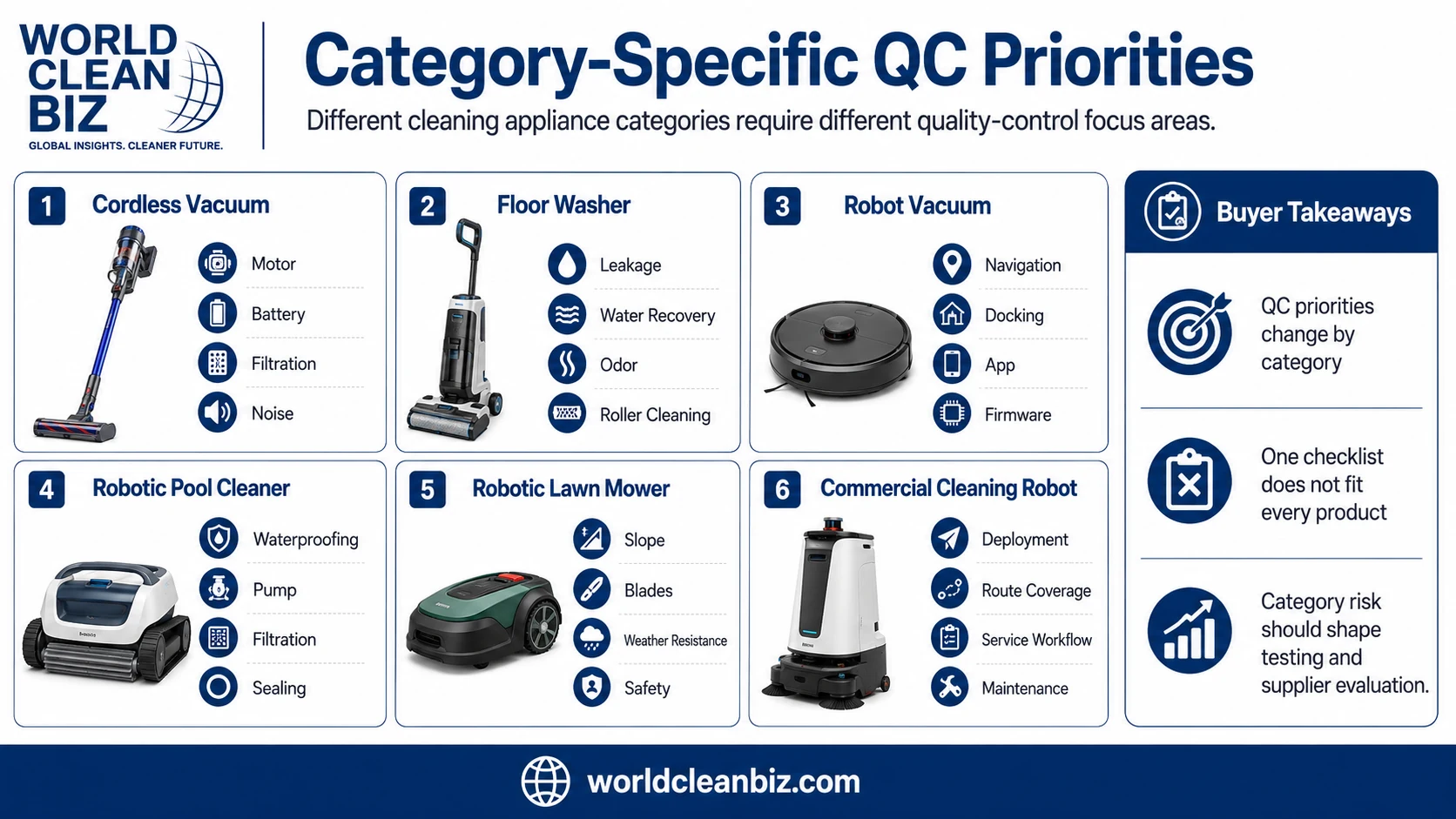
Different cleaning appliance categories require different QC priorities.
For cordless vacuums, buyers should focus on motor, airflow, suction stability, battery runtime, filtration, brush heads, noise, charging, and accessories. For more detail, see our guide to cordless vacuum cleaner OEM manufacturers in China.
For floor washers, QC must focus on leakage, water recovery, roller cleaning, odor, drying, dirty water tank design, self-cleaning, battery stability, and consumables. Buyers can compare product risks in our guide to floor washer manufacturers in China.
For robot vacuums, buyers need to check navigation, docking, app control, firmware, obstacle avoidance, mopping, battery, and spare parts. See our guide on how to source robot vacuum cleaners from China.
For robotic pool cleaners, quality risk includes waterproofing, pump performance, filtration, wall cleaning, waterline cleaning, battery, sealing, and maintenance. See our guide to robotic pool cleaner manufacturers in China.
For robotic lawn mowers, buyers must check slope handling, safety, blades, weather resistance, navigation, docking, and outdoor durability. See our guide to robotic lawn mower manufacturers in China.
For commercial cleaning robots, QC must include deployment, route coverage, water recovery, safety behavior, operator training, maintenance, and service workflow. See our guide to commercial cleaning robot manufacturers in China.
The purpose is not to create a long checklist for every product. The purpose is to identify which failures matter most before sampling begins.
Step 2: Check Supplier Quality Capability
A supplier’s quality capability is more important than its quality slogan.
Many suppliers say they have strict QC. Buyers need to understand what that means in practice.
A serious cleaning appliance supplier should be able to explain how incoming materials are checked, how key components are verified, what tests are done during production, what tests are done before shipment, how defective units are traced, and how repeated complaints are handled.
Buyers should also check whether the supplier understands the specific product category. A supplier that can assemble a good-looking appliance may not understand long-term battery performance, water leakage, firmware updates, filtration stability, docking failures, or spare parts planning.
Ask practical questions:
- What are the most common defects in this product category?
- Which components create the most complaints?
- What testing is done before mass production?
- What testing is repeated during production?
- What happens when defects are found?
- Can the supplier show real testing records?
Quality capability is not only about inspection workers. It includes engineering, production, testing, documentation, and feedback loops.
Step 3: Test Samples Under Real Use Conditions
Sample testing should be stricter than a basic product demo.
A sample that looks good on a table may still fail in real homes or commercial spaces. Buyers should test samples like end users, not like sourcing agents.
A sourcing agent may check whether the product turns on, charges, runs, and matches the catalog. A buyer should test whether the product can survive the real use case.
For a cordless vacuum, test suction, runtime, noise, filtration, dust leakage, brush head performance, hair tangling, charging, and how easy it is to clean.
For a floor washer, test real wet messes, water recovery, leakage, roller cleaning, tank handling, self-cleaning, drying, and odor after storage.
For a robot vacuum, test mapping, docking, obstacle avoidance, app connection, firmware stability, carpet behavior, mopping, and multiple room layouts.
For a commercial cleaning robot, test in a real facility. Check route coverage, safety behavior, water recovery, runtime, operator handover, maintenance, and service workflow.
Sample testing should answer three questions:
- Does the product meet the target user’s expectation?
- Can the supplier repeat this quality in production?
- What after-sales problems may appear after launch?
If the sample fails, buyers should not only ask for a better sample. They should ask why it failed and whether the supplier can fix the root cause.
Step 4: Review Key Components Before Mass Production
Many cleaning appliance quality problems start with component choices.
Before mass production, buyers should review key components and confirm whether they match the approved sample and target market requirements.
Important components may include motors, batteries, chargers, pumps, water tanks, brush rollers, filters, sensors, PCBs, wireless modules, charging docks, seals, and category-specific accessories.
The goal is not for every buyer to become an engineer. The goal is to prevent hidden changes.
Buyers should ask:
- Are the components in mass production the same as the approved sample?
- Which components are critical to performance or safety?
- Which components are sourced externally?
- Can the supplier change components without buyer approval?
- Will a component change affect compliance documents?
- Are spare parts available for these components?
Component control is especially important for OEM, ODM, and private label products. In private label, the buyer may have limited control over the supplier’s existing design, but should still know what is being used. For more detail, see our guide on private label cleaning products from China.
Step 5: Confirm In-Process Quality Control
In-process quality control checks whether production is stable before the final inspection.
This matters because defects caught early are easier to correct. Defects found after production is complete are more expensive and may delay shipment.
In-process QC may include:
- Incoming material inspection
- Assembly checks
- Component verification
- Functional testing during production
- Safety checks where relevant
- Appearance and workmanship checks
- Process records
- Defect tracking
- Corrective actions
Buyers should ask the supplier where quality is checked during production. If all quality control happens only at the end, risk is higher.
For example, battery, motor, pump, sensor, water sealing, docking, and charging issues should not wait until the final inspection. Some problems need to be controlled during assembly and testing.
Buyers should also confirm whether the factory has clear work instructions, testing equipment, trained operators, and records for each production batch.
For larger orders or higher-risk products, buyers may also use during-production inspection, not only pre-shipment inspection.
Step 6: Run Pre-Shipment Inspection the Right Way
Pre-shipment inspection is still important, but it should be treated as final confirmation, not the whole QC system.
It helps buyers confirm whether finished goods match the order before shipment. But it should be based on the product’s real risk, not only a generic inspection checklist.
A cleaning appliance pre-shipment inspection should usually include quantity and model confirmation, appearance and workmanship checks, key specifications, functional testing, charging or power checks, accessories, packaging, labels, manuals, carton marks, and basic safety-related checks where relevant.
Buyers should also add product-specific checks. For example, a cordless vacuum inspection may include suction, noise, accessory fit, filter fit, and charging. A floor washer inspection may include water tank fit, leakage checks, roller function, self-cleaning where relevant, and charging. A robot vacuum inspection may include docking, navigation basics, app connection where relevant, and accessory verification.
If many defects are found at this stage, the buyer should not only negotiate rework. The buyer should review why the defects were not caught earlier.
Step 7: Check Packaging, Labeling, and Documentation
Packaging and documentation are part of quality control.
A good product can still create problems if packaging is weak, labels are wrong, manuals are unclear, or accessories are missing.
Buyers should check:
- Retail box quality
- Shipping carton strength
- Drop protection
- Accessory placement
- User manual accuracy
- Warning labels
- Language requirements
- Barcode and product labels
- Plug and charger labeling
- Warranty card or service information
- Spare parts list where relevant
For cleaning appliances, documentation is especially important because users need to understand charging, cleaning, maintenance, filter replacement, tank cleaning, app use, docking, blade replacement, water safety, or troubleshooting.
Packaging should also match the sales channel. An Amazon seller, retail distributor, DTC brand, and commercial equipment dealer may need different packaging and documentation standards.
Compliance documents should match the exact model, configuration, charger, battery, wireless module, and target market where relevant. Buyers should not assume that documents for a similar product are enough.
Step 8: Plan Spare Parts, Warranty, and After-Sales Feedback
Spare parts and warranty feedback are part of quality control because they reveal real product failure patterns after shipment.
Many quality problems do not appear during inspection. They appear after users operate the product repeatedly.
Buyers should plan for spare parts before shipment. Depending on the category, spare parts may include filters, brush rollers, batteries, chargers, tanks, pumps, motors, sensors, docks, seals, wheels, blades, accessories, or consumables.
Buyers should ask:
- Which spare parts are available?
- How long will the supplier support spare parts?
- What is the warranty policy?
- How are repeated defects analyzed?
- What happens if the model is discontinued?
After-sales feedback is quality data. If buyers see repeated complaints about leakage, charging, battery life, docking, suction, odor, noise, or broken accessories, that information should influence future supplier discussions, product changes, and inspection priorities.
Quality control does not end when the shipment leaves China. For cleaning appliances, customer feedback is one of the most important quality signals.
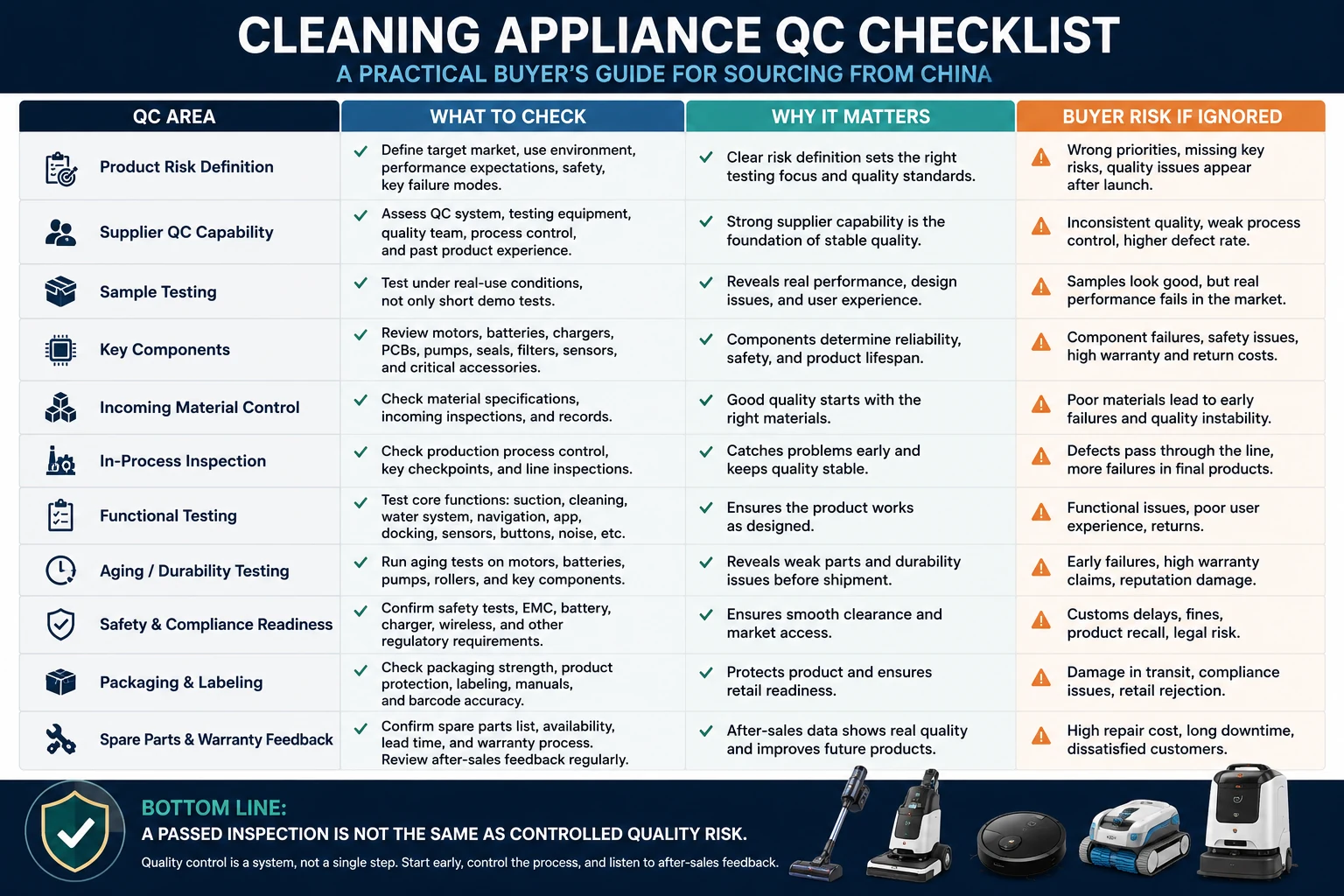
Quality Control Checklist for Cleaning Appliance Buyers
| QC Area | What to Check | Why It Matters | Buyer Risk If Ignored |
|---|---|---|---|
| Product risk definition | Target market, channel, user expectations, warranty model, key failure risks | Sets the QC priorities before sampling | Buyer may inspect the wrong things |
| Supplier QC capability | QC team, testing process, records, defect handling, category experience | Shows whether the supplier can control production quality | Supplier may rely only on final inspection |
| Sample testing | Real-use performance, not only appearance and basic function | Confirms whether the product fits the target user | Buyer may approve a product that fails in real use |
| Key components | Motors, batteries, chargers, pumps, sensors, filters, docks, seals | Components often drive performance and failure risk | Hidden component changes may create quality problems |
| Incoming material control | Checks on key parts before assembly | Prevents weak components from entering production | Defects may spread across the whole batch |
| In-process inspection | Assembly checks, functional checks, process records | Catches problems before production is complete | Defects may only appear at final inspection |
| Functional testing | Suction, water flow, docking, charging, navigation, app, or category-specific functions | Confirms product performance | Product may pass appearance checks but fail in use |
| Aging / durability testing | Repeated operation, charging, leakage, heat, runtime, or durability checks where relevant | Helps detect longer-term failure risk | Short tests may miss real-use failures |
| Safety and compliance readiness | Documents, labels, charger, battery, wireless module, target-market requirements | Supports legal sale and reduces import risk | Product may face shipment, sales, or recall issues |
| Packaging and labeling | Retail box, carton, manual, warnings, labels, accessories | Protects the product and supports user experience | Product may arrive damaged or create customer confusion |
| Pre-shipment inspection | Quantity, model, appearance, function, packaging, accessories, labels | Final check before shipment | Buyer may ship defective or incomplete goods |
| Spare parts and warranty feedback | Parts availability, warranty terms, complaint tracking, failure analysis | Reveals real product problems after sale | Buyer may repeat the same defects in future orders |
Common Quality Control Mistakes Buyers Make
The first mistake is starting QC too late. If quality control begins only at final inspection, many product risks have already been locked in.
The second mistake is trusting a good sample too much. A sample may be carefully prepared, while mass production may use different components, workers, or processes.
The third mistake is using a generic checklist for a category-specific product. Cordless vacuums, floor washers, robot vacuums, pool robots, lawn robots, and commercial robots need different QC priorities.
The fourth mistake is ignoring key components. Motors, batteries, pumps, sensors, filters, docks, chargers, seals, and firmware can decide whether the product works reliably.
The fifth mistake is treating compliance documents as paperwork. Documents should match the exact product configuration and target market.
The sixth mistake is ignoring packaging and user documentation. Poor manuals, missing warnings, weak cartons, or wrong labels can create complaints even when the product itself works.
The seventh mistake is not using after-sales feedback. Repeated customer complaints are quality data. They should guide future product changes, supplier discussions, and inspection priorities.
The biggest mistake is seeing quality control as a final gate. For cleaning appliances, QC is a full sourcing process.
How World Clean Biz Helps Buyers Reduce Quality Risk
World Clean Biz does not treat quality control as a final inspection task. For cleaning appliances, QC starts before the order: with product risk, supplier capability, sample testing, component control, and after-sales assumptions.
For cleaning appliance buyers, WCB helps evaluate product risk, supplier capability, sample quality, production readiness, category-specific QC issues, and after-sales risk before committing to a supplier or product.
This includes helping buyers understand which risks matter most in different categories, whether the supplier has relevant quality capability, whether the product is ready for the target market, and whether the buyer’s sourcing model matches the product complexity.
For broader supplier selection, read our guide on how to evaluate a Chinese cleaning appliance supplier. For sourcing model decisions, see OEM vs ODM cleaning products. Buyers who need market and category context can explore our cleaning industry reports, learn more about World Clean Biz, or follow World Clean Expo updates.
If you are sourcing cleaning appliances from China and want to reduce product quality risk before ordering, contact World Clean Biz for sourcing support.
FAQ
What is quality control for cleaning appliances sourced from China?
Quality control for cleaning appliances sourced from China means checking product risk, supplier capability, samples, components, production process, functional testing, packaging, documentation, pre-shipment inspection, spare parts, and warranty feedback.
It is not only a final inspection task. For cleaning appliances, QC should start before sample approval because many failures come from design, component choices, testing gaps, and supplier capability.
Is pre-shipment inspection enough?
No. Pre-shipment inspection is important, but it is not enough for cleaning appliances.
It can catch visible defects, missing accessories, packaging problems, and some functional failures. But it cannot fully fix weak product design, poor component choices, immature firmware, missing durability tests, or unclear after-sales responsibility.
When should buyers start quality control?
Buyers should start quality control before supplier selection and sample approval.
The first step is to define the product risk: category, target market, sales channel, price band, compliance needs, warranty model, and key failure points.
What should I check in a cleaning appliance sample?
Buyers should check real-use performance, not only appearance and basic function.
Depending on the category, this may include suction, runtime, noise, leakage, water recovery, docking, navigation, app connection, firmware stability, filtration, brush roller performance, battery behavior, waterproofing, or serviceability.
What quality risks are common in cordless vacuums and floor washers?
Cordless vacuum risks often include weak suction, battery runtime problems, noise, dust leakage, filtration issues, brush head performance, hair tangling, and charger problems.
Floor washer risks often include leakage, weak water recovery, roller cleaning problems, odor, dirty water tank design, poor self-cleaning, drying issues, battery instability, and spare parts problems.
What quality risks are common in robot vacuums and cleaning robots?
Robot vacuum risks often include navigation failure, docking problems, app instability, firmware issues, obstacle avoidance problems, mopping performance, battery behavior, and spare parts support.
Commercial cleaning robot risks include route coverage, water recovery, safety behavior, operator training, deployment support, maintenance, and service workflow.
Should I use a third-party inspection company in China?
For higher-risk cleaning appliances or larger orders, a third-party inspection company can be useful. It can help check quantity, appearance, function, packaging, labeling, and shipment readiness before goods leave the factory.
However, third-party inspection should not replace supplier evaluation, sample testing, component control, or in-process QC. It is one part of the system, not the whole system.
Can World Clean Biz help buyers reduce quality risk when sourcing cleaning appliances?
Yes. World Clean Biz helps buyers evaluate product risk, supplier capability, sample quality, production readiness, category-specific QC issues, and after-sales risk before placing orders.
The goal is to help buyers avoid choosing a product or supplier that looks acceptable at the sample stage but creates problems in mass production or after sale. If you need support, you can contact World Clean Biz.