In this article 12 sections
Floor washers and wet dry vacuums have become one of the most important categories in home cleaning appliances. They solve a real household problem: hard-floor wet mess, kitchen stains, pet dirt, dust, and daily floor maintenance that a normal vacuum or mop cannot handle well alone.
China plays a major role in this category. Many appliance brands, importers, Amazon sellers, distributors, and private label buyers look to China for floor washer manufacturers, wet dry vacuum OEM suppliers, ODM product platforms, components, tooling, and finished products.
But buyers should not choose suppliers only by FOB price, catalog photos, or marketplace listings.
Finding a floor washer supplier is not difficult. Choosing the right cleaning system, water management design, brush roller platform, battery capability, and after-sales model is much harder.
A floor washer may look simple from the outside. In reality, it is a wet-use cleaning appliance with suction, water flow, clean and dirty water tanks, brush roller cleaning, self-cleaning, drying, odor control, leakage risk, battery performance, spare parts, and warranty handling. If these systems are weak, the buyer may face returns, complaints, bad reviews, and service costs after launch.
Quick Answer
Buyers looking for floor washer manufacturers in China should evaluate supplier type, water management system, suction performance, brush roller design, clean and dirty water tank structure, self-cleaning and drying system, edge cleaning, leakage control, battery runtime, noise, spare parts, compliance readiness, and after-sales support.
The best supplier is not always the lowest-price factory. A basic wet dry vacuum, a premium floor washer, a self-cleaning model, and a retail-ready product for overseas channels require different levels of engineering, quality control, and service support.
If you need help comparing floor washer suppliers, wet dry vacuum OEM options, or cleaning appliance manufacturers in China, World Clean Biz provides cleaning product sourcing support for overseas buyers and brands.
Why Floor Washers Are Becoming a Strategic Category
Floor washers are important because they changed how many consumers think about hard-floor cleaning.
The first shift is from separate vacuuming and mopping to combined wet-and-dry cleaning. Instead of vacuuming dust first and mopping later, users expect one machine to handle dust, wet dirt, food spills, pet mess, and daily floor cleaning.
The second shift is from basic hard-floor cleaning to smarter water control and dirt detection. Better products manage water flow, suction, roller speed, dirty water recovery, and cleaning prompts more carefully.
The third shift is from simple roller washing to self-cleaning and drying. A floor washer is only convenient if users do not need to spend too much time cleaning the machine after each use. Self-cleaning, drying, odor control, and easy tank maintenance are now major product issues.
The fourth shift is from low-end private label products to differentiated platforms. Buyers now need to decide whether they want an entry-level product, a pet-focused model, a premium wet dry vacuum, a steam or hot-water direction, or a retail-ready product with better packaging and service.
The fifth shift is from hardware-only products to systems that require hygiene, consumables, spare parts, and after-sales support. Rollers, filters, water tanks, detergent, batteries, charging bases, and replacement parts can all affect the buyer’s real cost.
For more category research across cleaning appliances, buyers can explore World Clean Biz cleaning industry reports.
WCB Market Note
Floor washer sourcing is shifting from basic assembly toward cleaning-system capability. In the early stage, many buyers focused on whether a supplier could produce a wet dry vacuum at an attractive price. Today, that is not enough. A competitive floor washer depends on suction, water flow, brush roller design, tank separation, self-cleaning, drying, odor control, battery stability, spare parts, and after-sales working together.
A supplier that can produce a basic wet dry vacuum may not be able to support long-term hygiene, roller maintenance, water leakage control, odor complaints, and warranty service. This matters because floor washers create visible user feedback: streaks, dirty water residue, bad smell, weak suction, short runtime, and roller wear can quickly become customer complaints.
Buyer implication: Buyers should test the full cleaning cycle, including use, self-cleaning, drying, storage, and maintenance, not only the first cleaning demo.
Buyer implication: Buyers should avoid launching a me-too floor washer unless the product has a clear target user, cleaning scenario, price position, and service plan.
WCB View: In floor washers, the supplier choice is really a cleaning-system and after-sales risk decision, not just a purchasing decision.
What Types of Floor Washer Suppliers Exist in China?
Not every visible brand, online seller, or marketplace listing represents the actual manufacturer. Buyers must verify the real production, water system, brush roller, battery, quality-control, and engineering capability behind the product.
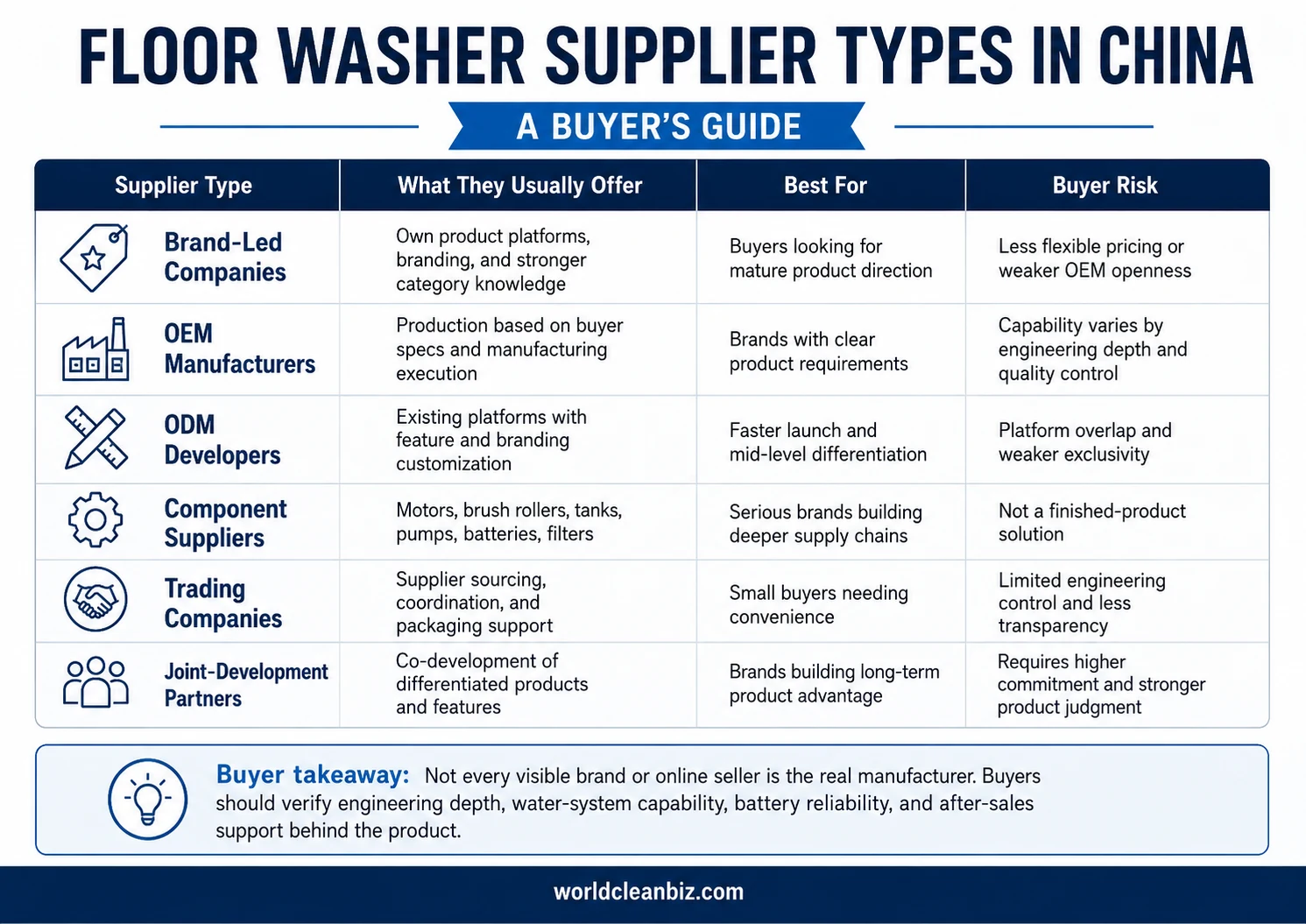
| Supplier Type | What They Usually Offer | Best For | Buyer Risk |
|---|---|---|---|
| Brand-led floor washer companies | Existing branded products, product roadmap, category experience, export knowledge | Buyers studying product direction or seeking strategic cooperation | May not offer deep OEM flexibility; brand conflict may exist |
| OEM manufacturers | Production based on buyer design, specifications, tooling, and quality standards | Established brands with clear product requirements | Higher development cost, longer timeline, stronger project management needed |
| ODM product developers | Existing floor washer platforms that can be customized | Buyers needing faster launch with moderate differentiation | Similar platforms may be sold to multiple buyers; differentiation may be limited |
| Component and module suppliers | Motors, pumps, batteries, PCBA, rollers, tanks, chargers, plastic parts | Buyers with their own engineering or lead manufacturer | Not a complete product supplier; integration risk remains |
| Trading companies and marketplace sellers | Ready-made products, lower MOQ, basic sourcing service | Small buyers testing the market | Weak technical support, unclear factory identity, limited after-sales control |
| Joint-development partners | Co-developed product platform, deeper engineering cooperation, stronger customization | Serious brands building long-term product lines | Requires product judgment, budget, testing, and close supplier management |
A trading company is not always bad, and a factory is not always good. The key is whether the supplier can support your product goal. For a simple entry-level launch, an ODM platform may be enough. For a serious brand, the buyer may need stronger control over water system design, roller structure, tooling, battery, quality testing, and after-sales parts.
Key Product Capabilities Buyers Should Evaluate
Floor washer buyers should evaluate real cleaning performance and maintenance experience, not only catalog specifications.
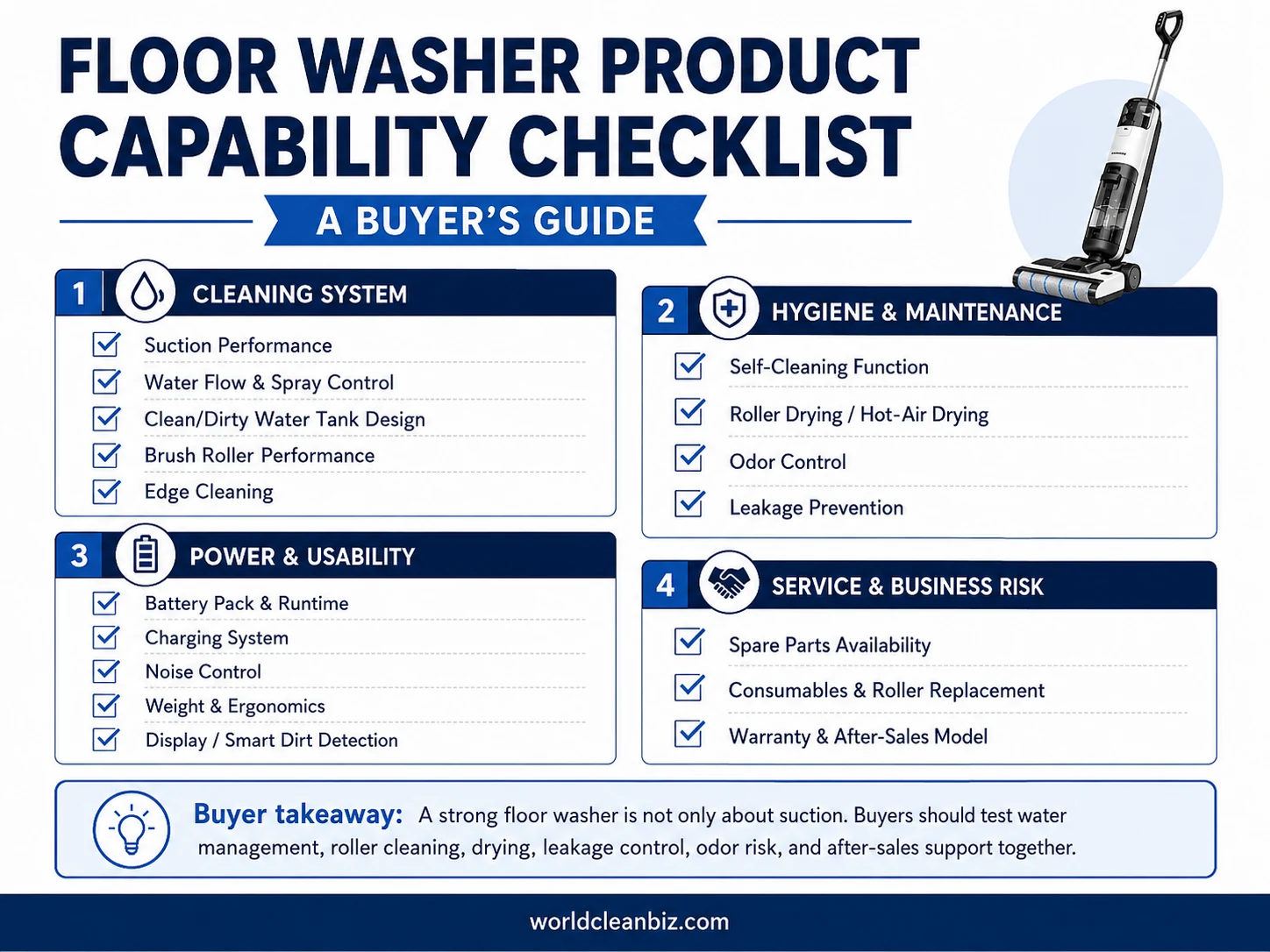
Suction performance
Suction affects dirty water recovery, floor dryness, debris pickup, and cleaning speed. Buyers should test wet dirt, dry debris, pet mess, and edge areas.
Water flow and spray control
Too little water reduces cleaning performance. Too much water may leave streaks, increase drying time, or create leakage risk. Water control should match the floor type and cleaning mode.
Clean water and dirty water tank design
Tank capacity, sealing, emptying method, cleaning convenience, and odor control all matter. A poor dirty water tank can create smell and maintenance complaints.
Solid-liquid separation if relevant
Some floor washers need to handle hair, food particles, dust, and liquid at the same time. Solid-liquid separation can affect clogging and user cleaning effort.
Brush roller performance
The roller must handle stains, hair, dust, and wet dirt without wearing out too quickly. Buyers should check roller material, cleaning pressure, replacement cost, and hair-tangle behavior.
Edge cleaning
Many users care about cleaning along walls, corners, kitchen cabinets, and furniture edges. Edge cleaning should be tested, not only claimed.
Self-cleaning function
Self-cleaning should clean the roller, internal water path, and dirty areas effectively. A weak self-cleaning system may leave odor, residue, or mold risk.
Roller drying or hot-air drying
Drying can reduce odor and bacteria growth, but it adds cost, energy use, noise, heat, and reliability requirements. Buyers should test whether drying is effective in real conditions.
Odor control
Bad smell is one of the most important user risks in floor washers. Odor can come from dirty water tanks, wet rollers, internal pipes, filters, and poor drying.
Leakage prevention
Water leakage can damage floors, packaging, reviews, and buyer trust. Buyers should test machine storage, tank sealing, tilt, transport, and long-term use.
Battery pack and runtime
Runtime should match the target home size. Buyers should also check battery safety, replacement policy, charging time, and performance decline.
Charging system
The charging base should be stable, safe, and easy to use. For products with drying or self-cleaning stations, the base becomes more important.
Noise control
Noise affects user experience, especially in apartments and family homes. Buyers should test vacuuming, self-cleaning, and drying noise.
Weight and ergonomics
A floor washer must feel easy to push, turn, lift, store, and clean. Handle angle, self-propulsion, tank weight, and balance matter.
Display, sensors, or smart dirt detection if relevant
Smart displays and dirt detection can improve user experience, but they should be accurate and useful. Extra electronics also increase cost and repair risk.
Spare parts availability
Rollers, filters, clean water tanks, dirty water tanks, batteries, charging bases, detergent, and small plastic parts must be available after launch.
Warranty and after-sales model
The supplier should explain how it handles leakage, battery claims, roller wear, tank damage, motor issues, and service claims in the buyer’s target market.
OEM vs ODM vs Private Label Floor Washers
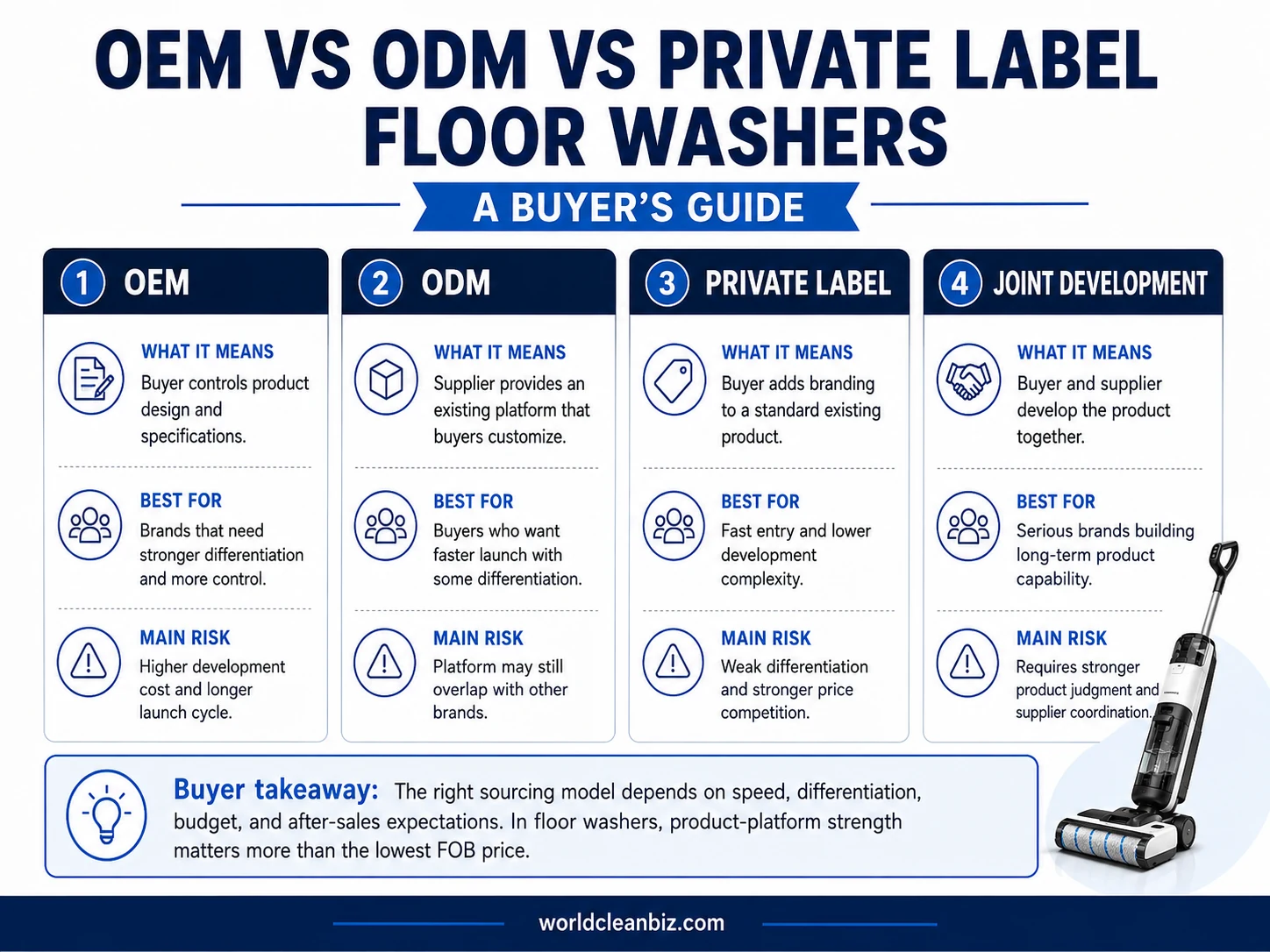
OEM means the buyer controls the product design, specifications, tooling, and often the product roadmap. The manufacturer produces according to the buyer’s requirements. This route gives the buyer stronger control, but it usually requires more time, more capital, and stronger engineering capability.
ODM means the supplier already has an existing floor washer platform. The buyer customizes design, features, branding, packaging, accessories, or price configuration. This is practical for buyers who want faster market entry but still need some differentiation.
Private label is the fastest route. The buyer selects a ready-made product, applies its own brand, and makes limited changes. It can help buyers test the category, but it often creates weak differentiation and price competition.
Joint development is the deepest model. The buyer and supplier co-develop a product platform from concept to launch. This can create a stronger long-term advantage, but it requires product judgment, testing budget, engineering communication, and project discipline.
Private label can help buyers enter the category quickly, but floor washer buyers often underestimate how quickly products become commoditized when water system design, roller cleaning, edge performance, and self-cleaning functions are not meaningfully different.
How to Evaluate a Floor Washer Manufacturer or Supplier
A serious buyer should use a structured checklist before choosing a floor washer supplier.
1. Verify the company type
Verify whether the company is a real manufacturer, brand owner, trading company, or distributor. Check business license, factory address, production lines, export history, and the relationship between the seller and the factory.
2. Check floor washer category experience
A supplier that makes general small appliances may not understand water systems, rollers, dirty water recovery, and odor control.
3. Review water system and brush roller capability
A capable supplier should explain water flow, tank design, brush roller system, and cleaning logic clearly, not only show the machine running in a short video.
4. Understand component control
Buyers should understand whether the supplier controls key components or relies fully on outside modules, and which parts are designed, sourced, assembled, or outsourced.
5. Ask for real performance test data
Ask whether the supplier can provide test data for suction, water flow, leakage, roller cleaning, drying, odor control, runtime, and noise. Ask for test methods, not only final claims.
6. Check battery safety and reliability testing
Battery quality is still important in wet-use products. Buyers should check protection systems, charging safety, and target-market requirements.
7. Confirm spare parts availability
Floor washers require more consumables and replacement parts than many buyers expect, including rollers, filters, water tanks, batteries, and charging bases.
8. Review target-market compliance readiness
Depending on the market, buyers may need to consider electrical safety, battery transportation, EMC, chemical restrictions, labeling, and product documentation. For EU products, buyers can refer to official CE marking guidance. For products with wireless functions, the U.S. market may involve FCC equipment authorization. Importers should also understand basic U.S. Customs and Border Protection importing guidance.
9. Check packaging, manuals, warranty handling, and service claims
Poor manuals and weak service processes can create high complaint rates even when the product works.
10. Confirm stable mass production capability
Check whether quality remains stable when moving from samples to mass production.
Common Mistakes Buyers Make
Many sourcing problems begin before the buyer even contacts suppliers.
Choosing only by FOB price
A lower price can hide weaker batteries, motors, rollers, tanks, pumps, plastics, testing, and after-sales support.
Treating all floor washers as similar
Two products may look similar but perform very differently in water recovery, roller cleaning, odor control, leakage, and drying.
Overtrusting catalog suction or runtime claims
Suction and runtime numbers are only useful if buyers understand the test conditions and real cleaning performance.
Ignoring water leakage and tank design
Leakage is one of the biggest risks in wet-use appliances. Buyers should test sealing, tank removal, storage, and transport.
Ignoring roller maintenance and odor problems
If users must clean the roller manually after every use, the product may lose its convenience advantage.
Ignoring self-cleaning and drying performance
Self-cleaning and drying should be tested after real dirty use, not only in clean water demonstrations.
Ignoring battery quality and safety
Battery and charging issues can create warranty claims, safety concerns, and negative reviews.
Ignoring after-sales and spare parts costs
Rollers, filters, tanks, batteries, bases, and detergent systems all affect the buyer’s real operating cost.
Choosing a supplier before defining product positioning
A buyer should know whether the product is entry-level, pet-focused, premium, compact, retail-ready, online-only, or designed for a specific hard-floor market.
Buying a me-too model too late in the product cycle
Floor washers have already become competitive. Generic products without a clear benefit often face price pressure.
The biggest risk is not only choosing the wrong supplier. It is choosing a floor washer concept that cannot compete once it reaches the market.
What Makes Floor Washer Sourcing Different From Basic Cleaning Products?
Floor washers are more complex than mops, brushes, spray cleaners, or simple small appliances.
Water system design creates leakage and hygiene risks. A product must control clean water, dirty water, internal flow, and storage safely.
Brush roller performance affects real cleaning results. Roller pressure, material, wear, hair handling, and cleaning efficiency all matter.
Dirty water tank design affects odor and maintenance. If users dislike emptying or cleaning the tank, complaints will rise.
Self-cleaning and drying systems add complexity. They improve convenience, but they also add parts, heat, noise, water flow, and reliability questions.
Battery and motor performance must remain stable under wet-use conditions. A floor washer works in a harsher environment than many dry appliances.
Spare parts and consumables matter more than many buyers expect. Rollers and filters are part of the product experience.
Customer complaints can come from odor, leakage, streaks, weak cleaning, roller wear, poor drying, or heavy handling.
Real-world testing is essential. A floor washer should be tested with kitchen stains, pet dirt, hair, dust, food particles, and different floor types.
Best Ways to Start Sourcing Floor Washers from China
A practical sourcing process should begin before supplier contact.
1. Define target market and floor type
Decide whether you are targeting hard-floor homes, pet owners, kitchens, apartments, premium users, Amazon buyers, retail channels, or distributor markets.
2. Decide product positioning and price segment
Choose whether the product is entry-level, pet-focused, lightweight, premium, steam or hot-water oriented, or designed for stronger self-cleaning.
3. Choose sourcing model
Decide whether OEM, ODM, private label, or joint development fits your budget, timeline, and differentiation needs.
4. Shortlist supplier types
Do not compare factories, trading companies, and brand sellers as if they have the same capability.
5. Request samples and test in real home conditions
Test dust, wet dirt, pet hair, kitchen stains, edge cleaning, self-cleaning, drying, tank emptying, storage, and repeated use.
6. Compare cleaning performance, not only specifications
A product with lower claimed suction may clean better if roller design and water recovery are stronger.
7. Check water system, roller, drying, odor, battery, and leakage performance
These are core product risks, not small technical details.
8. Check spare parts and after-sales support
Ask how the supplier supports rollers, filters, tanks, batteries, charging bases, warranty claims, and service issues.
9. Visit or verify the supplier if possible
Factory verification helps buyers understand production, testing, engineering, and quality systems.
10. Compare total business cost, not only FOB price
Include defect risk, returns, spare parts, warranty, packaging, compliance, shipping, and product life cycle.
How World Clean Biz Helps Buyers
World Clean Biz helps overseas buyers understand category changes, supplier capability, product opportunity, and China supply chain options before choosing suppliers.
For floor washers, this means looking beyond catalog products. Buyers need to understand whether the category is still growing in their target market, where differentiation still exists, what product platforms are worth testing, and which supplier type fits the buyer’s channel and positioning.
World Clean Biz supports buyers through product opportunity discovery, supplier screening, category intelligence, China supply chain connections, cleaning industry reports, and sourcing support. Buyers can also read our broader guide on how to find reliable cleaning product suppliers in China, compare adjacent smart cleaning categories such as robot vacuum sourcing, study cordless vacuum OEM sourcing, or review robotic pool cleaner sourcing.
To understand the platform and industry network behind this work, read more about World Clean Biz. If you follow China’s cleaning industry events and supplier ecosystem, you can also follow World Clean Expo updates.
Sourcing floor washers, wet dry vacuums, or other cleaning appliances from China? Contact World Clean Biz for sourcing support.
FAQ
Can I source floor washers from China?
Yes. China has a large floor washer and wet dry vacuum supply chain, including OEM manufacturers, ODM developers, component suppliers, private label sellers, and export-focused factories. The key is not simply finding a supplier, but verifying whether the supplier has the right water system, brush roller platform, battery capability, quality control, and after-sales support for your target market.
What is the difference between a floor washer manufacturer and a trading company?
A floor washer manufacturer usually has production capability and may control product engineering, tooling, quality testing, and assembly. A trading company may source products from different factories and manage communication, export, or small orders. A trading company can be useful for some buyers, but you should know who actually controls production, product quality, and after-sales support.
Should buyers choose OEM, ODM, or private label floor washers?
Choose OEM if you have your own design and need control. Choose ODM if you want to customize an existing product platform. Choose private label if speed matters more than differentiation. Choose joint development if you are building a serious long-term floor washer product line and can invest in product development.
What should buyers check before sourcing wet dry vacuum cleaners?
Buyers should check suction, water flow, clean and dirty water tank design, brush roller performance, self-cleaning, drying, odor control, leakage prevention, battery runtime, noise, spare parts, warranty handling, and real cleaning performance. Samples should be tested in real home conditions.
Why are water system, brush roller, and self-cleaning important in floor washer sourcing?
These areas decide whether the product actually solves the user’s cleaning problem. The water system affects cleaning and leakage. The brush roller affects stain removal, hair handling, and floor contact. Self-cleaning affects hygiene, odor, and daily convenience. Weakness in any of these areas can create complaints and returns.
What are the biggest risks when sourcing floor washers from China?
The main risks include leakage, poor dirty water tank design, weak roller cleaning, odor, short battery runtime, inflated specifications, poor self-cleaning, limited spare parts, unclear factory identity, weak quality control, and high after-sales costs. Another major risk is launching a generic product with no clear market positioning.
How do I evaluate the quality of a floor washer supplier?
Start by verifying whether the supplier is a real manufacturer, ODM developer, brand owner, or trading company. Then review its product platform, water system, roller design, test data, component control, production process, quality-control system, compliance readiness, spare parts policy, and warranty support. Do not rely only on catalog photos or sample appearance.
How can World Clean Biz help with floor washer sourcing?
World Clean Biz helps buyers understand product direction, supplier types, category timing, and sourcing risks before supplier selection. If you are evaluating floor washer manufacturers, wet dry vacuum OEM suppliers, ODM platforms, or private label options in China, you can contact World Clean Biz for sourcing support.
Before selecting a supplier, compare the six hard floor washer product opportunities by customer, channel, proof points, and after-sales economics.