In this article 13 sections
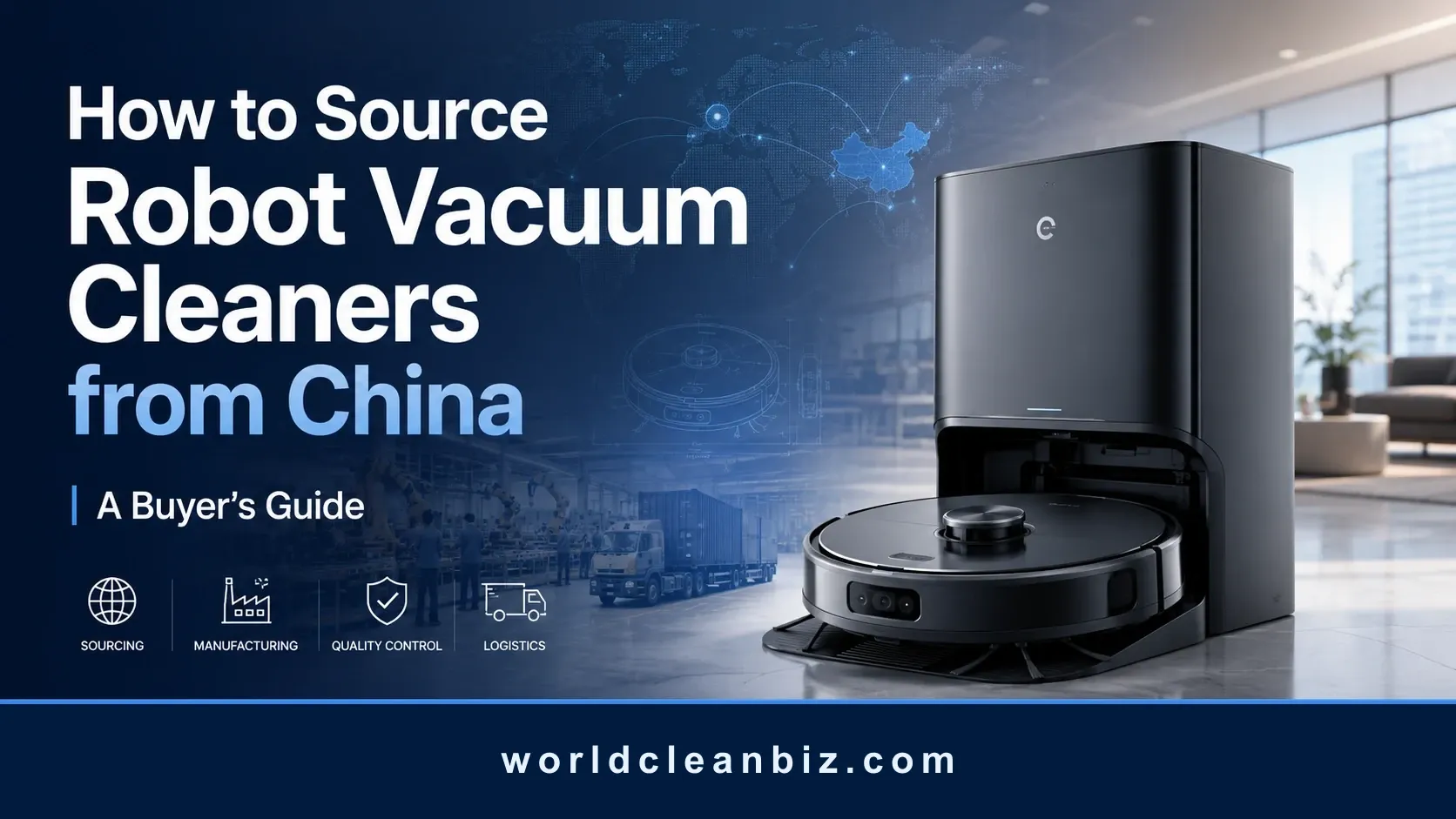
A useful robot vacuum supplier shortlist starts with the market you plan to serve, the product platform you need and the support you can provide after shipment. A catalog and a low unit price do not establish who controls the app, firmware, dock design or replacement parts.
This guide explains how to compare manufacturers, ODM platform suppliers and sourcing partners in China. It focuses on the evidence to request before ordering samples and the responsibilities to agree before production.
Quick Answer
If you want to source robot vacuum cleaners from China, evaluate more than factory price. Buyers should check supplier type, product platform, navigation capability, obstacle avoidance, suction system, mopping system, dock automation, battery performance, app control, firmware support, compliance readiness, spare parts, and after-sales service.
The best supplier depends on your target market and product positioning. A budget private label robot vacuum, a premium robot vacuum and mop, a self-emptying model, and a full self-cleaning dock system require different supplier capabilities.
If you need support comparing robot vacuum suppliers in China, you can contact World Clean Biz sourcing support.
Why Robot Vacuum Cleaners Are a Strategic Category
Robot vacuum cleaners have moved far beyond basic floor cleaning.
The first shift is from simple vacuuming to vacuum-and-mop systems. Many consumers now expect a robot vacuum to handle both dust pickup and wet mopping. This changes the product structure, water system, mop module, cleaning logic, and after-sales risk.
The second shift is from random movement to smarter navigation. Entry-level products may still use simpler movement patterns, but mid-range and premium products increasingly use LiDAR, vision, structured light, 3D sensing, or multi-sensor route planning. Buyers should understand which navigation system matches their target price segment.
The third shift is from standalone robots to dock-based systems. Self-emptying docks are now common in many markets. Higher-end models may include mop washing, drying, water refill, detergent dispensing, and dock self-cleaning.
The fourth shift is from simple suction products to cleaning systems. Suction power alone is no longer enough. Buyers must look at brush design, hair anti-tangle structure, airflow, dustbin design, mopping pressure, carpet avoidance, and how the robot handles real home layouts.
The fifth shift is from single hardware products to platform-style smart home cleaning ecosystems. A supplier may offer multiple product generations: basic robot vacuums, robot vacuum and mop products, self-emptying models, full dock systems, and app-connected products.
For buyers, this means the sourcing question is not only “Which factory can make a robot vacuum?” The better question is: “Which product platform can still compete when it reaches the market?”
WCB Market Note
Robot vacuum sourcing has moved from single-machine hardware to full system capability. A competitive product now depends on the robot body, navigation, obstacle avoidance, suction system, mopping system, dock automation, app control, firmware updates, spare parts, and after-sales model. A supplier that can assemble a robot may not be able to support the software, dock reliability, water system, OTA updates, and long-term service requirements that overseas buyers need.
This matters because robot vacuums can become outdated quickly when navigation, docking, and mopping systems improve. A private-label model may help a buyer enter the market fast, but weak differentiation and poor software support can lead to price pressure, customer complaints, and warranty costs. Buyers should judge the supplier’s product platform, not only the sample unit.
Buyer implication: Buyers should evaluate robot vacuum suppliers by platform maturity, software support, dock reliability, spare parts availability, and after-sales capability.
Buyer implication: Buyers should avoid sourcing a me-too model without checking whether its navigation, mopping, and dock system can compete in the target market.
WCB View: Robot vacuum sourcing is no longer about buying a machine; it is about choosing a complete cleaning system that can survive real user expectations.
What Types of Robot Vacuum Suppliers Exist in China?
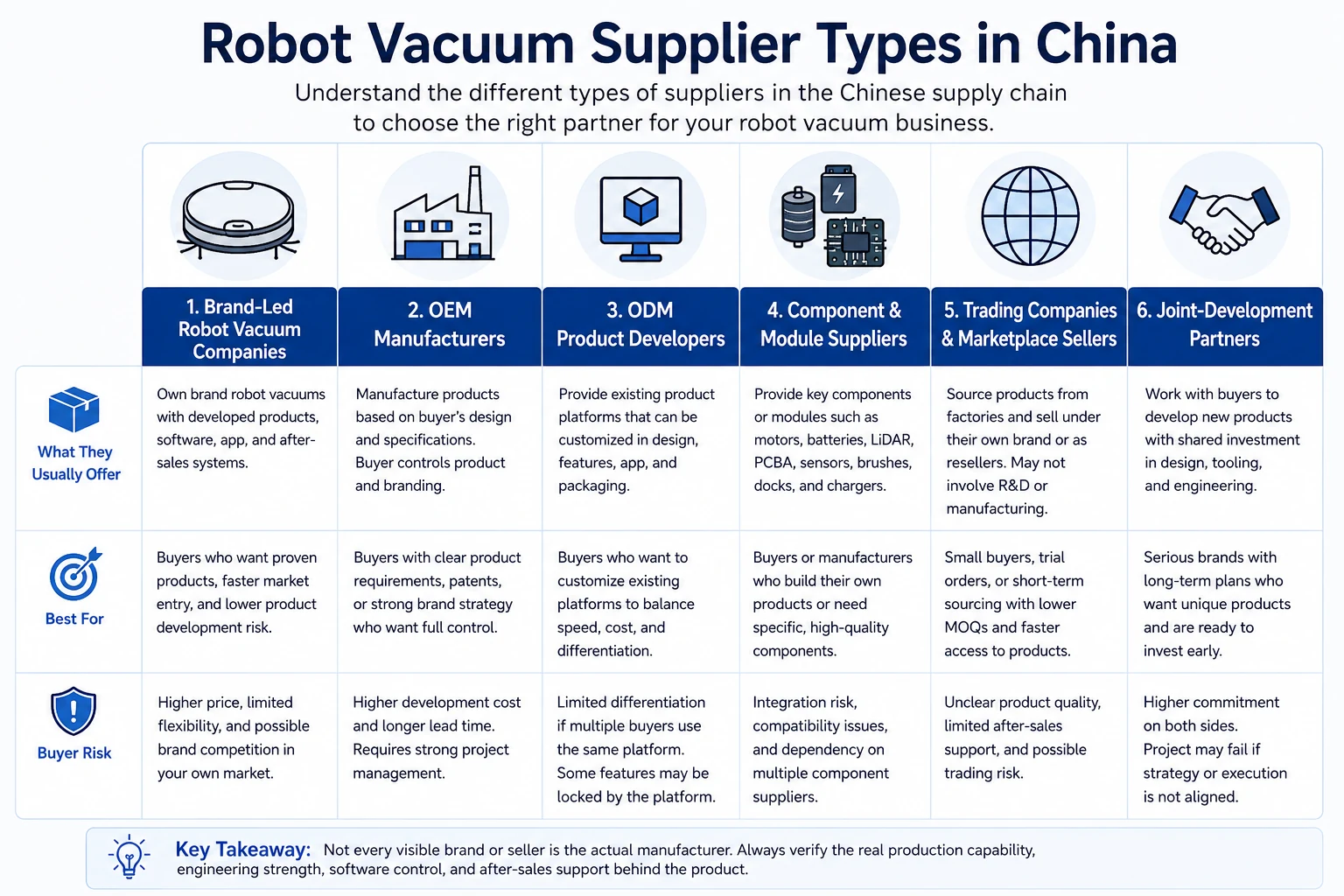
Not every visible brand, online seller, or marketplace listing represents the actual manufacturer. Some companies own brands. Some develop ODM platforms. Some assemble products. Some trade finished products. Some control software; others rely on outside modules.
Buyers must verify the real production, software, engineering, and quality-control capability behind the product.
| Supplier Type | What They Usually Offer | Best For | Buyer Risk |
|---|---|---|---|
| Brand-led robot vacuum companies | Branded product lines, product roadmap, app ecosystem, marketing materials, sometimes global sales experience | Buyers looking for proven product direction or strategic partnership | May not offer deep customization; brand conflict may exist |
| OEM manufacturers | Production based on buyer design, specifications, tooling, and quality standards | Established appliance or smart home brands with their own product plans | Longer development time, higher cost, buyer must control product definition |
| ODM product developers | Existing robot vacuum platforms that can be customized in design, features, branding, packaging, and sometimes software | Importers, distributors, and brands needing faster launch | Similar platforms may be sold to multiple buyers; differentiation may be limited |
| Component and module suppliers | Motors, fans, batteries, sensors, LiDAR modules, brushes, docks, PCBA, chargers | Brands or lead factories building custom platforms | Requires strong integration capability from buyer or main manufacturer |
| Trading companies and marketplace sellers | Product sourcing, mixed catalogs, fast quotations, flexible small orders | Early market testing or small-volume buyers | May not control engineering, software, quality, or after-sales support |
| Joint-development partners | Co-developed product architecture, engineering process, product roadmap, and testing standards | Serious brands building differentiated robot vacuum products | Requires time, technical judgment, and stronger buyer commitment |
The key is to understand who actually controls the product. Ask who owns the tooling, who writes the firmware, who maintains the app, who controls the dock design, who handles quality testing, and who supports warranty claims.
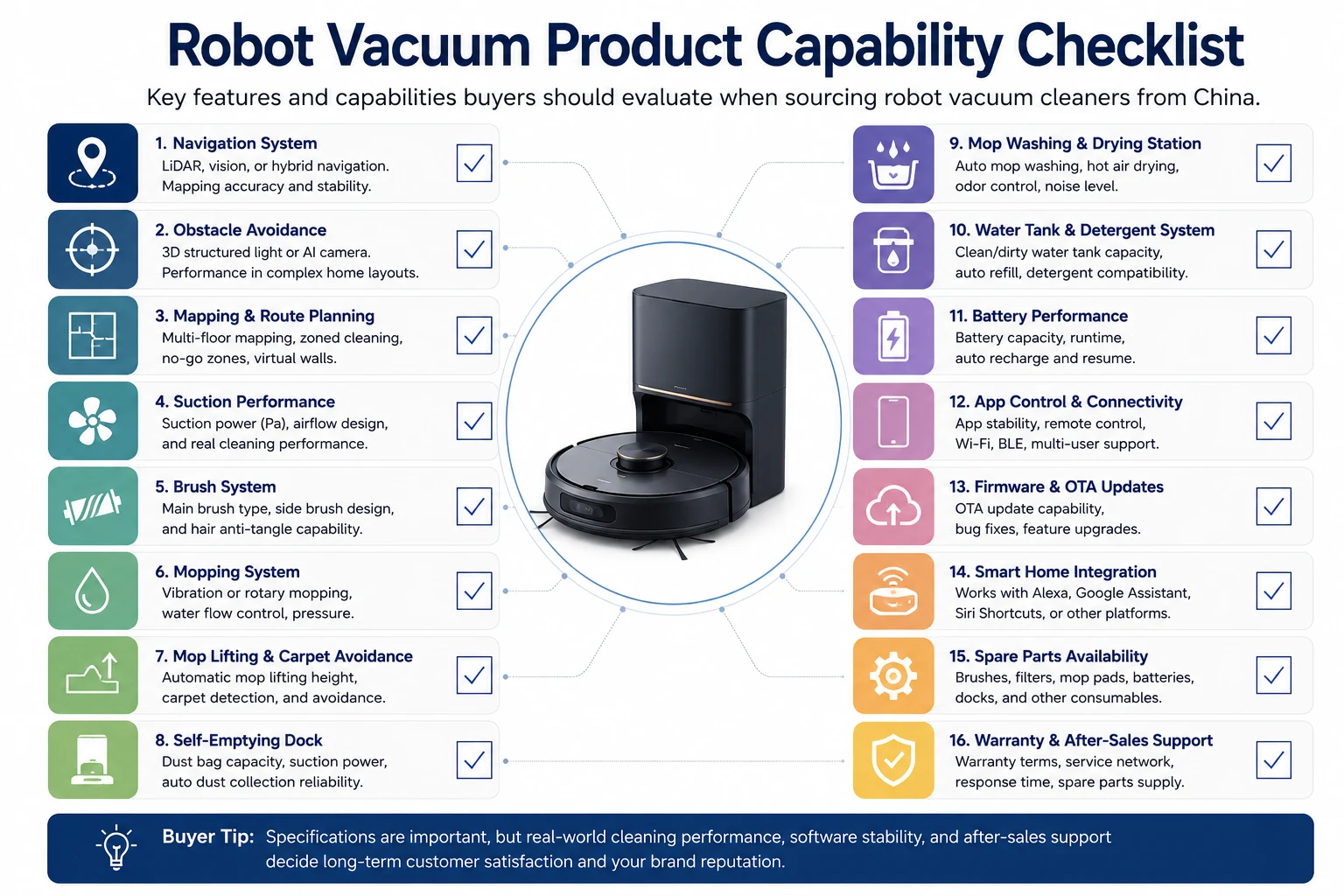
Key Product Capabilities Buyers Should Evaluate
This is the most important part of sourcing robot vacuum cleaners.
A robot vacuum may look good in photos but perform poorly in real homes. Buyers need to test how it cleans, maps, avoids obstacles, handles carpets, manages hair, returns to dock, and supports users after shipment.
Navigation System
Navigation defines how the robot understands the home.
Common systems include random movement, gyroscope navigation, LiDAR, visual navigation, structured light, 3D obstacle detection, or sensor fusion. Buyers should ask which system is used, how stable it is, and which price segment it fits.
A low-cost product does not need every sensor. But the supplier should explain the navigation logic clearly.
Obstacle Avoidance
Obstacle avoidance affects user satisfaction.
A robot that hits cables, socks, pet bowls, slippers, or furniture will create complaints. Ask whether the product uses mechanical bumpers, infrared sensors, structured light, cameras, AI recognition, or other systems.
Buyers should test obstacle avoidance in real home conditions, not only in a controlled demo.
Mapping and Route Planning
Mapping quality determines cleaning coverage.
Ask whether the robot can create maps, save multiple floors, define no-go zones, clean specific rooms, resume after charging, and avoid repeated cleaning. Poor mapping creates missed areas and user frustration.
Suction Performance
Suction power is important, but buyers should not judge only by advertised Pa numbers.
Real performance depends on airflow, motor design, dustbin structure, filter resistance, brush contact, and how suction works across hard floors and carpets.
Main Brush and Side Brush Design
Brush design affects dust pickup, hair handling, edge cleaning, and maintenance.
Buyers should evaluate:
- Main brush material
- Anti-tangle structure
- Side brush durability
- Carpet pickup
- Pet hair performance
- Replacement part availability
Hair Anti-Tangle System
Hair tangling is a common complaint in homes with pets or long hair.
Ask the supplier how the product reduces hair wrapping and whether the design has been tested against real hair conditions.
Mopping System
Robot vacuum and mop products need more than a water tank.
Check mop pressure, water flow control, mop vibration or rotation, cleaning coverage, stain removal, and whether the product avoids wetting carpets.
Mop Lifting or Carpet Avoidance
For mid-range and premium products, mop lifting or carpet avoidance can be important.
If the robot cannot manage carpets well, users may need to remove mop pads manually, which reduces convenience.
Self-Emptying Dock
Self-emptying docks reduce user maintenance, but they add complexity.
Evaluate dust transfer reliability, dock noise, bag capacity, clogging risk, replacement bags, and dust leakage.
Mop Washing and Drying Station
Higher-end robot vacuums may include mop washing and drying.
Buyers should check washing effectiveness, dirty water handling, drying performance, odor control, water leakage, pump reliability, and dock cleaning design.
Water Tank and Detergent System
If the product includes water refill or detergent dispensing, test leakage, dosing accuracy, clogging, tank cleaning, and long-term reliability.
Battery Life and Charging Time
Battery performance affects cleaning coverage.
Ask about battery cell type, runtime under real cleaning load, charging time, protection systems, battery cycle life, and replacement policy.
App Control and Connectivity
Robot vacuums depend heavily on app experience.
Check whether the app is stable, whether maps load correctly, whether firmware updates are available, and whether users can control schedules, zones, suction, water level, and room cleaning.
For connected products sold in the US, buyers may need to consider FCC equipment authorization requirements.
Firmware and OTA Update Capability
Firmware support is critical.
A supplier that cannot update firmware may not be able to fix bugs after shipment. Ask how updates are handled, how often they happen, and whether buyers can get support for software issues.
Voice Assistant and Smart Home Integration
Voice assistant or smart home integration can be useful for some markets, but it should not be added only for marketing.
Check whether integration is stable and relevant for the target market.
Spare Parts and Warranty
Robot vacuums need long-term parts support.
Ask for filters, brushes, side brushes, mop pads, wheels, batteries, dust bags, water tanks, chargers, docks, and repair parts. A supplier without a spare parts plan is risky.
OEM vs ODM vs Private Label Robot Vacuum Cleaners
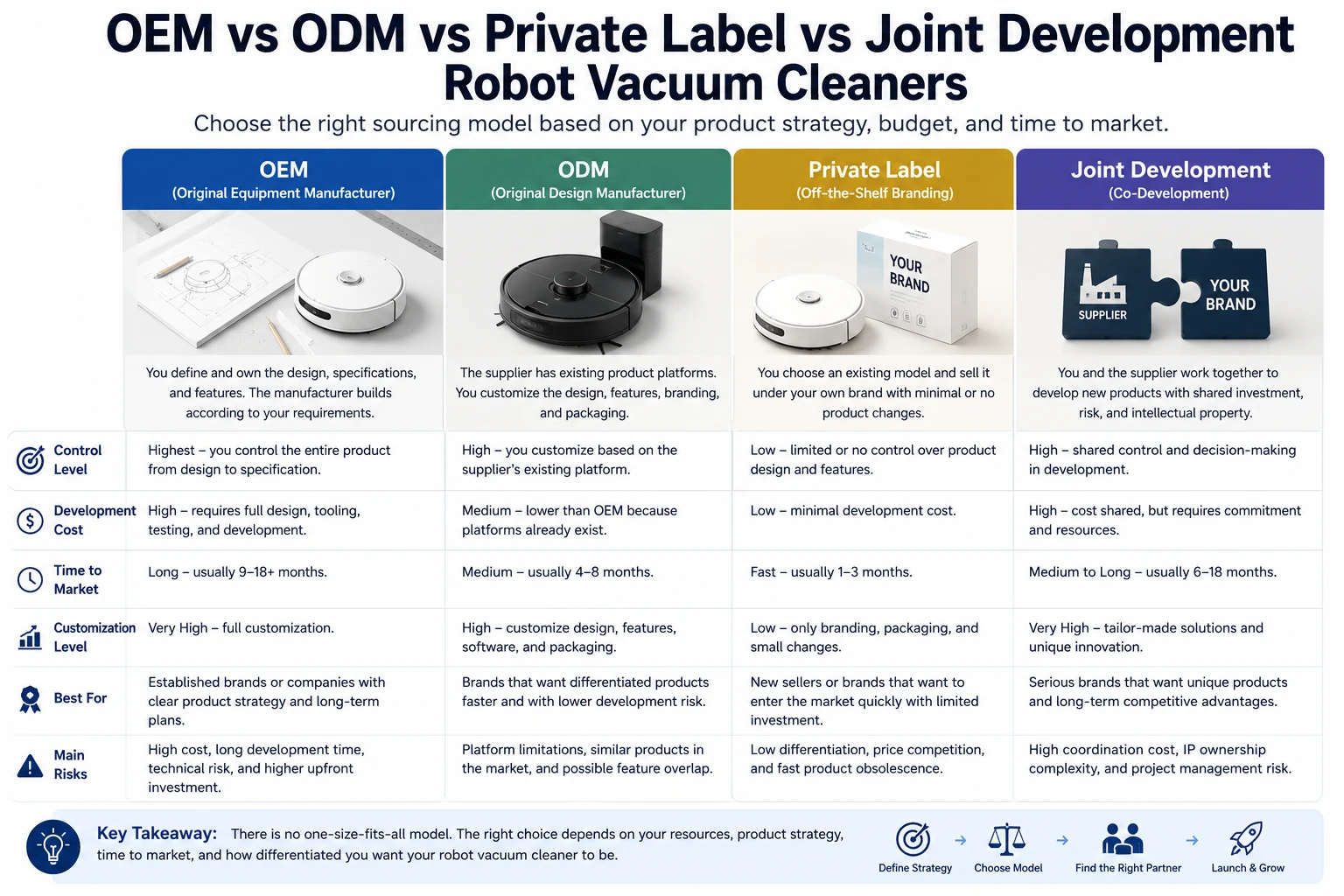
Buyers need to choose the right sourcing model before approaching suppliers.
OEM
OEM robot vacuum sourcing means the buyer controls product design, specifications, tooling, software requirements, and performance standards.
This gives the highest control, but it is slower and more expensive. It is best for established brands with product managers, engineers, and testing resources.
ODM
An ODM robot vacuum manufacturer offers an existing product platform that buyers can customize.
ODM is practical for buyers who want faster market entry while adjusting design, features, branding, packaging, accessories, and sometimes app settings.
The risk is that similar products may be sold to multiple buyers.
Private Label
Private label is the fastest route. Buyers choose an existing model, add a brand, adjust packaging, and launch.
This can work for market testing, but robot vacuum buyers often underestimate how fast products become outdated when navigation, docking, and mopping systems improve.
Joint Development
Joint development is best for serious brands that want stronger long-term differentiation.
The buyer and supplier work together on product definition, engineering, testing, software, app requirements, dock design, tooling, and product roadmap.
This model requires more effort, but it can create a product that is harder to copy.
What to Include in a Robot Vacuum Supplier RFQ
Send each shortlisted supplier the same brief so that quotations refer to comparable products. Ask for the base platform and firmware version behind the sample, and distinguish included functions from options that require further development.
| RFQ item | What to request |
|---|---|
| Target market and channel | Country, sales channel, intended retail segment and service arrangement |
| Robot and dock configuration | Navigation, mopping, carpet handling and the precise dock functions included |
| Order assumptions | Trial quantity, volume-price tiers, MOQ for branding and separate accessory minimums |
| Development charges | Tooling, packaging, app customization and certification-related work quoted separately |
| Sample acceptance | Test conditions, known limitations and a list of changes between the sample and production |
| Support after delivery | Firmware responsibility, spare-part list, service documentation and defect-handling process |
There is no single reliable MOQ or factory price for the whole category. Compare the robot vacuum manufacturing cost guide with the MOQ and hidden-cost checklist, then request an itemized quotation for the agreed configuration. For design and platform responsibilities, continue with the robot vacuum OEM/ODM guide.
How to Evaluate a Robot Vacuum Manufacturer or Supplier
Use this checklist before choosing a supplier.
- Is the company a real manufacturer, brand owner, trading company, or distributor?
Verify who owns production, tooling, engineering, software, and quality control.
- Does it have robot vacuum category experience?
A robot vacuum supplier needs experience in navigation, motors, brushes, batteries, sensors, docks, software, and after-sales service.
- Can it explain its navigation and mapping system clearly?
The supplier should explain how the robot maps, plans routes, avoids missed areas, and returns to dock.
- Does it control software, firmware, and app development?
Software dependency is high in this category. Buyers should know who maintains the app and firmware.
- Does it control key components or rely fully on outside modules?
Outsourcing is not always bad, but integration capability matters.
- Can it provide real cleaning test data for different floor types, debris types, and home layouts?
Test data should include hard floors, carpets, pet hair, fine dust, edges, obstacles, and mixed-room layouts.
- Can it support suction, mopping, dock, and battery reliability testing?
Dock functions create new failure points. Ask about long-term tests, water leakage tests, and clogging tests.
- Does it provide spare parts and after-sales support?
Without spare parts, warranty support becomes expensive and slow.
- Does it understand compliance requirements for target markets?
For EU markets, buyers should review official CE marking guidance. Compliance should not be treated as paperwork.
- Can it support packaging, manuals, warranty handling, and service claims?
Good export suppliers understand the full customer experience.
- Can it scale production without quality drops?
Ask about capacity, peak season planning, component supply, and quality control under volume pressure.
For broader supplier evaluation principles, see our guide on how to find reliable cleaning product suppliers in China.
Common Mistakes Buyers Make
Choosing Only by FOB Price
The lowest price is rarely the full cost.
For robot vacuums, the real cost includes returns, warranty claims, app problems, dock failures, battery issues, spare parts, customer support, and bad reviews.
Treating All Robot Vacuums as Similar
A basic robot vacuum, a LiDAR robot, a robot vacuum and mop, a self-emptying model, and a full dock system are not the same product.
They require different supplier capabilities.
Ignoring Software and Firmware Support
Robot vacuums are software-dependent products.
If the map fails, the app crashes, the robot cannot return to dock, or firmware bugs remain unresolved, users will blame the brand.
Overtrusting Product Photos and Catalog Specifications
Photos do not prove cleaning performance.
Ask for samples, test videos, app demos, firmware update history, and real cleaning tests.
Ignoring Real Cleaning Performance
Specifications do not always reflect results.
Buyers should test dust pickup, edge cleaning, pet hair, mopping performance, carpet handling, obstacle avoidance, route coverage, and dock reliability.
Ignoring After-Sales and Warranty Costs
After-sales cost can destroy margin.
Spare parts, replacement units, service claims, bad reviews, and software support should be considered before placing large orders.
Choosing a Supplier Before Defining Product Positioning
Do not start by asking, “Which supplier is cheapest?”
Start by asking:
- What market am I targeting?
- What price segment can I win?
- Do I need LiDAR, vision, or basic navigation?
- Do I need self-emptying or mop washing?
- What after-sales model can I support?
Buying a Me-Too Model Too Late in the Product Cycle
Robot vacuum products can become outdated quickly.
If competitors have already moved to better navigation, better docking, or better mopping, a simple private label model may struggle.
Confusing a Visible Brand or Marketplace Seller With the Actual Manufacturer
A product may appear under many names online. That does not tell you who developed it, who manufactures it, or who controls software and quality.
The biggest risk is not only choosing the wrong supplier. It is choosing a robot vacuum concept that cannot compete once it reaches the market.
What Makes Robot Vacuum Sourcing Different From Basic Cleaning Products?
Robot vacuum sourcing is harder than sourcing basic cleaning tools or simple appliances.
The first reason is software dependency. The product needs mapping, app control, firmware, and sometimes cloud or voice assistant integration.
The second reason is faster upgrade cycles. Navigation, obstacle avoidance, mopping, and dock systems improve quickly. A product can become outdated faster than buyers expect.
The third reason is system complexity. A robot vacuum includes motors, fans, brushes, wheels, sensors, batteries, PCBA, software, water systems, and docking systems.
The fourth reason is visible performance difference. Users quickly notice if the robot misses areas, gets stuck, fails to return to dock, or leaves dirt behind.
The fifth reason is higher customer complaint risk. Robot vacuums are used frequently, and users expect convenience.
The sixth reason is after-sales burden. A failed brush or filter is simple. A failed dock, firmware bug, navigation issue, or app problem is harder to solve.
This category needs real-world testing, not only catalog comparison.
Best Ways to Start Sourcing Robot Vacuum Cleaners from China
A good sourcing process should be step-based.
1. Define Target Market and Price Segment
Start with the market.
A product for budget online sellers is different from a product for retail channels, premium appliance brands, or smart home ecosystems.
2. Decide Product Positioning
Choose whether you want entry-level, mid-range, premium, self-emptying, robot vacuum and mop, or full dock system.
This decision affects navigation, sensors, dock functions, app features, packaging, warranty, and price.
3. Choose the Sourcing Model
Decide whether OEM, ODM, private label, or joint development fits your business.
Private label may be faster. Joint development may be better for serious long-term brands.
4. Shortlist Supplier Types
Do not shortlist only by catalog.
Include different supplier types: brand-led companies, ODM developers, OEM factories, component specialists, or joint-development partners.
5. Request Samples and Test in Real Home Conditions
Sample testing should happen in real homes, not only in showroom demos.
Test hard floors, carpets, pet hair, chair legs, cables, thresholds, mixed rooms, and dock return.
6. Compare Cleaning Performance, Not Only Specifications
A higher suction number does not automatically mean better cleaning.
Compare actual pickup, route coverage, edge cleaning, carpet performance, mopping results, obstacle avoidance, and dock reliability.
7. Check Software, Firmware, and App Support
Ask who develops the app, who maintains firmware, how OTA updates work, and how bugs are handled after shipment.
8. Check After-Sales and Spare Parts Support
Before ordering, ask for spare parts lists, warranty procedures, repair guidance, and service claim handling.
9. Visit or Verify the Supplier if Possible
A factory visit or third-party audit can help verify production capability, software team, testing process, quality control, and engineering depth.
10. Compare Total Business Cost, Not Only FOB Price
Include returns, warranty, freight, spare parts, service claims, software support, customer reviews, and brand risk.
If you need help comparing sourcing options, World Clean Biz can support supplier screening through our sourcing service.
How World Clean Biz Helps Buyers
World Clean Biz helps buyers understand category changes, supplier capability, product opportunity, and China supply chain options before choosing suppliers.
We do not treat robot vacuum sourcing as a supplier list problem.
A serious buyer needs to understand which product direction is still attractive, which supplier type fits the business model, which features are becoming standard, which risks may appear after shipment, and which products are too late, too similar, or too risky.
World Clean Biz helps with product opportunity discovery, supplier screening, category intelligence, China supply chain connections, cleaning industry reports, and sourcing support.
For more category research, explore our cleaning industry reports. To understand the people and industry network behind this platform, read more about World Clean Biz. If you follow China’s cleaning industry events and supplier ecosystem, you can also follow World Clean Expo updates.
You may also find our related guide on robotic pool cleaner manufacturers in China useful if you are comparing indoor and outdoor cleaning robot categories.
Sourcing robot vacuum cleaners, robot vacuum and mop products, or other smart cleaning appliances from China? Contact World Clean Biz for sourcing support.
FAQ
Can I source robot vacuum cleaners from China?
Yes. China has robot vacuum suppliers, brand-led companies, ODM developers, OEM manufacturers, component suppliers, and trading companies. Buyers should verify whether the company they contact has real manufacturing, software, engineering, and quality-control capability.
What is the difference between a robot vacuum manufacturer and a trading company?
A manufacturer usually controls production, engineering, testing, tooling, or software development. A trading company may source products from different factories and handle sales. Trading companies can be useful, but buyers should know who controls quality, firmware, and after-sales support.
Should buyers choose OEM, ODM, or private label robot vacuum cleaners?
It depends on the buyer’s goal. OEM is better for brands with strong product specifications. ODM is faster for buyers who want an existing platform with customization. Private label is fastest but usually has weaker differentiation. Joint development is often better for serious long-term brands.
What should buyers check before sourcing robot vacuum and mop products?
Buyers should check navigation, obstacle avoidance, suction, mopping system, mop lifting or carpet avoidance, dock functions, app control, firmware support, battery performance, spare parts, and warranty support.
Why is software support important for robot vacuum sourcing?
Robot vacuums depend on mapping, route planning, app control, firmware, dock behavior, and sometimes cloud services. If software support is weak, users may face app crashes, map errors, poor dock return, or unresolved bugs.
What are the biggest risks when sourcing robot vacuum cleaners from China?
The biggest risks include weak navigation, poor obstacle avoidance, unreliable mopping, dock failure, battery issues, poor app support, limited spare parts, unclear compliance, high return rates, and choosing a product concept that is already outdated.
How do I evaluate the quality of a robot vacuum supplier?
Evaluate category experience, real manufacturing capability, navigation explanation, software and firmware control, cleaning test data, dock reliability tests, spare parts support, compliance readiness, quality-control process, and ability to scale production.
How can World Clean Biz help with robot vacuum cleaner sourcing?
World Clean Biz helps buyers understand product trends, evaluate supplier types, compare sourcing models, and identify risks before choosing suppliers. If you need support, contact World Clean Biz for robot vacuum cleaner sourcing help.
Before selecting a supplier, compare the six robot vacuum product opportunities by household problem, channel, technical proof, and service economics.