- Dyson used Cyclone and high-speed brushless motors to reshape vacuum cleaners and hair dryers.
- Chinese suppliers turned brushless motors from premium technology into scalable industrial capability.
- Brand leadership in cleaning appliances is increasingly built on supply-chain leadership.
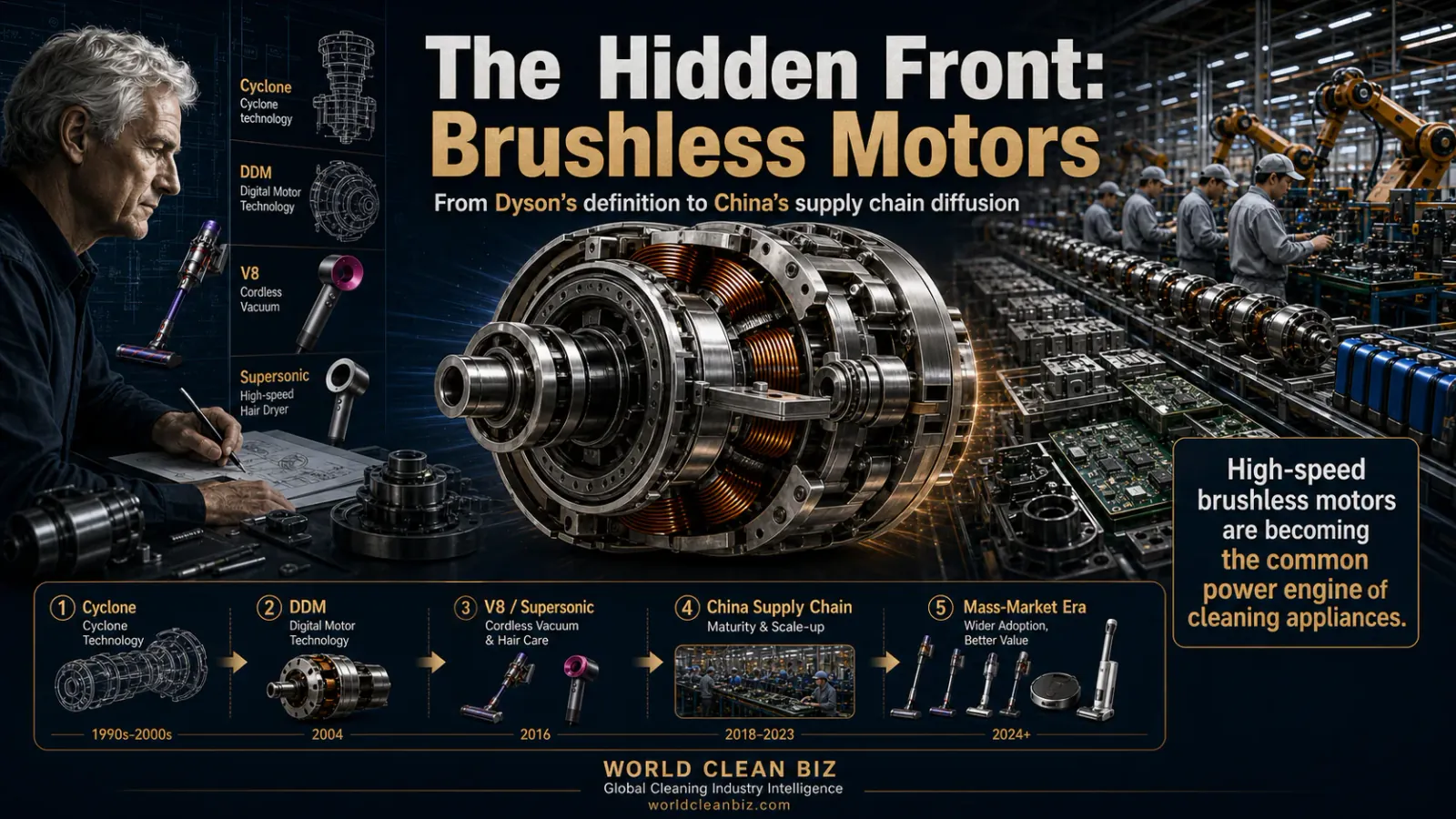
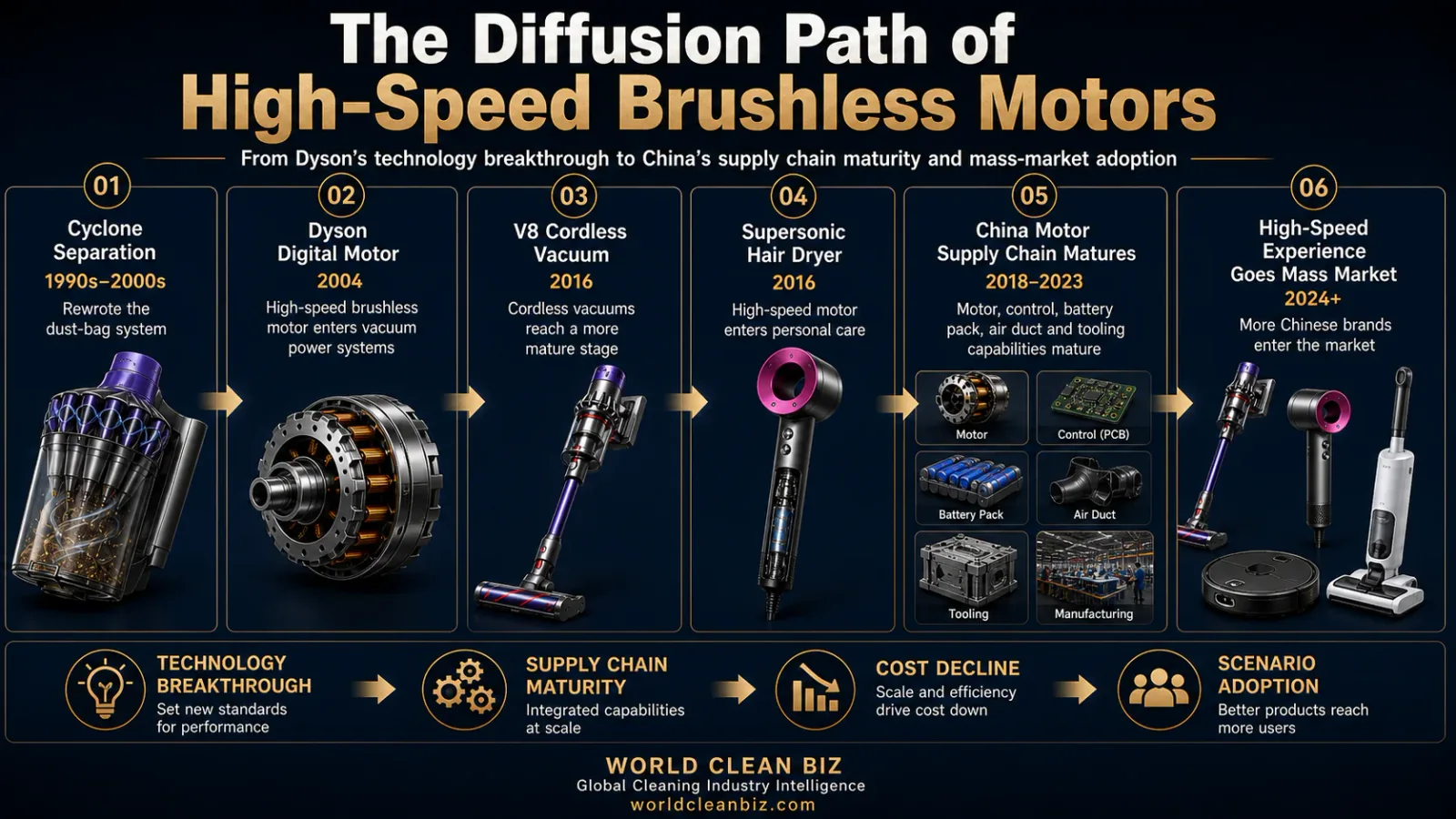
Dyson changed the vacuum cleaner industry twice.
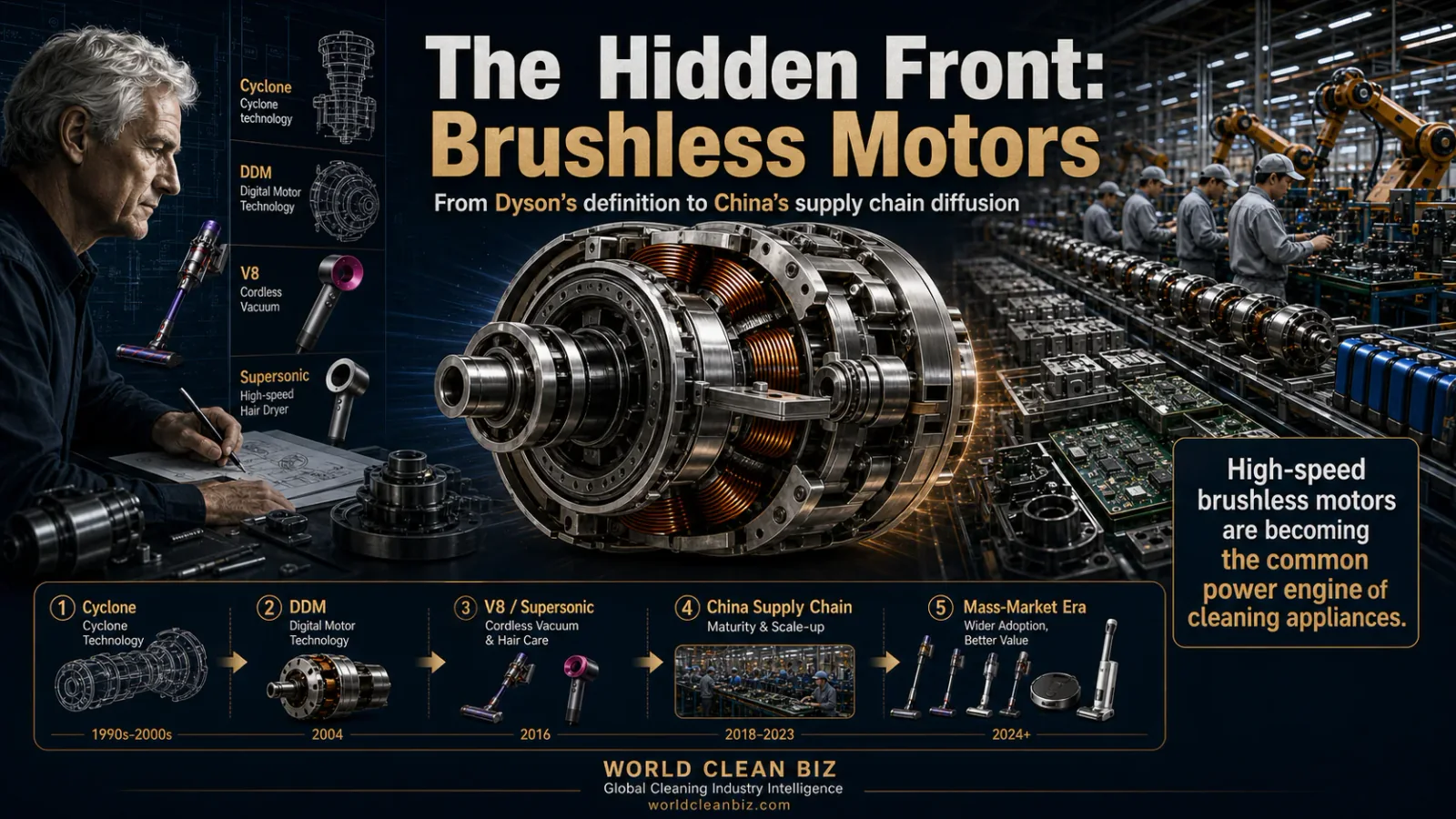
The first time was with Cyclone technology. Before that, the vacuum cleaner business had revolved around dust bags for decades. Dust was collected in a bag, suction weakened as the bag clogged, and users had to replace consumables regularly. When James Dyson turned cyclonic separation into a consumer product, the vacuum cleaner was freed from the dust bag. A structure that had defined the industry for nearly a century was broken open, and Dyson became a premium vacuum brand.
The second change came from high-speed brushless motors.
Dyson Digital Motor, or DDM, rebuilt the power system of the vacuum cleaner. By the time the Dyson V8 arrived, cordless vacuums had made clear progress in suction, battery life and overall product maturity. A vacuum cleaner no longer had to mean a canister body, a long hose, a power cord and a heavy machine. It could become a handheld device that users could pick up at any time, with strong suction generated by a high-speed motor.
In 2016, Dyson launched the Supersonic hair dryer and placed a high-speed brushless motor inside the handle. Traditional hair dryers were often bulky, relying on large barrels and heating wires. Supersonic changed the weight, airflow, shape and user experience of the product.
After cordless vacuums and high-speed hair dryers emerged, Dyson’s position also changed. It was no longer just a niche premium vacuum brand. It became closer to Apple in consumer electronics: expensive, clearly defined in product form, strongly associated with technology, and capable of turning an otherwise unglamorous home appliance into a premium product that mass consumers were willing to discuss and buy.
This route gave Dyson a long period of growth.
In China, Dyson long held a benchmark position in premium cordless vacuums and high-speed hair dryers. For many consumers, Dyson was their first real exposure to these two categories. Its high prices did not stop expansion. They reinforced its technology image in the premium market.
For Dyson, DDM was not just a component. It became a product language. Vacuums, hair dryers, air purifiers and personal care products all extended from the same high-speed motor capability.
In recent years, that position has started to loosen.
Dyson’s 2024 financial statement noted that although unit sales reached a record high, revenue was lower than the previous year. In 2025, Dyson’s revenue fell further to £6.13 billion, down from £6.57 billion in 2024. The Guardian reported that Dyson’s 2024 pre-tax profit dropped 47% to £561 million.
For a company that had long relied on technology premium and high-end positioning, these numbers were striking. Chinese brands were no longer entering only through lower prices. Their growing maturity in brushless motors, motor control, battery packs, air ducts, tooling and final assembly began to narrow the space Dyson had built through technology leadership.
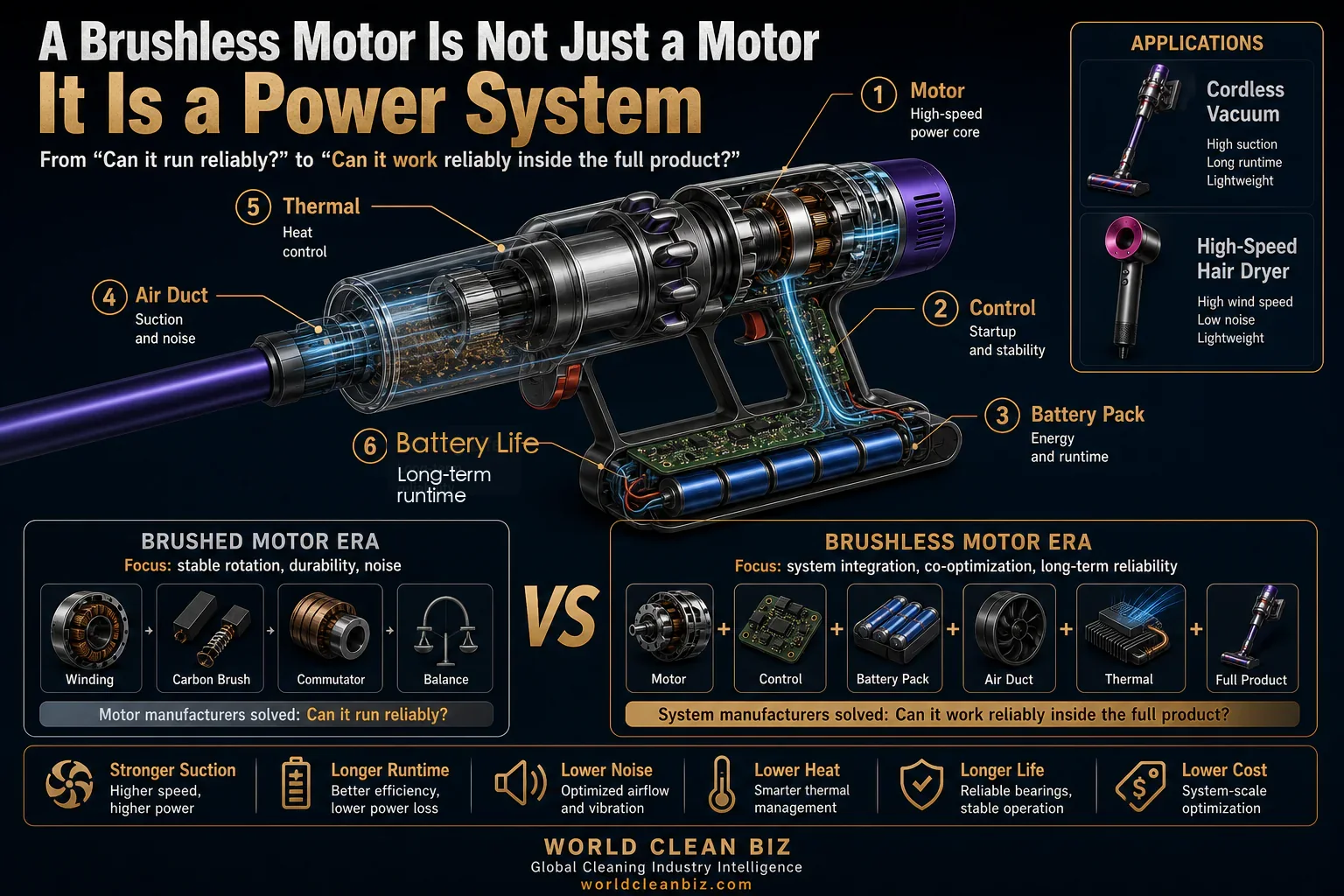
In the brushed motor era, vacuum motors were closer to a mechanical manufacturing business. Motor suppliers focused on winding, assembly, dynamic balancing, carbon brushes, commutators and batch consistency. A customer gave a specification; the supplier built a motor; if it ran steadily when powered on, with acceptable noise and lifetime, much of the job was done.
Brushless motors made the work more complicated.
In the brushed motor era, the main question was whether the motor could run reliably. In the brushless motor era, the question became whether it could run reliably inside the complete appliance. The motor now had to work with the battery, control board, air duct, heat dissipation and noise system. Many issues that motor factories had not previously faced directly became part of the job.
When a cordless vacuum is switched to high power, the user only feels suction rise instantly. The supplier has to think about much more: whether battery voltage will sag, whether the motor will shake during startup, whether the air duct will whistle, whether heat can be controlled during continuous use, and whether battery life can remain stable under high-speed operation.
For many early motor factories, the difficulty was not making the motor body. It was making that motor work reliably inside a finished product. Appliance makers were not asking for a standalone motor; they needed a power system that could survive real use.
After the motor was built, suppliers also had to avoid Dyson’s patent territory. In the early days, many companies did not dare to touch certain high-speed brushless motor structures and solutions directly. To enter mass production, they had to find alternative structures, control methods and system designs.
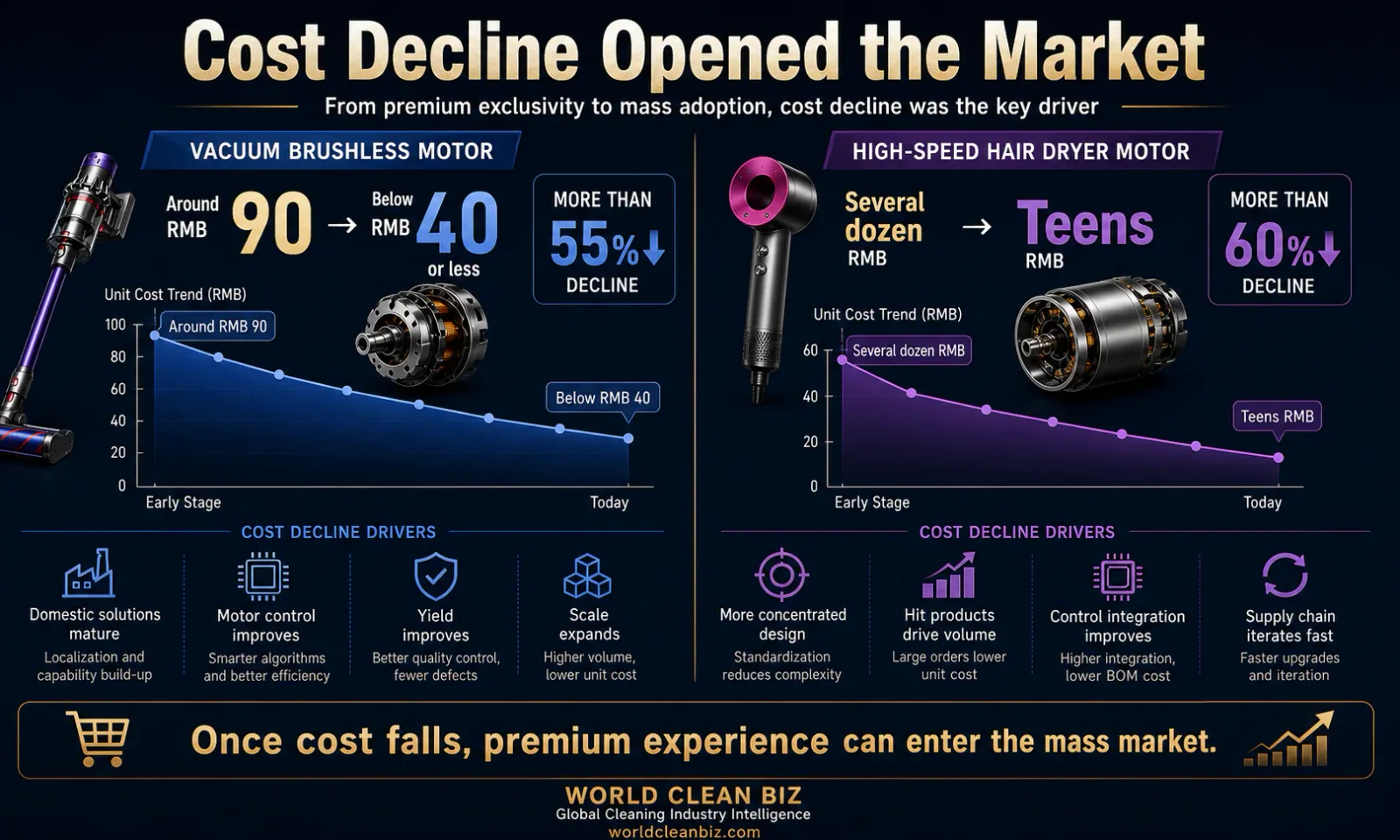
Cost then determined whether the technology could spread. People in the supply chain recall that an early brushless motor for a vacuum cleaner cost nearly RMB 90. As domestic solutions matured, yield improved, materials were optimized and scale increased, the price for a comparable configuration gradually fell below RMB 40. Only after motor prices came down could cordless vacuums move from premium products into broader price bands.
Cinderson — 星德胜 — moved to the front of the stage in this cycle.
Its founder, Zhu Yunfang, came from the vacuum motor industry. According to the company’s annual report, Zhu joined Suzhou Chunhua Vacuum Cleaner Factory in 1990 and later worked at the motor division of Suzhou Kingclean Electric. In 2004, he founded the predecessor of Cinderson.
Zhu’s career tracks closely with Suzhou’s vacuum cleaner industrial cluster. Chunhua, Kingclean, Ecovacs, Aipu and Midea, along with many suppliers, formed a dense cleaning appliance manufacturing network in the Yangtze River Delta. Cinderson did not suddenly enter the cleaning appliance supply chain. It grew out of that network.
When cordless vacuums began to scale, Cinderson’s early investment in brushless motors started to pay off.
Cinderson’s 2025 annual report shows that revenue reached RMB 2.573 billion, up 4.84% year on year, while net profit attributable to shareholders was RMB 174 million, down 12.56%. The more important change was in its product mix. In 2025, revenue from DC brushless motors reached RMB 1.081 billion, up 20.27%, with sales volume of 23.2135 million units, up 35.98%. In the same period, revenue from AC series motors fell 10.01% to RMB 1.128 billion.
Traditional motors still had scale, but the fastest growth had shifted to DC brushless motors.
Cinderson benefited from the cordless vacuum cycle. It invested in brushless motors early, achieved mass production early, and entered the supplier systems of Shark, Bissell, TTI, Xiaomi, Ecovacs, Roborock, Narwal, Dyson, Kärcher and other domestic and international customers. As cordless vacuums scaled, those early capabilities turned into revenue, profit and eventually a path to listing.
The same surge in demand also pushed a motor factory in Daishan, Zhoushan, into a more visible position.
Changguang Motor is based in Daishan, Zhoushan. Zhoushan is an island city. In earlier years, moving in and out often depended on boats. For a motor factory, that meant raw materials, components, customer visits and finished goods delivery were all more difficult than in core manufacturing cities in the Yangtze River Delta.
Its founder, Wu Yongkuan, also came step by step from motor manufacturing. Public prospectus materials show that he had been running motor-related businesses for many years before founding Changguang Motor. This kind of company has little consumer-brand story. Its history is more about manufacturing, customers and delivery.
As demand for cordless vacuums expanded rapidly, leading motor suppliers could not cover every customer. Appliance makers also needed second and third suppliers to reduce delivery and pricing risks. Changguang Motor captured part of that brushless motor demand and entered the capital market in 2026.
While brushless motors were still spreading through vacuum cleaners, a similar shift was already taking place in hair dryers.
Dyson Supersonic brought the high-speed brushless motor into hair dryers, and Chinese suppliers began to follow. One representative company was Shenzhen Zhongqu.
One detail often mentioned in the industry is that Zhongqu’s founder, Mr. Kuang, started again in his fifties. He had lost a lot of money before finally catching the high-speed hair dryer cycle. Stories like this are common in China’s supply chain. Many engineering founders do not emerge from a new concept. They wait through years of trials, losses and small projects until the right product cycle arrives.
For Zhongqu, the high-speed hair dryer was that window.
Supply chain sources generally believe that Zhongqu was among the earlier companies to work around Dyson’s patents in high-speed hair dryer motors, while continuing to improve its motor and control solutions. The early success of Laifen was not only about branding, design and channels. It also depended on a mature high-speed motor supply solution.
Laifen pushed the high-speed hair dryer from a Dyson-defined premium product into a more mass-market price band. Zhongqu provided key motor capability behind the product. Later, Zhongqu came to cover a large number of high-speed hair dryer customers. Some people in the supply chain also say it has entered a broader group of leading customer systems.
Compared with vacuum motors, hair dryer motors became cheaper faster.
Vacuum motors have many specifications. Different suction levels, battery voltages, air duct structures and product positions all require different solutions. It is difficult for a single specification to scale quickly.
Hair dryers are more concentrated. Their core specifications are more standardized. Once a hit product appears, a single solution can scale rapidly. Suppliers can repeatedly optimize similar motor, impeller, control board, housing and assembly designs.
That is why the cost of high-speed hair dryer motor solutions dropped so quickly. Early solutions costing several dozen yuan later fell to the teens. Once the motor cost came down, the final product price followed. The high-speed hair dryer moved from a Dyson premium product into a category where many Chinese brands could participate.
The maturity of brushless motors benefited more than traditional motor factories. A group of Shenzhen cross-border e-commerce companies also gained the tools to reshape the landscape for small and mid-sized firms.
In the past, products such as vacuum cleaners and hair dryers depended more heavily on major brands, major channels and traditional manufacturing systems. Once high-speed brushless motor solutions matured, smaller brands could call on ready-made supply chain solutions, then reach users through Amazon, independent websites, TikTok, domestic livestreaming platforms and content channels. They did not necessarily control the deepest technologies, but they could combine mature motor solutions, industrial design, price positioning and channel tactics.
Small companies that once had little chance of challenging Dyson suddenly had tools to enter the premium-experience market.
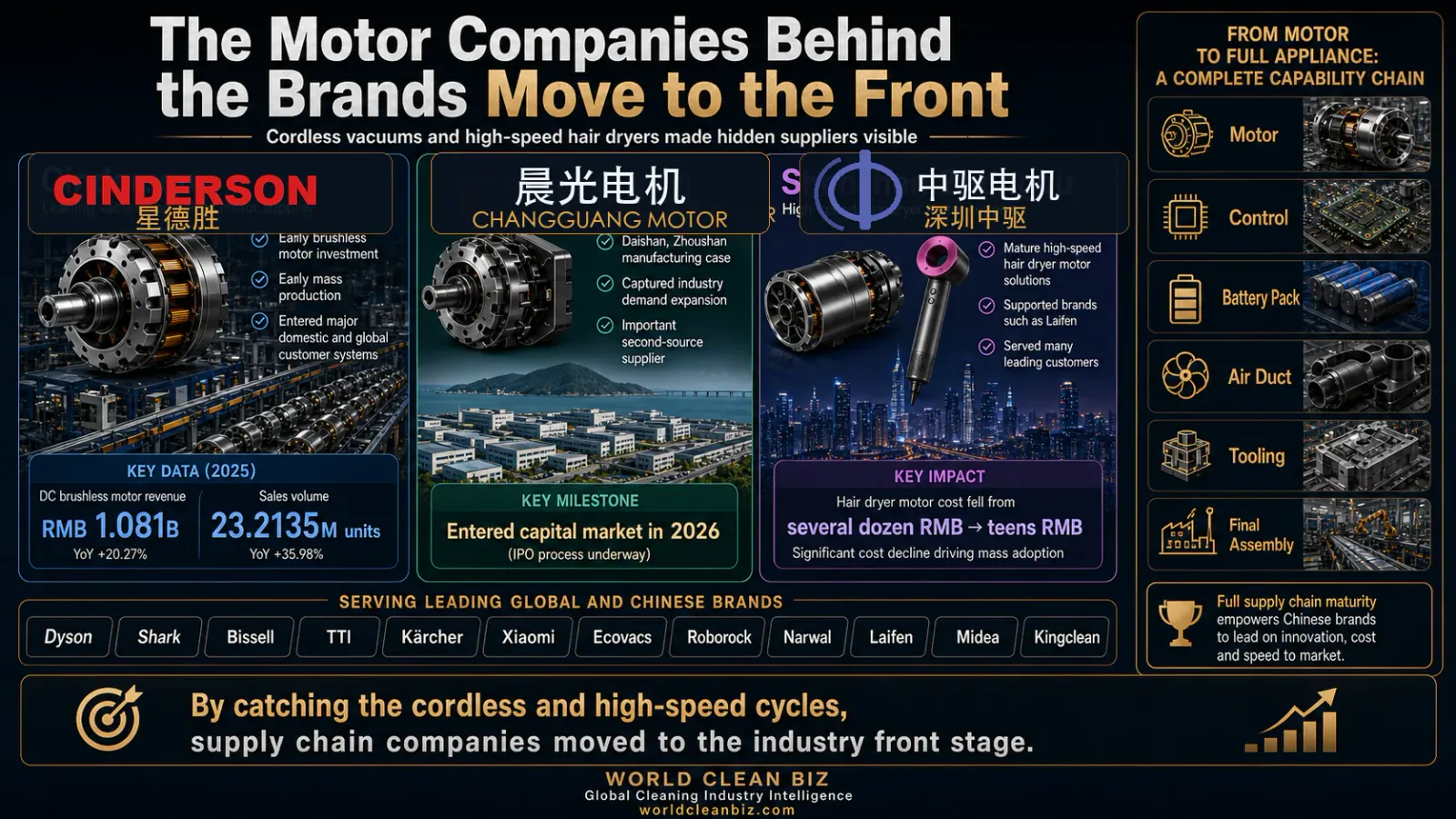
The timeline shows how this technology route spread. Dyson used high-speed brushless motors to push the V8 and Supersonic. Cinderson and Changguang Motor benefited from the cordless vacuum cycle. Zhongqu and Laifen brought high-speed hair dryers into mass-market price bands. After 2024, motor companies that had long sat behind the brands began appearing in the capital market.
Now the story has started to turn back on itself.
Dyson moved production from the United Kingdom to Malaysia years ago. The first Dyson Digital Motor was manufactured in Singapore. Today, from final assembly to key components, Chinese suppliers are entering more parts of the chain.
Dyson, once the company that defined the category through high-speed brushless motors, is also beginning to look for new product capabilities from China’s cleaning supply chain.
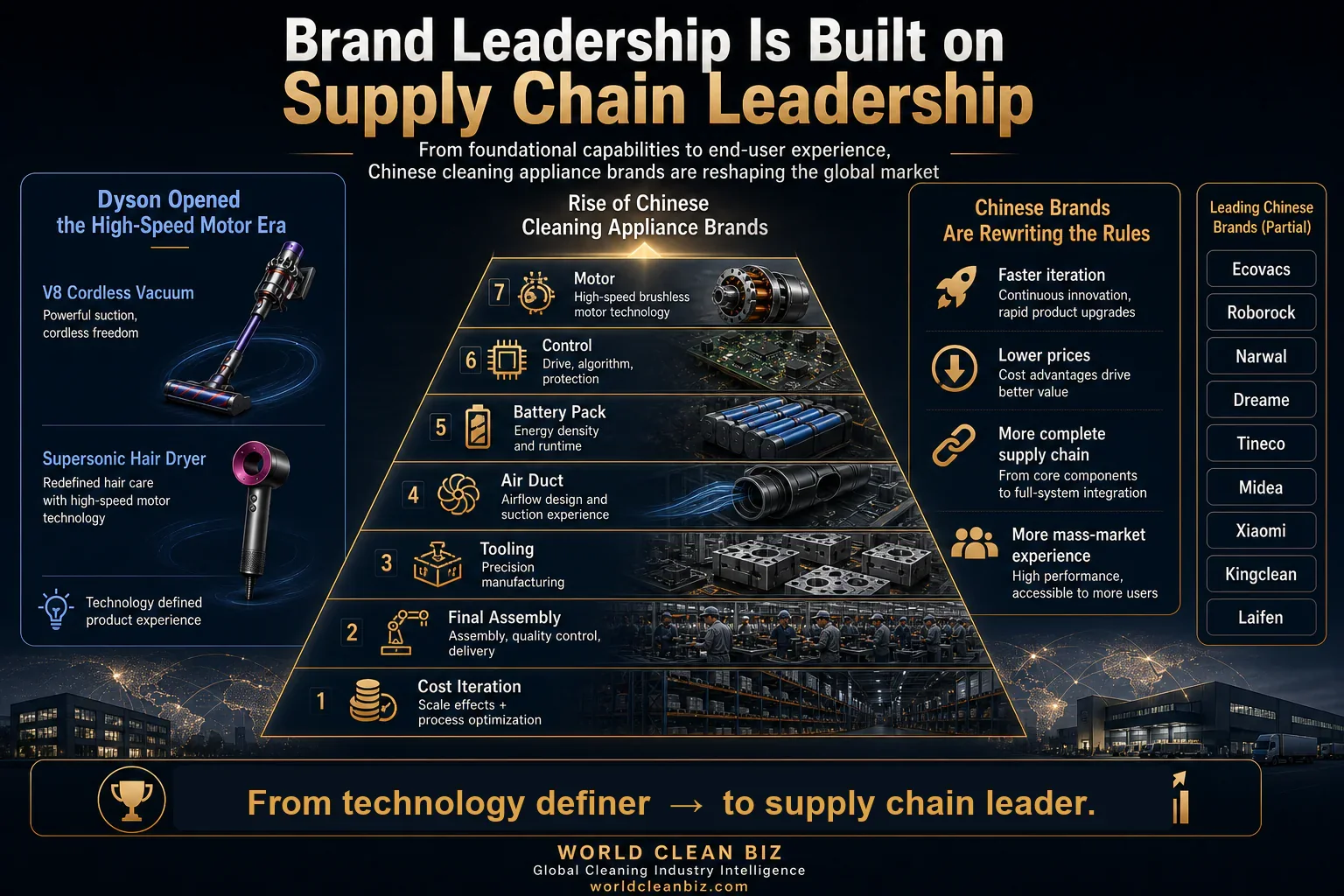
The rise of Chinese cleaning appliance brands in recent years certainly has something to do with marketing, channels and product definition. But if one only looks at the consumer brands, it is easy to miss the deeper change: motors, motor control, battery packs, air ducts, tooling, final assembly and cost iteration have all become mature capabilities inside China’s supply chain.
Brand-level leadership is ultimately built on supply-chain leadership.