In this article 17 sections
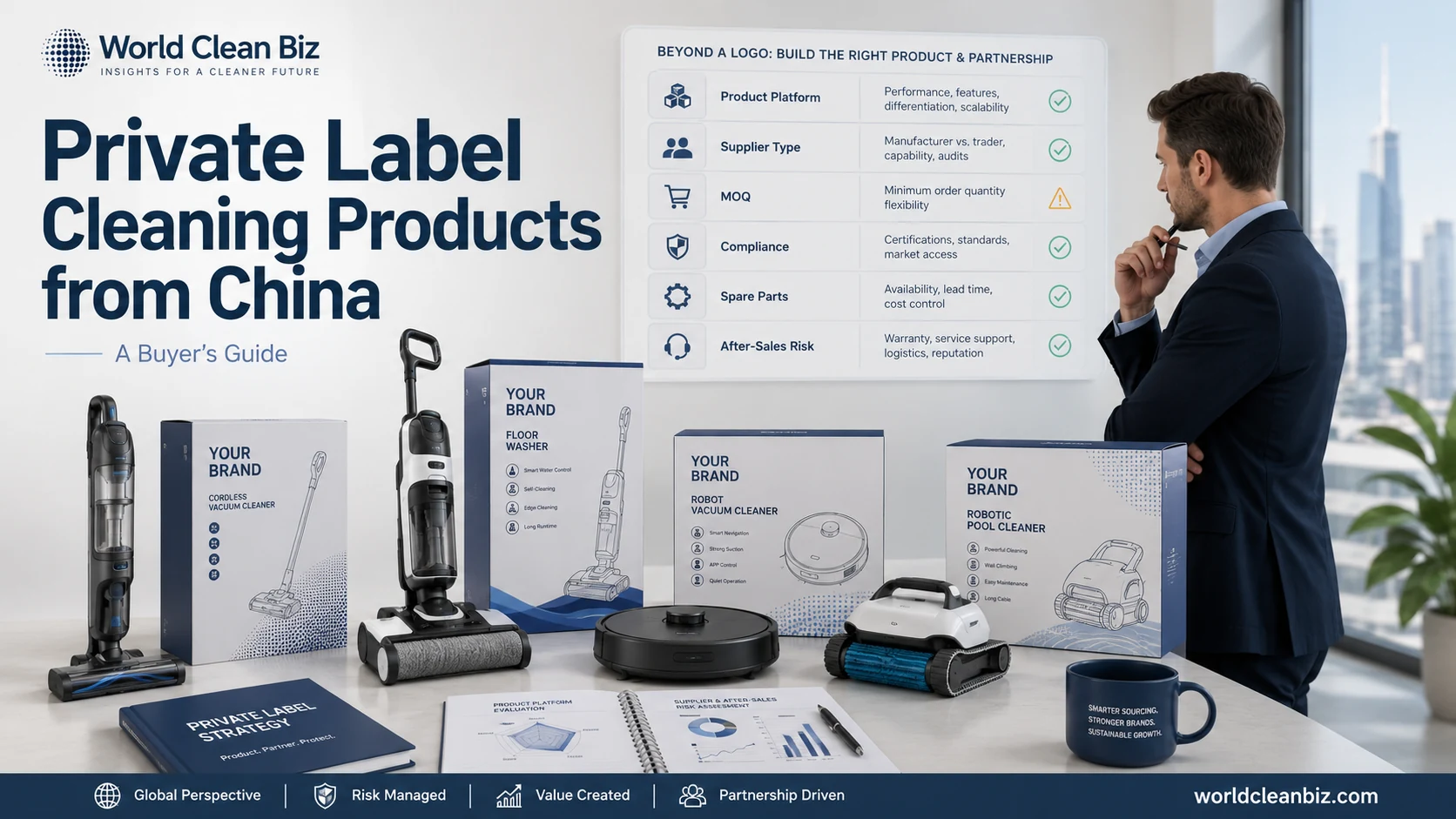
Private label cleaning products from China can help overseas buyers enter the market faster. Instead of developing a product from zero, buyers can use an existing product platform, apply their own branding, customize packaging, and launch through retail, distribution, Amazon, online marketplaces, or other sales channels.
But private label is not just about putting a logo on an existing product.
For simple cleaning tools, private label may be mostly about packaging, color, branding, and basic quality control. For cleaning appliances, the risk is much higher. A private label cordless vacuum, floor washer, robot vacuum, robotic pool cleaner, robotic lawn mower, or commercial cleaning robot carries the supplier’s product quality, component choices, compliance readiness, spare parts policy, and after-sales burden.
Private label can be a good first step. It can also become a trap if buyers choose a product that looks easy to launch but cannot compete, cannot pass compliance checks, or creates warranty problems after sale.
The key question is not “Can I put my brand on this product?”
The real question is:
Does this private label product fit my category, target market, sales channel, price band, compliance requirements, and after-sales model?
Quick Answer
Private label cleaning products from China can make sense when buyers want faster market entry, lower development cost, and a way to test product demand before investing in full OEM development or joint development.
But buyers should not evaluate private label only by logo options, MOQ, packaging, or FOB price. In cleaning appliances, buyers need to check the supplier’s base model, supplier type, category fit, customization limits, compliance readiness, spare parts support, warranty responsibility, and how widely the same product is sold to other buyers.
Private label is often faster than OEM, but it does not automatically create differentiation. For cleaning appliances, buyers should evaluate the product before evaluating branding options.
If you are still building your sourcing base, start with our guide on how to find reliable cleaning product suppliers in China. If you are comparing supplier types, read our guide on factory vs trading company in China.
What Are Private Label Cleaning Products?
Private label cleaning products are products made by a supplier and sold under the buyer’s own brand.
The buyer usually does not design the entire product from scratch. Instead, the buyer chooses an existing product or supplier’s base model and customizes certain elements such as:
- Brand name
- Logo
- Color
- Packaging
- User manual
- Accessories
- Labeling
- Language options
- Plug type
- Basic feature configuration
- Warranty card or service materials
In simple cleaning products, private label may involve mops, brushes, buckets, microfiber cloths, spray bottles, wipes, cleaning tools, or accessories. The main customization may be packaging, color, material selection, and brand identity.
In cleaning appliances, private label is more complex. Cordless vacuums, floor washers, robot vacuums, pool cleaning robots, robotic lawn mowers, and commercial cleaning robots involve mechanical, electrical, software, battery, water system, filtration, sealing, spare parts, and warranty risks.
This means private label buyers are not only buying a product. They are adopting the supplier’s existing design and the risks behind it.
That product foundation may be strong, tested, compliant, and serviceable. Or it may be a me-too product with weak differentiation and hidden after-sales risk.
Why Private Label Is Popular in Cleaning Products
Private label is popular because it is faster than developing a product from zero.
For buyers, private label can offer several advantages:
- Faster market entry
- Lower upfront development cost
- Lower technical burden
- Existing product foundation
- Easier sample evaluation
- Shorter launch timeline
- Branding and packaging flexibility
- Useful option for market testing
- Useful option for new sales channels
Private label is especially attractive for importers, distributors, Amazon sellers, retail buyers, and brand owners that want to test demand before investing in deeper product development.
It can also help buyers enter a category without building a full engineering team.
But speed has a cost.
Many private label products are also sold to other buyers with similar appearance, similar features, and similar positioning. If the buyer only changes the logo and packaging, the product may be easy for competitors to copy or match.
In cleaning appliances, the bigger issue is risk inheritance. The buyer inherits the supplier’s existing product quality, component choices, compliance status, spare parts support, and warranty burden.
Private label is useful, but it should not be confused with long-term product differentiation.
WCB Market Note
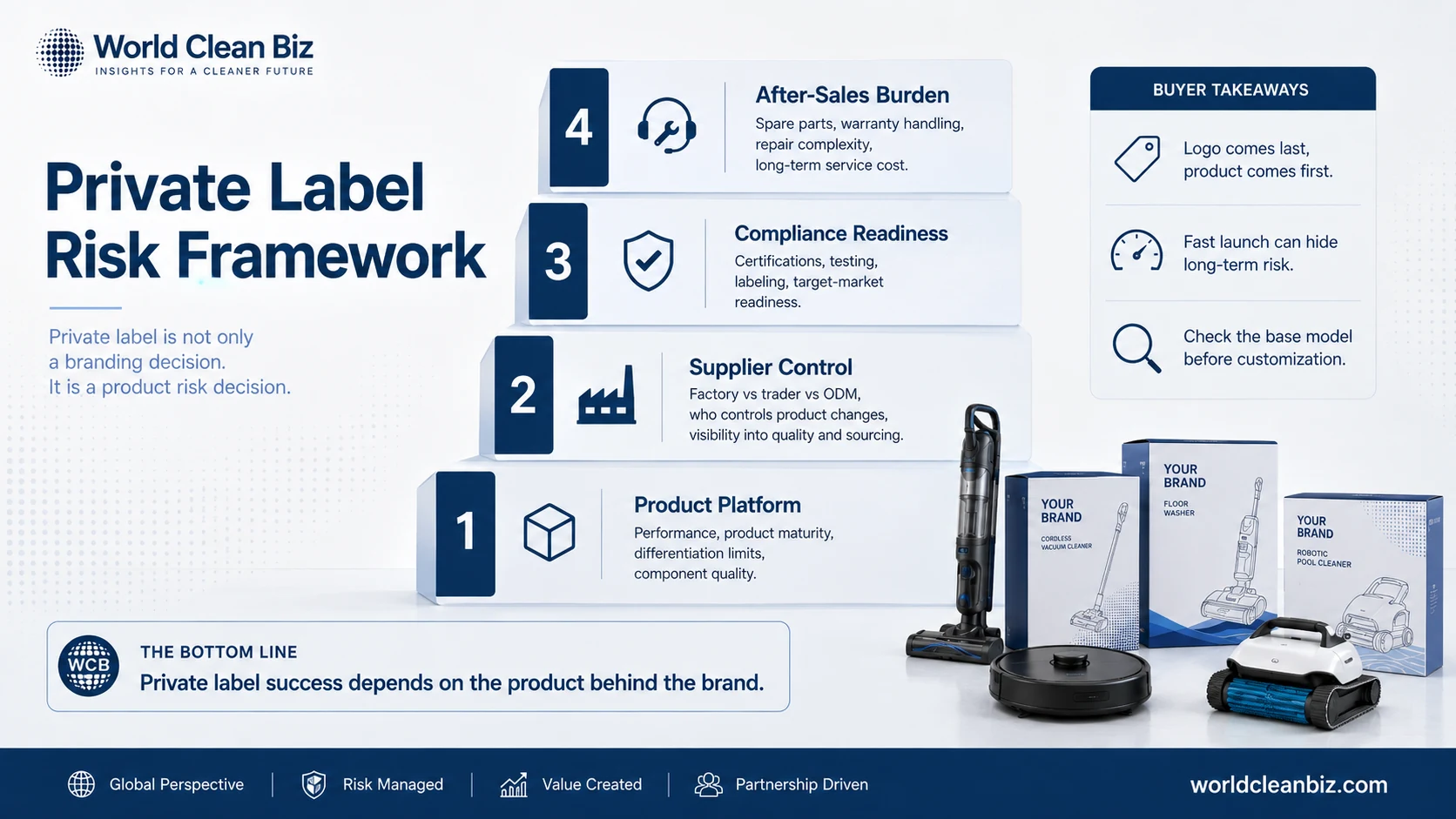
Private label is attractive because it gives buyers a faster route into cleaning product categories. It can help test a market, launch a new channel, or build an entry-level product line without full product development. But in cleaning appliances, private label is not only a branding decision. It is a product risk decision. Buyers are not only choosing a logo; they are choosing the supplier’s existing product platform, quality system, component choices, compliance readiness, and after-sales burden.
Buyer implication: Buyers should evaluate the product platform before discussing logo, color, packaging, or MOQ.
Buyer implication: Buyers should check whether the same private label platform is already being sold to many competitors in the same channel or market.
WCB view: Private label can be a smart first step, but it should not become a shortcut that hides product risk. In cleaning appliances, the best private label choice is not the fastest product to brand. It is the platform that fits the buyer’s market, channel, service model, and long-term differentiation plan.
Private Label vs OEM vs ODM: What Is the Difference?
Private label, OEM, and ODM are often used loosely, but they are not the same.
For a deeper explanation, see our guide to OEM vs ODM cleaning products.
In simple terms:
- Private label means the buyer puts its brand on an existing or lightly customized product.
- OEM means the buyer provides specifications or design, and the supplier manufactures according to those requirements.
- ODM means the supplier has an existing product design that the buyer can customize.
- Joint development means the buyer and supplier work together to develop a more differentiated product.
Private label is usually the fastest route. OEM usually gives the buyer more control but requires stronger product planning and higher development effort. ODM sits between the two: the buyer uses the supplier’s existing design but can often customize features, design, packaging, or configuration.
A private label product can come from several supplier structures:
- Factory catalog product
- ODM base model
- Trading company catalog
- Existing brand product adapted for another buyer
- Sourcing partner’s supplier network
That is why buyers should not only ask, “Can you do private label?”
They should ask:
Who owns the design? Who controls quality? Who provides spare parts? Who handles warranty claims? How many other buyers are using the same base product?
Which Cleaning Product Categories Fit Private Label?
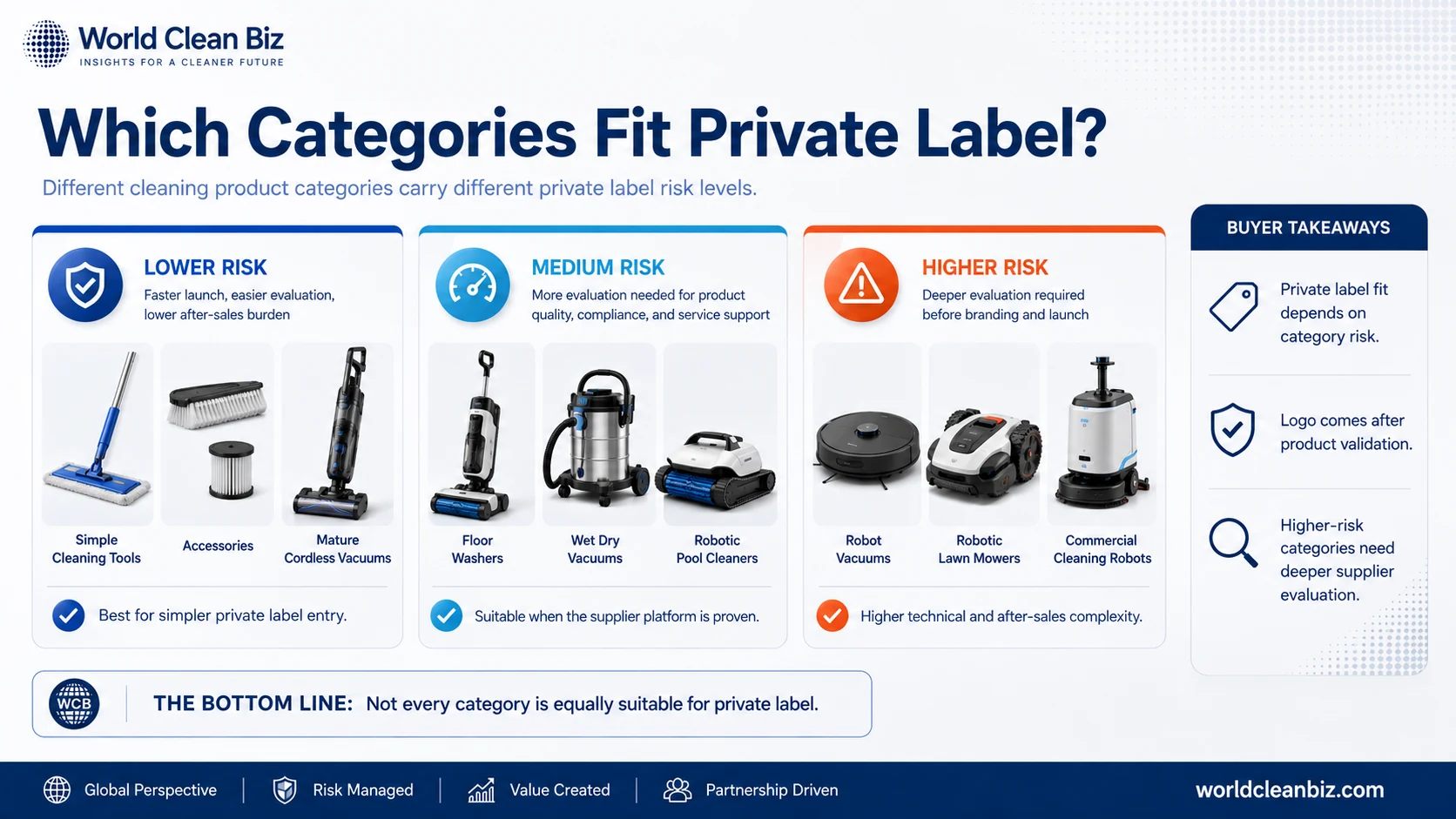
Private label can work in many cleaning product categories, but the risk level is very different.
Simple cleaning tools such as brushes, mops, cloths, buckets, sprayers, accessories, and basic manual tools often fit private label more easily because the technical risk is lower.
Cordless vacuums can fit private label when the product is mature and the buyer has a clear price segment. Buyers still need to evaluate motor performance, battery quality, filtration, brush head design, spare parts, and warranty risk; see our guide to cordless vacuum cleaner OEM manufacturers in China.
Floor washers and wet dry vacuums are more risky because they involve water systems, brush rollers, leakage control, self-cleaning, odor prevention, batteries, and consumables. Buyers can compare category risks in our guide to floor washer manufacturers in China.
Robot vacuums are difficult private label products because navigation, app control, docking, firmware, mopping, obstacle avoidance, and spare parts all affect user experience. Buyers should read our guide on how to source robot vacuum cleaners from China.
Robotic pool cleaners require strong waterproofing, pump performance, filtration, wall cleaning, waterline cleaning, battery safety, sealing, and service support. See our guide to robotic pool cleaner manufacturers in China.
Robotic lawn mowers carry outdoor, safety, navigation, terrain, waterproofing, and spare parts risk. Buyers can refer to our guide on robotic lawn mower manufacturers in China.
Commercial cleaning robots are usually high-risk private label products because deployment, training, maintenance, safety, route planning, and service support matter as much as the machine. See our guide to commercial cleaning robot manufacturers in China.
The more technical the product, the more private label becomes a product-risk decision.
When Private Label Makes Sense for Buyers
Private label can make sense when buyers need speed, market testing, or a lower-risk first step into a category.
It may be suitable when:
- The buyer wants a faster launch.
- The buyer is testing a category or channel.
- Product complexity is manageable.
- The supplier’s existing product is mature.
- The buyer does not need deep differentiation yet.
- After-sales risk is understood.
- The buyer has a plan for spare parts and warranty handling.
Private label can work for distributors that need a controlled product line for a regional market. It may help Amazon sellers test demand before investing in deeper customization. It may help retail buyers build a category entry point quickly.
But private label should be treated as a stage, not always as the final strategy.
If the product performs well, the buyer may later move toward ODM customization, OEM development, exclusive tooling, improved component selection, or joint development.
Private label is most useful when the buyer knows what it is testing.
When Private Label Becomes Risky
Private label becomes risky when buyers treat it as a shortcut.
Many sellers may use the same base product. If the buyer only changes the logo and packaging, weak differentiation can quickly lead to price competition.
The risk is higher in cleaning appliances because the buyer inherits the product’s quality, compliance readiness, component choices, spare parts policy, and warranty burden. A fast launch can hide long-term service cost.
Common risk situations include:
- The buyer chooses mainly by low MOQ.
- The buyer chooses mainly by fast delivery.
- The same product is sold by many competing sellers.
- The buyer does not test the product deeply.
- The supplier cannot explain the existing design.
- Certification documents do not match the final model.
- Spare parts and warranty terms are unclear.
- The buyer has no product differentiation plan.
- The buyer enters the market too late with a me-too product.
The sample may look acceptable. The supplier may offer logo printing. The packaging may look good. The price may seem competitive.
But the problems appear later: weak reviews, high return rate, missing spare parts, battery complaints, leakage complaints, firmware problems, docking failures, odor issues, or unclear warranty responsibility.
The biggest risk is not putting your brand on the wrong box. It is putting your brand on the wrong product platform.
What Buyers Should Check Before Choosing a Private Label Supplier
Before choosing a private label supplier, buyers should evaluate the supplier, the product, and the business model together.
Start with supplier identity. Is the company a factory, ODM supplier, trading company, brand owner, or sourcing partner? Each structure can work, but the buyer must understand who controls the product and who handles responsibility.
For supplier evaluation, see our guide on how to evaluate a Chinese cleaning appliance supplier.
Buyers should check:
- Supplier type and real role
- Product category experience
- Product quality and testing
- Customization limits
- Compliance readiness
- Spare parts and warranty support
- Whether the same product is sold to competitors
- Who controls product changes
Buyers should also understand supplier structure. A private label product from a factory may give more direct access to production. A private label product from a trading company may offer easier communication and smaller MOQ, but buyers must verify control. For more detail, see our guide on factory vs trading company in China.
Private label supplier selection should start with product risk, not logo options.
Packaging, Branding, and Customization Options
Private label buyers often focus first on branding and packaging. Those details matter, but they should come after product evaluation.
Common customization options include logo, color, packaging, manual, labeling, language version, accessories, plug type, warranty card, app branding if relevant, and basic feature configuration.
Not every customization is low risk. Packaging and logo changes are usually simple. Changing a battery, charger, motor, water tank, pump, docking system, sensor, or app function may require new testing or create production risk.
Buyers should separate customization into three levels:
- Branding customization — logo, packaging, manual, labels.
- Configuration customization — accessories, plugs, language, feature set.
- Product customization — components, structure, software, battery, motor, dock, water system.
The deeper the customization, the closer the project moves from private label toward ODM or OEM.
MOQ, Lead Time, and Cost: What Buyers Should Understand
Private label is often attractive because MOQ can be lower than full OEM development. But MOQ, lead time, and cost depend on product category, supplier type, customization level, packaging, component availability, and production schedule.
Buyers should not assume that the lowest MOQ is the best option.
A very low MOQ may be useful for testing, but it may also come with limited customization, higher unit cost, weaker supplier attention, or limited spare parts support.
Buyers should compare total business cost, not only FOB price. That includes unit price, packaging, customization, testing, certification if needed, inspection, spare parts, warranty, shipping, and return or replacement cost.
The lowest launch cost may not be the lowest total cost.
Compliance, Testing, and Target-Market Readiness
Compliance should be checked before private label production begins.
A product already sold in one market may not automatically be ready for another. Requirements may differ by country, product type, charger, battery, wireless function, labeling, materials, and packaging.
Buyers should verify whether certificates and test reports match the exact product configuration being purchased.
Important questions include:
- Which markets has this product been sold into?
- Do the certificates match this exact model?
- Are the charger, battery, motor, PCB, wireless module, and accessories the same?
- Will logo, packaging, labeling, or manual changes affect compliance?
- Can the supplier support updated testing if components change?
Private label buyers sometimes assume compliance is the supplier’s problem. That is risky. If the product is sold under the buyer’s brand, the buyer may carry market responsibility.
Compliance readiness should be part of product selection, not a final paperwork step.
Spare Parts, Warranty, and After-Sales Risk
After-sales risk is one of the most important parts of private label cleaning appliances.
When a product is sold under the buyer’s brand, the customer often sees the buyer as responsible. Even if the supplier caused the problem, the buyer’s brand receives the complaint.
For cleaning appliances, spare parts may include filters, brush rollers, batteries, chargers, tanks, pumps, motors, sensors, docks, seals, blades, wheels, accessories, and consumables.
Buyers should check:
- Which spare parts are available?
- How long will parts be supplied?
- What is the warranty period?
- Who pays for defective units?
- How are replacements shipped?
- What happens if the supplier stops producing the model?
- Can the supplier support recurring complaint analysis?
Private label can be fast to launch, but after-sales responsibility lasts much longer than the launch period.
A supplier that cannot support spare parts and warranty handling is risky, even if the product looks good and MOQ is low.
Common Buyer Mistakes
The first mistake is choosing by logo and packaging before testing the product. Branding cannot fix weak suction, leakage, poor navigation, battery complaints, odor problems, or missing spare parts.
The second mistake is choosing the lowest MOQ or fastest launch. Speed is useful, but a fast launch with the wrong product can create long-term problems.
The third mistake is ignoring product sameness across competitors. If the same base product is sold to many buyers, price competition may appear quickly.
The fourth mistake is misunderstanding OEM, ODM, and private label. Private label is usually faster, but it offers less control than OEM and often less differentiation than deeper ODM customization.
The fifth mistake is ignoring compliance documents. Certificates and test reports must match the exact product configuration and target market.
The sixth mistake is ignoring spare parts and warranty. The product may launch quickly, but after-sales problems can damage the brand later.
The seventh mistake is choosing supplier type before defining product and channel. Buyers should define target market, price band, sales channel, differentiation needs, and after-sales responsibility first.
The biggest mistake is choosing a private label product before understanding the product risk.
Private Label Cleaning Products Checklist
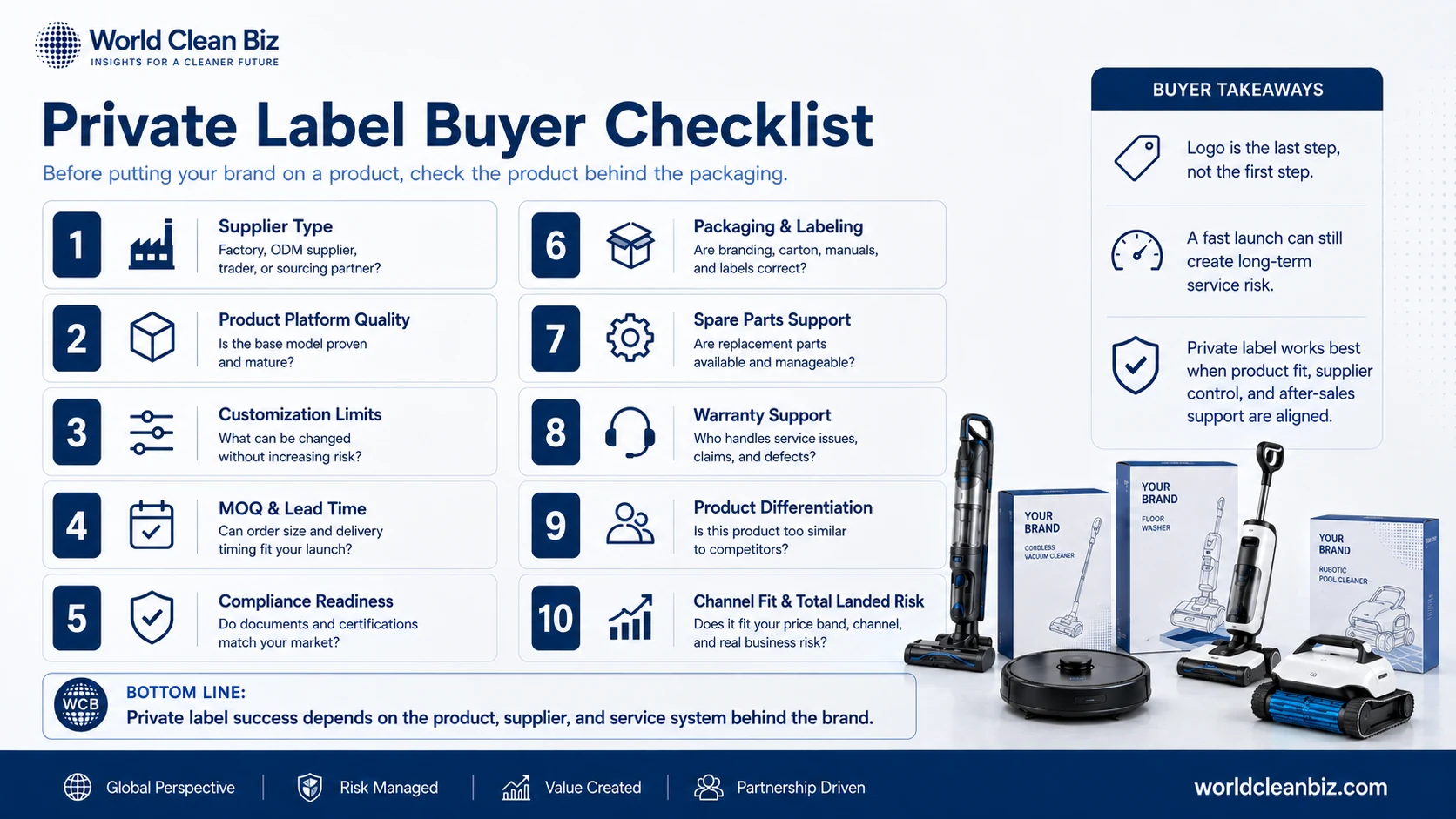
| Evaluation Area | What to Check | Why It Matters | Buyer Risk If Ignored |
|---|---|---|---|
| Product category fit | Whether the category is suitable for private label | Some categories are simple, others carry high technical and service risk | Buyer may choose a product too complex for basic private label |
| Supplier type | Factory, ODM supplier, trading company, brand owner, or sourcing partner | Determines who controls product, quality, and responsibility | Buyer may not know who is accountable when problems occur |
| Product platform quality | Performance, reliability, testing history, component choices | Private label depends on the supplier’s existing platform | Buyer may inherit weak design or quality problems |
| Customization options | Logo, packaging, color, accessories, feature configuration | Shows how much differentiation is possible | Product may look too similar to competitors |
| MOQ and lead time | Minimum order, production schedule, customization time | Affects launch planning and cash flow | Buyer may accept poor terms for speed |
| Compliance readiness | Certificates, test reports, labeling, target-market requirements | Needed for legal sale and import | Shipment delays, sales restrictions, or recall risk |
| Packaging and labeling | Brand packaging, manual, warnings, language, barcode, retail needs | Affects user experience and channel acceptance | Product may fail retail or marketplace requirements |
| Spare parts | Filters, rollers, batteries, chargers, tanks, motors, pumps, docks, accessories | Critical for service and warranty | Buyer may be unable to support customers after launch |
| Warranty support | Defect responsibility, replacement policy, claim handling | Defines post-sale cost and responsibility | Buyer may carry warranty cost alone |
| Product differentiation | Platform uniqueness, feature set, design, channel fit | Helps avoid direct price competition | Product may become a me-too listing |
| Channel fit | Amazon, retail, distributor, DTC, professional channel, regional market | Different channels require different service and positioning | Product may not match buyer’s sales model |
| Total landed risk | Product cost, shipping, testing, compliance, returns, spare parts, warranty | Shows true business cost | Low FOB price may hide high total cost |
How World Clean Biz Helps Buyers Evaluate Private Label Opportunities
World Clean Biz does not treat private label as a logo and packaging project. For cleaning appliances, private label is a product, supplier, and after-sales risk decision.
WCB helps buyers evaluate whether a private label opportunity fits the category, target market, supplier structure, OEM/ODM model, channel expectations, and after-sales responsibility.
This includes reviewing product opportunity, supplier capability, private label risk, category timing, China supply chain options, and whether private label is the right first step or whether the buyer should move toward ODM, OEM, or joint development.
For broader sourcing preparation, read our guide on how to find reliable cleaning product suppliers in China. If you are comparing sourcing models, see OEM vs ODM cleaning products. Buyers who need category context can explore our cleaning industry reports, learn more about World Clean Biz, or follow World Clean Expo updates.
If you are evaluating private label cleaning products from China, contact World Clean Biz for sourcing support.
FAQ
What are private label cleaning products?
Private label cleaning products are products made by a supplier and sold under the buyer’s own brand. The buyer usually customizes branding, packaging, labels, manuals, colors, or accessories rather than developing the product from zero.
In cleaning appliances, private label often means using an existing supplier product. That makes product quality, compliance readiness, spare parts, and after-sales support important.
Is private label the same as OEM?
No. Private label usually uses an existing product with branding or light customization. OEM usually means the buyer provides specifications or design, and the supplier manufactures according to the buyer’s requirements.
Private label is usually faster. OEM usually gives more control but requires stronger product planning, development time, and buyer-side technical knowledge.
Is private label the same as ODM?
Not exactly. ODM means the supplier has its own product design or base model, which buyers can customize. Private label can be based on an ODM design, but customization is often more limited.
A private label product may come from an ODM supplier, factory catalog, trading company catalog, or existing product line. Buyers should clarify who owns the design and what can be changed.
What cleaning products are good for private label?
Simple cleaning tools, accessories, mature cordless vacuums, and some established appliance products can be suitable for private label if quality and service support are stable.
More complex products such as robot vacuums, floor washers, robotic pool cleaners, robotic lawn mowers, and commercial cleaning robots require deeper evaluation because they involve higher technical and after-sales risk.
Are private label cleaning appliances risky?
They can be. The main risk is that buyers inherit the supplier’s existing product quality, component choices, compliance status, spare parts policy, and warranty burden.
Private label cleaning appliances should be tested carefully before launch. Buyers should not rely only on product photos, logo options, MOQ, or catalog claims.
How do I choose a private label cleaning product supplier in China?
Start by identifying the supplier type: factory, ODM supplier, trading company, brand owner, or sourcing partner. Then evaluate product quality, category experience, customization options, compliance readiness, spare parts support, warranty terms, and whether the same product is sold to many competitors.
A good private label supplier should be clear about what can be customized, what cannot be changed, and what risks the buyer will carry after launch.
What should I check before putting my brand on a cleaning appliance?
Check product performance, stability, component quality, compliance documents, spare parts availability, warranty terms, packaging requirements, user manual quality, and target-market readiness.
Also test the product like an end user. For cleaning appliances, real-use performance matters more than catalog specifications.
Can World Clean Biz help buyers find private label cleaning product opportunities?
Yes. World Clean Biz helps buyers evaluate private label opportunities, supplier structure, product risk, OEM/ODM fit, category timing, and China supply chain options before committing to a supplier or product.
The goal is not only to find a product that can carry your logo. It is to help you judge whether the product can support your market, channel, brand, and after-sales responsibility. If you need support, you can contact World Clean Biz.