In this article 16 sections
Finding Chinese cleaning appliance suppliers is not difficult. A buyer can collect supplier names from trade shows, online marketplaces, sourcing agents, referrals, or search results in a few hours.
The harder question is different:
Does this supplier actually fit your product category, price segment, sales channel, compliance requirements, and after-sales model?
That is where many sourcing projects fail. A supplier may look reliable on paper, respond quickly, show a good catalog, and provide a clean factory video. But for cleaning appliances, that is not enough.
Cleaning appliances involve motors, batteries, water systems, sensors, filtration, sealing, charging docks, software, spare parts, warranty handling, and user complaints. A supplier that can make a good-looking sample may still fail in mass production, compliance readiness, spare parts support, or after-sales service.
Supplier evaluation should begin before supplier selection. Before asking “which factory should I choose,” buyers should first define the product risk they are taking.
A supplier list is easy to collect. The hard part is knowing which supplier actually fits your category, channel, product risk, and after-sales model.
Quick Answer
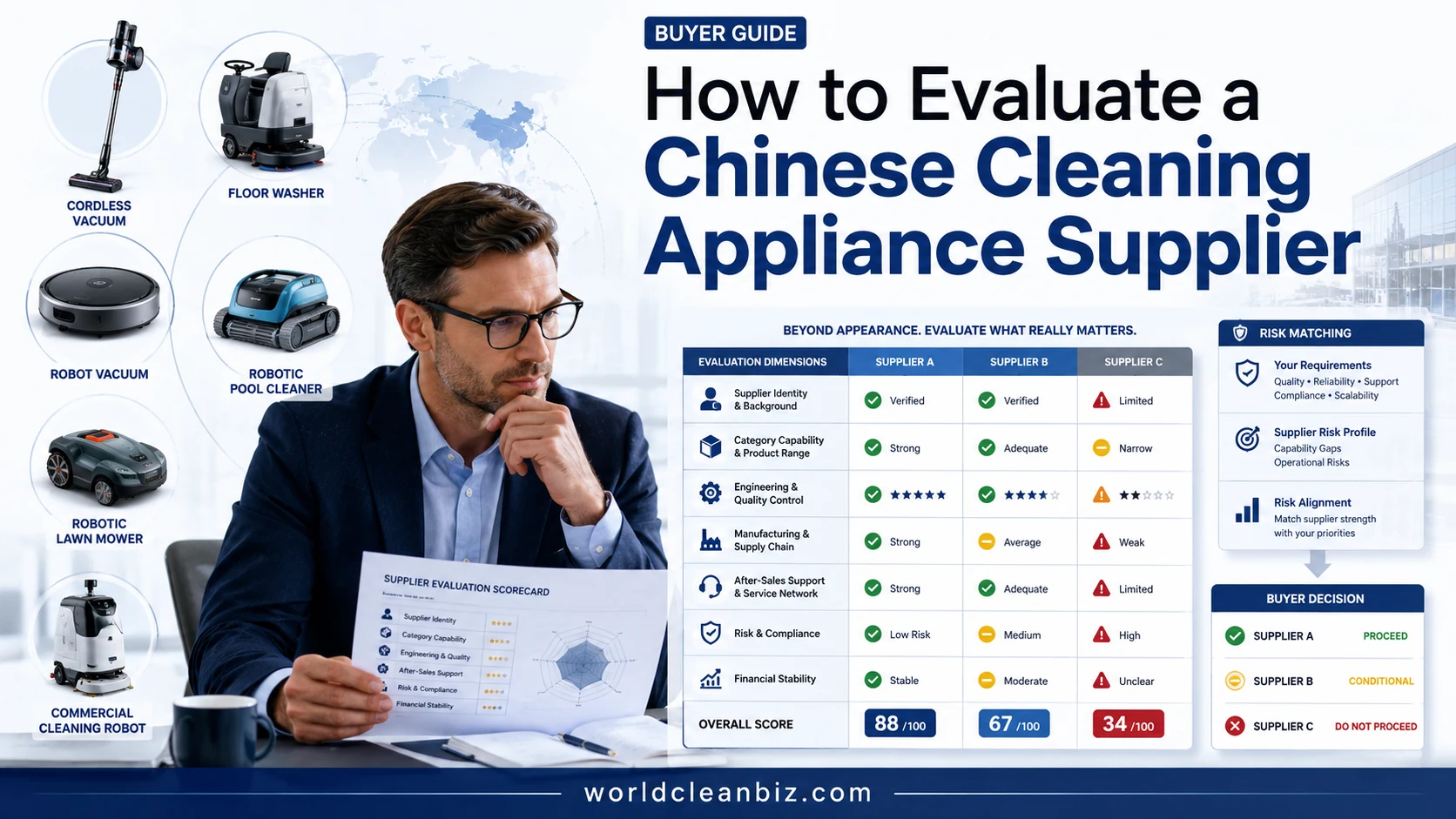
To evaluate a Chinese cleaning appliance supplier, buyers should check what type of supplier they are dealing with, whether the company has real category experience, how strong its engineering capability is, how it controls quality, whether it understands compliance requirements, how samples perform in real use, and whether it can support spare parts and after-sales service.
A reliable supplier is not simply a verified company or a factory with a good catalog. For cleaning appliances, supplier evaluation means checking whether the supplier’s category capability matches the buyer’s product, channel, target market, compliance requirements, and after-sales model.
If you are still at the early sourcing stage, start with a broader overview of how to find reliable cleaning product suppliers in China. If you already have supplier options, this guide will help you evaluate them more carefully before placing an order.
Why Supplier Evaluation Matters More in Cleaning Appliances
Cleaning appliances are different from many simple consumer goods.
A mop, brush, bucket, or plastic cleaning tool still needs quality control, but the technical risk is usually limited. A cleaning appliance is different. Once motors, batteries, water systems, pumps, sensors, firmware, charging docks, or app control are involved, supplier evaluation becomes much more important.
A weak supplier can create problems that do not appear during a short sample check:
- Battery runtime drops after repeated use.
- Water leakage appears after shipment.
- Brush rollers wear too quickly.
- Suction claims do not match real cleaning performance.
- Software or app support is unstable.
- Spare parts are unavailable after launch.
- Warranty claims become too expensive.
- Certification documents do not match the final product configuration.
This is why buyers should not evaluate suppliers only by FOB price, catalog photos, factory size, or sales response speed.
A reliable Chinese cleaning appliance supplier should be evaluated across four layers:
- Business identity — manufacturer, brand owner, ODM, trading company, or distributor.
- Category capability — whether the supplier understands the specific product category.
- Engineering and quality control — whether it can build and repeat the product at scale.
- Service and after-sales support — whether it can support the product after it reaches customers.
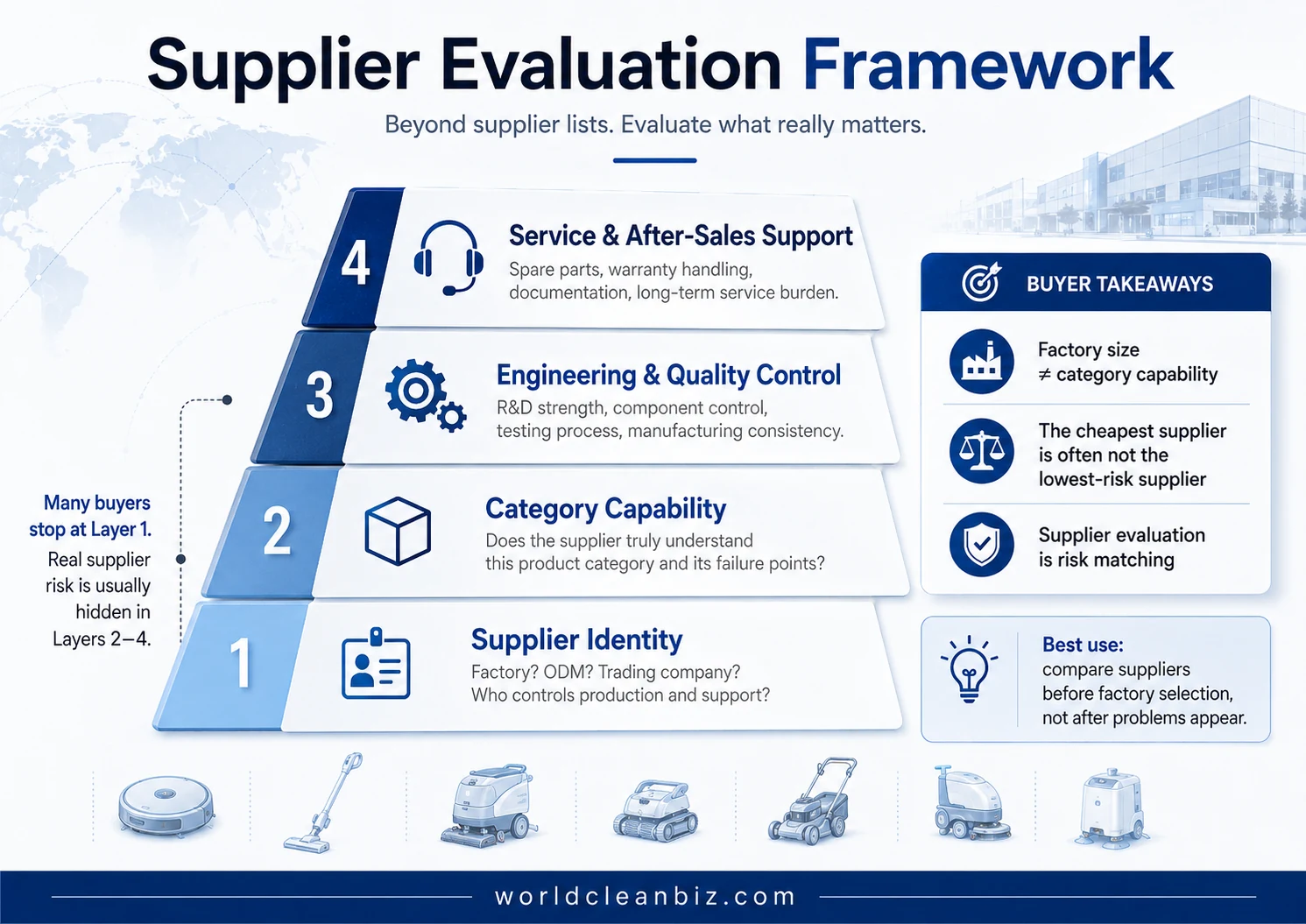
Many sourcing mistakes happen because buyers check only the first layer and ignore the other three.
WCB Market Note
Supplier evaluation in cleaning appliances has changed. In the past, many buyers mainly checked price, MOQ, factory size, certificates, and lead time. Those checks still matter, but they are no longer enough. Today, cleaning appliance products carry more technical and after-sales risk. A cordless vacuum depends on motor, battery, filtration, brush head, and spare parts. A floor washer depends on water management, roller cleaning, odor control, and leakage prevention. A robot vacuum or commercial cleaning robot depends on navigation, sensors, software, firmware, dock reliability, and service support.
Buyer implication: Buyers should evaluate whether the supplier’s category capability matches the product risk, not only whether the supplier can quote a competitive price.
Buyer implication: Buyers should define target market, sales channel, product positioning, compliance needs, and after-sales responsibility before building the supplier shortlist.
WCB view: In cleaning appliances, supplier evaluation is risk matching. The cheapest supplier is often not the lowest-risk supplier. The right supplier is the one whose engineering, quality, service, and business model match the buyer’s product risk, channel expectations, and after-sales burden.
Step 1: Verify What Type of Supplier You Are Dealing With
The first step is to understand who is actually behind the product.
Not every company that appears online as a supplier is the factory. Not every brand owns its production. Not every trading company is weak. Not every factory has strong engineering capability.
Common supplier types include:
- Factory manufacturer — owns production lines and manufactures products directly.
- ODM supplier — develops product platforms and sells customized versions to buyers.
- OEM manufacturer — manufactures according to the buyer’s design or specification.
- Brand owner — sells its own brand and may or may not own production.
- Trading company — sources from factories and manages communication, export, or coordination.
- Component supplier — provides motors, batteries, pumps, sensors, boards, brushes, filters, or modules.
- Hybrid supplier — combines manufacturing, ODM development, brand sales, and export trading.
Trading companies are not automatically bad. Some provide strong sourcing coordination, communication, export handling, quality follow-up, and project management. The risk appears when buyers do not know what role the company actually plays.
Ask these questions early:
- Are you the manufacturer, brand owner, trading company, or distributor?
- Which production steps are done in-house?
- Who owns the product design?
- Who controls tooling, firmware, app, and quality standards?
- Who handles spare parts and warranty claims?
- Can we visit or verify the factory behind the product?
The goal is not to reject every non-factory supplier. The goal is to understand where responsibility sits.
Step 2: Check Category Experience, Not Just Factory Size
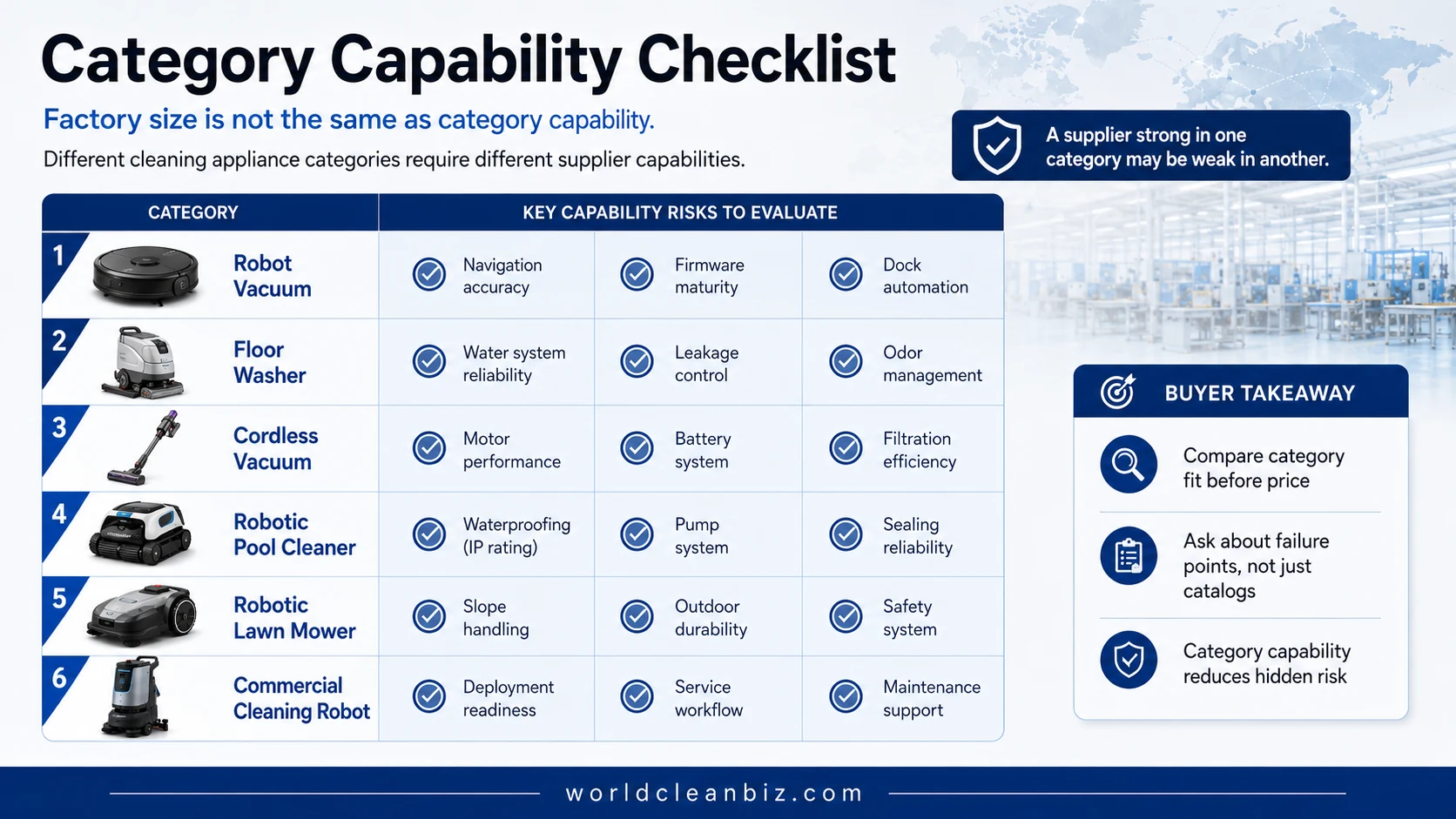
Factory size is not the same as category capability.
A large appliance factory may not understand robot vacuum navigation. A good plastic parts supplier may not understand battery safety. A supplier that can assemble a cordless vacuum may not be able to build a reliable floor washer. A commercial cleaning robot supplier may need deployment and service capability more than simple production capacity.
For robot vacuums, supplier capability should include navigation, obstacle avoidance, docking, app support, firmware, spare parts, and after-sales handling. For more detail, see our guide on how to source robot vacuum cleaners from China.
For cordless vacuums, the key is motor efficiency, suction stability, battery pack quality, filtration, brush head design, noise control, and accessories. Buyers can compare category-specific requirements in our guide to cordless vacuum cleaner OEM manufacturers in China.
For floor washers and wet dry vacuums, water management is the core risk. Buyers need to check suction, roller washing, tank separation, leakage, odor control, self-cleaning, drying, and spare parts. See our guide to floor washer manufacturers in China.
For robotic pool cleaners, waterproofing, pump performance, filtration, wall cleaning, waterline cleaning, battery safety, sealing, and after-sales support are critical. Our robotic pool cleaner manufacturer guide explains these risks in more detail.
For robotic lawn mowers, terrain, slope, boundary method, RTK or vision navigation, safety logic, waterproofing, docking, firmware, and blade replacement matter more than catalog appearance. See our guide to robotic lawn mower manufacturers in China.
For commercial cleaning robots, the real test is not the demo video. It is facility deployment, safety behavior, route planning, cleaning coverage, maintenance, operator training, and service workflow. Buyers can refer to our guide on commercial cleaning robot manufacturers in China.
The point is simple: do not choose a supplier because it is generally strong. Choose a supplier because it is strong in the specific category you want to source.
Step 3: Evaluate Engineering Capability
A cleaning appliance supplier must do more than assemble parts.
Engineering capability decides whether the product can work reliably, pass testing, scale production, and survive customer use.
A strong supplier should be able to explain the product architecture clearly. It should know why it uses a certain motor, battery pack, filtration design, water tank, pump, brush roller, sensor system, navigation platform, or charging dock design.
It should also understand failure points. Strong suppliers know where products break, leak, lose suction, lose runtime, create complaints, or become expensive to service. Weak suppliers only repeat catalog specifications.
Useful questions include:
- Who designs the motor, battery, pump, water system, filtration, sensor layout, or software?
- Which engineering work is in-house?
- Which components are outsourced?
- Can the supplier explain the key failure modes?
- Can it provide testing reports or validation records?
- Does it have engineers who can join technical calls, not only sales staff?
For cleaning appliances, engineering capability is not a bonus. It is part of supplier reliability.
Step 4: Review Quality Control and Testing Process
A good sample does not prove stable production.
Many buyers approve samples too quickly. The sample looks good, the supplier responds fast, and the price is acceptable. But quality problems may only appear during pilot production, shipment inspection, or customer use.
Buyers should check how the supplier controls quality before, during, and after production.
Important areas include:
- Incoming material and key component inspection
- In-line production checks
- Functional and performance testing
- Aging, safety, leakage, or charging tests when relevant
- Final inspection and packaging tests
- Traceability for defective units
- Complaint analysis and corrective action
A supplier should be able to explain its quality process in practical terms. Generic answers such as “we have strict QC” are not enough.
Quality control is not only about inspection. It is about whether the supplier understands what can go wrong and has a repeatable process to prevent it.
Step 5: Check Compliance Readiness for Your Target Market
Certification and compliance should not be treated as a formality.
Cleaning appliances may involve electrical safety, battery safety, wireless communication, chargers, chemical contact, water use, energy rules, labeling, packaging, and environmental requirements. The exact requirements depend on the target market and product configuration.
Buyers should not simply ask, “Do you have CE?” or “Do you have FCC?” A better question is:
Are the certificates valid for the exact product version, component configuration, charger, battery, wireless module, and target market we plan to sell?
Compliance readiness should include:
- Product safety requirements
- Battery and charger requirements
- EMC or radio requirements if wireless functions are included
- Material and environmental requirements
- Labeling and user manual requirements
- Market-specific documentation
- Test reports linked to the correct model
- Ability to support updated testing if the product changes
Buyers should also understand that certificates can become invalid if key components are changed. A different battery, charger, motor, PCB, wireless module, or housing design may require updated testing.
If a supplier treats compliance as a PDF attachment rather than a product responsibility, that is a warning sign.
Step 6: Test Samples Like a Buyer, Not Like a Sourcing Agent
Sample testing should not stop at appearance, packaging, and basic function.
A sourcing agent may check whether the product turns on, charges, runs, and matches the catalog. A real buyer should test whether the product can satisfy the end user, fit the sales channel, and survive after-sales pressure.
For cordless vacuums, test suction stability, runtime, noise, brush head performance, dust leakage, filtration, hair tangle, charging, accessories, and how easy the dust bin is to empty.
For floor washers, test real wet messes, dirty water recovery, roller cleaning, edge cleaning, tank handling, leakage, odor after storage, self-cleaning, drying, and replacement roller or filter cost.
For robot vacuums, test mapping, route planning, obstacle avoidance, docking, carpet behavior, mopping performance, app connection, firmware stability, and performance in real home layouts.
For commercial cleaning robots, test in a real facility. Check navigation, safety behavior around people, cleaning coverage, water recovery, runtime, route repeatability, operator training, maintenance, and spare parts support.
Sample testing should answer three questions:
- Does the product perform well enough for the target user?
- Can the supplier repeat this quality in mass production?
- What after-sales problems are likely after launch?
If a supplier resists deeper sample testing or cannot answer technical questions during testing, buyers should be cautious.
Step 7: Evaluate After-Sales Support and Spare Parts Capability
After-sales support is one of the most underestimated parts of cleaning appliance sourcing.
Many buyers focus on price, sample quality, and delivery time. But once the product reaches customers, problems become more expensive. Returns, repairs, missing spare parts, weak manuals, unclear warranty terms, and slow supplier response can destroy the profit of a product line.
Cleaning appliances often need spare parts such as batteries, chargers, filters, brush rollers, tanks, pumps, motors, sensors, docks, seals, and consumables.
Buyers should ask:
- Which spare parts are available?
- How long will spare parts be supplied?
- What is the warranty policy?
- Who pays for defective units?
- Can the supplier provide repair guidance?
- What happens if the product is discontinued?
A cheap product with weak spare parts support can become expensive after launch. A slightly higher-priced supplier with better after-sales structure may be lower risk.
Step 8: Compare OEM, ODM, Private Label, and Joint Development Fit
Supplier evaluation should match the sourcing model.
OEM, ODM, private label, and joint development are not just purchasing formats. They define how much responsibility the buyer and supplier each carry.
For a deeper explanation, see our guide to OEM vs ODM cleaning products.
In general:
- OEM works when the buyer has clear product specifications, engineering input, and long-term product control.
- ODM works when the supplier has an existing platform and the buyer needs customization with moderate speed.
- Private label works when the buyer wants fast market entry but accepts weaker differentiation.
- Joint development works when the buyer wants a more differentiated product and can manage a longer development process.
The right model depends on product complexity, channel expectations, differentiation needs, and after-sales responsibility.
A private label cordless vacuum may be acceptable for a low-risk channel test. A private label robot vacuum, floor washer, pool robot, or commercial cleaning robot may create higher risk if the buyer cannot control software, spare parts, warranty, or technical support.
Buyers should not choose a sourcing model only because it is faster or cheaper. The model must match the product ambition.
Step 9: Identify Red Flags Before Placing an Order
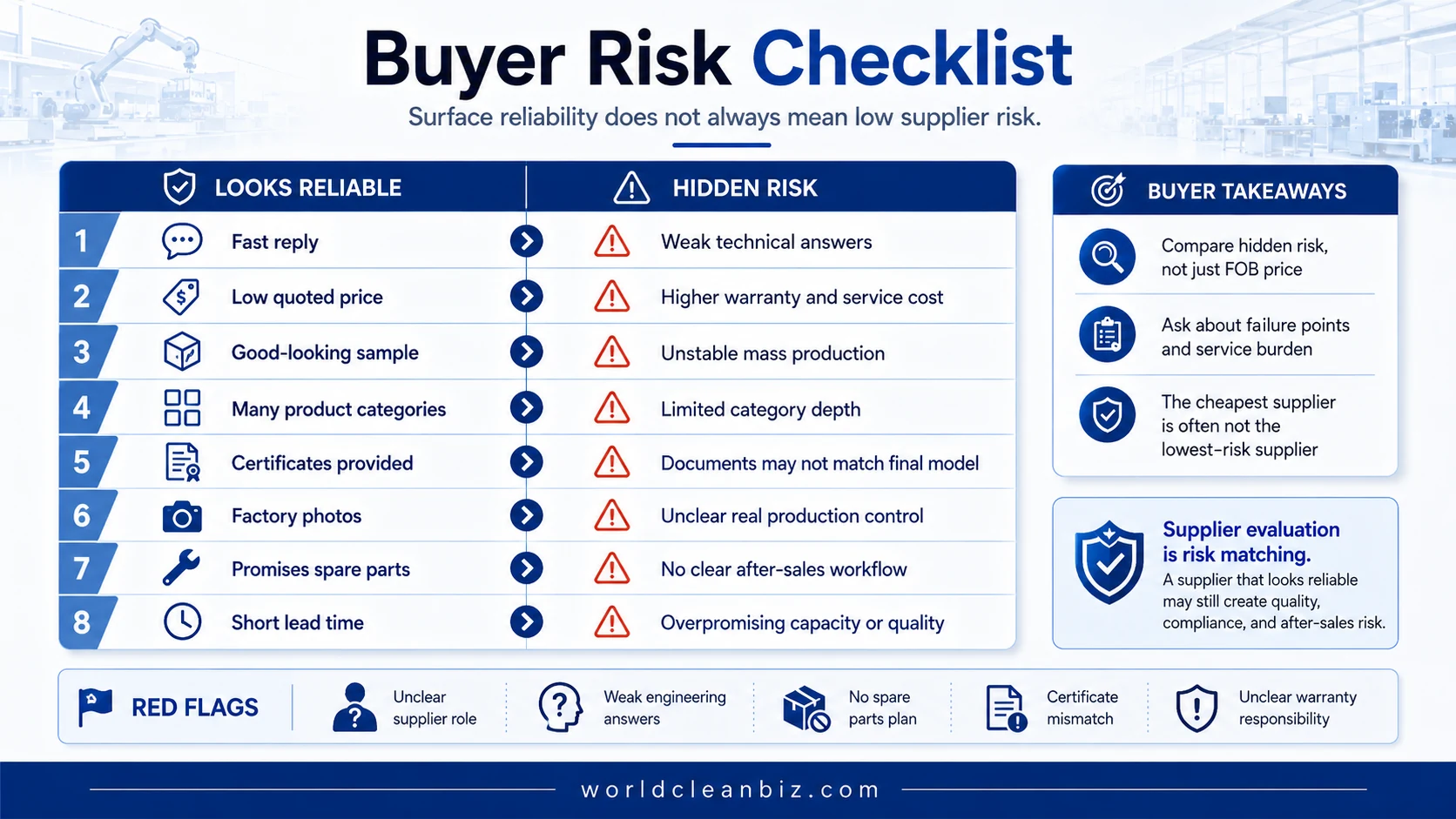
Many supplier problems can be detected before payment if buyers ask the right questions.
Common red flags include:
- The supplier cannot clearly explain whether it is a factory, brand owner, trader, or distributor.
- The supplier refuses factory verification without a reasonable explanation.
- The catalog includes too many unrelated product categories.
- The supplier cannot explain product failure points.
- Sales staff can answer price questions but not technical questions.
- Certificates do not match the exact product model.
- The supplier overclaims performance without test data.
- Sample quality is good, but pilot production control is unclear.
- Spare parts policy is vague.
- Warranty responsibility is unclear.
- The supplier pushes for large orders before proper testing.
- The supplier avoids written specifications.
One red flag does not always mean the supplier is unusable. But several red flags together usually mean the buyer is taking unnecessary risk.
Chinese Cleaning Appliance Supplier Evaluation Checklist
| Evaluation Area | What to Check | Why It Matters | Buyer Risk If Ignored |
|---|---|---|---|
| Supplier identity | Manufacturer, ODM, OEM, brand owner, trading company, distributor | Clarifies who controls production, engineering, and responsibility | Buyer may rely on the wrong party for quality or after-sales support |
| Category experience | Relevant cleaning appliance category experience and past projects | Each category has different failure points | Supplier may be strong generally but weak in the specific product category |
| Engineering capability | Motor, battery, water system, filtration, software, sensors, or mechanical design | Determines whether the product can perform and scale | Product may look good but fail in real use or mass production |
| Component control | Key components, outsourced modules, supplier network | Shows where technical risk sits | Buyer may not know who is responsible when a component fails |
| Quality control | Incoming inspection, in-line checks, functional tests, final inspection | Reduces mass production defects | Sample approval may not translate into stable shipment quality |
| Testing process | Category-specific performance, safety, leakage, runtime, docking, navigation, or durability tests | Confirms real product performance | Product may fail after launch despite passing basic checks |
| Compliance readiness | Certificates, test reports, labeling, manuals, target market requirements | Required for legal sale and import | Shipment delays, customs issues, recalls, or sales restrictions |
| Sample performance | Real-use testing, not only appearance and basic function | Shows user experience and failure risk | Buyer may approve a product that customers reject |
| Spare parts / warranty | Parts availability, warranty terms, replacement policy, repair support | Defines post-sale risk and service cost | Buyer may carry most warranty cost alone |
| Production and business stability | Capacity, lead time, export experience, business continuity | Important for scaling and long-term supply | Supplier may fail during demand spikes or product lifecycle support |
| Communication quality | Technical response, documentation, problem-solving speed | Reduces sourcing friction | Misunderstandings may create quality, compliance, or delivery problems |
| OEM/ODM fit | Whether the supplier model matches buyer needs | Aligns product control, speed, cost, and differentiation | Buyer may choose a model that does not fit product ambition |
Common Mistakes Buyers Make
The first mistake is choosing only by FOB price. Price matters, but the cheapest supplier may create higher total cost through returns, defects, delays, weak spare parts, and warranty problems.
The second mistake is treating all suppliers as interchangeable. Two suppliers may sell similar-looking products, but one may control engineering and quality while the other only assembles or resells.
The third mistake is checking documents without checking whether they match the exact product. Certificates, test reports, manuals, labels, and component specifications must match the version being sold.
The fourth mistake is trusting samples too quickly. A good sample is only the beginning. Buyers still need pilot production checks, testing, packaging review, and after-sales planning.
The fifth mistake is choosing a supplier before defining product positioning. A buyer should know the target market, price band, channel, expected differentiation, compliance needs, and service responsibility before supplier selection.
The biggest mistake is not only choosing the wrong supplier. It is choosing a supplier before understanding the product risk.
How World Clean Biz Helps Buyers Evaluate Suppliers
World Clean Biz does not only help buyers find supplier names. Supplier lists are easy to collect. The harder work is judging which supplier type, product platform, engineering capability, and after-sales model actually fit the buyer’s market.
For cleaning appliance buyers, WCB helps evaluate product opportunity, supplier capability, OEM/ODM fit, category risk, and China supply chain options before factory selection.
This matters because the right supplier depends on the product. A buyer sourcing cordless vacuums needs a different evaluation framework from a buyer sourcing floor washers, robot vacuums, robotic pool cleaners, robotic lawn mowers, or commercial cleaning robots.
For broader sourcing context, read our guide on finding reliable cleaning product suppliers in China. For sourcing model decisions, see OEM vs ODM cleaning products. Buyers who need category direction can explore our cleaning industry reports, learn more about World Clean Biz, or follow World Clean Expo updates.
If you are comparing Chinese cleaning appliance suppliers, contact World Clean Biz for sourcing support.
FAQ
How do I know if a Chinese cleaning appliance supplier is reliable?
A reliable supplier should be clear about its role, category experience, engineering capability, quality control process, compliance readiness, sample testing, spare parts support, and warranty responsibility.
Do not rely only on business licenses, online profiles, factory photos, or certificates. The best test is whether the supplier can explain the product’s real risks and provide a practical plan to control them.
Should I choose a factory or a trading company?
A factory is not always better, and a trading company is not always worse. A factory may offer better production control and direct technical access, while a trading company may provide better communication, export handling, and project management.
The key is to understand who controls engineering, quality, documentation, and after-sales support.
What should I check before ordering samples?
Before ordering samples, define your target market, price segment, sales channel, product positioning, compliance requirements, and after-sales expectations.
Then check whether the supplier can provide the correct model, specifications, testing information, spare parts list, warranty policy, packaging options, and customization limits.
What certifications do cleaning appliances need?
Certification requirements depend on the product type and target market. Cleaning appliances may require electrical safety, EMC, radio, battery, charger, environmental, labeling, and material compliance checks.
Buyers should confirm requirements with qualified compliance professionals or testing labs. Supplier documents should match the exact product configuration being purchased.
How do I evaluate OEM and ODM suppliers differently?
For OEM suppliers, buyers should focus on manufacturing capability, engineering support, production control, component sourcing, and whether the supplier can follow the buyer’s specifications accurately.
For ODM suppliers, buyers should evaluate the existing product platform, customization flexibility, design ownership, differentiation limits, compliance documents, and upgrade plan.
Why is after-sales support important for cleaning appliances?
Cleaning appliances often include parts that wear out or fail over time, such as batteries, filters, brush rollers, pumps, motors, sensors, docks, water tanks, and chargers.
If spare parts are unavailable or warranty terms are unclear, the buyer may carry the full cost of customer complaints. This can damage margin, reviews, distributor relationships, and brand reputation.
Should I visit the factory before placing an order?
For higher-risk products or larger orders, a factory visit or third-party verification is strongly recommended.
A visit can help buyers check production lines, testing equipment, quality control process, warehouse conditions, engineering team, and management attitude. If a visit is not possible, use video audits, third-party inspections, and staged pilot orders.
Can World Clean Biz help evaluate Chinese cleaning appliance suppliers?
Yes. World Clean Biz helps buyers understand supplier options, category risk, product opportunity, OEM/ODM fit, and China cleaning appliance supply chain structure before choosing factories.
WCB is not only focused on collecting supplier names. The goal is to help buyers judge whether a supplier’s category capability, engineering level, quality system, compliance readiness, and after-sales model match the buyer’s product and market. If you are evaluating Chinese cleaning appliance suppliers, you can contact World Clean Biz for sourcing support.