In this article 12 sections
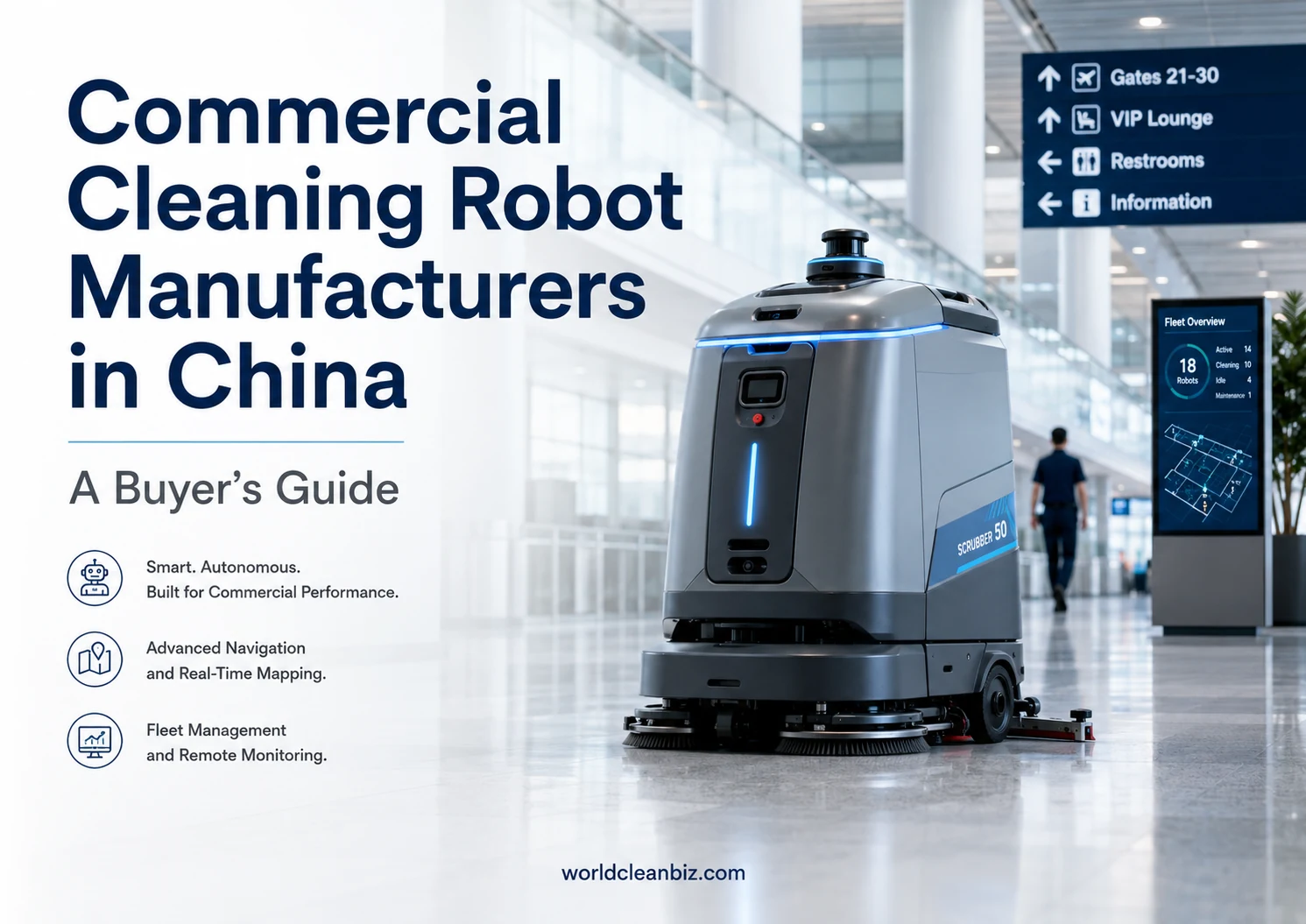
Commercial cleaning robots are becoming an important category in facility cleaning, retail, airports, warehouses, hospitals, schools, offices, and large indoor spaces. For overseas buyers, cleaning contractors, equipment dealers, facility service companies, and sourcing teams, the category offers real opportunity—but it is not simple to source.
China is increasingly relevant in commercial cleaning robot sourcing. Chinese suppliers are active in robotics, sensors, batteries, control boards, autonomous navigation, cleaning equipment manufacturing, software integration, and finished robotic floor scrubber systems. But buyers should not choose suppliers only by FOB price, product photos, or demo videos.
Finding a commercial cleaning robot supplier is not difficult. Choosing the right use case, navigation platform, cleaning system, safety design, service model, and after-sales structure is much harder.
Commercial cleaning robots are not simple cleaning machines with automation added. Buyers need to evaluate facility type, cleaning route, safety sensors, autonomous navigation, obstacle avoidance, cleaning coverage, water management, battery runtime, docking or charging, fleet management, operator training, spare parts, warranty handling, and service support.
Quick Answer
Buyers looking for commercial cleaning robot manufacturers in China should evaluate supplier type, facility use case, navigation system, cleaning platform, safety sensors, obstacle avoidance, water tank design, scrubbing performance, battery runtime, docking or charging model, fleet management software, operator training, spare parts, compliance readiness, and after-sales support.
The best supplier is not always the lowest-price factory. A robotic floor scrubber for a shopping mall, a warehouse cleaning robot, a hospital cleaning robot, a school cleaning robot, and a facility service fleet product may require very different navigation, safety, cleaning, and service capabilities.
If you need help comparing commercial cleaning robot suppliers in China, World Clean Biz provides cleaning equipment sourcing support for overseas buyers, dealers, and service companies.
Why Commercial Cleaning Robots Are Becoming a Strategic Category
Commercial cleaning robots are part of a broader shift from manual cleaning toward labor-saving automation. Facility operators face pressure to improve cleaning consistency, reduce labor dependence, manage large spaces more efficiently, and produce more measurable service results.
The category is also moving from traditional walk-behind or ride-on scrubbers toward autonomous floor scrubbers and robotic cleaning machines. This does not mean every facility needs a robot. It means more buyers are asking whether repetitive floor cleaning can be automated in large indoor spaces.
Commercial cleaning robots are also becoming connected service products. A buyer may need route planning, cleaning reports, battery status, remote monitoring, error alerts, fleet management, operator permissions, and maintenance records. This changes the product from a machine purchase into a service and deployment decision.
The real challenge is deployment. A robot that performs well in a clean demo area may struggle in a busy mall, school corridor, hospital lobby, airport terminal, or warehouse aisle. People, carts, wet floors, uneven surfaces, glass walls, elevators, narrow passages, and changing layouts all affect performance.
For buyers, this means the sourcing question is not only “Which supplier can build a robot?” The better question is: “Which supplier can support the robot in my real facility environment?”
For more category research across cleaning equipment and smart cleaning products, buyers can explore World Clean Biz cleaning industry reports.
WCB Market Note
Commercial cleaning robot sourcing is shifting from hardware purchase to deployment capability. In the early stage, many buyers focused on whether a supplier could provide an autonomous scrubber or floor cleaning robot at a competitive price. Today, that is not enough. Buyers need to evaluate mapping, route planning, safety behavior, cleaning coverage, water management, battery runtime, operator training, service workflow, spare parts, and fleet management together.
A supplier that can build a robot may not be able to support real commercial deployment across malls, schools, hospitals, airports, warehouses, and office buildings. The product must work around people, obstacles, cleaning schedules, facility layouts, local service teams, and customer reporting requirements.
Buyer implication: Buyers should test commercial cleaning robots in real facility conditions, not only in supplier demo videos or controlled showrooms.
Buyer implication: Buyers should avoid choosing a supplier without checking deployment support, operator training, maintenance process, and spare parts availability.
WCB View: In commercial cleaning robots, supplier selection is really a deployment-risk and service-risk decision, not just a machine purchasing decision.
What Types of Commercial Cleaning Robot Suppliers Exist in China?
Not every visible brand, online seller, or marketplace listing represents the actual manufacturer. Buyers must verify the real production, navigation, software, safety, quality-control, deployment, and service capability behind the product.
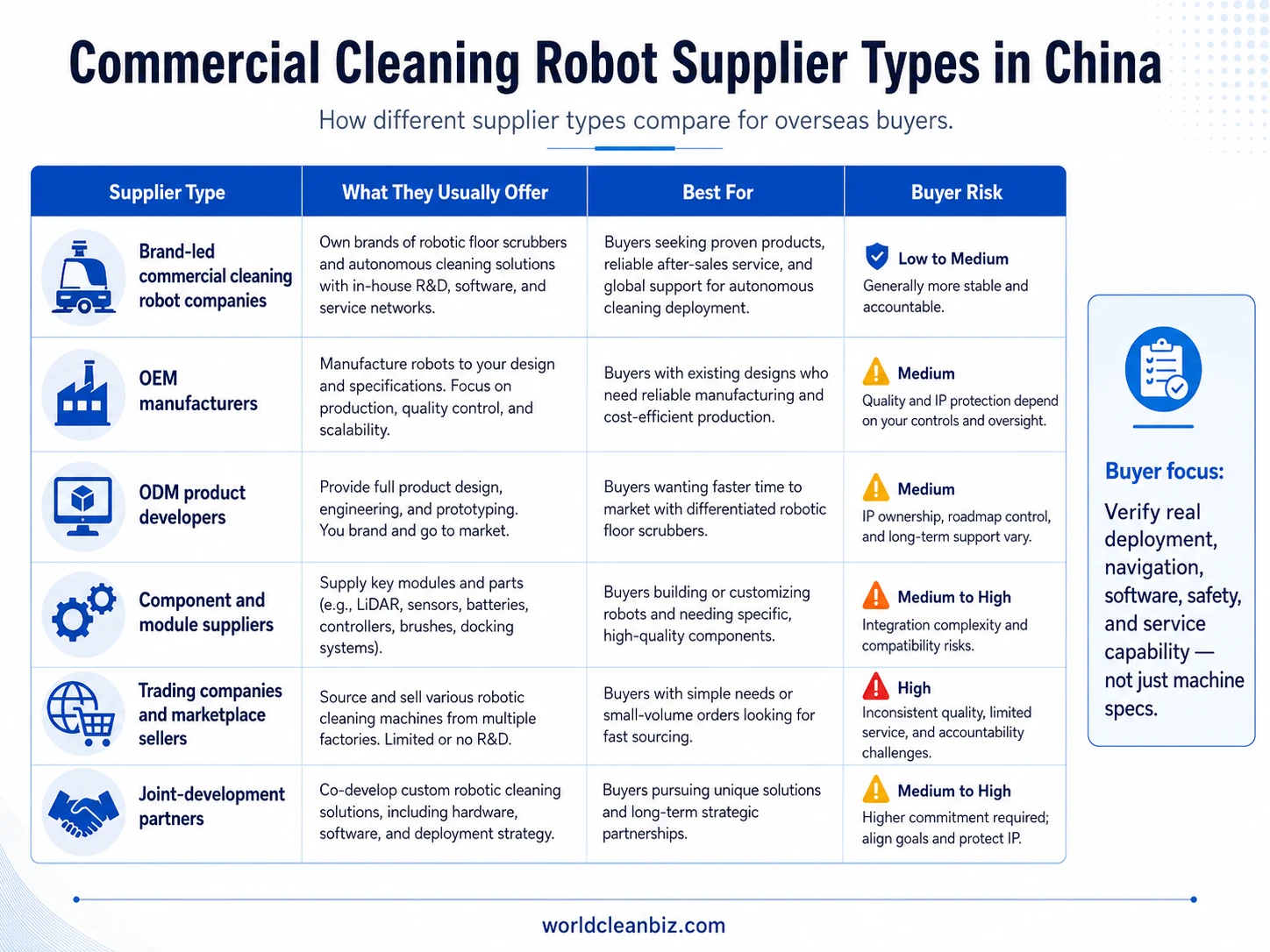
| Supplier Type | What They Usually Offer | Best For | Buyer Risk |
|---|---|---|---|
| Brand-led commercial cleaning robot companies | Branded robot lines, deployment cases, software, service system, product roadmap | Dealers, facility service companies, and buyers seeking proven platforms | May offer limited OEM flexibility; brand conflict may exist |
| OEM manufacturers | Production based on buyer design, specifications, tooling, and quality standards | Established equipment brands with clear product requirements | Higher development cost, longer timeline, buyer must manage product definition |
| ODM product developers | Existing robotic cleaning platforms that can be customized | Buyers needing faster launch with moderate differentiation | Similar platforms may be sold to multiple buyers; service support may be limited |
| Component and module suppliers | Sensors, motors, batteries, controllers, scrubber modules, navigation modules, charging systems | Buyers with engineering teams or lead manufacturers | Not a complete product supplier; integration risk remains |
| Trading companies and marketplace sellers | Ready-made products, flexible sourcing, basic export support | Small buyers testing demand | Weak technical support, unclear factory identity, limited deployment control |
| Joint-development partners | Co-developed robot platform, software, cleaning module, and service process | Serious brands, dealers, or service companies building long-term automation capability | Requires budget, testing, facility knowledge, and close project management |
A trading company is not always bad, and a manufacturer is not always the right partner. The key is whether the supplier can support your actual use case. A cleaning contractor with large facility clients may need service training and fleet reporting. A dealer may need spare parts and technical support. A private label buyer may need a stable platform and clear warranty terms.
Key Product Capabilities Buyers Should Evaluate
Commercial cleaning robot buyers should evaluate real deployment performance, not only product specifications.
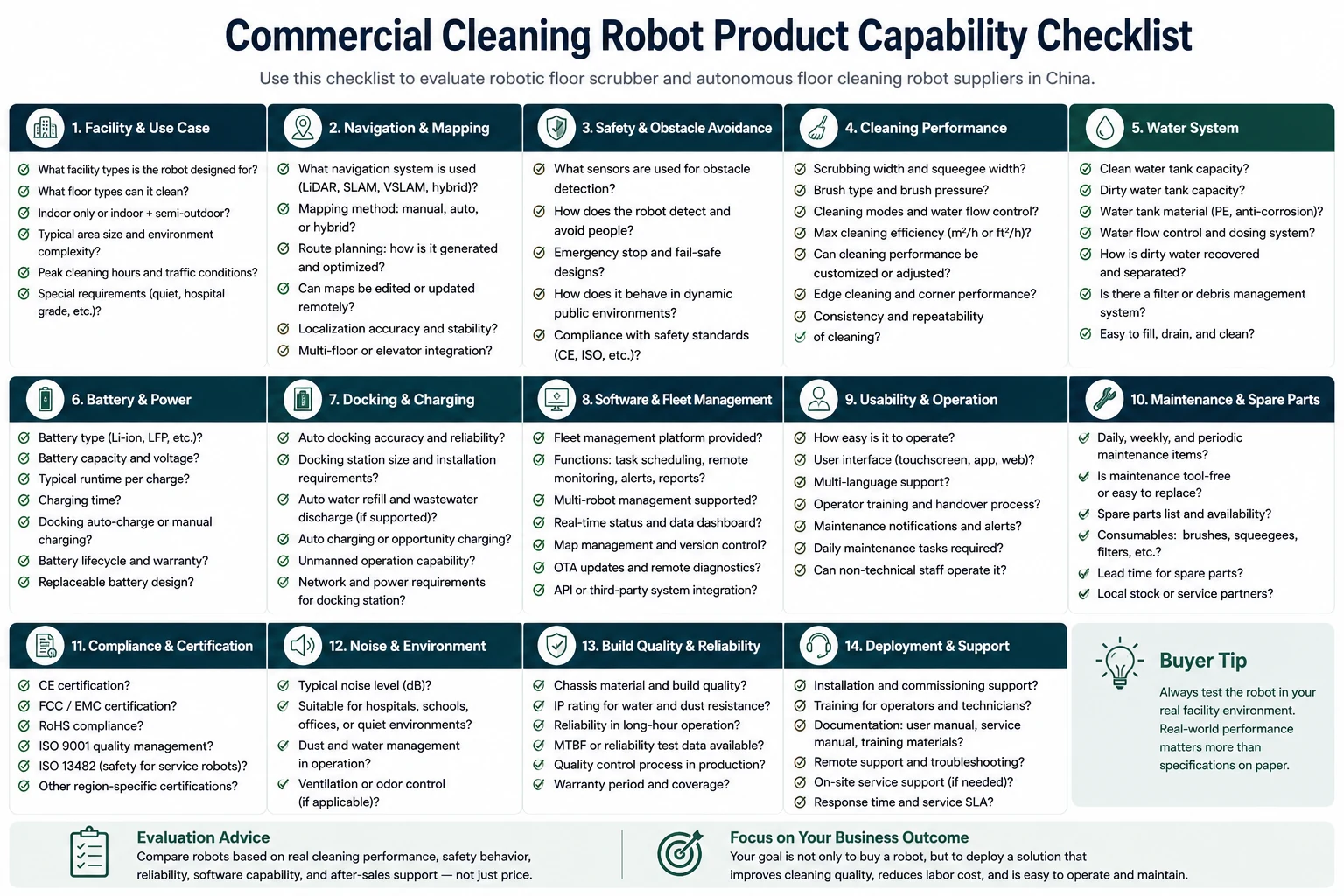
Facility type and cleaning use case
A robot for a mall is different from a robot for a warehouse, hospital, school, airport, supermarket, office building, or factory. Buyers should define the use case before supplier selection.
Autonomous navigation system
Navigation affects route reliability, obstacle handling, coverage, and user trust. Buyers should understand whether the robot uses LiDAR, vision, sensors, QR codes, beacons, maps, or hybrid systems.
Mapping and route planning
The robot should create, save, edit, and reuse maps. Route planning should support real facility layouts, no-go zones, cleaning areas, and repeated cleaning tasks.
Obstacle detection and avoidance
Commercial facilities include people, carts, displays, doors, chairs, bags, cleaning staff, and temporary obstacles. Avoidance behavior should be predictable and safe.
Human safety behavior in public spaces
The robot must behave safely around people. Buyers should test stop distance, slow-down behavior, emergency stop, sound alerts, lights, and operator control.
Cleaning coverage and repeatability
Coverage must be measurable. A commercial customer may ask whether the robot cleaned the assigned area consistently, not just whether it moved around.
Scrubbing system and brush pressure
The scrubbing system affects cleaning performance. Buyers should check brush type, pressure, cleaning width, floor compatibility, and wear parts.
Squeegee and water recovery performance
Poor water recovery can leave wet floors, create safety concerns, and reduce customer acceptance. Buyers should test performance on different floor types.
Clean water and dirty water tank design
Tank capacity, sealing, emptying method, cleaning convenience, and maintenance effort all affect facility use.
Battery runtime and charging system
Runtime should match the cleaning area and shift length. Charging time, battery replacement, and charging safety also matter.
Docking or manual charging model
Some buyers may need automatic docking. Others may accept manual charging. The right choice depends on facility size, staff workflow, and service model.
Noise level in public environments
Robots used in malls, hospitals, offices, or schools should not create unacceptable noise during operating hours.
Elevator or multi-floor operation if relevant
Some facilities need multi-floor cleaning. Buyers should not assume elevator integration is available unless the supplier can explain it clearly.
Fleet management software
For dealers and facility service companies, fleet management may be critical. The system may need remote monitoring, cleaning reports, error alerts, and usage records.
Remote monitoring and reporting
Commercial customers often want proof of service. Reporting can be more important than many product buyers expect.
Operator training and handover process
A commercial robot needs trained operators, not just a manual. Buyers should ask how training is delivered and what support materials are available.
Spare parts availability
Brushes, squeegees, filters, batteries, sensors, wheels, tanks, chargers, and covers must be available after shipment.
Maintenance and service model
Commercial robots need planned maintenance. Buyers should understand who performs service, how faults are diagnosed, and how spare parts are supplied.
Warranty and after-sales workflow
The supplier should explain how it handles robot failure, software issues, water leakage, battery problems, sensor faults, and service claims.
OEM vs ODM vs Private Label Commercial Cleaning Robots
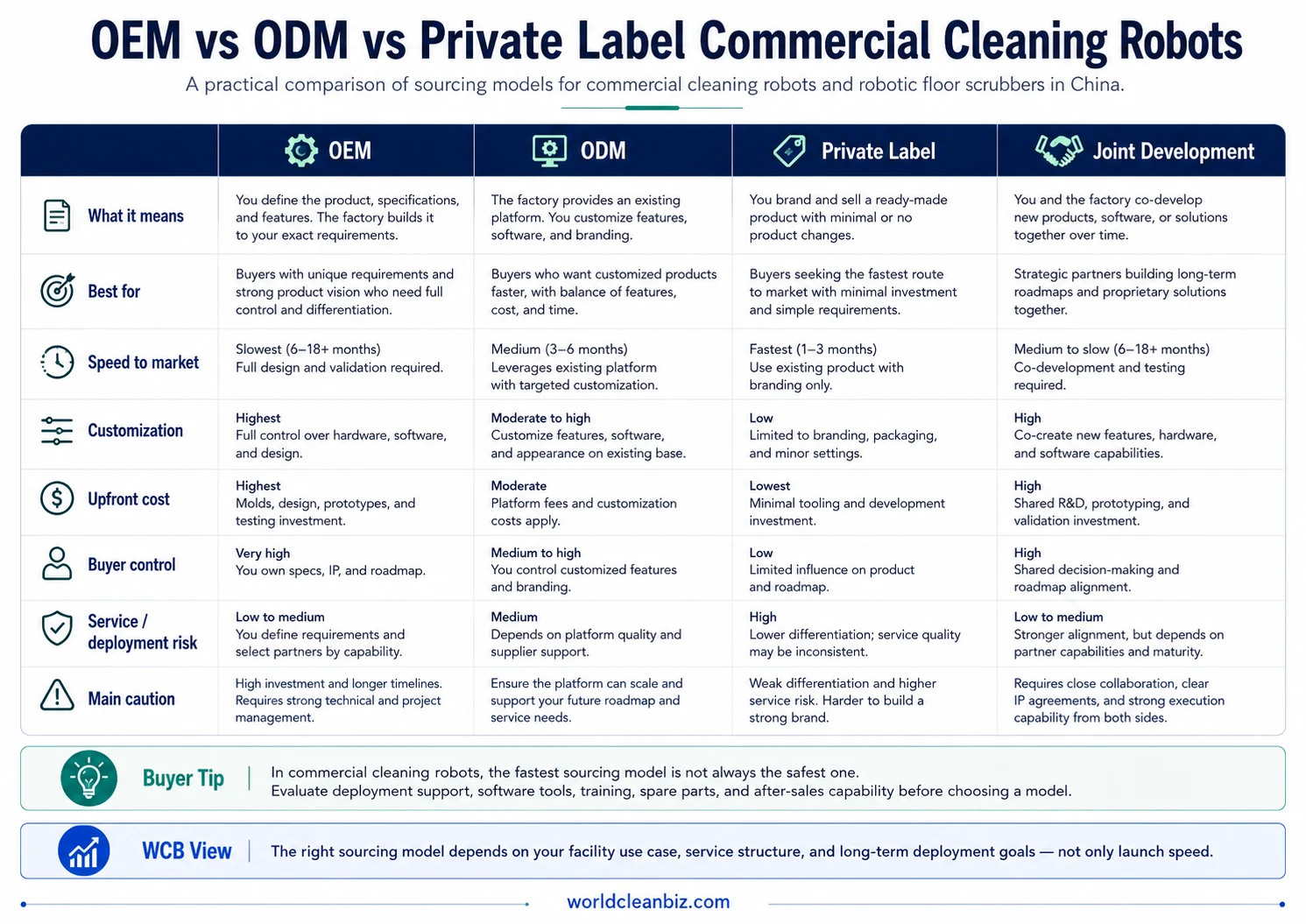
OEM means the buyer controls the product design, specifications, tooling, and often the product roadmap. The manufacturer produces according to buyer requirements. This route gives more control, but it usually requires more time, capital, engineering capability, and field testing.
ODM means the supplier already has an existing commercial cleaning robot platform. The buyer customizes design, branding, features, software options, packaging, or service configuration. This can be practical for buyers who need faster entry.
Private label is the fastest route. The buyer selects a ready-made robot, applies its own brand, and makes limited changes. It can help test the category, but it often creates weak differentiation and high service risk if the buyer lacks deployment capability.
Joint development is the deepest model. The buyer and supplier co-develop the robot platform, cleaning module, software, deployment process, and service model. This is best for serious brands, dealers, or service companies building long-term commercial cleaning automation capability.
Private label can help buyers enter the category quickly, but commercial cleaning robot buyers often underestimate deployment, training, maintenance, and service requirements.
How to Evaluate a Commercial Cleaning Robot Manufacturer or Supplier
A serious buyer should use a structured checklist before choosing a commercial cleaning robot supplier.
1. Verify the company type
Verify whether the company is a real manufacturer, brand owner, trading company, or distributor. Check business license, factory address, production lines, export history, and the relationship between the seller and the factory.
2. Check commercial cleaning robot or robotic floor scrubber experience
A supplier with only consumer robot experience may not understand commercial facility deployment.
3. Review navigation, mapping, and safety logic
Ask how the robot builds maps, plans routes, avoids people, handles obstacles, returns to charging, and recovers from errors.
4. Confirm software, firmware, and fleet management control
Commercial robots depend on software. Buyers should know who can fix bugs, update systems, and support customer reporting.
5. Understand component control
Buyers should understand whether the supplier controls key components or relies fully on outside modules, and which parts are designed, sourced, assembled, or outsourced.
6. Review real deployment cases or facility testing results
Demo videos are not enough. Ask for deployment experience by facility type if available.
7. Ask for cleaning and safety test data
Ask whether the supplier can provide test data for cleaning coverage, runtime, water recovery, obstacle avoidance, and safety behavior. Ask for test methods, not only claims.
8. Confirm operator training, maintenance, and spare parts support
A robot that cannot be serviced locally may become a long-term problem.
9. Review target-market compliance readiness
Depending on the market, buyers may need to consider electrical safety, EMC, battery transportation, wireless communication, machinery safety, and workplace safety expectations. For EU products, buyers can refer to official CE marking guidance. For connected products with radio functions, the U.S. market may involve FCC equipment authorization. For workplace robotics safety context, buyers can also review OSHA’s technical manual chapter on robot systems.
10. Check packaging, manuals, warranty handling, and service claims
Commercial equipment needs clear manuals, operator guides, maintenance documents, and support procedures.
11. Confirm stable production and service support capability
Scaling commercial robots requires both manufacturing consistency and service capacity.
Common Mistakes Buyers Make
Many sourcing problems begin before the buyer even contacts suppliers.
Choosing only by FOB price
A lower price can hide weaker navigation, poor water recovery, weak batteries, limited software, or poor service support.
Treating all commercial cleaning robots as similar
Two robots may both scrub floors, but their navigation, safety behavior, reporting, serviceability, and deployment readiness can be very different.
Overtrusting demo videos
A smooth video in an empty hallway does not prove the robot can work in a real facility.
Ignoring real facility deployment complexity
Malls, hospitals, warehouses, schools, and airports have different traffic, floors, obstacles, schedules, and safety requirements.
Ignoring safety behavior in public spaces
Robots working around people must be predictable, visible, and easy to stop.
Ignoring cleaning coverage and water recovery performance
Commercial customers need repeatable cleaning results and safe floors.
Ignoring operator training and service workflow
If facility staff cannot use, clean, charge, or troubleshoot the robot, deployment will fail.
Ignoring software, mapping, and fleet management
Commercial users often need reports, remote monitoring, route records, and error tracking.
Ignoring spare parts and maintenance costs
Brushes, squeegees, batteries, tanks, filters, wheels, sensors, and chargers all affect total cost.
Choosing a supplier before defining facility type and use case
A robot for a warehouse is not the same as a robot for a hospital or shopping mall.
Confusing a visible brand or marketplace seller with the actual manufacturer
Buyers should verify who controls production, software, testing, deployment, and service.
The biggest risk is not only choosing the wrong supplier. It is choosing a commercial cleaning robot concept that cannot perform in the buyer’s real facility environment.
What Makes Commercial Cleaning Robot Sourcing Different From Home Cleaning Products?
Commercial cleaning robots are harder to source than home cleaning appliances.
Facilities are larger and more complex. A home robot may clean a private room. A commercial robot may work in public areas with people, signs, carts, furniture, elevators, and changing layouts.
Public-space safety requirements are higher. A robot must behave safely around staff, visitors, patients, students, or shoppers.
Cleaning coverage must be repeatable and measurable. Commercial customers often want proof that the assigned area was cleaned.
Water recovery and floor safety matter. Poor water recovery can create slip risk and reduce customer trust.
Deployment, training, and maintenance are part of the product. A commercial robot is not finished when it leaves the factory.
Service support matters more than product appearance. Dealers and facility service companies need parts, troubleshooting, and support.
Fleet management and reporting may be required by customers. This is especially important for service companies managing multiple locations.
Real facility testing is essential. A robot should be tested in the type of facility where it will actually work.
Best Ways to Start Sourcing Commercial Cleaning Robots from China
A practical sourcing process should begin before supplier contact.
1. Define target facility type and cleaning use case
Decide whether you are targeting malls, offices, hospitals, schools, warehouses, airports, supermarkets, factories, or facility service companies.
2. Decide product positioning and price segment
Choose whether the product is entry-level, dealer-focused, service-company-oriented, premium, compact, large-area, or fleet-ready.
3. Choose robot type
Decide whether you need an autonomous floor scrubber, sweeping robot, vacuum robot, or hybrid model.
4. Choose sourcing model
Decide whether OEM, ODM, private label, or joint development fits your budget, timeline, and service capability.
5. Shortlist supplier types
Do not compare factories, trading companies, brand sellers, and software-led companies as if they have the same capability.
6. Request samples and test in real facility conditions
Test route planning, cleaning coverage, water recovery, safety behavior, obstacle handling, charging, operator use, and maintenance.
7. Compare cleaning performance, not only specifications
A robot with impressive specifications may still fail if coverage, water recovery, or route stability is weak.
8. Check navigation, safety, water recovery, runtime, and maintenance performance
These are core commercial deployment risks.
9. Check training, spare parts, and after-sales support
Ask how the supplier supports operators, dealers, service teams, parts, and warranty claims.
10. Visit or verify the supplier if possible
Factory and deployment verification help buyers understand real production, testing, engineering, and service capacity.
11. Compare total business cost, not only FOB price
Include defect risk, installation, training, service labor, spare parts, warranty, software support, shipping, and product life cycle.
How World Clean Biz Helps Buyers
World Clean Biz helps overseas buyers understand category changes, supplier capability, product opportunity, and China supply chain options before choosing suppliers.
For commercial cleaning robots, this means looking beyond catalog products. Buyers need to understand whether the category fits their customers, what facility type they are targeting, what service model is required, and which supplier type can support real deployment.
World Clean Biz supports buyers through product opportunity discovery, supplier screening, category intelligence, China supply chain connections, cleaning industry reports, and sourcing support. Buyers can also read our broader guide on how to find reliable cleaning product suppliers in China, review floor washer sourcing, compare robot vacuum sourcing, study cordless vacuum OEM sourcing, explore robotic lawn mower sourcing, or review robotic pool cleaner sourcing.
To understand the platform and industry network behind this work, read more about World Clean Biz. If you follow China’s cleaning industry events and supplier ecosystem, you can also follow World Clean Expo updates.
Sourcing commercial cleaning robots, robotic floor scrubbers, or other cleaning equipment from China? Contact World Clean Biz for sourcing support.
FAQ
Can I source commercial cleaning robots from China?
Yes. China has suppliers and manufacturers active in commercial cleaning robots, robotic floor scrubbers, components, navigation systems, batteries, electronics, and finished cleaning equipment. The key is verifying whether the supplier can support real facility deployment, not only product delivery.
What is the difference between a commercial cleaning robot manufacturer and a trading company?
A manufacturer may control production, engineering, quality testing, software, and service processes. A trading company may source products from factories and manage communication or export. Buyers should verify who controls the robot platform, software, spare parts, and after-sales support.
Should buyers choose OEM, ODM, or private label commercial cleaning robots?
Choose OEM if you have your own specifications and technical capability. Choose ODM if you want to customize an existing robot platform. Choose private label if speed matters more than differentiation. Choose joint development if you are building long-term commercial cleaning automation capability.
What should buyers check before sourcing robotic floor scrubbers?
Buyers should check navigation, safety behavior, cleaning coverage, scrubbing system, water recovery, battery runtime, charging model, software, reporting, spare parts, operator training, maintenance process, and after-sales support.
Why are navigation, safety, and deployment support important in commercial cleaning robot sourcing?
Commercial robots work in real facilities around people, obstacles, and changing layouts. Navigation keeps the robot productive, safety behavior protects users and visitors, and deployment support determines whether the robot can actually be used by facility staff.
What are the biggest risks when sourcing commercial cleaning robots from China?
The main risks include weak navigation, poor safety behavior, limited cleaning coverage, poor water recovery, weak software, insufficient training, lack of spare parts, unclear factory identity, and weak service support. Another major risk is choosing a robot that does not fit the target facility.
How do I evaluate the quality of a commercial cleaning robot supplier?
Verify whether the supplier is a real manufacturer, ODM developer, brand owner, or trading company. Then review its navigation platform, cleaning system, safety logic, software tools, deployment cases, test data, production process, spare parts policy, and service capability.
How can World Clean Biz help with commercial cleaning robot sourcing?
World Clean Biz helps buyers understand product direction, supplier types, facility use cases, category timing, and sourcing risks before supplier selection. If you are evaluating commercial cleaning robot manufacturers, robotic floor scrubber suppliers, ODM platforms, or private label options in China, you can contact World Clean Biz for sourcing support.
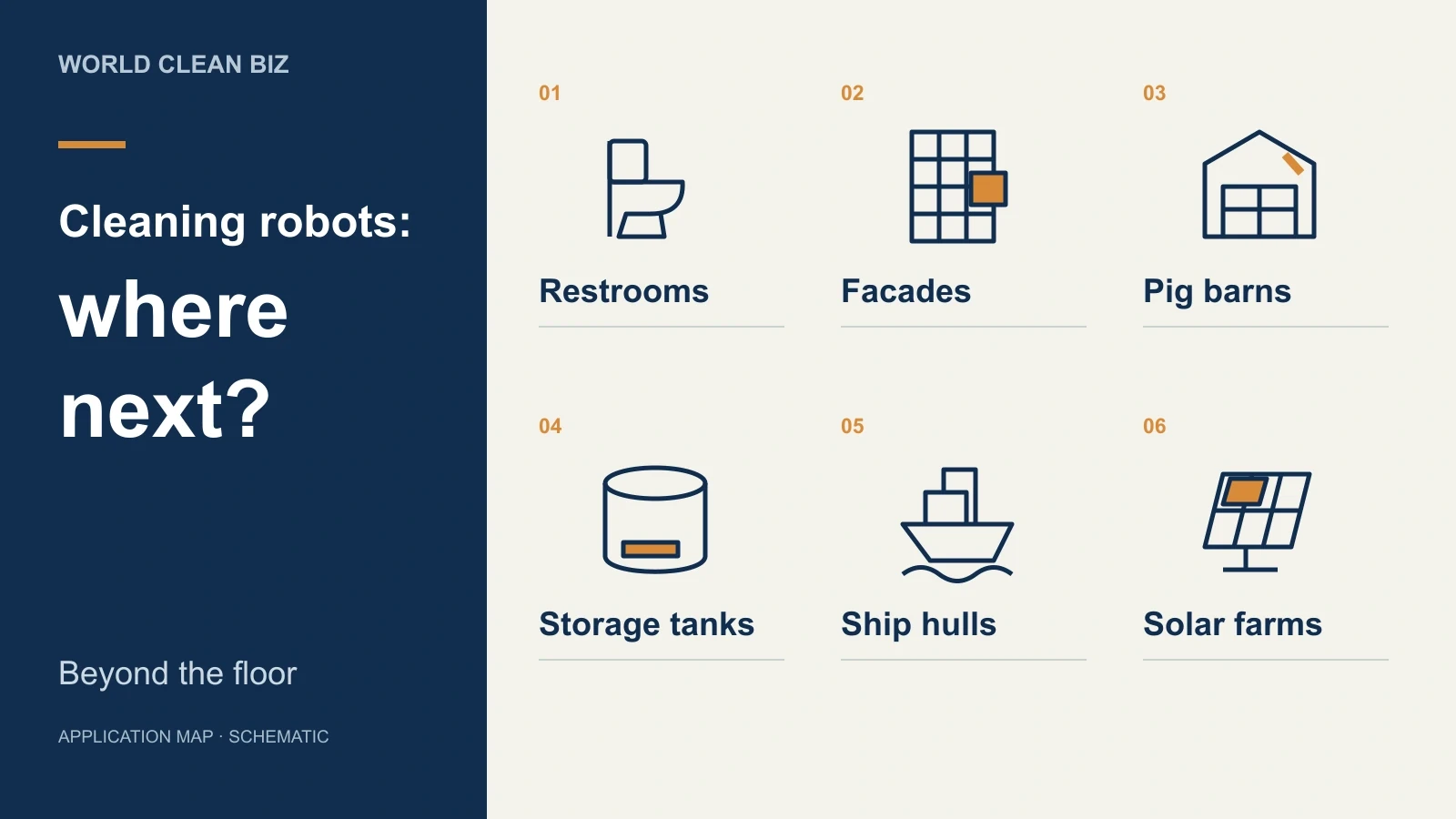
Before selecting a supplier, compare the six commercial cleaning robot opportunities by facility, deployment model, service route, and proof requirements.