In this article 14 sections
Should you buy directly from a Chinese factory, or work with a trading company or sourcing partner?
This is one of the most common questions overseas buyers ask when sourcing from China. But in cleaning appliances, the answer is not as simple as “factory is better” or “trading company is risky.”
A factory is not automatically better than a trading company. A trading company is not automatically bad.
The real question is different:
Which supplier structure matches your product complexity, order size, engineering needs, quality-control ability, target market, sales channel, and after-sales responsibility?
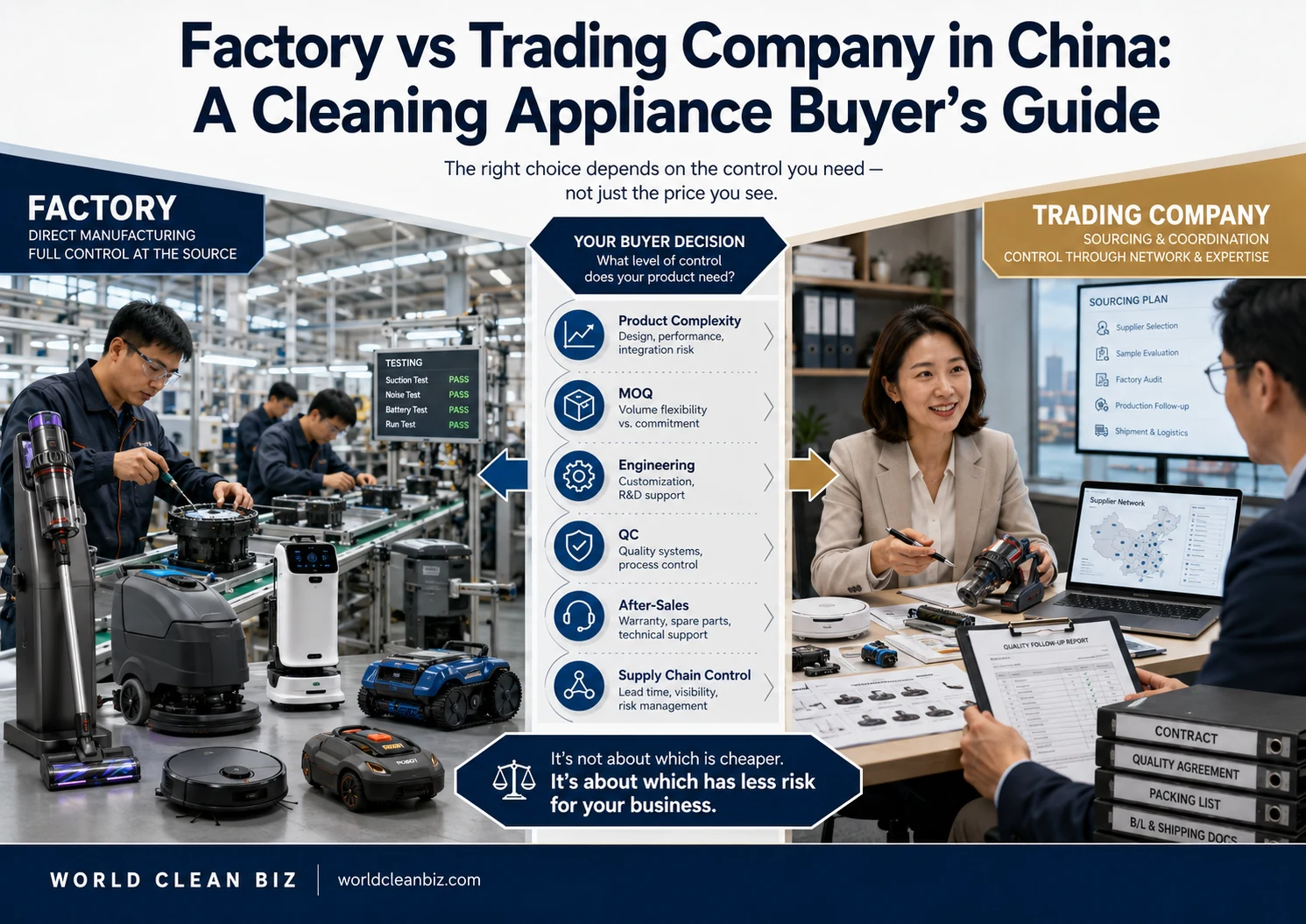
The decision is not factory vs trading company. The decision is what level of supply chain control the buyer actually needs.
For simple products, direct factory sourcing may be the most efficient route. For complex cleaning appliances, the lowest direct factory price may not be the lowest-risk sourcing path.
Cleaning appliances such as cordless vacuums, floor washers, robot vacuums, robotic pool cleaners, robotic lawn mowers, and commercial cleaning robots involve motors, batteries, water systems, sensors, software, firmware, filtration, sealing, spare parts, and warranty risks. The wrong supplier structure can create hidden cost even if the quoted price looks lower.
Quick Answer
Buying directly from a Chinese factory can make sense when the buyer has clear product specifications, enough order volume, sourcing experience, quality-control capability, and the ability to manage engineering, compliance, spare parts, and after-sales issues.
Working with a trading company or sourcing partner can make sense when the buyer needs supplier screening, communication support, smaller MOQ flexibility, product coordination, quality follow-up, or help comparing multiple factories. But buyers must verify whether the trading company actually controls supplier communication, QC, documentation, and after-sales support.
For cleaning appliances, the best supplier structure depends on product risk. A cordless vacuum, floor washer, robot vacuum, robotic pool cleaner, robotic lawn mower, or commercial cleaning robot may require very different levels of engineering support, testing, compliance readiness, and warranty handling.
If you are still building your sourcing approach, start with our guide on how to find reliable cleaning product suppliers in China. If you already have supplier candidates, use this article to judge whether a factory, trading company, sourcing partner, ODM supplier, or hybrid structure fits your business.
Why This Question Matters in Cleaning Appliances
In many product categories, the factory vs trading company question is mainly about price and control. Buyers often assume that buying directly from a factory means lower cost, better transparency, and fewer middlemen.
Sometimes that is true.
But in cleaning appliances, supplier structure affects much more than price. It affects product development, sample testing, quality control, compliance, documentation, spare parts, warranty handling, and long-term product iteration.
A factory may have strong production capability but weak export communication. It may be good at one category but not another. It may produce a good sample but lack the engineering team to support product changes. It may offer a low price but provide limited after-sales support.
A trading company may add margin, but it may also provide value if it can coordinate multiple factories, manage communication, support smaller buyers, follow up production, organize inspections, and help buyers avoid weak suppliers. The problem is not the trading company model itself. The problem is working with an intermediary that does not control quality, engineering communication, documentation, or after-sales responsibility.
Cleaning appliance buyers need to ask a more practical question:
Who can reduce the real sourcing risk?
That risk may come from product design, supplier mismatch, poor testing, weak compliance support, component changes, spare parts shortages, warranty claims, or wrong product positioning.
For cleaning appliances, supplier structure is not a purchasing detail. It is part of the business model.
WCB Market Note
The factory vs trading company question is becoming more important because cleaning appliance sourcing is no longer only about finding production capacity. Buyers are sourcing products with higher technical, compliance, quality-control, and after-sales risk. A cordless vacuum depends on motor, battery, filtration, brush head, and spare parts. A floor washer depends on water management, roller cleaning, leakage control, odor prevention, and warranty handling. A robot vacuum or commercial cleaning robot depends on navigation, software, firmware, sensors, docking, and service support.
Buyer implication: Buyers should not choose a factory only because the quoted price is lower; they should check whether they can manage the work the factory does not handle.
Buyer implication: Buyers should not choose a trading company only because communication is easier; they should verify whether the intermediary can actually control supplier selection, product risk, quality follow-up, and service responsibility.
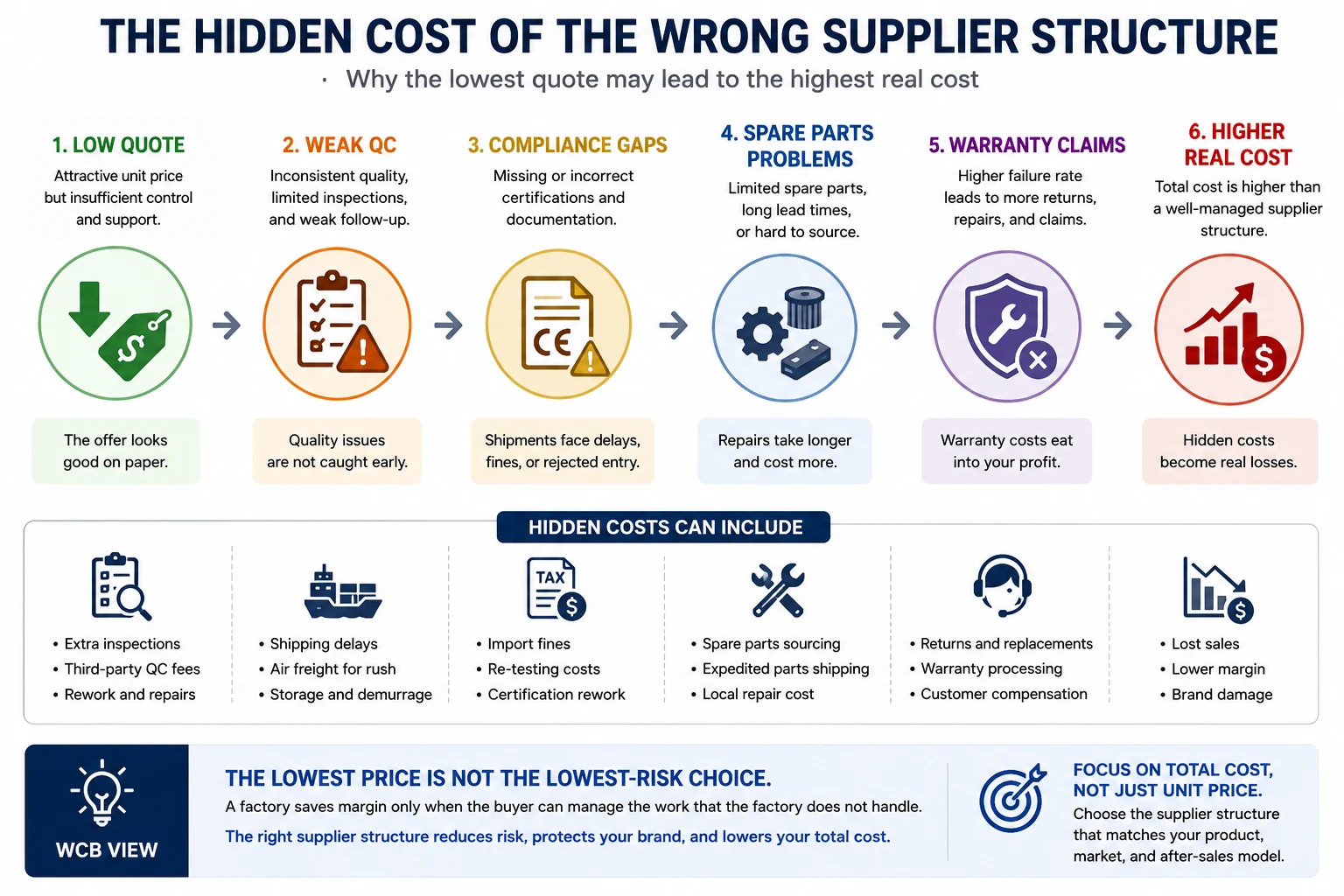
WCB view: In cleaning appliances, the lowest direct factory price may not be the lowest-risk sourcing path. A factory saves margin only when the buyer can manage the work that the factory does not handle. Supplier structure should be chosen based on product complexity, buyer capability, and after-sales burden.
What Is a Chinese Factory?
A Chinese factory is a company that directly manufactures products or key parts of the product. It may own production lines, tooling, assembly workers, testing equipment, engineering staff, and quality-control processes.
In cleaning appliances, factories can vary widely.
Some factories are true product developers with engineering teams, ODM platforms, testing labs, export experience, and category-specific know-how. Others are mainly assembly plants that rely on outside component suppliers, outside design houses, or customer-provided specifications.
A factory may specialize in one category, such as cordless vacuums, floor washers, motors, batteries, brush rollers, pumps, robot modules, plastic parts, or commercial equipment. Another factory may offer many product categories but have limited depth in each one.
Working directly with a factory can give buyers more transparency and control, especially when the buyer has clear specifications, enough order volume, and the ability to manage technical communication.
But direct factory sourcing also means the buyer may need to handle more work:
- Product specifications
- Technical discussion
- Sample testing
- Quality-control planning
- Compliance checking
- Production follow-up
- Spare parts and warranty planning
For experienced buyers, this can be an advantage. For smaller buyers or buyers entering a new category, it can become a risk.
What Is a Chinese Trading Company?
A Chinese trading company is a company that sources products from factories and sells them to overseas buyers. It may not own the factory that produces the product.
But trading companies are not all the same.
Some are simple resellers. They forward catalogs, add margin, and manage basic communication. Others are more specialized sourcing partners that understand product categories, maintain factory networks, coordinate samples, manage production follow-up, organize inspections, and help buyers communicate with factories.
In cleaning appliances, a trading company or sourcing partner may be useful when buyers need:
- Smaller MOQ support
- Multi-category sourcing
- Factory comparison
- Better English communication
- Export documentation support
- Sample coordination
- Supplier screening
- Quality follow-up
- Product matching across different factories
The risk is that some trading companies do not control the product. They may not understand the engineering details, may not have direct influence over quality control, and may disappear when warranty problems appear.
A trading company is valuable only if it adds control, not just communication. If it only forwards messages and hides the real factory, it may increase sourcing risk rather than reduce it.
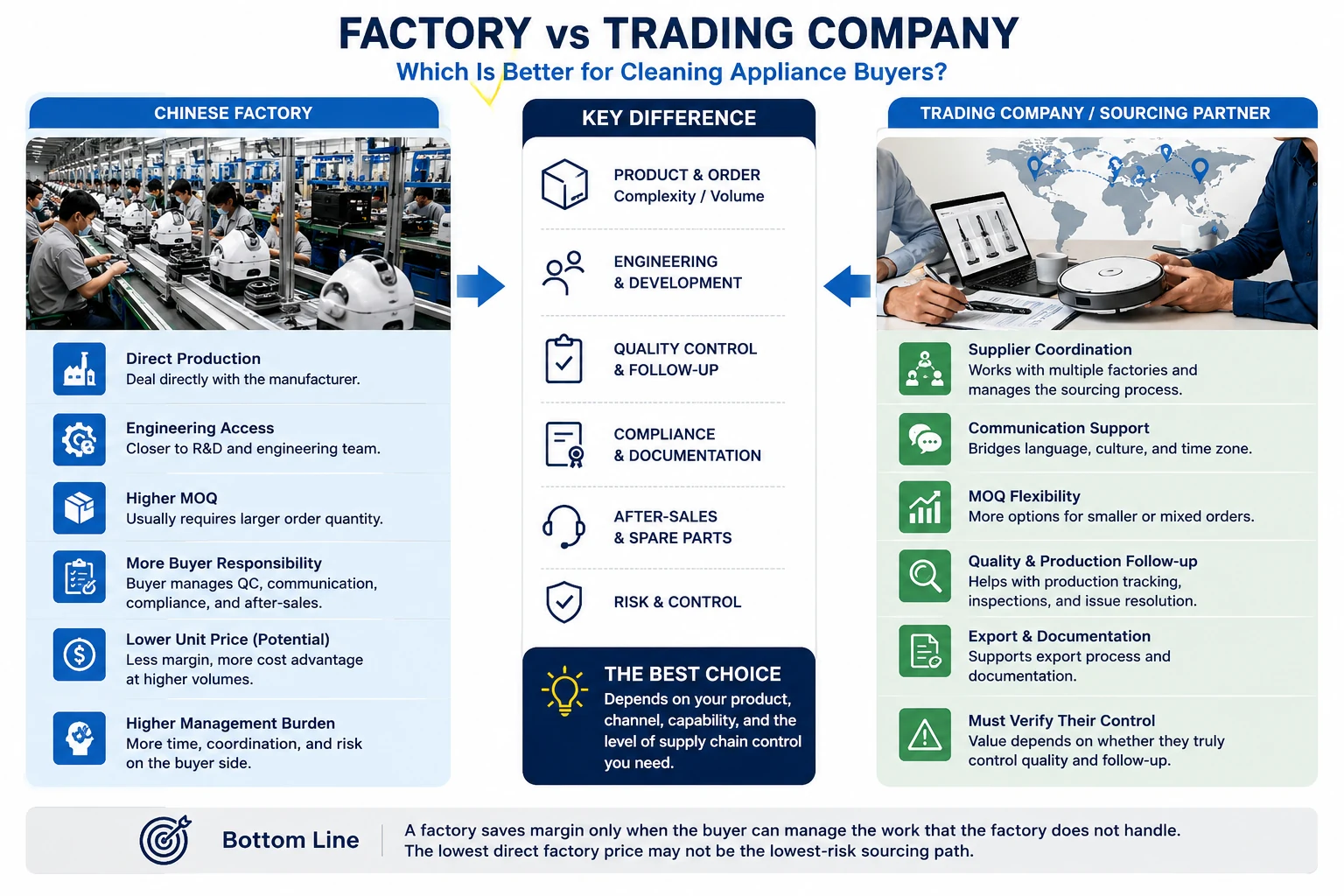
Factory vs Trading Company: Key Differences for Cleaning Appliance Buyers
For cleaning appliance buyers, the difference between a factory and a trading company is not only about price.
It affects how much control the buyer has, how quickly problems can be solved, who understands the product, and who takes responsibility when something goes wrong.
Factories may offer stronger production access and direct engineering communication. But they may also require higher MOQ, stronger buyer-side project management, and more direct responsibility from the buyer.
Trading companies may offer better communication, smaller order flexibility, and supplier coordination. But they may also create weaker technical transparency if they do not control the factory relationship.
The practical question is:
Which structure gives the buyer the best balance of price, control, technical support, communication, flexibility, and after-sales responsibility?
For simple cleaning tools, the answer may be straightforward. For cleaning appliances, the answer depends heavily on category complexity.
A buyer sourcing a basic private label vacuum accessory has different needs from a buyer sourcing a robot vacuum platform, a floor washer, a robotic pool cleaner, or a commercial cleaning robot.
When Working Directly With a Factory Makes Sense
Working directly with a Chinese factory can make sense when the buyer has enough capability to manage the project.
This route is usually better when:
- The buyer has clear product specifications.
- The order volume is large enough for the factory.
- The product category is already understood by the buyer.
- The buyer can manage technical discussions.
- The buyer has quality-control resources.
- The buyer can handle compliance verification.
- The buyer can manage spare parts and warranty planning.
- The buyer wants long-term product development with the supplier.
Direct factory sourcing is often suitable for established importers, appliance brands, distributors with technical teams, or buyers with experience in the category.
For example, a buyer sourcing cordless vacuums may prefer a direct OEM factory if it already understands motor performance, battery options, filtration, suction testing, brush head design, and target price bands. A buyer sourcing floor washers may prefer a factory with proven experience in water systems, brush rollers, tank design, leakage control, self-cleaning, and drying.
Direct factory sourcing also makes sense when the buyer wants more control over product specifications, packaging, quality standards, component selection, and long-term iteration.
But direct sourcing is not free. The buyer must be ready to manage details. If the buyer lacks technical knowledge or category experience, a low factory price can hide high execution risk.
When a Trading Company or Sourcing Partner Can Make Sense
A trading company or sourcing partner can make sense when the buyer needs coordination, not just production.
This may be useful when:
- The buyer is entering a new cleaning appliance category.
- The buyer needs to compare several supplier types.
- The buyer has a smaller initial order.
- The buyer needs better communication support.
- The buyer needs help screening factories.
- The buyer needs sample coordination.
- The buyer is sourcing multiple related products.
- The buyer does not have a China sourcing team.
- The buyer needs help managing production follow-up or inspection.
A good sourcing partner can help buyers avoid wasting time with unsuitable suppliers. It can also help compare factory claims, identify category risks, and organize communication across engineering, sales, QC, and export teams.
But the buyer should still ask hard questions:
- Which factories are involved?
- Can the intermediary arrange direct technical communication?
- Who is responsible for quality problems?
- Who controls sample approval?
- Who checks compliance documents?
- Who handles spare parts and warranty claims?
- How is margin built into the price?
A trading company is useful only if it reduces sourcing risk. If it only forwards information and hides the factory, it may increase risk.
Why Cleaning Appliances Are Different From Simple Consumer Goods
Cleaning appliances are not simple products to source.
A basic household item may be evaluated mainly by material, appearance, packaging, price, and simple function. Cleaning appliances require a deeper check because the product must perform repeatedly under real user conditions.
Cordless vacuums involve motors, battery packs, filtration, suction, airflow, brush heads, noise, heat, and accessories. Buyers should not choose only by catalog suction claims. For more category-specific detail, see our guide to cordless vacuum cleaner OEM manufacturers in China.
Floor washers and wet dry vacuums involve suction, water flow, dirty water recovery, roller cleaning, tank design, leakage, odor control, drying, and consumables. Buyers sourcing this category can refer to our guide on floor washer manufacturers in China.
Robot vacuums involve navigation, obstacle avoidance, app control, docking, mopping, firmware, spare parts, and after-sales support. Buyers can read our guide on how to source robot vacuum cleaners from China.
Robotic pool cleaners, robotic lawn mowers, and commercial cleaning robots add even more risk because they involve waterproofing, outdoor use, terrain, safety, navigation, deployment, maintenance, and service capability.
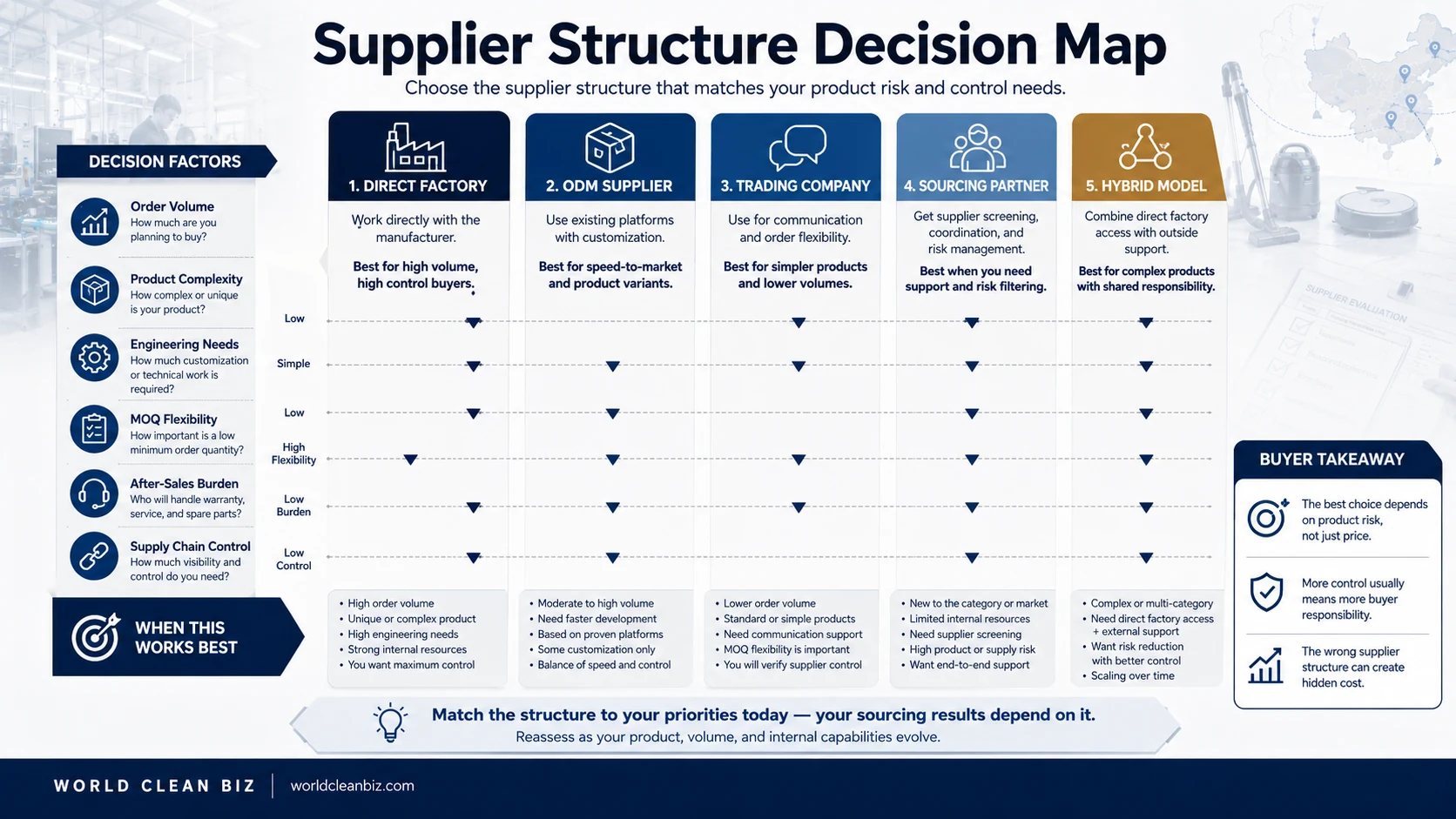
This is why supplier structure matters. The buyer needs to know whether the chosen factory, trading company, ODM supplier, or sourcing partner can actually manage the product risk.
OEM, ODM, Private Label, and Supplier Type: How They Connect
Factory vs trading company is only one layer of the sourcing decision. Buyers also need to understand the sourcing model.
OEM, ODM, private label, and joint development are different ways to work with suppliers. They can overlap with factory or trading company structures.
For a deeper explanation, see our guide to OEM vs ODM cleaning products.
In simple terms:
- OEM means the buyer provides specifications or design, and the supplier manufactures according to them.
- ODM means the supplier has an existing product platform that the buyer can customize.
- Private label means the buyer applies branding to an existing or lightly modified product.
- Joint development means the buyer and supplier work together to develop a more differentiated product.
A factory can be an OEM manufacturer. It can also be an ODM supplier. A trading company may sell private label products from multiple factories. A sourcing partner may help the buyer compare OEM and ODM options across different suppliers.
The buyer should not confuse supplier type with sourcing model.
For example, working directly with an ODM factory may be useful when the buyer wants faster launch using an existing platform. But it may create product overlap with other buyers. Working with a trading company may be useful for private label testing, but it may not be enough for long-term product differentiation.
The best structure depends on product complexity, differentiation needs, order size, channel expectations, and after-sales responsibility.
Common Buyer Mistakes
The first mistake is assuming factories are always better. A factory can be strong in production but weak in communication, export support, product strategy, documentation, or small-buyer flexibility.
The second mistake is assuming trading companies are always bad. Some trading companies are only resellers, but others provide useful sourcing coordination, supplier screening, sample management, and quality follow-up.
The third mistake is choosing by price before understanding product risk. The lowest quote may not include engineering support, testing, compliance readiness, spare parts, or warranty handling.
The fourth mistake is confusing an online seller with the actual manufacturer. A visible product listing does not prove who controls production or engineering.
The fifth mistake is choosing a supplier structure before defining the product. Buyers should first define target market, price band, channel, product positioning, sourcing model, and after-sales responsibility.
The sixth mistake is treating cleaning appliances like simple goods. Products involving technical, compliance, quality-control, and after-sales risk need deeper evaluation.
The biggest mistake is asking “factory or trading company?” before asking “what product risk am I trying to manage?”
Factory vs Trading Company Comparison Table
| Evaluation Area | Factory | Trading Company / Sourcing Partner | Buyer Judgment |
|---|---|---|---|
| Price transparency | May offer more direct pricing, especially at larger volume | May include margin or service fee | Direct price is useful only if the buyer can manage risk |
| Product engineering | Stronger if the factory has real category R&D | Usually depends on factory partners | For technical products, verify who controls engineering |
| MOQ flexibility | Often higher MOQ, especially for customization | May support smaller orders or mixed sourcing | Smaller buyers may need flexibility more than direct pricing |
| Communication | Can be direct but sometimes less buyer-friendly | Often stronger in English and project coordination | Good communication reduces execution risk |
| Quality control | Factory controls production process | May coordinate QC but may not own the process | Buyers must know who is responsible for defects |
| Compliance support | Strong if the factory exports the same product to target markets | Varies by sourcing partner capability | Check whether documents match the exact product |
| Spare parts | Better if the factory manages product lifecycle | Depends on relationship with factory partners | Spare parts responsibility must be defined in writing |
| After-sales handling | Can be direct but may be limited for overseas service | May help coordinate claims if properly managed | Warranty responsibility matters more than supplier label |
| Product differentiation | Stronger for OEM or joint development with capable factory | May be limited if sourcing existing products | Private label speed can create weak differentiation |
| Small buyer suitability | May be less flexible on MOQ and customization | Often more flexible for first orders | Small buyers may need coordination and risk filtering |
| Long-term development | Strong if both sides invest in product roadmap | Useful if partner manages supplier network well | Long-term fit depends on trust, capability, and product strategy |
How World Clean Biz Helps Buyers Choose the Right Supplier Structure
World Clean Biz does not treat factory vs trading company as a simple yes-or-no question. The real question is what level of supply chain control the buyer needs for the product, channel, and after-sales model.
For cleaning appliance buyers, WCB helps evaluate product opportunity, supplier structure, category risk, OEM/ODM fit, and China supply chain options before choosing factories or intermediaries.
This includes understanding whether the buyer should work directly with a factory, compare ODM platforms, use a sourcing partner, start with private label, or build a longer-term OEM or joint-development relationship.
Buyers can also use our related guides to build a clearer sourcing framework:
- How to find reliable cleaning product suppliers in China
- How to evaluate a Chinese cleaning appliance supplier
- OEM vs ODM cleaning products
For broader category research, explore our cleaning industry reports. To understand the people and industry network behind this platform, read more about World Clean Biz. If you follow China’s cleaning industry events and supplier ecosystem, you can also follow World Clean Expo updates.
If you are deciding whether to work with a factory, trading company, ODM supplier, or sourcing partner, contact World Clean Biz for sourcing support.
FAQ
Is it better to buy directly from a Chinese factory?
Buying directly from a Chinese factory can be better when the buyer has clear specifications, enough order volume, sourcing experience, quality-control ability, and the capacity to manage communication, compliance, spare parts, and after-sales issues.
But direct factory sourcing is not always lower risk. If the buyer lacks category knowledge or project management ability, a low factory quote can create hidden cost later.
Are Chinese trading companies bad for cleaning appliance buyers?
No. Chinese trading companies are not automatically bad. Some are simple resellers, but others provide useful sourcing coordination, factory comparison, communication support, sample management, and quality follow-up.
The key is whether the trading company adds real control and transparency. If it hides the factory, cannot answer technical questions, or avoids responsibility for quality and after-sales issues, the buyer should be cautious.
How do I know if a supplier is a factory or trading company?
Ask directly, but do not stop there. Request business license information, factory address, production photos, product ownership details, and permission for factory verification or video audit.
Also ask who owns tooling, who controls engineering, who manages QC, and who handles warranty claims. A real factory should be able to explain production and technical details clearly.
When should I choose a factory instead of a trading company?
Choose a factory when you need direct control, larger volume, clear specifications, product customization, long-term development, and direct engineering communication.
This is especially important for more technical cleaning appliances where product performance, testing, component control, and after-sales responsibility must be managed closely.
When can a trading company or sourcing partner be useful?
A trading company or sourcing partner can be useful when the buyer needs supplier screening, communication support, smaller MOQ flexibility, multi-category sourcing, sample coordination, or help comparing factories.
It can also be useful when the buyer is entering a new category and needs help understanding which supplier type fits the product risk.
Is an ODM supplier the same as a factory?
Not always. An ODM supplier may be a factory with its own product development capability, or it may coordinate production through partner factories.
The important question is who owns the product platform, who controls engineering, who manages production, and who supports quality and after-sales issues.
What is the biggest risk when choosing between a factory and trading company?
The biggest risk is choosing based only on price or supplier label. A factory is not automatically safer, and a trading company is not automatically weaker.
The real risk is choosing a supplier structure that does not match product complexity, buyer capability, target market, quality requirements, and after-sales responsibility.
Can World Clean Biz help buyers choose the right supplier structure?
Yes. World Clean Biz helps buyers evaluate whether a factory, trading company, sourcing partner, OEM supplier, ODM supplier, private label option, or joint-development model fits their cleaning appliance sourcing goals.
The goal is not only to find supplier names. It is to help buyers understand product opportunity, supplier capability, category risk, and China supply chain options before making sourcing decisions. If you need support, you can contact World Clean Biz.