- A robot-vacuum distribution agreement is a hardware, software, service and inventory commitment—not a simple discount from retail price.
- Calculate contribution margin after promotions, returns, warranty, parts, support, cloud obligations and obsolete stock; headline gross margin can be misleading.
- Do not accept exclusivity until territory, channels, performance targets, price protection, model transitions, customer-data roles and exit inventory are written clearly.
In this article 16 sections
A strong robot-vacuum distribution deal combines a competitive product line with protected territory, reliable regional software, compliant documentation, controlled returns, repairable hardware and contribution margin that survives promotions. Do not sign from a price list and brand deck alone.
Robot vacuums are connected appliances. The distributor is not only moving cartons; it may become the local owner of app setup, firmware incidents, consumer returns, batteries, water-system failures, spare parts and regulatory communication.
Distribution Is Not OEM or ODM
A distributor buys finished branded products and resells them in an agreed market. The brand normally controls industrial design, trademarks, app, cloud, firmware and roadmap. The distributor contributes local inventory, sales, retail access, marketing, customer support and sometimes repair.
An OEM or ODM program creates a product for the buyer’s own brand. It gives more control over assortment and channel, but also requires product definition, certification, packaging, app ownership and a larger operational system.
Choose distribution when:
- the brand already creates consumer demand;
- its product line fits the target retail channels;
- the app and cloud work in the market;
- the supplier supports regional marketing and service;
- launch speed matters more than product exclusivity.
Choose OEM/ODM when:
- channel customers need a differentiated brand or price point;
- the buyer can fund development, testing, tooling and inventory;
- the buyer is prepared to own software and compliance decisions;
- an existing brand cannot offer acceptable territory or margin.
Our robot vacuum OEM/ODM guide covers that separate path.
Define the Target Market Before Selecting a Brand
“We need a robot-vacuum brand” is not a strategy. Define the customer, channel and price architecture first.
For each target segment, document:
- home size and floor mix;
- pet ownership and carpet prevalence;
- need for mopping and plumbing;
- willingness to maintain a dock;
- expected retail price and financing;
- marketplace, specialist retail, mass retail or installer channel;
- local language, voice assistant and payment expectations;
- repair access and acceptable turnaround;
- replacement-part availability;
- data and privacy sensitivity.
A flagship all-in-one dock may create traffic in premium electronics retail but generate costly reverse logistics for a price-led online seller. A simple vacuum-only robot can have lower average selling price yet better contribution if returns and support remain controlled.
Build a Good-Better-Best Product Line
One hero SKU is rarely enough. A distributor needs a coherent ladder.
Good
An entry mapping robot with dependable vacuuming, basic app control and a simple charging or auto-empty dock. It should create an accessible price without using obsolete navigation that damages reviews.
Better
A stronger brush and obstacle system, better carpet behavior, self-emptying and optional mopping. This tier often balances volume and service risk.
Best
An advanced vacuum-and-mop system with pad or roller washing, hot-water or hot-air functions, larger batteries and premium obstacle handling. It creates differentiation but adds pumps, heaters, water seals, detergents and expensive return freight.
For every tier, identify a reason to trade up that a shopper can understand. Avoid a line where five nearly identical SKUs differ only by claimed suction.
Brand Due Diligence
A brand’s online visibility is useful, but a distributor should investigate the operating company.
Request:
- legal entity, ownership and trademark evidence;
- audited or credible management accounts where appropriate;
- current distributors and reference contacts;
- product-liability insurance;
- quality system and factory-audit process;
- recall and field-action history;
- cybersecurity contact and incident process;
- roadmap for 24 months;
- parts and firmware support after discontinuation;
- authorization to sell through each planned channel.
Compare public brand promises with the agreement. A presentation may promise “full marketing support,” while the contract provides no budget, asset deadline or approval service level.
Review current and historical product pages. Rapid SKU turnover can create excitement and inventory risk. Ask how the supplier protected distributors when a successor launched early or retail price dropped.
Territory and Channel Protection
Territory must be more precise than a country name.
Define:
- physical retail, owned website and third-party marketplaces;
- cross-border ecommerce and traveler warranty;
- direct sales by the brand;
- global marketplace sellers delivering into the territory;
- B2B, hospitality, property management and commercial projects;
- duty-free, television shopping and corporate gifts;
- repair-only and refurbished channels;
- reserved key accounts.
Exclusivity normally requires performance. The agreement should state whether targets use orders, shipments, paid sell-in or verified sell-through. A target based only on distributor purchases can create excess inventory while hiding weak consumer demand.
Also define:
- measurement period and currency;
- launch delays and supplier stockouts;
- target adjustment after price or roadmap changes;
- cure period before exclusivity is removed;
- treatment of unauthorized sellers;
- evidence and remedy for channel conflict.
Pricing policies, minimum advertised price and resale restrictions can be regulated differently by market. Use local competition counsel; do not copy a global clause into every country.
App, Cloud and Data Due Diligence
Hardware samples can work while the commercial launch fails because the software region is incomplete.
Test the exact production app from the local app store. Verify:
- account registration with local phone numbers and email;
- supported language and translation quality;
- map creation, editing and multi-floor behavior;
- home sharing and account transfer;
- Wi-Fi bands and router compatibility;
- voice-assistant availability;
- camera and remote-view controls;
- cloud region and privacy notice;
- data deletion and product factory reset;
- firmware release, rollback and support workflow;
- offline behavior during an internet outage;
- server availability and service-level commitments.
Create a responsibility matrix:
| Event | Brand | Distributor | Retailer |
|---|---|---|---|
| App registration failure | Platform fix and logs | Local triage and translation | First contact if sold in store |
| Firmware defect | Root cause, patch, release note | Impact list and customer communication | Stop-sale or exchange process |
| Cloud outage | Status and recovery | Local update | Customer expectation management |
| Account/privacy request | Tools and data process | Local routing | Verify customer channel |
| Returned connected unit | Reset instructions | Verify wipe and refurbish | Capture account-removal consent |
The contract should not make the distributor responsible for fixing code it cannot access.
Compliance and Product Documentation
Compliance follows the destination market and the distributor’s legal role. Importing a branded product does not automatically transfer responsibility back to the foreign supplier.
For the United States, the Consumer Product Safety Commission explains that manufacturers, importers, distributors and retailers can have product-safety and reporting duties. For products subject to applicable consumer-product rules, the domestic manufacturer or importer is responsible for the General Certificate of Conformity and must furnish it to distributors and retailers.
Build a market-specific checklist covering, as applicable:
- electrical and charging safety;
- lithium battery cell and pack evidence;
- transport testing and dangerous-goods documents;
- radio and electromagnetic requirements;
- restricted substances and chemical disclosures;
- cleaning liquids and safety data;
- labeling, manuals and warnings;
- recycling, battery and electronic-waste obligations;
- privacy and connected-device requirements;
- product registration, incident and recall processes.
Verify report numbers, model identifiers, factory names and critical components. A test report for a similar charger or earlier battery pack is not evidence for the shipped configuration.
This is a due-diligence framework, not legal advice. Confirm the current rules with the relevant authority, laboratory and local counsel.
Sample Testing Before the First Order
Use production-equivalent units, not only hand-built demonstration samples. Test at least one unit from each commercial SKU and preferably multiple units from the pilot batch.
Navigation and obstacles
- map speed and room segmentation;
- recovery after relocation;
- cords, socks, dark objects and reflective furniture;
- low furniture and thresholds;
- stairs and no-go zones.
Vacuuming
- hard-floor fine dust and large particles;
- carpet and rug edges;
- short and long hair;
- main-brush and side-brush tangles;
- bin sealing and filter loading.
Mopping and water
- uniform water flow;
- edge performance and carpet lift;
- dried stain and clean-floor redeposition;
- dock wash, drying and odor;
- leak, pump and dirty-water detection.
Dock
- docking success;
- dust transfer with a full hair load;
- bag or cyclone sealing;
- wash cycles and tank sensors;
- power consumption, sound and heat.
Software
- local accounts and app stores;
- firmware update and failed-update recovery;
- map backup or transfer;
- factory reset and refurbished-unit workflow;
- customer-support log export.
Convert failures into an acceptance standard. “Supplier will improve later” is not a gate.
MOQ, Forecast and Payment
MOQ should reflect sell-through and service capacity, not only the supplier’s container economics.
Break the order into:
- saleable units by SKU and color;
- free demonstration units;
- DOA replacement stock;
- warranty swap stock;
- repair parts;
- consumables;
- retail displays and packaging;
- launch marketing assets.
Negotiate a forecast process with frozen, flexible and indicative windows. Define what happens if the supplier ships late, changes a component, updates packaging or discontinues a SKU.
Payment terms should align risk. A new relationship may require a deposit, but the balance should be tied to agreed inspection, documents and shipping milestones. Avoid paying all commercial risk before production evidence exists.
Calculate Contribution Margin
Headline margin is usually:
`(Retail price – distributor buy price) / retail price`
That number is inadequate. Use:
`Net sales – landed product cost – channel fees – fulfillment – promotion – return cost – warranty reserve – support – software/localization – parts – inventory write-down`
Model at least three cases:
| Input | Base | Pressure | Severe |
|---|---|---|---|
| Average selling price | Planned | Promotion-heavy | Successor-driven discount |
| Return rate | Normal launch | Elevated | Major software or leak issue |
| Warranty cost | Historical evidence | New-model uplift | Field action |
| Inventory days | Target | Slow | Obsolete stock |
| Parts freight | Consolidated | Frequent | Airfreight shortage |
Separate entry robots from all-in-one docks. A heavy dock creates different freight, damage, repair and refurbishment economics.
Promotions, Price Protection and Inventory
Robot-vacuum pricing can move quickly around shopping events and product launches.
The agreement should define:
- who approves promotions;
- who funds discounts and coupons;
- claim documentation and payment timing;
- price protection for inventory bought at an earlier cost;
- treatment of brand-direct discounts;
- successor launch notice;
- stock rotation or buyback;
- refurbished and open-box policy.
Without price protection, the distributor may finance the launch and absorb the markdown when the brand cuts direct retail pricing.
Track serial-number sell-in and sell-through. Marketplace revenue alone cannot show whether channel inventory is healthy.
Returns, DOA and Warranty Reserve
Create reason codes before launch:
- buyer remorse;
- setup or Wi-Fi failure;
- map/navigation dissatisfaction;
- cleaning performance;
- hair tangle;
- water leak or pump;
- dock transfer;
- cosmetic or shipping damage;
- firmware or account;
- contaminated return.
Measure no-fault-found separately. A unit returned for “does not connect” may need better onboarding rather than a hardware swap.
Define DOA days, evidence, freight payer, credit timing and whether a replacement comes from distributor stock. For warranty, state:
- coverage by component;
- battery and consumable exclusions;
- repair attempt limits;
- labor reimbursement;
- replacement ownership;
- data reset and privacy;
- contaminated-unit handling;
- spare-unit replenishment.
Create a reserve from model-level evidence. Do not accept a single global return percentage across simple robots and complex water docks.
Parts and Repair Network
Consumables generate repeat sales; unavailable parts generate bad reviews.
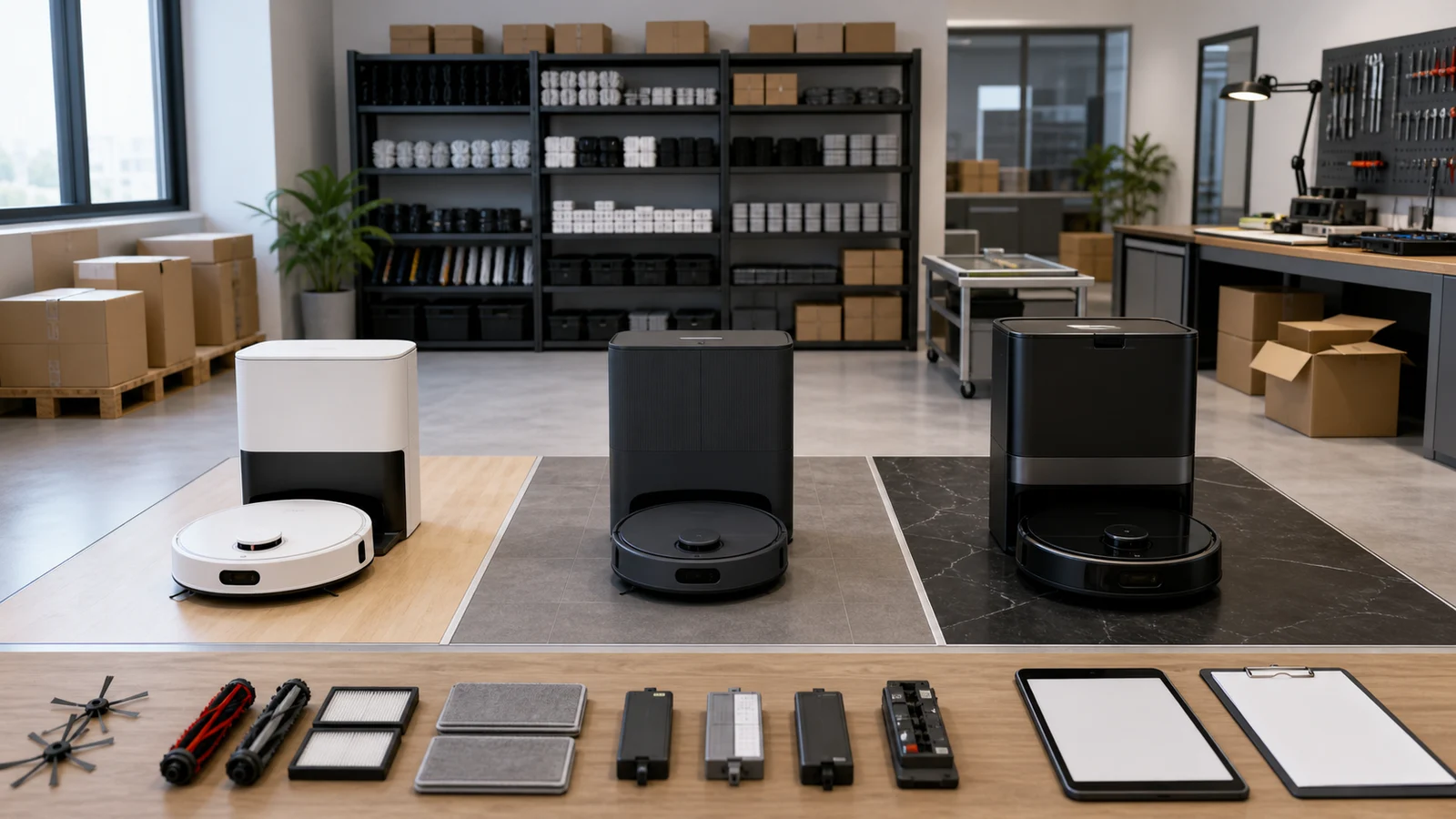
Obtain a priced bill of service parts:
- brushes, filters, bags, pads and rollers;
- wheels, caster and brush modules;
- battery and charging contacts;
- pumps, valves, heaters and sensors;
- clean/dirty tanks and seals;
- dock dust motor and duct;
- boards, cameras and LiDAR modules;
- cables and power supplies.
Define which parts a customer can replace, which need a trained technician and which require whole-unit exchange. Request manuals, diagnostic software, error-code definitions, training and repair-time standards.
The self-emptying robot vacuum market guide helps estimate how dock architecture changes parts and service.
Contract and Exit Terms
Plan the end before signing.
The contract should address:
- term, renewal and termination;
- unsold inventory and successor models;
- continuing warranty obligations;
- customer data and account support;
- use of trademarks after termination;
- spare-parts supply;
- open purchase orders;
- marketing-fund claims;
- confidentiality and local customer lists;
- dispute forum and applicable law.
If the brand exits the market, customers still need filters, batteries, firmware and warranty. Require a transition plan.
Distributor RFQ Checklist
- Legal entity, ownership, trademark and channel references
- Exact territory, channels, reserved accounts and online boundaries
- Product roadmap and good-better-best line
- Regional app, cloud, privacy and firmware responsibility
- Market-specific reports, certificates and change control
- Sample test and acceptance standard
- MOQ, forecast, lead time, inspection and payment
- Landed price, rebates, promotions and price protection
- Returns, DOA, warranty reserve and freight
- Parts list, training, repair and service levels
- Sales targets and exclusivity cure
- Discontinuation, exit inventory and continuing support
FAQ
How do I become a robot vacuum distributor?
Define your market and channels, shortlist brands, complete legal/product/software due diligence, test production-equivalent samples, model contribution margin, negotiate territory and service terms, then start with a controlled launch.
What margin should a robot vacuum distributor expect?
There is no universal number. Calculate contribution after landed cost, platform fees, promotions, returns, warranty, parts, support, software obligations and inventory markdowns. The required margin depends on channel and product complexity.
Should a distributor demand exclusivity?
Only when the territory, channels, targets, supplier direct sales, unauthorized sellers, cure period and remedies are clear. Exclusivity without price protection or supply commitment can add risk rather than value.
Who owns the app and cloud support?
Normally the brand owns the platform, but the contract must define local first-line support, escalation, outage communication, security patches, account deletion and refurbished-unit reset.
How many samples should be tested?
Test every commercial SKU and more than one unit for the pilot where possible. A single polished sample cannot reveal unit variation, packaging damage or early failure.
Who pays for returns and warranty?
The agreement should allocate diagnostic labor, freight, parts, replacements, credits and contaminated returns. If it is silent, the local distributor often absorbs the immediate customer cost.
What is the biggest hidden risk?
For connected cleaning appliances, software-region failure, rapid price cuts, water-dock returns and unavailable parts can destroy margin even when initial sales are strong.
Can I import products using the supplier’s certificates?
Do not assume so. Your legal role and destination rules determine responsibility. Verify that documents cover the exact model and shipped components, then confirm obligations with the relevant authority and counsel.
For sourcing context beyond brand distribution, see robot vacuum cleaners from China.