- Self-emptying is now a product architecture inside the wider robot vacuum market rather than a cleanly separated category.
- Automatic dust collection has become a base dock function, while premium competition has shifted to all-in-one maintenance stations.
- For brands and OEM buyers, dock reliability, consumables, software and after-sales responsibility now matter as much as the robot itself.
In this article 11 sections
The self-emptying robot vacuum market is no longer a cleanly separated product niche. Automatic dust collection has become a basic dock function across much of the robot vacuum category, while premium systems now combine it with mop washing, drying, water management and dock self-cleaning. For brands and buyers, the commercial question has moved from whether a robot can empty its bin to whether the entire robot-and-dock system can operate reliably, control consumable cost and remain supportable after launch.
That change makes the market difficult to measure.
IDC reported that global smart-vacuum shipments reached 24.12 million units in 2025, up 17.1% year over year. Smart vacuums accounted for nearly three quarters of the 32.72 million home-cleaning robots shipped worldwide. In the first quarter of 2026, smart-vacuum shipments rose another 29.4% to 6.563 million units. Neither public release separates self-emptying models from standalone robots or all-in-one dock systems.
The distinction matters. A market-size page that counts every robot with automatic dust collection may include entry-level self-emptying models, premium vacuum-and-mop products and full stations with water and detergent systems. Another report may use a narrower definition. Public estimates for the self-emptying segment consequently vary materially.
World Clean Biz therefore treats self-emptying as a product architecture inside the larger robot vacuum market, not as a precisely measurable standalone category. The useful questions are how the architecture spread, which product tiers it now serves, and how it changed the work of brands, manufacturers and suppliers.
What Counts as a Self-Emptying Robot Vacuum?
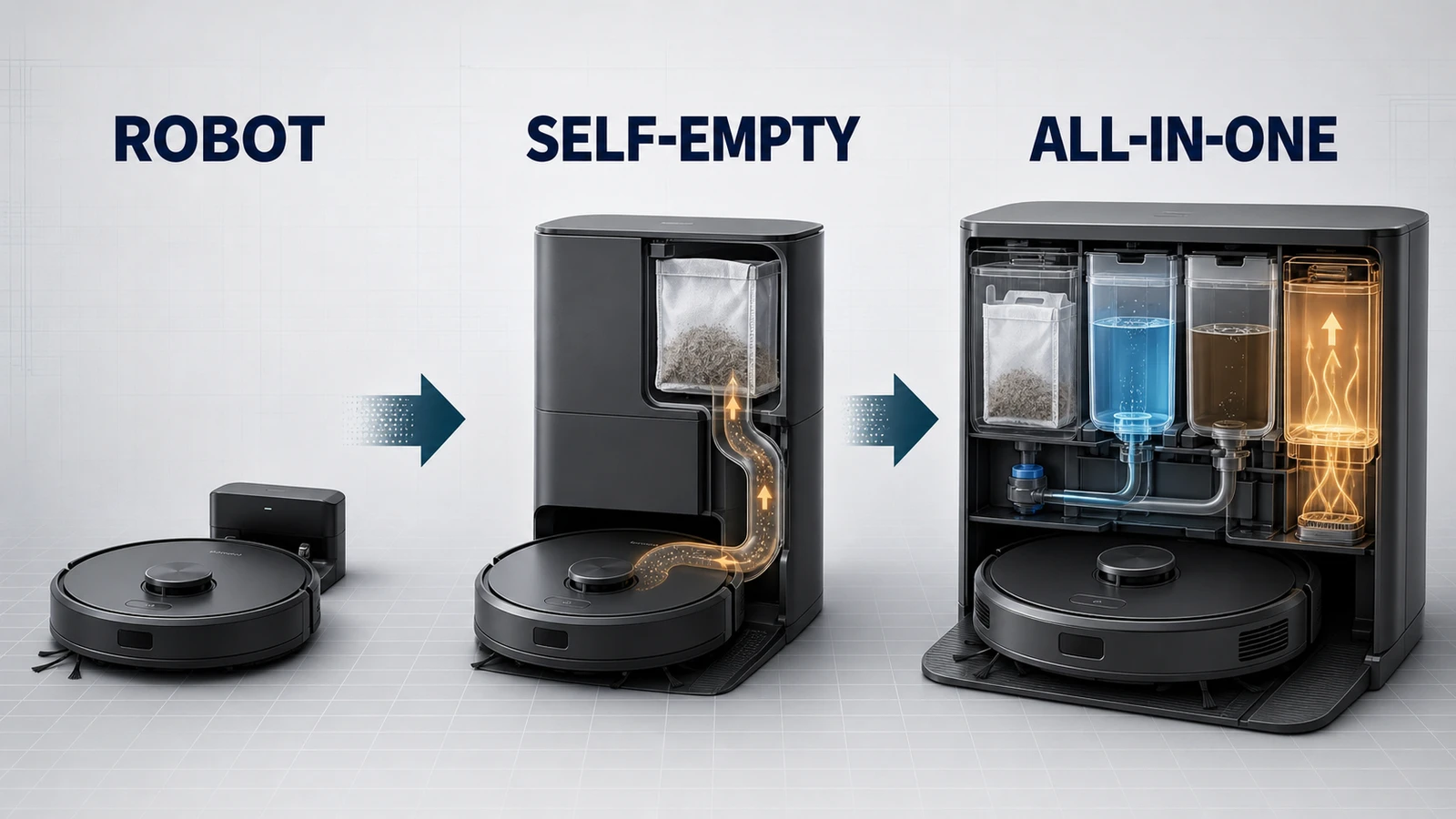
A self-emptying robot transfers debris from its onboard dustbin into a larger container in the dock. The dock uses a separate airflow path to pull dust through an outlet in the robot. The receiving container may be a sealed disposable bag or a reusable bagless bin.
That definition covers two different commercial products.
The first is a robot paired with a single-function self-emptying dock. The station charges the robot and removes dry debris. These systems still serve buyers who want lower maintenance without paying for a full wet-cleaning station.
The second is an all-in-one dock. Automatic dust collection is one task among several. Depending on the model, the station may also wash and dry mop pads, refill clean water, collect wastewater, dispense detergent and clean its own tray. Current systems from Roborock, ECOVACS, Dreame and eufy show how far the dock has moved beyond its original role.
The two architectures should not be combined casually in market analysis. Their component count, retail price, failure modes, freight cost and service burden are different.
How Self-Emptying Changed the Robot Vacuum Category
iRobot launched the Roomba i7+ with Clean Base Automatic Dirt Disposal in September 2018. The robot-and-base package started at $949 in the United States. The robot alone was $699, while a separate Clean Base cost $299. A three-pack of disposal bags cost $14.99.
Those prices exposed the early economics. Automatic emptying was a premium hardware upgrade, and the enclosed bag created a recurring consumable.
Shark answered a year later with the $549.99 Shark IQ Robot Self-Empty. Its bagless base held up to 30 days of debris. The version without the base was $449.99. Shark cut the package premium to about $100 and removed the disposal bag from the ownership model.
The difference between those two launches still shapes the category. Bagged systems emphasize sealed handling and easy disposal. Bagless systems remove the need to buy bags but give the user a reusable bin and filter path to empty and maintain.
The next product cycle absorbed automatic dust collection into a larger maintenance station. ECOVACS records the DEEBOT X1 Family and its all-in-one OMNI Station as a 2022 milestone. Roborock’s Hong Kong listing application describes 2018–2020 as the single-function docking-station stage and 2020–2024 as the all-in-one docking-station stage. After 2024, its industry timeline shifts toward AI interaction, self-diagnosis and more complete household service.
Automatic emptying did not disappear during that transition. It became part of the base layer.
The Market Is Growing, but the Self-Emptying Subset Is Unclear
IDC’s 2025 data provides a reliable baseline for the wider category:
| Market measure | 2025 result |
|---|---|
| Global home-cleaning robot shipments | 32.72 million units |
| Year-over-year growth | 20.1% |
| Smart-vacuum shipments | 24.12 million units |
| Smart-vacuum growth | 17.1% |
| Smart-vacuum share of cleaning-robot shipments | About 74% |
IDC’s first-quarter 2026 update reported 6.563 million smart vacuums shipped during the quarter, up 29.4%. Europe was particularly strong, with shipments rising 81.4% to 2.318 million units.
These figures support a growing robot vacuum market. They do not prove the size or growth rate of self-emptying models.
That limitation should stay visible. Market-report sales pages publish sharply different estimates because they do not share a transparent product universe, channel sample or treatment of all-in-one docks. Adding those numbers together does not produce a better estimate.
A more defensible market view comes from the product mix. Self-emptying appears in mainstream ranges, while the premium end competes on what the station adds after dust collection: water temperature, mop treatment, anti-tangle systems, obstacle handling, automated refilling and software-led maintenance.
Two Product Tiers Now Share the Same Feature
Self-emptying no longer identifies a single price tier.
Roborock’s current Q Series illustrates the split. Some Q models are sold with a Self-Emptying Dock. Others use a Multifunctional Dock that combines automatic dust collection with wet-cleaning support. The same brand can therefore use automatic emptying in a value-oriented “Plus” package and in a more automated vacuum-and-mop system.
The all-in-one tier has expanded quickly:
- Dreame’s PowerDock combines automatic dust collection, mop washing, hot-air drying, water refilling and automatic detergent addition, with the exact configuration varying by model.
- ECOVACS’ DEEBOT T30e OMNI combines auto-emptying with hot-air drying, hot-water mop washing, detergent dispensing and station self-cleaning.
- eufy’s X10 Pro Omni transfers debris into a 2.5-liter bag and adds mop washing, water refill and heated drying.
The product label can hide this difference. Two machines described as self-emptying robot vacuums may sit hundreds of dollars apart and require different engineering organizations behind them.
For a brand or importer, the relevant comparison is the complete maintenance workload transferred from the user to the station. Automatic dust collection handles one task. Water tanks, mop care, dirty-water odor, hair, filters and dock cleaning remain separate problems.
Brand Strategies: Bags, Bins and Full Stations
The leading brands are not following one dock design.
| Brand | Current or historical dock route | Commercial meaning |
|---|---|---|
| iRobot | Enclosed disposable bags in Clean Base; later Auto-Fill combinations | Strong dust-containment story and recurring bag demand |
| Shark | Bagless self-emptying from 2019; later NeverTouch full stations | Lower consumable dependence and familiar mass-market floor-care positioning |
| Roborock | Self-emptying docks and multifunctional docks across the same broader range | Feature ladder from value packages to high-automation systems |
| ECOVACS | Bagged Auto-Empty and OMNI stations; newer bagless cyclone route on selected products | Multiple approaches to consumables and station automation |
| Dreame | All-in-one PowerDock route across premium robot-and-mop systems | Dock automation used as a central product platform |
| eufy | Bagged Omni stations combining dust, water and mop maintenance | Smart-home brand uses the station to compete in the premium cleaning experience |
This is a product-route comparison, not a performance ranking. Each brand sells multiple models, and the functions vary by market and SKU.
The newest split is no longer simply bagged versus bagless. ECOVACS’ DEEBOT X12 OmniCyclone brings dual-stage cyclonic separation into an all-in-one station. That approach removes the disposable dust bag while keeping automated collection inside a premium dock.
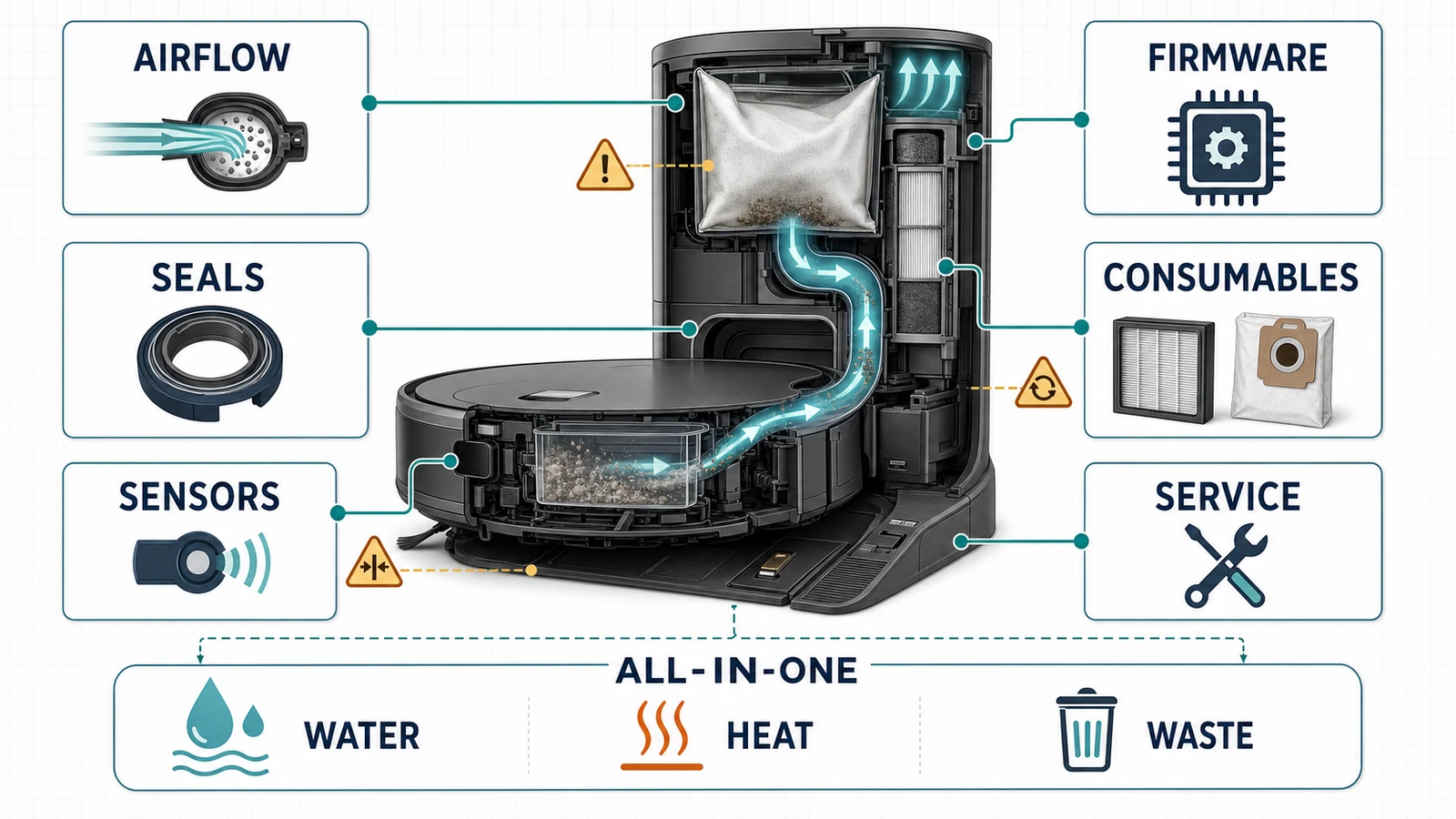
For suppliers, the design choice affects more than the plastic container. Airflow, filtration, seals, dust sensing, emptying noise, user contact with debris and replacement-part planning all change with the architecture.
How the Dock Changed the Supply Chain
A standalone robot vacuum concentrates most of its value in the moving unit: navigation, drive, cleaning head, battery, control board and software.
A self-emptying system adds another appliance around it. The dock needs its own suction path, motor or blower, filtration, power electronics, robot-to-dock alignment, dust-transfer interface and control logic. The robot’s bin needs a door or port that opens reliably during evacuation and remains sealed while cleaning.
All-in-one stations add water and heat. Pumps, tanks, valves, heaters, dryers, detergent paths, wastewater seals and washable trays bring floor-washer engineering into the robot vacuum category. The dock becomes the largest assembly in the box and one of the most important sources of warranty exposure.
Software also reaches deeper into the station. iRobot’s Clean Base support documentation describes automatic clog detection and additional clearing attempts. ECOVACS allows users to disable automatic emptying or trigger it manually. Emptying frequency, quiet hours, bag status and error recovery become part of the app and firmware experience.
This widens the supplier qualification task. A factory that can assemble a reliable robot body may still lack strong dock engineering, water-system validation, app maintenance or international consumables support.
Roborock’s Hong Kong application proof shows how a leading brand manages this complexity. It states that nearly 40% of 2024 production volume was manufactured in-house, while the company also used seven EMS providers, up from four in 2022. Contract manufacturing in Vietnam started in the fourth quarter of 2024. The structure combines tighter internal control with external capacity and geographic flexibility.
Buyers assessing other suppliers should verify who controls the dock design, firmware, app, tooling and after-sales parts. The supplier name on a quotation does not answer those questions.
For a wider sourcing framework, see World Clean Biz’s guide to robot vacuum manufacturers and suppliers in China.
Consumables Can Support Margin—or Create Friction
Disposable bags add a revenue stream after the robot is sold. They also create a stocking obligation.
The iRobot i7+ launch made the model visible: the Clean Base carried a hardware premium, and replacement bags were sold separately. A brand can earn from the original system and repeat purchases if customers can find the correct bag at a reasonable price.
The same model creates risk for private-label and distributor programs. A proprietary bag that disappears after the product is discontinued turns a convenience feature into a customer complaint. Regional sellers need a forecast for bag demand, replacement filters, robot bins, dock seals and transfer-channel parts over the expected service life.
Bagless systems reduce that dependency. They give the user more contact with the collection bin and filter, however, and can release dust during manual emptying. Neither route is automatically better. The choice should match the target consumer, channel and after-sales model.
An OEM quotation should therefore separate:
- robot and dock hardware cost;
- included and replacement consumables;
- estimated replacement intervals;
- packaging volume and freight;
- warranty parts and module-replacement policy;
- app, firmware and cloud-service responsibility;
- support period after the model leaves production.
The dock can raise retail value while quietly weakening gross margin through freight, replacements and service. World Clean Biz’s robot vacuum manufacturing-cost guide explains why BOM cost alone is not enough for this category.
Reliability Is Now a System Test
Self-emptying performance can fail even when the robot still vacuums.
ECOVACS’ official troubleshooting material asks users to check whether the bag is installed correctly, whether the collection cabin is closed, whether the robot is positioned on the station and whether firmware is current. Its product manuals also identify blocked dust outlets, full-bag errors and abnormal station components.
Those are not edge cases for a buyer’s test plan. They define the basic release conditions.
A supplier sample should be tested with fine dust, pet hair, long hair, mixed debris and partially filled bins. The program should measure transfer completion, residual debris, clog recovery, leakage, noise and behavior when the bag or bin is full. Docking accuracy needs to hold across different floors and after repeated cycles.
All-in-one stations require a second test layer. Water leakage, pump life, dirty-water odor, heater protection, mop-drying performance and tray maintenance should be validated separately from dust evacuation.
The acceptance plan should also distinguish a successful demonstration from repeatable production. A golden sample, pilot lot and mass-production unit must produce the same dock behavior. Changes to the dust bag, seal, blower, filter, firmware or bin geometry can alter performance even when the external design is unchanged.
Where the Commercial Opportunity Remains
The self-emptying market still offers two clear product opportunities.
The first is a simpler value system: a reliable dry-cleaning or light-mopping robot with a compact self-emptying dock. It suits channels where consumers want lower maintenance but do not want the price, size or water handling of an all-in-one station.
The second is a full maintenance platform. Here, automatic emptying is expected. Differentiation moves to real cleaning performance, station hygiene, lower manual intervention, dependable software and manageable service cost.
The weakest opportunity is a late me-too product that adds a large dock without a clear price, reliability or channel advantage. The station raises tooling, freight and warranty exposure before it creates any durable differentiation.
Roomba’s 2026 ownership and manufacturing changes add another example of how brand, platform and factory roles can separate. World Clean Biz covers that structure in Who Owns Roomba Now? and How a Chinese Manufacturer Is Rebuilding Roomba.
Brands should define the target route before approaching an OEM or ODM:
- Is the product competing as an affordable self-emptying robot or a premium all-in-one system?
- Will the dust system be bagged or bagless?
- Who supplies consumables after launch and after discontinuation?
- Which dock functions are essential for the target price?
- Who owns the firmware, app and cloud-service obligations?
- Which failures can the local service network repair by replacing a module?
The answers determine the right factory, development budget and warranty reserve.
What Comes After Self-Emptying?
Self-emptying will remain in the robot vacuum market because onboard bins are small and automatic maintenance supports the category’s central promise.
Its role as a standalone differentiator is fading.
In value products, automatic emptying is becoming a package option. In premium products, it is one line in a much larger station specification. The next competitive layer is already moving toward better object understanding, active stain response, anti-tangle systems, adaptive maintenance and tighter coordination between the robot, dock and app.
The result is a broader market, not a separate self-emptying niche. Brands still need the function, but they win or lose on the complete system around it.
For suppliers, that system is the commercial opportunity and the risk. The dock increases product value, opens consumable revenue and creates room for engineering differentiation. It also adds parts, failure modes and long-term service obligations that a catalog cannot show.
FAQ
How large is the self-emptying robot vacuum market?
There is no publicly available, independently auditable shipment figure for the self-emptying segment. IDC reported 24.12 million global smart-vacuum shipments in 2025, but its public release does not separate self-emptying models. Published standalone market estimates use inconsistent definitions and should not be treated as directly comparable.
Is a self-emptying robot vacuum the same as an all-in-one robot vacuum?
No. A self-emptying system transfers dry debris from the robot into the dock. An all-in-one station can add mop washing, drying, clean-water refill, wastewater collection, detergent dispensing and station self-cleaning.
Are bagged or bagless self-emptying docks better?
Bagged docks usually offer easier sealed disposal and recurring consumable sales. Bagless docks avoid replacement bags but require the user to empty and maintain a reusable bin and filtration path. The better route depends on the target user, channel and service model.
What should an OEM buyer test in a self-emptying dock?
Test dust transfer with fine particles, pet hair and mixed debris; clog recovery; leakage; noise; full-bag or full-bin detection; docking accuracy; repeated cycles; firmware behavior; consumable availability; and module replacement. All-in-one docks also need water, pump, heater, drying and odor tests.
Does self-emptying still justify a price premium?
It can support a package premium in value and mid-range products. At the premium end, consumers increasingly expect it as part of an all-in-one station, so price depends on the performance and reliability of the entire system rather than automatic emptying alone.
Can private-label buyers source self-emptying robot vacuums from China?
Yes. Chinese suppliers offer private-label, ODM, OEM and joint-development routes. Buyers should verify who controls the robot platform, dock engineering, software, tooling, testing, consumables and after-sales support before selecting a product.