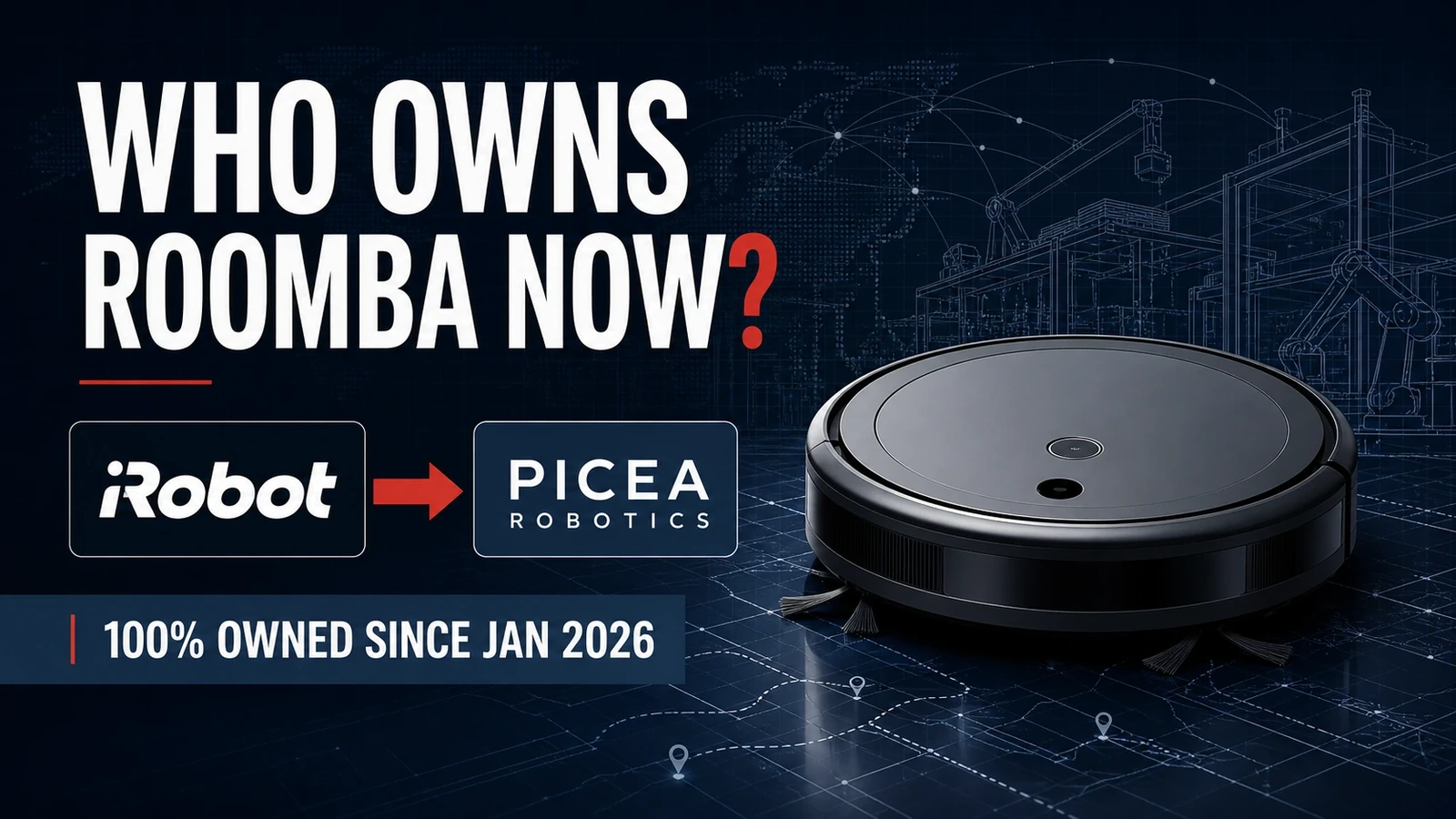
- Roomba maker iRobot has been privately held and wholly owned by Picea since 23 January 2026.
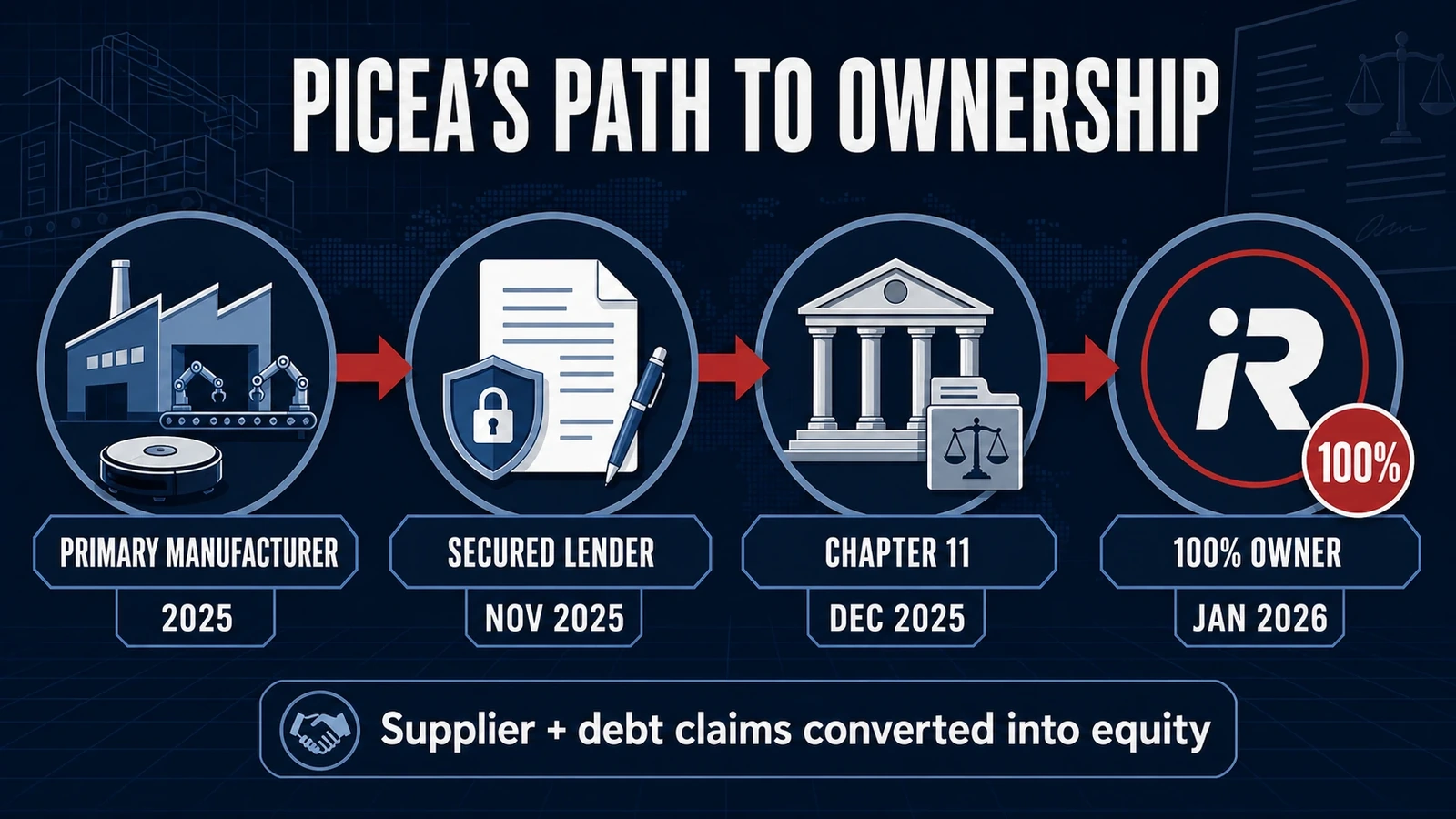
- Picea moved from primary contract manufacturer to secured lender and then owner through iRobot's prepackaged Chapter 11 restructuring.
- The deal cancelled the old public shares, while iRobot retained its U.S. headquarters and created iRobot Safe for data governance.
In this article 13 sections
Roomba is owned by iRobot, and iRobot is now wholly owned by Picea Robotics. Picea acquired 100% of iRobot's equity on 23 January 2026 through a court-supervised restructuring. The transaction took iRobot private and ended the old public shareholders' ownership.
Picea was not a conventional outside buyer. Shenzhen PICEA Robotics Co., Ltd.—formerly Shenzhen 3irobotix Co., Ltd.—had already become iRobot's primary contract manufacturer, with manufacturing locations in China and Vietnam. Its wholly owned Hong Kong subsidiary, Santrum, then acquired iRobot's secured loan. Weeks later, Picea used its creditor and supplier claims to receive all of the reorganized company's equity.
The result is an unusual but important cleaning-industry case: a manufacturing partner became a supplier-creditor, a secured lender and finally the owner of one of the world's best-known robot-vacuum brands.
iRobot, Roomba and Picea at a Glance
| Entity | What it is | Current relationship |
|---|---|---|
| iRobot Corporation | The U.S.-based consumer robotics company behind Roomba | Privately held and wholly owned by Picea |
| Roomba | iRobot's best-known floor-cleaning product brand | Remains part of iRobot; it is not a separate company |
| Shenzhen PICEA Robotics Co., Ltd. | Chinese robot-vacuum developer and manufacturer formerly known as Shenzhen 3irobotix | iRobot's industrial owner and long-standing manufacturing partner |
| Santrum Hong Kong Co., Limited | Wholly owned subsidiary of Picea Robotics | Acquired iRobot's secured loan and participated in the restructuring transaction |
| iRobot Safe Corporation | Separate U.S.-based subsidiary created after the transaction | Responsible for U.S. consumer-data protection and governance; it does not own iRobot |
Calling Picea “the factory that bought Roomba” is directionally understandable but legally incomplete. The owner is the Picea transaction group identified in iRobot's filings, while Roomba remains a brand operated by iRobot.
Is Roomba Still an American Brand?
The answer depends on what “American” is intended to describe.
iRobot remains a Delaware corporation headquartered in Bedford, Massachusetts. Its transaction-completion announcement says engineering, product development, marketing and other corporate functions will remain anchored in the United States. The Roomba brand and iRobot organization therefore retain a U.S. operating identity.
Ownership is different. Since 23 January 2026, iRobot has been a privately held company wholly owned by Picea, whose research, development and manufacturing facilities are in China and Vietnam. Describing Roomba as simply “American-owned” is no longer accurate.
The most precise answer is that Roomba is a U.S.-operated brand under Chinese industrial ownership.
How Picea Became iRobot's Manufacturer
iRobot gradually outsourced more of its production to third-party manufacturers. By 2025, it said it primarily depended on one development and contract-manufacturing partner: Shenzhen 3irobotix, doing business as Picea.
Picea operated through manufacturing locations in China and Vietnam and managed materials, facilities and labor for the products it supplied. iRobot's third-quarter 2025 filing warned that losing Picea could significantly disrupt production and that finding a replacement on acceptable terms or within a useful timeframe would be difficult.
That dependency gave Picea more than ordinary supplier importance. It had practical knowledge of product development, manufacturing economics, production capacity and component sourcing. But manufacturing iRobot products did not by itself give Picea ownership of iRobot or Roomba. Ownership changed only through the later financing and restructuring transactions.
How the Manufacturer Became the Lender
The decisive change came on 24 November 2025. Santrum, Picea Robotics' wholly owned Hong Kong subsidiary, acquired all lender rights under iRobot's credit agreement from affiliates of The Carlyle Group.
According to iRobot's Form 8-K, Santrum assumed $190.7 million in principal and interest outstanding under the loan and replaced the previous administrative and collateral agent.
At the same time, iRobot owed Picea $161.5 million for product manufacturing, of which $90.9 million was past due. Picea therefore occupied two critical positions:
- it controlled iRobot's primary manufacturing relationship and held substantial supplier claims; and
- through Santrum, it controlled the secured loan.
The $190.7 million was the loan balance Picea assumed, not a disclosed cash purchase price for iRobot. The manufacturing payables were also separate obligations, not part of a simple acquisition-price calculation.
Why iRobot Entered Chapter 11
iRobot had been under pressure before Picea became its lender. Amazon agreed to acquire the company in 2022, but the parties terminated that transaction in January 2024. Amazon never became the owner of iRobot or Roomba.
iRobot then cut costs, reduced headcount and reviewed strategic alternatives. By September 2025, it reported $24.8 million in cash and cash equivalents, a term-loan fair value of $205.3 million and substantial doubt about its ability to continue as a going concern. A potential sale counterparty withdrew from exclusive negotiations in October.
On 14 December 2025, iRobot and two subsidiaries filed voluntary Chapter 11 petitions in Delaware. This was a prepackaged reorganization, not an uncontrolled shutdown or immediate liquidation. iRobot and Picea had negotiated the restructuring terms before the filing, allowing the company to seek court approval on an accelerated timetable while continuing operations.
How Picea Received 100% of iRobot
The restructuring filing divided Picea's new ownership according to its claims:
- 95% of the reorganized company's common equity was allocated on account of claims under the credit agreement; and
- 5% was allocated on account of certain claims under the original supply agreement.
The Delaware bankruptcy court confirmed the plan on 22 January 2026. It became effective the following day. The company then issued 10,000 new common shares to its new stockholder under the plan.
This was a debt-for-equity restructuring rather than a normal public-company acquisition in which a buyer pays each shareholder a negotiated price. Picea's secured and supplier claims became the basis for its 100% ownership of the reorganized iRobot.
What Happened to IRBT Shares and Existing Shareholders?
The old shares did not convert into shares of Picea or the reorganized iRobot. The plan cancelled and extinguished all common stock and other equity interests outstanding before the effective date. Holders of the existing common stock received no recovery.
iRobot's January 2026 Form 8-K also said the company intended to file Form 15 to deregister its securities and suspend its regular SEC reporting obligations. iRobot is therefore no longer a Nasdaq-listed company with the same quarterly and annual public-reporting cycle it had before restructuring.
For researchers and commercial partners, that change matters. Future financial visibility may depend more heavily on company announcements, court records, supplier disclosures and counterparties than on full public-company filings.
Who Controls Roomba Customer Data?
Connected cleaning robots collect information needed for account management, mapping, navigation and product operation. Non-U.S. ownership therefore raised a question that a simple ownership answer cannot ignore: how will consumer data be governed?
iRobot announced the creation of iRobot Safe Corporation, a separate U.S.-based subsidiary responsible for protecting U.S. consumer data. The company said iRobot Safe would have an independent board composed of U.S. citizens, a U.S.-based data security officer with data-protection authority and its own chief executive, all subject to eligibility requirements.
These are meaningful structural commitments, but they should be described accurately. They are the governance safeguards announced by iRobot after the transaction; they are not an independent guarantee that no privacy or cybersecurity risk can ever occur. Buyers, enterprise partners and regulators should continue to review applicable privacy policies, hosting arrangements, access controls and contractual data obligations.
What the Takeover Means for Products and Operations
The transaction did not end the iRobot or Roomba names. iRobot kept its Massachusetts headquarters, and Gary Cohen continued as chief executive through the transaction. The company said Picea provided liquidity and operational support during restructuring.
Product activity also continued. In March 2026, iRobot launched Roomba Mini in the United Kingdom and Europe. On 7 July, it announced its largest portfolio expansion in years, including the Roomba Electro Plus hard-floor cleaner and five Roomba robot models for North America.
Those launches show operating continuity and a broader floor-care ambition. They do not yet prove that the restructuring has restored sustainable profitability. As a private company, iRobot is also no longer required to provide the same level of financial disclosure that would allow outside readers to test that conclusion quickly.
Why This Deal Matters to the Cleaning Industry
The strategic lesson is larger than one distressed brand.
An outsourced manufacturer can accumulate influence through several channels at once: product-development knowledge, control of production capacity, unpaid supplier balances and secured debt. When the brand company becomes financially constrained, those positions can create a route from supplier to owner.
For robot-vacuum brands, the case highlights four risks:
- single-partner concentration: transferring too much production and development to one supplier can reduce switching options;
- supplier financing exposure: overdue manufacturing balances can turn an operating partner into a major creditor;
- debt and supply-chain convergence: the same group controlling both secured debt and production has leverage beyond either role alone; and
- brand-manufacturing separation: consumer brand equity can survive even when the industrial owner changes.
Picea also acquires something difficult to build through manufacturing alone: Roomba's brand recognition, installed customer base, distribution relationships, software history and intellectual property portfolio. iRobot, in return, gains an owner already familiar with its products and supply chain. Whether that combination creates a durable recovery will depend on execution, investment and trust—not ownership alone.
World Clean Biz has examined the company's earlier competitive and financial pressures in iRobot's uncertain future. That article focuses on the operating crisis; this page owns the current ownership and restructuring questions.
What Distributors and Suppliers Should Verify
Corporate continuity does not remove transaction-level due diligence. Commercial partners should verify:
- Contracting entity: Is the agreement with iRobot Corporation, a regional subsidiary or another Picea entity?
- Brand authorization: Which entity can grant Roomba distribution or marketing rights in the target territory and channel?
- Manufacturer of record: Which legal entity appears on the product label, technical documentation and factory records?
- Warranty responsibility: Who funds claims, provides parts and manages authorized service after the restructuring?
- Data obligations: Which entity processes account, map and device data, and where are contractual security duties documented?
- Credit terms: Have payment, retention-of-title, inventory and insolvency provisions been updated for the post-restructuring structure?
The name “iRobot” may remain on the contract and product, while ownership, manufacturing, data governance and regional responsibility sit with different legal entities. Each role should be verified independently.
Frequently Asked Questions
Who owns Roomba now?
Roomba remains an iRobot brand. Since 23 January 2026, iRobot has been a privately held company wholly owned by Picea Robotics through the court-approved restructuring.
Is iRobot owned by a Chinese company?
Yes. Shenzhen PICEA Robotics and its wholly owned Hong Kong subsidiary Santrum were the Picea parties in the transaction that acquired 100% of iRobot. iRobot continues to be headquartered and operated in Massachusetts.
Is Picea the same as 3irobotix?
Shenzhen PICEA Robotics Co., Ltd. was formerly named Shenzhen 3irobotix Co., Ltd. iRobot's SEC filings explicitly identify that corporate-name history.
Does Amazon own iRobot or Roomba?
No. Amazon and iRobot signed an acquisition agreement in 2022 but terminated it in January 2024. That acquisition never closed.
Did iRobot go out of business?
No. iRobot used a prepackaged Chapter 11 process to restructure its obligations and transfer ownership to Picea. It emerged from the process in January 2026 and continued launching products.
What happened to the old IRBT stock?
The old common shares were cancelled and extinguished when the restructuring became effective. Existing shareholders received no recovery under the confirmed plan.
Who manufactures Roomba robots?
Before the transaction, iRobot said it primarily depended on Picea as its contract manufacturer, with manufacturing locations in China and Vietnam. Model-level manufacturing and compliance records should still be checked because corporate ownership does not identify every factory for every product.
Where are Roomba vacuums made?
iRobot identified Picea as its primary contract manufacturer and said the supplier used manufacturing locations in China and Vietnam. That does not establish one country or factory for every Roomba model, so buyers should verify the label, declaration and origin records for the exact SKU and production batch.
Final Answer
Roomba is an iRobot brand, and Picea Robotics has owned 100% of iRobot since 23 January 2026. Picea's route to ownership ran through the supply chain: it was iRobot's primary contract manufacturer, became its secured lender through Santrum, and exchanged lender and supplier claims for all of the reorganized company's equity.
iRobot remains based in Massachusetts and continues to operate the Roomba business, but it is now private and under Chinese industrial ownership. The ownership change preserved the brand and operations while cancelling the old public shares—and it turned one of the cleaning industry's most important supplier relationships into a full corporate takeover.