- Define the robot, dock, app, cloud, consumables and service system as one product before requesting an OEM or ODM quote.
- Choose navigation, obstacle avoidance, mopping and dock functions from the target homes and price architecture—not from a supplier feature checklist.
- A credible supplier audit follows requirements through design ownership, software releases, validation, pilot yield, traceability, spare parts and corrective action.
In this article 17 sections
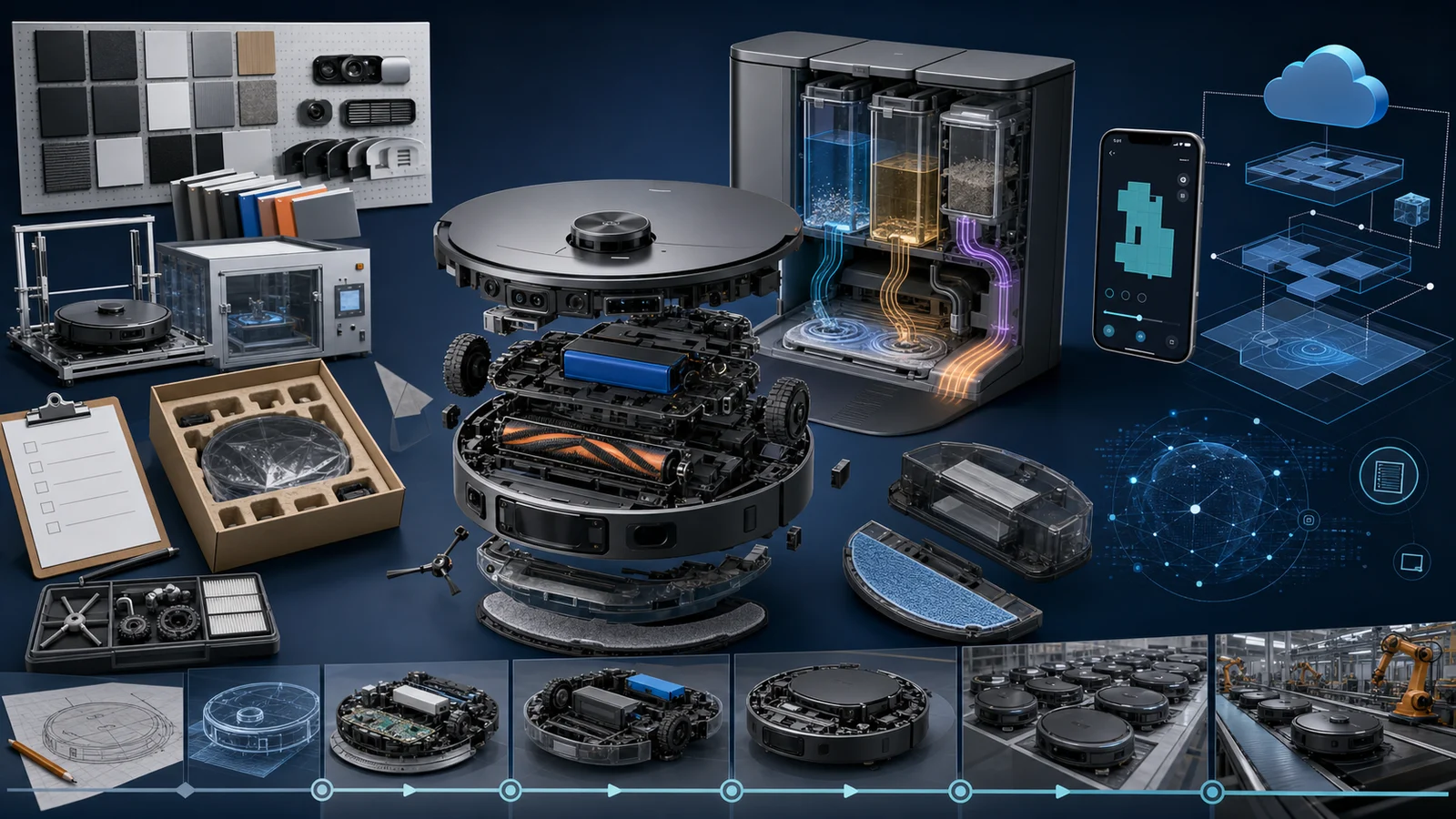
A robot vacuum OEM/ODM project is no longer a circular appliance with a logo. It is a connected cleaning system: robot, navigation stack, charging or all-in-one dock, consumables, App, cloud, firmware, packaging, compliance file and after-sales operation. Buyers should define ownership and acceptance for every layer before paying tooling or ordering samples.
The lowest-risk route is usually a proven platform with controlled changes. The highest-risk route is a heavily customized robot and dock whose mechanical, fluid, software and compliance boundaries remain divided among several suppliers.
OEM, ODM, Platform and In-House Development
| Route | Supplier contribution | Buyer contribution | Main risk |
|---|---|---|---|
| Private label / OEM | Existing certified configuration, branding and packaging | Market fit, channel, local compliance role and support | Minimal differentiation; hidden platform dependencies |
| Light ODM | Existing robot/dock with selected CMF, tools and firmware changes | Requirements, change approval and validation | A small change can affect flow, noise, reliability or certification |
| Deep ODM | New mechanical, electrical or software modules on a reusable base | Product management, NRE, engineering decisions and staged testing | Integration, schedule and field-maturity risk |
| Technology/platform license | Navigation, perception, App SDK, cloud or reference design | System integration and lifecycle ownership | Vendor lock-in and incomplete subsystem responsibility |
| In-house platform | Buyer owns architecture and core IP; factories manufacture modules or units | Full engineering, quality, compliance and service system | Highest capital and team requirement |
The contract should list every reusable supplier asset and every buyer-funded deliverable. “ODM” does not automatically transfer algorithms, source code, tooling or exclusivity.
Define the Target Product Before the Supplier
A credible product requirements document includes:
- destination markets and expected retail price;
- household type, floor materials, rugs and thresholds;
- pet hair, long hair, fine dust, cereal, litter and other debris;
- target cleaning area and room complexity;
- furniture clearance and minimum pass height;
- map, multi-floor, no-go zone and shared-account requirements;
- privacy and local-processing expectations;
- charging-only, self-empty, mop-wash or full-service dock;
- consumable replacement model;
- warranty duration, return allowance and service route;
- target channel, packaging and logistics constraints.
Define measurable acceptance criteria. “Strong suction,” “AI avoidance” and “hands-free” are marketing phrases, not engineering requirements.
Robot Chassis, Vacuum and Brush Architecture
Start with the debris path.
Specify the inlet geometry, main-brush type, side-brush reach, fan, ducts, dustbin, filters and sealing interfaces. The complete system determines pickup; a maximum pressure number alone does not.
Test:
- fine dust and sand on hard floor;
- debris at wall edges and corners;
- long hair and pet hair on brush, bearings and side-brush hub;
- cereal, litter and mixed particle sizes;
- carpet pickup and automatic carpet behavior;
- dust leakage at the bin, filter and dock interface;
- pickup as the filter loads;
- removal and cleaning without contaminating the user.
Brushless inlets can reduce hair wrapping but may change carpet performance. Rubber, bristle and mixed brushes behave differently across flooring. Select the architecture from the target debris library.
LDS, Vision, Structured Light and Hybrid Navigation
Navigation has at least three layers: localization, coverage planning and obstacle response.
LDS / laser ranging
An LDS turret can provide stable room geometry and mapping but adds height and a rotating optical mechanism. Verify behavior beside mirrors, dark surfaces, glass, curtains and tight furniture.
Camera vision
Vision can classify objects and support semantic features, but performance depends on lighting, lens cleanliness, training data and compute. It also creates a privacy and data-governance question.
Structured light or time-of-flight
Front depth sensors can improve close obstacle geometry. They still need test coverage for transparent, reflective, black, low and deformable objects.
Hybrid systems
Premium products increasingly combine ranging, cameras, depth sensors, wheel odometry, IMUs and contact sensors. More sensors can improve coverage, but only if calibration, fusion, cleaning and service are controlled.
Build an obstacle library: cables, socks, shoes, pet toys, low furniture, black legs, mirrors, glass, scales, floor vents, thresholds, wet spills and representative pet waste simulants. Record collision, entanglement, false avoidance and missed-area rates.
For an overview of technology providers, see Robot Vacuum Navigation Solution Companies.
Charging, Self-Empty, Mop-Wash and Full-Service Docks
The dock can contain more failure modes than the robot.
| Dock type | Main systems | Key validation |
|---|---|---|
| Charging only | Contacts, power supply, mechanical alignment | Docking success, contact contamination, temperature and charge control |
| Self-empty | Fan, dust tunnel, bag/bin, seals | Dust transfer, clogging, leakage, noise and bag detection |
| Mop-wash | Clean-water tank, pump, tray, drains, dirty-water tank | Water delivery, drainage, sediment, leaks and odor |
| Full-service | Emptying, washing, refilling, drying, detergent and sometimes water/drain connection | Cross-system sequencing, sanitation, error recovery and service access |
Define whether the robot uses a passive cloth, vibrating plate, roller mop, dual rotating pads or another system. Then define pad lifting, carpet avoidance, detergent dosing and dock washing around that architecture.
Do not accept “hot-water wash” or “hot-air dry” without measurement location, temperature tolerance, cycle time, energy, material compatibility and safety controls.
Water, Dust, Waste and Drying Hygiene
Map each flow path physically.
Robot wet path
Clean water or solution moves through a tank, valves, pump and outlets to the mop. Residual water can remain in tubing, tanks and pad interfaces.
Dock wet path
Water may travel from a clean tank through valves and pumps into a washing tray and back through a filter, drain channel or pump to a dirty-water tank. Sediment, hair and detergent foam can obstruct the path.
Dust path
Self-empty airflow passes through the robot bin, dock tunnel, fan and disposable bag or reusable container. Leakage can contaminate the dock or room.
Drying path
Air temperature, distribution and exhaust determine whether a pad dries evenly. A heated feature does not remove the need to empty dirty water, clean trays and follow the maintenance instructions.
Validation should include 24- and 72-hour residue holding, mixed soil, warm climates, hard-water scale, approved detergent, overfill, blocked drain, tank misinstallation and power interruption.
Battery, Charging, Noise and Thermal Design
Record cell manufacturer, cell model, pack configuration, watt-hours, BMS, fusing, thermal sensors, charger and firmware limits. The battery must be controlled as a configured pack, not a generic purchasing line.
The current UNECE Manual of Tests and Criteria includes lithium-battery transport tests in subsection 38.3. A test summary supports transport evidence; it is not a universal product-safety certificate and does not replace carrier, packaging or destination-market requirements.
Test the complete charge and cleaning system for:
- stalled brush and blocked suction;
- carpet and high-load operation;
- repeated short docking and charging;
- hot and cold ambient conditions;
- aged battery margin;
- charger and contact contamination;
- dock fan and heater overlap;
- abnormal temperature and protective shutdown.
Noise should be measured by operating state: normal cleaning, maximum cleaning, self-emptying, washing and drying. A short high-noise emptying event may be acceptable in one channel and unacceptable in another.
App, Maps, Cloud, OTA and Ecosystem
Assign ownership for:
- mobile App accounts and store listings;
- device provisioning and Wi-Fi support;
- map data, room names and household sharing;
- cloud hosting, logs and data residency;
- voice-assistant or smart-home integrations;
- firmware signing, staged release and rollback;
- vulnerability intake and security updates;
- API, SDK and third-party license compliance;
- service diagnostics and device transfer at resale.
An App skin is not product ownership. If the supplier controls the production cloud and signing keys, the brand may be unable to change factories, fix a security problem or support products after the commercial relationship ends.
ETSI's current EN 303 645 provides baseline consumer-IoT security provisions. In the EU, the Cyber Resilience Act entered into force in December 2024; reporting obligations apply from September 2026 and the main obligations from December 2027. Buyers shipping connected products across that lifecycle need a vulnerability and update plan now.
Tooling, CMF, Accessories and Packaging
Create a tooling register with:
- tool owner and physical location;
- mold number, cavities, material and expected life;
- maintenance, modification and duplicate-tool rights;
- approval samples and dimensional reports;
- withdrawal or transfer rights after termination.
CMF changes can alter sensor windows, radio performance, warpage, scratch visibility and cleaning-chemical resistance. Accessories can alter weight, airflow and mechanical loads. Packaging affects impact, vibration, compression, humidity and return rates.
Approve the entire packaged SKU, not an engineering unit assembled from hand-selected parts.
Safety, EMC, Radio, Battery and Cybersecurity
Compliance scope depends on market and configuration. For household robot vacuums, the newly published IEC 60335-2-2:2026 expressly includes automatic battery-operated cleaners and is aligned with IEC 60335-1:2020. National adoption, transition and certification routes still need confirmation with the responsible test laboratory.
Connected products add radio duties. The EU Radio Equipment Directive covers radio-equipment market access. In the United States, FCC rules apply to intentional radiators such as Wi-Fi and Bluetooth transmitters; the authorization route depends on the configured device and modules.
Build a market matrix for:
- electrical and appliance safety;
- EMC and radio spectrum;
- RF exposure where applicable;
- battery safety and transport;
- materials and restricted substances;
- recycling, batteries and packaging;
- cybersecurity and privacy;
- labeling, manuals and responsible economic operator.
A module certificate does not automatically authorize the final product. Antenna, enclosure, host electronics, firmware and integration conditions must match the approved use.
Cleaning, Avoidance, Durability and Dock Validation
Use controlled test plans with traceable units.
Cleaning matrix
Test hard floors and carpets with standardized and market-relevant debris, edges, hair, filter loading and repeat runs.
Navigation matrix
Test maps, room transitions, dark zones, reflections, thresholds, narrow passages, dynamic obstacles and recovery after relocation.
Wet system matrix
Test flow, residue, pad cleaning, drainage, leaks, foam, scale, odor, tank errors and long idle periods.
Durability matrix
Cycle wheels, brush drives, bumpers, LDS, pumps, valves, doors, tanks, latches, contacts and cable strain. Add packaged drop, vibration, temperature and humidity.
Software matrix
Test provisioning, offline use, weak networks, cloud outage, multi-user roles, App updates, OTA interruption, rollback and factory reset.
Release criteria should include distributions and failure counts, not one “golden sample.”
Pilot Production, Yield, Service and Spare Parts
EVT proves engineering feasibility. DVT proves the design against requirements. PVT proves the production process and tools. Names vary, but the gates should not be collapsed.
Before mass production, require:
- frozen BOM, drawings, firmware and approved samples;
- critical-component traceability;
- incoming and in-process control plans;
- end-of-line functional tests for robot and dock;
- software-version and key-provisioning records;
- pilot yield by failure category;
- rework limits and failure analysis;
- packaging validation;
- service manuals, diagnostics and training;
- spare-parts list, price and lead time;
- return analysis and corrective-action workflow.
Yield must be defined at first pass and final pass. A high final yield achieved through repeated rework can hide process instability.
Supplier Audit and Intellectual Property
A useful audit follows one requirement through the factory:
- drawing and BOM control;
- incoming component identity;
- line instructions and test limits;
- equipment calibration;
- software loading and key control;
- serial-number traceability;
- nonconforming-material quarantine;
- repair and rework authorization;
- outgoing audit;
- field-return analysis and corrective action.
Score the robot and dock suppliers together, even if they are separate factories. Verify who owns the industrial design, mechanical patents, navigation code, perception models, App, cloud, firmware, test fixtures and tooling.
For a broader factory method, use How to Audit Cleaning-Appliance Suppliers in China.
Cost, MOQ, NRE and Platform Lock-In
The commercial model should separate:
- robot and dock unit cost;
- battery, charger, water tanks, dust bags and accessories;
- molds, fixtures, compliance tests and engineering NRE;
- App, cloud and third-party license fees;
- packaging, freight, duties and inventory;
- spare parts, warranty, returns and field campaigns.
See Robot Vacuum Manufacturing Cost for cost structure and Robot Vacuum Cleaners from China for the wider sourcing landscape.
Release NRE by evidence: requirements, design review, engineering validation, design validation, production validation and approved pilot. Avoid paying all NRE against a cosmetic prototype.
Platform lock-in is highest when the supplier exclusively controls cloud accounts, signing keys, calibration tools, custom components and diagnostic software. Price the exit route before approving the platform.
Robot Vacuum OEM/ODM RFQ
Ask suppliers to return:
- legal manufacturer, factory and contracting entity;
- exact reusable platform and current production history;
- target markets and approved configurations;
- robot and dock architecture;
- navigation, obstacle and map functions;
- cleaning modes and measurable test methods;
- complete water, dust and drying paths;
- battery, charger and transport file;
- App, cloud, OTA and data-responsibility matrix;
- tooling and IP ownership;
- proposed BOM and critical components;
- compliance plan by destination market;
- EVT/DVT/PVT and pilot plan;
- factory audit and quality-control records;
- first-pass yield and field-return data for the base platform;
- spare-parts and service plan;
- MOQ, NRE, unit-cost ladder and payment gates;
- change-control and end-of-life notice.
FAQ
What is the difference between robot vacuum OEM and ODM?
Private-label OEM usually reuses an existing approved product with branding changes. ODM adds product, appearance, software or tooling development. Contracts should define the actual deliverables rather than rely on the labels.
Should a new brand start with an all-in-one dock?
Only if the target price, service capability and validation budget can support it. A full dock adds pumps, valves, tanks, dust transfer, washing, drying, firmware and sanitation failure modes.
Who should own the App and cloud?
At minimum, the brand needs contractual control over production accounts, data, App listings, firmware signing, vulnerability handling, updates, export and transition. A supplier can operate services, but responsibility and exit rights must be explicit.
Is an FCC or CE module certificate enough?
Not automatically. Final-product configuration, antenna, host electronics, enclosure, firmware, labels and integration conditions must be evaluated for the destination market.
How many samples are enough?
One sample can support concept review, not product approval. Use multiple traceable units across engineering, design, pilot and production gates, with enough repeats to expose variation.
Final Procurement Rule
Select a robot vacuum supplier only after the complete robot-dock-software-service system has measurable requirements, named owners and staged acceptance. A feature-rich demonstration is easy. A platform that can be manufactured consistently, updated securely, repaired locally and supported through several years of field use is the real product.