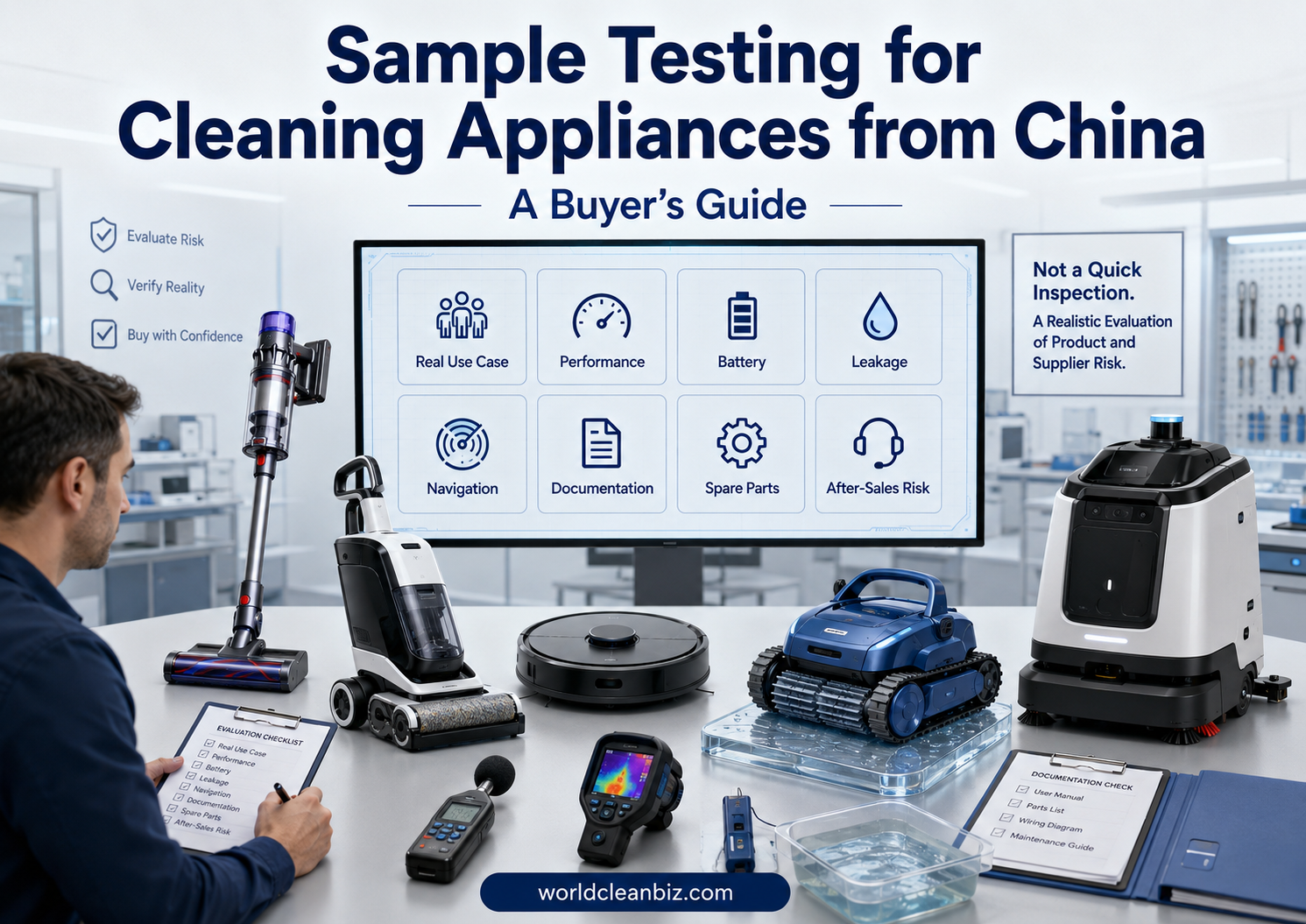
Sample testing for cleaning appliances from China should not be treated as a quick product check.
Many buyers receive a sample, open the box, check the appearance, turn the product on, confirm that it charges, and compare it with the supplier’s catalog. If everything looks acceptable, they move toward a purchase order.
That is risky.
For cleaning appliances, a sample should be tested like a real user will use it, not like a sourcing agent will inspect it.
A good-looking sample does not guarantee stable mass production. It does not prove the product will survive repeated use, meet customer expectations, fit the buyer’s sales channel, pass documentation review, or avoid after-sales problems.
Cordless vacuums, floor washers, robot vacuums, robotic pool cleaners, robotic lawn mowers, commercial cleaning robots, and related cleaning products all carry category-specific risks. These may include motors, batteries, chargers, water systems, filtration, brush rollers, sensors, docking, app control, firmware, sealing, noise, heat, spare parts, maintenance, and warranty exposure.
The purpose of sample testing is not only to answer:
Does the product work?
The better question is:
Does this sample reveal whether the product, supplier, and sourcing model are ready for the buyer’s market?
Quick Answer
Buyers should test cleaning appliance samples from China under real-use conditions before placing orders. A sample test should evaluate appearance, build quality, basic function, cleaning performance, battery and charging, noise and heat, category-specific failure points, maintenance, spare parts, labels, manuals, documentation, and supplier explanations.
A sample should answer four questions:
- Does the product solve the user problem?
- Does it fit the buyer’s channel and price band?
- Can the supplier repeat this quality in mass production?
- What after-sales problems may appear later?
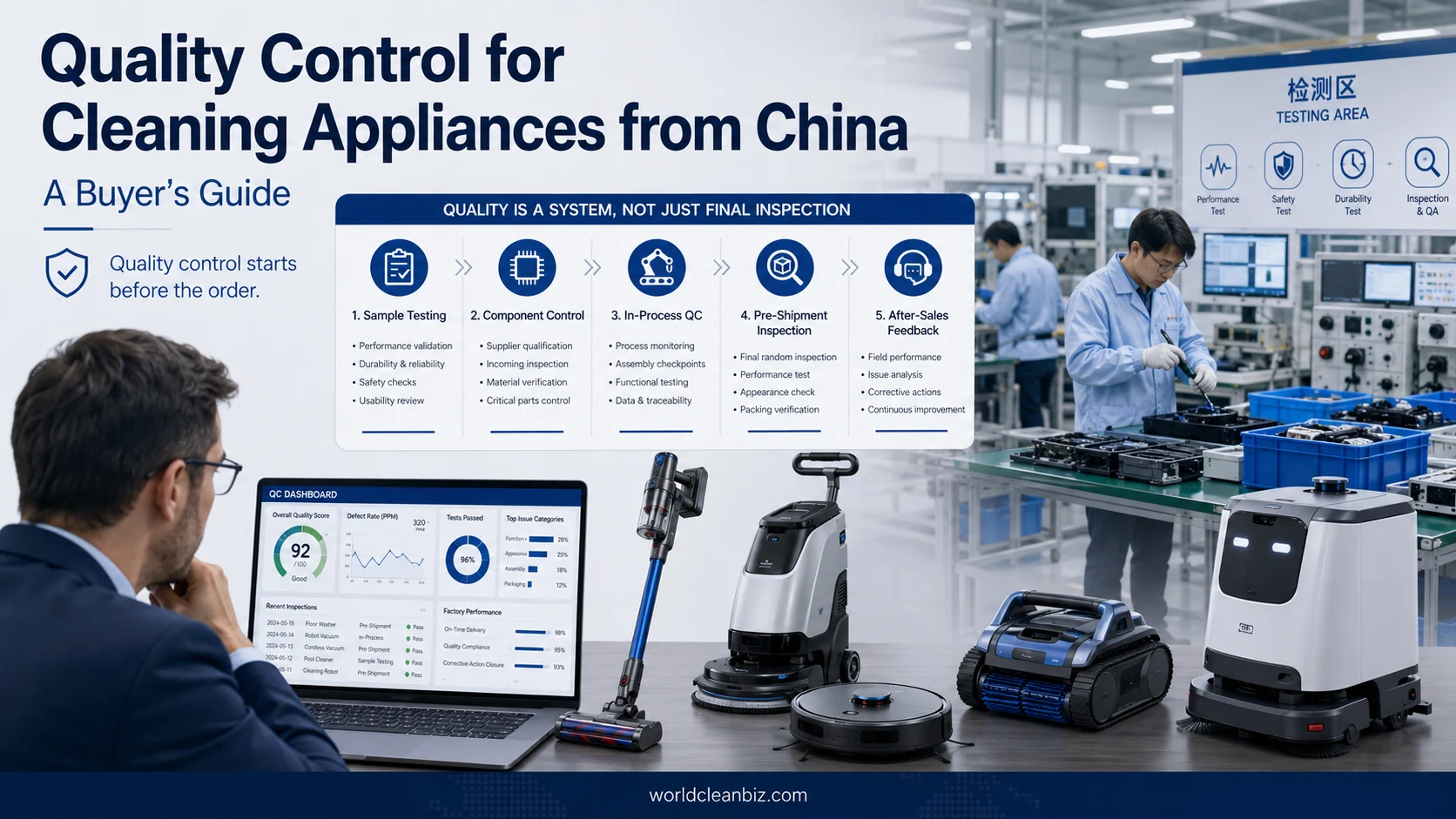
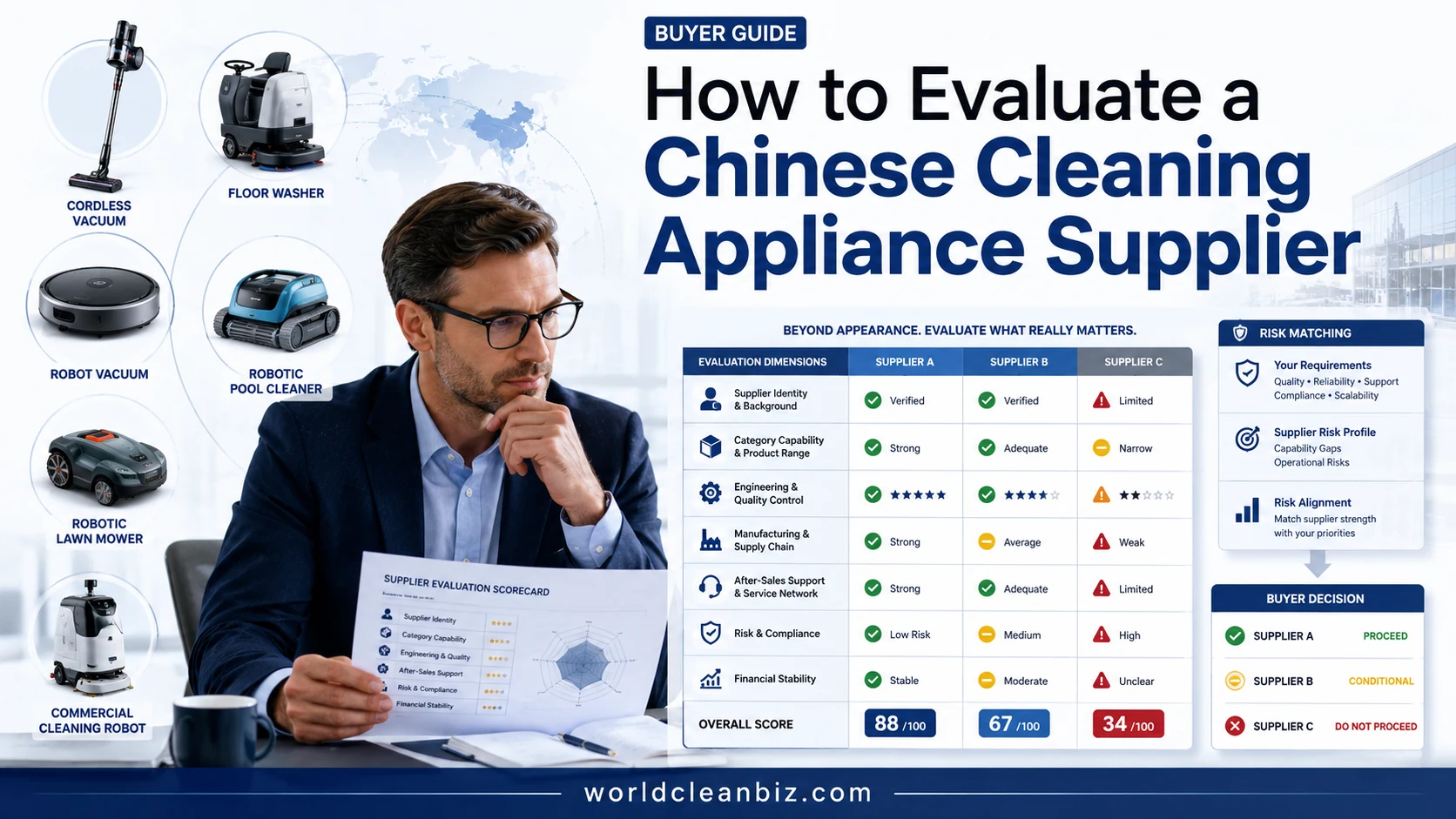
Sample testing should connect with quality control, compliance, MOQ, pricing, spare parts, and warranty planning. For a broader QC framework, see our guide on quality control for cleaning appliances from China. If you are still evaluating suppliers, read our guide on how to evaluate a Chinese cleaning appliance supplier.
Why Sample Testing Matters More in Cleaning Appliances
Cleaning appliance samples are different from samples of simple cleaning tools.
A mop, brush, cloth, bucket, or accessory can often be checked through material, size, packaging, workmanship, and basic use. A cleaning appliance needs deeper testing because it includes electrical, mechanical, software, water, battery, or robotic systems.
A cordless vacuum sample may look good but have weak suction, short runtime, high noise, dust leakage, or poor brush head performance. A floor washer may clean well at first but leak, smell, leave dirty water behind, or fail self-cleaning. A robot vacuum may run in a demo room but fail with docking, mapping, obstacle avoidance, app connection, or firmware stability. A commercial cleaning robot may perform well in a controlled demo but struggle in a real facility.
Sample testing is also a supplier test.
How a supplier explains the sample matters. Can the supplier explain why certain components were chosen? Can it explain common failure points? Can it provide testing records? Can it tell the buyer what may change in mass production? Can it support spare parts and warranty handling?
Buyers should not approve a sample only because it looks acceptable. They should understand what the sample proves and what it does not prove.
A sample is not the end of evaluation. It is the beginning of risk control.
WCB Market Note
Sample testing is becoming more important in China cleaning appliance sourcing because buyers are sourcing more complex products with higher after-sales exposure. In the past, many buyers treated samples as confirmation of appearance, packaging, and basic function. That is no longer enough. A cleaning appliance sample may hide risks in battery stability, water leakage, docking, navigation, firmware, noise, filtration, spare parts, or maintenance. These problems may not appear during a short power-on check.
Buyer implication: Buyers should test samples according to the real use case, target market, sales channel, and warranty model.
Buyer implication: Buyers should evaluate how the supplier explains failures, not only whether the sample passes a simple test.
WCB view: In cleaning appliances, sample testing is not a demo. It is an early risk filter. Buyers are not only testing one unit; they are testing the supplier’s product platform, component choices, quality-control thinking, documentation readiness, and after-sales burden.
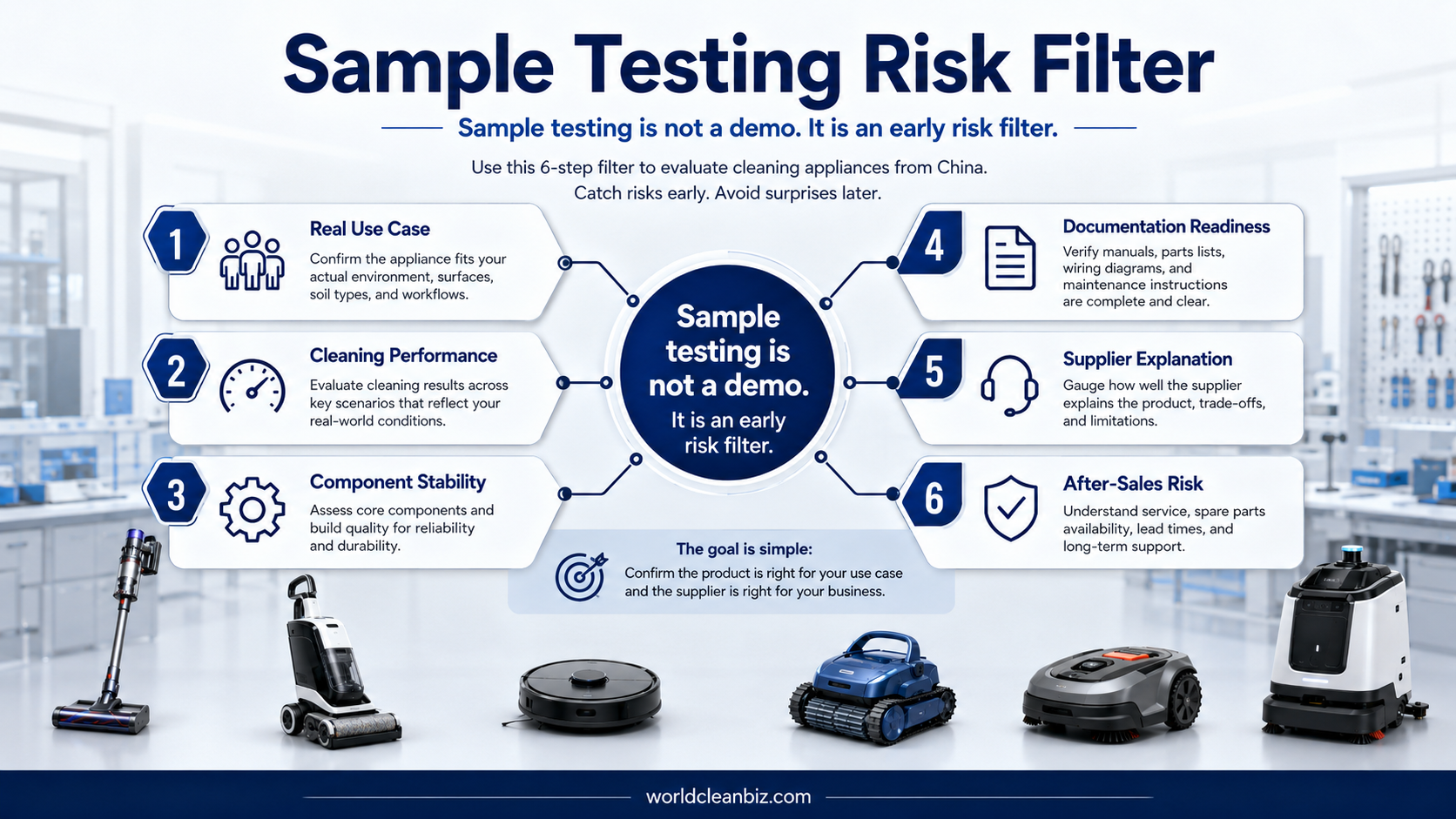
Sample Testing Is Not Just Checking Whether the Product Works
Many buyers test samples too casually.
They check the box. They check the logo. They turn on the product. They confirm basic function. They compare the sample with photos. Then they approve it.
That may be enough for very simple products. It is not enough for cleaning appliances.
A sample can work for a few minutes and still be unsuitable for the market. It may have weak cleaning performance, poor usability, confusing instructions, high noise, unstable charging, difficult maintenance, missing spare parts, or a design that will create warranty complaints.
Buyers should treat the sample as a risk signal.
A good sample should show:
- Whether the product solves the user problem
- Whether the product fits the buyer’s price band
- Whether the supplier understands the category
- Whether the product is serviceable
- Whether documents and labels are ready
- Whether the supplier can repeat the quality in production
- Whether the buyer should proceed, revise, or reject the product
Sample testing should also be connected with sourcing model decisions. OEM, ODM, and private label projects all carry different sample risks. For more on sourcing models, see OEM vs ODM cleaning products and private label cleaning products from China.
Step 1: Define the Real Use Case Before Testing
Before testing a sample, buyers should define the real use case.
A sample test without a use case is just a product demo.
Start with these questions:
- Who is the target user?
- Which market will the product be sold in?
- Which channel will sell it?
- What price band is expected?
- What problem must the product solve?
- What performance level will customers expect?
- What warranty model will the buyer offer?
- What after-sales issues would be expensive?
- What compliance or documentation requirements may apply?
- What type of product comparison will customers make?
The same product may be acceptable in one channel and weak in another. A low-cost private label product may be acceptable for a basic test, but not for a premium retail channel. A floor washer that works for small apartments may not satisfy users with larger homes. A commercial cleaning robot that looks good in a showroom may not work in a busy facility.
Buyers should write down the target use case before testing.
This helps prevent a common mistake: approving a sample because it works, without checking whether it works for the buyer’s actual market.
Step 2: Check Appearance, Packaging, and Basic Function
Appearance and basic function still matter.
Buyers should check:
- Product appearance
- Material and workmanship
- Weight and ergonomics
- Assembly quality
- Buttons, switches, display, or controls
- Accessories
- Charging or power-on function
- Packaging condition
- Manual and labels
- Product markings
- Carton and protection
- Basic safety warnings
This first check helps confirm whether the sample matches what the supplier promised.
But this is only the first layer.
A product can pass appearance and basic function checks but fail real-use testing. The surface may look good, but the motor may be weak. The vacuum may turn on, but dust may leak. The robot may move, but docking may fail. The floor washer may spray water, but recovery may be poor.
Buyers should not confuse a basic inspection with sample testing.
The purpose of this step is to catch obvious problems early. If a supplier cannot deliver a clean, complete, properly packed sample, buyers should be cautious before trusting mass production.
Step 3: Test Cleaning Performance Under Real Conditions
Cleaning performance should be tested in real conditions, not only in a clean showroom.
The sample should be tested against the user problem it is supposed to solve.
For cordless vacuums, test dust, debris, hair, edges, carpet, hard floors, accessories, dust bin emptying, and filter handling. Compare suction claims with actual cleaning results.
For floor washers, test real wet messes, sticky dirt, water recovery, edge cleaning, roller cleaning, dirty water tank handling, self-cleaning, drying, and odor after storage.
For robot vacuums, test multiple rooms, obstacles, docking, carpet behavior, mopping, route planning, app connection, firmware stability, and whether the robot can recover from common household situations.
For commercial cleaning robots, test in a real facility. Check route coverage, water recovery, safety behavior around people, runtime, operator handover, maintenance, and service workflow.
The goal is not to create laboratory results. The goal is to see whether the product is believable for the target customer.
If the product does not clean well under real conditions, better packaging or branding will not solve the problem.
Step 4: Test Battery, Charging, Runtime, Noise, and Heat
Battery, charging, runtime, noise, and heat are common sources of user complaints in cleaning appliances.
Buyers should test:
- Charging behavior
- Runtime under real use
- Battery indicator accuracy
- Charger fit and ease of use
- Heat during use and charging
- Noise level during normal operation
- Power drop during use
- Charging dock behavior where relevant
- Battery removal or replacement if applicable
A product may run well for a short demo but perform poorly under longer use. Runtime may be lower than expected. Noise may be acceptable in a factory video but annoying in a real home. Heat may become noticeable after repeated use. Charging may be unstable.
For robot vacuums, robotic pool cleaners, robotic lawn mowers, and commercial robots, charging and docking behavior are especially important. A product that cannot reliably return, dock, charge, or restart will create user frustration.
Battery and charger issues also connect with compliance readiness. Buyers should review related documentation before mass production. For more on this topic, see our guide to compliance and certification for cleaning appliances from China.
Step 5: Test Category-Specific Failure Points
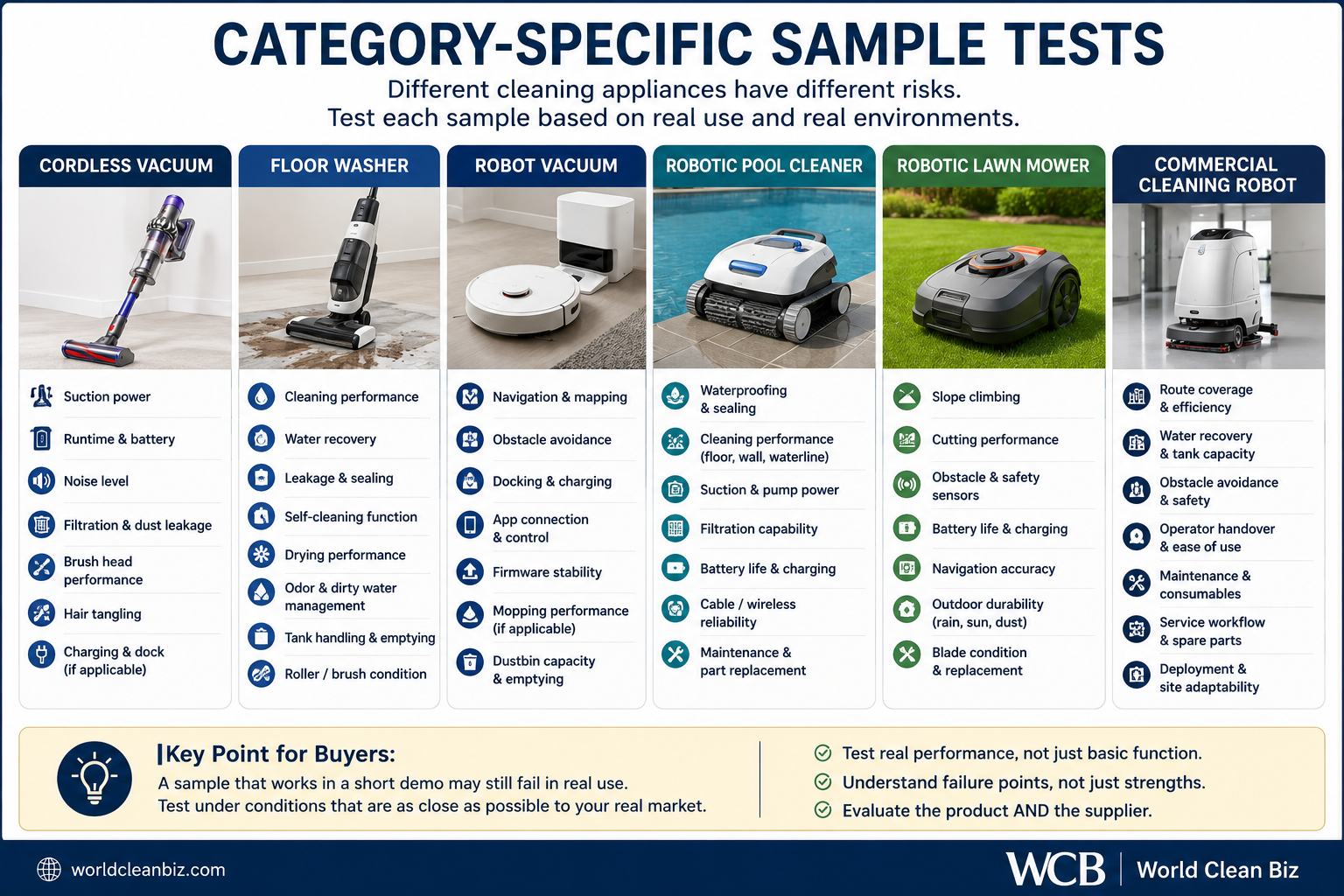
Each cleaning appliance category has its own failure points.
Buyers should not use the same testing checklist for every product.
Cordless vacuums should be tested for suction, runtime, noise, filtration, brush head performance, hair tangling, charging, and dust handling. Buyers sourcing this category can review our guide on cordless vacuum cleaner OEM manufacturers in China.
Floor washers should be tested for leakage, water recovery, roller cleaning, self-cleaning, drying, odor, tank handling, and consumables. Buyers can compare category risks in our guide to floor washer manufacturers in China.
Robot vacuums should be tested for navigation, docking, obstacle avoidance, app connection, firmware stability, mopping, spare parts, and multi-room behavior. See our guide on how to source robot vacuum cleaners from China.
Robotic pool cleaners should be tested for waterproofing, pump performance, filtration, wall cleaning, waterline cleaning, battery, maintenance, and debris handling. See our guide to robotic pool cleaner manufacturers in China.
Robotic lawn mowers should be tested for slope, safety, blades, outdoor durability, docking, navigation, rain exposure, and terrain handling. See our guide to robotic lawn mower manufacturers in China.
Commercial cleaning robots should be tested for deployment, route coverage, water recovery, operator handover, maintenance, safety behavior, and service workflow. See our guide to commercial cleaning robot manufacturers in China.
The point is simple: sample testing should follow the product category, not a generic sourcing checklist.
Step 6: Check Spare Parts, Consumables, and Maintenance
A sample should also reveal how easy the product is to maintain.
Buyers often focus on the first-use experience. Customers care about repeated use.
Check whether users can easily:
- Empty dust bins or dirty water tanks
- Clean filters
- Replace brush rollers
- Remove tangled hair
- Clean tanks, hoses, or nozzles
- Replace batteries where relevant
- Replace blades or wheels where relevant
- Clean sensors or docking areas
- Understand maintenance instructions
Buyers should also ask which spare parts and consumables are available.
For cleaning appliances, spare parts may include filters, brush rollers, batteries, chargers, tanks, pumps, motors, sensors, docks, seals, wheels, blades, accessories, and consumables.
Sample testing should include maintenance because after-sales problems often begin there. If the product is hard to clean, hard to repair, or hard to explain to users, the buyer may face returns and complaints later.
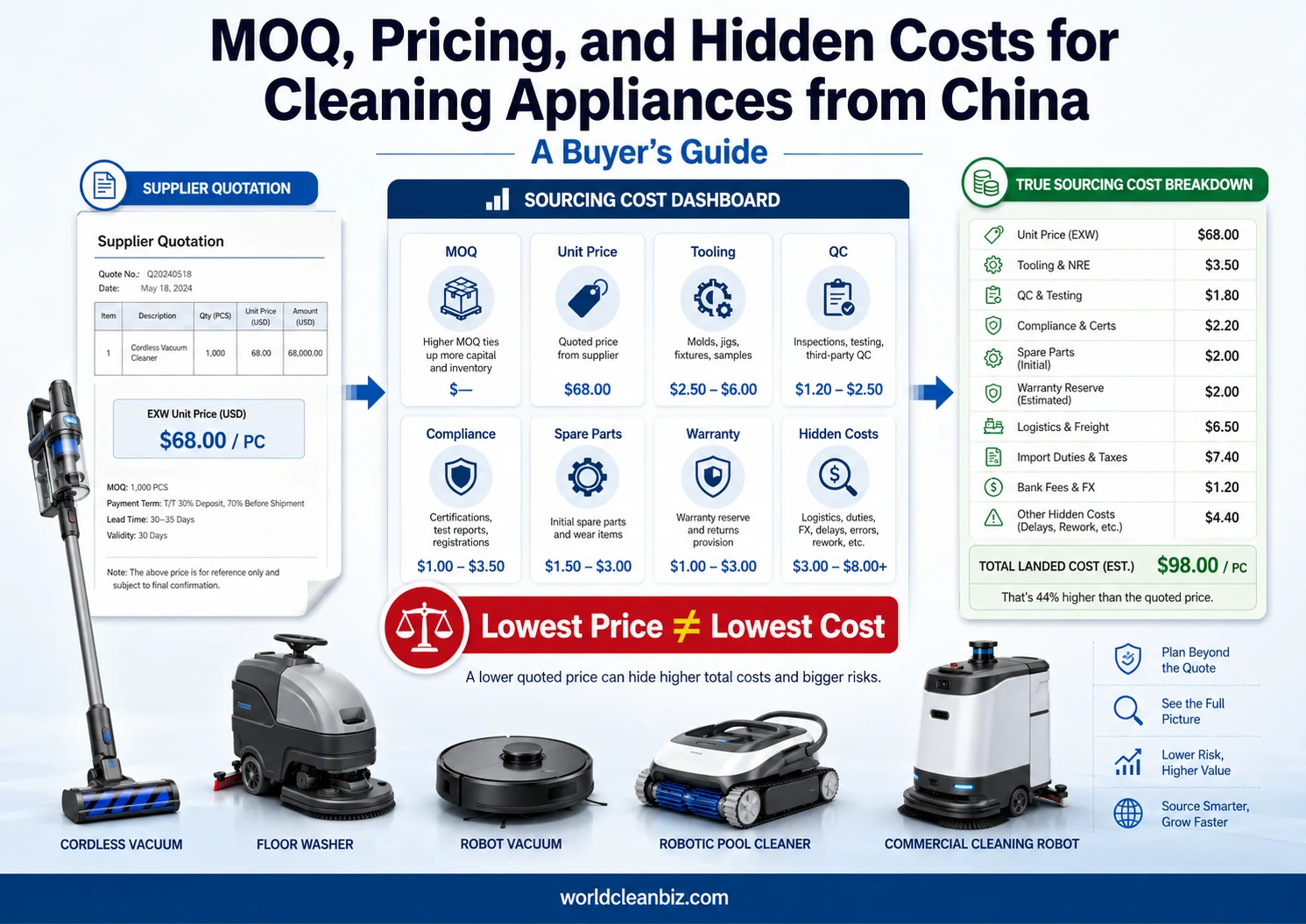
Spare parts should also be considered when calculating real sourcing cost. Our guide on MOQ, pricing, and hidden costs for cleaning appliances from China explains why spare parts and warranty exposure should be included before placing orders.
Step 7: Review Compliance, Labels, Manuals, and Documentation
A sample should include more than the product itself.
Buyers should review labels, manuals, packaging, warnings, charger information, battery information, and available documentation.
Check:
- Product label
- Charger label
- Battery label where relevant
- User manual
- Safety warnings
- Maintenance instructions
- Packaging markings
- Warranty card or service information
- Compliance documents where available
- Test reports or certificates if provided
This is not legal advice. Requirements depend on product type and target market. Buyers should verify final compliance requirements with qualified compliance professionals or testing labs.
But from a sourcing perspective, buyers should check whether the supplier’s documents match the exact sample and target market.
A common mistake is accepting documents for a similar product, old version, different charger, different battery, or different wireless module.
Documentation readiness should be reviewed before mass production, not after shipment.
Step 8: Compare Sample Quality With Supplier Capability
Sample quality is important, but supplier capability is equally important.
A sample may be good because it was carefully prepared. The real question is whether the supplier can repeat that quality in mass production.
Buyers should ask:
- Is the sample from normal production or a hand-prepared unit?
- Are the components the same as mass production?
- What can change after sample approval?
- What testing will be repeated during production?
- What quality controls are used?
- What happens if defects appear?
- Can the supplier explain failure points?
- Can the supplier support spare parts and warranty claims?
Supplier explanation matters.
If a sample fails and the supplier only says “we will improve,” that is not enough. Buyers should ask why it failed, what will be changed, how the change will be verified, and whether the change affects cost, lead time, compliance, or production stability.
A supplier’s response to a failed sample often reveals more than a perfect sample.
Step 9: Decide Whether the Sample Is Ready for Pilot Order
After testing, buyers should not rush from sample approval to full mass production.
A better next step is often a pilot order, small batch, or staged order, especially for higher-risk cleaning appliances.
Before approving a pilot order, buyers should answer:
- Does the product solve the user problem?
- Does it fit the target market and sales channel?
- Does the supplier understand the product risk?
- Are the components confirmed?
- Are documents and labels acceptable for the next stage?
- Are spare parts available?
- Is the warranty policy clear?
- What defects appeared during testing?
- What changes are needed before production?
- What inspection plan will be used?
A sample can lead to several decisions:
- Approve for pilot order
- Request improvements and retest
- Change supplier
- Change product positioning
- Switch from private label to ODM customization
- Delay launch
- Reject the product
The goal is not to approve samples faster. The goal is to avoid scaling the wrong product.
Sample Testing Checklist for Cleaning Appliance Buyers
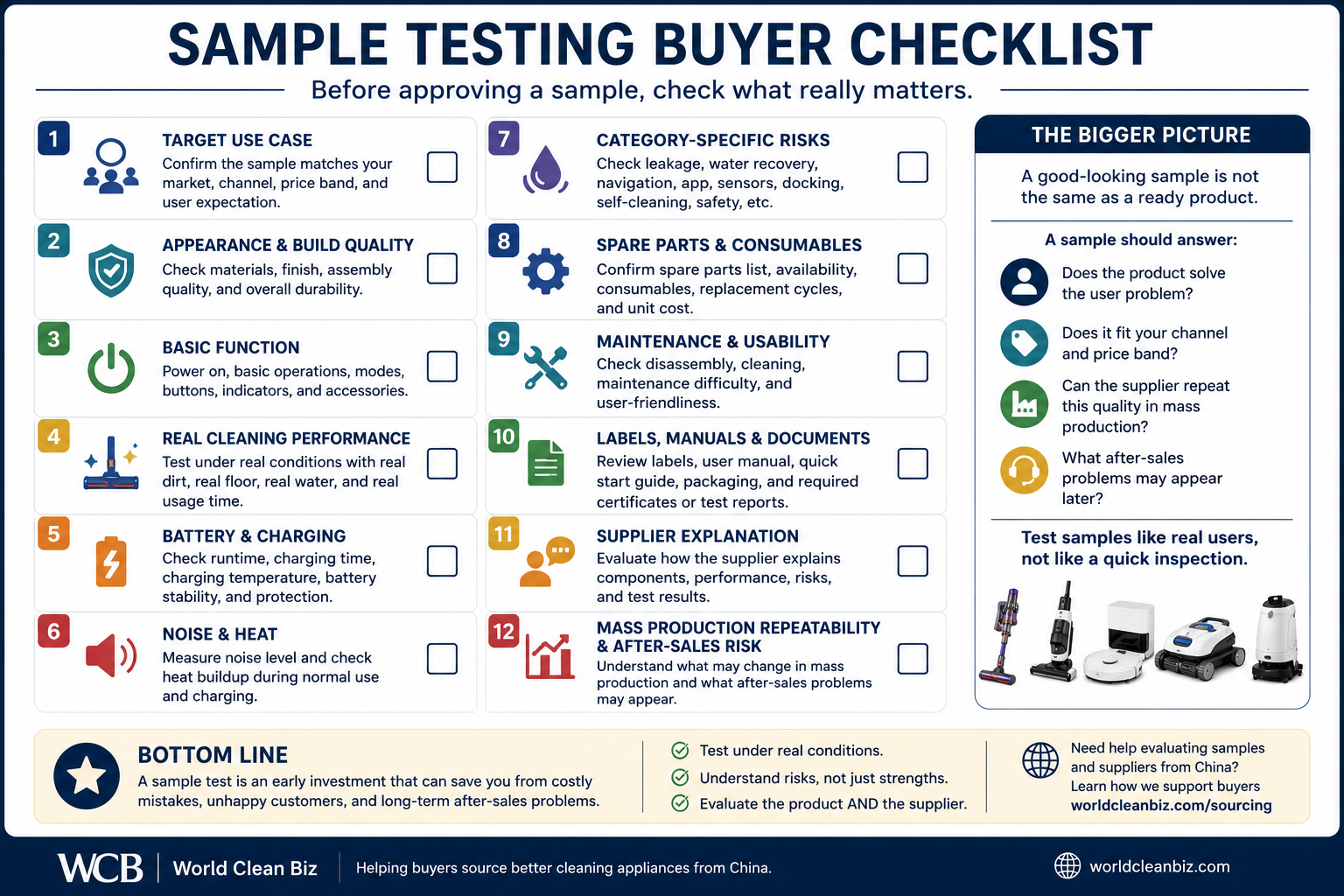
| Testing Area | What to Test | Why It Matters | Buyer Risk If Ignored |
|---|---|---|---|
| Target use case | Market, channel, price band, user need, warranty model | Defines what the sample must prove | Buyer may test the wrong things |
| Appearance and build quality | Materials, finish, assembly, controls, accessories | Shows basic workmanship and supplier attention | Obvious defects may appear in customer hands |
| Basic function | Power, charging, operation, accessory fit | Confirms minimum function | Buyer may approve an incomplete or unstable sample |
| Cleaning performance | Real dirt, debris, hair, water, surfaces, room layouts, facility use | Shows whether product solves the user problem | Product may look good but fail in real use |
| Battery and charging | Runtime, charging behavior, dock behavior, heat, power drop | Battery and charging issues create complaints | Customer returns and warranty risk may increase |
| Noise and heat | Noise level, heat during use and charging | Affects user experience and safety perception | Product may be rejected despite working |
| Water system / leakage where relevant | Water tank, pump, recovery, seals, leakage, drying | Critical for floor washers and water-related products | Leakage and odor may cause returns |
| Navigation / app / firmware where relevant | Mapping, docking, obstacle avoidance, app, updates | Critical for robots and connected products | Product may fail outside demo conditions |
| Spare parts and consumables | Filters, rollers, batteries, chargers, tanks, docks, seals, accessories | Supports warranty and service | Buyer may be unable to support customers |
| Maintenance and usability | Cleaning, emptying, replacement, troubleshooting | Determines repeated-use satisfaction | Customers may complain after short use |
| Labels and manuals | Labels, warnings, instructions, language, packaging | Supports safe and correct use | Misuse, complaints, or compliance issues may appear |
| Supplier explanation | Failure reasons, component choices, testing process | Reveals supplier capability | Buyer may trust a sample without understanding risk |
| Mass production repeatability | Component consistency, QC process, production testing | Confirms whether sample quality can scale | Mass production may differ from sample |
| After-sales risk | Likely complaints, warranty terms, spare parts support | Shows post-sale cost exposure | Buyer may carry hidden service cost |
Common Sample Testing Mistakes Buyers Make
The first mistake is testing only appearance and basic function. A product can look good and still fail in real use.
The second mistake is testing without a target use case. Buyers need to know the market, channel, price band, user expectation, and warranty model before testing.
The third mistake is trusting one good sample too much. A good sample does not guarantee stable mass production.
The fourth mistake is ignoring category-specific risks. A cordless vacuum, floor washer, robot vacuum, robotic pool cleaner, robotic lawn mower, and commercial robot require different tests.
The fifth mistake is not asking why a sample fails. Buyers should understand the root cause, not only request another sample.
The sixth mistake is ignoring documentation. Labels, manuals, warnings, charger information, and compliance documents should be checked during sample evaluation.
The seventh mistake is approving samples without confirming what can change in mass production. Components, packaging, firmware, accessories, or suppliers may change if not controlled.
The biggest mistake is treating sample testing as a buying formality instead of an early risk filter.
How World Clean Biz Helps Buyers Evaluate Samples Before Ordering
World Clean Biz helps buyers evaluate product samples before placing orders, not just after problems appear.
For cleaning appliance buyers, WCB helps review sample performance, supplier capability, category-specific risk, quality-control readiness, compliance readiness, MOQ and pricing trade-offs, spare parts, and after-sales exposure.
This matters because the right sample decision depends on more than whether the product turns on. Buyers need to understand whether the product fits the market, whether the supplier can repeat the quality, and whether the sourcing model supports the buyer’s long-term plan.
For supplier evaluation, read our guide on how to evaluate a Chinese cleaning appliance supplier. For QC planning, see quality control for cleaning appliances from China. Buyers who need category context can explore our cleaning industry reports, learn more about World Clean Biz, or follow World Clean Expo updates.
If you are testing cleaning appliance samples from China before placing orders, contact World Clean Biz for sourcing support.
FAQ
How should buyers test cleaning appliance samples from China?
Buyers should test samples under real-use conditions, not only by checking appearance and basic function.
A good sample test should cover cleaning performance, battery, charging, noise, heat, category-specific risks, maintenance, spare parts, labels, manuals, documentation, and supplier explanation.
Is a good sample enough to place a mass production order?
Not always. A good sample does not guarantee stable mass production.
Before placing a large order, buyers should confirm whether the sample uses the same components as mass production, whether the supplier can repeat the quality, and whether a pilot order or staged order is needed.
What should I test in a cordless vacuum sample?
Buyers should test suction, runtime, noise, filtration, dust leakage, brush head performance, hair tangling, charging, accessories, dust bin cleaning, and spare parts availability.
The sample should be tested on real surfaces and with real debris, not only in a short demo.
What should I test in a floor washer sample?
Buyers should test leakage, water recovery, roller cleaning, self-cleaning, drying, odor after storage, tank handling, battery behavior, noise, and replacement parts.
Floor washers should be tested with real wet messes because water system problems often appear only during practical use.
What should I test in a robot vacuum or cleaning robot sample?
For robot vacuums, buyers should test mapping, docking, obstacle avoidance, app connection, firmware stability, mopping, carpet behavior, multi-room cleaning, and spare parts.
For commercial cleaning robots, buyers should test route coverage, water recovery, safety behavior, operator handover, maintenance, runtime, and service workflow in a real facility.
Should I test samples myself or use a third-party inspection company?
Buyers can do both. The buyer should test user experience, product fit, channel fit, and after-sales risk. A third-party inspection company can help with structured checks, documentation, and pre-shipment inspections.
However, third-party inspection should not replace buyer-side product judgment.
What should I ask the supplier if a sample fails?
Ask why it failed, what caused the problem, what will be changed, how the change will be tested, whether it affects cost or lead time, and whether the same problem could appear in mass production.
A supplier’s explanation is often as important as the failure itself.
Can World Clean Biz help buyers evaluate cleaning appliance samples?
Yes. World Clean Biz helps buyers evaluate product samples, supplier capability, category-specific risk, quality-control readiness, compliance readiness, MOQ and pricing trade-offs, spare parts, and after-sales exposure before placing orders.
The goal is to help buyers decide whether to approve, improve, retest, reject, or reposition a product before scaling. If you need support, you can contact World Clean Biz.