In this article 16 sections
MOQ and pricing are usually among the first questions buyers ask when sourcing cleaning appliances from China.
That is understandable. Buyers need to know whether a supplier can support their order size, price target, channel margin, and launch plan.
But in cleaning appliances, the lowest MOQ or lowest unit price is not always the best sourcing decision.
A low MOQ may come with limited customization, weak supplier attention, higher unit cost, limited spare parts support, or poor quality control. A low unit price may exclude testing, certification, packaging, inspection, spare parts, warranty, rework, or after-sales cost.
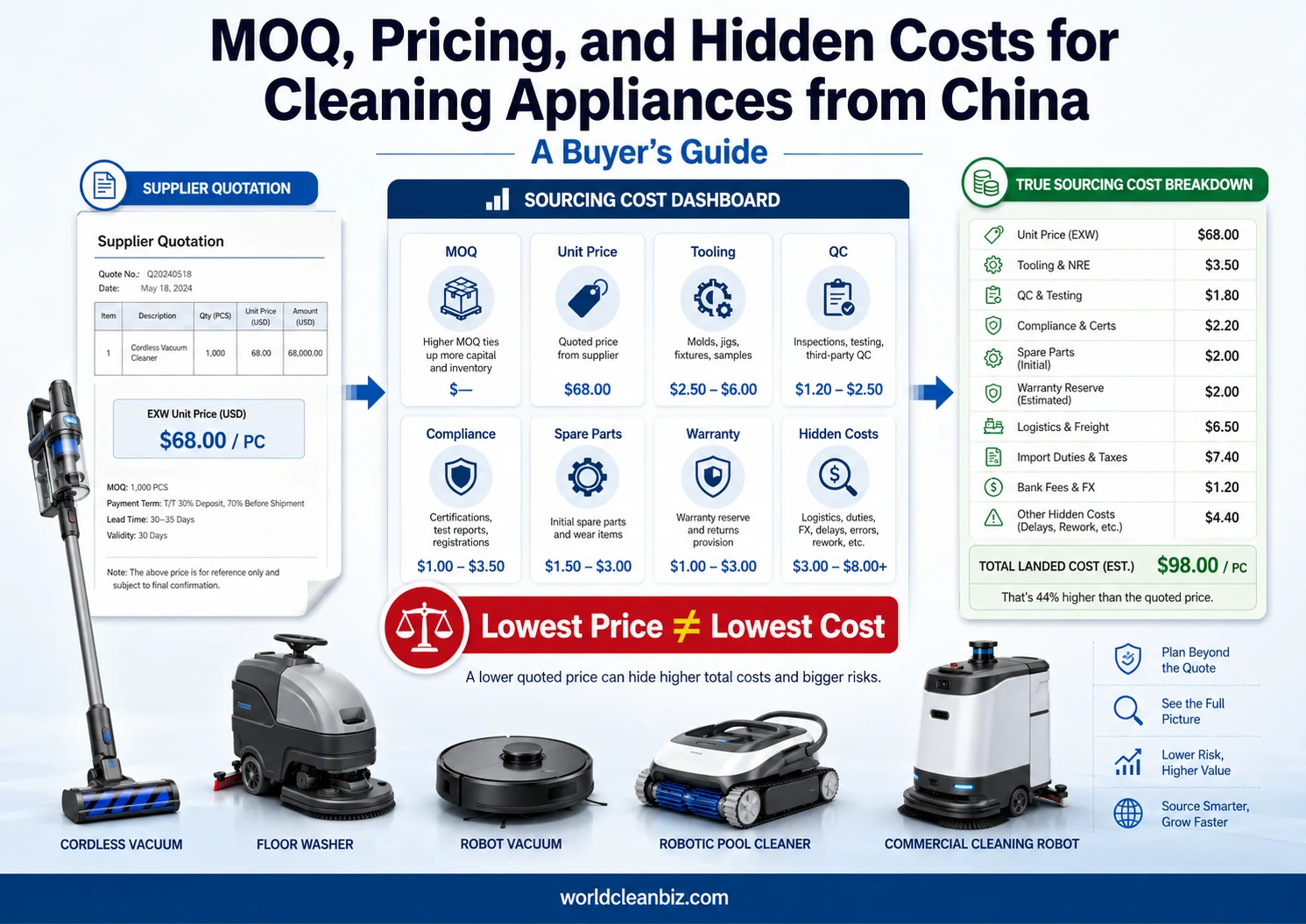
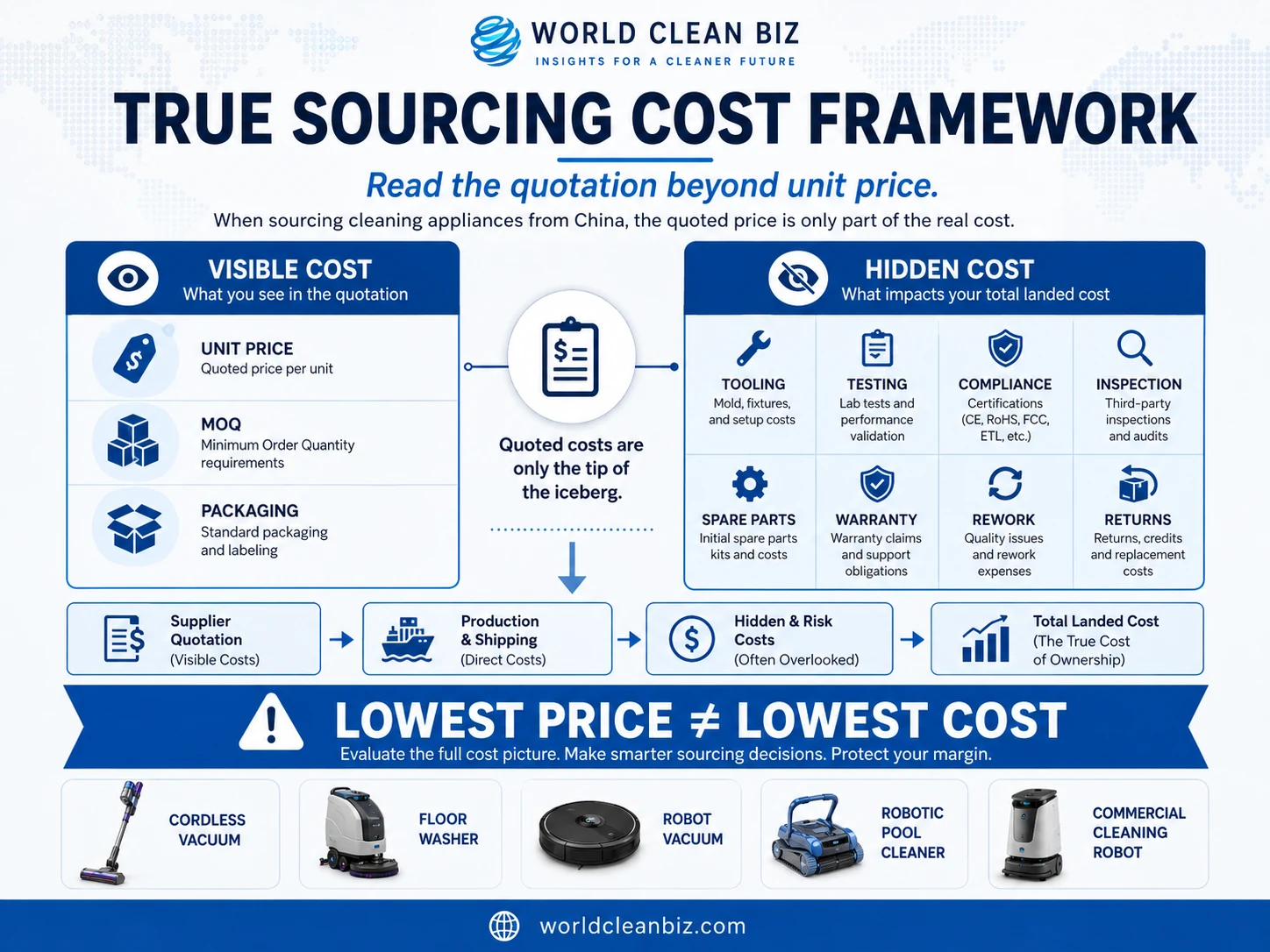
For cleaning appliances, the real cost is not only the FOB price on the quotation.
Cordless vacuums, floor washers, robot vacuums, robotic pool cleaners, robotic lawn mowers, commercial cleaning robots, and related cleaning products may involve motors, batteries, chargers, water systems, sensors, software, firmware, docking, sealing, spare parts, compliance documents, quality-control checks, and warranty risk.
The core question is not:
Which supplier gives the lowest price?
The better question is:
Which supplier gives the lowest total sourcing risk for the product, channel, and after-sales model?
Quick Answer
MOQ for cleaning appliances from China depends on product category, supplier type, component sourcing, customization level, packaging, production planning, and buyer relationship. There is no single “typical MOQ” that applies to all cleaning appliances.
Pricing also depends on the sourcing model. OEM, ODM, private label, factory-direct sourcing, trading companies, and sourcing partners may all quote differently. A lower unit price may not include tooling, packaging, testing, certification, inspections, spare parts, warranty support, or product changes.
Buyers should compare total sourcing cost, not only the supplier quotation. That means reviewing MOQ, unit price, tooling, customization, packaging, quality control, compliance readiness, logistics, spare parts, warranty exposure, and after-sales risk together.
If you are still building your supplier base, start with our guide on how to find reliable cleaning product suppliers in China. If you are already comparing suppliers, read our guide on how to evaluate a Chinese cleaning appliance supplier.
Why MOQ and Pricing Are Different in Cleaning Appliances
MOQ and pricing are more complicated in cleaning appliances than in simple cleaning tools.
A manual cleaning tool may mainly involve material cost, packaging, labor, and shipping. Cleaning appliances involve more layers: motors, batteries, chargers, electronic components, pumps, sensors, filters, brush rollers, water tanks, docks, software, firmware, tooling, testing, compliance documents, and spare parts.
Different categories also behave differently.
A cordless vacuum may be priced around motor, battery, filtration, brush head, accessories, and packaging. A floor washer may involve water tanks, rollers, pumps, drying functions, leakage control, and consumables. A robot vacuum may include navigation, obstacle avoidance, docking, app control, firmware, battery, and mopping systems. A robotic pool cleaner or robotic lawn mower may involve outdoor or water-related reliability risk. A commercial cleaning robot may require deployment, training, maintenance, and service support.
This is why buyers should not compare cleaning appliance quotes only by unit price.
Two suppliers may quote similar-looking products at different prices because one uses better components, stronger testing, more complete documentation, better packaging, or stronger spare parts support. Another supplier may quote lower because key costs are excluded or because the product platform is weaker.
MOQ also reflects more than supplier preference. It may be linked to component procurement, production line setup, packaging printing, customization, supplier attention, and factory scheduling.
A low MOQ can be useful. But it should not be the only reason to choose a supplier.
WCB Market Note
MOQ and pricing decisions are becoming more important in cleaning appliance sourcing because buyers are no longer sourcing only simple products. Cleaning appliances now carry higher technical, compliance, quality-control, and after-sales risk. A quotation may look attractive at first, but the real cost depends on what is included: component quality, testing, packaging, certification readiness, inspection, spare parts, warranty support, and supplier responsibility. A low price can be useful only if the product risk is controlled.
Buyer implication: Buyers should compare quotations by total sourcing cost, not only unit price or MOQ.
Buyer implication: Buyers should ask what is excluded from the quotation before assuming one supplier is cheaper than another.
WCB view: In cleaning appliances, price is not only a purchase number. It is a risk signal. A quotation should be read together with product complexity, supplier capability, QC process, compliance readiness, and after-sales burden.
MOQ Is Not Just a Supplier Rule
Many buyers treat MOQ as a fixed supplier rule.
In reality, MOQ often reflects the supplier’s production economics and risk.
MOQ may be affected by:
- Product category
- Component sourcing
- Packaging requirements
- Customization level
- Production line setup
- Mold or tooling needs
- Supplier capacity
- Material purchasing quantity
- Color or branding requirements
- Buyer relationship
- Forecast and repeat order potential
- Seasonality or production schedule
For example, a supplier may allow a lower MOQ for an existing product with standard packaging. But if the buyer needs custom color, custom mold, special packaging, specific battery configuration, unique accessories, or private label branding, MOQ may increase.
MOQ may also differ by supplier type. A factory may require higher MOQ for efficient production. A trading company or sourcing partner may help consolidate orders or support smaller buyers, but may add margin. An ODM supplier may offer an existing platform with more flexible entry than a full OEM project. A private label product may have lower development burden but less differentiation.
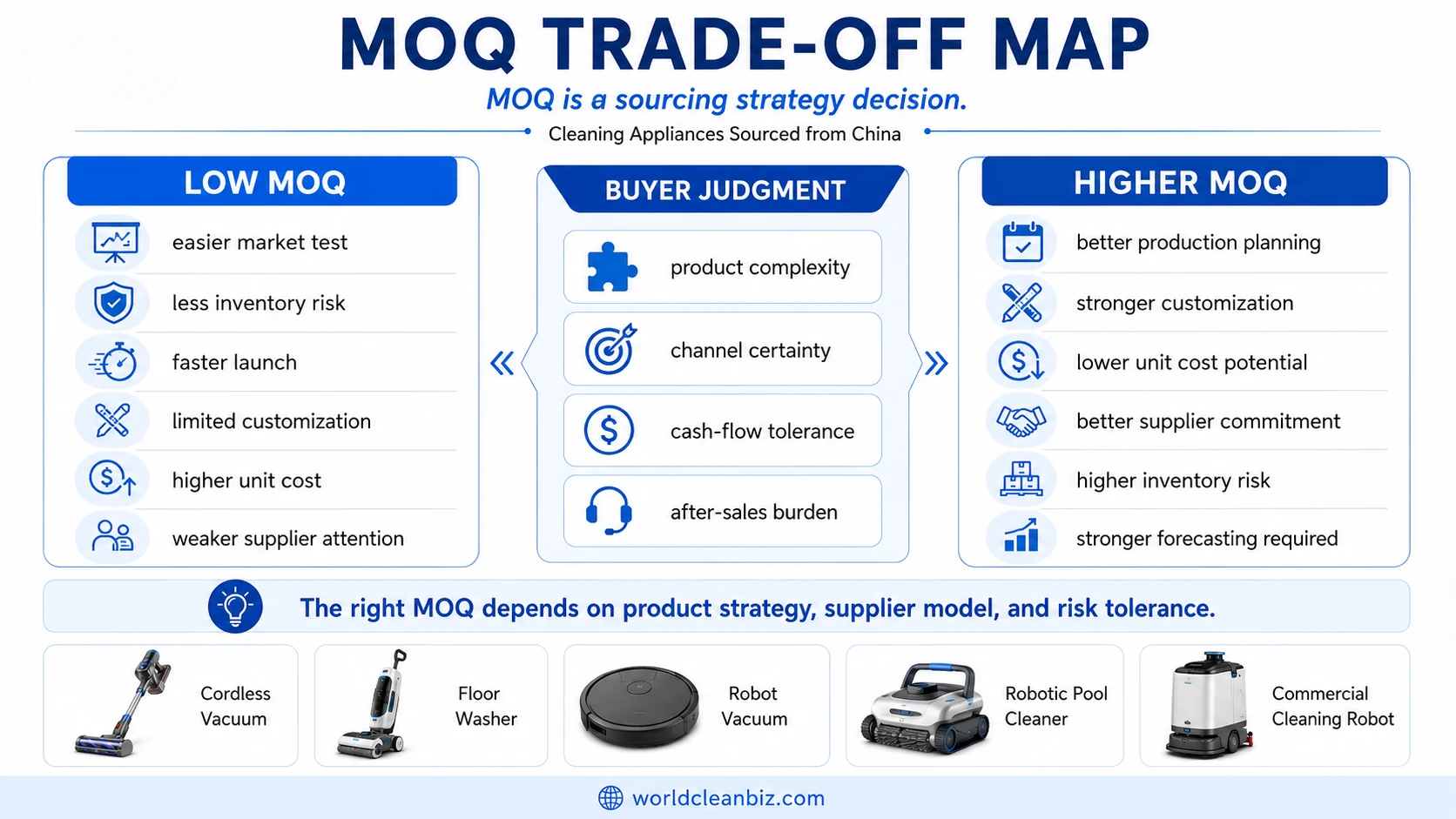
The point is not to push for the lowest MOQ. The point is to understand why the MOQ exists and what trade-offs come with it.
A lower MOQ is helpful only if the product, supplier, quality-control process, and after-sales support still fit the buyer’s market.
Step 1: Understand What Drives MOQ
Before negotiating MOQ, buyers should understand what drives it.
In cleaning appliances, MOQ is often shaped by product complexity and component sourcing. Motors, batteries, chargers, PCBs, pumps, water tanks, brush rollers, sensors, docks, filters, seals, accessories, and packaging may all have their own procurement requirements.
Customization also affects MOQ. A logo may be easy. Custom packaging may require printing minimums. A custom color may require material or coating minimums. A component change may require larger procurement volume. A structural change may require tooling or mold investment.
Production planning matters too. Factories prefer efficient production runs. Small orders can create setup cost, lower line efficiency, and more management work. That is why some factories are not flexible for small buyers, even if they are capable.
Buyers should ask:
- Is the MOQ based on product assembly, components, packaging, or customization?
- Is there a lower MOQ for standard products?
- Does private label packaging change the MOQ?
- Does color customization change the MOQ?
- Do components have their own minimum order requirements?
- Can the supplier support a pilot order?
- What changes if repeat orders are expected?
MOQ should be discussed together with product strategy. A buyer testing a category may need lower MOQ. A buyer building a long-term product line may accept a higher MOQ for better control, better supplier attention, or better customization.
Step 2: Compare Factory, Trading Company, ODM, OEM, and Private Label Pricing
Different supplier structures create different pricing logic.
A factory may offer more direct pricing, especially when the buyer has volume and clear specifications. But direct factory pricing may require the buyer to manage more work: technical communication, sampling, quality control, compliance, inspection, spare parts, and after-sales issues.
A trading company or sourcing partner may add margin, but may reduce coordination cost if it genuinely controls supplier communication, sample follow-up, production tracking, quality coordination, and risk management. For a buyer without a China sourcing team, this service may be valuable. For more on this decision, see our guide on factory vs trading company in China.
An ODM supplier may provide an existing product platform, which can reduce development time. But buyers should check product overlap, customization limits, and whether the same platform is sold to competitors.
An OEM project may require more planning, tooling, testing, and project management. But it can offer more control over product design, components, differentiation, and long-term roadmap.
Private label can reduce development burden and support faster market entry. But buyers should check product sameness, compliance documents, spare parts, warranty exposure, and whether the supplier’s base product is strong enough. For more detail, see private label cleaning products from China.
For sourcing model comparison, see our guide to OEM vs ODM cleaning products.
The cheapest quote may not come from the best structure. Buyers should ask which structure fits their product, market, and risk level.
Step 3: Read the Quotation Beyond Unit Price
A supplier quotation should be read carefully.
The unit price is only one part of the real cost.
Buyers should check whether the quotation includes or excludes:
- Product configuration
- Accessories
- Packaging
- Logo or branding
- Custom color
- Manual and labels
- Plug or charger type
- Battery configuration
- Spare parts
- Testing
- Certification support
- Inspection
- Tooling or molds
- Sample cost
- Payment terms
- Lead time
- Warranty terms
- Incoterms
- Shipping-related responsibilities
Two quotations may look similar but include different product configurations. One may include accessories, packaging, or a better battery. Another may exclude them. One may include export packaging. Another may quote only basic packaging. One may support spare parts. Another may treat spare parts as a separate order.
Buyers should also confirm whether the quoted price is for the exact product version tested. If the supplier changes battery, charger, motor, packaging, accessories, or software after the quotation, the cost and compliance situation may change.
The quotation should be treated as a product definition document, not only a price sheet.
Step 4: Identify Hidden Costs Before Placing an Order
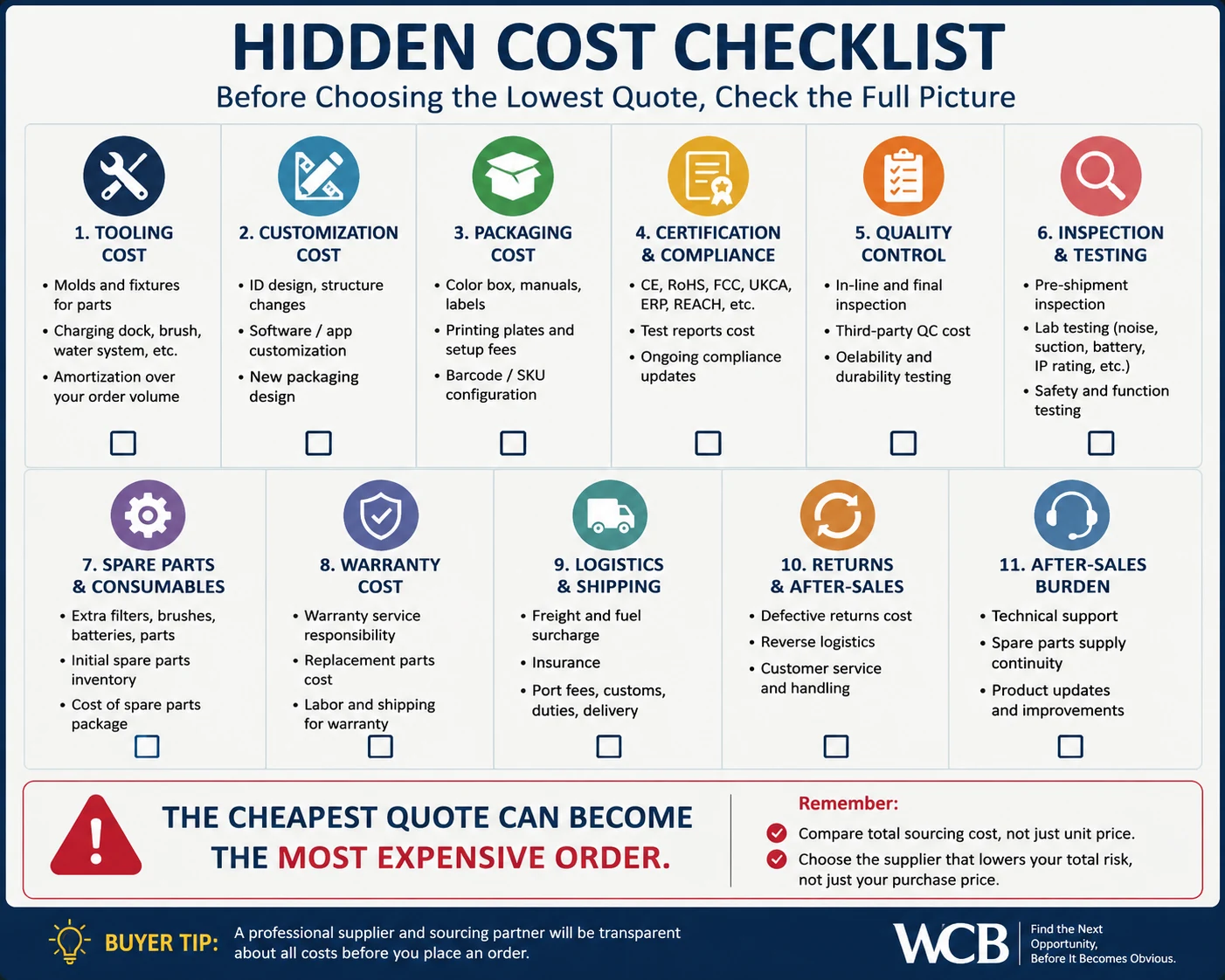
Hidden costs often appear after buyers choose the lowest quote.
Common hidden costs include:
- Tooling or mold cost
- Custom packaging cost
- Logo setup cost
- Label and manual design cost
- Sample cost
- Product testing cost
- Certification or document update cost
- Inspection cost
- Rework cost
- Spare parts cost
- Warranty replacements
- Return handling
- Platform listing corrections
- Delayed shipment cost
- Packaging damage cost
- Component upgrade cost
Some costs are normal. The issue is not that they exist. The issue is whether the buyer knows them before placing the order.
Cleaning appliances often create hidden costs because performance problems may appear after launch. A product with weak suction, water leakage, docking problems, poor battery life, missing spare parts, or incomplete documentation may generate returns, refunds, replacement parts, negative reviews, and distributor complaints.
The cheapest supplier may become expensive if the buyer has to pay later for rework, replacement parts, additional testing, customer support, or lost sales.
Buyers should ask suppliers to separate the quotation clearly:
- Base product cost
- Customization cost
- Packaging cost
- Testing or certification support cost
- Spare parts cost
- Warranty policy
- Tooling or mold cost
- Sample and pilot order cost
If the quote is too simple for a complex appliance, the buyer should ask more questions.
Step 5: Understand Tooling, Customization, and Packaging Costs
Tooling and customization can change the cost structure.
For simple private label products, customization may only include logo, packaging, color, or manual. For more complex cleaning appliances, customization may involve housing, components, water tanks, brush rollers, battery options, docking stations, software, app branding, sensors, or accessories.
Buyers should separate customization into levels:
- Branding customization — logo, packaging, labels, manuals.
- Configuration customization — accessories, plug type, battery option, feature set.
- Structural customization — housing, internal parts, molds, docking system, water system.
- Software or firmware customization — app branding, firmware settings, connectivity, user interface.
The deeper the customization, the more likely it will affect cost, MOQ, lead time, testing, compliance, and quality risk.
Packaging cost also matters. Retail packaging, e-commerce packaging, distributor packaging, and commercial equipment packaging may require different designs, materials, protection levels, and labeling.
A buyer should not ask only, “How much to print my logo?”
A better question is:
Which customization can be done safely without increasing product risk, MOQ, compliance burden, or after-sales cost?
Step 6: Include Quality Control and Compliance Costs
Quality control and compliance are not optional costs for cleaning appliances.
A buyer may save money by skipping inspections or document review, but that does not remove risk. It only moves the risk to a later stage.
Quality-related costs may include:
- Sample testing
- During-production inspection
- Pre-shipment inspection
- Product performance testing
- Packaging testing
- Rework after defects
- Third-party inspection service
- Defect analysis
For a deeper QC framework, see our guide on quality control for cleaning appliances from China.
Compliance-related costs may include document review, testing support, certification updates, label changes, manual updates, packaging changes, or component review. Requirements depend on product type and target market. Buyers should verify final requirements with qualified compliance partners or testing labs.
For more detail, see our guide on compliance and certification for cleaning appliances from China.
The key point is simple: if these costs are not considered before purchase, they may appear later as shipment delays, customs problems, platform listing issues, rework, recalls, or warranty disputes.
Step 7: Plan Spare Parts, Warranty, and After-Sales Cost
After-sales cost is often underestimated in cleaning appliance sourcing.
A product may look profitable at the quotation stage but become expensive after returns, spare parts requests, warranty claims, and customer complaints.
Cleaning appliances often need spare parts such as filters, brush rollers, batteries, chargers, tanks, pumps, motors, sensors, docks, seals, wheels, blades, accessories, and consumables.
Buyers should ask:
- Which spare parts are available?
- What spare parts should be ordered with the first shipment?
- How long will the supplier support parts?
- What is the warranty policy?
- Who pays for defective units?
- How are replacement parts shipped?
- What happens if the model is discontinued?
- Can the supplier help analyze repeated defects?
Warranty cost should be part of the sourcing calculation. If the supplier offers a low price but cannot support spare parts or defect handling, the buyer may carry the real cost alone.
This is especially important for robot vacuums, floor washers, robotic pool cleaners, robotic lawn mowers, and commercial cleaning robots, where service expectations can be higher.
Step 8: Calculate Total Landed Risk, Not Just FOB Price
FOB price is important, but it is not the full cost.
Buyers should calculate total landed risk, which includes both visible and hidden costs.
This may include:
- Unit price
- MOQ
- Tooling or mold cost
- Customization cost
- Packaging cost
- Testing and compliance cost
- Inspection cost
- Spare parts cost
- Warranty reserve
- Shipping cost
- Duties and import-related costs
- Warehousing
- Rework
- Replacement parts
- Return cost
- Customer service burden
- Lost sales from poor reviews or delays
Not every buyer can calculate every number exactly before ordering. But buyers can identify where risk may appear and compare suppliers more realistically.
A higher unit price may be acceptable if the supplier provides stronger product quality, better documentation, better QC, more stable components, better packaging, reliable spare parts, and clearer warranty responsibility.
A lower price may still be attractive if the product is simple, the buyer understands the risk, and the supplier is transparent.
The goal is not to avoid low prices. The goal is to know what the price includes and what risk remains outside the quotation.
MOQ and Pricing Checklist for Cleaning Appliance Buyers
| Cost Area | What to Check | Why It Matters | Buyer Risk If Ignored |
|---|---|---|---|
| MOQ structure | Product MOQ, packaging MOQ, component MOQ, customization MOQ | Shows why the minimum order exists | Buyer may push for low MOQ without understanding trade-offs |
| Unit price | Exact product configuration, accessories, packaging, battery, charger | Unit price may not include the same product scope | Buyer may compare unequal quotations |
| Tooling or mold cost | New mold, housing changes, structural customization | Tooling changes cost, timeline, and control | Buyer may underestimate development cost |
| Customization cost | Logo, color, accessories, feature configuration, software | Customization may affect MOQ, testing, and lead time | Buyer may create hidden cost or quality risk |
| Packaging cost | Retail box, shipping carton, e-commerce packaging, labels | Packaging affects channel readiness and damage risk | Product may fail retail, online, or shipment requirements |
| Certification and testing cost | Test reports, document updates, target-market review | Compliance readiness depends on product and market | Shipment, listing, or sales issues may appear later |
| Quality control and inspection cost | Sample tests, in-process checks, pre-shipment inspection | QC reduces defect and shipment risk | Buyer may save inspection cost but pay later in returns |
| Spare parts | Filters, rollers, batteries, chargers, tanks, pumps, docks, accessories | Spare parts affect warranty and service | Buyer may be unable to support customers |
| Warranty reserve | Defect handling, replacements, repair support | Warranty cost affects real margin | Buyer may underestimate post-sale cost |
| Logistics and landed cost | Shipping, duties, warehousing, local handling | FOB price is not total cost | Buyer may miscalculate margin |
| Supplier structure | Factory, trading company, sourcing partner, ODM, OEM, private label | Structure affects margin, control, and service | Buyer may choose the wrong cost model |
| Payment terms | Deposit, balance, inspection timing, payment risk | Affects cash flow and control | Buyer may lose leverage before quality is confirmed |
| Product changes | Component, packaging, label, color, charger, battery changes | Changes can affect cost and compliance | Buyer may face unexpected price increases |
| After-sales burden | Returns, repairs, replacement parts, support workload | Post-sale cost can exceed expected savings | Low price may become expensive after launch |
Common Buyer Mistakes
The first mistake is choosing the lowest unit price without checking what is included. A quote is not useful if it excludes important accessories, packaging, testing, spare parts, or warranty responsibility.
The second mistake is treating MOQ as only a number to negotiate. MOQ may reflect component sourcing, packaging, customization, and production planning. Pushing too low can reduce supplier attention or product control.
The third mistake is ignoring hidden costs. Tooling, testing, compliance, inspection, rework, spare parts, and warranty claims can change the real sourcing cost.
The fourth mistake is comparing factory and trading company prices without comparing responsibility. A trading company may add margin but reduce coordination cost if it genuinely manages supplier communication and quality follow-up.
The fifth mistake is choosing private label only because it is cheaper or faster. Private label may reduce development burden, but it can create product sameness, limited control, and after-sales cost.
The sixth mistake is not planning spare parts. A product without spare parts support can become expensive even if the first shipment is cheap.
The seventh mistake is separating pricing from product strategy. MOQ and pricing should be evaluated together with target market, sales channel, warranty model, and sourcing model.
The biggest mistake is seeing price as a purchasing decision only. In cleaning appliances, price is also a risk signal.
How World Clean Biz Helps Buyers Evaluate Real Sourcing Cost
World Clean Biz helps buyers look beyond MOQ and unit price.
For cleaning appliance buyers, WCB helps evaluate product opportunity, supplier structure, MOQ, pricing, quality-control risk, compliance readiness, spare parts, warranty exposure, and China supply chain options before placing orders.
This matters because the right sourcing decision depends on more than whether a supplier can quote a lower price. Buyers need to understand whether the product fits the market, whether the supplier can support the category, whether the sourcing model is suitable, and whether hidden costs may appear after shipment.
For supplier selection, read our guide on how to evaluate a Chinese cleaning appliance supplier. For sourcing model comparison, see OEM vs ODM cleaning products. Buyers who need broader market context can explore our cleaning industry reports, learn more about World Clean Biz, or follow World Clean Expo updates.
If you are comparing MOQ, pricing, and hidden costs for cleaning appliances from China, contact World Clean Biz for sourcing support.
FAQ
What is the typical MOQ for cleaning appliances from China?
There is no single typical MOQ for all cleaning appliances. MOQ depends on product category, supplier type, component sourcing, packaging, customization, production planning, and buyer relationship.
Buyers should ask what drives the MOQ instead of only asking for a lower number.
Why do cleaning appliance MOQs vary so much?
Cleaning appliance MOQs vary because products use different components, production processes, packaging requirements, and customization levels.
A standard private label product may have one MOQ, while a customized OEM product with special components, packaging, or tooling may require a different MOQ.
Is a lower MOQ always better?
No. A lower MOQ can help buyers test the market, but it is not always better.
If lower MOQ comes with weak supplier attention, limited customization, higher unit cost, poor quality control, or weak spare parts support, it may create higher risk.
Why is the lowest unit price not always the best option?
The lowest unit price may exclude important costs such as testing, certification, packaging, inspections, spare parts, warranty support, or product changes.
For cleaning appliances, a low price can become expensive if defects, returns, rework, compliance gaps, or after-sales problems appear later.
What hidden costs should buyers check before ordering?
Buyers should check tooling, customization, packaging, testing, compliance, inspection, rework, spare parts, warranty, logistics, return handling, and after-sales support.
They should also check whether the quoted price includes the exact product configuration being evaluated.
How do OEM, ODM, and private label affect MOQ and pricing?
OEM may require more planning, tooling, testing, and project management, but can offer more control. ODM may be faster because it uses an existing platform, but customization and product overlap must be checked.
Private label may reduce development burden and support faster launch, but buyers should evaluate product sameness, compliance documents, spare parts, and warranty exposure.
Should buyers work with a factory or trading company to reduce cost?
It depends on the buyer’s capability and product complexity. A factory may offer more direct pricing, but the buyer may need to manage more technical, QC, compliance, and after-sales work.
A trading company or sourcing partner may add margin, but can reduce coordination cost if it genuinely helps manage supplier communication, production follow-up, quality, and risk.
Can World Clean Biz help buyers evaluate real sourcing cost?
Yes. World Clean Biz helps buyers evaluate product opportunity, supplier structure, MOQ, pricing, quality-control risk, compliance readiness, spare parts, warranty exposure, and China supply chain options before placing orders.
The goal is to help buyers understand the real sourcing cost, not only the first quotation. If you need support, you can contact World Clean Biz.