In this article 16 sections
Compliance and certification for cleaning appliances from China should not be treated as a final paperwork step.
A supplier saying “we have certificates” does not automatically mean the product is ready for your market.
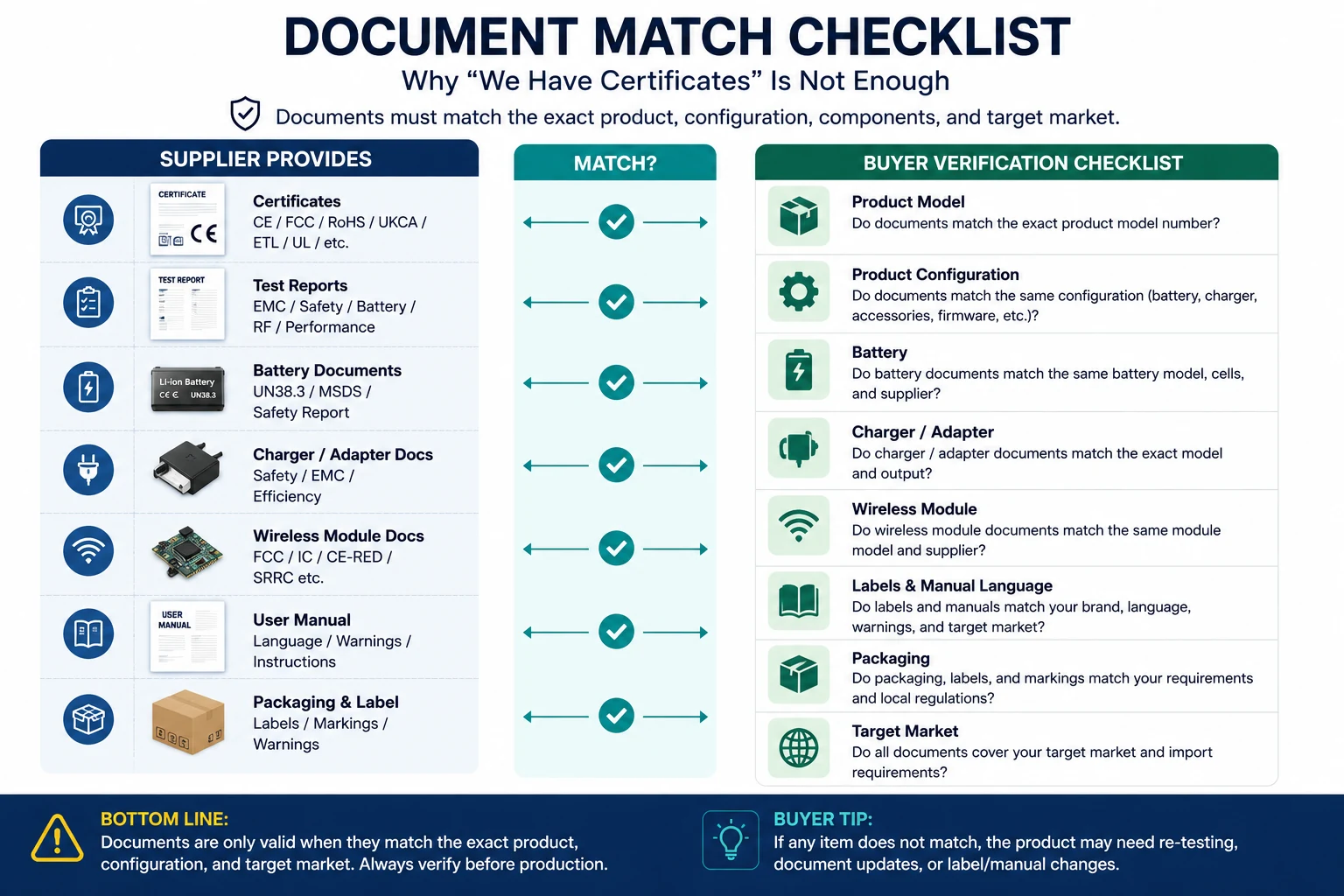
For cleaning appliances, buyers need to check whether certificates, test reports, labels, manuals, chargers, batteries, adapters, wireless modules, packaging, and product configurations match the exact product they plan to import and sell.
This matters because cleaning appliances are not simple goods. Cordless vacuums, floor washers, robot vacuums, robotic pool cleaners, robotic lawn mowers, and commercial cleaning robots may involve motors, batteries, chargers, wireless communication, water systems, docking stations, outdoor use, safety warnings, software-related documentation, spare parts, and service instructions.
Compliance requirements depend on product type and destination market. This article is not legal advice and not a technical standards manual. Buyers should always verify final requirements with qualified compliance professionals, testing labs, customs advisors, or local regulatory experts.
But from a sourcing perspective, the buyer’s first job is clear:
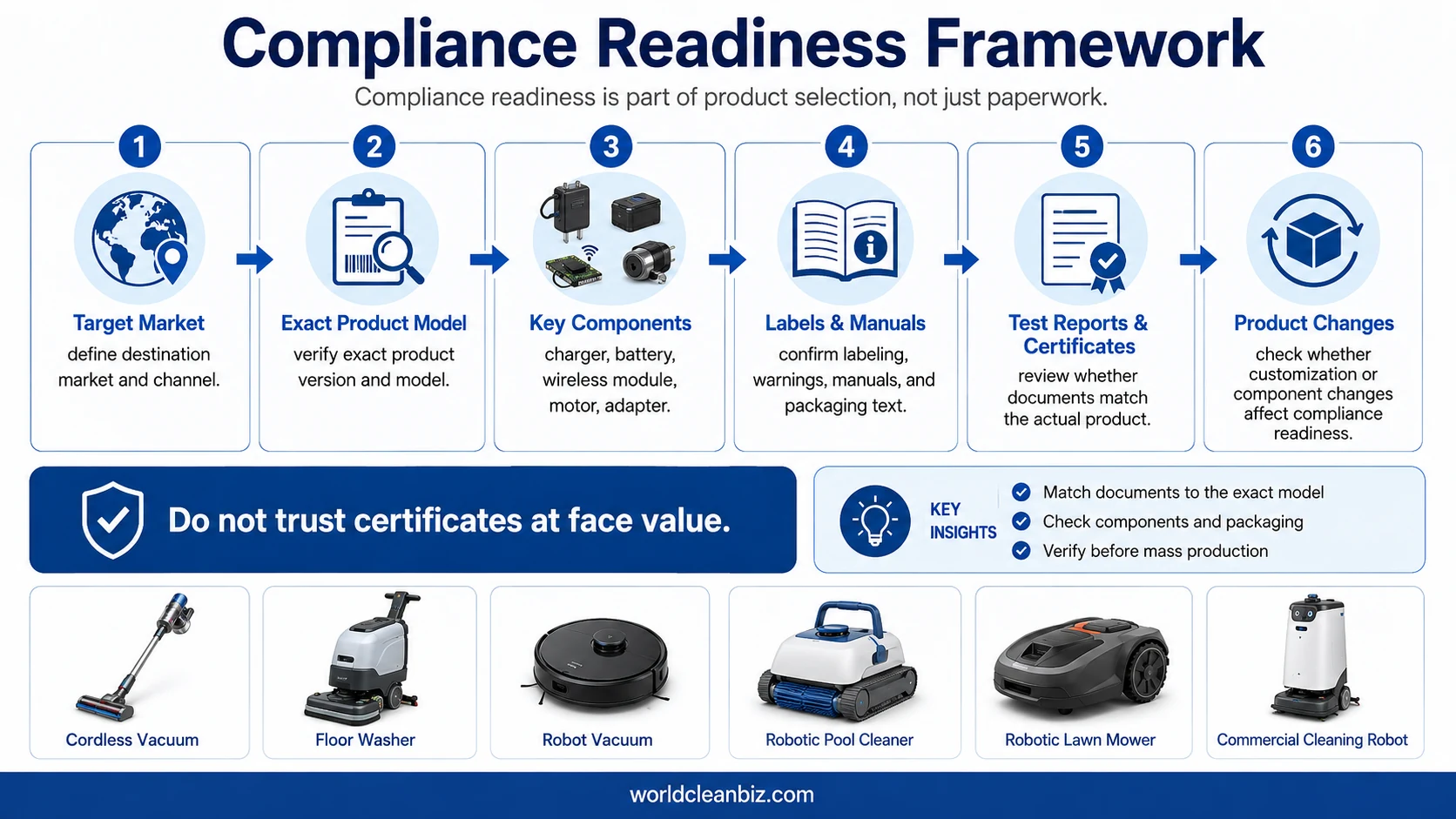
Do not trust a certificate at face value. Verify whether it actually matches the product, configuration, supplier, and target market.
Quick Answer
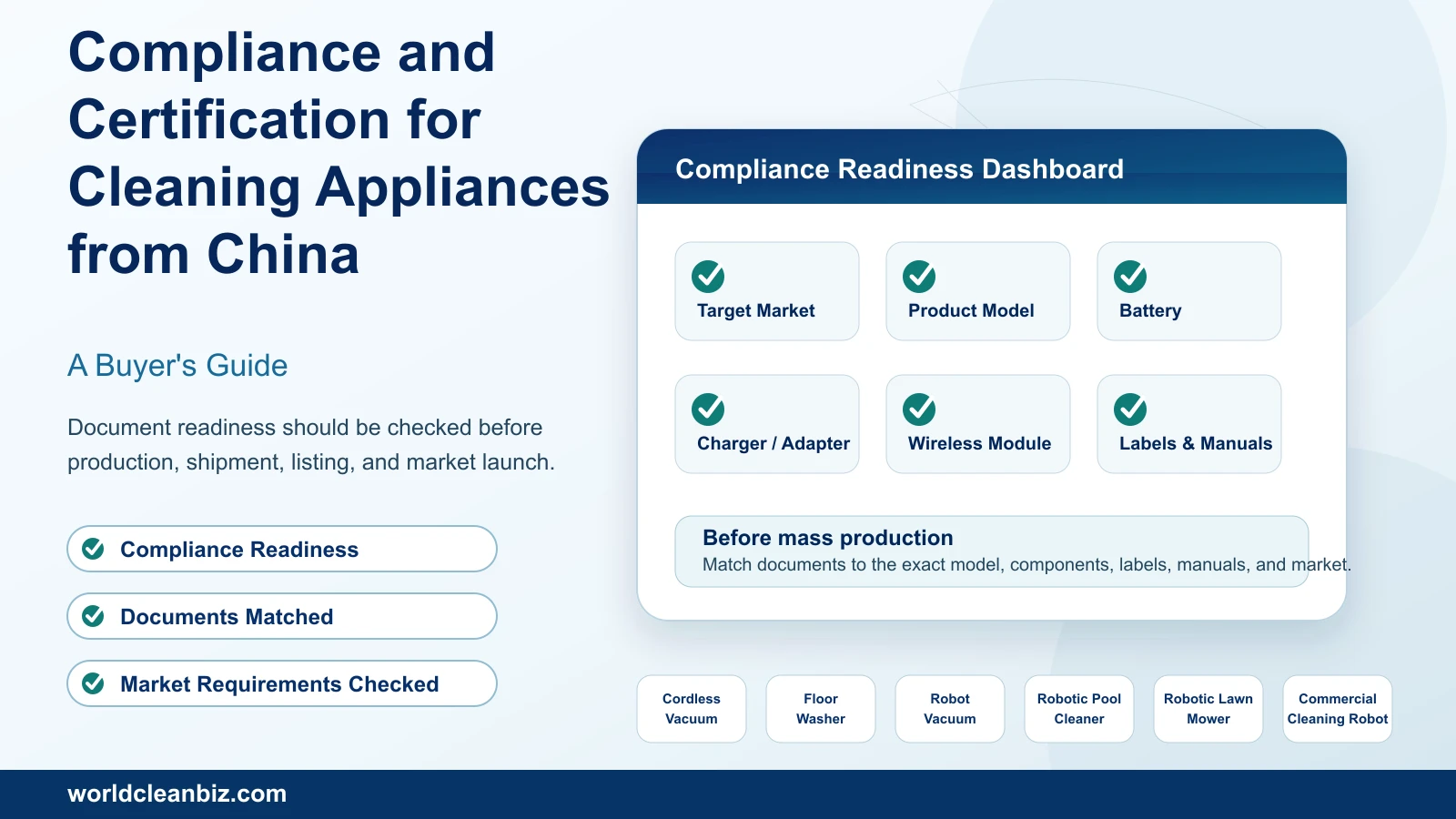
When sourcing cleaning appliances from China, buyers should check whether compliance documents match the exact product model, configuration, charger, battery, adapter, wireless module, label, manual, packaging, and target market.
A supplier may provide CE, FCC, RoHS, UL-related, battery, EMC, safety, or other documents depending on the product and market. But the existence of documents does not prove the product is ready for import or sale. Buyers need to verify whether those documents apply to the exact product version being purchased.
Compliance readiness should be checked before mass production, not after the goods are packed. Product changes, charger changes, battery changes, wireless module changes, packaging changes, private label changes, and ODM customization can affect whether existing documents still apply.
For broader supplier evaluation, read our guide on how to evaluate a Chinese cleaning appliance supplier. For quality control planning, see our guide on quality control for cleaning appliances from China.
Why Compliance Matters More in Cleaning Appliances
Compliance matters more in cleaning appliances because these products often combine electrical systems, batteries, chargers, motors, water contact, wireless communication, moving parts, user maintenance, and sometimes outdoor or commercial use.
This creates more risk than simple cleaning tools.
A basic mop or brush may need material, labeling, and packaging checks. A cordless vacuum may involve battery and charger requirements. A floor washer may involve water systems and electrical safety. A robot vacuum may include wireless modules, firmware, docking, and app-related user documentation. A robotic pool cleaner may involve waterproofing, battery, charger, and safety warnings. A robotic lawn mower may involve outdoor use, blades, battery, navigation, and safety instructions. A commercial cleaning robot may require more careful review of operator manuals, service instructions, battery handling, and deployment environment.
Poor compliance preparation can create serious business problems:
- Shipment delays
- Customs questions
- Platform listing issues
- Sales restrictions
- Product relabeling
- Additional testing cost
- Product recalls
- Distributor complaints
- Retail rejection
- Brand damage
Buyers should not wait until shipment to ask for documents. By that point, the product may already be manufactured, packaged, and difficult to correct.
Compliance readiness should be part of product selection, supplier evaluation, sample approval, and quality control.
WCB Market Note
Compliance risk is rising in cleaning appliance sourcing because products are becoming more complex and buyers are using more mixed sourcing models. A product may come from a factory catalog, ODM platform, private label program, trading company, or sourcing partner. It may include batteries, chargers, wireless modules, docking stations, water systems, motors, labels, manuals, and packaging that differ from the version originally tested. A certificate may exist, but it may not cover the exact product configuration, brand version, or target market.
Buyer implication: Buyers should verify compliance readiness before placing orders, not after production or shipment.
Buyer implication: Buyers should check whether documents match the exact model, components, labels, manuals, packaging, and destination market.
WCB view: In cleaning appliances, compliance readiness is part of product selection. Buyers are not only choosing a supplier; they are choosing a product configuration, component system, documentation package, and target-market risk profile.
Compliance Is Not Just a Supplier Certificate
Many buyers ask suppliers a simple question:
Do you have certificates?
The supplier may answer yes and send several PDF files. That is only the beginning.
Buyers should ask more specific questions:
- Which product model does this certificate cover?
- Does it match the exact product we plan to buy?
- Does it include the same charger, battery, adapter, motor, PCB, and wireless module?
- Does it apply to the target market?
- Does it match our private label version?
- Does it cover the packaging and manual language we will use?
- Who arranged the testing?
- Who owns the report?
- Is the report still valid for the current product configuration?
A certificate for a similar product may not be enough. A certificate for an older version may not cover the current model. A test report under another company name may require further review. A product may be compliant in one market but not ready for another.
This is why compliance should be treated as a product-readiness issue, not just a document request.
For buyers still selecting suppliers, our guide on how to find reliable cleaning product suppliers in China explains why supplier capability matters before documentation.
Step 1: Define the Target Market Before Choosing a Product
Compliance requirements depend on where the product will be sold.
Before choosing a cleaning appliance from China, buyers should define the target market clearly. A product intended for the US, EU, UK, Australia, Middle East, Southeast Asia, or other regions may face different requirements for safety, EMC, radio, batteries, chargers, labels, manuals, and packaging.
Buyers should not choose a product first and ask about compliance later.
Start with these questions:
- Which country or region will the product be sold in?
- Will the product be sold online, through retail, through distributors, or through professional channels?
- Is the product battery-powered?
- Does it include a charger or adapter?
- Does it include wireless communication?
- Does it involve water contact?
- Does it include moving blades, brushes, pumps, or motors?
- Is it used indoors, outdoors, in pools, or in commercial environments?
- Who is responsible for import, listing, labeling, and after-sales service?
The target market affects product selection. A supplier may have documents for one market but not another. A private label product may be easy to launch in one channel but difficult in another if labels, manuals, packaging, or compliance documents are incomplete.
Compliance readiness should influence which product you choose, not only which supplier you choose.
Step 2: Match Certificates to the Exact Product Model
A common buyer mistake is accepting a certificate without checking the model.
A supplier may send a document that looks professional, but buyers need to confirm whether it matches the exact product model being purchased.
Check:
- Model number
- Product name
- Product photos or descriptions
- Rated voltage and power
- Charger or adapter model
- Battery specification
- Wireless module if applicable
- Applicant or manufacturer name
- Test standard or requirement listed
- Date of issue
- Product configuration covered
- Target market relevance
If the model number on the document does not match the product being ordered, ask why.
Sometimes there is a reasonable explanation, such as a family model structure or internal model naming. But buyers should not assume. They should ask the supplier or testing partner to explain whether the document covers the specific product configuration.
This is especially important for OEM, ODM, and private label projects. A small change in battery, charger, wireless module, motor, casing, PCB, or docking station may affect whether the existing documents still apply.
For buyers comparing sourcing models, see our guide on OEM vs ODM cleaning products.
Step 3: Check Key Components: Charger, Battery, Motor, Wireless Module, and Adapter
Cleaning appliance compliance risk often comes from components.
A buyer may focus on the main product and forget that chargers, adapters, batteries, wireless modules, motors, and docking stations may also affect compliance readiness.
Important components to review include:
- Charger
- Adapter
- Battery pack
- Motor
- PCB
- Wireless module
- Docking station
- Pump
- Water system
- Seals
- Sensors
- Power cord
- Plug type
- Category-specific accessories
For battery-powered cleaning appliances, battery and charger documentation may be important depending on the product and target market. Buyers should check whether the documents match the exact battery pack and charger used in production.
For connected products such as robot vacuums, robotic lawn mowers, commercial cleaning robots, or app-controlled appliances, wireless module documentation may require attention. A change in module or communication function can affect compliance readiness.
For products involving water, such as floor washers or robotic pool cleaners, buyers should also consider safety warnings, sealing, charging instructions, user maintenance, and risk of misuse.
The key question is simple:
Are the components in mass production the same as the components covered by the documents?
If the supplier can change components without buyer approval, compliance risk increases.
Step 4: Review Labels, Manuals, Packaging, and Warnings
Compliance is not only about test reports.
Labels, manuals, packaging, warning statements, user instructions, and product markings are also part of market readiness.
Buyers should review:
- Product labels
- Rating labels
- Charger labels
- Battery labels where relevant
- Warning labels
- Packaging markings
- User manual language
- Safety instructions
- Maintenance instructions
- Disposal or recycling symbols where relevant
- Importer or responsible party information where required
- Warranty and service information
Cleaning appliances often require clear user instructions because customers must charge, clean, maintain, replace parts, handle water tanks, clean filters, empty dust bins, replace rollers, maintain blades, connect apps, or dock the product correctly.
Poor manuals and missing warnings can create customer complaints, misuse, service problems, and compliance issues.
Private label buyers should be especially careful. If the product is sold under the buyer’s brand, the buyer may need updated labels, manuals, packaging, and warranty materials. Existing supplier documents may not be enough if the branding, language, configuration, or target market changes.
Step 5: Understand Product Category Differences
Different cleaning appliance categories carry different compliance and documentation risks.
Cordless vacuums may involve motor, battery, charger, filtration, labels, manuals, and accessories. Buyers sourcing this category can review our guide on cordless vacuum cleaner OEM manufacturers in China.
Floor washers and wet dry vacuums may involve water systems, charger, battery, cleaning solution claims, leakage risk, user maintenance, and cleaning instructions. Buyers can refer to our guide on floor washer manufacturers in China.
Robot vacuums may involve wireless modules, app control, charger, battery, docking station, firmware-related documentation, labels, and manuals. See our guide on how to source robot vacuum cleaners from China.
Robotic pool cleaners may involve waterproofing, charger, battery, safety warnings, sealing, maintenance instructions, and pool-use conditions. See our guide to robotic pool cleaner manufacturers in China.
Robotic lawn mowers may involve outdoor use, battery, charger, blades, safety warnings, wireless or navigation-related documents, and user instructions. Buyers can read our guide to robotic lawn mower manufacturers in China.
Commercial cleaning robots may involve deployment environment, battery, charger, safety warnings, operator manuals, service documentation, and maintenance instructions. See our guide on commercial cleaning robot manufacturers in China.
The point is not to memorize every requirement. The point is to know that each product category needs a different compliance review.
Step 6: Check OEM, ODM, and Private Label Compliance Responsibility
Compliance responsibility changes depending on the sourcing model.
In an OEM project, the buyer may control product specifications more deeply. That can give more control, but it also requires earlier compliance planning. If the buyer changes components, structure, functions, or labeling, testing and documentation may need to be reviewed.
In an ODM project, the supplier may already have existing documents for its product platform. That can save time, but buyers must check whether the documents still apply after customization.
In a private label project, buyers may inherit supplier documents. But private label is not automatically easier. The buyer must verify whether the documents cover the buyer’s brand version, packaging, manual, labels, configuration, and target market. For more detail, see our guide on private label cleaning products from China.
Supplier structure also matters. A trading company may provide certificates, but buyers should confirm who owns the product, who arranged testing, who controls components, and whether the documents match the real manufacturer and model. For more on supplier structure, see our guide on factory vs trading company in China.
Compliance responsibility should be discussed before purchase order confirmation. It should not be left for the shipment stage.
Step 7: Verify Documents Before Mass Production
Compliance documents should be reviewed before mass production begins.
If buyers wait until the goods are finished, problems become harder to correct. Labels may need to be changed. Manuals may need rewriting. Packaging may need updates. Components may need review. Testing may need to be repeated. Shipments may be delayed.
Before mass production, buyers should check:
- Final product model
- Final configuration
- Charger and adapter
- Battery pack
- Wireless module if applicable
- Product labels
- Manual language
- Packaging
- Warning statements
- Certificate and report model numbers
- Applicant or manufacturer names
- Target market relevance
- Whether customization affects existing documents
Buyers should also confirm whether any component can be changed during production without approval. If yes, that risk should be controlled in writing.
Compliance verification should be connected with quality control. Our guide on quality control for cleaning appliances from China explains why document checks, component checks, sample testing, and inspection should not be separated.
Step 8: Avoid Common Compliance Red Flags
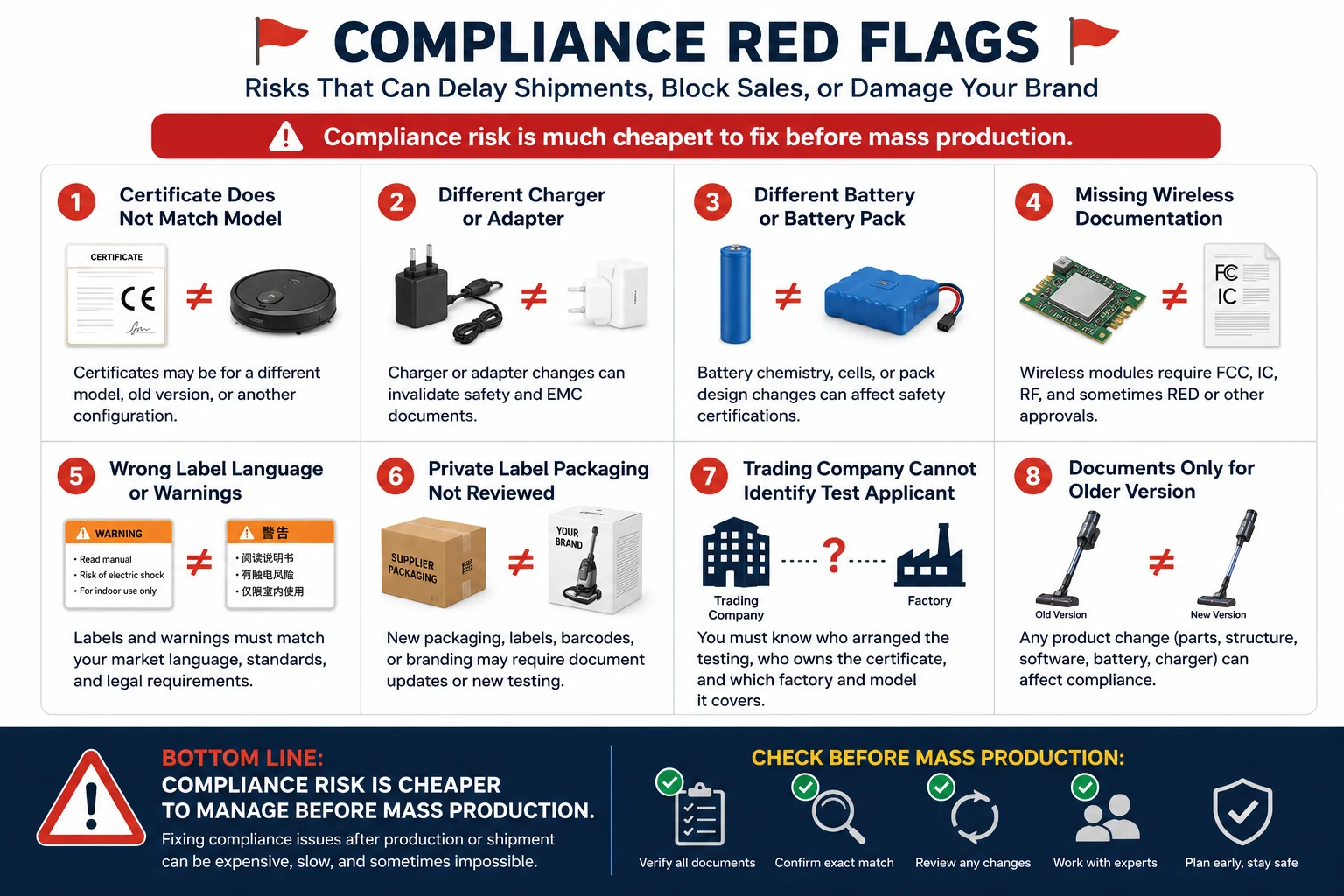
Compliance red flags often appear before production if buyers know what to ask.
Common warning signs include:
- Supplier says “we have certificates” but cannot match them to the exact model.
- Documents show a different company, model, charger, battery, or product description.
- The supplier refuses to explain component differences.
- The product has wireless functions but wireless documentation is unclear.
- The charger or adapter differs from the tested version.
- The battery specification changes after sample approval.
- Labels and manuals are incomplete or in the wrong language.
- The supplier treats compliance as only a sales document.
- Private label packaging is created without checking documentation.
- The supplier cannot explain target-market requirements.
- A trading company provides documents but cannot identify the real manufacturer or test applicant.
One red flag does not always mean the product cannot be used. But it means buyers should ask more questions before placing an order.
Compliance risk is much cheaper to manage before mass production than after shipment.
Compliance Checklist for Cleaning Appliance Buyers
| Compliance Area | What to Check | Why It Matters | Buyer Risk If Ignored |
|---|---|---|---|
| Target market | Country, region, sales channel, importer responsibility | Requirements depend on destination market | Product may not be ready for intended sale channel |
| Product model | Exact model number and product description | Documents must match the product being purchased | Certificate may not apply to the ordered product |
| Product configuration | Functions, components, accessories, plug, dock, packaging | Changes can affect document validity | Buyer may rely on documents for a different version |
| Charger and adapter | Model, rating, plug type, supplier, documents | Chargers often carry separate risk | Product may face safety or import issues |
| Battery | Battery pack, cells, rating, documentation | Battery-powered products may need deeper review | Battery problems may create shipment or safety risk |
| Wireless module | Module type, app connection, communication function, documents | Connected products may require radio-related review | Product may not meet target-market expectations |
| Motor and electrical system | Rated power, motor type, PCB, wiring, safety-related design | Core electrical system affects product readiness | Product may fail testing or create safety concerns |
| Labels and warnings | Rating label, warning label, charger label, battery label | Labels support user safety and market readiness | Product may require relabeling or face sales issues |
| User manual | Language, safety instructions, maintenance instructions | Users need correct guidance for safe operation | Customer misuse, complaints, or listing problems |
| Packaging | Markings, barcode, importer details where relevant, warnings | Packaging must fit channel and market needs | Retail, customs, or platform issues may occur |
| Test reports and certificates | Model, applicant, manufacturer, date, configuration, market relevance | Confirms whether documents apply | Buyer may trust unrelated paperwork |
| Supplier responsibility | Who arranged testing, who owns documents, who updates them | Clarifies accountability | Buyer may carry all compliance risk alone |
| Product changes | Component, design, charger, battery, wireless, label, manual changes | Changes may affect compliance readiness | Existing documents may no longer apply |
| Private label / ODM customization | Brand, packaging, manual, configuration, feature changes | Customization may require document review | Buyer may inherit documents that do not match final product |
Common Buyer Mistakes
The first mistake is accepting supplier certificates at face value. A certificate is useful only if it matches the exact product and market.
The second mistake is checking documents after production. Compliance should be reviewed before mass production begins.
The third mistake is ignoring chargers, batteries, adapters, and wireless modules. These components can affect compliance readiness even if the main product looks unchanged.
The fourth mistake is assuming ODM or private label products are already covered. Existing documents may not apply after branding, packaging, component, or configuration changes.
The fifth mistake is relying on a trading company without checking document ownership and product identity. Buyers need to know who owns the product, who arranged testing, and which model was tested.
The sixth mistake is ignoring labels, manuals, and warnings. Documents are not only lab reports; user-facing materials matter too.
The biggest mistake is treating compliance as paperwork instead of product risk.
How World Clean Biz Helps Buyers Reduce Compliance Risk
World Clean Biz does not provide legal advice or replace qualified compliance professionals. But WCB helps buyers understand compliance readiness as part of sourcing risk before placing orders.
For cleaning appliance buyers, WCB helps evaluate product risk, supplier capability, compliance readiness, quality-control issues, OEM/ODM fit, private label risk, and China supply chain options before committing to a supplier or product.
This includes helping buyers ask better questions: whether documents match the exact model, whether components are covered, whether customization affects documents, whether the supplier structure is clear, and whether the product is suitable for the target market.
For broader sourcing preparation, read our guide on how to evaluate a Chinese cleaning appliance supplier. Buyers who need quality planning can read quality control for cleaning appliances from China. For category context, explore our cleaning industry reports, learn more about World Clean Biz, or follow World Clean Expo updates.
If you are sourcing cleaning appliances from China and want to reduce compliance risk before placing orders, contact World Clean Biz for sourcing support.
FAQ
What certifications do cleaning appliances from China need?
Certification requirements depend on the product type, configuration, and destination market. A cordless vacuum, floor washer, robot vacuum, pool cleaner, robotic lawn mower, or commercial cleaning robot may involve different safety, EMC, battery, charger, wireless, labeling, or environmental requirements.
Buyers should verify final requirements with qualified compliance professionals, testing labs, or local market experts before importing or selling.
Can I trust supplier certificates?
Supplier certificates can be useful, but they should not be accepted at face value.
Buyers should check whether the documents match the exact product model, charger, battery, wireless module, configuration, label, manual, packaging, and target market.
Do certificates need to match the exact product model?
Yes, buyers should verify whether the documents apply to the exact product model and configuration being purchased.
A certificate for a similar model, old version, different charger, different battery, or different wireless module may not be enough.
What compliance risks are common in battery-powered cleaning appliances?
Battery-powered cleaning appliances may involve battery pack, charger, adapter, motor, electrical system, labeling, manual, and shipping-related document considerations depending on product type and market.
Buyers should confirm whether the battery and charger used in mass production match the documents provided by the supplier.
Are OEM and ODM compliance responsibilities different?
They can be. In OEM projects, buyers may control specifications and product changes, so compliance planning should begin early.
In ODM projects, suppliers may already have documents, but buyers must verify whether those documents still apply after customization, branding, packaging, or component changes.
Is private label compliance easier?
Not always. Private label may use an existing product, but buyers still need to check whether documents cover the buyer’s brand version, labels, manuals, packaging, configuration, and target market.
Private label buyers should not assume that supplier documents automatically cover their final product.
Should buyers verify compliance before or after production?
Before production. Compliance readiness should be checked before mass production begins.
If issues are found after goods are produced or packed, corrections can become expensive and may delay shipment or sales.
Can World Clean Biz help buyers reduce compliance risk when sourcing cleaning appliances?
Yes. World Clean Biz helps buyers evaluate product risk, supplier capability, compliance readiness, quality-control issues, OEM/ODM fit, private label risk, and China supply chain options before placing orders.
WCB does not replace qualified compliance professionals, but it helps buyers ask the right sourcing and product-readiness questions before committing to a supplier. If you need support, you can contact World Clean Biz.