Sourcing cleaning appliances from China does not end when the goods leave the factory.
For many overseas buyers, the real cost appears after shipment: replacement filters, batteries, chargers, rollers, tanks, pumps, sensors, docks, seals, blades, firmware support, customer complaints, warranty claims, and service parts.
A product that looks profitable at the quotation stage can become expensive after returns, replacement shipments, poor spare parts planning, and weak supplier support.
This is why spare parts and warranty support should be part of the sourcing decision, not a topic buyers discuss only after customers complain.
For cleaning appliances, the question is not only:
Can the supplier make the product?
The better question is:
Can the supplier support the product after it has been sold?
This matters for cordless vacuums, floor washers, robot vacuums, robotic pool cleaners, robotic lawn mowers, commercial cleaning robots, and other cleaning products where parts wear out, components fail, and users expect service.
A cleaning appliance without spare parts and warranty support is not a complete sourcing decision.
Quick Answer
Buyers sourcing cleaning appliances from China should discuss spare parts, consumables, warranty terms, defect claims, replacement shipment processes, discontinued model support, and after-sales responsibility before placing the order.
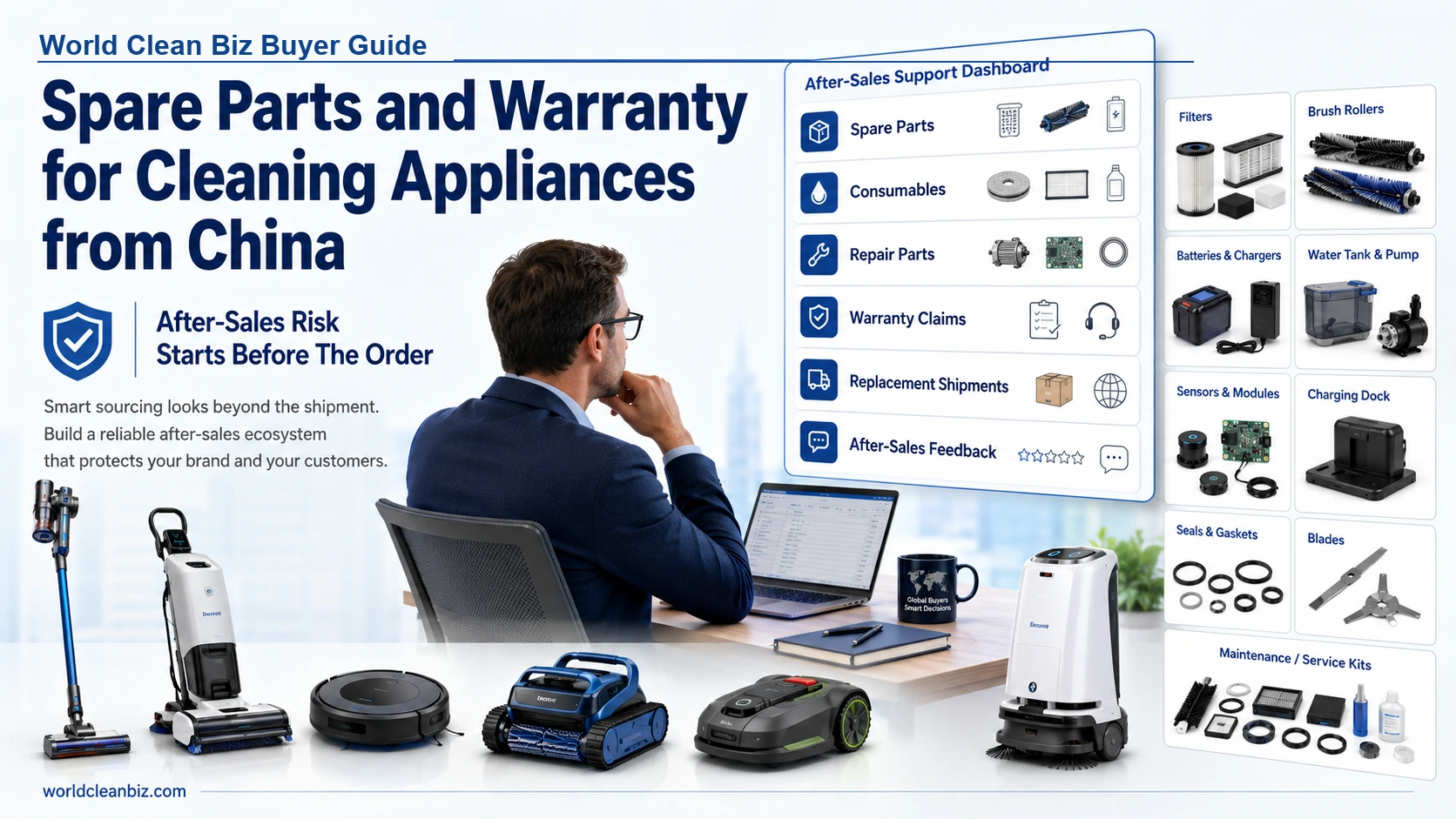
Spare parts may include filters, brush rollers, batteries, chargers, water tanks, pumps, motors, sensors, docks, seals, wheels, blades, accessories, and consumables. The exact list depends on the category.
Warranty support should not be treated as a line in a contract only. Buyers need to know who diagnoses problems, who pays for replacement parts, who ships parts, who supports discontinued models, and how repeated defects are handled.
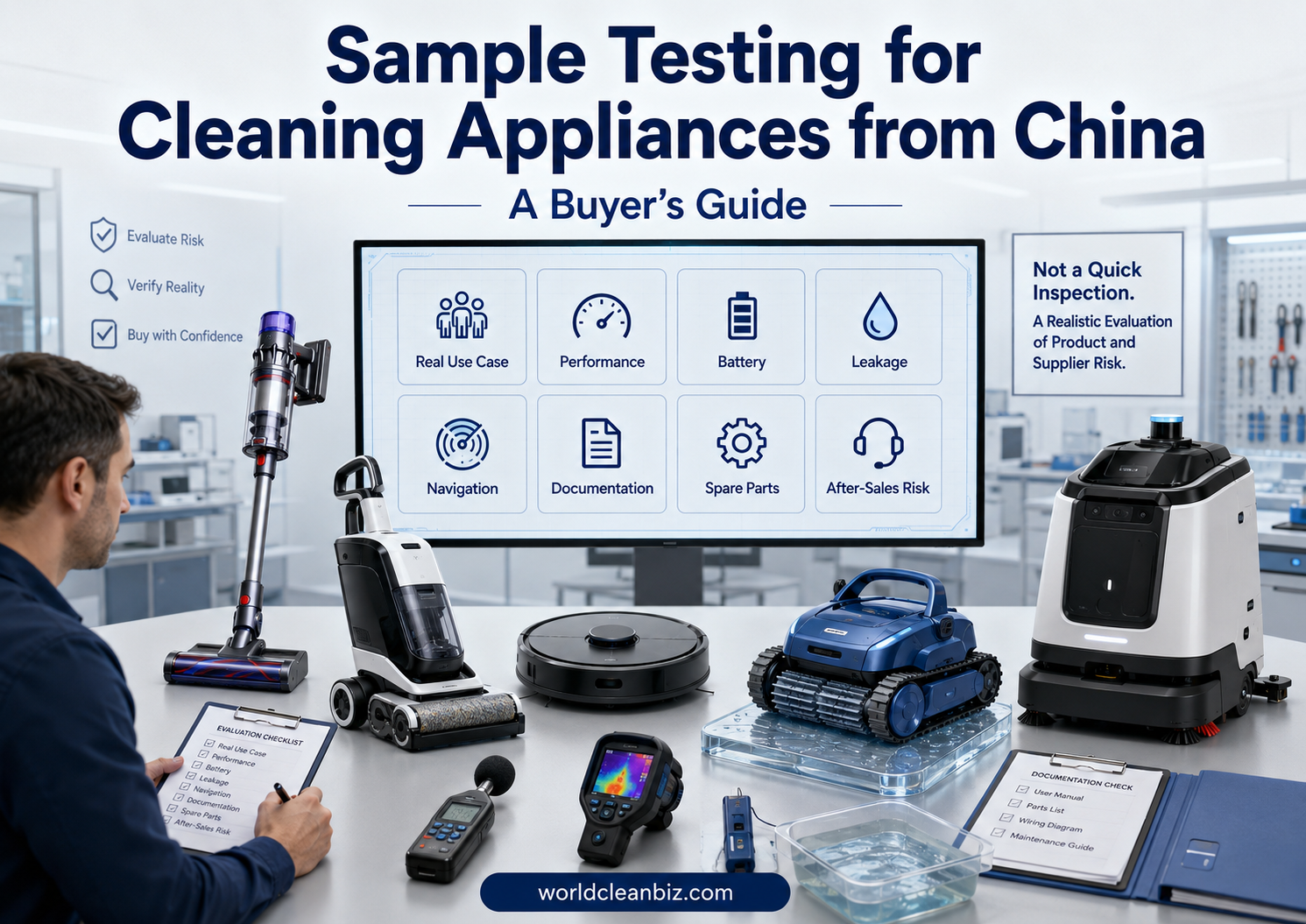
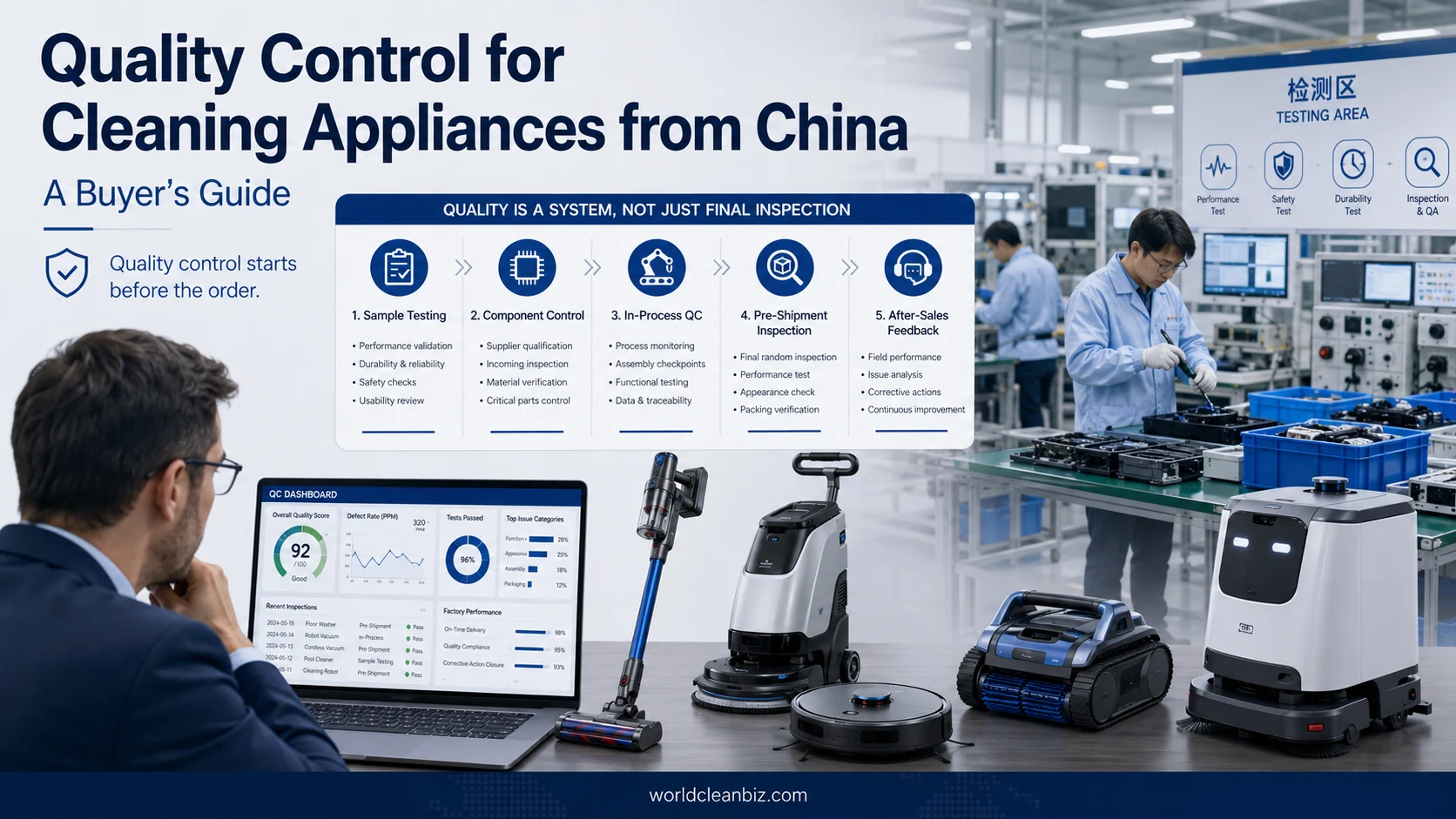
Spare parts and warranty planning should connect with sample testing, quality control, MOQ and pricing, and supplier evaluation before mass production begins.
Why Spare Parts and Warranty Matter More in Cleaning Appliances
Cleaning appliances are not simple one-time-use products. They include parts that wear out, parts that fail, and parts that users expect to replace.
A cordless vacuum may need filters, brush heads, batteries, dust bins, chargers, and motors. A floor washer may need brush rollers, water tanks, filters, pumps, squeegees, and self-cleaning parts. A robot vacuum may need brushes, wheels, sensors, docks, batteries, filters, and firmware support.
For robotic pool cleaners, robotic lawn mowers, and commercial cleaning robots, the after-sales burden can be even heavier because the product works in water, outdoor environments, or commercial facilities.
Many buyers focus on unit price, packaging, and launch timing. They ask whether the sample works, whether the MOQ is acceptable, and whether the supplier can ship on time.
Those questions are important, but they are incomplete.
If spare parts are not available, warranty handling is unclear, or the supplier cannot support replacement claims, the buyer may absorb the cost through refunds, replacements, negative reviews, distributor complaints, or damaged channel relationships.
In cleaning appliances, after-sales risk is part of product risk.
WCB Market Note
Spare parts and warranty planning are becoming more important in cleaning appliance sourcing because buyers are moving into more complex products. A basic cleaning tool may have limited after-sales exposure. A cleaning appliance may include batteries, chargers, motors, pumps, rollers, tanks, sensors, docks, software, firmware, sealing parts, and consumables. These parts shape the real cost of ownership after the product is sold.
Buyer implication: Buyers should ask for spare parts lists, consumable plans, warranty workflows, and defect claim processes before confirming an order.
Buyer implication: Buyers should not judge a supplier only by sample quality or unit price; they should check whether the supplier can support the product through its full sales and service cycle.
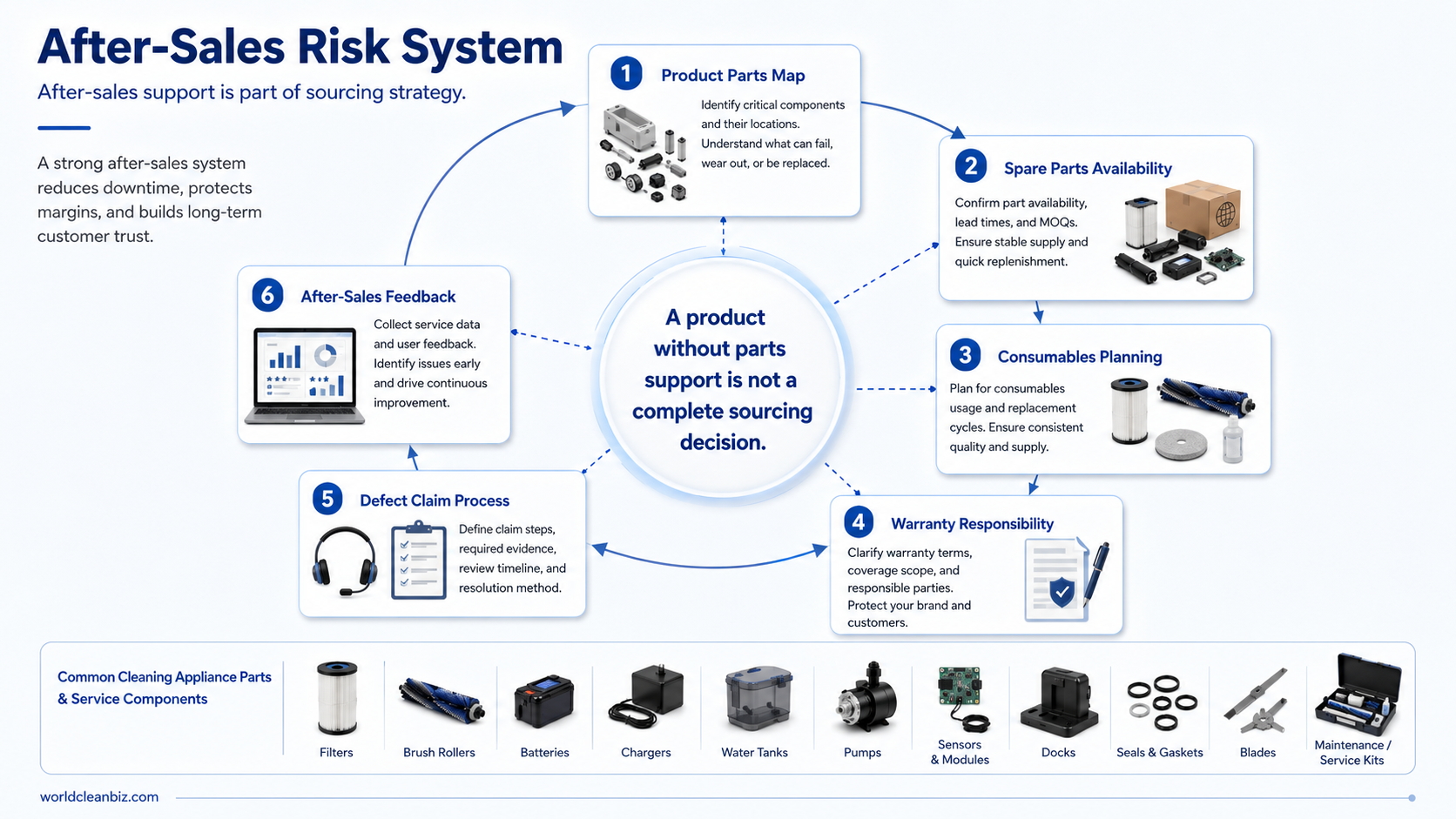
WCB view: In cleaning appliances, after-sales support is part of sourcing strategy. Buyers are not only buying a product; they are accepting a future service burden. The right supplier should support the product after shipment, not only during quotation and sample approval.
After-Sales Risk Starts Before the Order
After-sales problems often begin before the first shipment.
They begin when the buyer chooses a product without understanding which parts are fragile, which parts wear out, which parts are consumables, and which parts are difficult to replace.
They begin when the buyer approves a sample without asking how the supplier handles defects.
They begin when the buyer negotiates the lowest unit price but does not include spare parts, warranty reserves, or replacement logistics in the real sourcing cost.
They also begin when the buyer chooses a supplier without understanding whether it is a factory, ODM supplier, trading company, brand owner, or sourcing partner. Different supplier structures may handle after-sales very differently. For a broader supplier structure discussion, see our guide on factory vs trading company in China.
After-sales risk should be discussed before the order because once the product is in the market, the buyer is usually the party facing the customer.
For private label buyers, this is especially important. Even if a defect comes from the supplier’s product design or component choice, the buyer’s brand is the one customers see. Our guide on private label cleaning products from China explains why private label buyers need to evaluate product risk before putting their brand on an existing product.
Step 1: Identify Which Parts May Fail, Wear Out, or Need Replacement
The first step is to map the product’s parts.
Buyers should separate parts into three groups:
- Parts that wear out through normal use
- Parts that may fail and require repair or replacement
- Parts that users may need to buy repeatedly as consumables
For cleaning appliances, common spare parts may include:
- Filters
- Brush rollers
- Main brushes and side brushes
- Batteries
- Chargers and adapters
- Water tanks
- Dirty water tanks
- Pumps
- Motors
- Sensors
- Wheels and tracks
- Charging docks
- Seals and gaskets
- Blades
- Squeegees
- Cleaning accessories
- Consumables
The right list depends on the product category. Buyers should ask the supplier for a model-specific spare parts list, not a generic catalog.
A supplier that cannot provide a clear parts list may not be ready to support after-sales. This does not always mean the supplier is unreliable, but it means the buyer should investigate further before placing a larger order.
Step 2: Check Whether the Supplier Can Provide Spare Parts
Having spare parts in theory is different from being able to provide them reliably.
Buyers should ask practical questions:
- Which spare parts are available now?
- Which parts must be ordered with production?
- Which parts have separate MOQ requirements?
- How long will parts remain available after the model is discontinued?
- Can the supplier provide exploded diagrams or parts codes?
- Can parts be packed and labeled for service use?
- Can the supplier support small replacement shipments?
- What happens if a key component supplier changes?
These questions are especially important for OEM and ODM projects.
In an ODM project, the supplier may already have a spare parts system for its existing product platform. That can be useful, but buyers still need to verify availability, continuity, and whether the same parts apply after customization.
In an OEM project, customized parts may require earlier planning. If a housing, tank, dock, roller, blade, or PCB is customized, replacement planning becomes more important.
For buyers still comparing sourcing models, our guide on OEM vs ODM cleaning products explains how sourcing model affects control, speed, differentiation, and risk.
Step 3: Understand Consumables vs Repair Parts
Buyers should not treat all spare parts the same.
Consumables are parts users expect to replace during normal use. Examples include filters, brushes, rollers, blades, mop pads, cleaning solution cartridges, and some accessories.
Repair parts are parts needed when something fails. Examples may include motors, pumps, batteries, sensors, PCBs, chargers, docks, wheels, seals, and tanks.
This distinction matters because consumables and repair parts affect the business differently.
Consumables may become part of the buyer’s recurring revenue or customer support plan. If managed well, they can improve customer retention. If ignored, customers may complain that they cannot maintain the product.
Repair parts affect warranty cost and service burden. If a buyer cannot access repair parts quickly, even a small defect can become a replacement, refund, or lost customer.
Buyers should define:
- Which parts are user-replaceable
- Which parts require service support
- Which parts are included in the product package
- Which parts should be stocked by the buyer
- Which parts should be stocked by the supplier
- Which parts are covered under warranty
- Which parts are consumables and not warranty items
This should be clear before the product is sold.
Step 4: Define Warranty Responsibility Before Placing an Order
Warranty support is not only a written policy.
A supplier may say the product has warranty support, but buyers need to understand what that means in real operations.
Important questions include:
- What defects are covered?
- What defects are excluded?
- Who diagnoses the problem?
- What evidence does the supplier require?
- Who pays for replacement parts?
- Who pays for replacement shipping?
- How are batch defects handled?
- How are discontinued models supported?
- How quickly does the supplier respond to claims?
Buyers should also define their own warranty model.
A distributor selling through offline retail may need different warranty planning from an Amazon seller. A private label brand may need a different service approach from a commercial equipment dealer. A commercial cleaning robot buyer may need training, maintenance, and service workflow support, not only parts.
Warranty responsibility should match the buyer’s channel, product price band, and customer expectation.
The cheapest supplier may not be the lowest-cost supplier if warranty support is weak.
Step 5: Check Category-Specific After-Sales Risks
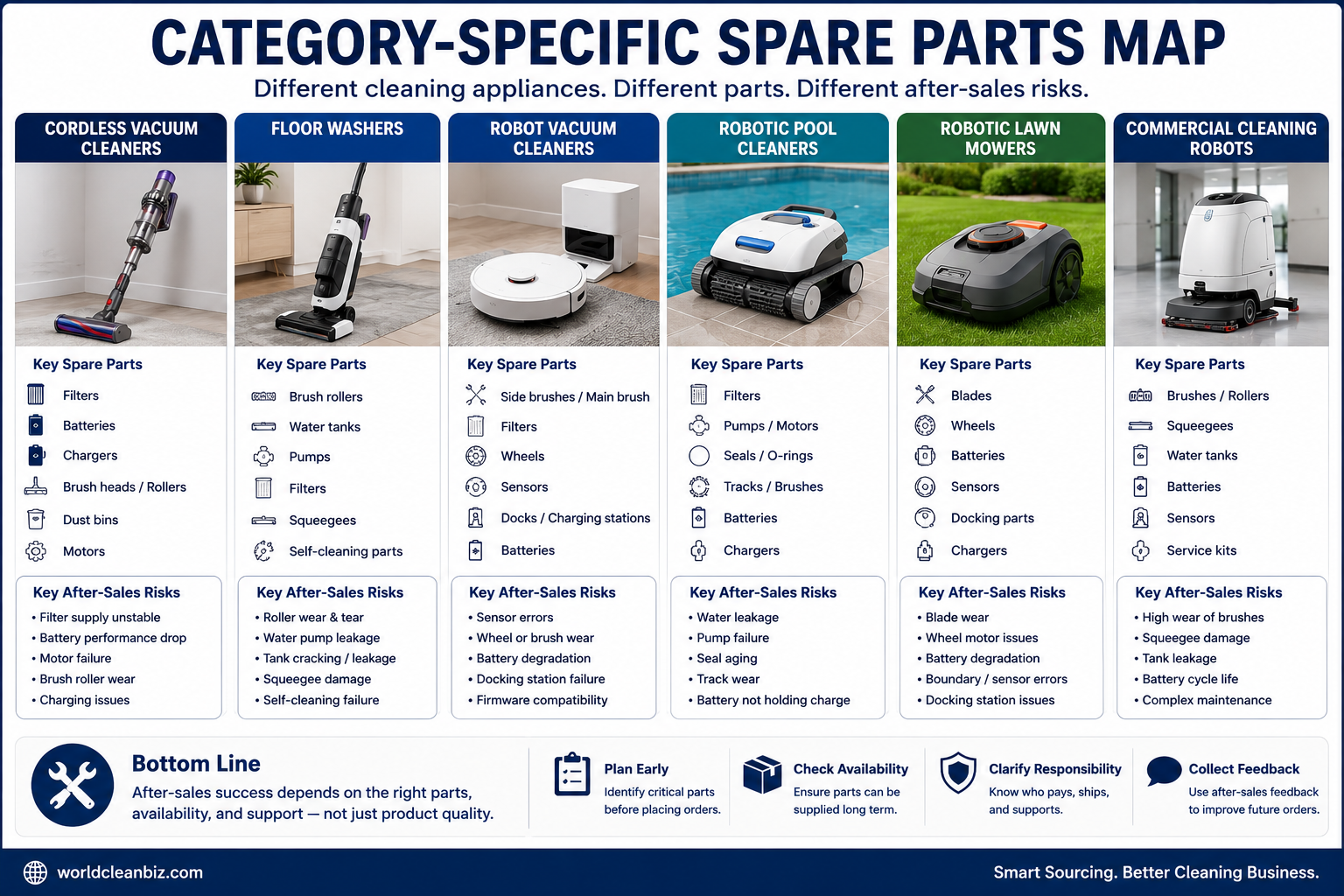
Different cleaning appliance categories create different after-sales risks. Buyers should not use one generic spare parts checklist for every product.
Cordless vacuums usually require attention to filters, batteries, chargers, brush heads, dust bins, motors, and accessories. Buyer complaints may involve weak suction, short runtime, dust leakage, hair tangling, or battery failure.
Floor washers and wet dry vacuums often need rollers, tanks, pumps, filters, squeegees, self-cleaning parts, and parts related to water flow. Common issues may involve leakage, odor, dirty water recovery, roller wear, or weak self-cleaning. See our guide on floor washer manufacturers in China for category-specific sourcing issues.
Robot vacuums may require brushes, filters, wheels, sensors, docks, batteries, and firmware support. After-sales risk often comes from docking failure, app problems, mapping instability, obstacle avoidance, mopping system issues, or consumable availability. For sourcing logic, see our guide on how to source robot vacuum cleaners from China.
Robotic pool cleaners need deeper attention to filters, pumps, seals, tracks, batteries, chargers, and maintenance parts. Water exposure increases the importance of sealing, waterproofing, and repair planning. Our guide on robotic pool cleaner manufacturers in China explains why this category carries higher service risk.
Robotic lawn mowers require blades, wheels, batteries, chargers, sensors, docking parts, covers, and outdoor-use components. Buyers should consider weather exposure, navigation complaints, blade replacement, slope handling, and docking reliability. See our guide on robotic lawn mower manufacturers in China.
Commercial cleaning robots may require brushes, squeegees, tanks, batteries, sensors, service kits, software support, operator training, and maintenance workflow. After-sales support is part of deployment, not just warranty. For more detail, see our guide on commercial cleaning robot manufacturers in China.
The lesson is simple: after-sales planning should follow the product category, not only the supplier’s standard warranty statement.
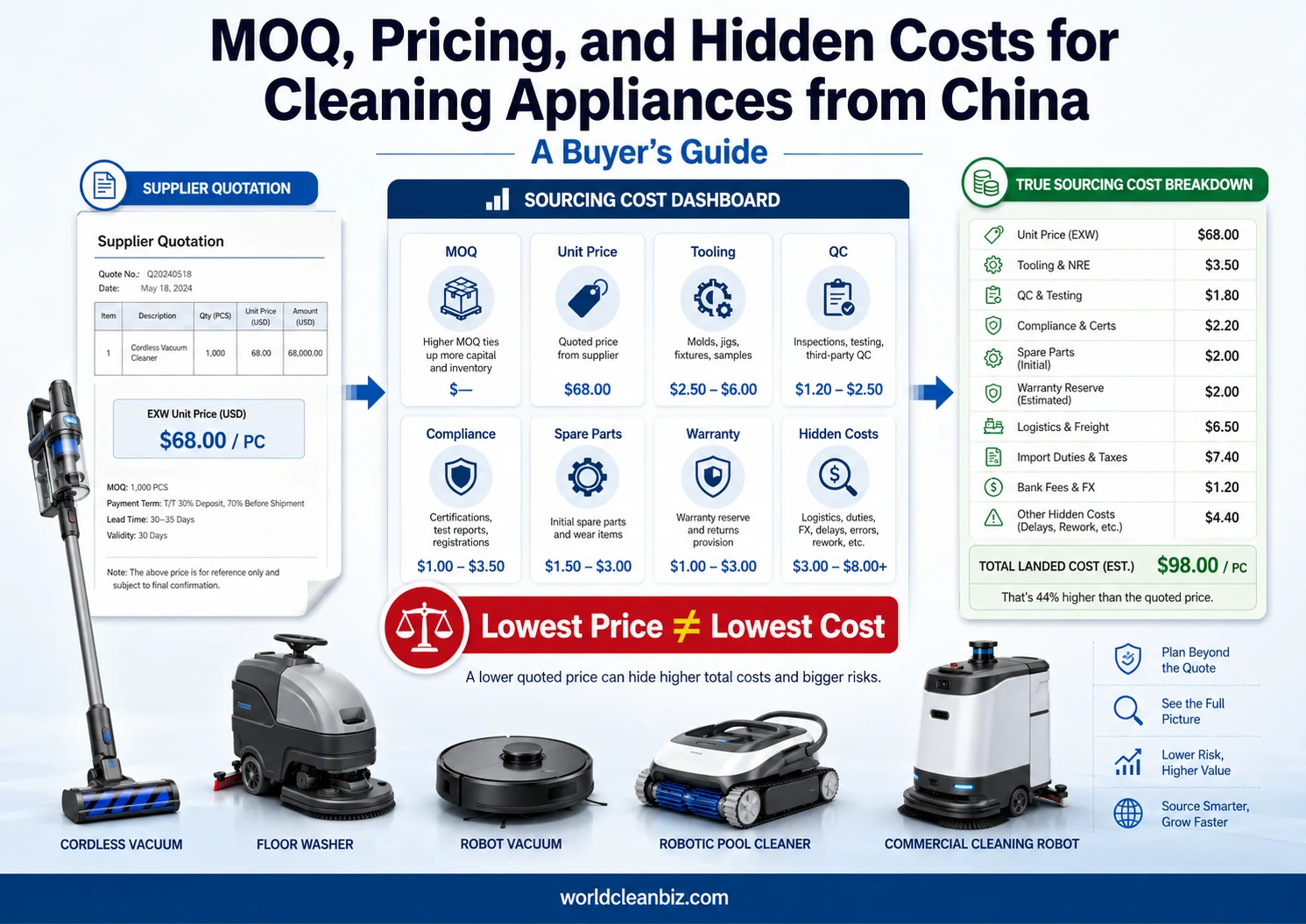
Step 6: Include Spare Parts in MOQ, Pricing, and Cost Planning
Spare parts are part of real sourcing cost.
Many buyers compare quotations based on unit price, but exclude service parts, replacement parts, warranty reserves, inspection cost, compliance review, and after-sales logistics.
That can create a false view of profitability.
Buyers should ask whether spare parts have separate MOQ requirements. Some parts may be easy to order in small quantities. Others may depend on component suppliers, mold runs, battery pack production, charger suppliers, or production batches.
Buyers should also decide whether to order spare parts with the first shipment.
This may be important when:
- The product is new to the buyer
- The product contains batteries, pumps, tanks, sensors, docks, or custom parts
- The sales channel expects fast replacement support
- The buyer sells under its own brand
- The product is sold through distributors or retailers
- The model may change quickly
For a broader cost framework, see our guide on MOQ, pricing, and hidden costs for cleaning appliances from China.
The lowest unit price is not always the lowest total cost if spare parts and warranty exposure are ignored.
Step 7: Ask How the Supplier Handles Defects and Claims
A good supplier should be able to explain its defect handling process.
Buyers should not wait until problems appear to ask these questions.
A basic claim process should clarify:
- What information the buyer must provide
- Whether photos, videos, batch numbers, or serial numbers are required
- How the supplier identifies root cause
- Whether the issue is isolated or batch-related
- Whether replacement parts, repair guidance, credit, or product replacement will be offered
- How long the supplier takes to respond
- Whether repeated issues trigger product changes or QC adjustments
This connects directly with quality control for cleaning appliances from China. After-sales claims should not be treated as isolated customer service events. They should feed back into inspection priorities, supplier discussions, sample testing, and future product improvements.
Buyers should also be careful when working through trading companies or intermediaries. A trading company may be useful if it coordinates communication, claims, parts, and supplier follow-up. But buyers should verify whether it can actually control the supplier response.
A trading company that only passes messages may not reduce after-sales risk.
Step 8: Use After-Sales Feedback to Improve Future Orders
After-sales feedback is product intelligence.
Repeated complaints show where the product, supplier, or sourcing model is weak.
If buyers see repeated battery complaints, they should review battery supplier choices, charger compatibility, runtime claims, and testing process.
If floor washer customers complain about odor or leakage, buyers should review tank design, roller drying, sealing, self-cleaning performance, and user instructions.
If robot vacuum buyers report docking or app problems, buyers should review firmware support, docking station design, sensor calibration, and supplier software capability.
If commercial cleaning robot customers struggle with deployment, buyers should review training, route setup, maintenance process, and service workflow.
Buyers should not collect complaints only for customer service. They should use them to adjust:
- Future QC checks
- Sample testing methods
- Spare parts stock
- Packaging and manuals
- Supplier negotiations
- Product changes
- Warranty assumptions
- Future supplier decisions
The best sourcing systems improve after the first shipment. The weakest ones repeat the same problem across multiple orders.
Spare Parts and Warranty Checklist for Cleaning Appliance Buyers
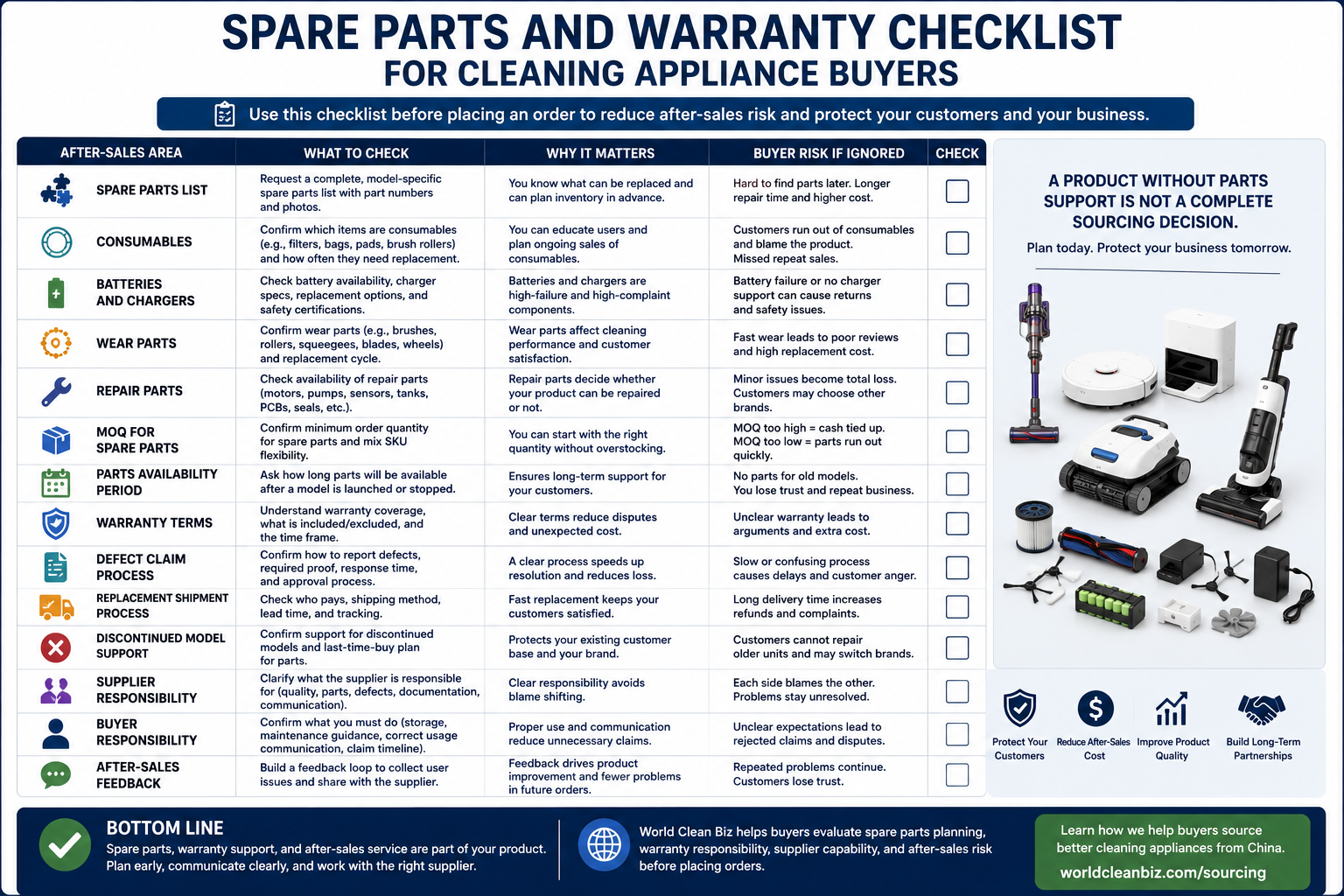
| After-Sales Area | What to Check | Why It Matters | Buyer Risk If Ignored |
|---|---|---|---|
| Spare parts list | Model-specific list of replaceable parts | Shows whether the supplier understands service needs | Buyer discovers missing parts only after customer complaints |
| Consumables | Filters, rollers, brushes, blades, pads, accessories | Consumables affect user maintenance and repeat purchase | Customers cannot maintain the product properly |
| Batteries and chargers | Availability, compatibility, packaging, replacement process | Battery and charging issues can create high complaint risk | Expensive replacements, safety concerns, or customer dissatisfaction |
| Wear parts | Rollers, brushes, wheels, blades, squeegees, seals | Wear parts often need regular replacement | Product performance declines and complaints increase |
| Repair parts | Motors, pumps, sensors, tanks, PCBs, docks | Repair parts affect warranty handling | Minor failures become full product replacements |
| MOQ for spare parts | Minimum order quantity for key parts | Determines whether parts can be stocked economically | Buyer cannot source small replacement quantities |
| Parts availability period | How long parts remain available after model changes | Important for discontinued products and warranty continuity | Buyer cannot support customers after model updates |
| Warranty terms | What is covered, excluded, and required for claims | Written warranty must match real service process | Disputes with supplier after defects appear |
| Defect claim process | Evidence, response time, root-cause handling | Shows whether supplier can manage after-sales professionally | Slow claims and unclear responsibility |
| Replacement shipment process | Who ships parts, who pays, and how parts are packed | Affects service speed and cost | Buyer absorbs unexpected logistics cost |
| Discontinued model support | Parts plan for models no longer in production | Important for brands and distributors | Old customers cannot be supported |
| Supplier responsibility | What the supplier will actually support after shipment | Clarifies commercial responsibility | Buyer assumes all after-sales burden |
| Buyer responsibility | What the buyer must manage locally | Prevents unrealistic expectations | Buyer underestimates service workload |
| After-sales feedback | How complaints affect future QC and product changes | Turns service data into product improvement | Same defects repeat across future orders |
Common Buyer Mistakes
1. Treating spare parts as a later issue
Many buyers discuss spare parts only after customers complain. By then, parts may be unavailable, expensive, or slow to ship.
2. Comparing only unit price
A product with a lower quotation can become more expensive if it creates returns, replacement shipments, warranty claims, and poor reviews.
3. Not separating consumables from warranty parts
Consumables should be planned as part of the product’s user lifecycle. Warranty parts should be planned as part of service risk. They are not the same.
4. Assuming the supplier will handle all warranty issues
Some suppliers provide parts support. Others only provide limited help. Buyers need to define responsibility clearly before placing the order.
5. Ignoring discontinued model support
Cleaning appliance models change quickly. If spare parts disappear when the supplier updates the product, the buyer may be unable to support existing customers.
6. Choosing private label without service planning
Private label can be fast, but the buyer still carries brand responsibility. If the supplier’s existing product has weak spare parts support, the buyer inherits that risk.
7. Not using after-sales feedback
Repeated complaints should influence QC, supplier decisions, sample testing, and future product changes. If they are treated only as customer service problems, the buyer loses valuable product intelligence.
How World Clean Biz Helps Buyers Reduce After-Sales Risk
World Clean Biz does not treat spare parts and warranty as a small detail after sourcing. For cleaning appliances, after-sales planning is part of product selection, supplier evaluation, and real cost control.
Before choosing a supplier, buyers need to understand whether the product category creates high parts demand, whether the supplier can provide stable service parts, whether the warranty model matches the buyer’s channel, and whether the sourcing structure supports long-term after-sales responsibility.
World Clean Biz helps buyers evaluate:
- Product category risk
- Spare parts planning
- Consumable and repair part needs
- Supplier service capability
- Warranty responsibility
- Sample testing results
- Quality-control risk
- MOQ and pricing trade-offs
- Private label, OEM, and ODM fit
- China supply chain options
For broader sourcing strategy, buyers can also read our guide on how to find reliable cleaning product suppliers in China, explore WCB cleaning industry reports, learn more about World Clean Biz, or follow World Clean Expo updates.
Sourcing cleaning appliances, cleaning robots, floor washers, pool cleaners, or commercial cleaning equipment from China? Contact World Clean Biz for sourcing support.
FAQ
Why are spare parts important when sourcing cleaning appliances from China?
Spare parts are important because cleaning appliances often include parts that wear out, fail, or require replacement after sale. Filters, batteries, chargers, rollers, tanks, pumps, sensors, docks, seals, blades, and consumables can affect customer satisfaction and warranty cost.
Without spare parts planning, a product that looks profitable at shipment may become expensive after returns, complaints, and replacement requests.
What spare parts should buyers ask for?
Buyers should ask for a model-specific spare parts list. Common parts may include filters, brush rollers, batteries, chargers, motors, pumps, water tanks, sensors, docks, wheels, seals, blades, accessories, and consumables.
The exact list depends on the product category. Buyers should also ask which parts are user-replaceable, which require service support, and which parts have separate MOQ requirements.
Are consumables the same as warranty parts?
No. Consumables are parts users normally replace during use, such as filters, brushes, rollers, mop pads, blades, or accessories. Warranty parts are related to defects or failures.
Buyers should define both clearly. Confusing consumables with warranty parts can create customer disputes and unexpected service cost.
Who is responsible for warranty claims?
Responsibility depends on the agreement between buyer and supplier. Buyers should clarify who diagnoses defects, who pays for replacement parts, who pays for shipping, what evidence is required, and how batch defects are handled.
Private label buyers should be especially careful because customers usually see the buyer’s brand, not the supplier’s factory name.
Should buyers order spare parts with the first shipment?
Often, buyers should consider ordering key spare parts with the first shipment, especially for new products, private label products, products with batteries or water systems, and products sold through channels that expect fast service.
The right quantity depends on product risk, sales volume, channel expectations, and supplier support. Buyers should avoid guessing and discuss the parts plan before placing the order.
How do spare parts affect real sourcing cost?
Spare parts affect real sourcing cost because they influence returns, warranty claims, customer service, replacement shipments, repair planning, and long-term brand reputation.
A low unit price may not be low-cost if the buyer later pays for missing parts, urgent shipments, refunds, or full product replacements.
What after-sales risks are common in cleaning appliances?
Common risks include battery failure, charger problems, weak motors, leaking tanks, worn rollers, clogged filters, docking issues, app or firmware problems, sensor failures, broken accessories, unavailable consumables, and unclear warranty responsibility.
Different categories carry different risks, so buyers should plan after-sales support based on the specific product type.
Can World Clean Biz help buyers reduce spare parts and warranty risk?
Yes. World Clean Biz helps buyers evaluate spare parts planning, warranty responsibility, supplier capability, quality-control risk, sample testing results, MOQ and pricing trade-offs, and China supply chain options before placing orders.
If you are comparing suppliers or private label products, contact World Clean Biz for sourcing support.