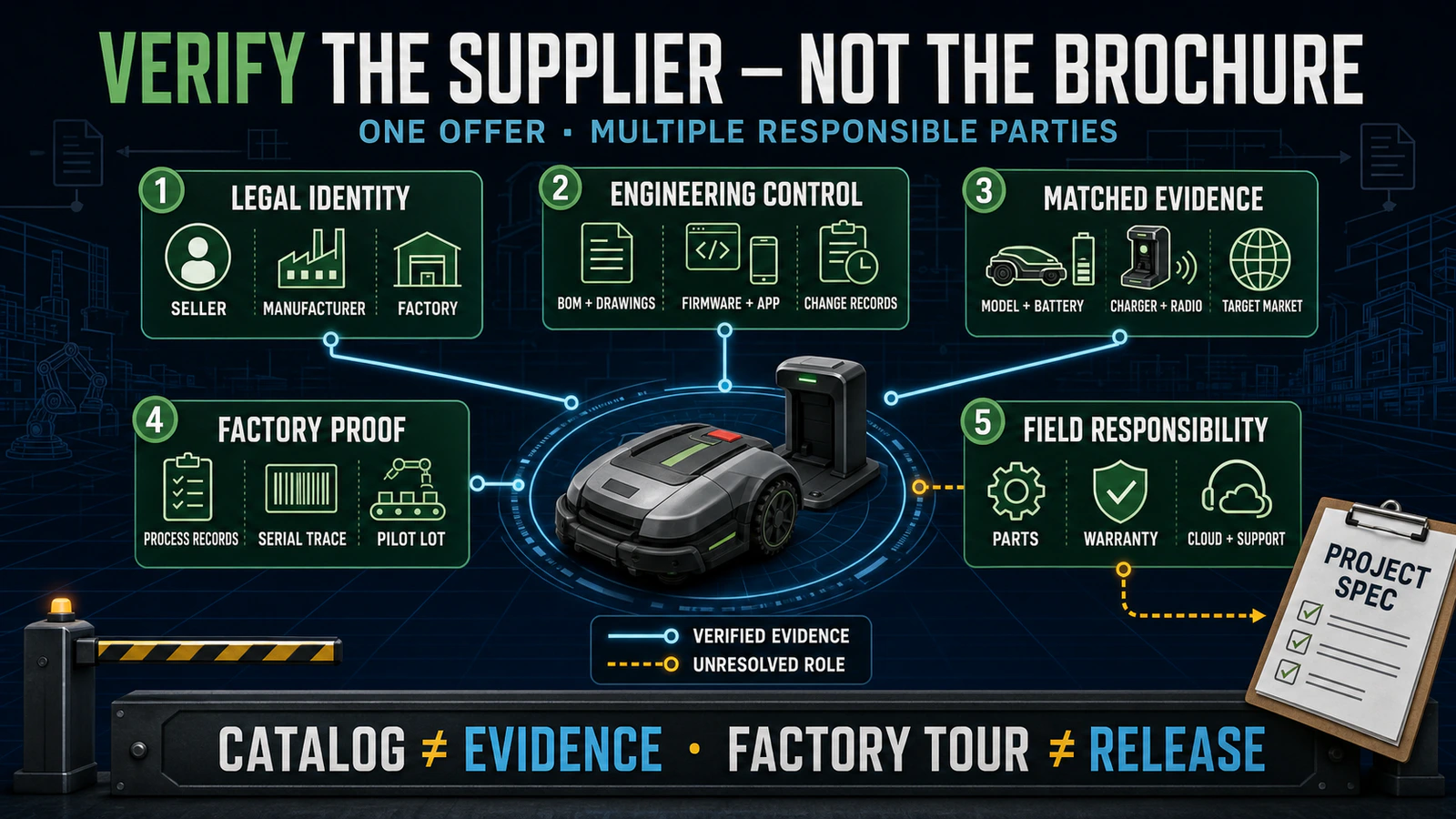
- A commercial robot mower supplier should be qualified by matched evidence—not a catalog, factory tour or certificate list.
- The buyer should verify who designs, manufactures, sells and supports the exact mower, battery, charging system, firmware, app and cloud service.
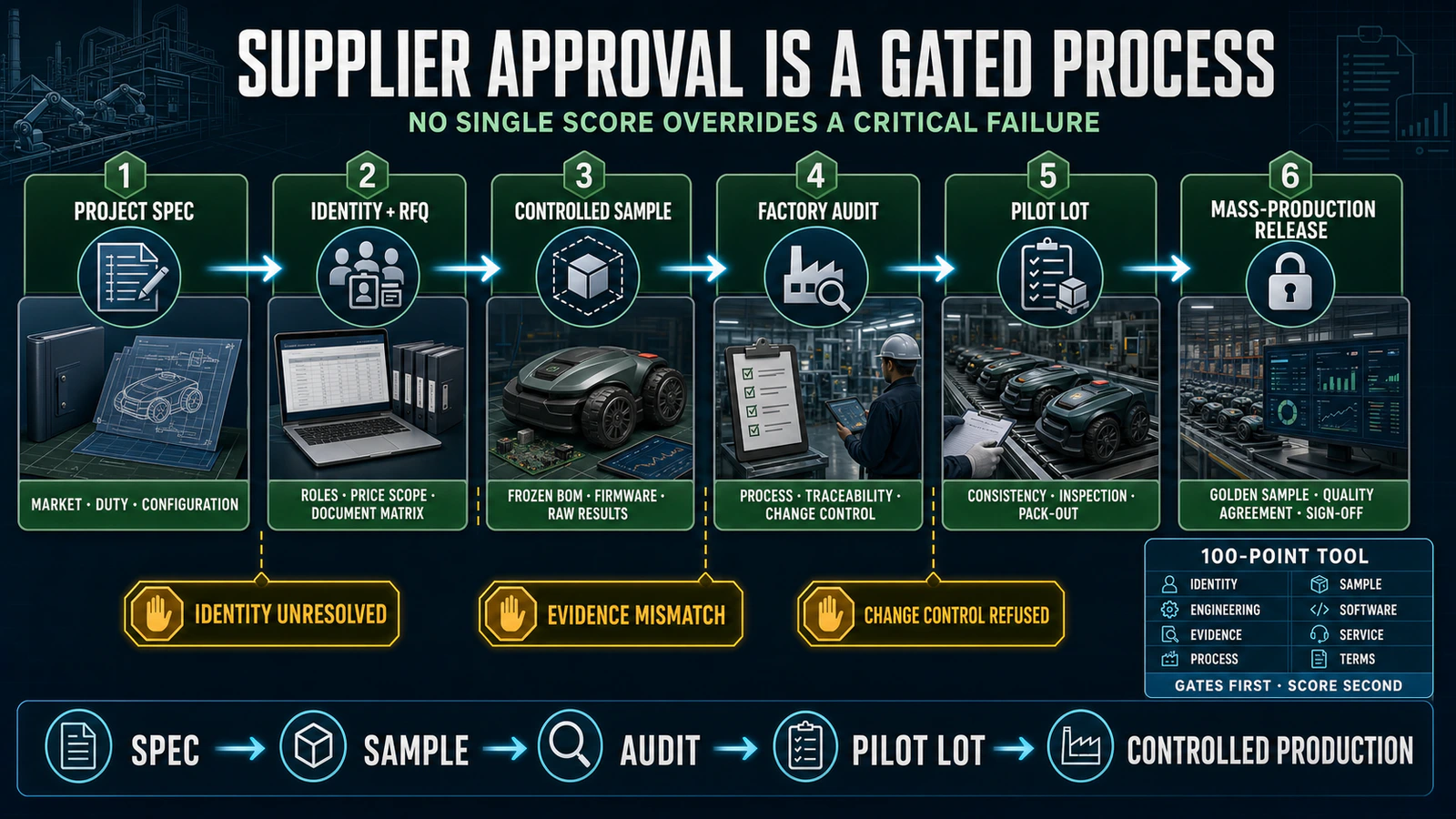
- A controlled sample, pilot lot, golden sample and written change-notification process are separate gates before mass-production release.
In this article 13 sections
A commercial robot mower supplier should not be approved from a catalog, factory tour or certificate list alone. The buyer must verify the legal and manufacturing identity behind the exact product; engineering and software control; model-specific safety, radio and battery evidence; production traceability; representative sample performance; change control; and written responsibility for parts, warranty, cloud services and field failures.
The purpose of supplier evaluation is not to find the factory with the longest capability list. It is to decide whether a supplier should enter the RFQ, controlled-sample, pilot-lot and mass-production stages—and what evidence is required at each gate.
This guide is for brands, importers, distributors, commercial-equipment dealers and sourcing teams. It does not rank manufacturers. If your team has not yet defined the site mission, capacity, fleet and service model, begin with Commercial Robotic Lawn Mowers. Supplier evaluation only works after the buyer knows what the system must deliver.
Commercial Robot Mower Supplier Evaluation at a Glance
| Gate | What the buyer must establish | Evidence to request | Do not accept as proof |
|---|---|---|---|
| Project fit | Exact market, duty, site conditions, configuration and service requirement | Buyer specification and compliance matrix | “Commercial-grade” |
| Identity | Who sells, designs, manufactures, imports and supports the product | Registrations, addresses, contracts, organization chart and role map | One company name on a brochure |
| Engineering | Who controls mechanical, electrical, firmware, app and cloud changes | Controlled drawings/BOM, version records, issue logs and change procedure | R&D headcount or patent count |
| Compliance | Whether evidence matches the supplied mower and target market | Declarations, reports, labels, manuals and battery documents for the exact configuration | A folder of unrelated certificates |
| Factory | Whether critical processes are controlled and traceable | Process flow, work instructions, inspection records, calibration and serial trace | A clean assembly line |
| Sample | Whether a production-intent unit survives representative use | Test plan, raw logs, failures, corrective action and retest | A short lawn demonstration |
| Commercial | Whether price, warranty and change responsibility are comparable | Normalized RFQ, warranty matrix, parts list and quality agreement | Unit price alone |
| Release | Whether the approved configuration can be reproduced | Golden sample, pilot-lot records, release criteria and change notice | “Same as sample” in an email |
The central rule is simple: verify the supplier-product-system relationship, not the supplier’s presentation.
1. Define the Project Before Evaluating a Supplier
A weak RFQ asks for a mower with a target area, slope rating and low price. That leaves suppliers free to quote products built around different assumptions.
A useful supplier specification should define:
- target countries and planned market-entry date;
- residential, professional, rental or other duty;
- net mowing area, zone geometry and expected operating window;
- target cut height, frequency and acceptable finish;
- slopes, edges, water, tree cover, passages and public interfaces;
- boundary or positioning architecture and loss-of-signal behavior;
- battery, charging station, power supply and included accessories;
- app, account, fleet, connectivity and data requirements;
- languages, labels, manuals, packaging and importer information;
- service response, spare-parts period and warranty use case;
- sample, pilot-lot and mass-production acceptance criteria; and
- required legal, safety, radio, environmental and transport documents.
The project specification should distinguish mandatory gates from scored preferences. A missing color option may reduce a score. An unverified legal manufacturer or mismatched safety report should stop the process.
For a first view of supplier types and OEM, ODM and private-label routes, see Robotic Lawn Mower Manufacturers in China. This article starts where a supplier landscape ends: evidence-based qualification of a shortlisted company and product.
2. Verify Who Designs, Manufactures, Sells and Supports the Product
One product can involve several companies:
| Role | Questions the buyer should answer |
|---|---|
| Contract seller | Which legal entity signs the order, receives payment and accepts contractual liability? |
| Brand owner | Who owns the name, packaging, market claims and customer channel? |
| Legal manufacturer | Which entity is identified as manufacturer in target-market documentation? |
| Actual factory | At which address are assembly, programming, testing and final release performed? |
| Design owner | Who controls mechanical, electrical and software design changes? |
| Component provider | Who supplies the battery pack, charger, radio module, motors, sensors and compute platform? |
| Importer or authorized representative | Who performs the applicable market role where required? |
| Platform operator | Who controls the app, cloud, accounts, map data, subscriptions and security updates? |
| Warranty provider | Who diagnoses failures, supplies parts, authorizes returns and pays field costs? |
These roles can belong to one group, but the buyer should not assume that they do. Compare company registration, factory address, quotation, bank beneficiary, certificate applicant, product label, declaration, manual, app publisher and warranty terms. Differences are not automatically disqualifying; unexplained differences are.
Ask the supplier to draw the relationship and name the responsible entity for each role. If the seller says a “partner factory” owns the product, obtain written access to the partner’s technical and quality evidence before approving the seller.
Identity checks should answer three practical questions
- Can this entity legally make the promise in the contract?
- Can the factory reproduce the approved configuration?
- Can the responsible parties correct a field problem after shipment?
A factory audit that skips these questions may confirm that a building exists while leaving product and liability ownership unresolved.
3. Audit Engineering and Production Controls
ISO 19011:2026 provides guidance for auditing management systems, including audit principles, programs, execution and auditor competence. It does not certify a robot mower or prove product capability. Likewise, an ISO 9001 certificate should be checked for the legal entity, address, issuing body, validity and scope—but it cannot replace a product and process audit.
A commercial robot mower audit should trace one production-intent unit from approved specification to shipment.
Engineering control
Request evidence that the supplier controls:
- product requirements and design inputs;
- mechanical and electrical drawings;
- approved bill of materials;
- firmware, app and cloud version compatibility;
- risk assessment and verification plan;
- design reviews and issue tracking;
- supplier and component qualification;
- engineering change approval; and
- regression testing after hardware or software changes.
Do not ask only whether the company “has R&D.” Select one recent change—such as a battery-cell substitution, new radio module, sensor revision or firmware release—and audit how the company evaluated risk, updated documents, tested the change and notified customers.
Production control
Walk the actual process rather than following the showroom route. Depending on the product architecture, records may include:
- incoming checks for battery packs, chargers, blades, motors, boards and sensors;
- torque or fastening control;
- sealing, leak or ingress-related process checks;
- firmware loading and version verification;
- safety-function and sensor checks;
- charging, docking and communication checks;
- end-of-line functional test;
- label and serial-number generation;
- nonconforming-product segregation;
- repair, rework and software-reflash authorization; and
- final inspection and release.
The buyer does not need every factory to use the same equipment. The requirement is that each critical characteristic has an appropriate control, acceptance rule, record and owner.
Traceability test
Select one finished unit and ask the factory to retrieve:
- its sales and production order;
- exact BOM or configuration;
- battery, charger and major electronic identifiers;
- firmware and app compatibility version;
- incoming and end-of-line inspection results;
- any repair or rework record; and
- pack-out, shipment and warranty history if available.
Then reverse the exercise: choose a suspect component lot or firmware version and determine which finished serial numbers contain it. This is what turns a recall or field correction from a broad guess into a controlled action.
For a more general audit framework, use Factory Audit Checklist for Cleaning Appliance Suppliers in China alongside the robot-mower-specific checks above.
4. Match Compliance Evidence to the Exact Product
“CE available” or “UN38.3 passed” is not a compliance file. Start with a product-configuration matrix.
| Evidence field | What must match |
|---|---|
| Product | Brand, model, SKU, rating and intended use |
| Manufacturer | Legal name and address used in the target market |
| Configuration | Mower, cutting unit, battery, charger, charging station, power supply and radio modules |
| Software | Firmware or software boundary where it affects tested functions |
| Applicant and laboratory | Named parties, report identity and test dates |
| Market | Applicable legislation, standards, languages, labels and economic-operator information |
| Production | Current BOM and approved alternatives |
The current IEC product-family standard for battery-powered robotic rotary lawnmowers is IEC 60335-2-107:2017, with 2020 and 2021 amendments incorporated in a consolidated version. Its scope includes the mower and peripherals up to 75 V DC and addresses safety requirements such as markings, stopping, stability, mechanical hazards, work-area functions, sensors, connectors, charging and battery operation.
Do not substitute IEC 62841-4-3. The current IEC 62841-4-3:2020+A1:2025 covers pedestrian-controlled walk-behind lawnmowers and explicitly excludes robotic lawnmowers.
Standard references still need target-market review. In the EU, for example, the Machinery Regulation (EU) 2023/1230 applies from January 20, 2027. A project sourced in 2026 may therefore need a transition plan based on when the product will be placed on the market. Connected products may also bring Radio Equipment Directive requirements into scope. EN 18031-1:2024 is referenced for internet-connected radio equipment, but the EU publication includes limitations; it should not be reduced to a generic “cyber certified” claim.
Battery transport evidence
The UN Manual of Tests and Criteria addresses lithium cells and batteries in subsection 38.3. A buyer should request the 38.3.5 test summary and match it to the battery actually supplied. The summary includes the manufacturer, laboratory, report identity and date, battery description and model, tests and results, referenced edition and signature.
This is stronger than a Yes/No cell in the RFQ. It also gives the buyer a basis for controlling battery changes. “UN38.3” is transport evidence; it is not a complete product-safety conclusion.
Use declarations and manuals as consistency checks
Official commercial mower documents show the level of specificity buyers should expect. A Husqvarna CEORA operator manual, for example, identifies the brand, model, serial-number period, applicable legislation and standards, and the person responsible for technical documentation. A Kress manual identifies the mower models together with the relevant charger and charging station.
The point is not that a new supplier must copy those brands. The point is that conformity and user documents should describe one coherent, traceable product system.
5. Run a Controlled Sample and Reliability Program
A supplier-selected demonstration on a short, open lawn proves very little. A controlled sample program asks whether a production-intent configuration can complete the buyer’s representative mission and recover from predictable faults.
Freeze the sample identity
Before testing, record:
- mower and charging-system model;
- serial numbers;
- battery pack and cell configuration;
- hardware and firmware versions;
- app version, server region and account type;
- positioning and connectivity services;
- included accessories and spare parts;
- BOM deviation from planned mass production; and
- packaging, labels and manual revision.
If the sample is hand-built, pre-production or uses temporary software, label it accordingly. Do not allow a successful engineering sample to become the “approved product” without closing the differences to production.
Test representative failure modes
Build the test plan from the buyer’s use case. It may include:
- route and mission completion under representative grass growth;
- slopes, transitions, edges, narrow passages and surface changes;
- obstruction detection and safe stop behavior;
- lift, tilt, manual stop and restart behavior;
- docking and charging across repeated cycles;
- loss and recovery of positioning, network or cloud connection;
- wet grass, debris and cleaning procedures within approved use;
- battery runtime, charging behavior and abnormal heat;
- blade, wheel, seal and connector wear;
- account, permission and multi-unit administration;
- app/firmware update and rollback or recovery process; and
- packaging and transport simulation for the planned route.
The applicable standard and legal tests must be defined by qualified compliance specialists. The buyer’s reliability program is additional commercial evidence; it does not replace conformity assessment.
Record failures as evidence
For every failure, record the environment, product identity, software version, reproduction steps, logs, photos or video, containment, root-cause analysis, corrective action and regression result. “Fixed in the latest firmware” is not a closure record unless the supplier identifies the version, affected serials and verification.
A historic U.S. CPSC recall involving specified robotic mower models used a software update as part of the remedy and replaced batteries in some units. It illustrates why supplier evaluation should include serial traceability, remote-update control, customer notification and field-correction capability—not why any current brand should be generalized from an old model event.
6. Normalize the RFQ, Warranty and Commercial Terms
Two unit prices are not comparable until the supplied system and responsibilities are aligned.
RFQ cost matrix
Require separate pricing for:
- mower and cutting unit;
- battery and charger or charging station;
- positioning hardware and installation materials;
- connectivity, correction service, cloud or fleet subscriptions;
- app or private-label software work;
- tooling, fixtures, packaging and certification work;
- initial spare-parts kit and wear parts;
- sample, test and pilot-lot charges;
- warranty reserve, service training and diagnostic tools;
- freight assumptions, dangerous-goods documents and Incoterms; and
- minimum order, forecast, lead time and price-validity conditions.
Warranty matrix
Normalize warranty by:
- country or sales region;
- residential versus commercial or rental use;
- months, operating hours or whichever limit applies first;
- separate coverage for mower, battery, charger, station and accessories;
- consumable and wear exclusions;
- labor, freight, diagnosis and field-service responsibility;
- dead-on-arrival and early-life failure process;
- repair, replacement, credit and return authorization;
- response and corrective-action deadlines; and
- parts availability after the warranty period.
Official warranty pages often distinguish commercial use, battery coverage and component limits. That is why “three-year warranty” cannot be compared without its use case and exclusions.
Quality agreement and change control
The purchase agreement should define the approved specification, golden sample, controlled BOM, firmware and app baseline, inspection and release records, defect classification, traceability period, complaint process and change-notification rule.
Changes that may require buyer review include:
- battery cell, pack or BMS;
- charger or power supply;
- radio module, antenna or component;
- motor, blade, safety sensor or compute board;
- seal, housing resin or critical fastener;
- manufacturing site or key sub-supplier;
- firmware, app, cloud endpoint or third-party service; and
- labels, manuals or regulatory declarations.
Not every change requires complete retesting, but every relevant change needs documented impact assessment and an agreed approval route.
7. Assign Software, Parts and Warranty Responsibility
Robot mowers are physical products with digital dependencies. Supplier approval should therefore survive four uncomfortable questions:
- Who owns and signs the firmware?
- Who operates the app, cloud and user-account infrastructure?
- What still works if connectivity, a correction service or a third-party API stops?
- Who supports installed units if the commercial relationship ends?
Ask for:
- software-component and third-party dependency ownership;
- supported phone operating systems and regions;
- user-role, password and account-recovery controls;
- update signing, release, rollback and incident-response process;
- security-update and cloud-support period;
- export or transfer of fleet and account data where applicable;
- service diagnostics and log access;
- end-of-support notice and transition plan; and
- contractual rights to continue support if the supplier changes platform.
Do not treat a polished app as proof of software ownership. Confirm the publisher account, backend operator, source-code or license rights, development contract and maintenance responsibility.
Parts require the same clarity. A spare-parts spreadsheet is not a service system unless part numbers, compatible revisions, price, lead time, storage life, replacement instructions and order route are controlled.
8. Red Flags That Should Stop or Delay Approval
Pause supplier approval when:
- the legal manufacturer or actual production site cannot be identified;
- the contract seller, bank beneficiary and certificate applicant have unexplained relationships;
- compliance documents refer to a different model, battery, charger, factory or applicant;
- the supplier presents IEC 62841-4-3 as the robotic mower product standard;
- the battery test summary cannot be matched to the supplied pack;
- engineering cannot retrieve controlled BOM, firmware or change records;
- the factory cannot trace a finished serial number to critical components and tests;
- sample failures are closed by assertion rather than root cause and retest;
- the planned mass-production unit differs materially from the sample;
- app, cloud, map data or intellectual-property responsibility is unclear;
- commercial-use warranty and field-cost responsibility are not written;
- the supplier refuses a golden sample or advance change notification; or
- the team pressures the buyer to accept production before pilot-lot evidence is complete.
These findings do not all mean permanent rejection. They mean the supplier has not yet provided enough evidence for the next gate.
Commercial Robot Mower Supplier Scorecard
Use the scorecard only after critical gates pass.
| Module | Weight | What earns the score |
|---|---|---|
| Company identity and roles | 10 | Verified entities, addresses, ownership and responsibility map |
| Product and engineering control | 15 | Controlled design/BOM/software, risk review and change records |
| Safety, compliance and battery evidence | 15 | Exact, current and configuration-matched documentation |
| Manufacturing and process control | 15 | Critical controls, calibration, records, segregation and traceability |
| Sample and reliability evidence | 15 | Representative plan, raw results, failure closure and production intent |
| Software, cybersecurity and data continuity | 10 | Clear ownership, update control, support period and exit plan |
| Parts, warranty and service | 10 | Market-specific written coverage, parts path and field responsibility |
| Commercial terms and change control | 10 | Normalized RFQ, quality agreement, golden sample and notification process |
| Total | 100 |
This is a World Clean Biz buyer tool, not a certification or an industry standard. Set minimum scores before bids are opened, preserve raw evidence and keep gate failures independent from the total. A supplier should not offset a mismatched safety file with a better price or presentation score.
Recommended Approval Sequence
| Stage | Buyer decision | Minimum output |
|---|---|---|
| Longlist | Does the supplier broadly fit the project and target market? | Capability response with identities and product family |
| RFQ shortlist | Is the offer comparable and is key evidence available? | Normalized RFQ, role map and initial document matrix |
| Controlled sample | Does one identified configuration meet the representative mission? | Frozen sample record, test results and closed critical failures |
| Factory and engineering audit | Can the supplier reproduce and control the approved product? | Audit findings, corrective actions and traceability demonstration |
| Pilot lot | Does the production process deliver consistent units? | Pilot records, inspection results, issue closure and packaging verification |
| Mass-production release | Are product, process and responsibilities contractually frozen? | Golden sample, approved BOM/software, quality agreement and release record |
FAQ
What is the most important step in evaluating a commercial robot mower supplier?
Verify the relationship between the legal entities, actual factory and exact product system. The buyer should know who designs, manufactures, sells and supports the mower, battery, charging system, firmware, app and cloud service before relying on performance or compliance claims.
Is an ISO 9001 certificate enough to approve a robot mower factory?
No. It may provide useful management-system evidence when the legal entity, site, scope, issuing body and validity are confirmed. It does not prove that the exact mower is safe, reliable, compliant or consistently manufactured. A product- and process-specific audit is still required.
Which IEC standard applies to robotic lawnmowers?
IEC 60335-2-107 covers safety requirements and verification for specified battery-powered robotic rotary lawnmowers and peripherals. IEC 62841-4-3 covers pedestrian-controlled walk-behind lawnmowers and explicitly excludes robotic lawnmowers. The exact target-market standard, edition and legal route still require professional review.
What should buyers check in a robot mower compliance file?
Match the brand, model, ratings, legal manufacturer, factory where relevant, battery, charger, charging station, radio modules, applicant, laboratory, reports, declarations, labels, manuals, software boundary and target-market requirements. A document that cannot be connected to the supplied configuration is not adequate evidence.
How should buyers test a commercial robot mower sample?
Freeze the sample identity, then test a representative mission rather than a short demonstration. Include terrain, edges, obstacles, docking, charging, positioning and connection loss, safety behavior, wear, software updates and recovery. Record raw results, failures, corrective actions and retests.
Is one good sample enough to approve mass production?
No. A sample proves only that the identified unit achieved the test result. The buyer still needs a factory and engineering audit, pilot-lot consistency, a golden sample, production records, traceability and written change control before mass-production release.
How should buyers compare warranties?
Normalize the sales region, commercial or rental use, time and operating-hour limits, coverage for the mower, battery and charger, exclusions, labor, freight, parts, diagnosis, replacement route and field-response responsibility. Do not compare warranty duration alone.
Should buyers work directly with a factory or through a trading company?
Either structure can work if roles and evidence are transparent. A trading company may add communication, consolidation or service value; a factory may offer more direct technical access. The buyer still needs written access to the legal manufacturer, product evidence, change control and field responsibility.
The Practical Answer
The best commercial robot mower supplier is not the company with the largest factory, the most certificates or the lowest unit price. It is the supplier system that can prove who is responsible, reproduce the approved product, match evidence to the exact configuration, close failures with data, control hardware and software changes, and support units after they enter the field.
Start with the buyer’s specification. Verify identities and engineering ownership. Audit the actual process. Freeze and test a production-intent sample. Validate a pilot lot. Release mass production only after the golden sample, controlled configuration, quality agreement and service responsibilities are written.
That sequence turns supplier selection from a marketing comparison into a controlled procurement decision.