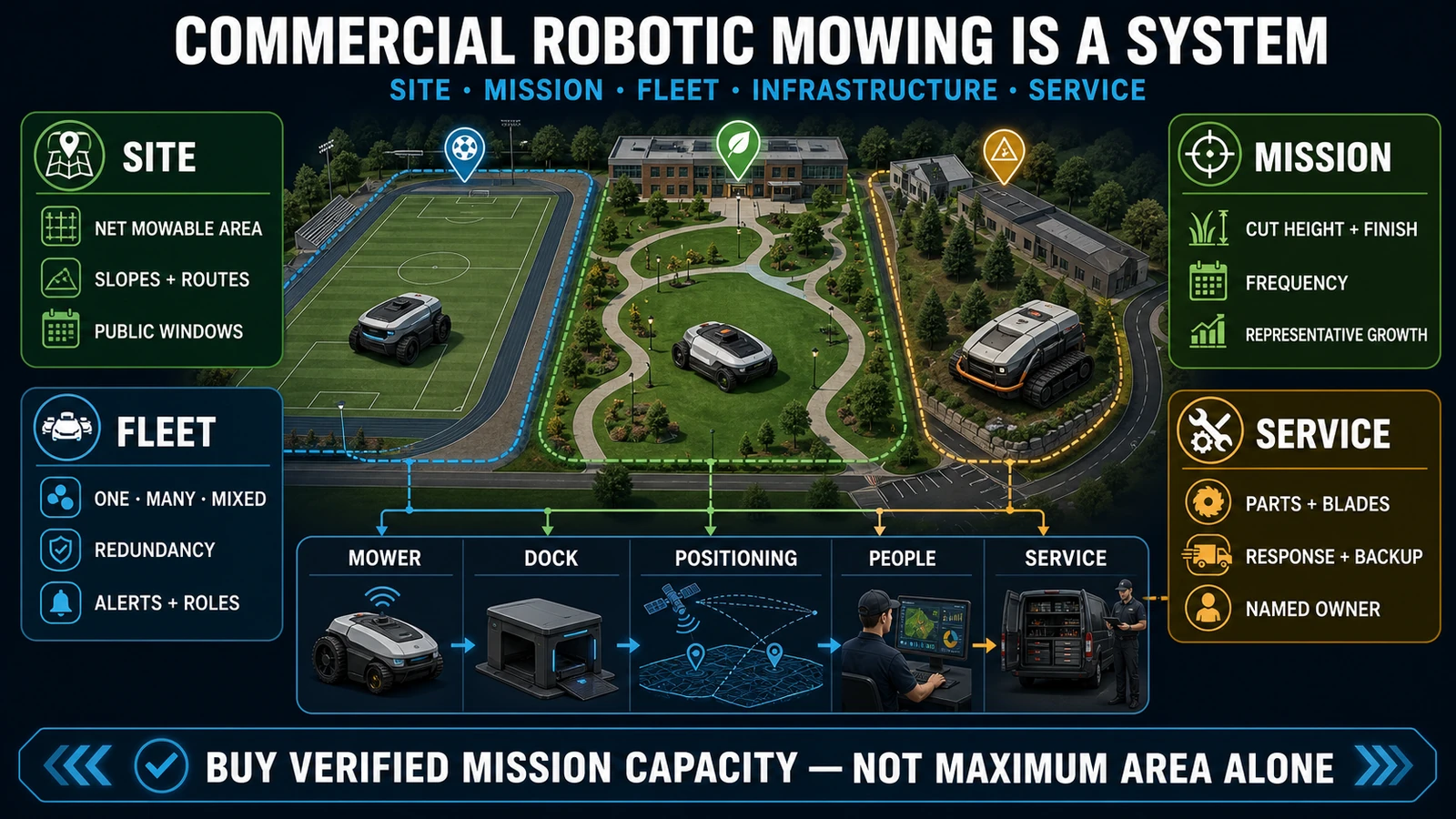
- A commercial robotic lawn mower should be procured as an operating system: site, mission, mower, charging and positioning infrastructure, fleet software, people, service and backup.
- Published area ratings are not directly comparable unless the cutting interval, turf standard, terrain, operating window and intervention assumptions are aligned.
- ROI should be calculated from verified site data and total lifecycle cost, while commissioning should assign every alert, rescue, repair, map change and cloud dependency to a named party.
In this article 16 sections
A commercial robotic lawn mower should be bought as an operating system, not as a larger residential gadget. The buyer must verify the complete mowing mission: usable daily capacity, turf standard, site layout, operating window, charging and positioning infrastructure, fleet control, human intervention, maintenance, service response and backup. A maximum-area number alone does not prove that a mower can deliver the required result.
Commercial robotic mowing can move recurring cutting hours away from an operator and release a grounds team for edging, horticulture, inspection and other skilled work. It does not remove people from turf care. Someone still has to prepare the site, supervise exceptions, clean and inspect machines, change blades, manage public access, recover faults and coordinate service.
This guide is for landscapers, sports and golf facilities, campuses, municipalities, commercial-property managers, dealers, distributors and sourcing teams. It does not rank models. It explains how to specify, compare, pilot and accept a commercial robotic mowing system.
If the immediate question is how a boundary-wire, RTK, LiDAR or vision system is physically set up, see Robot Lawn Mower Installation. This article owns the commercial decision after that: how much work the system can deliver, how many machines the site needs and whether the business case survives real operating conditions.
Commercial Robotic Lawn Mowers at a Glance
| Decision | Weak specification | Commercial specification |
|---|---|---|
| Area | “Up to 6 acres” | Acres or hectares completed at the required cut frequency, height, finish and operating window |
| Site | Total lawn size | Mowable zones, slopes, passages, obstacles, public interfaces, transport routes and dock locations |
| Machine | Commercial label and headline features | Exact SKU, market, duty assumptions, cutting system, charging cycle, positioning chain and approved use |
| Fleet | Number of robots | Zone allocation, coordination, redundancy, intervention load, account roles and spare capacity |
| Labor | “Autonomous” | Human minutes for preparation, monitoring, rescue, cleaning, blades, trimming, transport and service |
| Cost | Purchase price | Equipment, installation, connectivity, energy, labor, parts, maintenance, downtime, storage and backup |
| Support | Warranty length | Local parts, trained service, response time, loaner or spare plan, exclusions and end-of-support policy |
| Acceptance | One successful demonstration | A representative pilot with recorded completion, stops, interventions, turf result and recovery |
The central procurement rule is: buy verified mission capacity, not published maximum area alone.
What Makes a Robotic Lawn Mower Commercial-Grade?
“Commercial” is not a complete specification. For procurement, treat it as a claim that must be supported in six layers.
1. Repeatable task capacity
The mower must maintain the agreed area at the required cutting height and frequency. Capacity must include charging, travel, turning, restricted hours, normal stops and expected grass conditions—not only theoretical blade-on-grass time.
2. Operational control
A professional system may need remote status, alerts, schedules, map or zone control, user roles, activity history and group commands. Husqvarna’s current Fleet Services page shows location, work performance, technical status, daily review, service reminders and grouping. Segway Navimow’s current commercial solution presents mower location, performance data and technical status through NavimowFleet. These are useful examples of fleet functions, not proof that every function or service term is identical across platforms.
3. Maintainability
Commercial buyers need access to blades, cutting discs, wheels, batteries, charging hardware, positioning hardware, cables and other wear or service parts. Cleaning access, blade-change time, diagnostics and field-replaceable modules affect uptime as much as the maximum area rating.
4. Serviceability and support
A warranty without local diagnosis, parts and response time may not protect the mowing schedule. Husqvarna’s current U.S. Service Plus page demonstrates one possible service structure covering repairs, preventive maintenance and blades for specified professional robotic products. The buyer still needs the exact local contract, exclusions and service route.
5. Approved commercial use
Confirm the exact model, market SKU and warranty are intended for the proposed commercial duty. A consumer product used on a large lawn is not automatically a commercial asset, even if its advertised area appears sufficient.
6. An accountable operating system
The quotation should identify the legal manufacturer, importer where applicable, contract seller, installer or integrator, software or connectivity provider, owner/operator and repair or warranty provider. These roles may belong to one company—or several—but they should not be merged by assumption.
Which Commercial Sites Fit Robotic Mowing?
Robotic mowing works best where the task is frequent, repeatable and measurable.
| Site pattern | Why it may fit | Questions to resolve before purchase |
|---|---|---|
| Sports field or training ground | Regular mowing, defined geometry and value in freeing specialist staff | Required finish, event windows, movable equipment, line marking, debris and access control |
| Golf rough or semi-rough | Large recurring areas and flexible schedules | Exact turf zone, cutting-height range, tree cover, slopes, crossings and whether the model is approved for the intended finish |
| Campus or corporate property | Multiple zones and noise-sensitive operating periods | Public paths, disconnected lawns, account roles, charging sites, vandalism and intervention response |
| Municipal park | Repetitive mowing and potential fleet scale | Public interaction, animals, temporary events, litter, water edges, operating windows and local procedures |
| Resort, hotel or estate | Presentation quality and quieter scheduling | Guest access, night-time restrictions, objects, security, service response and visual finish |
| Landscaping contractor route | Repeatable client sites and labor reallocation | Transport, rapid remapping, charging between sites, custody, connectivity and who handles faults at each property |
Poor candidates are not defined only by size. A smaller but highly fragmented property may be harder than one large field. Sites with frequent tall growth, dense temporary obstacles, soft or waterlogged ground, unsafe edges, uncontrolled public access, unsuitable positioning coverage or no reliable service route may require redesign, a different machine mix or conventional mowing.
Golf is also not one homogeneous application. Sunseeker’s current X9 page, for example, states that the series is suitable for golf-course rough and semi-rough, not high-standard areas such as tees and fairways. That kind of limitation is more useful than the word “golf” in a marketing image.
How Much Area Can a Commercial Robotic Lawn Mower Cover?
The honest answer is: the area that it can maintain under a defined service level.
Current official product pages illustrate why headline numbers cannot be compared as if they were laboratory scores.
| Official example | Published area language | The missing comparison question |
|---|---|---|
| Husqvarna CEORA | Up to 6 acres with a pro-sports-quality cut; the current FAQ also describes larger areas at lower mowing frequency | What turf standard and mowing frequency does the project require? |
| Kress KR236 | Recommended area of 6 acres when cutting every 48 hours; maximum area of 9 acres when cutting every 72 hours | Is a 48-hour or 72-hour cycle acceptable in the growing season? |
| Segway Navimow Terranox | Commercial line presented in 3-acre and 6-acre versions; the CM240M1 is described as mowing a standard football-field-equivalent area in one day | What does “one day” include, and does the field geometry match the site? |
| Sunseeker X9 / X9 Plus | 3 acres per 48 hours and 6 acres per 48 hours | Are terrain, slopes, charging and allowed operating hours consistent with that claim? |
These are manufacturer specifications, not independent WCB performance tests. They use different wording, quality assumptions, intervals, products and markets.
For a bid, convert every product claim into the same project worksheet:
- net mowable area, excluding buildings and permanent non-turf surfaces;
- number and geometry of zones;
- cutting height and acceptable finish;
- maximum time between cuts in peak growth;
- daily operating window after accounting for events and public access;
- expected slope, surface, tree cover and positioning conditions;
- charging and travel time;
- planned rain, irrigation and wet-turf restrictions;
- acceptable number and duration of interventions; and
- reserve capacity needed when one mower is unavailable.
Do not multiply a brochure figure by the number of robots and call the result fleet capacity. Machines may share the same weather window, charging constraints, communications failure, access restrictions and technician.
For slope-specific measurement and acceptance, see Can Robot Lawn Mowers Handle Slopes?.
One Large Mower or a Fleet of Smaller Robots?
The answer depends on site topology and the cost of downtime.
One larger machine may be better when:
- the turf is large, contiguous and accessible;
- the mower can move between all work areas autonomously;
- one charging and positioning system can serve the mission;
- the required cutting width and finish suit the turf; and
- a backup machine or conventional response can cover a breakdown.
The benefits are fewer assets, docks, blade sets, software objects and daily status checks. The main risk is concentration: one unavailable mower can remove a large share of capacity.
A fleet of smaller machines may be better when:
- the property has separated zones or different turf requirements;
- steep, narrow and open areas require different chassis or cutting systems;
- redundancy is more valuable than minimum asset count;
- the operator wants to scale one site or contract at a time; or
- multiple machines can work without interfering with one another.
The trade-off is operational overhead. More robots mean more charging points, consumables, cleaning, maps, alerts, firmware states and service records. Fleet software can reduce that burden, but it does not eliminate physical interventions.
A mixed fleet may be the strongest design
A large systematic mower can own the open field while smaller units maintain narrow or complex zones. A crew may retain a ride-on, walk-behind or handheld tool for weather recovery, overgrowth, collection, edges and exceptions. The objective is not to maximize robot count; it is to minimize the verified cost of delivering the turf standard.
What Infrastructure Does a Commercial Robotic Mower Need?
Wire-free does not mean infrastructure-free.
Commercial site planning may include:
- Power and charging: approved electrical supply, dock surface, drainage, approach geometry, service access and protection from site operations.
- Positioning: boundary wire, local RTK reference station, Network RTK or correction service, LiDAR/vision mapping conditions, or a hybrid arrangement.
- Connectivity: cellular, Wi-Fi, Bluetooth, cloud account, correction data, app or web portal and regional service availability.
- Routes and access: transport paths, gates, crossings, disconnected areas, maintenance point and human handling rules.
- Site controls: signage, event schedules, temporary exclusions, irrigation coordination, litter checks and escalation for people or animals in the work area.
- Workshop support: cleaning area, blades and parts, charging or storage, lifting and transport equipment, asset records and secure custody.
- Digital administration: named account owner, user roles, map backup, change approval, alert routing, firmware policy and exit or transfer process.
The installation guide explains the physical and digital commissioning layers in detail. Commercial procurement adds a further question: who pays and responds when any one of these dependencies fails?
Does a Commercial Robot Mower Replace Mowing Labor?
It replaces or reduces a specific recurring task: a person driving or pushing a mower through the same cutting mission. It does not replace the grounds operation.
Human work remains for:
- walking the site and removing dangerous or damaging debris;
- trimming edges and areas outside the machine’s reach;
- inspecting turf health, drainage, irrigation and surface damage;
- cleaning the chassis and cutting deck;
- changing blades and other wear parts;
- responding to stops, trapped machines, map issues and docking failures;
- transporting machines between sites or disconnected zones;
- managing public access, temporary events and operating windows;
- coordinating firmware, accounts, connectivity and data; and
- arranging diagnosis, repair, loaners and backup mowing.
The valuable business question is not “How many people can be removed?” It is “How many recurring mowing hours can be converted into higher-value work after all new intervention hours are counted?”
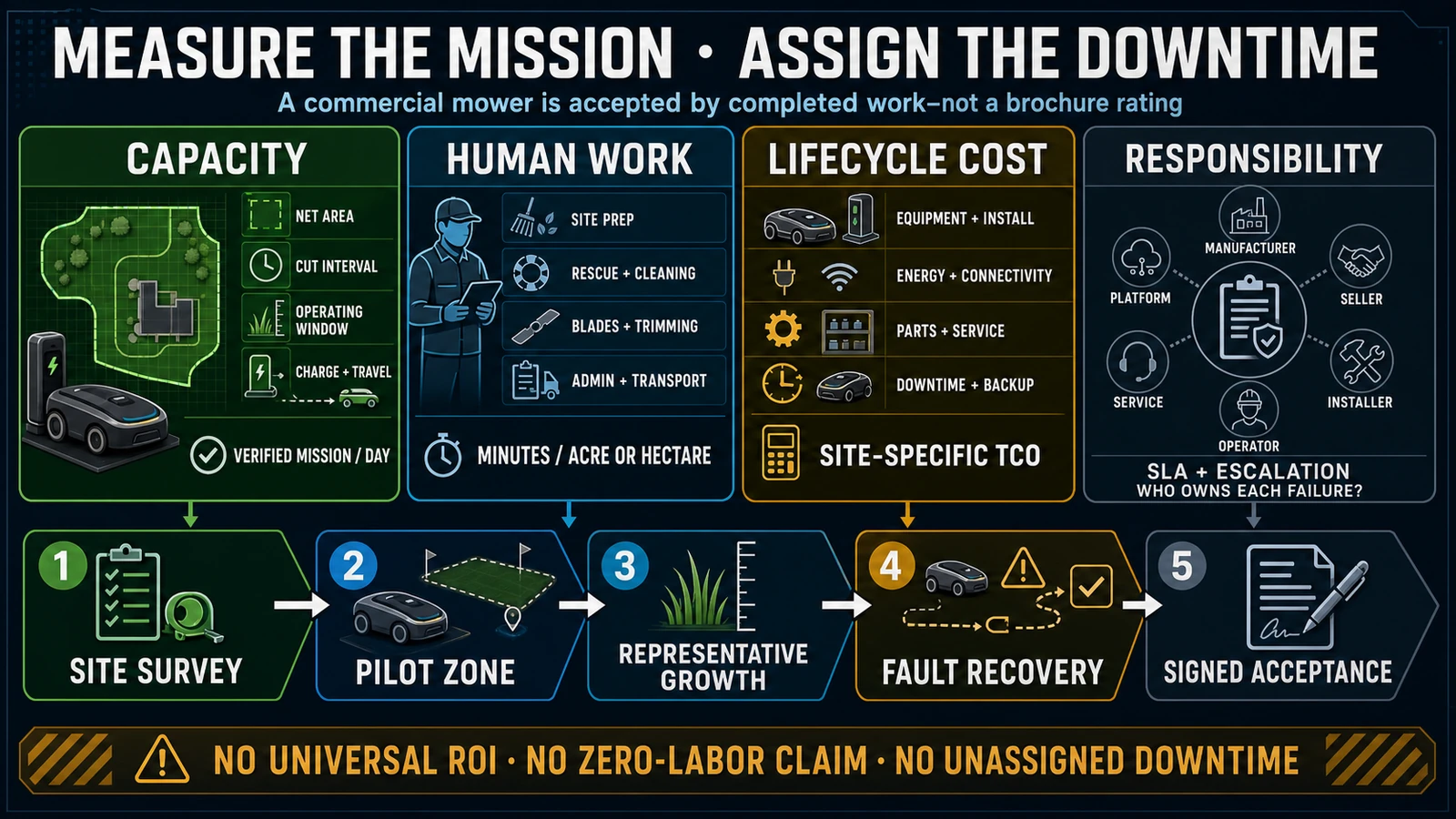
During a pilot, log human minutes per site and per completed hectare or acre. Include preparation, monitoring, travel, rescue, cleaning, blades and administration. A claim of “unmanned mowing” does not make those minutes zero.
How Should Buyers Calculate ROI and Total Cost of Ownership?
Start with two verified annual cost models using the same turf standard and service level.
Conventional mowing baseline
Include:
- mower purchase, lease or depreciation;
- operator wages, payroll burden and supervision;
- fuel or electricity;
- service, tires, blades and repairs;
- transport vehicle, trailer and site-to-site time;
- storage, insurance and compliance costs; and
- rework or additional visits needed to meet the standard.
Robotic mowing system
Include:
- mowers, cutting decks and charging systems;
- positioning, mapping, site preparation and commissioning;
- subscriptions, cellular data, correction services or software where applicable;
- electricity;
- blades, wheels, batteries, cutting parts and preventive maintenance;
- human preparation, monitoring, rescue, cleaning and administration;
- transport, storage and theft protection;
- dealer or service contract;
- downtime, backup equipment and missed-service risk; and
- end-of-life replacement and any non-transferable digital dependency.
A useful project formula is:
`Annual net benefit = verified conventional annual cost − verified robotic-system annual cost`
`Simple payback period = incremental upfront investment ÷ verified annual net benefit`
This is a planning model, not an accounting standard. Agree with finance how capex, depreciation, tax, financing and residual value will be treated.
Husqvarna Group stated at CEORA’s 2021 launch that its own calculation estimated approximately 30% lower cost over five years versus a conventional commercial mower. The footnote says the calculation used Husqvarna estimates for installation, staff, energy, service, maintenance and repairs in Europe. That is a manufacturer scenario—not a universal ROI promise. Each site needs its own baseline, utilization and downtime assumptions.
Run sensitivity cases for peak grass growth, shorter operating windows, additional human interventions, battery or major-part replacement, subscription changes and loss of one machine. If the business case fails under a realistic downside case, the project is not yet robust.
What Safety, Cybersecurity and Data Questions Matter?
Autonomous operation changes where risks are managed. It does not remove them.
Physical operation
Use the exact operator manual, declaration and market documentation. Define operating windows, pre-start inspection, temporary exclusions, response to people and animals, emergency procedure, theft or movement alerts and who may restart a stopped mower. A product’s object-detection feature is one layer; it is not permission to ignore site-specific risk.
The separate Robot Lawn Mower Safety guide covers sensors, blades, children, pets, wildlife, site conditions and procurement checks.
Connected-system security
Ask:
- Who owns the administrator account and maps?
- Can roles and permissions separate operator, dealer and service access?
- How are credentials protected and revoked?
- What data leaves the site, where is it processed and how long is it retained?
- Can logs and maps be exported before changing dealer or platform?
- How are vulnerabilities and firmware updates communicated?
- What happens when the cloud, cellular link or correction service is unavailable?
- How long will the exact product receive security and platform support?
Certification claims must remain exact. Kress’s current Voyager page states that the KR800 Voyager received specified mechanical/electrical certifications and an EN 18031 RED cybersecurity certification issued by TÜV SÜD. That claim should be checked against the exact model, certificate, market and contract; it does not certify every Kress mower or every customer deployment.
Maintenance, Service and Downtime Decide Commercial Value
Commercial buyers should ask for an uptime plan, not only a maintenance list.
| Failure or service event | Questions for the contract |
|---|---|
| Blade wear or cutting imbalance | Inspection interval, blade stock, change procedure, responsible person and safe handling |
| Chassis, wheel or deck damage | Field-replaceable parts, diagnostic path, repair location and target response time |
| Battery or charger problem | Diagnostic ownership, replacement lead time, warranty exclusions and temporary charging option |
| Positioning or map failure | Who diagnoses site, hardware, correction, firmware and account layers? |
| Cloud or connectivity outage | Offline behavior, alert path, data-plan ownership and escalation route |
| Mower unavailable during peak growth | Spare ratio, loaner terms, conventional backup and who bears missed-service cost |
| Landscape or event change | Map-change authority, documentation, revalidation and chargeable work |
Service capacity is regional. A global brand page does not prove that the local dealer stocks the necessary parts or can meet a two-day response. Put the local service promise in writing and identify whether it comes from the seller, distributor, authorized repairer or manufacturer.
How Should a Commercial Robotic Mower Be Piloted and Accepted?
A showroom demonstration proves that a machine can move and cut. A site pilot must prove that the complete operation can meet the contract.
Before the pilot
Define:
- map and net mowable area;
- turf zones, height and visual standard;
- maximum cutting interval in representative growth;
- operating windows and public restrictions;
- approved site conditions and exclusions;
- intervention and downtime targets;
- required reports and evidence; and
- responsible party for every exception.
During the pilot
Record, by zone and date:
- mission completion and missed areas;
- mowing, charging, travel and stopped time;
- every alert, rescue and manual repositioning;
- docking and positioning failures;
- object, public-access and temporary-exclusion events;
- wheelspin, rutting, scalping or other turf damage;
- blade, cleaning and service labor;
- connectivity or cloud interruption; and
- final turf result after the agreed interval.
Test only within the current manual and approved procedures. Do not create a dangerous failure to see what happens.
Acceptance metrics
Useful metrics include:
- percentage of scheduled missions completed;
- unplanned stops per operating day or hour;
- human intervention minutes per completed acre or hectare;
- charging and docking success;
- missed or overcut area;
- turf damage and remediation;
- blade and wear-part consumption;
- mean time to acknowledge and recover a fault; and
- days of mowing capacity lost to repair.
There is no universal pass threshold. The buyer and supplier should agree thresholds from the site mission, then run the pilot through representative grass growth and operating conditions.
Who Is Responsible for What?
| Party | Responsibility to document |
|---|---|
| Brand / legal manufacturer | Product documentation, conformity for the supplied market, technical support route and product-level warranty terms |
| Importer or regional entity | Market placement, local documentation and legally assigned obligations where applicable |
| Contract seller / dealer | Correct SKU, quotation scope, commercial-use statement, delivery, exclusions and customer remedy |
| Installer / integrator | Site survey, infrastructure, maps, configuration, commissioning records and handover |
| Platform or connectivity provider | Account, cloud, cellular or correction-service scope, availability terms, data and end-of-support information |
| Owner / operator | Site control, inspection, schedules, consumables, alert response, authorized users and maintenance records |
| Service / warranty provider | Diagnosis, parts, repair, preventive maintenance, response time, loaner or backup and exclusions |
One company may fill several rows. The contract should still preserve the rows, because a map failure, wheel failure and cloud outage do not have the same cause or remedy.
Commercial Robotic Lawn Mower Procurement Checklist
- [ ] Define net mowable area, zones, slopes, passages, crossings and disconnected lawns.
- [ ] Specify cutting height, finish, frequency and allowed operating window.
- [ ] Convert each manufacturer area claim to the same project assumptions.
- [ ] Decide whether one large mower, a smaller fleet or a mixed fleet fits the site.
- [ ] Verify the exact commercial SKU, market, approved use and warranty.
- [ ] Confirm power, dock, positioning, connectivity, map and transport-route requirements.
- [ ] Price all installation, subscription, data and correction-service dependencies.
- [ ] Measure human preparation, intervention, cleaning, blade, trimming and administration time.
- [ ] Obtain local parts availability, service response and backup terms in writing.
- [ ] Assign account ownership, user roles, data, firmware and end-of-support responsibility.
- [ ] Pilot a representative zone and growth period before fleet rollout.
- [ ] Sign acceptance against mission completion, turf result, intervention and downtime—not a brochure area.
FAQ
What is a commercial robotic lawn mower?
A commercial robotic lawn mower is a robotic cutting system sold and supported for professional turf operations. Buyers should verify duty assumptions, fleet control, maintainability, commercial use, local service and the complete site mission rather than rely on the label alone.
Can a robotic lawn mower handle a large commercial lawn?
Yes, current commercial systems are marketed for sports fields, golf-course zones, campuses, parks, resorts and other large sites. Suitability depends on the exact area definition, cutting interval, finish, terrain, operating window, charging, positioning, intervention and service assumptions.
Is one commercial robot mower enough for six acres?
It may be, but “six acres” appears under different manufacturer conditions. One product may mean daily pro-sports quality; another may mean a 48-hour cycle. Verify the mission on the actual site and include reserve capacity for downtime.
Do commercial robotic mowers replace a lawn crew?
They can reduce recurring ride-on or walk-behind mowing hours. People remain responsible for site inspection, debris, trimming, cleaning, blades, exceptions, public access, turf decisions, transport and service coordination.
Are commercial robot mowers suitable for golf courses and sports fields?
Some are designed for those applications, but the exact turf zone matters. Rough, semi-rough, fairway, tee and sports-turf quality can require different cutting systems, heights and service levels. Use the exact product documentation and a site pilot.
How do I calculate commercial robotic mower ROI?
Compare verified annual conventional mowing cost with the complete annual robotic-system cost. Include equipment, installation, energy, labor, connectivity, parts, maintenance, transport, downtime and backup on both sides. Do not use a manufacturer saving percentage without rebuilding its assumptions for the site.
Can a commercial robotic mower work at night?
Some products support low-light or night operation, but technical capability is not automatic site approval. Consider people, wildlife, noise expectations, irrigation, visibility, local procedures and the exact manual before setting an operating window.
The Practical Answer
The best commercial robotic lawn mower is not the machine with the largest published area. It is the system that can repeatedly deliver the required turf result within the available hours, with an intervention load, service plan and lifecycle cost the operator can support.
Start with the site and mission. Normalize capacity claims. Choose the fleet architecture. Count every remaining human task. Price the digital and physical infrastructure. Assign downtime. Then pilot the complete operation before scaling.
That process turns autonomous mowing from a product demonstration into a commercial production tool.
Official Sources
- Husqvarna — Commercial Robotic Lawn Mowers
- Husqvarna — CEORA
- Husqvarna — Fleet Services
- Husqvarna — Lease Plus and Service Plus
- Husqvarna Group — CEORA Launch and TCO Calculation Scope
- Kress — KR236 RTK Commercial Robotic Mower
- Kress — Voyager Commercial Autonomous Mower
- Segway Navimow — Commercial Solutions and NavimowFleet
- Segway Navimow — Terranox Professional Mower
- Sunseeker Elite — X9 Series