- Robot lawn mowers can be operated safely when the exact product, site and operating controls are suitable, but rotating blades, autonomous movement, charging and battery systems still create residual risk.
- Obstacle detection is not a universal safety guarantee: low, small, soft or partly hidden objects may be missed, and a physical or virtual boundary is not a protective barrier.
- Professional buyers should verify the complete safety system: exact SKU, manual, declarations and test scope, site barriers, operating schedule, serial traceability, recall process and responsible market entities.
In this article 14 sections
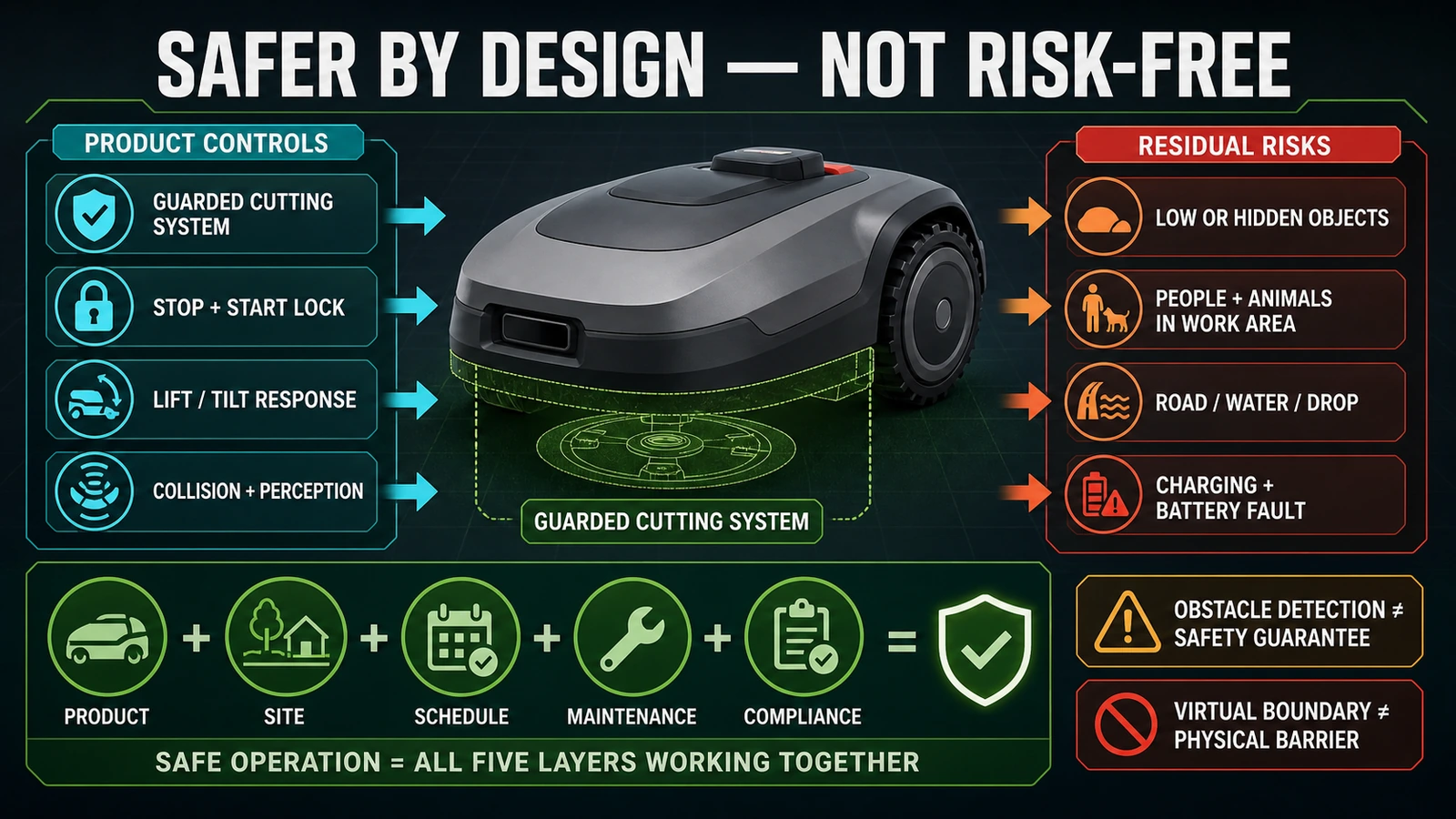
Robot lawn mowers can be operated safely when the product is correctly selected, installed, scheduled and maintained—but they are not risk-free. They still contain rotating blades, move without a driver and rely on a charging and battery system. Lift, tilt, collision and obstacle sensors reduce risk; they do not make contact or failure impossible.
The practical answer therefore depends on five layers:
- the safety design of the exact mower and its peripherals;
- the limits of its sensors, cutting system and boundary controls;
- the lawn, nearby roads, water, drops and public access;
- the operating schedule, supervision and maintenance procedure; and
- the documents, traceability, recall route and responsible companies in the destination market.
This distinction matters for households, but it is even more important for distributors, importers, installers, grounds contractors and facility operators. A product marketed as “AI-powered” or “pet friendly” still needs a model-specific safety case.
Robot Lawn Mower Safety at a Glance
| Safety layer | Typical controls | Important limit | What a buyer should verify |
|---|---|---|---|
| Cutting system | Enclosed deck, body overhang, blade disc, pivoting or fixed blades, guards and fasteners | A guarded blade can still injure a person or animal that enters its path or reaches underneath | Blade architecture, stopping behavior, damaged-part criteria and approved replacements |
| Machine state | STOP button, PIN or lock, lift, tilt, rollover and abnormal-state responses | A sensor can be blocked, damaged, miscalibrated or affected by software and mechanics | Exact test method, fault behavior, restart conditions and firmware version |
| Obstacle perception | Bumper, ultrasonic, radar, camera, LiDAR or sensor fusion | Small, low, soft, thin, hidden or poorly contrasted objects may not be detected | Detection limits, disabled zones, grass and lighting effects, sensor-cleaning requirements |
| Work-area control | Physical boundary wire, virtual boundary, stay-out zone, map and transport path | A signal or digital line is not a fence around a road, pool, drop or public area | Physical barriers, offsets, weak-signal response, map ownership and change control |
| Operation | Scheduling, lawn clearance, child lock, warning signs, supervision and emergency response | Operating rules cannot correct a defective product | Named operator, written procedure, permitted hours, incident and stop-use process |
| Market compliance | Label, declaration, instructions, test records, serial traceability and recall support | A logo or one test report does not prove the complete configured SKU complies everywhere | Legal manufacturer, importer, seller, test scope, destination rules and corrective-action route |
Are Robot Lawn Mowers Designed to Be Safe?
Yes. Safety is an engineering requirement, not merely a convenience feature.
The international standard IEC 60335-2-107 covers safety requirements and verification for battery-powered electrical rotary robotic lawn mowers and their peripherals within its stated scope. The IEC says the standard addresses significant hazards during intended use and reasonably foreseeable misuse. Its consolidated 2017 edition with 2020 and 2021 amendments is listed as valid at the time of this article.
That does not mean every mower has the same design or performance. It also does not mean a website statement that a product “meets IEC” is enough. The buyer still has to confirm which exact model, battery, charging station, power supply and accessories were evaluated, which edition or national adoption was used, and what additional requirements apply in the destination market.
UL Solutions, for example, describes testing services around IEC and ANSI/OPEI 60335-2-107, together with battery, charging, wireless, interoperability and cybersecurity considerations. That page explains a testing framework; it is not evidence that an unnamed product carries a UL certification.
Common safety controls
Depending on the model, a mower may include:
- a body wider than the cutting system;
- a protected cutting disc or deck;
- small pivoting blades or another blade architecture;
- a prominent STOP control;
- a PIN, child lock or authenticated start sequence;
- lift, tilt or rollover response;
- collision sensing and direction change;
- camera, radar, ultrasonic or LiDAR obstacle detection;
- physical or virtual work-area limits;
- alerts when the mower leaves its defined area; and
- software-controlled scheduling, parking and updates.
These controls work as layers. No single feature proves the whole machine is safe under every condition.
What Hazards Still Remain?
Blade contact
The blade hazard does not disappear because the mower is compact or autonomous. A current Husqvarna professional Automower manual explicitly states that the product is not a toy and that its blades can injure people and animals. It instructs users to switch the named models off before clearing blockages, performing maintenance or examining the machine, and not to touch hazardous moving parts before they stop completely.
The exact shutdown method varies. Some products use a physical key or main switch; others use a STOP button, PIN, App or combination of controls. A distributor should never replace the model manual with a generic training slide.
Objects and projectiles
Stones, branches, tools, toys, cables, irrigation parts and damaged blade hardware can cause a stop, blade damage or material ejection. A camera or bumper may help the mower respond, but site clearance remains a basic control.
Loose or incorrect replacement hardware adds another risk. Blade, screw, disc and guard part numbers should be controlled by SKU, and a serviced mower should receive a functional and safety check before returning to operation.
Leaving the intended work area
A physical perimeter wire and a virtual boundary both tell the controller where it should operate. Neither is a physical barrier.
The consequences of a boundary error depend on the edge. Crossing into another patch of grass is different from moving toward a swimming pool, pond, precipice, public road, parking area or playground. The installation must therefore be designed around consequence, not only positioning accuracy.
A Husqvarna manual for specified Automower models, for example, calls for a physical barrier between the boundary wire and water bodies, slopes, precipices or public roads and gives model-specific dimensions. Those numbers should not be copied to another mower. The transferable lesson is that high-consequence edges may need a wall, fence or other physical protection defined by the exact manual and site assessment.
Charging, electrical and battery hazards
The mower is only one part of the safety system. The charging station, power supply, cable, connectors, battery pack and software-controlled charging behavior also matter.
A UK notice published in 2022 about a 2021 recall of specific Husqvarna 435X and 535 units identified a battery and charging-related fire risk. The published corrective action involved battery replacement and mandatory software updates for the affected products.
This was a model-specific recall, not a conclusion about every Husqvarna mower. It demonstrates why buyers need serial traceability and a corrective-action channel for the dock, battery and firmware—not only the blade assembly.
Do Lift, Tilt and Obstacle Sensors Make a Robot Mower Safe?
They reduce risk, but they should not be treated as a guarantee.
Lift or tilt detection can command the cutting system to stop when the mower is raised or overturned. Collision sensing can make it stop, reverse or turn after contact. More advanced perception may help it avoid an object before contact.
The limitation is straightforward: a safety outcome depends on detection, control logic, stopping behavior and the mechanical condition of the machine. A feature name does not prove all four.
Husqvarna’s current radar and ultrasonic object-avoidance guidance is unusually clear about this distinction. It says detection depends on object size, grass height and object position; low or flat objects can be missed. For the listed models, it also says obstacle avoidance is disabled near the work-area boundary and explicitly states that the feature is not a safety feature and cannot guarantee an object will not be run over.
Other brands, models and sensor stacks behave differently. Buyers should ask for limitations rather than only a list of objects a marketing page says the mower can recognize.
A real recall shows why durability matters
In 2024, the UK Office for Product Safety and Standards recalled specified Honda Miimo models and serial ranges because a sensor mounting shaft could develop a defect after repeated contact with obstacles. The official Honda Miimo recall notice says the sensor could become stuck and fail to detect objects, creating a serious injury risk.
The lesson is not that all Honda products are unsafe. It is that a sensor must remain effective after real mechanical use, and safety management must include exact model and serial identification, field monitoring, recall communication and a stop-use process.
Are Robot Lawn Mowers Safe Around Children?
Children should not play in the mowing area while the machine operates. A child lock or PIN can help prevent an unauthorized start, but it does not protect a child who enters the path of an already running mower.
Instructions differ by product. The current Husqvarna professional manual cited above gives specific supervision, separation-distance and public-warning requirements for the models it covers. Husqvarna’s broader robotic mower FAQ also says the mower should not be used when people—especially children—or animals are in the work area.
A safe household or facility procedure should therefore:
- schedule mowing when the lawn is not being used;
- prevent children from starting or riding on the mower;
- remove toys, cords and small objects before operation;
- stop and park the mower before people enter for play, sport or maintenance;
- keep the charging station and power equipment inaccessible as required; and
- teach adults the exact STOP and isolation procedure.
Marketing claims about human recognition do not replace these controls.
Are Robot Lawn Mowers Safe for Dogs, Cats and Other Pets?
The safest operating plan keeps pets out of the active work area.
An obstacle system may identify or contact a standing dog more readily than a small animal lying in long grass. Detection can change with size, posture, movement, lighting, vegetation and sensor cleanliness. Pets may also approach the mower, bark at it, chase it or place a paw near the body edge.
“Pet friendly” should therefore be treated as a feature claim that requires model-level evidence, not permission to run the mower beside an unsupervised animal. For a multi-property installation, the supplier should define the operating rule in writing so a customer, contractor and site manager do not follow different assumptions.
What About Hedgehogs and Other Wildlife?
Wildlife presents a different problem because small animals may remain still, hide in vegetation or be active when people are not watching the lawn.
A peer-reviewed 2021 study of 18 robotic lawn mower models tested collisions using dead European hedgehogs. In those controlled tests, the mowers had to touch the hedgehogs to detect them, and dependent juveniles under 200 grams were not detected. The researchers found meaningful differences among machines; pivoting blades, skid plates and front-wheel drive were associated with a higher safety index in the tested sample.
The study has important limits. It used dead hedgehogs, particular models available at the time and controlled test positions. It is not a measurement of real-world accident rates, and it cannot describe every current mower. Its value is narrower: small wildlife cannot be assumed to behave like a large, upright obstacle, and product architecture matters.
Practical controls include:
- operate during daylight rather than when nocturnal animals are active;
- inspect the lawn before starting;
- avoid mowing through dense wildlife shelter areas;
- use the exact model’s wildlife mode if available, without treating it as a guarantee; and
- keep operating records if the site has known wildlife activity.
Husqvarna’s current Consideration for Wildlife routine, for example, parks supported mowers between sunset and sunrise based on location. That is a useful scheduling control, not proof that the remaining daylight operation is risk-free.
Is a Wire-Free Robot Mower Safer Than a Perimeter-Wire Model?
Not automatically. The two architectures move risk rather than eliminating it.
| Safety question | Physical perimeter wire | Virtual boundary / wire-free system |
|---|---|---|
| How the work area is defined | Low-voltage loop signal and installation geometry | Digital map plus GNSS/RTK, vision, LiDAR or sensor fusion |
| Possible failure source | Wire break, connector, poor layout, signal fault or displaced installation | Positioning loss, map error, reference/network issue, sensor obstruction or software state |
| Landscape change | Cable may need moving or repairing | Map, stay-out zone or reference conditions may need updating |
| High-consequence edge | May still require physical separation | May still require physical separation |
| Main procurement question | Who verifies and restores the loop and safe offset? | Who controls maps, positioning service, fallback behavior and updates? |
A virtual boundary is easier to edit, but that convenience is not the same as containment under every fault condition. A physical wire has a visible installation responsibility, but it is also not a fence.
The correct comparison is site-specific: What happens if the signal, correction service, map, sensor, cable or power fails near the most dangerous edge? For more detail on the technology itself, see Robot Lawn Mowers Without Perimeter Wire: Navigation and Procurement Explained.
Public and Commercial Sites Need Stronger Operating Controls
An autonomous mower in a closed residential garden does not create the same exposure as one operating at a hotel, school, housing development, campus, sports facility, cemetery, municipal park or contractor-managed site.
Public and commercial deployments should define:
- the hours when the work area is reliably clear;
- warning signs, temporary closures or physical separation;
- responsibility for daily clearance and weather decisions;
- authorized App, account and manual-control users;
- remote stop, local STOP and escalation procedures;
- mowing routes that do not cross public pathways unless expressly designed and controlled;
- response to boundary, positioning, sensor or connectivity faults;
- inspection after impact, abnormal vibration or blade damage;
- serial-level service, firmware and incident records; and
- service-level terms for safety-related failures and corrective actions.
The current professional Husqvarna manual cited earlier, for example, requires warning signs in public areas for its named models and tells installers not to create work areas or transport paths across public pathways. This is a useful example of why professional installation cannot be reduced to drawing a map in an App.
Which Safety Standards and Documents Should Buyers Check?
There is no single global certificate package for every destination. Product category, voltage, radio functions, battery, charger, intended use and placement date all matter.
Product and test identity
Ask for documents that identify:
- the complete mower model and market variant;
- battery, charging station, power supply and safety-relevant accessories;
- legal manufacturer and contact details;
- destination-market importer or other responsible economic operator;
- model, batch or serial traceability;
- applicable standard editions and national adoptions;
- laboratory, report or certificate number and exact scope;
- firmware or software version where it affects safety functions; and
- labels, warnings and instructions in required languages.
A report for a similar model, a different charger or a prototype configuration does not automatically cover the product being shipped.
European Union timing matters
The EU Machinery Regulation (EU) 2023/1230 generally applies from 20 January 2027, according to EU-OSHA’s official summary. This article is dated July 2026, so buyers should not describe the new Regulation as the sole regime already governing every current EU placement. They should verify the applicable rules—including the existing Machinery Directive framework—against the actual placement date and configured product.
Great Britain has its own current framework
The UK Health and Safety Executive says the Supply of Machinery (Safety) Regulations 2008 remain in force. Its current buying-new-machinery notice states that new machinery placed on the Great Britain market must carry the applicable UKCA or CE marking, be supplied with a declaration of conformity and include instructions in English. The same notice warns that older marking-transition guidance has changed.
Rules can change. A distributor should recheck official destination-market guidance before each launch rather than copying a prior product’s compliance list.
B2B Safety Procurement and Commissioning Checklist
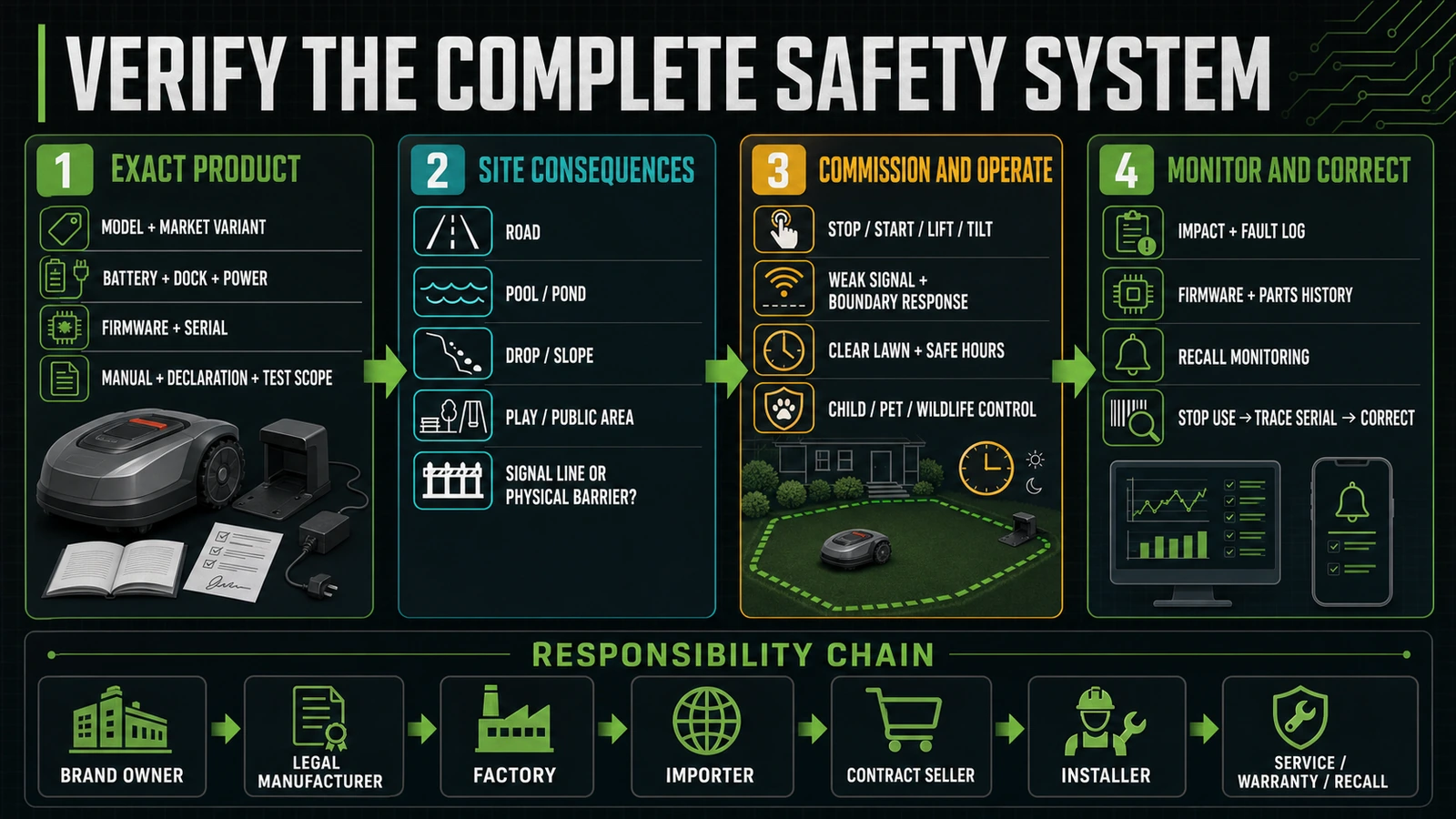
1. Lock the exact configured product
- Record the mower, battery, dock, power supply, reference station, accessories, plug and radio configuration.
- Match every declaration, report, label and manual to that configuration.
- Record the production batch, serial format and installed firmware.
- Confirm residential, commercial, rental and public-space use separately.
2. Map the consequence zones
- Mark roads, driveways, car parks, pools, ponds, drops, stairs, steep edges, play areas and public paths.
- Decide which edges require a physical barrier rather than a wire, virtual line or vision boundary.
- Document slopes, wet ground, long grass, low objects, irrigation and sensor-obscuring conditions.
- Assign ownership for landscape or map changes after commissioning.
3. Test controls using the approved procedure
- Verify STOP, authorized start, lift, tilt and defined abnormal-state responses.
- Test physical or virtual boundaries and the approved response to signal or positioning weakness.
- Observe docking, charging, alerts and recovery without creating an uncontrolled blade hazard.
- Record limitations and residual risks, not only pass/fail marketing claims.
4. Define operation and maintenance
- Schedule the machine when children, pets, visitors and the public are absent.
- Include wildlife timing and pre-start lawn inspection.
- Define shutdown and isolation before cleaning, blade work, transport or fault inspection.
- Use exact part numbers and complete a safety check after repair.
- Keep a serial-level log of impacts, alarms, firmware, parts, complaints and corrective actions.
5. Separate the responsible parties
Record each role rather than assuming the brand performs all of them:
- brand owner;
- legal manufacturer on the product documents;
- actual factory and declared country of origin;
- destination-market importer or other responsible operator;
- contract seller;
- installer and commissioning provider;
- repair provider; and
- written warranty and recall provider.
The same company may hold several roles, but brand ownership, manufacturing, importing, selling, installing and warranty responsibility are different facts.
6. Build the recall and incident route before launch
- Monitor official recalls and manufacturer safety bulletins in every sales market.
- Be able to locate affected customers by model and serial number.
- Define who can stop use, push a mandatory update, replace a component or withdraw stock.
- Preserve complaints, near misses, property damage and injury records.
- Inform distributors, installers and end users through a tested contact chain.
For supplier identity and OEM screening, see Robotic Lawn Mower Manufacturers in China. For lifecycle and repairability, see How Long Do Robot Lawn Mowers Last?.
Frequently Asked Questions
Are robot lawn mowers safe for children?
They include safety controls, but children should not play in the work area while the mower operates. Use the exact manual, schedule mowing when the lawn is empty, prevent unauthorized starting and stop the mower before children enter.
Are robot lawn mowers safe for dogs and cats?
Do not rely on pet detection as the only control. Keep pets out of the active mowing area. Size, posture, movement, grass, lighting and sensor condition can affect detection, and an animal may approach the machine after it passes.
Can robot lawn mowers hurt hedgehogs?
Controlled research has shown that mower models differ and that small hedgehogs may not be detected before contact. The studies do not establish a real-world accident rate for every current product. Daylight scheduling, lawn inspection and model-specific design evidence reduce risk.
Is obstacle avoidance a safety feature?
Not necessarily. It can reduce collisions, but detection has limits. Husqvarna explicitly says the radar and ultrasonic obstacle avoidance on its listed models is not a safety feature and does not guarantee objects will not be run over. Check the exact product documentation.
Is a virtual boundary safe near a pool or road?
A virtual boundary is not a physical barrier. Use the product manual and site risk assessment to decide the required offset, wall, fence or exclusion zone near water, drops, traffic and public access.
Can a robot mower operate unattended?
Autonomous operation does not mean unmanaged operation. The site still needs a safe schedule, initial commissioning, pre-start clearance, fault monitoring, maintenance and a responsible person who can stop the machine and respond to incidents.
What certification should a robot lawn mower have?
There is no one certificate for every market. IEC 60335-2-107 is an important safety standard within its scope, but the required conformity process, labels, declarations, instructions and supporting records depend on the complete product, intended use, destination and placement date.
Related World Clean Biz Guides
- How Do Robot Lawn Mowers Work?
- Robot Lawn Mowers Without Perimeter Wire
- How Long Do Robot Lawn Mowers Last?
- Who Owns Husqvarna Automower?
- Who Makes LUBA Robot Mowers? Mammotion and AgileX Explained
- Who Owns Segway Navimow? Ninebot and Willand Explained
Final Takeaway
The most accurate answer to “are robot lawn mowers safe?” is conditional:
```text
Safe operation = suitable product × safe site × controlled schedule × correct maintenance × traceable compliance
```
A modern mower can incorporate several well-designed protections and still require people and animals to remain outside the active work area. A sophisticated perception system can reduce collisions and still miss a low object. A precise virtual map can improve navigation and still need a physical barrier beside a road or pool.
For professional buyers, safety is not a feature count. It is a documented system that begins with the exact SKU and continues through installation, operation, service, incident monitoring and recall.