- A robot lawn mower is a battery-powered maintenance machine that cuts a small amount frequently, stays within a physical or virtual work area and normally returns to a charging dock by itself.
- Boundary control, localization, route planning and obstacle detection are different functions; a mower may use a wire, RTK-GNSS, LiDAR, vision or several systems together.
- Professional buyers should test the exact SKU on the real site and verify safety files, digital dependencies, parts, importer, contract seller and written warranty before deployment.
In this article 11 sections
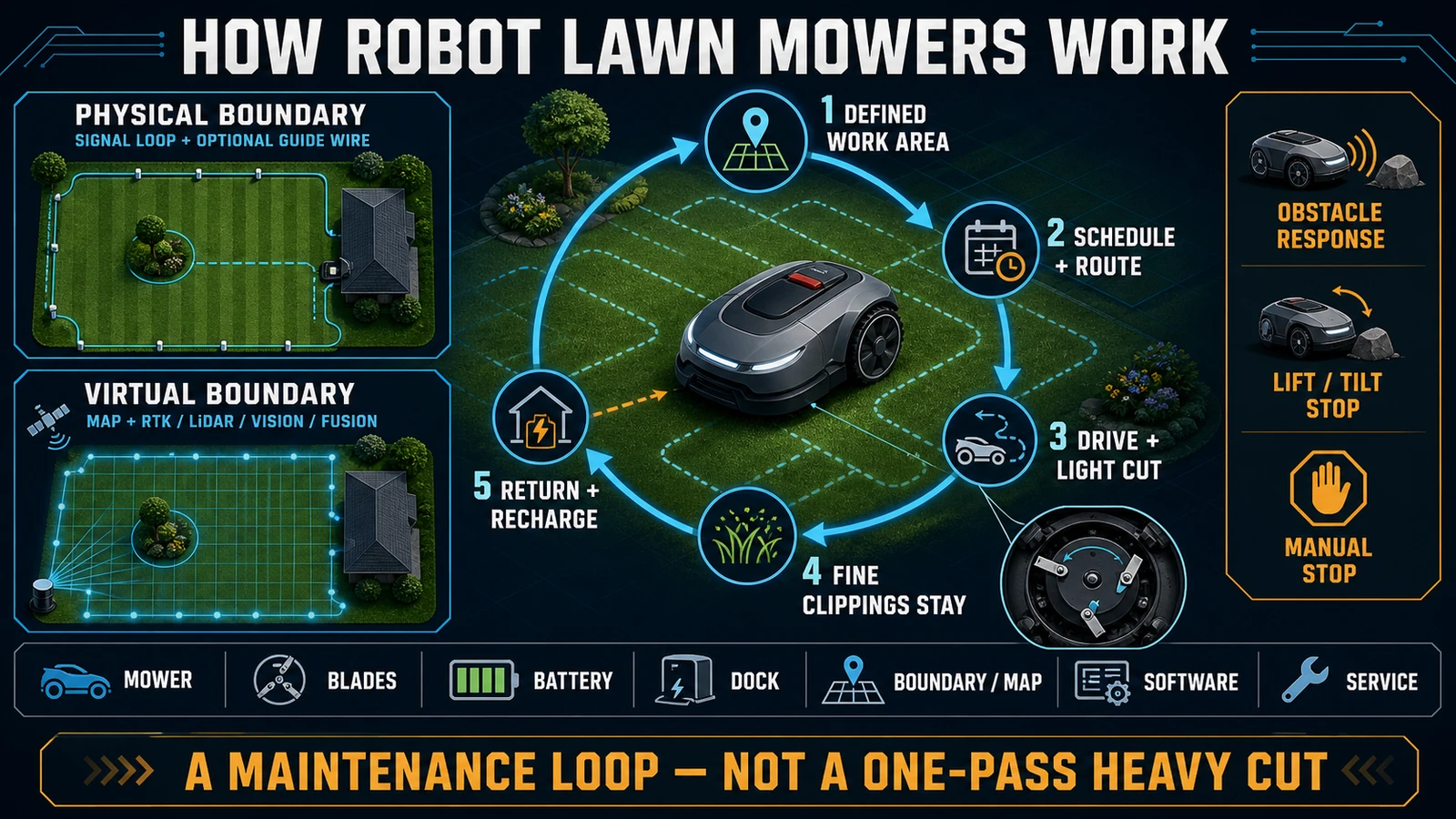
A robot lawn mower is a battery-powered autonomous maintenance mower. It follows a schedule inside a defined work area, drives a cutting system across the grass, removes a small amount of growth on repeated passes, and normally returns to a charging station when its battery is low. Most models leave the fine clippings on the lawn rather than collecting them.
That direct answer applies to the category, but not every machine uses the same architecture. A traditional robot mower detects a signal from a physical boundary wire. A wire-free model may localize itself with RTK-GNSS, LiDAR, cameras or sensor fusion and follow a virtual map. Some machines move in changing patterns over time; others mow in systematic parallel lines.
The word “robotic” also does not guarantee a particular slope capability, edge finish, obstacle response, App function or commercial duty rating. The complete system includes the mower, blades, battery, charger or dock, boundary infrastructure, software, connectivity, site conditions and service organization.
How a Robot Lawn Mower Works at a Glance
| System | What it does | What a buyer should verify |
|---|---|---|
| Work-area boundary | Keeps the mower inside a physical-wire loop or virtual map | Lawn edges, roads, water, drops, no-go zones, map changes and behavior after signal loss |
| Localization and route logic | Estimates position and selects the next path | Wire, RTK, LiDAR, vision, fusion, random or systematic pattern, weak-condition behavior |
| Drive and steering | Moves the mower across grass, slopes and passages | Traction, turning damage, ground clearance, minimum passages and recovery from soft ground |
| Cutting system | Rotates a disc, blades or cutting deck at the selected height | Grass type, cutting width and height, blade protection, wear parts and long-grass limits |
| Obstacle and safety system | Detects contact, lift, tilt or other hazards and stops or redirects the machine | Detection limits, blade stopping, manual stop, children, animals, public access and acceptance tests |
| Battery and charging | Supplies power and returns the mower to its dock when required | Real duty cycle, docking reliability, charger, battery replacement, temperature and transport records |
| Scheduling and connectivity | Runs the mowing plan and may provide maps, alerts or fleet control | App, account, Bluetooth, Wi-Fi, cellular or cloud dependence, offline behavior and data handover |
| Service system | Keeps the mower operating across the season | Blades, wheels, seals, charging contacts, wire repairs, diagnostics, firmware, local parts and warranty |
The machine succeeds by repeating a controlled cycle. It is not simply a small conventional mower with nobody walking behind it.
What Happens During a Robot Mower’s Operating Cycle?
1. The work area is defined
Before mowing starts, the system needs to know where it may operate.
A boundary-wire installation creates a loop around the lawn and around excluded areas. The mower detects the wire’s signal and turns before leaving the work area. Some installations add a guide wire that gives the mower a direct route between remote parts of the lawn and the charging station.
A wire-free installation creates a digital work area instead. Depending on the product, the map may be driven around manually, generated with assisted mapping or created from sensor data. Virtual channels can connect mowing zones, while digital no-go areas exclude ponds, flower beds or other hazards.
Neither type removes the need for a site survey. A cable is not a physical fence, and a virtual line cannot stop a mower mechanically if localization, mapping or control fails.
2. The schedule releases the mower
Robot mowers are designed around repeated maintenance, not a single heavy weekly cut. The controller starts a session according to a schedule, weather-related rule or operator command.
The schedule should reflect grass growth, lawn size, machine capacity, irrigation, public use and quiet periods. More operating hours are not automatically better. Excessive traffic can mark soft turf, while insufficient operating time can allow grass to become too long for the mower’s normal cutting method.
3. The mower localizes and chooses a route
The mower determines whether it remains inside the work area and decides where to travel next. A wired machine can react to boundary and guide signals while using wheel movement, orientation and collision events. A wire-free machine can combine satellite corrections, inertial data, LiDAR scans, cameras, wheel odometry and a stored map.
Route strategy is a separate decision. Traditional models may change direction after a boundary or obstacle event and achieve coverage through many passes over time. Systematic products plan line-like routes and may divide the lawn into zones. A neat pattern is not proof that obstacle detection or boundary safety is stronger; those functions must be evaluated separately.
4. The cutting system removes a small amount of grass
A common residential design uses a motor-driven disc carrying several small pivoting blades. Other machines use fixed blades, different discs or wider cutting assemblies. As the mower travels, the blades trim the top of the grass at the selected height.
Because the machine works frequently, the clippings are normally small enough to fall back into the turf. Honda’s current robotic mower explanation describes this “little and often” cycle, automatic charging and the fine-clipping approach.
This operating principle sets an important limit: most robot mowers maintain established grass; they are not designed to recover an overgrown site in one pass. Long, wet or dense grass can increase cutting load, clog the underside or reduce effective area per charge.
5. Sensors respond to obstacles and unsafe states
Basic machines may detect physical contact and then stop, reverse and change direction. Other products add ultrasonic, radar, camera, LiDAR or fused obstacle sensing. Lift and tilt inputs can command the cutting motor to stop if the unit is raised or tips over.
Detection is never equivalent to a promise that every child, animal, toy, cable, low object or drop will be recognized. Object size, material, lighting, approach angle, grass height, sensor cleanliness, firmware and speed can change the result. The site should be cleared before operation, and the schedule should avoid periods when people or animals normally occupy the work area.
6. The mower returns to the charging station
When the battery reaches a defined level—or when the session ends—the mower finds its dock. A wired model may follow a guide wire, boundary signal or station signal. A mapped model may use its stored route and localization system.
Husqvarna’s current Automower explanation describes automatic return by station signal, boundary wire or guide wire on applicable models. The important procurement question is docking reliability on the real site: the narrow passage, slope, wet approach, charging-contact alignment and weak-signal condition.
7. The cycle repeats—and maintenance becomes part of performance
After charging, the mower follows its schedule again. Frequent operation turns small service issues into operating losses: dull blades increase cutting load, grass around wheels affects traction, dirty sensors affect perception, damaged boundary wires stop a wired system and charging-contact problems reduce availability.
Maintenance intervals are product- and site-specific. The correct method comes from the exact manual. A fixed internet claim such as “replace blades every X weeks” should not be used as a universal procurement assumption.
How Do Robot Lawn Mowers Know Where to Go?
Four layers are often compressed into the word “navigation”:
- Boundary control: where the mower is allowed to operate.
- Localization: where the mower estimates it is.
- Route planning: which path it chooses to cover the area.
- Obstacle response: what it does when something unexpected appears.
A product can be strong in one layer and limited in another.
Physical boundary wire
A low-voltage signal in a perimeter loop defines the work area. The approach is mature and does not require satellite visibility, but installation quality and cable integrity matter. Landscaping changes may require moving the wire, and breaks need to be located and repaired.
RTK-GNSS and virtual boundaries
RTK systems use satellite positioning plus correction data to improve localization. Corrections may come from a customer-installed reference station or a network service. Performance depends on the complete design, including satellite view, reference or network coverage, antenna placement, sensor fusion and fallback behavior.
LiDAR and local mapping
LiDAR measures surrounding geometry and can support localization and mapping without treating satellites as the only reference. Trees, walls, narrow passages, moving objects, feature-poor areas, weather and sensor contamination can still influence a specific implementation.
Vision and sensor fusion
Cameras can identify lawn edges and objects or provide landmarks for localization. Their output may be combined with RTK, LiDAR, inertial sensing and wheel movement. The category does not have one standardized meaning for “AI vision” or “sensor fusion.”
Segway Navimow’s current wire-free explanation, for example, describes RTK, cameras and virtual mapping as features of current wire-free systems. These are manufacturer-described routes, not proof that every wire-free mower uses the same stack or performs equally.
For a detailed comparison of these routes, see World Clean Biz’s guide to robot lawn mowers without perimeter wires. This broader article keeps its focus on the whole mowing cycle.
Do Robot Lawn Mowers Collect Grass Clippings?
Most mainstream robot mowers do not use a collection bag. Their normal method is to cut frequently, produce small clippings and leave them in the lawn.
That does not mean every grass condition disappears into the turf. Heavy growth, leaves, seed heads, wet clumps and existing thatch can remain visible or interfere with the cutting system. A grounds team may still need conventional mowing, leaf collection, trimming, scarifying, aeration and other turf work.
Buyers should also avoid turning the word “mulching” into an unconditional agronomic claim. The practical result depends on cutting frequency, grass species, growth rate, weather, blade condition and the broader turf-maintenance program.
Can a Robot Mower Handle Every Lawn?
No. Published area and slope ratings are only a starting point.
| Site factor | Why it matters | Acceptance question |
|---|---|---|
| Total grass area | Determines required operating hours, charging cycles or fleet size | Can the machine maintain the complete area during peak growth with operating reserve? |
| Slope and cross-slope | Affects traction, stability, braking, turning and docking | Is the rating for mowing, boundary operation or transport—and under what surface condition? |
| Narrow passages | Can restrict turning, signal quality and travel between zones | What is the minimum reliable passage with the real boundary and obstacle settings? |
| Disconnected lawns | May require manual transfer, separate docks or approved transport routes | Can the mower travel safely between zones, or must an operator move it? |
| Trees and buildings | Can affect satellite visibility, light, mapping and communication | What happens in every shaded, covered or signal-obstructed section? |
| Soft, wet or uneven ground | Changes traction, rutting, ground clearance and energy use | Can it recover without damaging turf or requiring frequent intervention? |
| Lawn edges and drops | Determine whether the mower can cut to the edge and remain safely contained | Which edges need a physical barrier, no-go offset or manual trimming? |
| Obstacles and public access | Create detection and liability requirements | What objects must be removed, physically protected or excluded by schedule? |
| Dock location and power | Controls charging reliability and site uptime | Is there a compliant, drainable and connected location with a reliable approach? |
The real question is not whether a model can mow one ideal area. It is how much of the site it can maintain reliably without unsafe conditions or repeated human rescue.
Are Robot Lawn Mowers Safe?
Robot mowers use protective design, sensors and control logic, but rotating blades remain a machinery hazard.
Current product material commonly describes collision response and automatic blade stopping after lift or tilt. An official Husqvarna Automower operator manual, for example, instructs operators to use schedules that avoid children, pets and objects in the work area, stop and switch off the mower before handling it, and follow the specified charging and maintenance procedures. Those instructions apply to the named product; buyers need the exact manual for their own SKU.
Safety must be tested at the product level. A 2024 UK government Honda Miimo recall covered named models and serial ranges where a sensor mount could fail after repeated obstacle contact, preventing obstacle detection. A U.S. CPSC STIHL iMOW docking-station recall concerned moisture-related short-circuit risk in a named charging component.
These cases do not support a brand-wide ranking. They show why the mower, dock, sensors, serial traceability and corrective-action route belong in one safety system.
For the European machinery framework, an official EU implementing decision includes EN 50636-2-107 and its amendments for robotic battery-powered electrical lawnmowers. A standard reference is not a global sales passport. The applicable declaration, standards, labels, instructions, radio requirements, battery records and responsible economic operator must be checked for the exact SKU, configuration, destination and placement date.
Residential and Commercial Robot Mowers Are Different Operating Systems
A residential mower normally serves one property, one account and a seasonal household schedule. A commercial system may need to maintain sports turf, a campus, a hotel, a municipality or multiple customer sites while preserving uptime, operator control and service records.
Husqvarna maintains a separate commercial robotic mower range and describes fleet functions such as remote monitoring, alerts, location, schedule and pattern control. This illustrates a real commercial architecture; it does not make one supplier the answer for every project.
Commercial evaluation should add:
- rated use and permitted operating environment;
- peak-season area capacity with reserve;
- fleet size, backup plan and intervention rate;
- work-hour, error and maintenance records;
- role-based App and account access;
- theft, vandalism and public-access controls;
- dealer commissioning and operator training;
- local blades, batteries, wheels, sensors, docks and boards;
- repair turnaround, loan units and service-level terms;
- written commercial warranty and any exclusions.
A consumer runtime figure cannot replace an operating plan. The product page also cannot replace the commercial contract.
The App and Cloud Are Part of the Product
Connected mowers may depend on Bluetooth, Wi-Fi, cellular service, GNSS corrections, a cloud account or a vendor App. Those functions can affect installation, map editing, alerts, theft tracking, remote control, diagnostics and fleet management.
Procurement teams should ask:
- Which functions work locally and which require internet access?
- Is cellular or correction service included, time-limited or separately renewed?
- Who owns the site map and operating history?
- Can an account, mower and map be transferred to a customer or new service provider?
- What continues after a subscription ends, a server is unavailable or a product is discontinued?
- Can firmware be controlled, rolled back or documented for a commercial fleet?
- What diagnostic information can the distributor and repair center access?
“No boundary wire” does not mean no infrastructure. The operating package may still include a dock, reference station, network correction service, App, account and cloud platform.
B2B Procurement and Acceptance Checklist
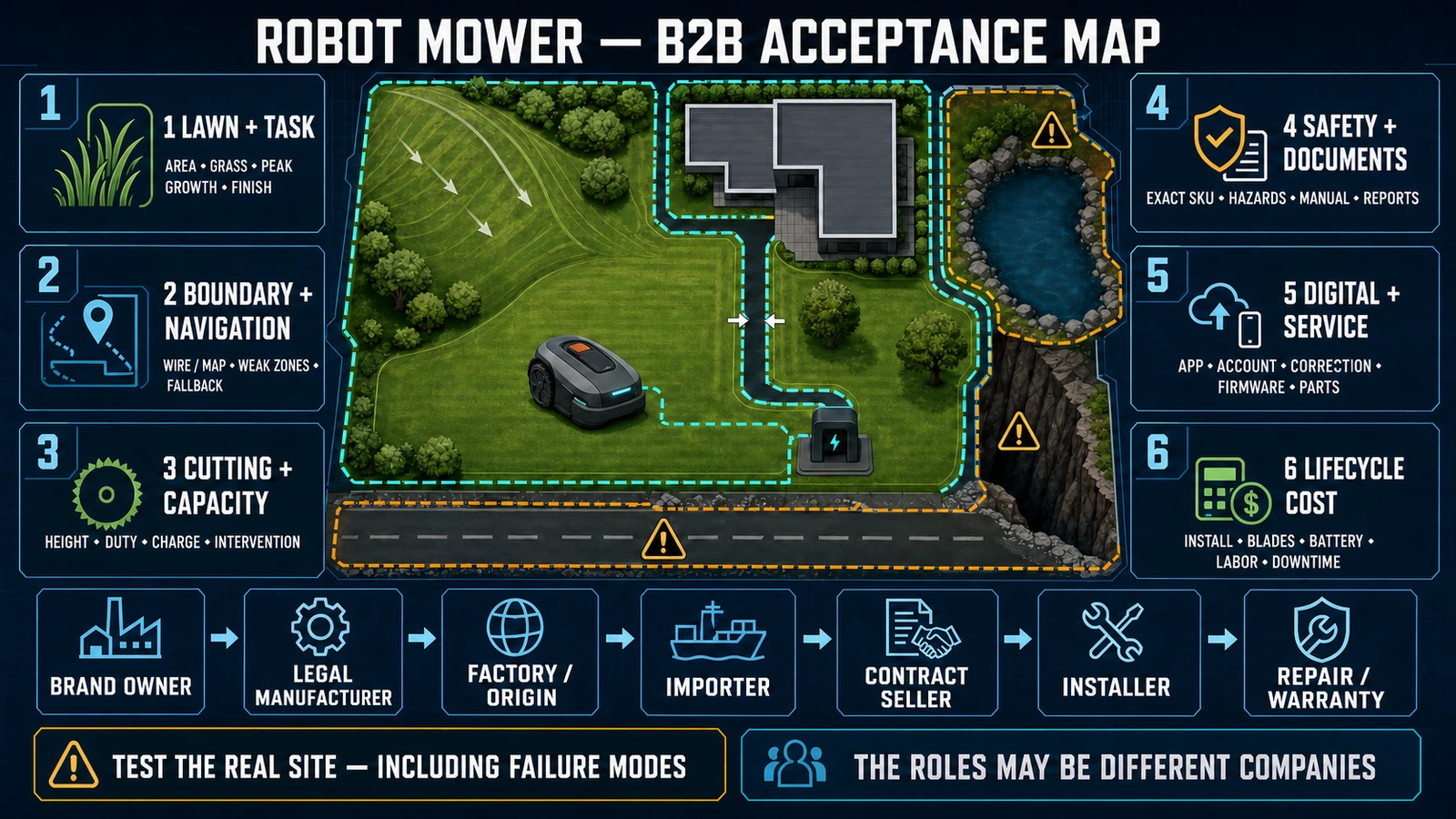
Define the mowing task
- Measure actual grass area rather than total property area.
- Record slopes, cross-slopes, passages, curbs, drops, roads, water, tree cover and disconnected zones.
- Identify grass type, peak growth, cutting height, edge standard and the remaining manual work.
- Define residential, rental, contractor, facility, sports-turf or public-space use.
Lock the exact product configuration
- Record model, variant, battery, charger, dock, reference station, accessories, plug and radio configuration.
- Confirm whether physical wire, local RTK, Network RTK, LiDAR, vision or fusion is required.
- Record included connectivity periods, correction services, App regions and account terms.
Run a site acceptance test
- Test the complete route during peak grass and realistic ground conditions.
- Observe boundaries, roads, ponds, drops, narrow passages, trees, buildings and docking approaches.
- Test object response with approved safe procedures; never create an uncontrolled blade hazard.
- Record missed areas, repeated rescue, false stops, wheel slip, turf damage, charging failures and manual finishing time.
- Test defined weak conditions such as correction loss, network loss or dirty sensors according to the supplier’s safe procedure.
Verify safety and market documents
- Obtain the exact manual, declaration, label artwork, test reports and applicable market records.
- Check the mower, charger, dock, battery and wireless functions as one configured product system.
- Confirm warnings, serial traceability, software version and corrective-action procedure.
- For lithium-battery transport, obtain the applicable UN 38.3 test summary and verify current carrier, mode, packaging and destination rules. IATA’s 2026 battery guidance explains the test-summary information but is guidance rather than a substitute for the governing rules.
Separate the responsible parties
Record each role independently:
- brand owner;
- legal manufacturer shown on product documents;
- factory and declared country of origin;
- destination-market importer or other responsible economic operator;
- contract seller;
- installer or commissioning provider;
- repair provider;
- written warranty provider.
The same company may perform several roles, but the brand name alone does not prove that it performs all of them.
Calculate lifecycle cost
Include installation or mapping, boundary-wire repair, reference or network service, connectivity renewal, blades, batteries, wheels, cleaning, seasonal storage, diagnostics, labor interventions, backup equipment, freight, repair and downtime.
A lower purchase price can become expensive if the mower needs frequent rescue or if the repair path requires cross-border freight. A premium system can also fail the business case if its digital service, fleet tools or local support do not match the deployment.
For supplier screening, see World Clean Biz’s guide to robotic lawn mower manufacturers in China. For category context, see the robotic lawn mower market-size guide.
Frequently Asked Questions
Do all robot lawn mowers need a boundary wire?
No. Traditional products use a physical perimeter loop. Wire-free products can use RTK-GNSS, LiDAR, vision or sensor fusion to operate inside a virtual map. The exact infrastructure and fallback behavior vary by model.
How does a robot lawn mower know where to go?
It combines a boundary system with localization and route logic. It may detect a wire, follow guide signals, estimate position from satellites or local sensors, and respond to obstacles. Boundary control, route planning and obstacle detection should be verified separately.
Do robot lawn mowers pick up grass?
Most do not. They normally cut small amounts frequently and leave fine clippings in the turf. Heavy growth, leaves and other debris can still require conventional collection or lawn-care work.
Can a robot lawn mower work in the rain?
Some models are designed to operate in specified wet conditions; others pause or should be parked according to their instructions. Waterproof or weather-resistant construction does not prove good traction, turf protection or safe charging in every rain condition. Follow the exact manual and site plan.
Are robot lawn mowers safe around children and pets?
They use safety design and sensors, but they still contain rotating blades. Remove objects, use the prescribed schedule and keep people and animals out of the work area while the mower operates. Do not use obstacle detection as the only safety control around roads, water, drops or public access.
Can a robot mower replace a conventional lawn mower?
It can take over regular mowing on a suitable, established lawn. Initial long-grass reduction, edging, leaf collection, recovery work and broader turf care may still require other equipment and labor.
Can a residential robot mower be used commercially?
Only if the manufacturer and contract documents permit the intended duty. Confirm operating hours, site type, fleet support, service level and written commercial warranty rather than relying on a residential product page.
How often should robot mower blades be replaced?
There is no universal interval. Blade design, grass, soil, debris, area, operating hours and product instructions all matter. Inspect and replace blades according to the exact manual, and track consumption during the site trial.
Bottom Line
A robot lawn mower works by combining a defined work area, repeated autonomous movement, frequent light cutting, battery charging and safety controls. Its value comes from the whole operating loop—not from one navigation sensor or one headline area rating.
For buyers, distributors and facility teams, the decisive test is whether the exact configured system can maintain the real site safely and economically through a full season, with clear responsibility for software, parts, repair and warranty.