- There is no verified industry-wide lifespan for robot lawn mowers: the answer depends on the exact machine, seasonal operating hours, terrain, weather, maintenance and support.
- Battery life, blade replacement, warranty and whole-machine life are different measurements and should never be treated as one number.
- Professional buyers should price the complete system: mower, charging station, boundary or positioning infrastructure, parts, software, service, downtime and battery logistics.
In this article 13 sections
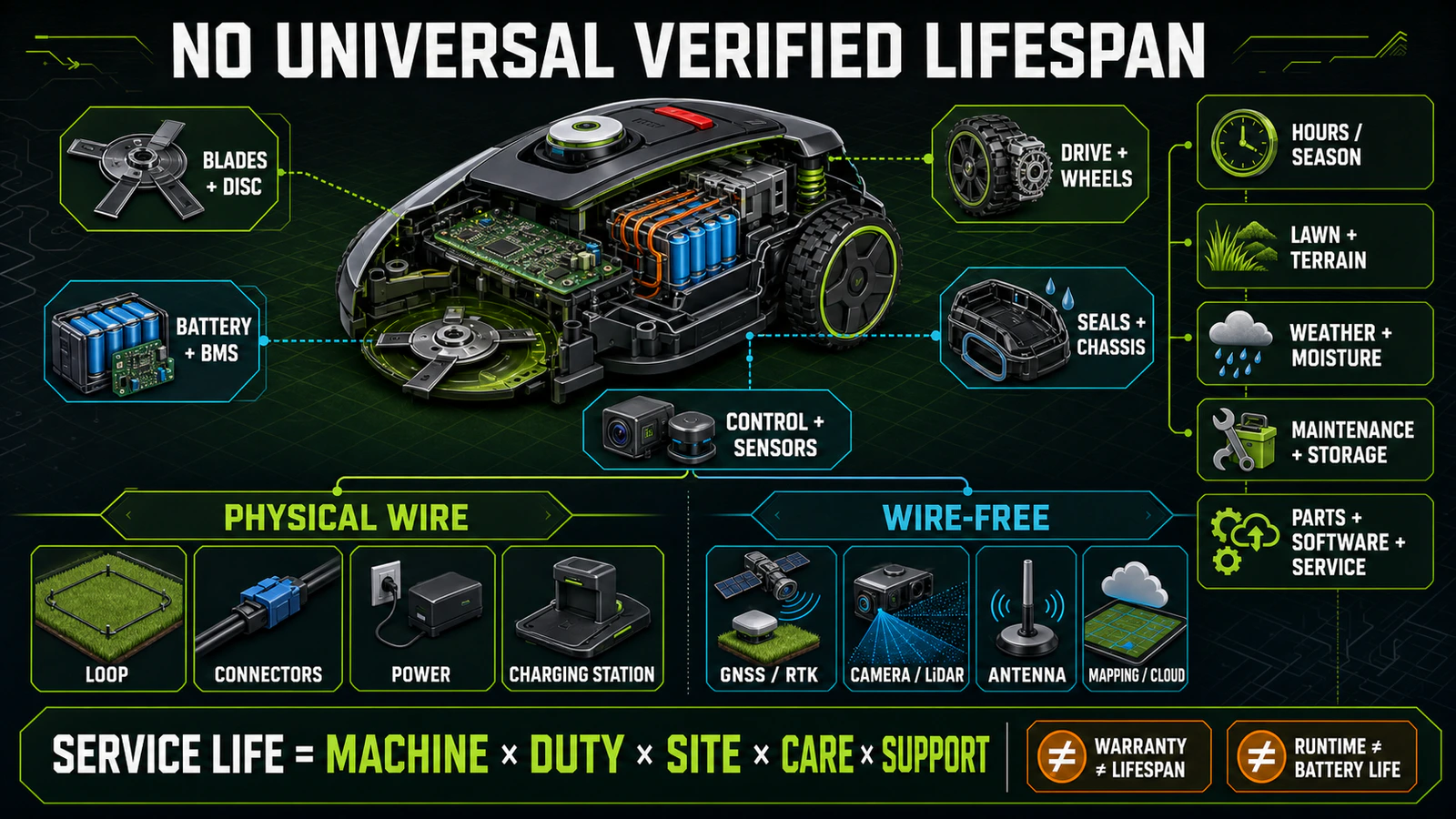
There is no verified industry-wide lifespan for a robot lawn mower. A well-matched, maintained and repairable machine may remain useful across many mowing seasons, while another can become uneconomic much sooner. The result depends on the exact model, operating hours, lawn and terrain, weather exposure, battery and charging conditions, maintenance, storage, spare parts, software and local service—not one universal number of years.
It is also important to separate four questions that are often mixed together:
- How long can the complete mower remain economically serviceable?
- When will its battery capacity become inadequate for the assigned lawn?
- How often do blades and other wear parts need replacement?
- How long will the manufacturer or local service network support the product?
A battery warranty is not a battery-life forecast. A blade interval is not the life of the mower. And a machine that still powers on is not necessarily a useful asset if its charging station, boundary loop, reference station, App or proprietary parts are no longer supported.
Robot Lawn Mower Lifespan at a Glance
| Lifecycle layer | What ages, wears or becomes unsupported | What a buyer should verify |
|---|---|---|
| Cutting system | Blades, screws, cutting disc and guards | Exact part numbers, safe replacement method, operating-hour guidance and local stock |
| Battery and charging | Battery pack, BMS, contacts, station and power supply | Battery service level, price, test method, charging trend and replacement availability |
| Mobility and structure | Drive motors, gears, wheels, bearings, seals, shell and fasteners | Module-level repair, ingress diagnosis, terrain limits and post-repair testing |
| Boundary or positioning | Perimeter wire, connectors and loop signal—or GNSS/RTK, antenna, camera or LiDAR | Failure recovery, installation ownership, replacement hardware and site limitations |
| Control and connectivity | Sensors, controller, firmware, App, account, cellular/Wi-Fi and cloud functions | Diagnostics, offline behavior, update policy and support after discontinuation |
| Operating system | Mowing hours, area, slopes, grass growth, obstacles, wet ground and seasonal storage | Actual duty profile, inspection plan, logs and operator responsibility |
| Commercial support | Dealer, installer, importer, warranty provider, parts stock and SLA | Permitted use, service geography, response time, loan unit and lifecycle cost |
This system view is more useful than asking which single component “lasts longest.” A mower can outlive several sets of blades and perhaps a serviceable battery. It can also be retired early because a drive module, charger, positioning accessory or repair route is unavailable.
Why a Fixed Number of Years Is Misleading
Current official material from leading manufacturers publishes model-specific maintenance, battery, blade, storage, warranty and service information. It does not establish one expected life for the whole category.
Calendar age does not measure workload
Two five-year-old mowers may have very different histories. One may cover a small residential lawn for a short growing season. The other may run long daily schedules across several zones, steep slopes or commercial grounds.
Operating hours, charging behavior, terrain and faults describe the asset better than purchase date alone. Professional operators should record at least seasonal hours, assigned area, recurring alarms, manual rescues, blade changes, battery or charging symptoms, wheel and drive repairs, station faults and software versions.
Product architectures are not interchangeable
A compact vision mower, a four-wheel-drive RTK mower and a perimeter-wire machine do not have the same load path, positioning hardware or site infrastructure. Even products from the same brand can use different batteries, blades, charging systems and service policies.
This is why a range published for one brand or a maintenance interval for one series cannot be converted into an industry standard.
Useful life depends on repairability
A worn wheel is a routine cost when the correct module is stocked, diagnosis is clear and repair can be tested. The same fault can end a product’s economic life when the assembly is unavailable, the machine must cross a border for service or opening the enclosure creates an unacceptable sealing or safety risk.
The right procurement question is therefore: how long can this exact SKU perform the required job at an acceptable total cost, with safe parts and service available in the destination market?
Which Parts Usually Need Attention First?
There is no universal failure order, but the lifecycle layers can be evaluated separately.
Blades, screws and the cutting system
Robot mowers cut frequently with small blades. Contact with twigs, stones, roots, edging or other hard objects can dull or damage them. Cut quality, noise and energy use may change before the rest of the mower has a fault.
Husqvarna’s current Automower blade guidance says blade life depends on operating frequency and duration, lawn size, grass type and seasonal growth. It also says dull or damaged blades can reduce efficiency and increase energy use. That is a stronger basis for maintenance than one calendar interval for every lawn.
Navimow provides a useful model-specific contrast. Its current X3 support page suggests replacing X3 blades after 80 operating hours and uses App maintenance prompts. The number applies to that series; it is not a universal robot-mower blade cycle.
Use the exact manual. Replace blades, screws and related hardware in the combinations specified by the manufacturer. Mixing worn and new blades, reusing unsafe fasteners or fitting an unverified part can create imbalance or a safety risk.
Battery, BMS and charging contacts
Battery aging is visible as a change in usable work, not simply a birthday. A mower may return to charge more often, stop earlier or fail to complete the same area under similar conditions. Before condemning the pack, the service process should also check charging contacts, station placement, power supply, software, blade condition and changes in grass load.
Husqvarna’s current U.S. Automower battery support states a typical battery lifespan of two to five years for its Automower context and explains that use and care affect the result. Its broader robotic mower FAQ lists daily mowing time, lawn structure, terrain, station location, model and features as battery-life variables.
Those figures should not be advertised as the lifespan of all robot-mower batteries. Battery chemistry, pack design, capacity threshold, climate, duty and service method differ by SKU.
Mammotion’s current U.S. after-sales policy makes another important distinction: battery warranty coverage differs among product series, with current tables showing two- or three-year periods for named models. Those are contractual coverage periods, not promises that the packs will fail—or remain healthy—on those dates.
Wheels, drive modules and structure
Slopes, ruts, wet soil, narrow passages and frequent turning add mechanical load. Worn tires can first appear as slipping or poor docking; grass wound around an axle can imitate a drive problem; a damaged bearing, gearbox or motor is a deeper repair.
The diagnostic sequence should begin with cleaning and visual inspection permitted by the manual, followed by fault logs and an authorized mechanical or electrical test. “Replace the motor” is not a credible first answer without isolating the wheel, obstruction, connector, control and power path.
Charging station and power supply
The charging station lives outdoors and is part of the asset. Dirty or corroded contacts, poor alignment, water exposure, damaged cables, an unstable base or a failed power supply can produce short runtimes or repeated docking failures even when the battery is serviceable.
Treat the station, power supply and installation hardware as separately identified SKUs. A distributor should know which party diagnoses the mains-side supply, low-voltage cable, dock electronics and robot contacts—and which parts can be replaced locally.
Sensors, positioning hardware and software
Modern robot mowers may rely on lift, tilt, collision and wheel sensors plus cameras, GNSS/RTK, LiDAR or other positioning components. Dirt on a camera, movement of an antenna, changed landscaping or poor satellite visibility can appear to the operator as a “bad robot” even when the drive and battery remain functional.
Software is part of service life too. Buyers should ask what happens when the phone OS changes, the App is updated, a cloud service is unavailable or a product is discontinued. Offline behavior, diagnostic access, map export, account transfer and firmware support can determine whether mechanically sound hardware stays usable.
Perimeter Wire vs Wire-Free: Which Lasts Longer?
Neither architecture has a universal lifespan advantage. They move lifecycle risk to different parts of the system.
| Lifecycle question | Physical perimeter wire | Wire-free positioning |
|---|---|---|
| Site infrastructure | Boundary loop, guide wire, connectors, stakes or buried cable | Reference station or antenna on some systems, plus mapped boundaries |
| Common recovery task | Locate and repair a break, connector or signal fault | Restore positioning, clean sensors, remap or correct antenna/network conditions |
| Landscape change | Wire may need to be moved or reinstalled | Map may need editing; hardware visibility and calibration may need rechecking |
| Digital dependency | Varies by model; basic boundary operation may be less cloud-dependent | App, firmware, account, GNSS correction or network services can be more important |
| Procurement question | Who owns cable routing, break diagnosis and restoration? | Who owns reference hardware, map data, connectivity and software continuity? |
Husqvarna’s professional EPOS onboarding material illustrates that a wire-free deployment can still include GNSS, a reference station, charging station, virtual boundaries, maintenance points and fleet monitoring. Removing a perimeter wire does not remove infrastructure; it changes the infrastructure.
For a cemetery, solar site, hotel, campus or sports facility, compare the expected fault frequency and recovery time for the actual landscape. A wire break that a local technician can locate in an hour may be less costly than a positioning outage that requires specialist support—or the reverse. The site decides.
What Shortens a Robot Mower’s Service Life?
Excessive duty for the selected model
Area capacity is not the same as lifecycle suitability. A mower that can technically cover a site may need long schedules, frequent charging and little recovery margin to do so. Growth peaks, rain delays and blocked zones can push it beyond the assumed duty.
Size the machine with seasonal conditions and service margin, not only the supplier’s maximum area headline. For commercial use, obtain written confirmation of permitted duty and warranty coverage.
Wet grass, mud and accumulated debris
Wet conditions increase grass adhesion around the cutting deck, wheels and charging path. Mud can obscure sensors or reduce traction. A weather-resistant enclosure does not mean the product should be pressure-washed or operated outside its manual.
The operator should follow the model’s cleaning method, remove power as instructed, wear appropriate protection around blades and stop if water enters a sealed electrical area.
Heat, ultraviolet exposure, frost and poor storage
The mower, station, battery and positioning accessories may have different storage requirements. Leaving all components outdoors through an inactive season can expose plastics, seals, contacts and batteries unnecessarily.
Manufacturer instructions are model-specific. Navimow’s X3 winter storage guide, for example, covers the mower, blades, camera, station, GNSS accessories and exposed connectors as one system. Mammotion’s LUBA winter maintenance guide similarly includes the cutting plate, charging contacts, station and RTK-related equipment.
Do not copy the temperature, state-of-charge or recharge interval from one product into another. Use the exact manual and market version.
Repeated impact and poor site preparation
Unmarked holes, exposed roots, stones, loose edging, toys, irrigation equipment and low obstacles increase blade damage, stalls and recovery work. Site preparation is a lifecycle control, not just an installation task.
A commissioning record should document hazards, slopes, narrow areas, water edges, public access, exclusion zones and the party responsible when landscaping changes.
Maintenance That Protects Service Life
A practical program separates routine operator work from trained service work.
Routine operator checks
- Stop and isolate the mower as the manual requires before touching the cutting system.
- Inspect blades, screws, cutting disc and guards for damage or abnormal noise.
- Remove packed grass and debris using the approved cleaning method.
- Clean charging contacts, wheels and accessible sensors without damaging coatings or seals.
- Check the station base, cables, connectors and positioning accessories.
- Review App alerts, operating hours, docking failures and repeated manual rescues.
- Record each action against the model and serial number.
Mammotion’s current weekly maintenance guidance is a brand-specific example of regular inspection, correct fasteners and approved replacement parts. It should inform the process, not replace the manual for another product.
Seasonal or service-level work
- Inspect drive condition, wheel play, seals and enclosure damage.
- Test battery and charging performance against a repeatable duty profile.
- Check station power, contacts and positioning or boundary-system health.
- Install applicable firmware and retain the previous fault record.
- Replace parts using the correct SKU and complete functional and safety tests.
- Store the mower and all required infrastructure under the exact product instructions.
Husqvarna’s current commercial robotic mower pages combine dedicated products, fleet monitoring, service information, spare parts and firmware. This illustrates why commercial lifecycle performance depends on an operating and service system, not just a durable shell.
Is Warranty the Same as Expected Lifespan?
No. A warranty is a limited contract for defined defects and remedies. It is not a prediction of when the product will fail.
Coverage may vary by:
- exact model, component and serial range;
- country of purchase or delivery;
- authorized seller and proof of purchase;
- residential, commercial, rental or demonstration use;
- maintenance and storage compliance;
- unauthorized parts, modification or repair;
- who pays diagnosis, freight, labor and return shipment.
Husqvarna’s current U.S. warranty page describes coverage for defects in material or workmanship under normal use and requires product and purchase information. Mammotion’s policy separately lists main-product, battery and wear-part treatment by series and market. Neither document establishes the physical life of the complete category.
For procurement, convert the warranty into a responsibility matrix:
| Field | Required written answer |
|---|---|
| Responsible entity | Brand owner, importer, contract seller, distributor or service provider |
| Covered product | Exact SKU, market version and serial range |
| Covered parts | Mower, battery, station, power supply, positioning hardware and accessories |
| Permitted duty | Residential, commercial, rental, demonstration or fleet |
| Remedy | Repair, replacement, refurbished unit, parts, refund or other remedy |
| Service location | Local site, dealer, national center or cross-border return |
| Cost allocation | Diagnosis, labor, inbound/outbound freight, duty and battery handling |
| Evidence | Invoice, seller authorization, serial number, photos, logs and maintenance record |
When Should You Repair or Replace a Robot Mower?
Repair is usually worth investigating when the fault is isolated, the correct part and procedure exist, safety and weather protection can be restored, and total repair cost is lower than the value of a working machine.
Replacement becomes more rational when several core modules have degraded, the battery or electronics present a safety concern, proprietary parts are unavailable, the product cannot be validated after repair, or downtime and logistics exceed the remaining value.
Use complete cost equations:
```text
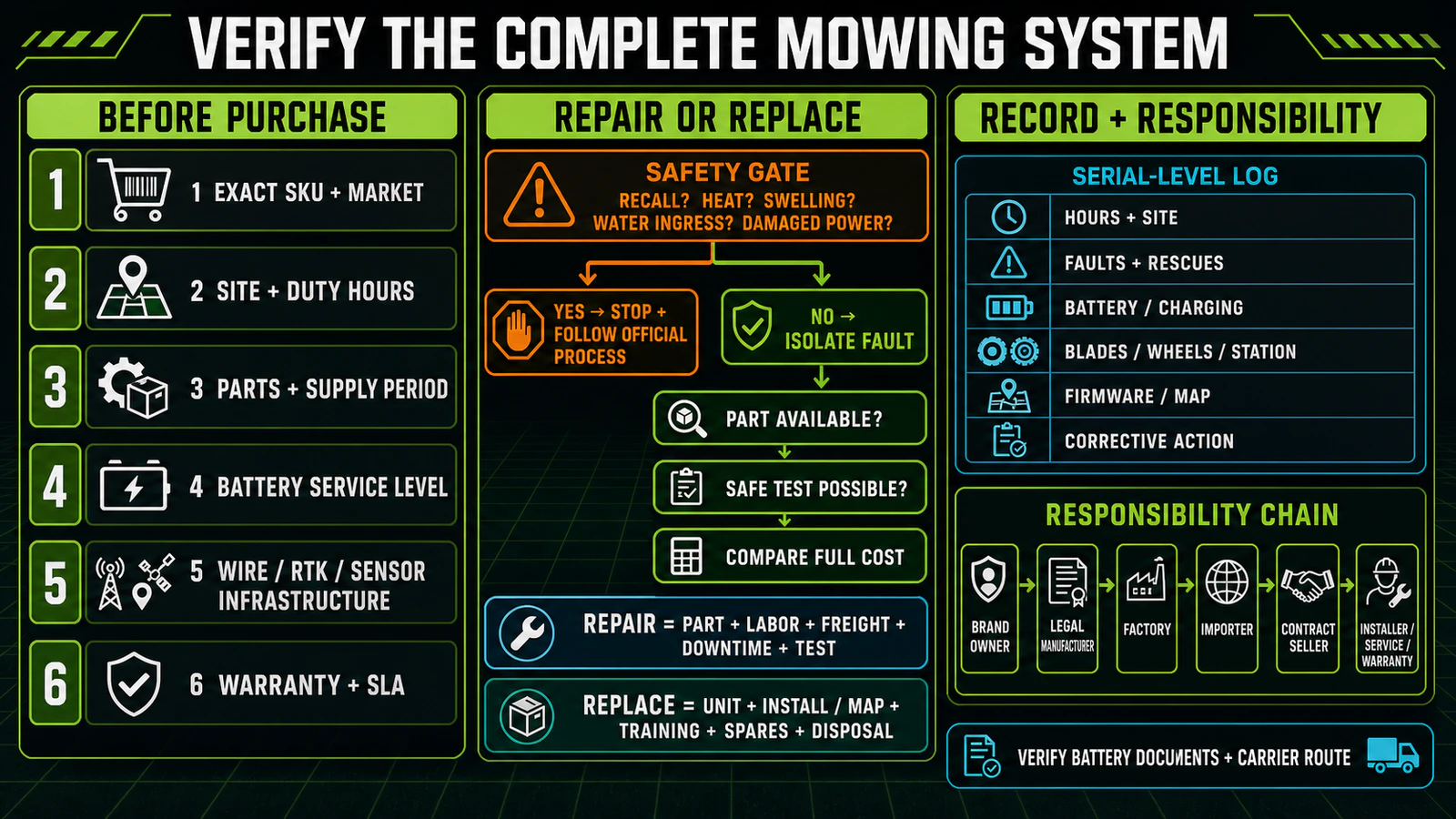
Repair cost = diagnosis + part + labor + two-way freight + downtime + post-repair testing
Replacement cost = new mower + installation/remapping + training + spare-stock reset + disposal
```
Then apply a safety gate first:
- Is the model or serial number subject to a recall or stop-use notice?
- Is the battery swollen, leaking, unusually hot or producing an odor?
- Is there water inside a sealed electrical area?
- Is the power supply, cable, connector or station visibly damaged?
- Does the manufacturer require authorized service for the repair?
If any answer is yes, follow the manufacturer or safety authority’s instructions before comparing costs.
B2B Procurement and Fleet Checklist
Before supplier approval
- Record the legal manufacturer, factory, country of origin, importer, contract seller, installer, warranty provider and repair provider separately.
- Obtain the full model number, market version, battery identity, station and power-supply SKU, positioning accessories and serial-number format.
- Define lawn area, zones, slopes, passages, obstacles, grass type, growing season and expected operating hours.
- Confirm permitted residential or commercial duty in writing.
- Request exploded parts views, part numbers, current prices, minimum orders and a written supply period.
- Classify repairs as operator-, dealer-, regional-center- or factory-level.
- Establish App, account, firmware, cloud, data-transfer and offline-support policy.
- For wire-free systems, document antenna or reference-station ownership, map access and failure recovery.
- For perimeter-wire systems, document cable route, connectors, break diagnosis and reinstatement after landscape work.
- Define SLA, exchange stock, peak-season coverage and end-of-support notification.
During operation
Maintain a serial-level record with:
| Record | Why it matters |
|---|---|
| Date, site and assigned zone | Separates product faults from local conditions |
| Operating hours and charging trend | Shows duty and battery-system change over time |
| Alerts, docking failures and rescues | Reveals repeatable navigation, traction or infrastructure problems |
| Blade, wheel, battery and station work | Establishes true parts and labor cost |
| Firmware and map changes | Preserves the digital configuration history |
| Photos and corrective action | Supports warranty, supplier review and fleet learning |
This record turns “the mower did not last” into an actionable failure mode: wear, selection, installation, maintenance, component quality, software or service.
Battery Replacement and Return Logistics
A replacement pack is not only a parts decision. Buyers should verify the battery part number, watt-hour rating, approved replacement level, packaging, documentation and carrier route before a failed product is returned.
IATA’s current 2026 battery guidance explains that lithium batteries and equipment containing them are classified for transport and that manufacturers and subsequent distributors should make the applicable UN 38.3 test summary available.
That document is not a universal shipping instruction. Acceptance depends on the battery’s condition, whether it is installed or packed separately, transport mode, carrier and destination. A damaged or defective battery may require a different process. The seller and service provider should define this route before launch, not after the first return.
Frequently Asked Questions
How many years does a robot lawn mower last?
There is no verified industry-wide number. Whole-machine service life depends on the exact model, seasonal operating hours, lawn and terrain, environment, maintenance, storage, parts, software and repair support. Ask for model-level evidence instead of relying on a generic range.
How long does a robotic lawn mower battery last?
It varies by pack, duty, charging conditions, temperature and the remaining runtime required by the site. Husqvarna currently gives a two-to-five-year typical range for its Automower context, but that is not an industry standard. Track runtime and charging trends for the exact SKU.
How often should robot mower blades be replaced?
Follow the model’s operating-hour or inspection guidance. Grass type, lawn size, seasonal growth, run time and contact with hard objects all matter. Navimow’s 80-hour X3 guidance is a model-series example, not a universal interval.
Does a longer warranty mean a longer-lasting mower?
Not necessarily. Warranty is a contractual coverage period with conditions and exclusions. Expected service life also depends on wear parts, battery condition, duty, maintenance, repairability and post-warranty support.
Do wire-free robot mowers last longer than perimeter-wire models?
There is no universal winner. Perimeter-wire systems add cable and connector maintenance. Wire-free systems may add reference hardware, sensors, mapping, firmware, network or cloud dependencies. Compare recovery cost for the actual site.
Should a robot lawn mower be stored indoors for winter?
Follow the exact model’s instructions for the mower, battery, station, power supply and positioning accessories. Many manufacturer guides call for cleaning and protected dry storage, but temperature, charge level and recharge intervals are product-specific.
Is it better to repair or replace an old robot mower?
Repair when the fault is isolated, parts and safe procedures exist, and the full repair cost is below the remaining asset value. Replace when multiple core systems are degraded, support has ended, repair cannot be validated, or safety, logistics and downtime dominate the decision.
Related World Clean Biz Guides
- How Do Robot Lawn Mowers Work?
- Robot Lawn Mowers Without Perimeter Wire: Navigation and Procurement Explained
- Robotic Lawn Mower Manufacturers in China
- Who Owns Husqvarna Automower?
- Who Makes LUBA Robot Mowers? Mammotion and AgileX Explained
- Who Owns Segway Navimow? Ninebot and Willand Explained
- Spare Parts and Warranty When Sourcing Cleaning Appliances from China
Final Takeaway
The honest answer to “how long do robot lawn mowers last?” is not a universal year range. It is a lifecycle equation:
```text
Useful service life = machine condition × duty fit × site conditions × maintenance × support
```
Consumers may focus on whether the mower still cuts. A professional buyer must go further: can the complete mower-and-site system meet the required duty, can faults be diagnosed, can batteries and parts be sourced, can software and positioning be supported, and can service be delivered in the destination market at an acceptable total cost?
That is the difference between buying a robot and managing a mowing asset.