- Many robot lawn mowers can work on slopes, but suitability depends on the exact SKU, the part of the site and the documented test conditions—not one category-wide limit.
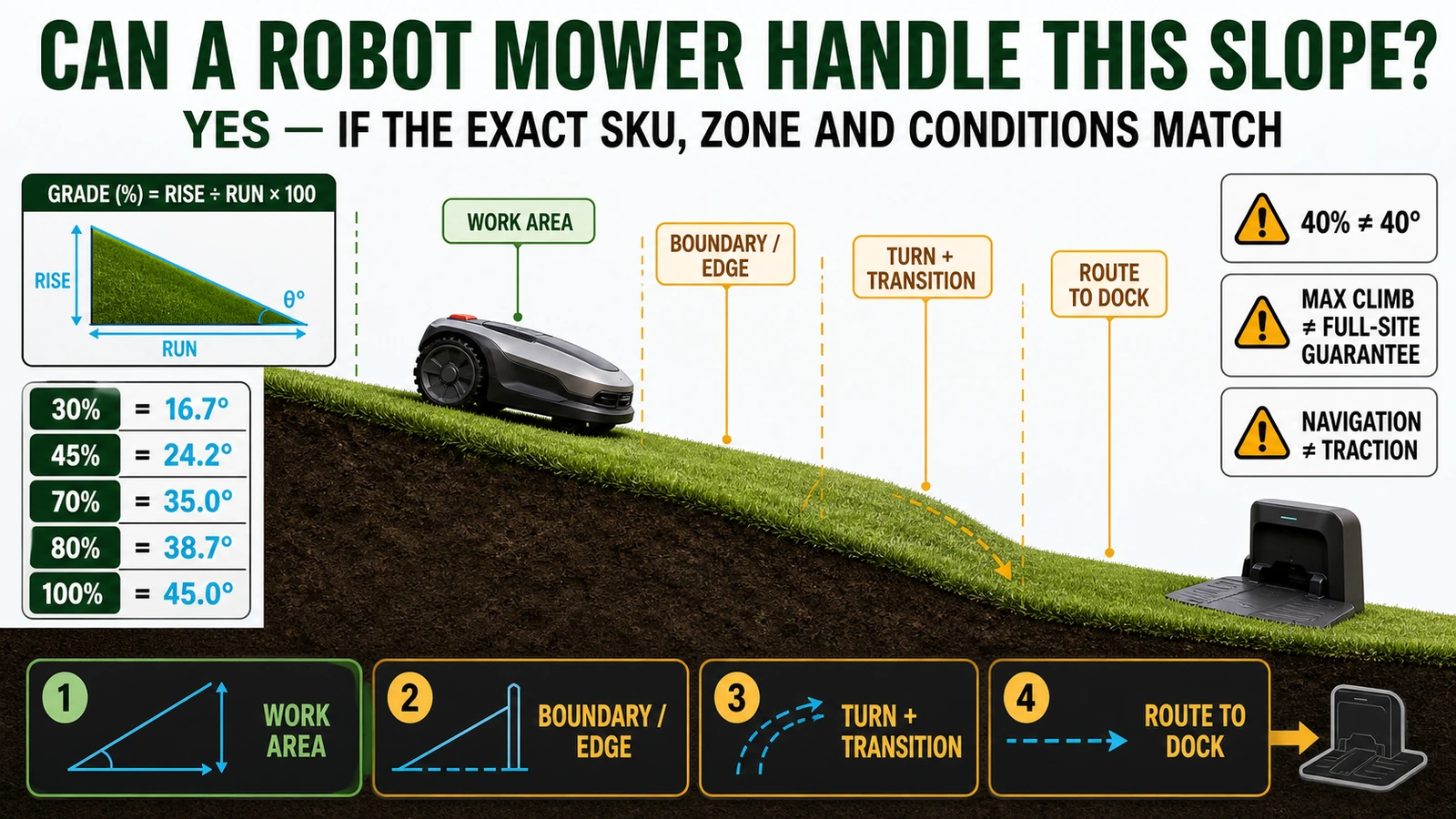
- Slope percentages are not degrees: a 40% grade is about 21.8 degrees, while a 40-degree slope is about 83.9%.
- Professional buyers should separately verify the mowing area, boundary, turns, transitions, transport route and dock approach, then accept the system using real-site completion, intervention, slip, turf-damage and docking evidence.
In this article 12 sections
Yes—many robot lawn mowers can handle slopes, but only within the limits of the exact model, the exact part of the site and the conditions covered by its documentation. A maximum climbing figure is not a promise that the mower can safely cut every hill, turn at every edge, cross wet grass and return to its dock without intervention.
The first check is the unit. A 40% slope is about 21.8°, not 40°. The second is the zone: manufacturers may publish one limit for the main work area and a lower limit at a physical or virtual boundary. The third is the test condition. Dry, obstacle-free grass is not the same surface as wet turf, loose soil, exposed roots or a sharp transition at the top of a bank.
For homeowners, that distinction prevents an expensive mismatch. For distributors, dealers, installers, facilities and landscaping operators, it determines whether a quoted slope specification can become a repeatable site-acceptance result.
For the broader system behind cutting, navigation, charging and route execution, see How Do Robot Lawn Mowers Work?. This guide focuses specifically on the terrain limits that broad operating explanations cannot settle.
Robot Mower Slope Suitability at a Glance
| Question | What the number can tell you | What still needs verification |
|---|---|---|
| What is the slope? | Percentage grade or angle describes the measured incline | Measurement method, local peaks, direction and length of the slope |
| Can the mower climb it? | The exact SKU may publish a maximum work-area or climbing rating | Surface, grass, obstacles, direction, turning, firmware and test conditions |
| Can it work near the edge? | Some manuals publish a separate boundary or edge limit | Runoff space, physical protection and what lies beyond the boundary |
| Will AWD solve it? | More driven wheels can improve available traction and control | Tires, weight distribution, steering, braking, ground contact and turf damage |
| Will RTK, LiDAR or vision solve it? | Navigation can improve localization, mapping and route planning | Navigation does not create grip or guarantee braking and stability |
| Is the whole site suitable? | A specification can screen candidate machines | Only a mapped site test can verify completion, interventions and docking |
What Does a Robot Mower Slope Rating Mean?
Slope is commonly expressed either as a percentage grade or an angle.
```text
slope (%) = vertical rise ÷ horizontal run × 100
```
If the ground rises 30 cm over a horizontal distance of 100 cm, the grade is 30%. The angle is approximately 16.7°.
| Grade | Approximate angle |
|---|---|
| 20% | 11.3° |
| 30% | 16.7° |
| 40% | 21.8° |
| 45% | 24.2° |
| 50% | 26.6° |
| 70% | 35.0° |
| 80% | 38.7° |
| 84% | 40.0° |
| 100% | 45.0° |
The calculation uses horizontal run, not the length measured along the sloping surface. A phone inclinometer can help with an initial survey, but a professional assessment should record the measurement method and take readings across the full site. One average value can hide a short, steep lip where the mower loses contact or bottoms out.
Husqvarna’s current Automower slope support uses the same rise-over-run formula and publishes both percentages and approximate angles. The important point is not one brand’s table. It is that buyers must preserve the original unit and stop treating percentages and degrees as interchangeable marketing language.
Is the Maximum Slope a Full-Site Guarantee?
No. A published maximum should be treated as a model-level screening limit, not a complete site promise.
Current official material shows why.
| Documented example | Main slope figure | Separate limit or condition | Procurement lesson |
|---|---|---|---|
| Husqvarna Automower support | Model-dependent; current table includes 25–50% for several standard groups and 70% for named AWD models | Boundary limits are separately listed and are lower in the table | Record the exact model and whether the number applies inside the work area or at the boundary |
| Mammotion LUBA 2 AWD specifications | 80% maximum climbing ability | 45% maximum slope at the edge | A machine’s headline climb figure may not be its edge limit |
| Segway Navimow X4 official page | 84% published maximum | Footnote describes an internal 85% test using manual remote control, named grass height, overlap and four travel directions | Read the footnote before treating a demonstration as autonomous whole-site performance |
| Husqvarna 560/580/580L EPOS manual | 50% / 45% / 45% maximum slope for cutting area | 20% maximum slope for virtual boundary for all three listed models | Professional products also require separate cutting-area and boundary checks |
These examples are not a ranking. They use different products, designs, markets and documentation. They show that a buyer should ask at least four questions:
- Which exact SKU does the number cover?
- Is it a work-area, boundary, edge, transport or one-time climbing figure?
- In which directions and surface conditions was it tested?
- Was the test autonomous, manually controlled or part of a full mission including return to charge?
The current Mammotion LUBA 2 AWD specification page, for example, separates maximum climbing ability from maximum slope at the edge. The current Navimow X4 page publishes both a headline value and unusually specific test notes. A responsible comparison keeps both layers together.
Why Is the Boundary Often More Important Than the Hill?
A mower can climb a steep section and still be unsuitable for the property.
At a boundary, the machine may need to slow, stop, turn or recover traction. If the ground falls toward a road, pond, retaining wall, public path or drop, a small lateral slide can have a larger consequence than a failed climb in the middle of an open lawn.
That is why current official documents may publish a lower limit at an edge, physical wire or virtual boundary. Husqvarna’s current support table separates work-area and boundary figures across multiple model groups. Its current commercial 560/580/580L EPOS manual similarly separates maximum cutting-area slope from maximum virtual-boundary slope.
For site qualification, map the following separately:
- the open mowing face;
- the top and bottom transitions;
- the boundary corridor;
- areas where the mower must turn around obstacles;
- the route between disconnected zones;
- the return path to the charging station; and
- every edge where an overrun would create a safety or property risk.
The broader safety treatment belongs in Are Robot Lawn Mowers Safe?. The slope decision here is narrower: an impressive climbing number cannot replace boundary design and consequence control.
What Actually Determines Traction on a Slope?
Drive-wheel count matters, but it is only one part of the system.
Tires and ground contact
Tread, diameter, width, material and the ability to clear wet grass affect the usable friction between the mower and turf. Wheels packed with clippings may slip earlier than clean wheels. Aggressive tread may add grip but can also mark soft ground during repeated turns.
Weight distribution and center of gravity
The mower must keep enough load on the driven wheels while climbing, descending and traversing sideways. A low center of gravity can improve stability, but chassis geometry, battery location and the position of the cutting deck also affect ground contact at crests and dips.
Steering and torque control
Skid steering, articulated steering, a caster, a driven front wheel and independent wheel control place different loads on the turf. A machine can climb straight up a hill yet damage grass when it rotates in place. Electronic traction or stability control can reduce wheelspin, but its behavior is model- and firmware-specific.
Braking and safe recovery
Climbing is only half the task. The mower must descend, stop after an alarm, recover from an obstacle and avoid rolling or sliding into an excluded area. Mammotion’s current LUBA 2 release notes show that slope-protection behavior can also change through firmware, not only through motors and tires.
An AWD label therefore deserves verification, not automatic preference. A well-matched two- or three-wheel-drive machine may be adequate for a moderate, dry site, while a demanding bank may require a specific AWD architecture. The real question is whether the complete machine passes the required route without unsafe movement, repeated rescue or unacceptable turf damage.
Slope duty can also change wheel, drivetrain and battery load over time. Long-term maintenance and replacement questions belong in How Long Do Robot Lawn Mowers Last?, rather than being inferred from one climbing specification.
Does Better Navigation Mean Better Hill Performance?
Not by itself.
RTK, network RTK, LiDAR, cameras, inertial sensors and physical boundary wires solve localization and boundary problems. They help a mower know where it is, where it should cut and how to reach another zone. They do not change the friction available between tire and ground.
A navigation system can still improve a slope project indirectly by:
- orienting systematic passes in a more suitable direction;
- creating stay-out zones around over-limit areas;
- reducing unnecessary turns on a bank;
- defining safer transport paths; and
- recording repeated faults at a specific location.
Husqvarna’s current slope guidance recommends considering mowing-pattern direction, transport paths and stay-out zones, while also warning that obstacles and wet conditions can increase slipping and grass wear. Those instructions are product-specific, but the distinction is transferable: navigation plans the route; the chassis must still execute it.
For the underlying navigation choices, see How Do Robot Lawn Mowers Work Without Boundary Wires?.
How Do Wet Grass, Obstacles and Transitions Change the Result?
Maximum ratings often come from controlled conditions. Real properties add variables that reduce available margin.
Segway’s current Navimow H2 page states that its maximum-slope ability was measured on dry, obstacle-free grass at a named grass height. This is a useful disclosure because it prevents the buyer from silently extending the claim to mud, dew, leaves or ruts.
The real-site risk factors include:
- wet grass, irrigation runoff or morning dew;
- loose soil, sand, moss and decomposing leaves;
- exposed roots, holes, stones and uneven settlement;
- tall or dense grass that adds cutting load;
- obstacles that force a turn on the slope;
- a sharp crest or concave transition that changes wheel contact;
- repeated traffic over the same route; and
- seasonal changes after landscaping, aeration or drainage work.
Do not deliberately test outside the manual. If wet operation is prohibited or the edge creates a high-consequence hazard, exclude the area or change the installation. When representative-condition testing is permitted, define it in the commissioning plan instead of assuming the dry maximum remains available.
How Should a Slope Be Surveyed Before Purchase?
A useful survey produces a slope map, not one number in a quotation.
1. Divide the property into operating zones
Separate the main lawn, boundary strips, steep banks, narrow passages, transport routes, dock approach and disconnected areas. Mark roads, water, drops and public access.
2. Measure local peaks and transitions
Measure up, down and across the slope. Record short steep sections as well as the average. Inspect the crest and toe for grounding, loss of wheel contact or abrupt direction changes.
3. Record the surface
Note grass type and height, soil firmness, drainage, irrigation, shade, moss, roots, leaves, ruts and likely wet periods. A percentage without a surface description is incomplete.
4. Map every forced turn
Trees, beds, furniture, signs and narrow corners may force the mower to rotate on the bank. Those locations can create more slipping and turf wear than a straight climb.
5. Check the complete route
The machine must reach every zone and return to charge. Confirm boundary or positioning coverage, passage width, dock alignment and the behavior after a weak signal, blocked route or low-battery return.
B2B Procurement and Commissioning Checklist
Before ordering
- Obtain the current manual and specification for the exact market SKU.
- Record whether each slope figure refers to work area, cutting area, boundary, edge or climbing test.
- Keep percentages and degrees in their original units and verify every conversion.
- Request test conditions: grass, moisture, obstacles, direction, travel mode and duration.
- Confirm required wheels, terrain kits, firmware, positioning service and installation method.
- Define commercial-use permission, installer responsibility, site support and mismatch remedies in writing.
During commissioning
- Test every mapped zone and the full return-to-dock route.
- Record completion, manual rescues, wheelspin, lateral slide, boundary overrun, tilt alarms and stops.
- Inspect turf for rutting, tearing and repeated turn marks.
- Verify safe behavior at roads, water, drops and public-access edges.
- Compare actual operating time, charging cycles and daily coverage with the project requirement.
- Save the site map, settings, firmware, test conditions, exceptions and acceptance record.
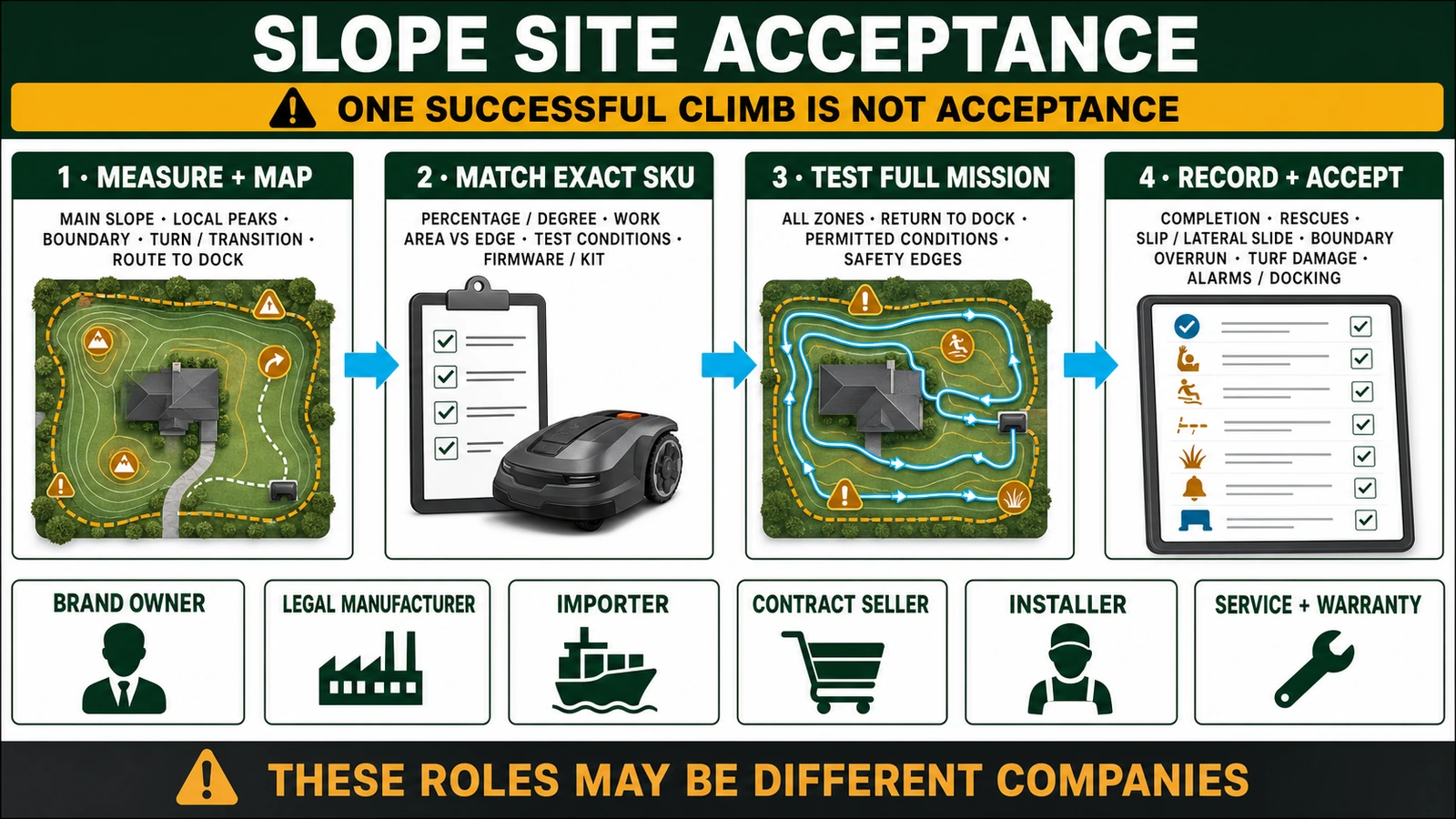
The acceptance threshold should come from the project, not from this article. A private garden, hotel, school, sports facility and distributed dealer fleet may tolerate different intervention rates, finish levels and downtime. The written test should define those limits before the supplier arrives.
What Should Be Written Into the Supply Agreement?
A slope-capable machine is still part of a larger commercial system.
Record the legal manufacturer, factory where relevant, importer, contract seller, installer, software or positioning provider, service organization and warranty party separately. The company that markets the maximum slope may not be the party that surveys the property, corrects the map or approves a return.
Useful contract attachments include:
- the dated site plan and measured slope zones;
- the exact mower, dock, antenna, wheel kit and software configuration;
- the supplier documents used for selection;
- exclusions and physical barriers;
- commissioning procedures and acceptance thresholds;
- responsibility for landscaping or signal changes;
- service response, spare parts and recovery equipment; and
- the process for a site that fails acceptance.
For broader supplier screening, use Robotic Lawn Mower Manufacturers in China. World Clean Biz also maintains company-structure guides for LUBA and Mammotion and Segway Navimow. Those ownership and manufacturing relationships should remain separate from model-level slope performance.
Frequently Asked Questions
Can robot lawn mowers handle slopes?
Yes, many can. The acceptable slope depends on the exact model, whether the area is inside the lawn or at a boundary, the surface, travel direction, obstacles, weather and installation. Check the current manual and test the real site.
What does a 40% slope mean?
It means the ground rises 40 units for every 100 units of horizontal run. A 40% grade is approximately 21.8°. It is not a 40° slope.
Is a 45-degree slope the same as a 45% slope?
No. A 45° slope is a 100% grade. A 45% grade is approximately 24.2°.
Are AWD robot lawn mowers better on hills?
AWD can improve traction and control, especially on demanding terrain, but the label does not settle the decision. Tires, weight distribution, steering, braking, firmware, surface and site layout still matter.
Can a robot mower work sideways across a hill?
Only if the exact product documentation and site test support that direction. Cross-slope travel changes lateral stability and sliding behavior. Do not infer it from an uphill climbing figure.
Can robot lawn mowers cut wet slopes?
Do not assume so. Wet grass can reduce traction and increase turf damage. Follow the exact weather and operating instructions, and do not extend a dry-condition maximum rating to wet ground without evidence.
Does a wire-free robot mower handle slopes better?
Wire-free navigation can make it easier to adjust zones, directions and exclusions. It does not automatically improve tire grip, braking or chassis stability. Physical performance and navigation should be assessed separately.
How should a dealer prove slope performance?
Use a documented site survey and commissioning test covering every slope zone, boundary, turn, transport path and dock return. Record interventions, slipping, turf damage, alarms and completion—not just one successful climb.
Final Takeaway
The answer to “Can robot lawn mowers handle slopes?” is yes, within documented limits—but the maximum number is only the start of the decision.
Measure the site correctly, preserve percentage and degree units, separate the work area from the boundary, read the test conditions and verify the complete autonomous mission. For professional buyers, a slope claim becomes useful only when the exact SKU can finish the real property, protect its edges, preserve the turf and return to charge with an acceptable level of intervention.