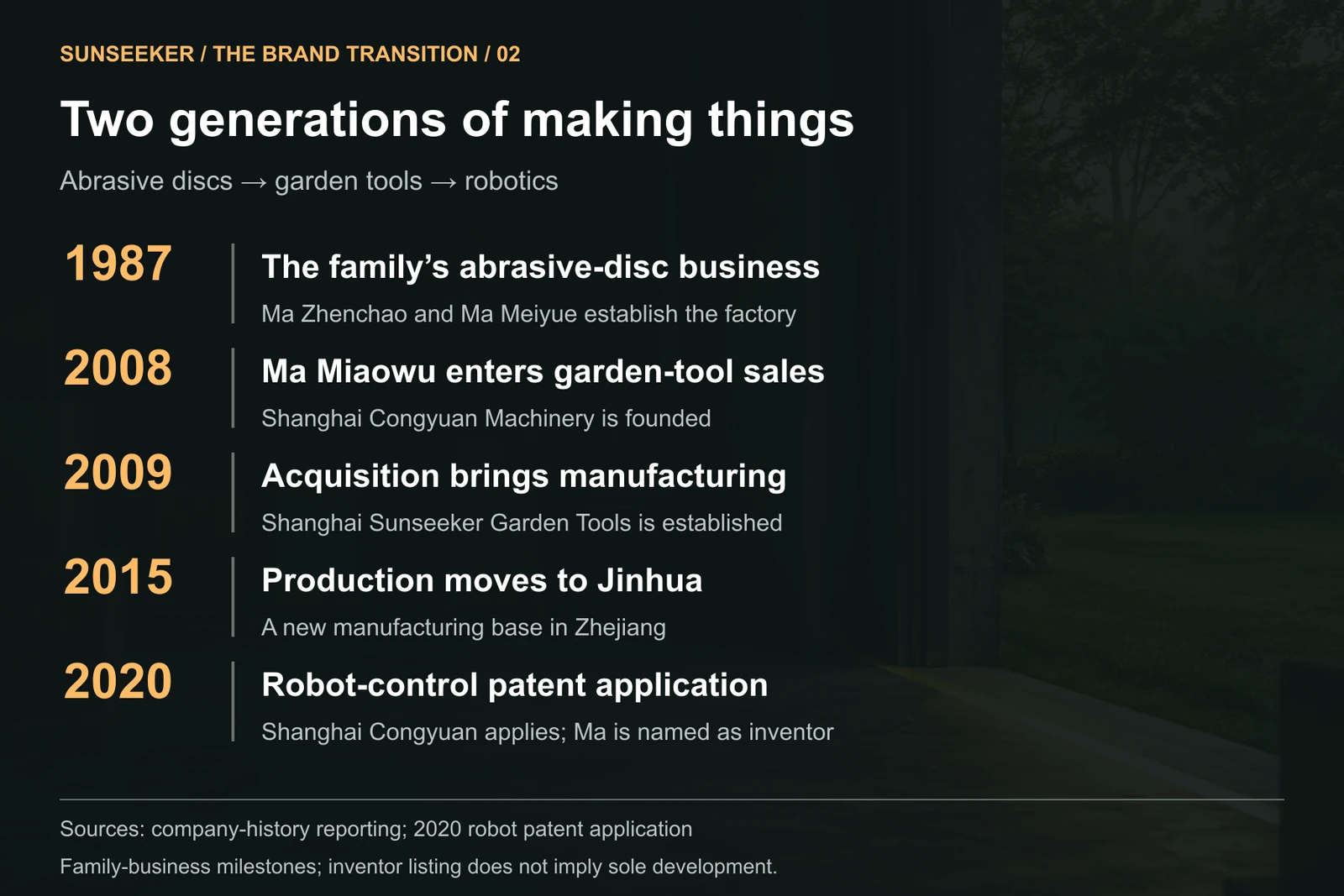
- Baima's garden-tool business grew out of a family enterprise that began making abrasive cutting discs in 1987.
- Denny's industry information describes a team recruited from Positec taking responsibility for product development and sales, supported by Baima's manufacturing and supply chain.
- Nearly RMB 500 million in Series B funding gives Baima more resources for brand competition; gaining an industry foothold does not mean Sunseeker has secured its position with consumers.
Baima's Vietnam factory was originally a hedge against tariff risk in the United States.
The Chinese manufacturer had spent years supplying European and American garden-tool brands. It needed to give those customers a supply route that could keep delivering as trade policy changed. Later, the tariff battle pushed by Husqvarna prompted more robotic mower companies to look for capacity outside China. Baima's earlier investment in Vietnam began bringing in new orders.
I have visited that factory. Today, it makes garden tools and robotic mowers. The first business in Ma Miaowu's family made abrasive cutting discs.
In 1987, Ma Zhenchao and Ma Meiyue founded the Yongkang Baima Grinding Wheel Factory. Ma Miaowu, the family's second-generation entrepreneur, entered the garden-tool trade in 2008 by founding Shanghai Congyuan Machinery. The following year, he acquired Kunshan Greendili Tools and established Shanghai Sunseeker Garden Tools, moving into the production of brush cutters and other handheld outdoor equipment. Company history
Ma learned the customer side before moving into manufacturing. In 2015, as Zhejiang encouraged entrepreneurs to bring their businesses back to their home province, he moved the Shanghai production operation to a new manufacturing base in Jinhua. The business gradually expanded from petrol-powered equipment into lithium-battery tools, supplying garden-tool companies in China and overseas. Company development
Along the way, Baima learned what outdoor products have to withstand. Garden tools work in dirt and rain. Surviving a full season matters more to a customer's next order than the specifications presented at launch. Years of manufacturing experience gave Baima a foundation for entering robotic mowing.
It had also started preparing relatively early. In 2020, Shanghai Congyuan Machinery filed a patent application for a mobile robot, its control method and a robotic system. Ma Miaowu was named as an inventor. The application addressed working-area subdivision and movement control. By then, at least, robotics was already part of the company's development work. Patent application
Ecovacs showed many Chinese factory owners what else might be possible. A manufacturer used robot vacuums to build its own brand and reach annual sales on the order of RMB 20 billion. After years of making products for others, who would not want consumers to buy something carrying their own name?
Baima chose Sunseeker as its vehicle for that ambition. It had already experimented with its own brands, established a US subsidiary and overseas warehousing, and sold through channels including Amazon. Turning robotic mowers into a brand that European and American consumers actively choose would take more than that experience alone. Baima's company profile
Robotic mowers require continuing improvements to navigation and software. Their development cycle is very different from that of traditional garden tools. Dealers also have to deal with installation and service, while developers need a closer understanding of customers' gardens. Shipping the machine is far from the end of a brand's work.
From what I understand, Baima recruited an entire team from Positec to take responsibility for Sunseeker's product development and sales. Baima provides the manufacturing and supply-chain support.
Positec has spent years building Worx. The incoming team knows garden tools and has direct experience running a brand. Its involvement begins with defining the product, bringing requirements from the sales side into development. That shortens Baima's learning curve and gives its manufacturing operation a clearer product direction.
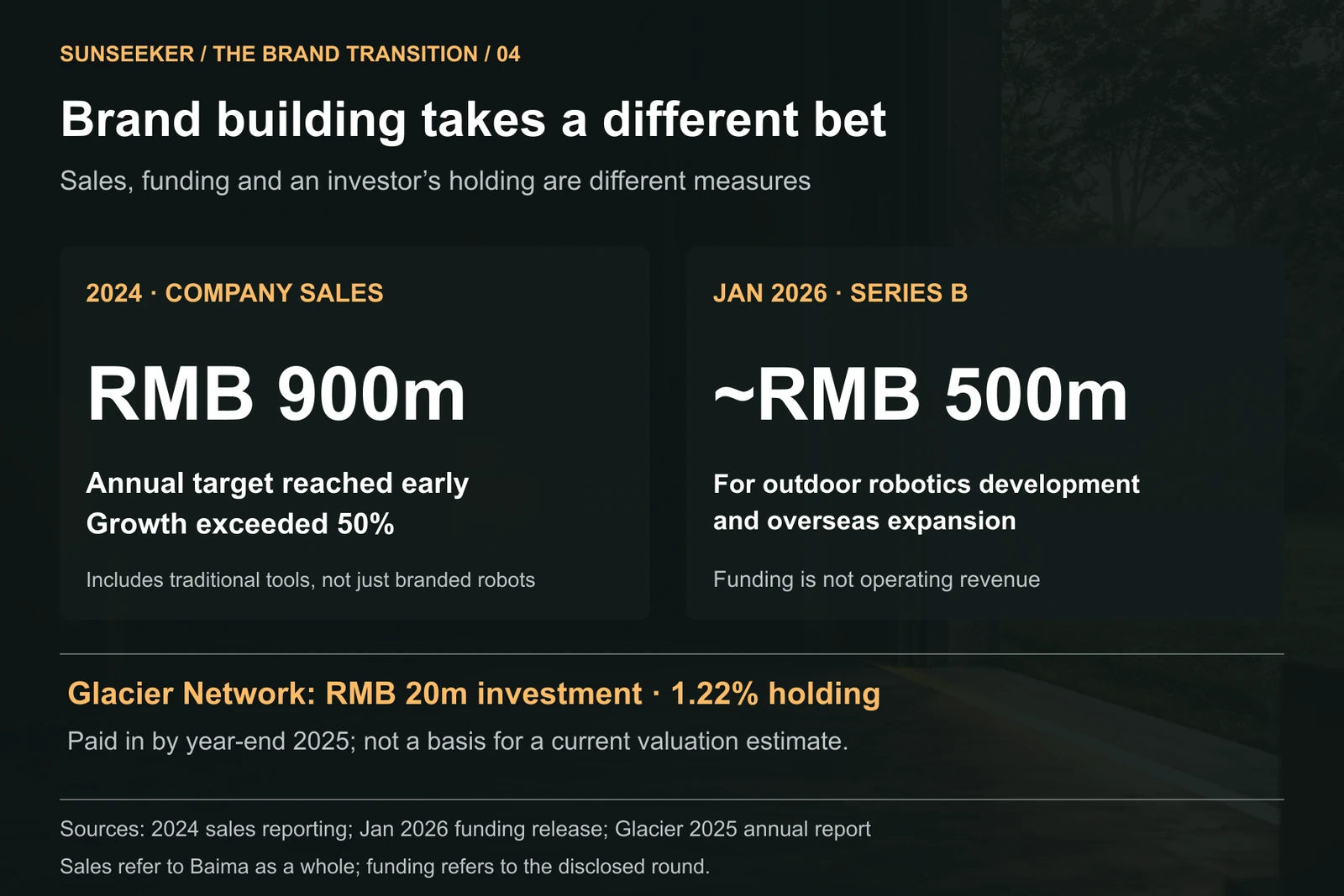
An established business was helping support this investment. According to media coverage citing Baima operations director Wu Jiayi, the company reached its RMB 900 million sales target ahead of schedule in 2024, with growth exceeding 50%. That figure covers Baima's overall business, including traditional garden tools. It cannot all be counted as revenue from Sunseeker-branded robotic mowers. Reported company sales
In February 2025, Ma appeared at Sunseeker's brand launch in Hamburg under the name Terry Ma. The company was formally introducing its robotic mowers to Europe, and the local team was already at work.
The German garden-equipment trade press reported that Torsten Bollweg headed the EMEA operation and that several team members had previously worked at Positec Germany. At the time, Sunseeker was organizing training for around 400 German specialist dealers while building its after-sales team. German launch coverage
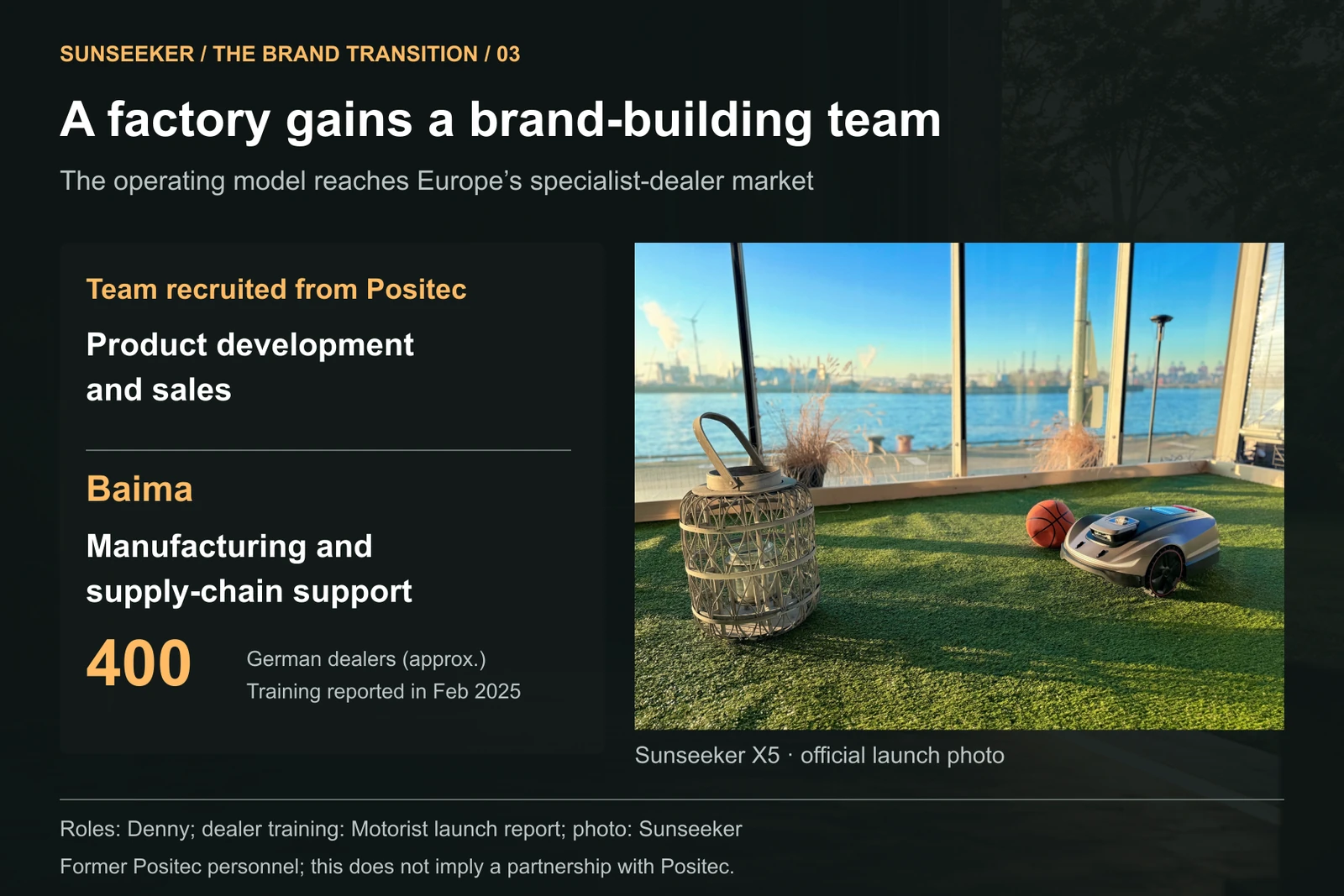
Getting a robotic mower into a specialist dealership still leaves plenty of work to do. Dealers need to know which gardens the machine suits, and they need help when customers run into problems. An experienced local team can get a product onto the sales floor faster. Whether it stays there depends on how it performs.
All of this requires spending ahead of sales. Overseas teams have to be established before volume builds. Dealer training and service capacity cannot wait until customers have problems. Even after a disappointing season, development of the next generation must continue.
In January 2026, Baima disclosed a Series B round of nearly RMB 500 million. Investors included Zhejiang Venture Capital, Yunqi Partners, CMB International, Zheshang Securities and Glacier Network, with Cloudview Capital serving as exclusive financial adviser. The company said the funds would support outdoor robotics development and overseas expansion. Series B announcement
Investors were also looking at what Baima had already built. In the funding announcement, Yunqi managing partner Chen Yu specifically highlighted its years in European and American markets and its relationships with major retailers. Resources accumulated while serving customers were now being put to work for Baima's own brand. Investor comments
The product lineup described in the financing materials already addressed both home gardens and professional grounds care. The S4 targeted mainstream consumers, while the X9 extended the range into commercial applications. Product positioning
That is a recognizable expansion strategy for a company with a manufacturing base. More models can open different channels and cover more of the market. Homeowners and professional operators have different requirements, however, and every additional product broadens the problems the team must solve. Funding makes expansion possible. Turning that investment into a consistently good experience takes time.
Segway Navimow and Mammotion have already established distinct positions with consumers. Navimow built an early user base around wire-free installation. Mammotion developed a clearer performance identity through all-wheel drive and slope capability. For owners of difficult terrain, Mammotion's reason to buy is easy to understand.
In my view, Sunseeker still needs to make a clearer case for choosing it over Navimow or Mammotion. A broader range helps win channel access. The number of models alone is not much of a reason for a consumer to choose a brand.
Baima's Chinese and Vietnamese capacity can continue helping it manage delivery and trade-policy changes. The team recruited from Positec has also shortened the journey in development and sales. But once Baima builds its own brand, its OEM customers may encounter Sunseeker as a competitor. Ma will have to keep managing the relationship between serving those customers and investing in his own brand.
As a representative of the traditional garden-tool industry, Baima has gained a foothold in robotic mowing and earned its place in the contest. That does not mean Sunseeker has secured its position in the consumer market. It now faces intense competition from established garden-equipment companies and leaders such as Navimow and Mammotion.
Contract manufacturing is comparatively straightforward. A brand specifies what it needs; a factory that delivers the product has a chance to win the order. With your own brand, the decisions previously made by the customer become yours. Choose the wrong product direction or build stock that does not sell, and the loss is yours too. Even when the direction is right, building a brand requires sustained cash burn.
Baima's nearly RMB 500 million fundraising also shows that it is learning this playbook. Ma is using outside capital to sustain development and spending overseas. The next test is whether a company that has spent years making garden tools can adapt to the pace of brand competition—and turn its entry ticket into the strength to stay in the game.