- The September 9 FCC notice covers four specified Husqvarna platforms, not the company's entire product range.
- Husqvarna's detailed commitments remain undisclosed; phased localization, US manufacturing partnerships and security controls are possible routes, not confirmed arrangements.
- Approval timing and the cost of compliance could affect dealer orders and competition in the US robotic mower market.
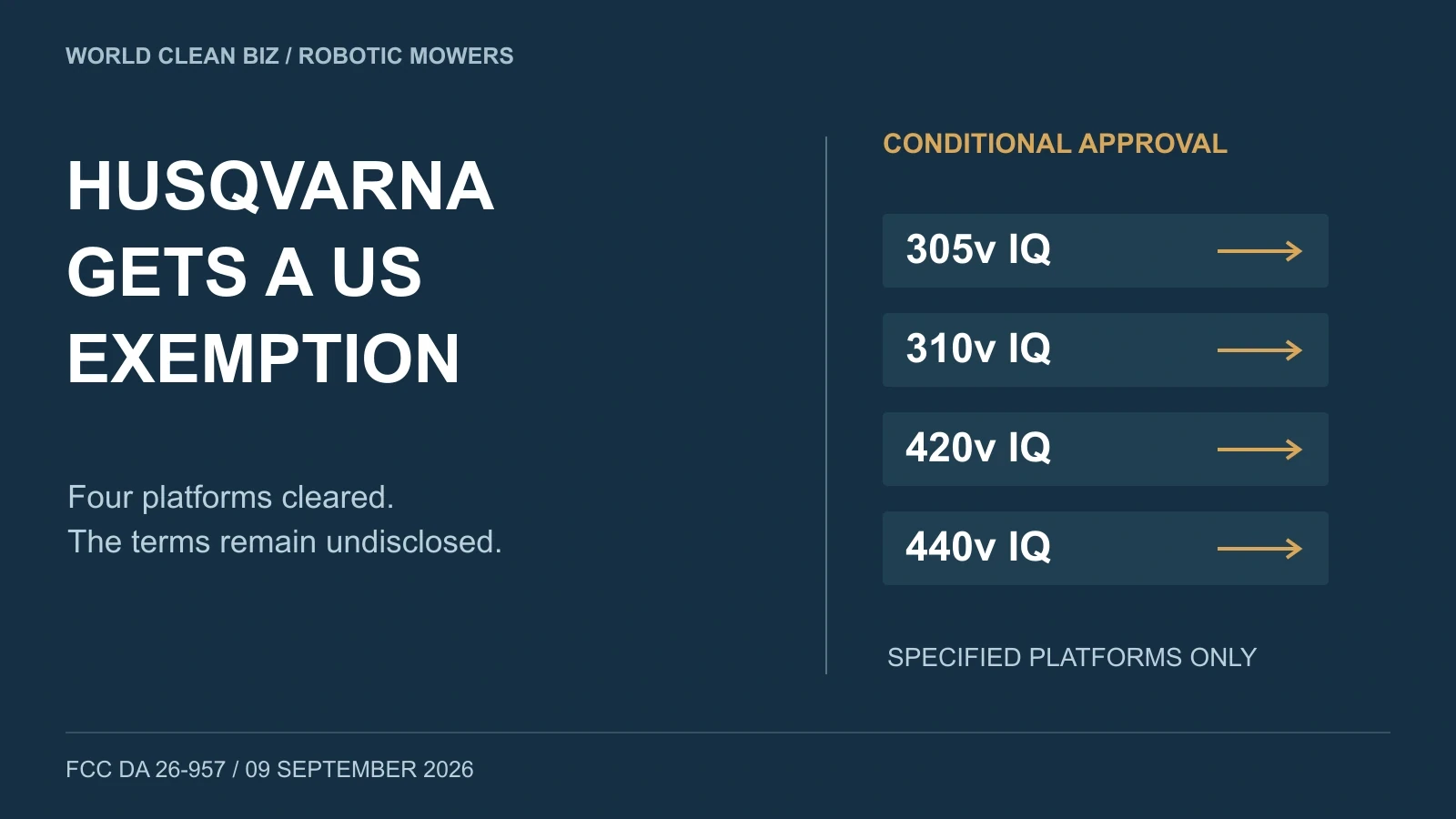
Little more than a month after the United States restricted foreign-produced mobile robots, Husqvarna secured an exemption.
On September 9, the Federal Communications Commission announced that four Husqvarna robotic mower platforms—305v IQ, 310v IQ, 420v IQ and 440v IQ—had received conditional approval and were exempt from the relevant Covered List restrictions.
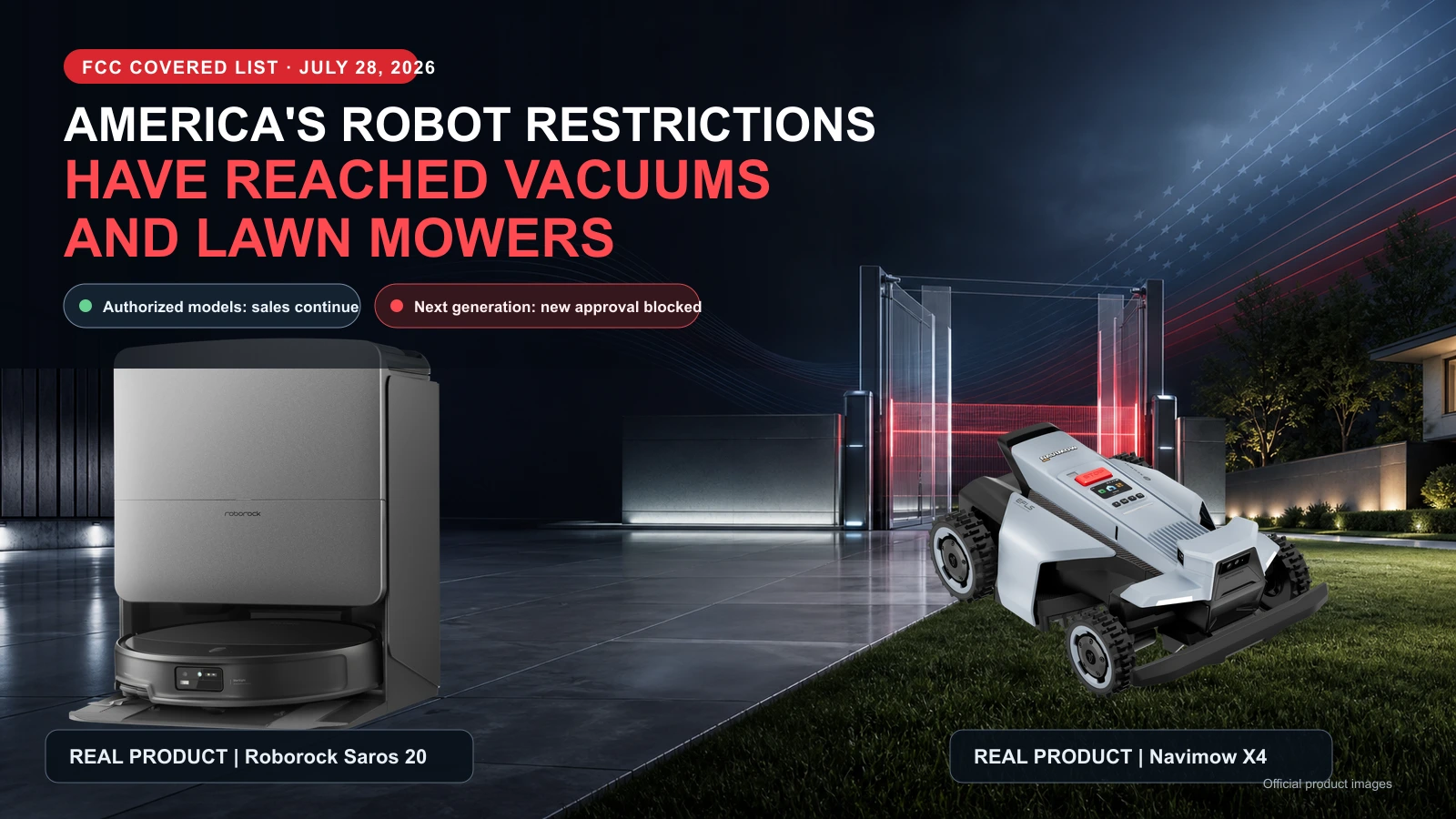
For companies preparing new products for the American market, the decision deserves a close reading. The restrictions introduced on July 28 had left the industry facing the same question: could new foreign-produced models still enter the United States? Husqvarna's approval supplied an answer, without disclosing what it took to obtain it.
The FCC's notice states:
“DoW has reviewed submissions and granted Conditional Approvals for the following devices:”
Husqvarna's four platforms appear on that list. A second sentence makes the outcome explicit:
“Therefore, such devices are exempt from the Covered List.”
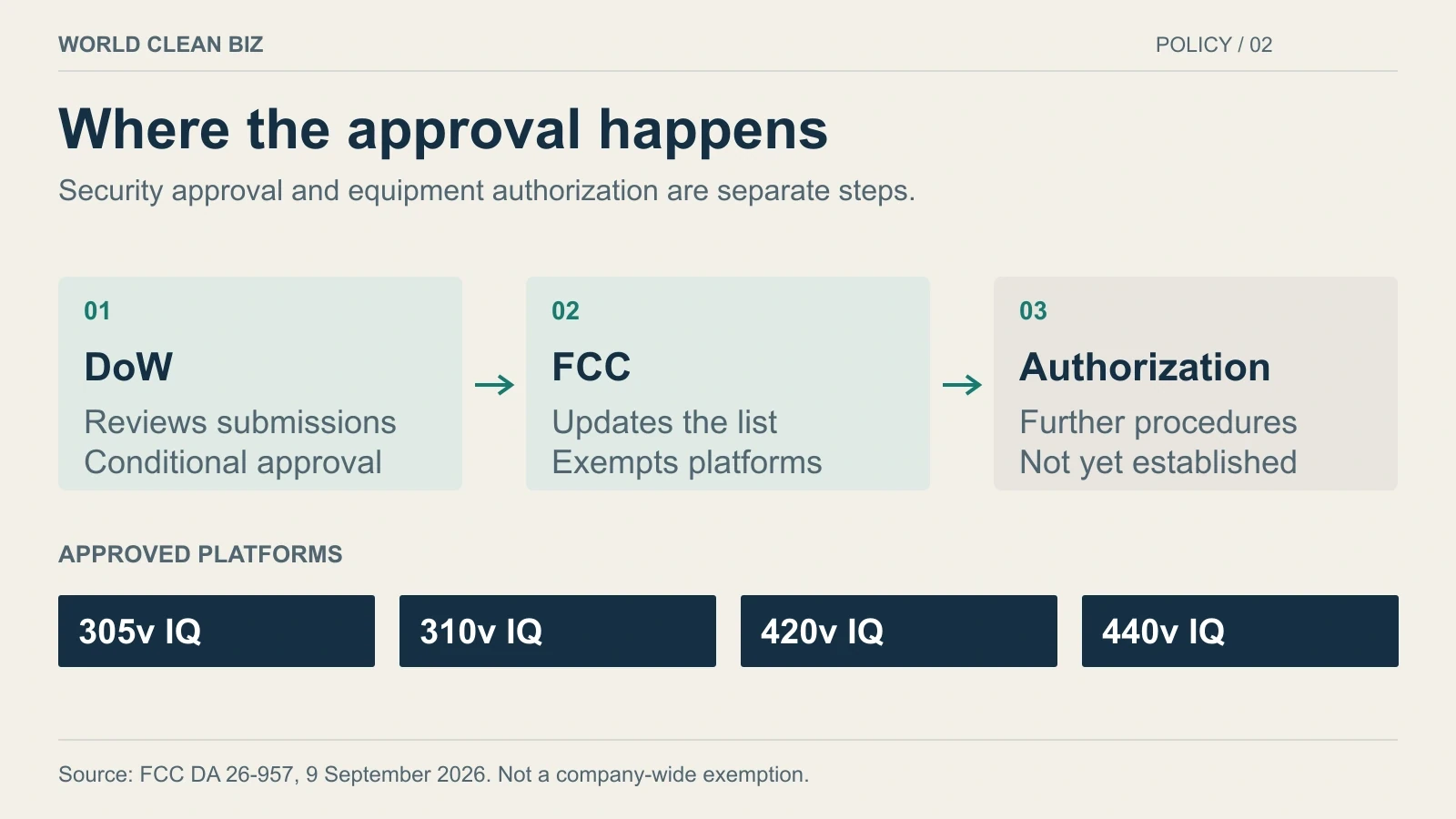
The decision has clear limits. The Department of War conducted the review; the FCC updated its list accordingly. Approval applies to four platforms, not every Husqvarna product. It removes this particular barrier to further FCC equipment authorization, without establishing that all remaining procedures have been completed.
The notice does not disclose Husqvarna's manufacturing plan or say whether it committed to US investment. The public can see the outcome, but not the terms the two sides accepted.
Even the relationship between these four platforms and Husqvarna's existing products remains unclear. The company launched the 420 iQ and 440 iQ in 2025, but the approved names include an additional “v.” Available information does not establish that these are entirely new platforms, much less that Husqvarna developed four US-specific products in response to the restrictions. Husqvarna's 2025 launch announcement
For Segway Navimow, Mammotion and other Chinese brands, however, the extent of hardware reuse is not the most urgent question. They need to know what commitments Husqvarna made to gain access to the US market—and whether they could accept the same arrangements.
The published requirements for robot conditional-approval applications already extend to US manufacturing plans. Applicants must quantify investment, hiring and expansion of manufacturing space, and report on implementation. A product-access application therefore reaches into decisions about where a company will manufacture over the coming years. Application requirements
An assembly line can move. An established supply chain is much harder to transplant. Robotic mowers contain parts from multiple suppliers; replacing them one by one with American sources means recalculating costs and validating quality again. For consumer products still competing to win users, those expenses ultimately fall on either company margins or buyers.
In my view, requiring this category to establish an entirely American supply chain in the short term is commercially unrealistic. A more workable negotiation would focus on which processes move first and which existing sources can remain.
The United States has dealt with similar problems in other industries. Those cases offer a way to explore the paths Husqvarna may have taken. They are not inside accounts of this approval, nor do they automatically give robotic mowers the same compliance status. But they offer more concrete precedents than simply moving everything to America.
1. Secure approval, then carry out the manufacturing plan
In April 2026, NETGEAR received conditional approval for foreign-produced routers. The company said it had applied under the published guidelines, which require a time-bound US manufacturing plan and quarterly progress reports. Its full localization commitments were not disclosed. NETGEAR's explanation, FCC application guidance
That precedent leaves room for an approach in which a company gains access before completing every production transfer, then implements the accepted plan after approval.
Husqvarna could similarly preserve the launch schedule for its four platforms while gradually investing in US production. A transition period would keep sales from having to wait for factory construction. The time and investment it may have committed remain undisclosed.
2. Keep European development and manufacture in the United States
French drone company Parrot took this route into relevant US procurement markets.
In 2020, Parrot launched ANAFI USA and selected US manufacturing-services company NEOTech to produce it. The drone was developed in France and manufactured in the United States. Its GOV and MIL versions entered the Blue sUAS approval system, accompanied by component-origin controls and software-security measures. Parrot's annual report, approval announcement
Husqvarna would not necessarily need to build a new factory of its own. It could retain European development and place some production with an American manufacturing partner.
Semi-knocked-down, or SKD, assembly could also provide a starting point: major modules would be completed overseas, then shipped to the United States for assembly and testing. That is easier than moving the entire upstream supply chain. It does not follow, however, that simple assembly would satisfy the requirements. Parrot's example does not establish that, and only Husqvarna's specific approval terms can tell us how much manufacturing it would have to undertake.
3. Localize key processes and seek relief for the rest
Nokia's approach was a selective production transfer.
To meet domestic-purchasing requirements under the US BEAD broadband program, Nokia partnered with Sanmina to manufacture specified equipment in Wisconsin. In April 2024, the first compliant optical line terminal cards came off the line. Nokia's announcement
Meanwhile, the Commerce Department waived component-cost-percentage requirements for certain electronics within that program and specified the manufacturing processes that had to take place in the United States, including the applicable printed-circuit-board assembly operations. Commerce Department waiver
Companies could retain some global sourcing while establishing substantive American manufacturing capacity.
Husqvarna might choose a similar level of localization, transferring some electronics manufacturing as well as final assembly. Such a plan would need explicit US acceptance. The broadband waiver does not apply to robots, but it shows that domestic-manufacturing requirements have previously been adjusted to an industry's supply-chain conditions.
4. Restrict data and software access as well
A factory address cannot answer every security question about a connected device. Even if a machine is assembled in America, who can access it remotely and who controls software updates may still matter to the review.
In 2021, Google and Meta signed national-security agreements with US authorities over the Pacific Light Cable Network. The companies changed the proposed connections, restricted access by a specified partner and accepted annual risk assessments. US authorities subsequently recommended FCC approval conditional on compliance with those agreements. US Department of Justice announcement
Husqvarna could likewise establish separate data-access and software permissions for its American devices. Such measures would generally have to accompany a manufacturing plan. They cannot substitute for production requirements, but could form part of an acceptable overall arrangement.
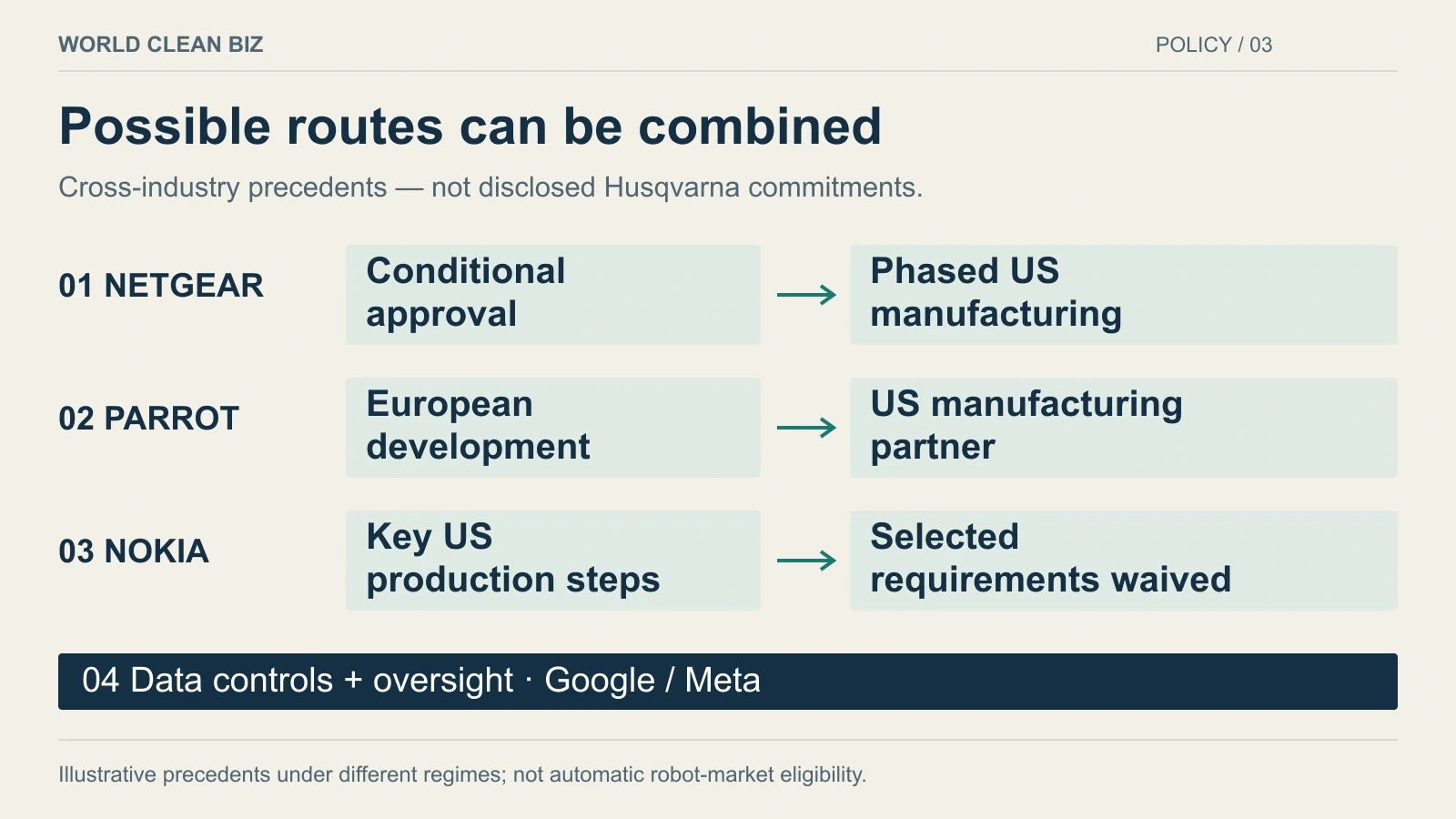
Several paths could converge in the same agreement: approval for specified products, followed by more US production and continuing oversight. How far Husqvarna has gone along any of them remains unknown.
Its competitors cannot wait indefinitely for the answer.
New robotic mowers have to make it into dealers' purchasing plans. If Husqvarna can launch on schedule while other brands are still working through authorization, the approval timetable could influence which machines reach the sales floor. Chinese companies need to include that delay, alongside the additional cost of US production, in their margin calculations.
I previously argued that these restrictions would probably follow the pattern of recent trade battles: more thunder than rain, with tough rules followed by further clarification and exemptions. Husqvarna's approval shows that exceptions have arrived. Whether they widen over time or remain available only to a few companies able to meet the conditions will produce very different outcomes for the industry.
The next approval for a Chinese robotic mower company may make the route clearer. Until then, Husqvarna has its pass; everyone else is still trying to learn the price. How the industry finds a way through remains to be seen.