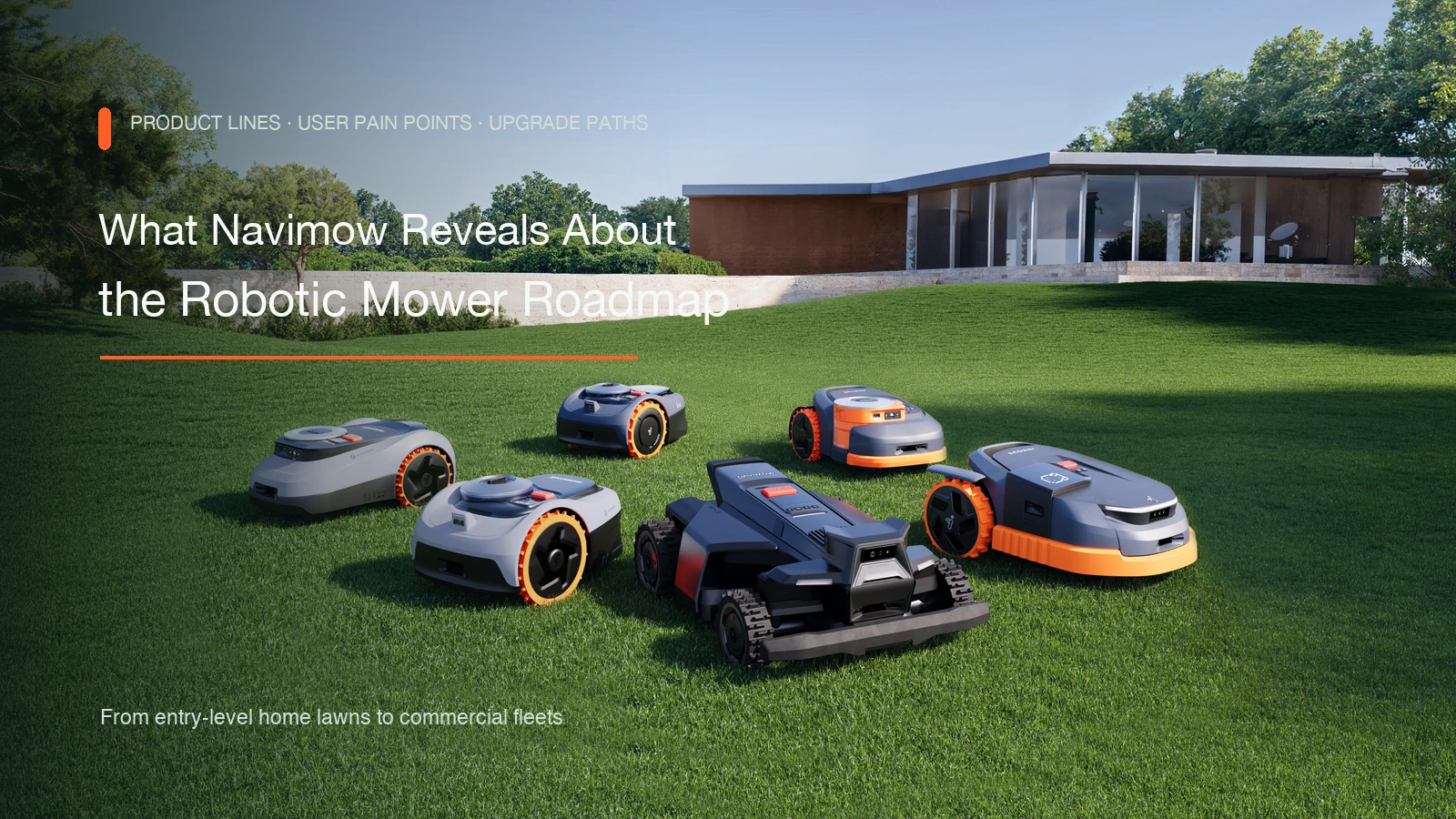
- H5 Pro's EdgeMaestro extends by 7.7 cm and uses the same cutting disc for the main lawn and its edges; availability is expected in early 2027.
- Worx, Husqvarna, Roborock and Dreame have already pursued edge-cutting solutions; extension itself is not new.
- Denny sees coordinated cutting and guarding as a direction others will follow. Design features are not proof that a particular production model has passed certification.

Segway Navimow has moved the mower's cutting disc beyond its usual reach.
On September 3, Navimow, part of Ninebot, introduced the H5 Pro at IFA in Berlin. Its EdgeMaestro mechanism extends outward by 7.7 cm, bringing the cutting system closer to grass the mower's body would otherwise leave beyond reach. The company expects availability in early 2027. Navimow's announcement, official availability
In my view, poor edge cutting is one of the most pressing problems robotic mowers still need to solve. A homeowner spends several thousand dollars on a machine. The middle of the lawn looks neat, but a strip of grass remains along the wall or flower bed, and someone still has to take out a trimmer to finish the job.
That strip may account for very little of the lawn's area. The owner still has to do the work, though. This is where the promise of replacing manual mowing falls short.
Over the past few years, the industry has poured resources into navigation without boundary wires. Mowers know their position more accurately and follow planned routes more effectively. But driving precisely along an edge does not mean the blades can reach it. With a cutting disc tucked beneath the body, a gap remains between the blade path and the wall even when the housing is close to it.
If the lawn meets paving at the same height, the problem is easier. The mower can straddle the lawn and the path, letting the disc cover the grass edge. Husqvarna's installation instructions describe this arrangement. A wall or raised flower bed prevents the mower from driving farther out, so the remaining grass needs another solution. Husqvarna's installation instructions
Worx introduced an offset disc on Landroid years ago, moving the cutting position toward one side. Cut-to-Edge narrows the uncut strip; the company's description focuses on reducing manual trimming, rather than promising no remaining grass at every boundary. A protective structure remains underneath, limiting how far toward the outside the blade can reach. Worx's technical explanation
Husqvarna's EdgeCut adds a dedicated disc at the rear. Near the boundary, the mower makes a sweeping turn so that the rear disc cuts along the edge. Separate discs handle the main lawn and the perimeter, reducing the constraint imposed by the main disc's position. Husqvarna's EdgeCut explanation
Chinese brands have been working on the problem too. Roborock's PreciEdge module is advertised as cutting to within approximately 3 cm of the boundary. Dreame's A2 already used an automatically extending disc: its EdgeMaster system claims a disc-to-edge distance below 5 cm. The idea of extension predates the H5 Pro. Roborock's product information, Dreame A2
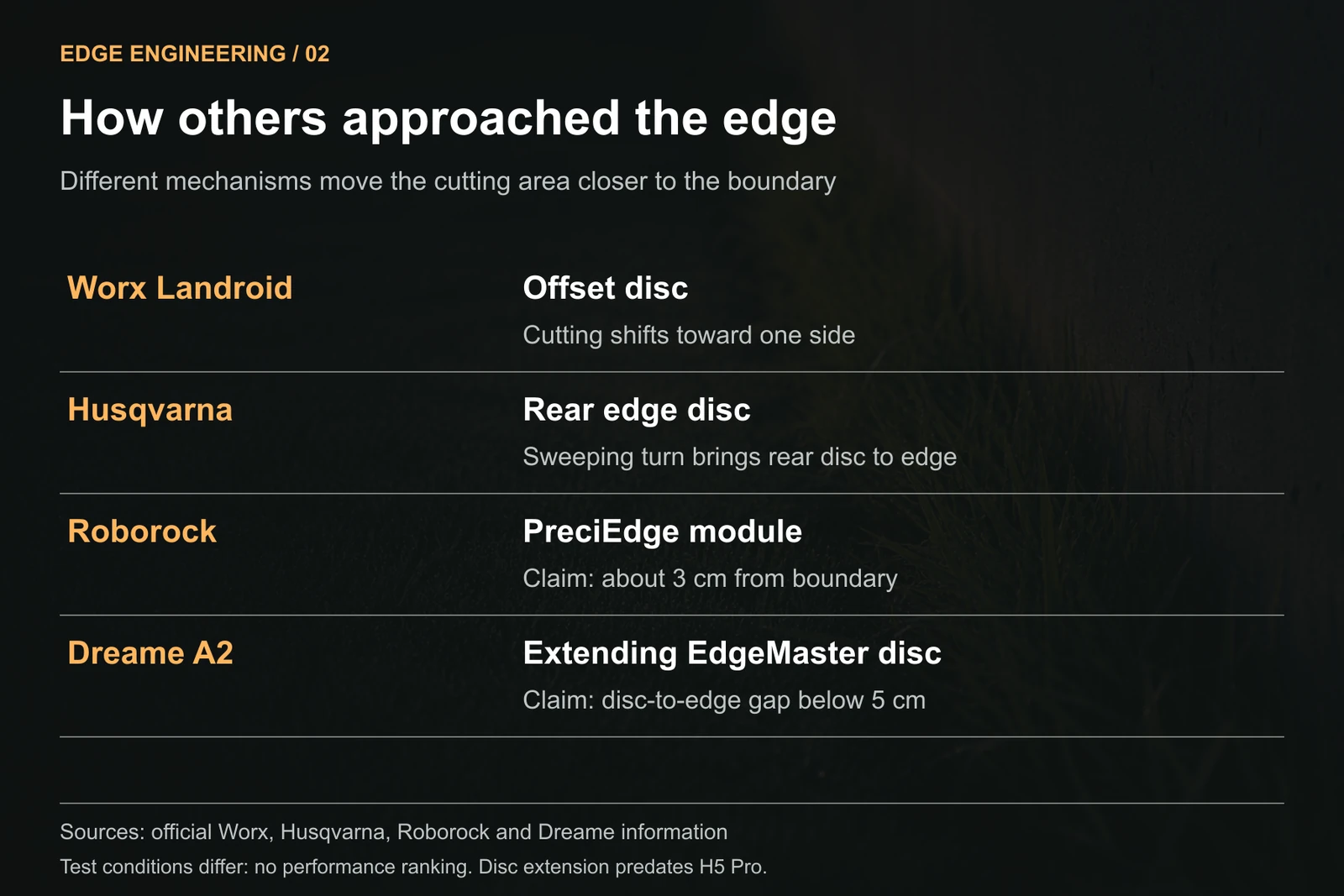
Those figures do not all come from the same test conditions and should not be turned into a performance league table. The designs do show a consistent effort to push the cutting area outward while retaining protection.
That brings us to an important difference between a robotic mower and a robot vacuum.
Extending a vacuum's side brush beyond its body involves relatively limited risk. A mower is moving high-speed blades outward. The closer the disc gets to the edge, the more carefully the risk of accidental human contact must be reassessed. The uncut margin cannot simply be blamed on manufacturers being unwilling to improve their products.
In Europe, for example, machinery has to meet legal safety requirements. Relevant machinery placed on the EU market before January 20, 2027 falls under the current Machinery Directive, 2006/42/EC; the new Machinery Regulation, EU 2023/1230, applies from that date. With the H5 Pro scheduled for early 2027, its actual market-placement date matters. Harmonised standards are an important way to demonstrate compliance with legal requirements, but standards and legislation are not interchangeable. European Commission guidance
The safety standards commonly used for robotic mowers include IEC 60335-2-107 and its regional adoptions, covering matters such as access to the cutting means and stopping. Testing goes beyond measuring the distance between a blade and the housing. Probes representing parts of the human body are used to assess whether someone could reach the dangerous cutting area from around the machine. IEC's standard overview
Intertek's published update for the related North American standard describes static foot-probe tests, foot-contact tests while the machine operates, and finger-access protection when someone attempts to lift it. Versions and details need to be checked for each market, but preventing unintended contact with rotating blades is a common priority. Intertek's standards update
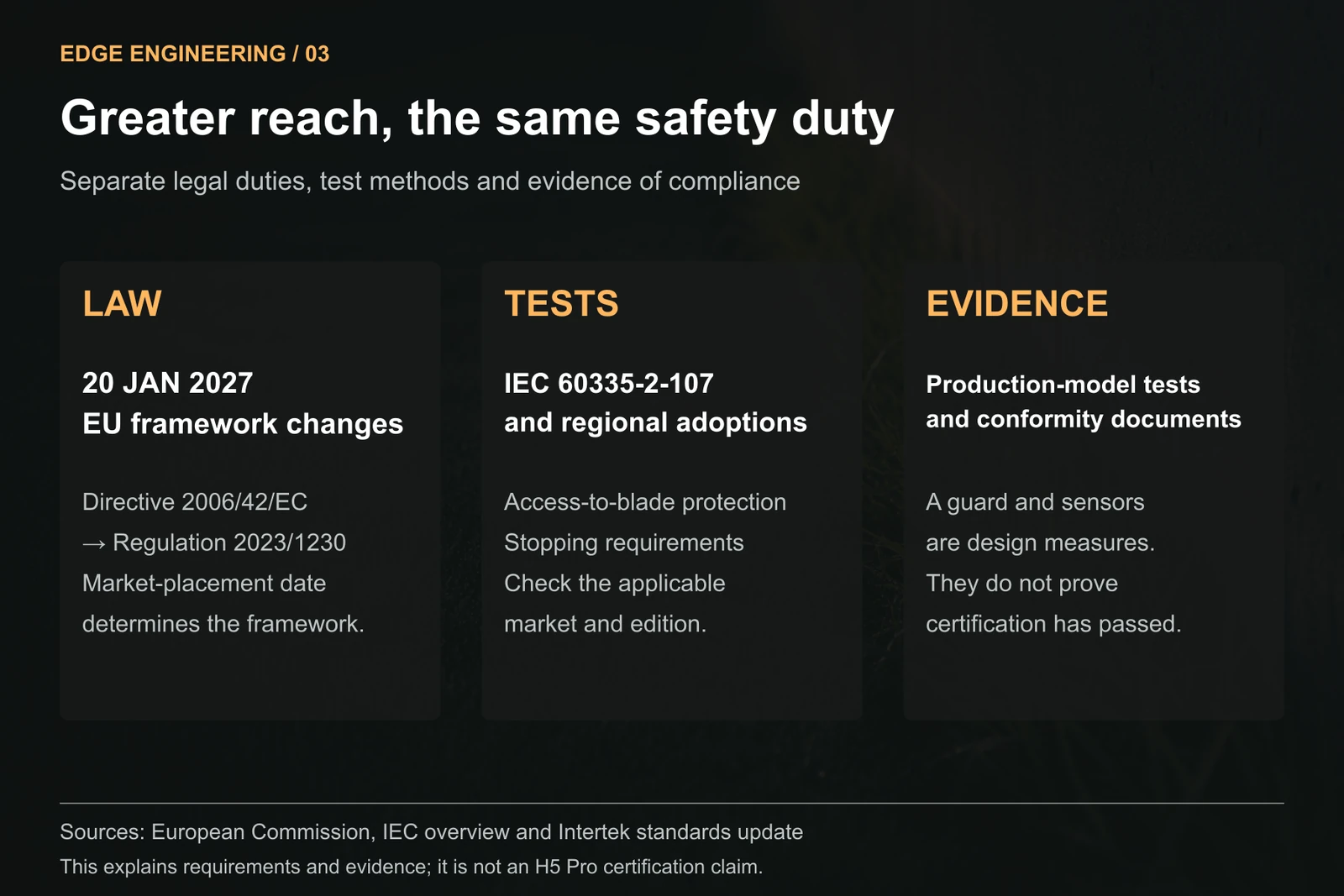
The rules therefore should not be reduced to “the disc must never extend beyond the body.” The design question is whether protection still works in the new position, and whether cutting can stop promptly when danger arises.
The H5 Pro addresses those questions alongside the extension mechanism.
Navimow says EdgeMaestro has omnidirectional floating movement as well as its 7.7 cm extension. It can follow uneven ground and rebound from side obstacles such as garden lights. The same disc cuts the main lawn and its edges, without a separate cutting attachment. H5 Pro's mechanism
From what I understand, EdgeMaestro also has an extendable protective cover. As the cutting mechanism moves outward, the cover extends with it, keeping the disc within a guarded structure rather than leaving it directly exposed outside the mower's body. Built-in sensors stop the disc when a person or animal is detected.
The moving cover maintains physical protection, while sensor-triggered stopping further reduces the risk of accidental contact. This allows the disc to approach the lawn edge while retaining guarding. The production model's test results and conformity documentation must still establish its specific compliance, but the design shows how Navimow is addressing the safety problem created by an extending disc.
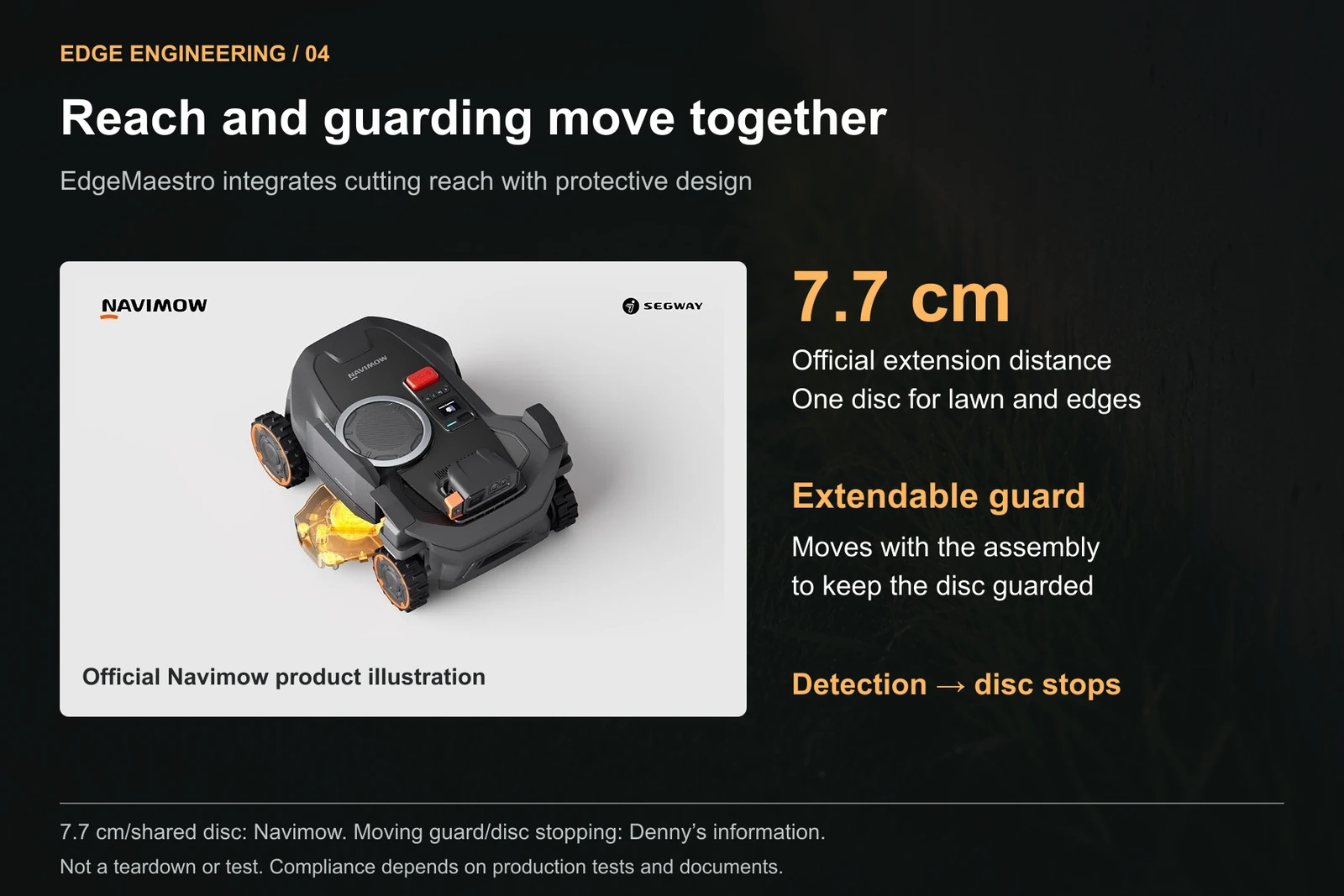
Compared with simply making the whole mower hug the wall more closely, EdgeMaestro gives the cutting disc room to adjust its position independently. The mower follows the boundary; the cutting assembly reaches toward the grass edge, with the cover moving alongside it. Navimow has taken a longstanding user problem into coordinated cutting-and-guard design.
If the production H5 Pro delivers what the launch promises, I expect other brands to accelerate their own efforts. Dreame already has an extending disc, and others have edge-cutting modules. They will continue improving those mechanisms to reach areas their machines previously missed.
The competition will not be decided solely by whose arm extends farthest. Mowers work outdoors every day, with grit and grass clippings constantly collecting around moving parts. An arm that extends smoothly on day one must still do so after a full season. That will determine whether it becomes a selling point or a service burden. The added cost will also influence whether the feature moves from flagships into higher-volume models.
Manufacturers have long been able to tell owners that a strip of grass beside the wall is normal for a robotic mower. Once products can finish that strip too, the question changes: why does your machine still need me to finish the job?
In my view, Navimow has opened a path worth following. When the mower can reliably handle the edges on its own, it will be another step closer to the fully automatic experience buyers expect.