- A bottom-up scenario puts the global installed base at roughly 150,000 commercial robotic mowers, with a wide sensitivity range of 20,000 to 600,000 units.
- The first accessible market for new entrants is likely to be ordinary 3–6 acre sites rather than golf greens and elite sports turf.
- Lower hardware prices matter only when uptime, remote recovery and local service are strong enough for commercial procurement.
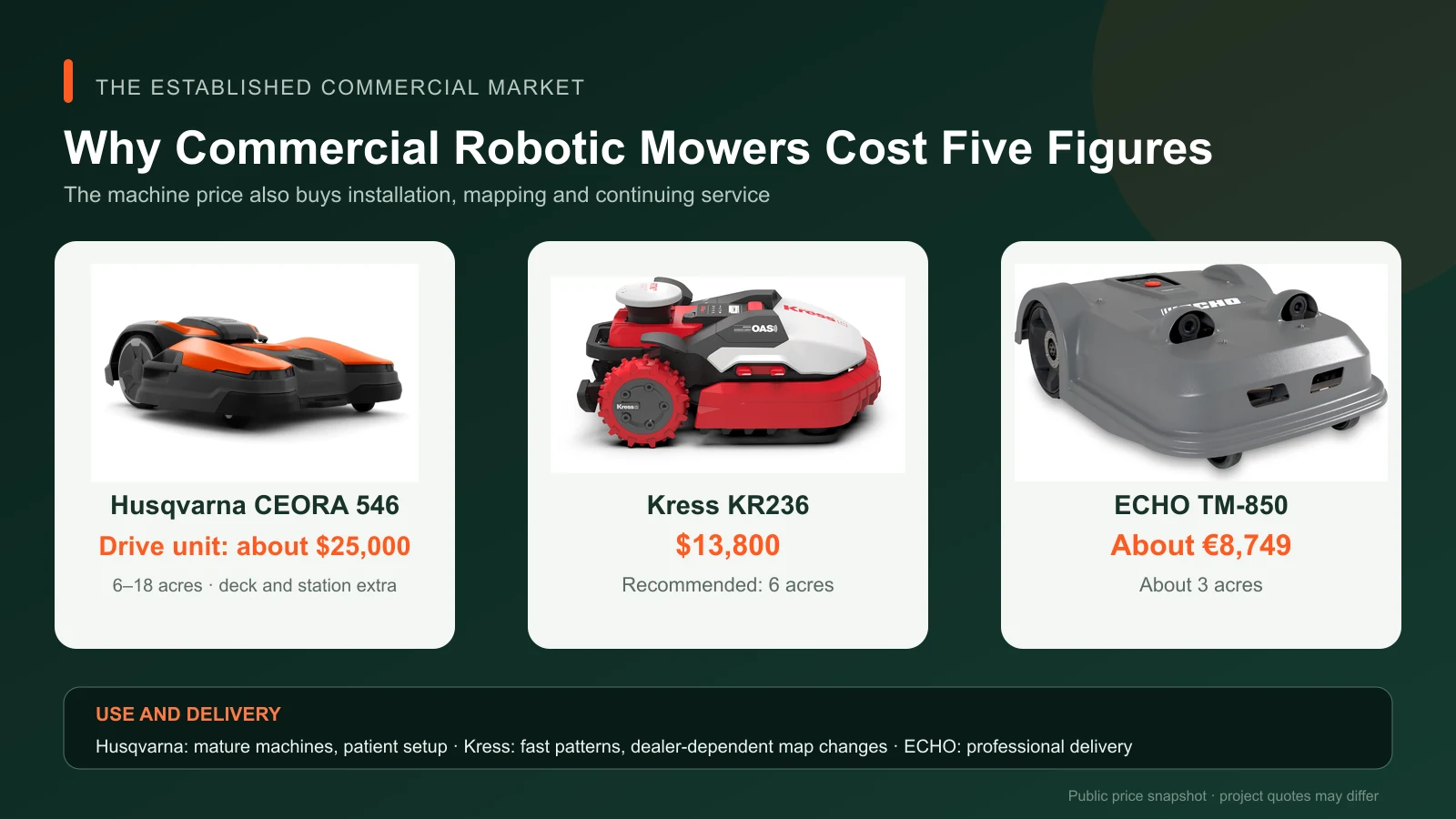
A flagship robotic mower for the home now costs roughly $2,000 to $3,000. Move into the commercial market, and machines using the same RTK positioning and automatic charging quickly rise above $10,000. The US list price of the Kress KR236, a product from Positec, is about RMB 94,000 ($13,800). The drive unit alone for the Husqvarna CEORA 546 is close to RMB 170,000 ($25,000), before adding the cutting deck and charging equipment.
That price gap has faced little pressure. Commercial buyers need machines that can keep working through the mowing season, with people responsible for installation and continuing support. Husqvarna, Kress and ECHO Robotics have built a stable, high-priced market around professional dealers.
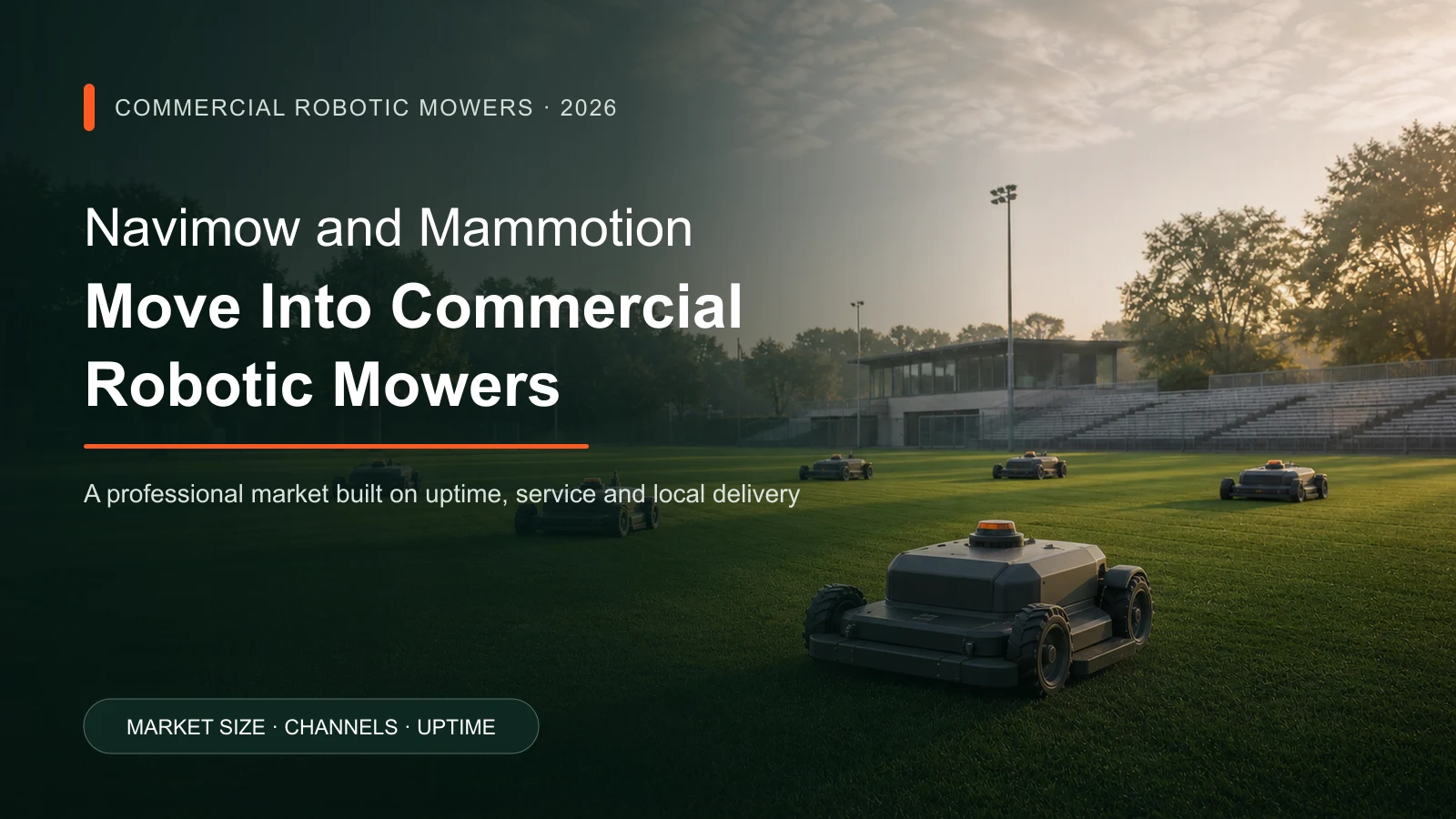
Competition began to shift in 2026. Navimow, operated by Willand under Segway-Ninebot, brought Terranox to commercial turf. Sunseeker launched the X9, while Mammotion, operated by KuMa Power, announced Maston for the commercial market. Chinese robotics companies that grew quickly in residential mowing are now moving beyond private yards and into a professional market long served by Husqvarna, Kress and ECHO Robotics.
Husqvarna’s portfolio makes the pricing structure especially clear. The 535, 560 and 580 EPOS serve lawns of roughly one to two acres, with US prices from about RMB 34,000 to RMB 58,000 ($4,999 to $8,599). Above them sits CEORA, whose modular 68-centimeter cutting deck can maintain six to 18 acres depending on mowing frequency.
User feedback broadly fits Husqvarna’s long history in professional equipment: the machines are mature, but initial setup still requires patience. One owner using a 550H EPOS on 2.5 acres of mixed grass rated it nine out of ten, praising its reliability and clean straight-line pattern. The same owner warned that the mower needs a clear view of the sky and that app and connectivity setup take time.
Husqvarna’s published Royal Porthcawl Golf Club case offers another view. Course manager Ian Kinley said staff previously drove fairway mowers two or three times a week, spending six or seven hours on each session. After CEORA took over, the grounds team could devote more time to precision areas such as greens. During tournaments, Husqvarna technicians still cleaned and calibrated the machines and replaced blades every day. The robot reduced repetitive driving; it did not eliminate professional maintenance.
Kress approaches the market through larger single-machine coverage. The KR233 is designed for about three acres and costs roughly RMB 58,000 ($8,499). The KR236 covers six acres and rises to about RMB 94,000 ($13,800). The MasterSeries Mega 600 moves further into golf fairways, with an official claim of maintaining 88,000 square meters within 48 hours.
One owner who switched from Husqvarna to Kress RTKn was pleased with its systematic routes, saying the lawn looked more even and the work finished faster. In his view, having the dealer map the property was worth the cost. The trade-off is that major site changes often require another call to the dealer.
Another user who inherited a multi-hectare Kress installation wanted to add only two no-go zones around new trees, but could not find a map-editing control in the app. A fleet user replied that the map first had to be deactivated before editing, and that the interface remained unintuitive. Professional commissioning lowers the barrier at installation, while making later adjustments more dependent on the service provider.
ECHO Robotics follows a similar professional pricing model. The TM-850 is suited to roughly three acres and costs about RMB 68,000 (€8,749) in Germany. The TM-2050, with a cutting width of more than one meter, approaches RMB 200,000 (€25,998). Dealers normally survey the site and take over when service is required.
Husqvarna and Kress do not disclose a separate margin for their commercial robotic mower lines. What can be confirmed is that this market has sustained high prices for years and still has relatively few mature suppliers. Any new brand entering the category must first ask how many machines the professional market can actually absorb.
Existing research reports do not provide a reliable answer. Estimates for the total global robotic mower market in 2025 alone range from roughly $2.4 billion to more than $10 billion, mixing residential products with large autonomous commercial equipment.
A bottom-up estimate can start with the number of lawns. This article uses one machine responsible for four acres over the long term as its standard unit, midway between the three-acre Terranox CM120 and six-acre CM240. The assumed system cost, including basic installation, is about RMB 82,000 ($12,000), with a six-year operating life.
The United States and Europe together have roughly 24,000 golf courses. An 18-hole course typically maintains 90 to 95 acres of turf, although current robots are better suited to rough, semi-rough and selected fairway areas. If 15% of courses adopt robots first and open 50 acres per course, the calculation is “24,000 courses × 15% × 50 acres ÷ 4 acres,” producing capacity for about 45,000 machines.
Schools and sports grounds are more numerous, but each project is smaller. The United States has approximately 99,300 public elementary and secondary schools. After adding European schools and independent sports grounds, assume that 160,000 sites have substantial lawns, 10% adopt robots, and each opens three acres. That corresponds to roughly 12,000 machines.
The municipal park estimate is less precise. Assume about eight million acres of parkland across North America and Europe, with turf representing 25%, 40% of that turf suitable for unmanned operation, and 10% of qualifying sites completing a purchase. The result is about 20,000 machines.
Golf courses, schools and parks together account for roughly 77,000 units. Hotels, corporate campuses, cemeteries and airports lack consistent statistics, so the model adds 35% to the total. That produces approximately 104,000 units for North America and Europe. If the two regions represent 70% of global demand, the worldwide base case approaches 150,000 machines.
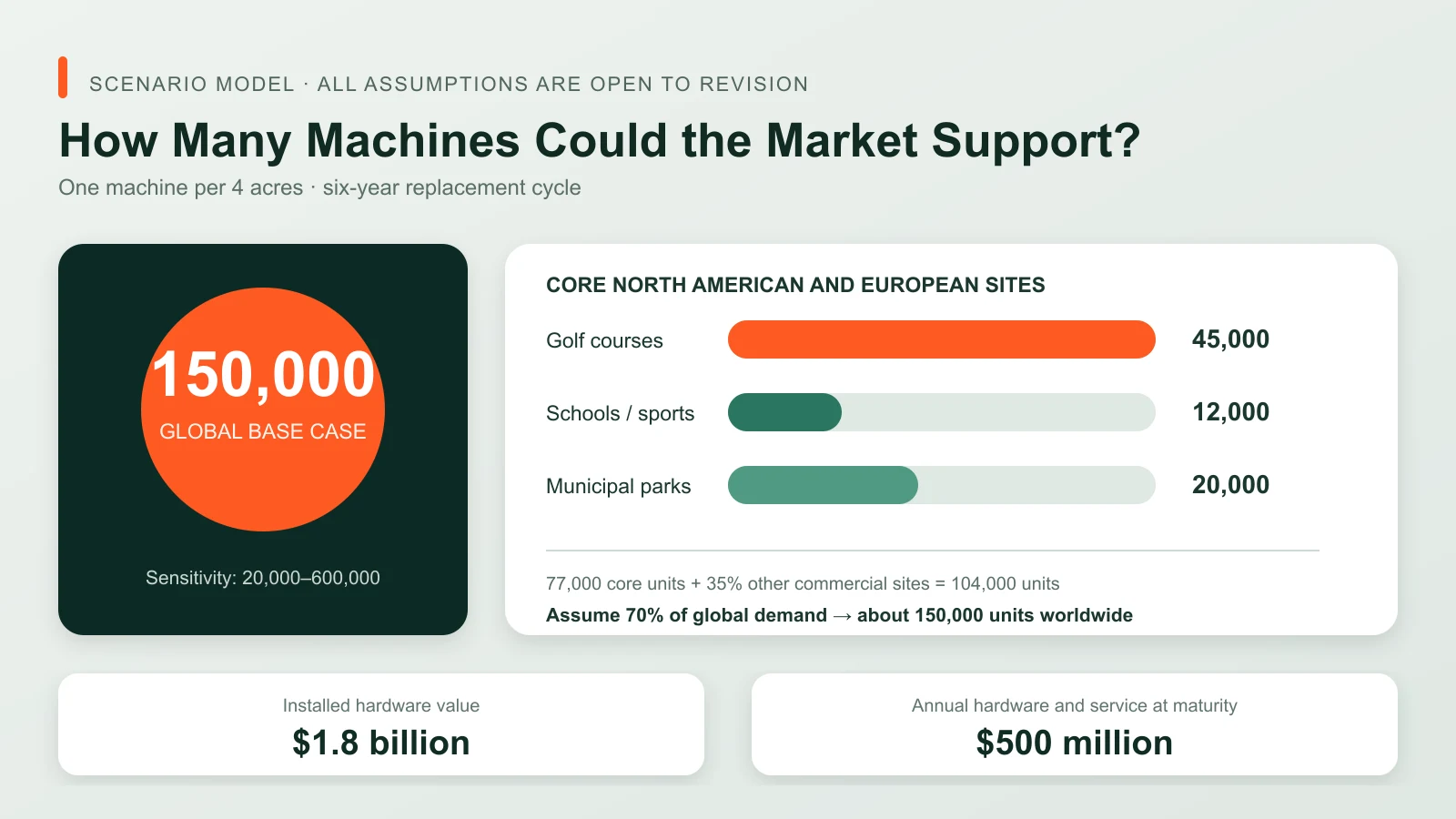
Small changes in adoption and accessible acreage move the result anywhere from 20,000 to 600,000 machines. Golf and professional sports turf can support a market of tens of thousands. Procurement by schools and ordinary parks determines whether the category reaches the hundreds of thousands.
Under the midpoint assumptions, 150,000 machines represent installed hardware value of roughly RMB 12.2 billion ($1.8 billion). Replacing the fleet every six years creates annual hardware demand of about RMB 2 billion ($300 million). Including maintenance and software brings the mature annual market close to RMB 3.4 billion ($500 million). Faster adoption by schools and parks could push annual value toward RMB 13.6 billion ($2 billion).
These units will not be released at the same time. Golf greens and professional sports venues are difficult first targets for new brands. They require millimeter-level cutting heights and consistent striping, while equipment failure can interfere with an event. Husqvarna, Kress and ECHO have already accumulated long-term validation with local grounds teams.
Schools and ordinary parks are more accessible. They do not demand putting-green quality, but they face persistent labor costs and hiring pressure. A machine that reliably completes work outside public hours can remove a large amount of repetitive driving.
The United States has about 950,000 landscaping and groundskeeping workers, with average pay of roughly $20.33 an hour. Once insurance, management and other employment costs are added, the annual cost of one full-time employee rises well above wages alone. A system priced at $10,000 to $20,000 and capable of taking over part of the repetitive mowing workload already has a plausible economic case.
New entrants can avoid CEORA’s strongest applications and first compete for ordinary commercial projects covering three to six acres. That is where Terranox, Sunseeker X9 and Maston are positioned.
Navimow has already taken the first step. The Terranox CM120 and CM240 target roughly three and six acres respectively, using a four-wheel chassis and a 43-centimeter dual cutting deck. Their positioning system can use Network RTK or deploy a local base station when necessary.
NavimowFleet provides remote status monitoring and task assignment, giving Terranox the foundations of fleet management. Navimow can also reuse navigation, chassis and supply-chain capabilities developed for its residential products. In schools and ordinary parks, that gives it an opportunity to lower the procurement price of a professional machine.
Early commercial use has also exposed gaps. A user at an airport project reported that a mower could not be recovered through the app after losing RTK and still required a person to visit the site. One rescue on a residential lawn is an inconvenience. The same fault across a fleet distributed among several sites can quickly consume the labor savings.
Remote recovery and peak-season uptime will determine whether Terranox can enter larger projects. The machine must first complete its work reliably before a price advantage has meaning.
Mammotion moved slightly later. At CES 2026, the company announced Maston as its entry into commercial mowing. The LUBA family has already built recognition in residential all-terrain mowing, making a larger four-wheel-drive platform a natural product extension.
Maston remains at the announcement stage, with pricing and the service model still unclear. Mammotion has shown that it can develop all-terrain machines quickly and enter new price bands with higher specifications.
Commercial buyers will then examine service. Who responds when a machine stops? Are common parts available locally? How long does a peak-season repair take? These questions go directly into a procurement decision. Maston’s reach will depend on whether Mammotion can convert its residential product speed into commercial service capacity.
Sunseeker X9 has a clearer position. The X9 and X9 Plus target approximately three and six acres, with four-wheel drive and fleet management. The company limits the stated golf applications to rough and semi-rough instead of directly challenging greens and other high-standard turf. That boundary closely matches the market new entrants can realistically win today.
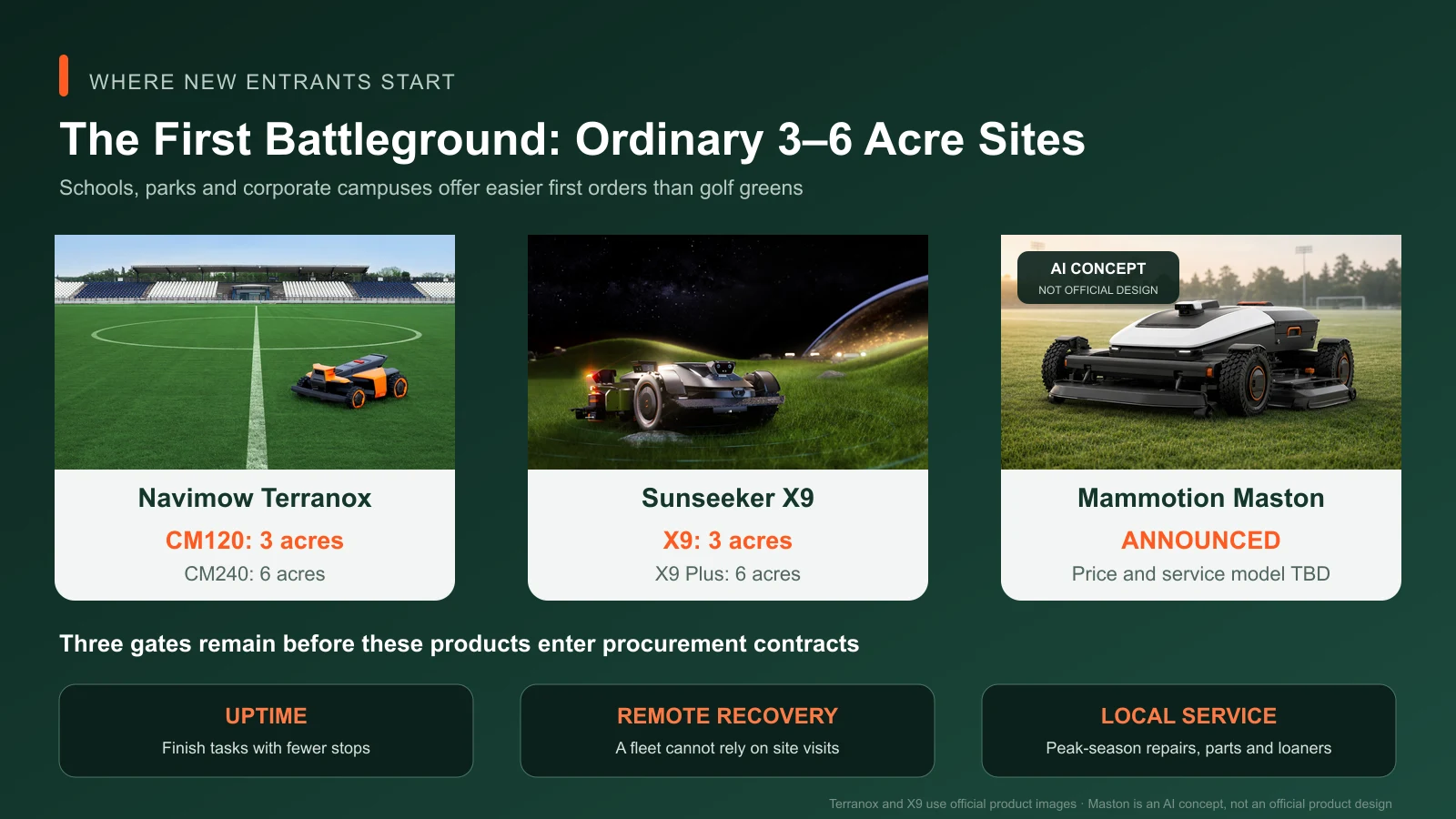
In the commercial market, three calculations follow the specification sheet: how many tasks the machine finishes in a week, how quickly it recovers from a fault, and whether a replacement machine is available during peak season.
The mower must maintain positioning beneath trees and around buildings, and it must preserve task progress after charging or a temporary connection loss. Long operating hours also require common parts that can be replaced quickly.
The service network is therefore the established suppliers’ strongest defense. Husqvarna, Kress and ECHO already use dealers for site surveys, installation and repair. Terranox and Maston can reduce hardware prices and add features faster, but they still need people in each market who will take responsibility for delivery.
Price will still change the category. If a system for three to six acres falls from more than $10,000 to $5,000 or $6,000, schools and ordinary parks will find it easier to run a trial. As volume rises, weaknesses in both the product and service system will also surface faster.
Commercial autonomous mowing remains a relatively small professional market. Under the midpoint scenario, the installed base eventually reaches about 150,000 machines, while mature annual hardware and service revenue approaches RMB 3.4 billion ($500 million). That is enough to support several specialist companies and justify long-term investment by Chinese robotics manufacturers.
The premium territory held by Husqvarna and Kress will not disappear after one product-launch cycle. Change will begin in places that were previously uneconomic for them to serve: sites that are not enormous, have limited budgets and urgently need to reduce repetitive labor. Terranox has already started testing this ground, and Maston is preparing to join it. The company that keeps its machines working reliably through several mowing seasons will have the opportunity to redraw the boundaries of commercial robotic mowing.