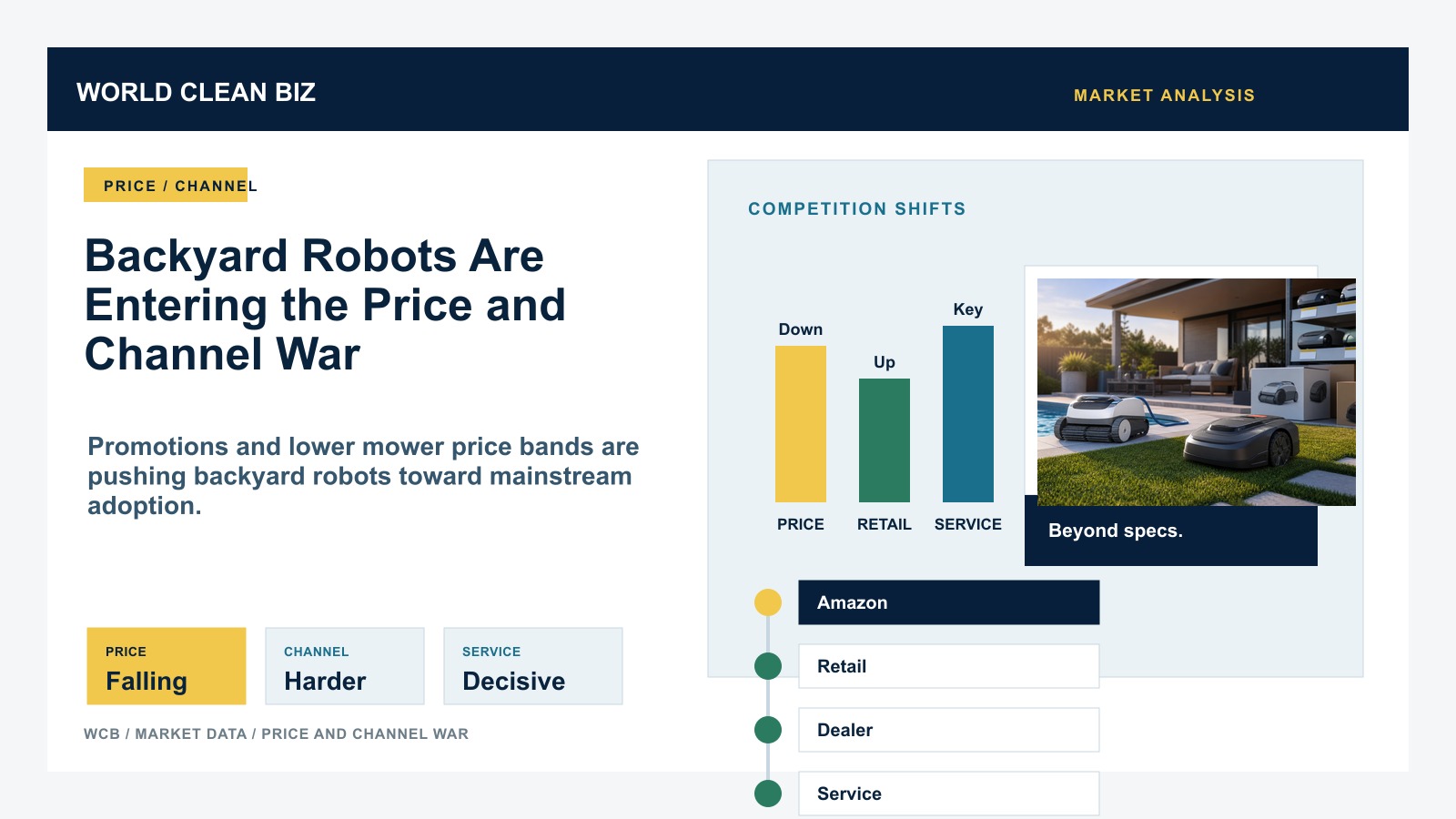
- Dealer and commercial channels exchange margin for local product selection, installation and service.
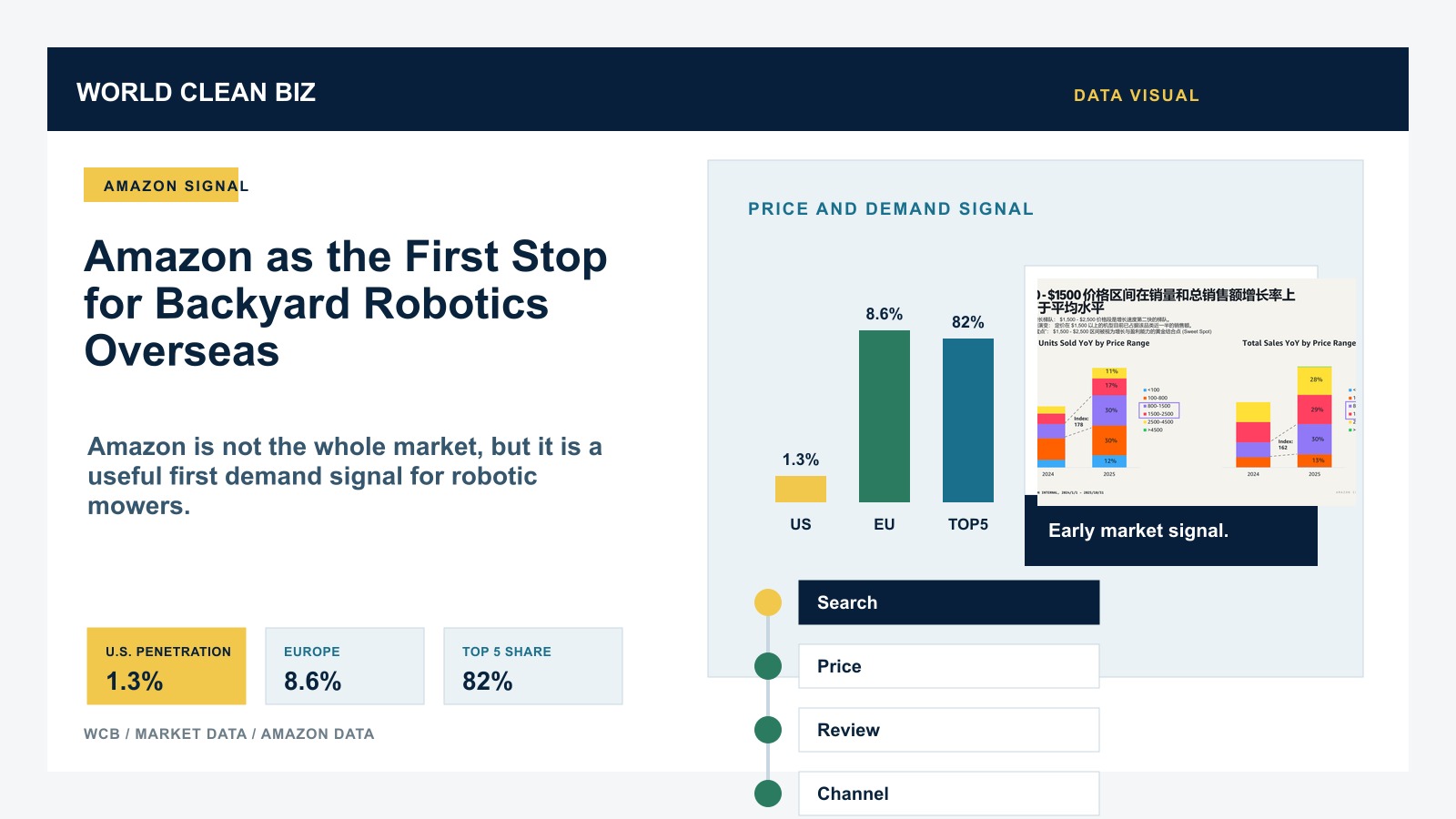
- Amazon, brand websites and crowdfunding all depend on paid traffic; listing a product does not create sales by itself.
- Channel performance should be measured by sell-out to end users, not inventory shipped to distributors.
In this article 6 sections
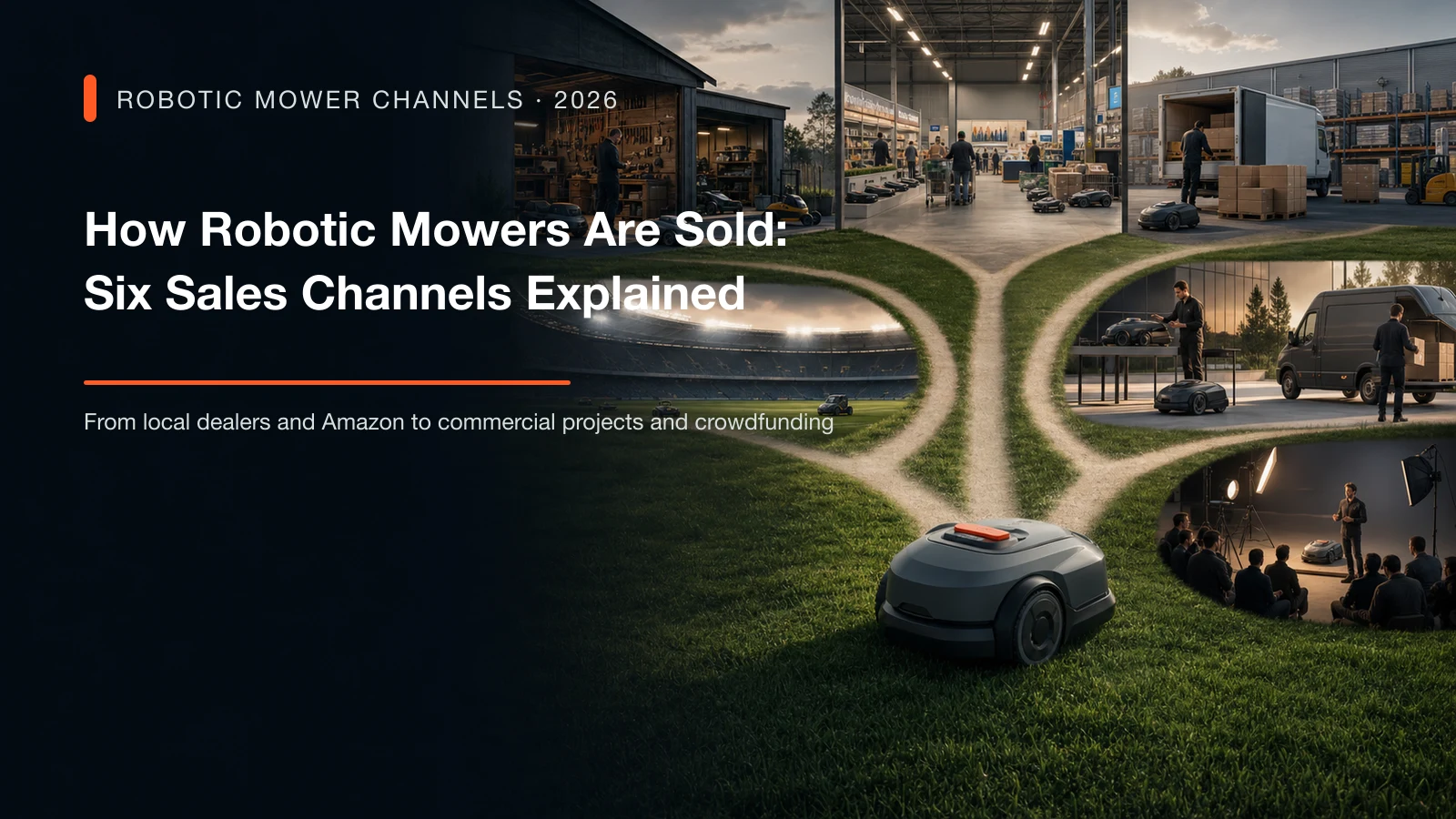
Robotic mowers are moving from professional garden equipment into the mass consumer market. Established brands such as Husqvarna and Kress rely heavily on specialist dealers. Newer brands including Navimow and Mammotion are entering brand websites, Amazon and large retail chains at the same time, while more start-ups begin with crowdfunding to build their first user base.
The same machine can be sold through very different channels, each with its own customer, fee structure and delivery responsibilities. Specialist dealers provide product selection and installation. Large retailers offer scale. Amazon and brand websites depend on advertising to generate orders. Commercial projects add site surveys and continuing service.
The six main channels below are examined through four questions: where the customer comes from, who holds the inventory, how the channel gets paid, and who takes responsibility for installation and service. National agents and regional distributors handle importing, inventory and downstream channel development, so their costs are included under the relevant sales channels.
1. Professional Outdoor Power Equipment Dealers
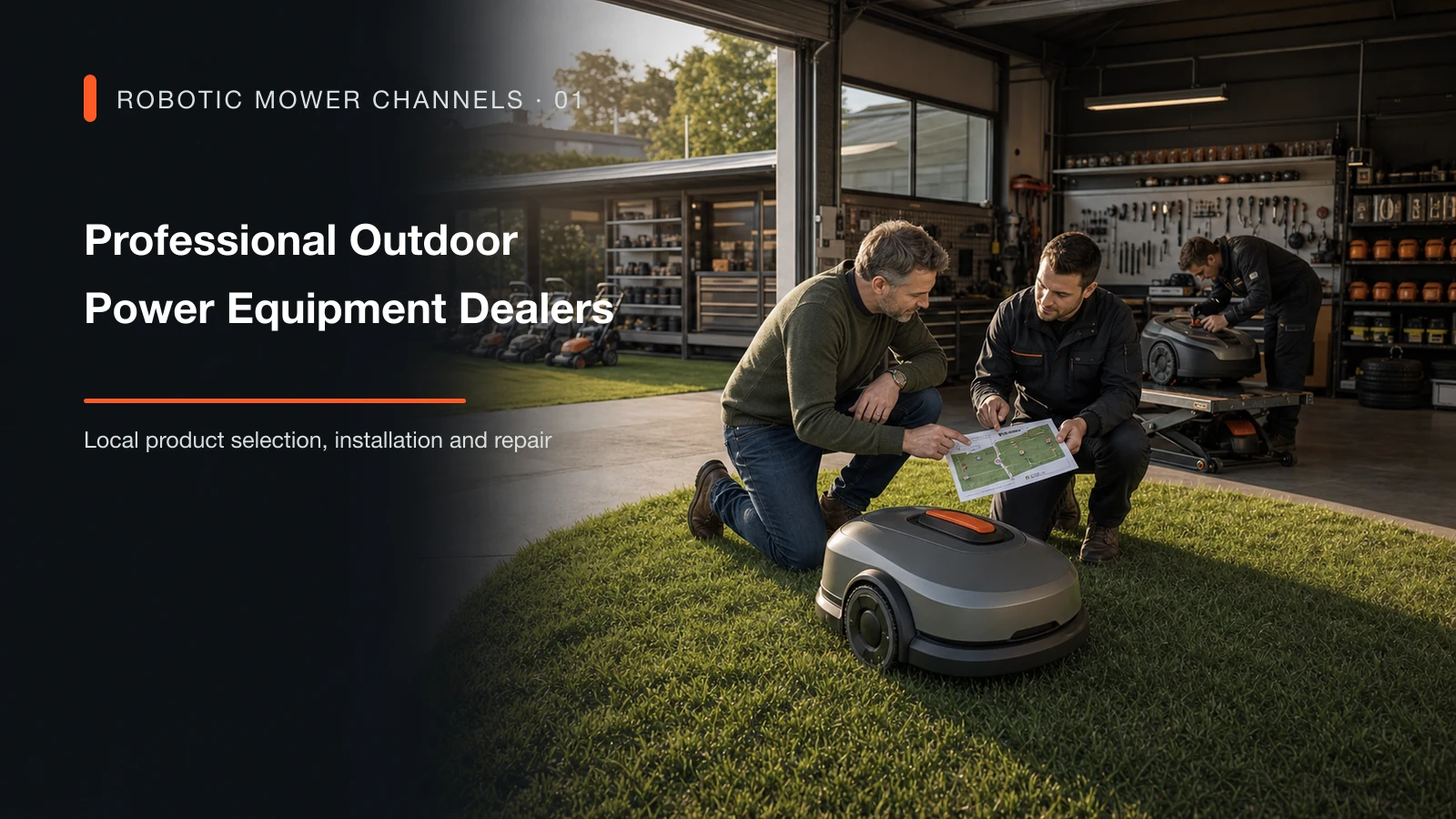
OPE stands for outdoor power equipment, a category that includes lawn mowers, leaf blowers and chainsaws. When the industry refers to a dealer, it usually means a local specialist that sells and repairs this type of equipment.
Traditional brands such as Husqvarna, Kress and STIHL have long relied on these dealers to sell robotic mowers. Sunseeker is building a similar network. One store normally serves the surrounding area, allowing it to recommend products for local lawn conditions and provide installation and repair.
A common route is “brand–national distributor–local dealer–consumer.” A brand with its own local subsidiary can also supply dealers directly. The national distributor handles importing, inventory and payment terms for downstream partners. The local dealer completes the final sale and serves the customer.
Distributors earn a wholesale margin while taking responsibility for demand forecasts and inventory risk. A working budget can allocate 10% to 18% of the retail price to the distribution layer and 25% to 35% to the dealer, with additional allowances for marketing and service. After both layers, the brand’s ex-factory revenue can fall to 45% to 60% of the suggested retail price.
Customers often arrive with a lawn size and several photographs. The dealer will still ask about slope, tree cover and positioning conditions. Some properties require an on-site inspection before a product can be recommended.
Husqvarna separates household products that consumers can install themselves from products that require professional delivery. Some residential models can be purchased directly from its US website, while professional machines continue to be sold by authorized dealers. Kress uses its website for product education and sales inquiries, but the purchase is completed through a local dealer. The dealer also confirms whether the positioning network covers the property. Some STIHL dealers in Germany and the United Kingdom offer annual maintenance and winter storage.
Customers who visit specialist dealers often have larger or more complex properties and a higher budget. They want someone to complete the installation and a specific local business to call if the machine fails. Professional users such as landscaping contractors are also accustomed to buying through this channel.
Most brands use a wholesale model: the dealer buys at a trade price and resells at retail. The retail margin is the main source of income, while installation, repair and winter maintenance create continuing revenue. During the warranty period, the brand supplies parts and reimburses agreed labor costs. Brands can also provide demonstration machines, training and volume rebates to encourage investment in sales and service.
Under a common industry budget, a mower with a retail price of about RMB 6,800 ($999) needs to leave the dealer a margin of 25% to 35%, or roughly RMB 1,700 to RMB 2,400. Demonstration units, training and warranty parts require additional support. Consumers normally pay separately for installation. If the brand promises free installation, it must compensate the dealer.
Robotic mowers create recurring service revenue, but they also consume technician time. A conventional mechanical fault can be diagnosed in the workshop. A robot introduces connectivity, maps and software. Dealers cannot provide unlimited free visits and software troubleshooting if they earn only the initial sales margin. Brands must supply diagnostic tools, spare parts and a workable method for reimbursing warranty labor.
This channel suits premium products, complex properties and commercial buyers. On-site assessment reduces incorrect product selection, while demonstrations help explain unfamiliar technology. Expansion is constrained by dealer density: if a region has no trained dealer, inquiries generated by the brand website are difficult to convert into sales. As lower-priced wire-free models grow, free on-site service will also become harder to sustain. Basic advice, paid installation and repair coverage will increasingly be separated.
2. Home Improvement and Mass Retail
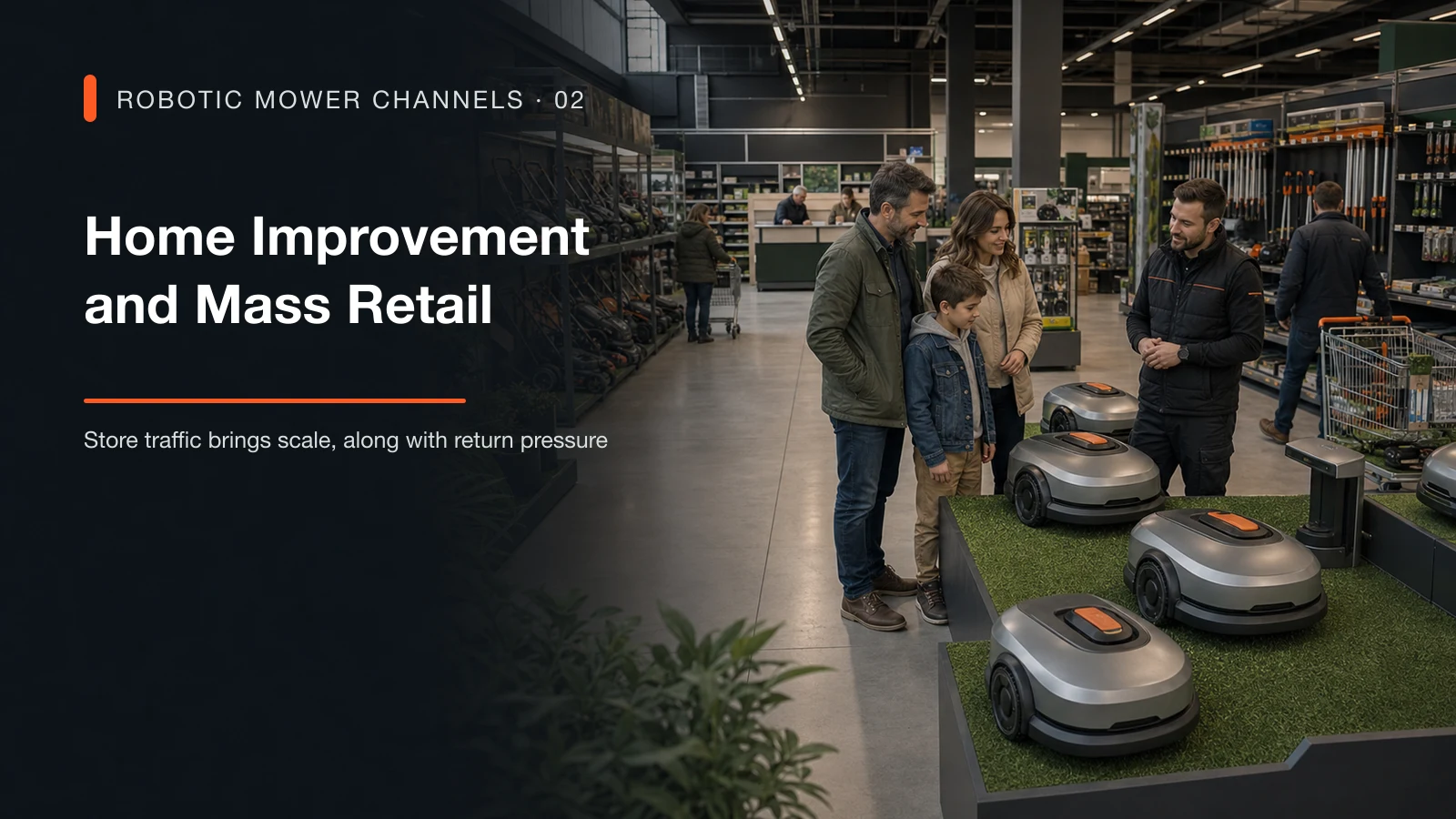
Worx sells through Home Depot and Lowe’s. Greenworks has placed AiMowbot in Walmart, while Mammotion products are available through European chains including BAUHAUS, OBI and Hornbach. Large retail is designed for scale. Consumers already visit these stores for lawn mowers and garden products, so robotic mowers can use the existing foot traffic and trust.
A large chain can buy directly from the brand’s local company or source through a national distributor. The second route adds another margin layer, while the distributor takes responsibility for store replenishment, returns coordination and the financing pressure created by delayed retailer payments.
The main customers are mainstream households and people who are comfortable installing products themselves. They care about price, ease of setup and the ability to return a product that does not fit the property. Many would never search for a robotic mower specialist, but can discover the product while shopping for a conventional mower.
Large retailers buy at a discount and retain the difference between wholesale and retail prices. Brands can also pay listing, promotion, distribution and return costs. The chains provide store exposure and national delivery. A supplier already selling power tools or garden equipment to the same retailer has an easier route for adding robotic mowers.
The commercial terms of Home Depot, Lowe’s and European home-improvement chains are not public. A common industry budget leaves retailers 25% to 35% of the retail price, with another 5% to 12% reserved for promotions, rebates, returns and distribution. On a mower retailing for RMB 6,800, the brand can ultimately receive about RMB 3,600 to RMB 4,800. Higher returns or deeper promotions reduce that amount further.
Retailers focus on sales per store, inventory turnover and return rates. The machine needs to map the lawn with minimal help so that store employees can explain it quickly. If product selection is complicated or yard compatibility varies widely, the questions will still end up with the brand’s customer-service team.
After-sales support is the weak point. A store can accept a return, but it usually cannot determine whether a positioning failure comes from the property, the installation or the hardware. Generous return policies reduce purchase anxiety while turning software problems and poor product fit into reverse-logistics costs. Before entering a large retail chain, a brand needs remote diagnostics, regional repair capacity and a process for handling refurbished units.
3. Amazon and Third-Party Marketplaces
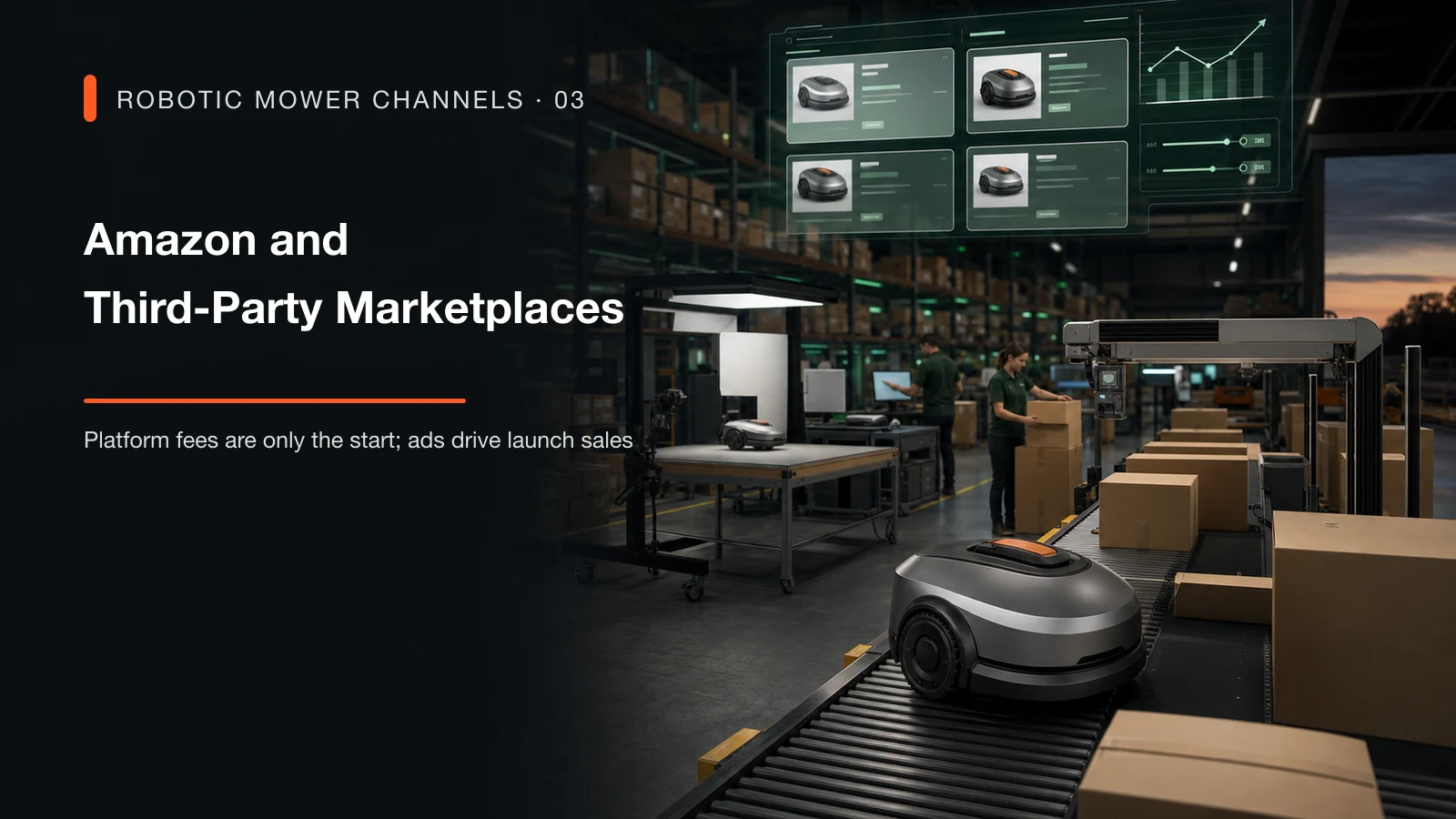
Amazon is often the first stop for a new brand entering Europe or North America. ANTHBOT moved from crowdfunding into regular sales on Amazon. Roborock also used Amazon as the main early US sales channel for its robotic mowers. Mammotion and Dreame treat the platform as an important route to market.
Amazon has an existing audience ready to buy, but it does not give new products free visibility. Without sponsored listings, a newly launched mower will struggle to hold a useful position in search. Without continuing orders and reviews, the ranking can fall again when advertising stops. The platform provides a system in which traffic can be purchased and converted into transactions.
The “official store” a consumer sees is not always operated by the brand. In one country it can belong to the brand’s local subsidiary; in another, a national distributor or authorized seller can run it. The operating entity matters because a distributor-run store needs enough room for distributor profit in addition to platform costs.
Marketplace customers are usually willing to study specifications, read reviews and complete installation themselves. They are accustomed to online shopping and pay close attention to prices and promotions. Products with effective automatic mapping and a simple setup process can gain traction quickly.
Review count and star ratings directly influence conversion, while early feedback can expose product problems quickly. For a brand entering a new country, Amazon is both a sales channel and a public product test.
There are two main operating models. A brand can run its own third-party store and pay commission, fulfillment and advertising costs. It can also supply inventory directly to the platform and let the platform retail the product. Running the store preserves more pricing control but requires the brand to manage traffic. Supplying the platform is simpler, but pricing, promotions and payment terms are more restricted.
Amazon US charges an 8% referral fee for lawn mowers priced above $500. For a mower selling at about RMB 6,800 ($999), the referral fee is roughly RMB 541. If the packed shipping weight is 40 pounds and Amazon handles fulfillment, the basic fulfillment fee is about RMB 165. Together they total roughly RMB 706, or 10.5% of the retail price.
That 10.5% covers only the transaction and basic fulfillment. Amazon sponsored listings use cost-per-click auctions, so the price of a search term changes with competition. A new launch can require advertising equal to 8% to 20% of sales. After storage, returns and service are added, a practical budget for the complete Amazon channel is 20% to 35% of sales. On a RMB 6,800 mower, that is about RMB 1,360 to RMB 2,380.
Walmart Marketplace has a similar structure. Outdoor power equipment priced above $500 also carries an 8% referral fee. Using the same mower assumptions, commission and basic fulfillment total about RMB 688, or 10.2% of the selling price. Advertising, storage and returns are additional.
Many teams treat Amazon’s 8% referral fee as the main cost. In practice, advertising can be heavier than the commission. Robotic mowers also contain batteries and often ship in large packages, so one return can remove a meaningful share of the margin.
Amazon can complete the transaction and delivery, but the brand still has to arrange installation support and repair. Returning a heavy all-terrain model costs more, while battery transport adds handling complexity. Marketplace-first distribution works as a launch route. As sales grow, the brand still needs local spare parts and repair capacity.
4. Brand Websites and Country Stores
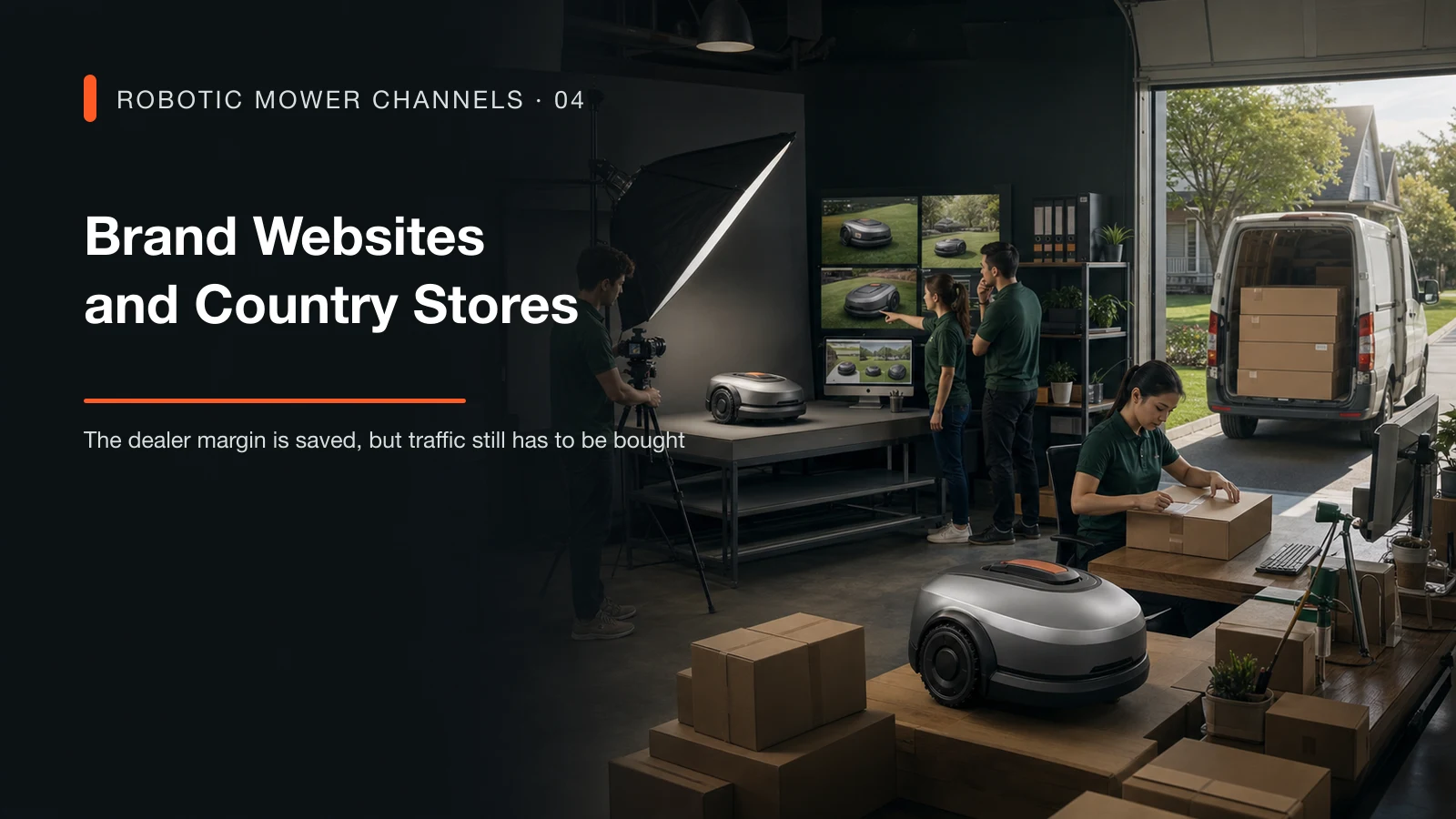
Ecovacs, Navimow, TerraMow, Lymow and Yarbo all use direct sales through their websites. These customers have usually completed some initial research, are willing to choose a model online and can accept remote support. The brand controls prices and bundles while receiving customer information directly.
A brand website does not have Amazon’s purchase traffic. A new product needs Google search, Meta advertising, media coverage and affiliate promotion to bring customers to the page. When spending stops, visits and orders can fall quickly. A meaningful share of the dealer margin saved by direct sales is paid instead to traffic platforms and promotion partners.
A “brand website” is not necessarily operated by the brand’s headquarters. A global site can collect payment for the parent company, while a country store can be operated by the local distributor. The industry calls the first model DTC, or direct-to-consumer sales. The payment entity, invoice and return address usually reveal who is actually operating the store.
The main value of direct sales is the direct customer relationship. The brand knows which models a visitor considered and which accessories were purchased, and it can connect device data with customer-service records. Product upgrades, accessory sales and recall notices become more direct. A website can also test prices and bundles faster than a wholesale system.
Direct sales remove the dealer margin, but the brand must pay for advertising, payment processing, distribution and returns. Local installation is usually outsourced to a service partner, while repairs are handled through mail-in service or authorized centers. The heavier and more expensive the mower, the harder it is to ignore delivery damage and return costs.
Using a common US online payment rate, a domestic card payment of about RMB 6,800 ($999) costs roughly RMB 198, or 2.9% of the order. Payment processing alone makes the direct-sales margin look attractive.
Bringing customers to the website is the larger expense. A new brand or product can budget paid advertising at 15% to 30% of sales, with another 3% to 10% for content and promotion partners. Delivery, returns and service add more. Some categories overlap, but a complete direct-sales budget of 25% to 50% of sales is a practical starting point. On a RMB 6,800 mower, that is roughly RMB 1,700 to RMB 3,400. Brands with existing awareness and a large installed user base can operate at a lower level.
The ability to accept payment only proves that the transaction system exists. Continuing sales still require advertising creative, landing pages, reviews and repeated remarketing. Installation and returns continue to consume money after the machine reaches the customer.
The website should also screen the property before purchase. Lawn area alone is insufficient: tree cover, the narrowest passage and slopes can all change the correct product choice. Filtering out poor-fit orders before payment can reduce both returns and service costs.
5. Commercial Project Sales
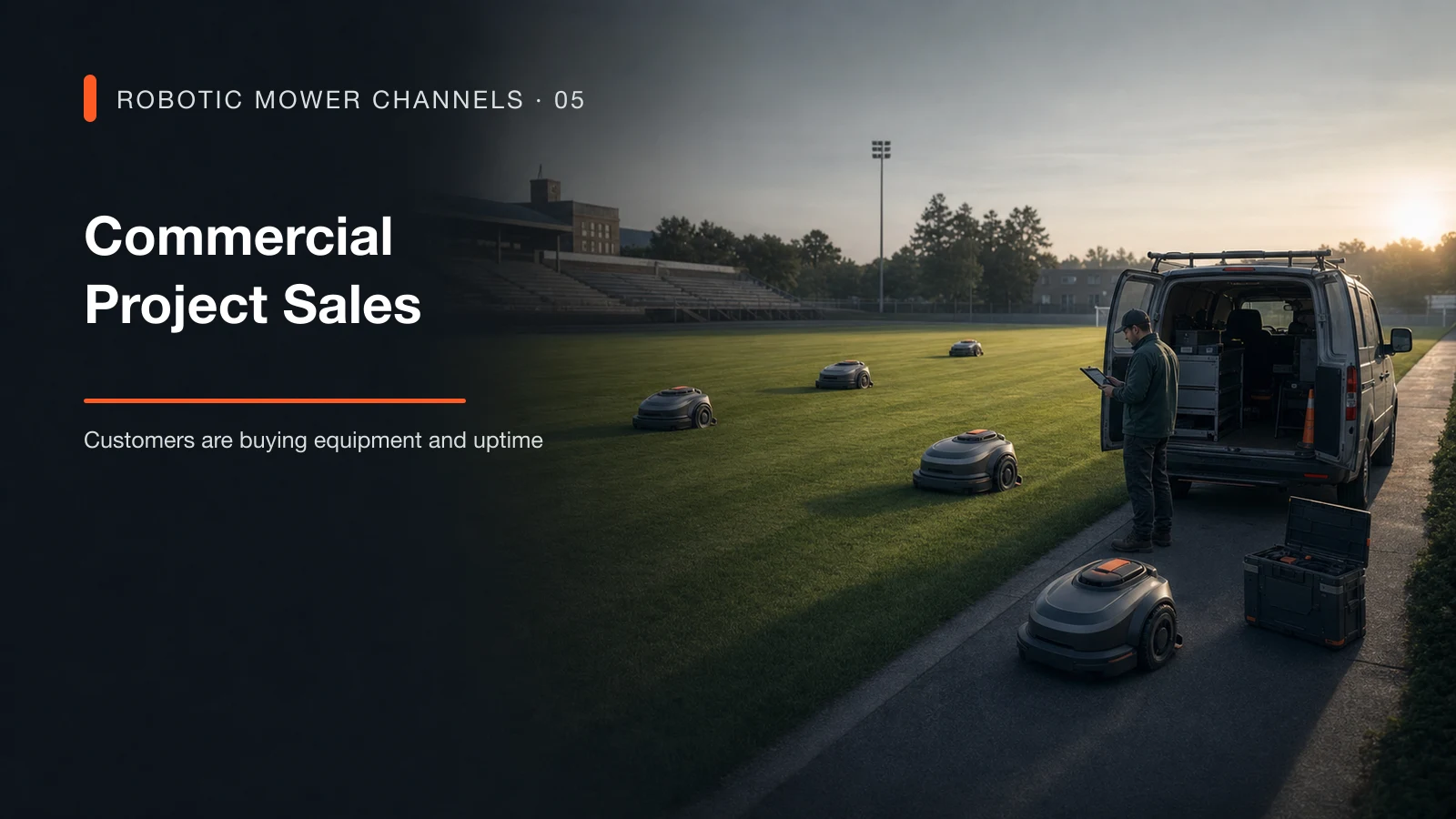
Stadiums, schools, hotels, public institutions and landscaping companies buy robotic mowers through a different process. Professional products from Husqvarna and Kress, as well as Navimow Terranox, depend on demonstrations and project sales.
A project can be sold directly by the brand’s key-account team or pass through a national distributor and a local project provider. An integrator is a company that designs the site solution, installs the equipment and provides continuing service. The party signing the final contract is responsible for the project as a whole.
These buyers first examine whether the machine can cover the site, then calculate labor savings and downtime risk. Larger purchases often require a trial. The sales cycle can last for months, and the final contract normally includes equipment, installation and service.
The channel can be managed by the brand’s key-account team, a specialist dealer or a landscaping-equipment integrator. The project is normally quoted as a complete package, with installation and annual maintenance added to the equipment price. Fleet-management software can be billed annually, while some customers choose leasing, installment payments or a spare machine. One project can include multiple units, and the sales cycle is longer than for residential products.
A common commercial-project budget gives the dealer or integrator a margin of 15% to 25%. Installation represents roughly 5% to 15% of the project value, while annual maintenance can equal 8% to 15% of the equipment value. More dispersed sites and faster response requirements raise the service cost. A direct sale removes one margin layer, but the brand must then handle the survey, bid and continuing support itself.
Customers require a clear service level: how quickly a peak-season fault will receive a response, whether common parts are available immediately, and whether a replacement machine is available during repair. Fleet management, remote monitoring and operating reports also enter the purchase decision. The mail-in repair model common in the residential market rarely works for a commercial site.
This channel tests long-term operating capacity. A demonstration can show that a machine cuts grass; a full season of operating records is needed to show that the project works. A brand entering the commercial market needs regional service coverage and dealers capable of handling failures across multiple machines.
6. Crowdfunding and Preorders
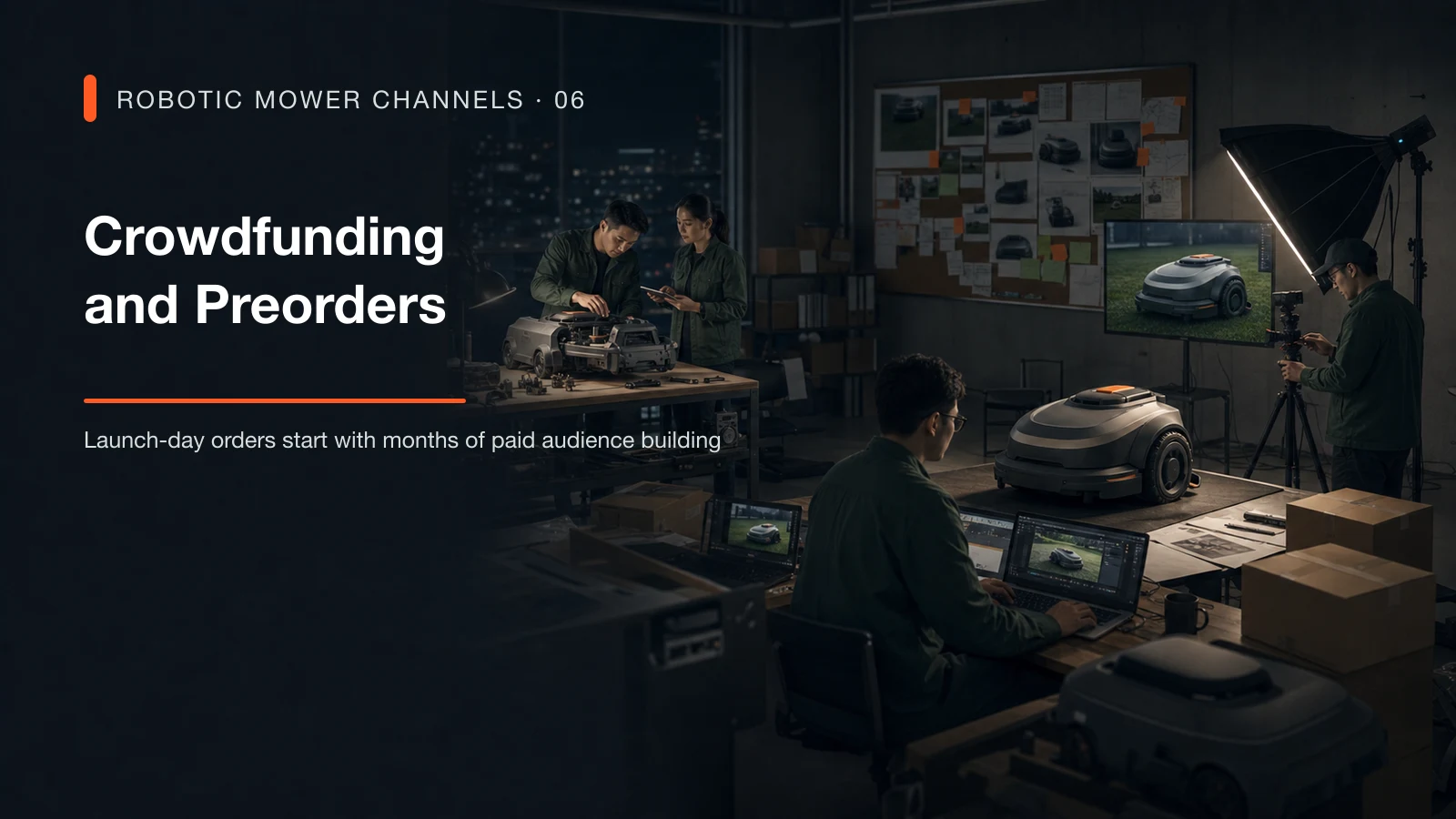
Crowdfunding and preorders are common entry points before a new brand establishes regular distribution. ANTHBOT, Lymow and Yarbo all passed through this stage. A brand presents the product on Kickstarter, Indiegogo or its own preorder page. Consumers pay first and receive the machine several months later.
Crowdfunding platforms rarely provide enough free traffic by themselves. Before the campaign opens, the brand has normally spent months on advertising, content and review units, using a reservation list to create first-day orders. That opening performance then influences platform recommendations and later conversion. Without early spending and audience building, a live campaign page is unlikely to generate continuing orders.
The customers are early adopters. They are willing to try a new product and accept more uncertainty. The brand can use their orders to validate demand, receive cash earlier and modify the product in response to supporter feedback.
Kickstarter charges a 5% platform fee on successfully funded projects, while payment processing normally costs another 3% to 5%. Visible platform and payment costs therefore reach 8% to 10% of funds raised. Pre-launch advertising, content and affiliate promotion can require another 15% to 30%. Together they represent about 23% to 40%, before manufacturing, international delivery, refunds and service.
Crowdfunding brings cash in earlier, but marketing spending also occurs earlier. Once a project is delayed, customer-service and refund pressure continues to build. If a heavy product requires concentrated returns, logistics and compensation can consume the early cash quickly.
Crowdfunding orders arrive in a concentrated launch period and cannot be compared directly with normal retail. Supporters often place orders at once, while a regular channel needs stable sales every month. After crowdfunding ends, the brand still has to decide whether national distributors, Amazon, local dealers or the brand website will carry the next stage.
When all six channels are measured together, “brand shipments into the channel” must be separated from “channel sales to users.” The industry calls these sell-in and sell-out. If a brand supplies 1,000 machines to a national distributor, that is channel inventory. If dealers, retailers and Amazon sell only 400, the remaining 600 are still in stock. Channel performance should therefore be measured by sales to final users.
Most brands do not disclose unit sales by channel, so external data can only provide a reference. In OpenBrand’s US outdoor power equipment retail sample, in-store purchases represented 69% of orders in the second quarter of 2025 and online purchases 31%. Among the national retailers included, Home Depot represented 38% of sampled orders, Lowe’s 30%, Amazon 16% and Walmart 15%. The sample excludes independent dealers and is not limited to robotic mowers. A separate European robotic mower market estimate puts the offline share of 2025 revenue at about 68%. The two sources use different scopes, but both place offline sales close to 70%.
A 100-order budget can illustrate three channel structures. A traditional professional brand can start with 65 dealer orders, 15 large-retail orders, 10 marketplace orders, five website orders and five commercial-project orders. A mature mixed-channel brand can model 35 marketplace orders, 20 website orders, 25 large-retail orders, 15 dealer orders and five commercial-project orders. For a new e-commerce-led brand, marketplaces can reach 55 orders, the website 30, established retail and dealers about 10, with the remainder coming from crowdfunding or other routes. These are planning models for staffing, inventory and costs, not the actual sales mix of any named company.
Few brands now rely on a single channel. Navimow combines its website, online stores and authorized outlets. Mammotion has expanded from direct sales and Amazon into large retail and dealers. Husqvarna separates direct-to-consumer residential products from its professional dealer network.
Mixed distribution offers broader coverage and creates the greatest management difficulty. If the website brings the customer, the retailer completes the transaction and the dealer provides service, each party’s share of the revenue must be agreed in advance. If the website promotion price falls below the dealer’s inventory cost, the local partner has no reason to hold demonstration units and spare parts. A model that requires dealers to provide free visits for online orders is equally difficult to sustain.
Common responses include separate channel models and bundles, standalone installation prices, inventory protection during promotions, and payments to the partner completing the repair. Warranty terms also need to state whether the original seller, a local authorized service point or the brand itself handles the claim. Channel conflict usually begins when responsibility and income sit with different parties.
Europe and North America also require different mixes. Europe is divided country by country, which gives national agents, specialist dealers and home-improvement chains a larger role. North America has Amazon and national home-improvement retailers that can create exposure quickly, while larger and more complex properties preserve a role for specialist dealers. A global “Where to Buy” page cannot replace local delivery and support.
A long list of partners on a website only shows that a brand is building distribution. Who holds the inventory, who pays for returns and who responds during the peak mowing season reveal whether the channel is actually working. Listing the product is only the first step.