- SBD has agreed to sell Excel, primarily the Hustler professional gas mower business, to Bad Boy Mowers; closing remains subject to conditions.
- The company still sees opportunity in outdoor electrification, but is reducing the traditional equipment businesses it operates directly.
- The strategic test is whether retained brands and electric outdoor products gain stronger development and market support.
In 2021, Stanley Black & Decker believed that buying traditional lawn mower manufacturers could help it win the future of outdoor electrification.
Five years later, it still believes in electrification. But it plans to sell Excel Industries, one of the businesses it bought.
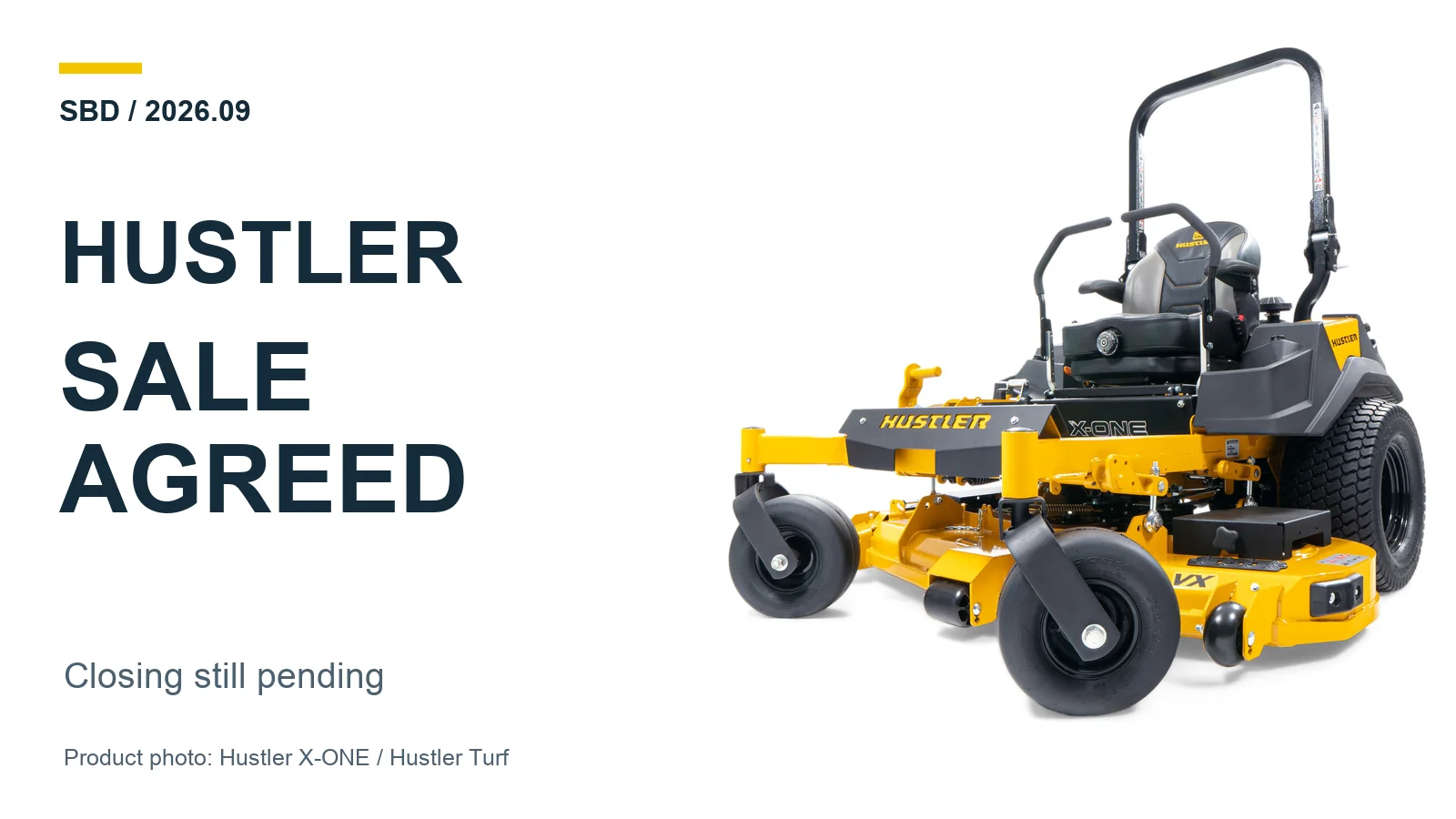
On September 4, Stanley Black & Decker announced an agreement to sell Excel to Bad Boy Mowers. Excel primarily comprises professional-grade, gas-powered ride-on and zero-turn mowers under the Hustler brand and is expected to generate approximately $300 million in revenue this year. The transaction remains subject to regulatory approval and other closing conditions; the price was not disclosed. In the same announcement, the company emphasized its continued investment in electric outdoor products and high-performance residential ride-on and zero-turn mowers. Sale announcement
The apparent contradiction reveals a different calculation about the outdoor business. Electrification is still worth pursuing. Whether that requires owning so many traditional equipment operations is now open to reconsideration.
The original acquisition logic was persuasive. Stanley Black & Decker owned DEWALT, CRAFTSMAN and BLACK+DECKER, with capabilities in batteries, motors and cordless tool development. MTD and Excel brought established mower products, manufacturing capabilities and dealer networks serving professional customers.
In 2021, the company completed its purchase of the remaining 80% of MTD and its acquisition of Excel for a combined price of approximately $1.9 billion. It described the acquired operations, together with its existing outdoor business, as a growth engine with approximately $4 billion in annual revenue, explicitly setting out to lead outdoor electrification. 2021 acquisition announcement
The approach was to buy the pieces needed to compete, then bring its electric technology into the mix. Compared with building mower brands and dealer networks from scratch, acquisitions appeared to offer a shortcut. Traditional gas products could keep generating revenue to support new product development.
There was a condition attached to that logic: the company needed enough time and capital to run the existing businesses well while building the new ones.
That breathing room soon disappeared. By the second quarter of 2022, group inventory had reached $6.6 billion. With demand weakening, the company sharply curtailed production and launched a cost program intended to generate approximately $2 billion in pretax savings within three years. The inventory problem cannot be attributed entirely to the outdoor acquisitions, but the newly purchased businesses had to join the group's effort to reduce inventory and costs. Q2 2022 results
The scale that had looked attractive at acquisition also meant more products, factories and inventory to manage when demand fell. The potential benefits of electrification lay ahead; the cost of owning the full operation was incurred every day. Cash and efficiency became the immediate priorities.
After several years of adjustment, the company began to recover. In the second quarter of this year, Tools & Outdoor organic revenue grew 3%, primarily driven by power tools in U.S. channels. Whether that recovery could last was the question in our earlier earnings analysis. Q2 2026 results
The Excel sale adds a new signal: improving operations have not persuaded Stanley Black & Decker to pick up its old expansion plan where it left off.
The company had already decided to move gas-powered walk-behind outdoor products from manufacturing to a brand-licensing model. It now plans to sell the business centered on Hustler. The first move reduces its direct involvement in manufacturing; the second would transfer ownership of the business. Investor presentation
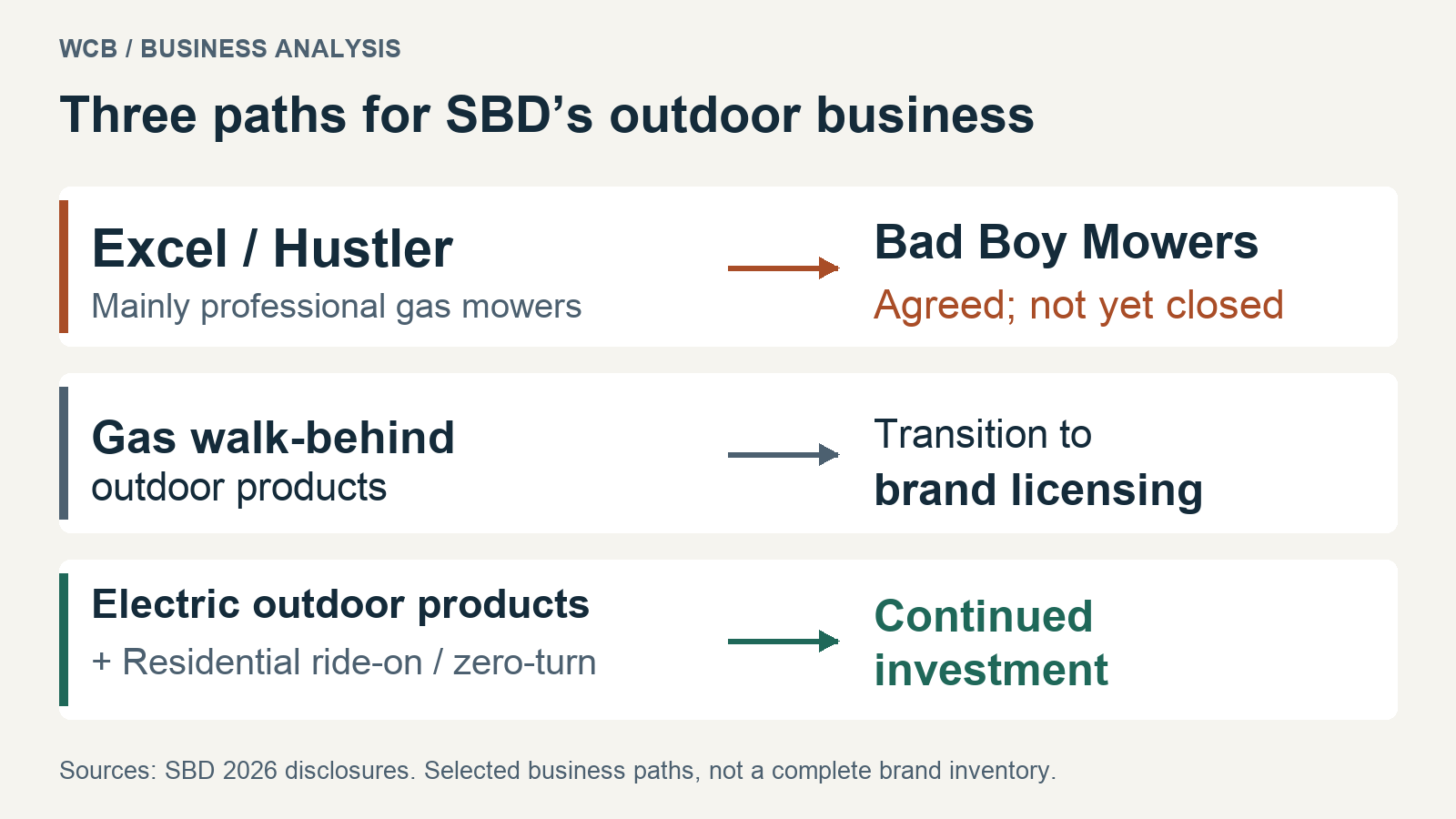
Both steps narrow the traditional outdoor operations it runs directly. The retained portfolio includes brands such as Cub Cadet, residential ride-on mowers and the electric outdoor products management continues to favor. The company is making different choices about assets it once brought together.
To me, that is what makes this sale worth examining. Battery technology can be applied to different products. Technical compatibility, however, does not guarantee that every business will earn a sufficient return under the same corporate roof.
Professional gas mowers have their own customer requirements and service networks. Running that business well requires continuing investment in products and dealer support; progressively electrifying it requires additional investment. Within a group managing many tool brands, the business has to compete with other projects for capital and management attention. Revenue and an established name do not necessarily make it the highest investment priority.
Bad Boy's willingness to acquire Hustler also prevents a simple reading of the deal as evidence that gas equipment has lost its value. The same operation may have a different value to a mower-focused company than to a large tool group. Without a disclosed sale price and a full account of returns over the ownership period, we cannot yet say whether Stanley Black & Decker ultimately made or lost money on the acquisition. It has, however, decided against keeping the original combination intact.
Alongside the sale, the company is reinvesting in capabilities it already possesses. In August, it announced plans to invest $1 billion in the United States through 2028, with approximately half going to research and development. That month, DEWALT also expanded its cordless carpentry lineup, adding tools such as a track saw, sanders and nailers to an existing battery platform. Those moves do not establish where proceeds from an Excel sale would go. They do show the company seeking growth through existing brands and product development. Investment plan, DEWALT product announcement
Five years ago, Stanley Black & Decker was willing to buy a broad outdoor operation and wait for electrification to unlock its value. Today, it appears to be applying a stricter test to the cost of that wait. Confidence in a market and a commitment to owning every business within it are being considered separately.
Cub Cadet and electric outdoor products now face a more direct test. They need to show whether a narrower business receives stronger support for product development and market competition. If the retained brands can bring products that customers want to market faster, the sale will have become part of a growth strategy.
*Cover product photograph: Hustler X-ONE, Hustler Turf. Editorial layout and business diagram: World Clean Biz.*