- DEWALT’s turnaround came from sharper professional positioning.
- Brand architecture and channel focus can change the fate of a mature tool business.
- The case is useful for appliance brands trying to move beyond generic product competition.
"Joe, I like these friends of mine, but give Makita 10 feet of space; I will give you the same amount of space. Their sales are eight times yours. How do we make this work?"
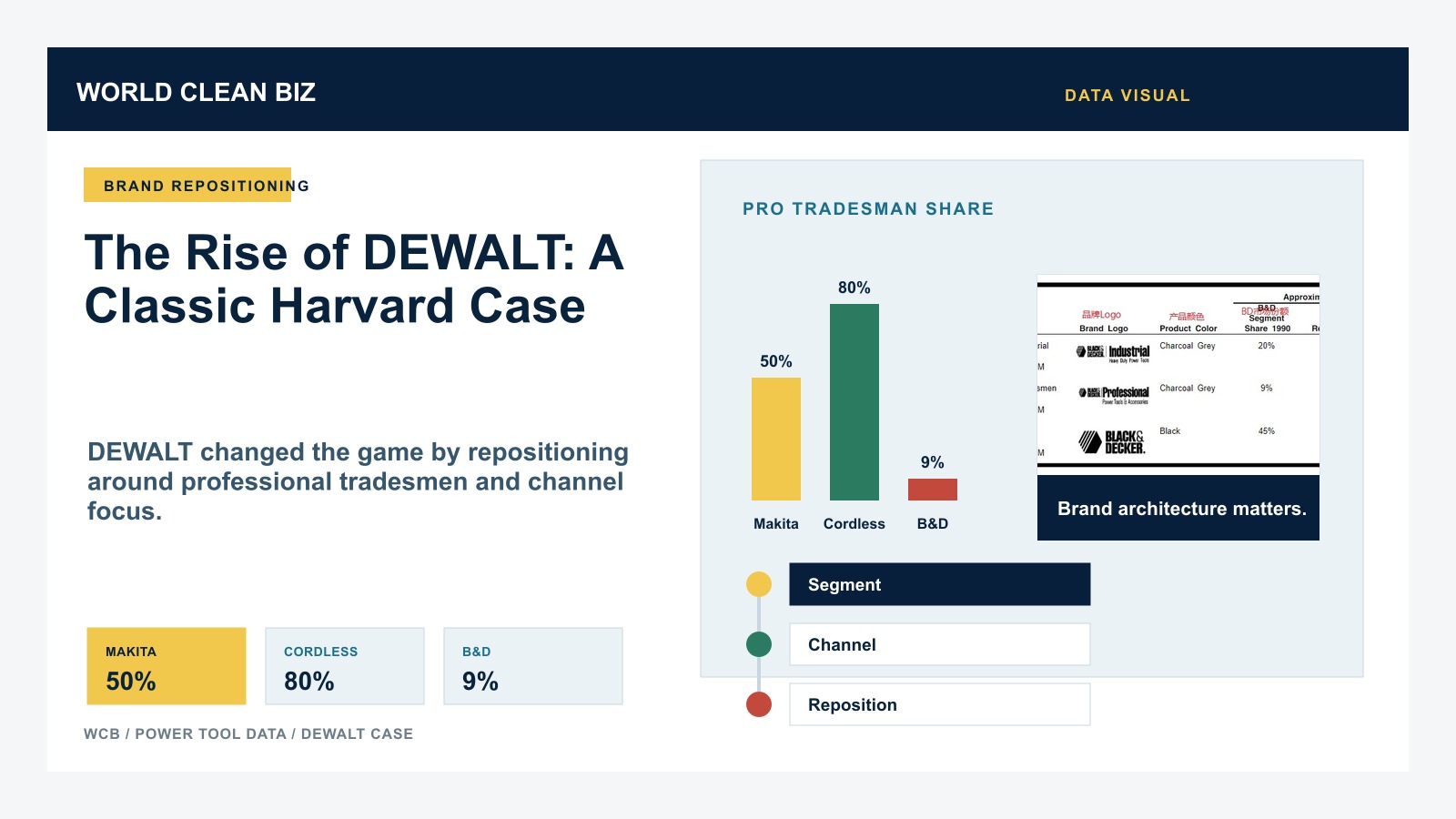
Such comments from channel partners no longer surprise Joseph Galli, who was then the Vice President of Sales and Marketing at Black & Decker. Makita, a Japanese manufacturer of power tools, has dominated the professional tradesman market for over a decade, holding 50% of the share in this segment. Additionally, Makita holds an impressive 80% share in the category of cordless drills.
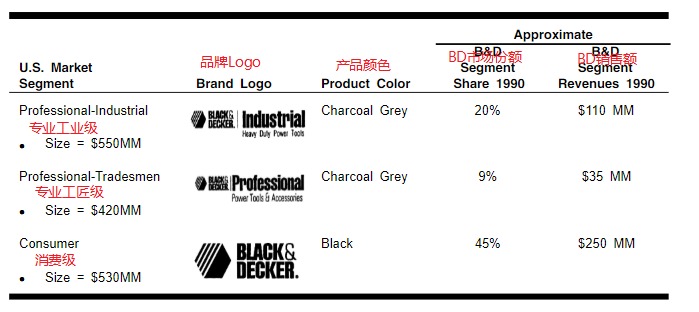
The power tool market is divided into three segments:
- Consumer: For general household use by ordinary consumers.
- Professional Industries: Used by professional users, typically purchased by certain professional companies for their employees.
- Professional Tradesman: Also used by professional users but differs from industrial-level tools in terms of the user. These are individuals who purchase and use tools to earn a living, such as plumbers, carpenters, etc.
Makita currently holds 50% of the market share in the professional tradesman segment and an astounding 80% in the category of cordless drills. In contrast, Black & Decker, a brand that has been pioneering the American power tool industry since 1910, leads in both consumer and professional industries with top market shares but only holds 9% in the new professional tradesman segment.
By 1990, the portable power tool market was valued at $1.5 billion, ranging from cordless screwdrivers used occasionally at home to circular saws that are constantly utilized on construction sites. The market landscape looked like this:
Non-professional market sales amounted to $530 million, accounting for 35% of the market share. Consumers typically purchase such products from large retailers like Walmart and Kmart.
The professional tool market for electric tools is divided into "professional industrial grade" and "professional craftsman grade." The professional industrial grade segment has a market size of $550 million. This market is primarily composed of commercial contractors, where distributors (such as W.W. Grainger) play an important role. Distributors can specify the requirements for contractor tools and recommend specific brands. With a stock of 32,000 products, Grainger can deliver to contractors in the shortest possible time.
In this market, it is the company that procures and owns the tools (rather than employees).
The professional craftsman grade targets individual tradespeople such as electricians, plumbers, carpenters, farmers, etc. These individuals typically carry their own tools to work locations. Consumers in this segment tend to purchase from emerging channels like Home Depot, Lowe's, Ace, and others. In 1990, the professional craftsman grade market was the smallest of the three markets with sales of $420 million but had the fastest annual growth rate at 9%, compared to a 7% increase in the consumer-grade segment and no growth in the professional industrial grade segment.
Black & Decker is deeply involved in all three markets. The Black & Decker brand holds a 30% share of the overall electric tool market. As shown below, the company uses different brands for each of these distinct markets.
In the professional industrial market segment, Bosch's share is comparable to that of Milwaukee Electric Tool, a private company founded in 1924, which operates exclusively in the high-end market and generates annual global sales of around $200 million. The second-tier suppliers include DeWalt, Porter Cable, and Makita. In this professional industrial classification, discerning purchasing opinion leaders believe that Bosch offers premium quality, differentiated products, and excellent service.
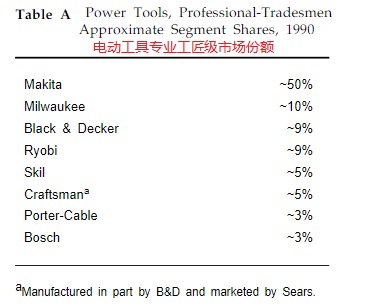
Bosch's leading advantages in both the industrial and consumer markets have not translated into significant market share in the craftsman segment. As of 1990, the market shares among major brands in the professional craftsman segment were as follows:
Drills, saws, and polishers account for 80% of sales in the professional craftsman market. The top three manufacturers each offer approximately 175 SKUs. Since entering the market in 1978, Makita has effectively held a leading position in all products within this segment. As shown in Figure 1 below, this is Makita's market share.
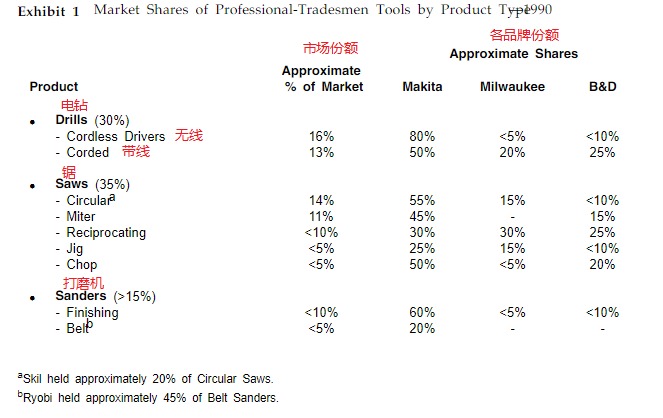
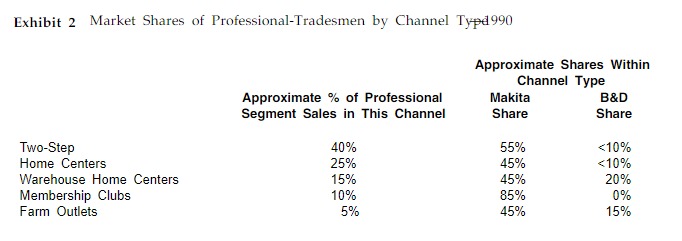
Figure 2 Market Share of Makita and DeWalt in Five Major Channels.
On a Monday morning, Galli's boss, Gary Dicamillo, President of Black & Decker Power Tools in the United States, recounted this story to Joe:
"Joe, yesterday I visited a new Home Depot. The afternoon was sunny with many people in the store. A guy similar to a carpenter gave demonstrations for several hours at the aisle entrance to customers using a Skil saw. When I arrived around 4 PM, he was packing up to leave.
I asked him, 'How do you feel about the Skil saw?' He replied, 'It's very good.' 'What other brands do you like?' I inquired. He responded, 'Oh, Milwaukee makes great reciprocating saws, and Ryobi has some good stuff too.' 'And Makita?' he said, 'They're okay; they are indeed very good, but you just need to stay away from Black & Decker.'"
Although the "stay away from Black & Decker" view might be a bit extreme, Galli understood that as a consumer brand leader, Black & Decker could not benefit in the professional craftsman market. Some individual contractors viewed all Black & Decker products as household items rather than tools for making money.
Typical plumbers, electricians, and remodelers would spend $3,000 on 10 tools and another $1,000 annually on tool replacements. Tools and their performance are constant topics in the workplace. Overall, individual contractors were generally satisfied with the tools they could obtain—based on Makita's superior product quality across various products and other suppliers' strengths in specific areas, such as Skil's circular saws.
As shown in the above chart 2, consumers most frequently purchased from independent stores that provided services through distributors like Two Step. However, Home Centers also grew very rapidly. For instance, in 1990, the largest single professional craftsman-level discount store for power tools was Home Depot, with sales of $5 million, and second place was Home Clue at $3.5 million. Home Depot was the largest and fastest-growing chain store in home improvement markets, with 145 stores and $3.8 billion in sales. Home Depot's strategy involved selling 30,000 model products across a 100,000-square-foot store at prices 30% lower than traditional tool shops while providing excellent service. Makita's market dominance was also attributed to the rapid development of new distribution channels.
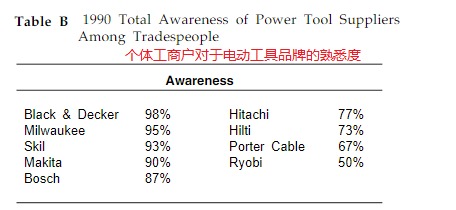
Black & Decker conducted research on how professional craftsmen perceived various brands in the professional market.
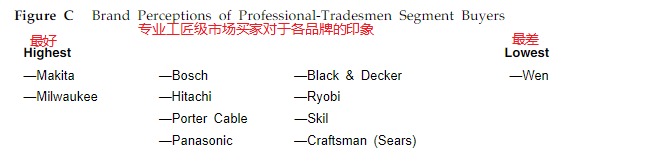
Milwaukee and Makita are priced 10% and 5% higher than Black+Decker, respectively. Although they are more expensive than Black+Decker, some of Makita's product pricing is less than half the price in its home market of Japan. In the Japanese market, Makita follows Hitachi as the second-largest brand by market share. Makita’s low-price strategy later became a factor in its anti-subsidy lawsuit in the United States.
While Makita maintains a stable position among individual retailers, not all retailers are equally fond of the brand. Some describe them as "arrogant and dictatorial." Makita does not provide product protection to channels, selling identical products across different channels, including discount membership stores—exactly where Black+Decker excludes professional-grade tool products.
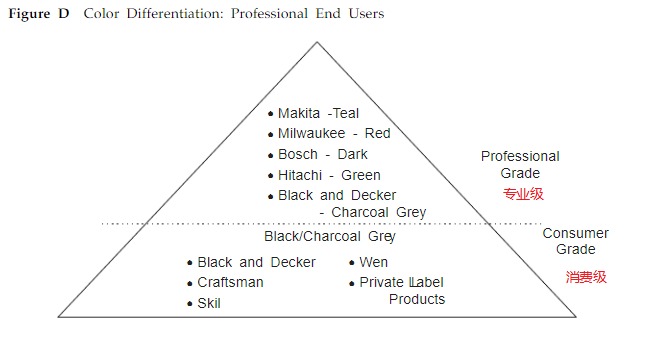
Although no individual retailer would explicitly cite color as a decisive factor in their purchasing decisions, color is widely recognized as an important aspect of differentiation. Consumer-level electric tool manufacturers largely follow Black+Decker’s style from 1981, with black or charcoal gray being the predominant colors. Black+Decker's strategy was to use black for consumer-grade tools and charcoal gray for professional industrial and craft-grade tools. Competitors in the professional tool market have very different color schemes:
Product Development
Since 1985, product development has been at the core of Black+Decker's focus, and its tools have received high praise in professional industrial markets. This is why Galli believes that Black+Decker does not hold a significant share in the professional craftsman market due to quality issues; this notion was upheld through two methods. First, Black+Decker conducted performance, reliability, and durability tests on both their own products and those of competitors in their laboratories. Their products consistently ranked among the top.
Second, extensive field testing was carried out. All products (both Black+Decker's and its competitors') with identifiable appearances and colors were anonymized. These products were used under actual working conditions for a month, after which users submitted feedback on product usage. Additionally, their interest in purchasing new products when replacements were needed was assessed. This field test also supported the results from the laboratory tests, indicating that Black+Decker's products are highly competitive across a wide range of categories.
Brand Image Survey via Telephone Interviews
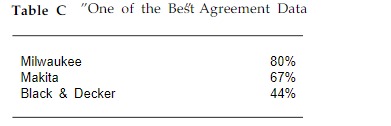
Respondents were also asked which brand is the best, with 80% of those surveyed considering Milwaukee to be the top brand.
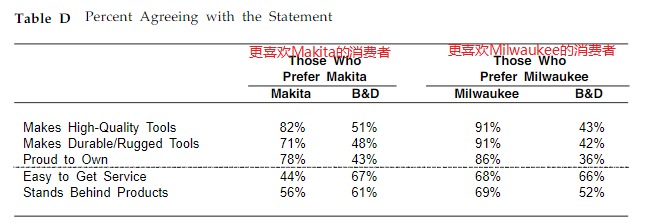
Another survey showcased consumer preferences between Makita and DeWalt as well as Milwaukee and DeWalt.
After obtaining these market surveys and tests, Galli recalled some comments from several individual merchants:
"Black+Decker makes great popcorn machines; my wife likes her vacuum cleaner, but I need to rely on these tools for a living."
"When working, others will notice what tools you use... If I pull out some Black+Decker branded tools somewhere, they would laugh at me."
Galli clearly understands that mimicking strategies, such as painting the products blue and spending advertising fees in professional craftsman markets to promote the Black+Decker brand, would not gain internal support. Currently, there are three strategies:
Strategy 1: Harvesting the Professional Craftsman Market
This strategy involves focusing Black+Decker on consumer and professional industrial markets while only considering profits for the professional craftsman market without worrying about market share.
Strategy 2:
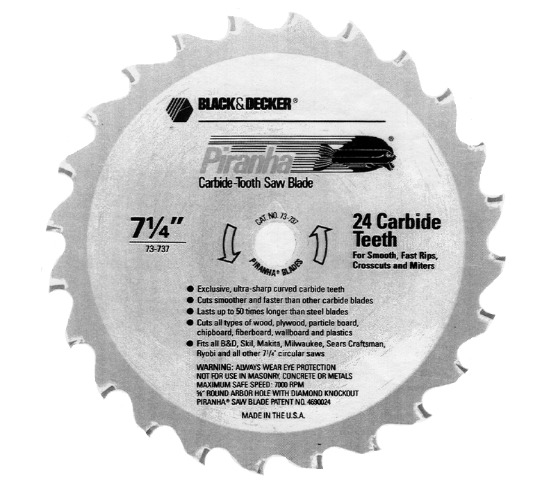
Previous attempts to re-establish the Black+Decker brand in the craftsman market have all failed. A new direction is now being considered, which involves replicating the successful sub-branding strategy used on the Spacemaker product line. Galli has also utilized this strategy when introducing the "Piranha" brand circular saw.
Strategy 3: Abandon the Use of Black & Decker Brand in Professional Craftsmanship Markets
Galli can imagine the reaction his colleagues would have at an internal meeting if he proposed this idea. Everyone is proud that the "Black & Decker" brand ranks seventh on the brand list. One of his colleagues challenged him, saying, "Joe, it doesn't make sense to remove the name of the inventor of power tools from the industry. You're suggesting Black & Decker can't produce good power tools. Moreover, if General Electric can apply its brand across everything from aircraft engines to telephones, why can't we?"
If Black & Decker is indeed to be abandoned, a suitable alternative would be Dewalt, which was founded in 1918 and acquired by Black & Decker in 1960. Dewalt is a leader in stationary woodworking equipment, with annual sales reaching up to $70 million. The main issue currently is that the Dewalt brand has never been used for portable power tools.
According to surveys, Dewalt has a 70% brand awareness rate. Most customers who know about Dewalt have high evaluations of the brand. Additionally, in craftsmanship excellence comparisons, Dewalt holds a 63% advantage.