- Galli brings experience in professional brands, cordless platforms and building international teams.
- EGO, SKIL and FLEX give Chervon several paths to growth; a Milwaukee-style strategy need not mean betting everything on FLEX.
- Chervon’s 2025 revenue was less than one-ninth of TTI’s or SBD’s, leaving a substantial gap to close.

One of Joseph Galli’s earliest tool showrooms was inside a van.
After graduating from college in 1980, he joined Black & Decker as a salesman covering North Carolina. He fitted a display wall of tool accessories inside his vehicle. On hot afternoons, he would invite hardware-store managers aboard for a cold soda and a look at the products. Forbes later recorded the detail.
More than four decades later, the salesman who worked his way up from the field has taken the chief executive’s job at Chervon.
On September 10, 2026, Chervon announced Galli’s appointment, effective immediately. Founder Peter Longquan Pan relinquished the CEO role while remaining chairman and an executive director. More than two years had passed since Galli retired from Techtronic Industries, or TTI.
Before that retirement, he had helped relaunch DeWalt in professional power tools and spent years leading TTI, working with its teams to expand Milwaukee. The two brands are now central to Stanley Black & Decker and TTI, respectively.
At Chervon, he will be challenging an industry order he helped create.
In the early 1990s, Galli faced a particular problem at Black & Decker: enormous name recognition had failed to translate into comparable standing among professional tradespeople.
The brand was too closely associated with household products. For someone who earned a living with tools, the name used at home was not necessarily the first choice on a jobsite. Black & Decker could manufacture professional tools. Performance alone struggled to overcome that perception.
The company had another name available: DeWalt.
Founded in 1924 and acquired by Black & Decker years earlier, DeWalt offered a way back into the professional market. Galli helped put that name to work. In 1992, a range of yellow-and-black power tools reached the market, creating distance from Black & Decker’s household identity.
The launch was called Operation Sudden Impact. The team assembled a full range of tools and accessories and assigned 75 people from the existing organization to sell DeWalt exclusively. A customer encountering the brand for the first time could already see a complete product line.
The mobile demonstrations Galli had used early in his career reappeared in the rollout. A program called Wolfpack took demonstration vehicles onto construction sites so workers could try the tools. Free maintenance, repair-turnaround commitments and loaner tools helped reduce the disruption caused by equipment failures.
Yellow and black became DeWalt’s most recognizable asset. Products, a dedicated sales force and service stood behind it. Galli had helped reorganize Black & Decker’s existing capabilities into a business professionals were willing to buy from.
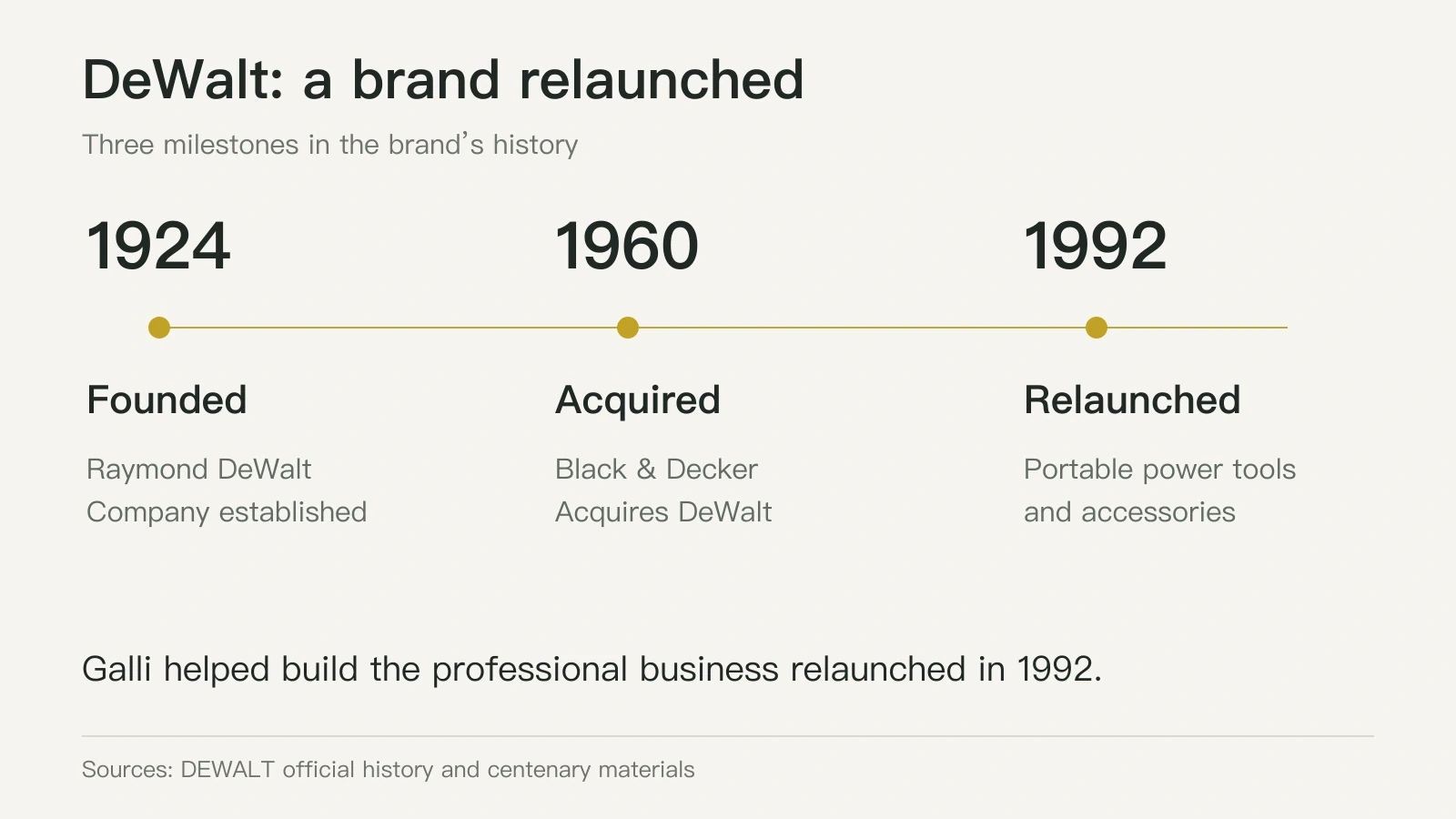
After leaving Black & Decker, he held senior roles at Amazon and Newell Rubbermaid. He joined TTI in 2006 and became group CEO in 2008.
Milwaukee was already part of TTI. Its acquisition in 2005 preceded Galli’s arrival. Steve Richman, who began leading Milwaukee in 2007, was another central figure in the brand’s subsequent growth. Galli’s task was to work with these teams to turn existing technology and brand assets into a much larger business.
TTI had revenue of about $3.412 billion in 2008 and was still restructuring and reorganizing production. One of Galli’s stated responsibilities was to integrate acquisitions in North America and Europe and expand the global sales potential of the group’s brands.
Years later, he recalled the direction he and founder Horst Pudwill had chosen with undiminished aggression.
At an earnings presentation in March 2024, Galli said their agreement had been to recruit exceptional people and make cordless technology the company’s priority. In his telling, some investors questioned the concentration of resources: if cordless products represented only part of the market, why focus so heavily on them?
His answer was that this was like asking Steve Jobs, as he launched the iPhone, why he was not making payphones and fax machines.
He then directed the audience’s attention to the products in the room: power tools, lawn mowers and vacuum cleaners, all cordless.
Galli could make a strategy sound like a clear choice and then explain it through products. As Milwaukee expanded its cordless platforms, a customer who had bought a first tool and battery could buy the next tool without another battery. Adding equipment became less expensive, and staying with the brand made more sense. One order could lead to years of further business.
His work extended beyond Milwaukee. Ryobi’s consumer tools and outdoor equipment were important to TTI’s strategy as well. Separate brands served professionals and households, giving the group a wider customer base. He also kept investing in people who could make that model work in different countries.
By 2023, the last full year before his retirement, TTI’s revenue had reached $13.731 billion. Galli had helped build a large multinational tool group.
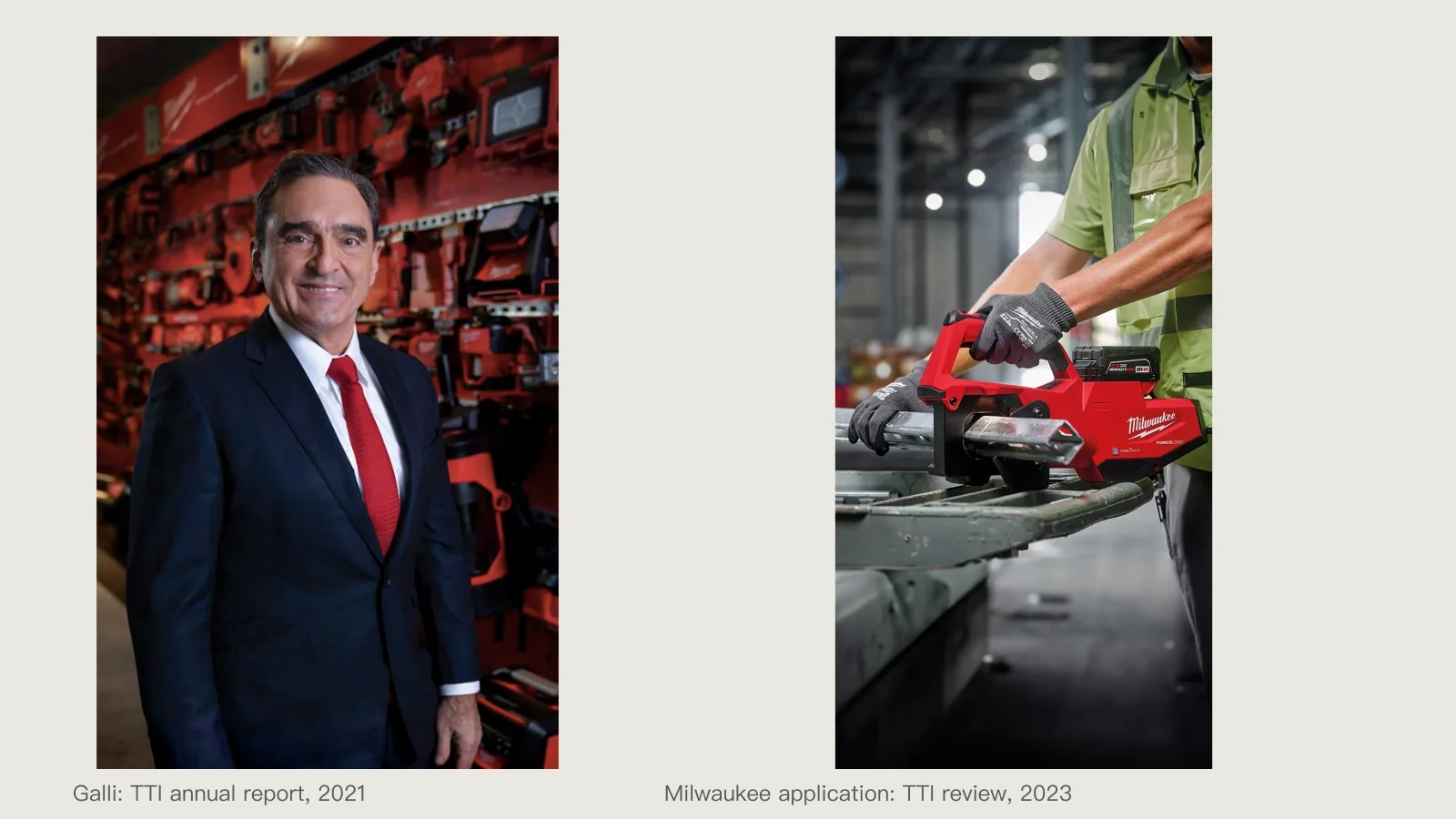
*Left: TTI 2021 annual report. Right: TTI 2023 annual review. These are separate photographs, not one scene.*
In rising from frontline sales to president and CEO roles at several companies, he had seen the whole journey from factory to shelf to customer. He understood products and selling—and what had to happen after a tool was manufactured for it to become a substantial business.
An executive of this kind can shape a company almost as deeply as a founder. He can influence product direction and bring together people capable of putting those choices into the market. Galli founded neither DeWalt nor Milwaukee, but he helped change their positions in the industry.
Today’s Chervon recalls the TTI he once took over.
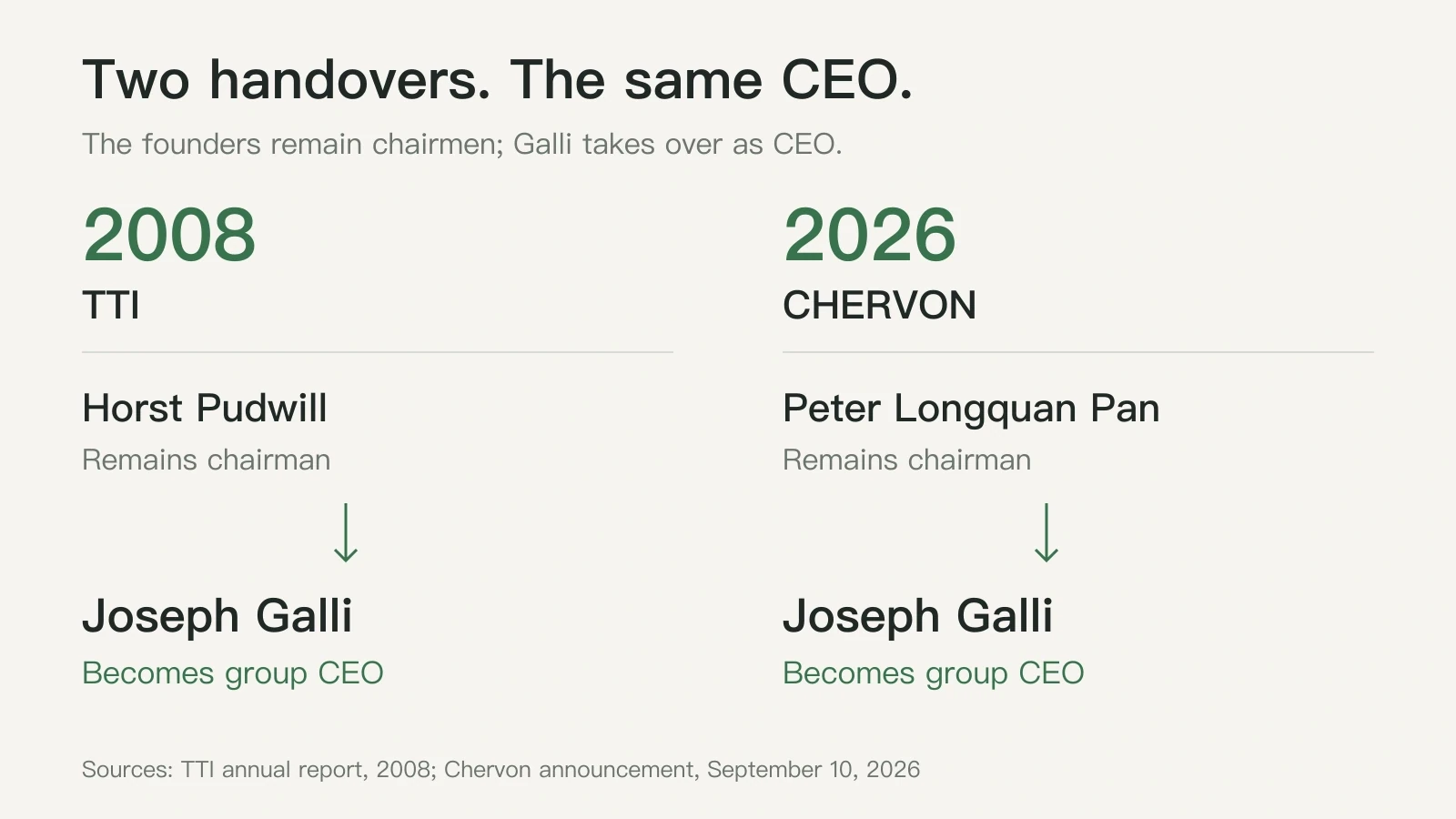
In 2008, Pudwill handed over the CEO position while remaining chairman. Galli took responsibility for running the group. Eighteen years later, Pan has made a similar arrangement.
Chervon, too, has assembled assets with room to grow. Revenue in 2025 was about $1.628 billion, with owned brands accounting for 76.7%. More than three-quarters of sales at this Chinese company, which grew out of manufacturing, now came from its own brands. After revenue declined in 2025, first-half 2026 sales rebounded 12.8% to about $1.029 billion.
Galli does not have to build engineering, manufacturing or distribution from scratch. EGO has already demonstrated that Chervon can build an internationally competitive brand. FLEX and SKIL provide additional foundations for expansion. His job is to take these assets into a larger market.
That also helps explain Chervon’s appeal. A much smaller company might require years of basic construction. An established giant might leave less room to change its direction. Chervon has enough substance to work with and enough space still open.
Galli has worked with a founder before to turn a comparable set of capabilities into a global tool group. He now has an opportunity to do it again.
A figure of his standing is also a rallying point.
Former employees, channel partners and suppliers form a network built over many years. His arrival will likely prompt people to ask about opportunities at Chervon and partners to reconsider the company. An introduction that once required repeated approaches may now begin with the other side making the call.
Good managers choose colleagues as well as employers. For those who know Galli and respect his record, his presence is a powerful reason to consider joining. The same applies to distribution: he can help Chervon reach the people who actually make decisions. Recruiting and relationship-building have a chance to accelerate.
The United States will be Chervon’s most important competitive battleground. It is where Galli built his strongest brand-management record and where longstanding relationships could produce results fastest. Chervon’s existing products and brands give him something concrete with which to compete for DeWalt, Milwaukee and Ryobi customers, shelf space and talent.
His arrival makes the possibility of Chervon becoming the next TTI more real.
The ambition on both sides clearly points toward the top of the global tool industry. In 2025, TTI and SBD generated group revenue of approximately $15.260 billion and $15.130 billion, respectively—each more than nine times Chervon’s. Beyond those two, Bosch Power Tools, Makita and Hilti, along with outdoor-equipment companies STIHL and Husqvarna, also have larger businesses.
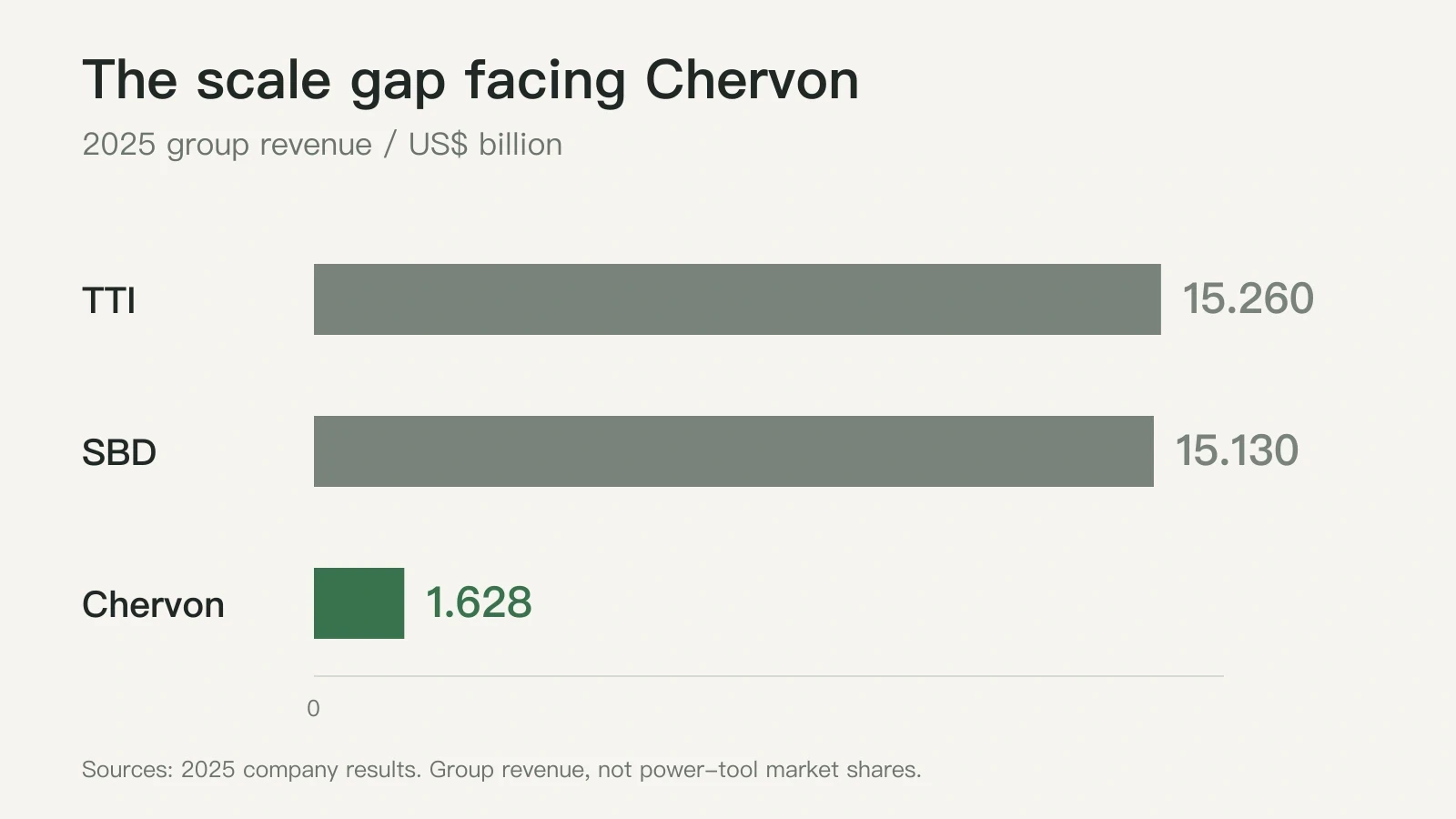
*Group revenue, not a ranking of power-tool market shares. Business portfolios differ.*
Chervon must climb past a succession of established multinationals. Yet Galli may not put every available resource into FLEX simply to recreate Milwaukee.
EGO already has advantages. SKIL is entering more retail channels. Both offer opportunities to expand. Chervon has been developing commercial outdoor equipment and robotic mowers while extending SKIL’s reach through Walmart and Tractor Supply. Those initiatives predate Galli. His first task will be to turn investments already made into more sustained growth.
SKIL could matter more than outside observers expect. It has brand recognition and can use Chervon’s products and manufacturing to reach more customers. Galli’s experience running TTI’s consumer business is relevant here. Chervon does not have to wait for FLEX to succeed before increasing the group’s scale.
FLEX faces a harder assignment. Professional users often already own another brand’s tools and batteries. They need a compelling reason to add a new platform. A more practical route is to concentrate investment in professional applications where the brand has a foundation, retain a core of users and then broaden the range. Matching Milwaukee across the board can be the ambition; it should not be a reason to spread resources evenly from the beginning.
Acquisitions could fill gaps in these businesses. Distribution, service networks or specific professional categories could all offer useful targets. But an important part of Galli’s TTI experience was making acquired brands perform. Chervon already has brands. It needs more of them to become businesses large enough to support the group.
The method most worth replicating is how he helped build a multibrand group at TTI. EGO extending its strengths, SKIL adding scale and FLEX breaking through in professional tools could together bring Chervon closer to the leaders.
For Galli himself, the job is difficult to explain through pay alone.
In 2023, his last full year at TTI, total remuneration reached $32.557 million. He has already earned substantial financial rewards. Another chance to change the industry may be a more powerful attraction in coming back.
If, after DeWalt and Milwaukee, he can take Chervon into the front rank of the global tool industry, his name will appear in the histories of three different companies. That would make him one of the industry’s most consequential and best-known figures.
I see Chervon as the final campaign of Galli’s career. This time, the giants he must challenge are the ones he helped build.
*Reporting sources include Forbes’ 2001 profile, DeWalt’s official history, TTI’s 2008 annual report, TTI’s 2023 annual report, TTI’s 2025 annual report, SBD’s 2025 results, and Chervon’s 2025 results and first-half 2026 results. Cover photograph: Chervon.*