- Milwaukee generated $10.7 billion in 2025, equal to 70% of TTI revenue.
- Its trade-specific development model across M12, M18 and MX FUEL continues to deliver near-double-digit growth while major peers grow more slowly.
- At an 8% to 10% compound annual growth rate, Milwaukee can approach $20 billion around 2032, while roughly $25 billion is a more realistic medium- to long-term ceiling under its current model.
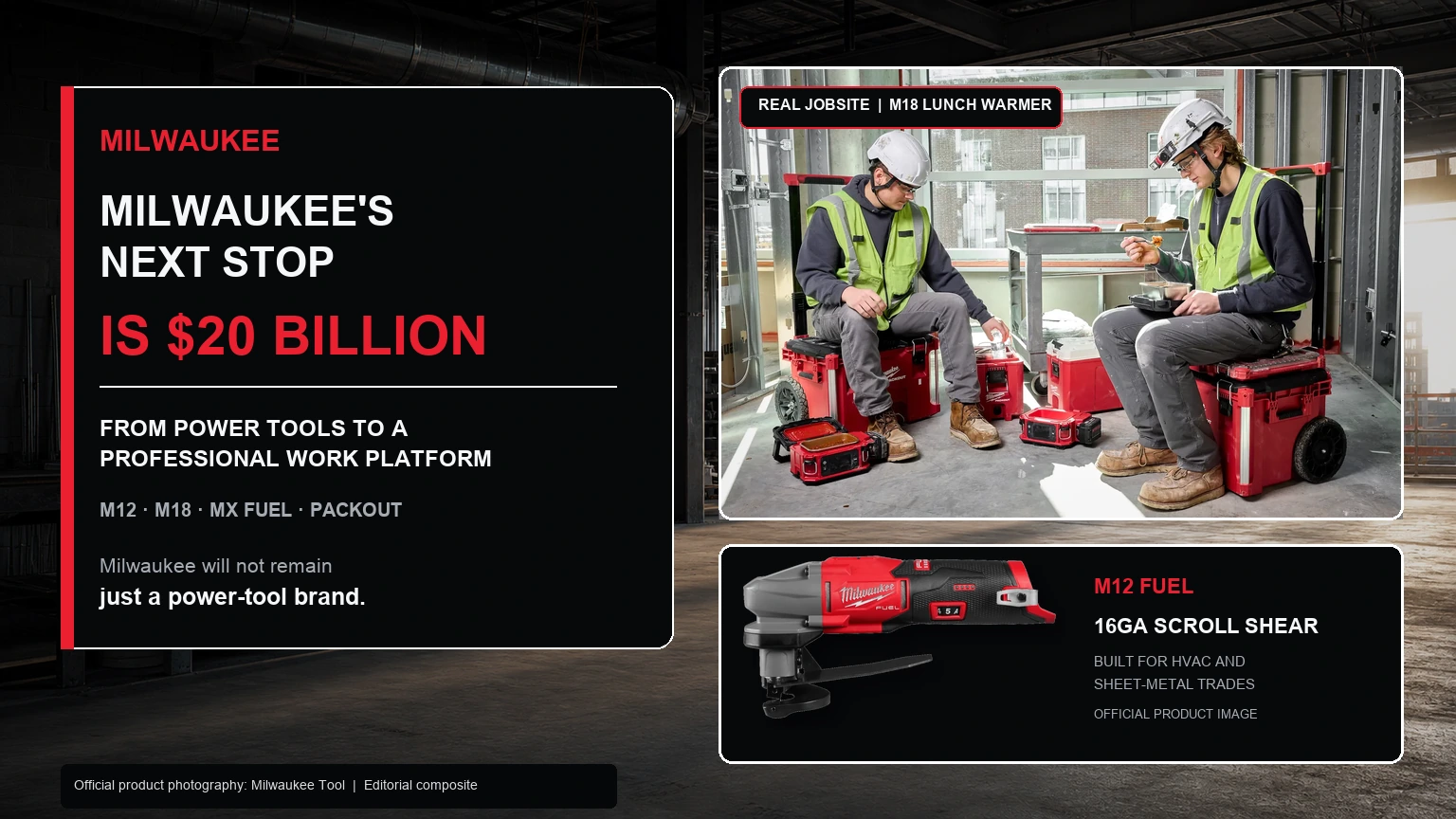
In July 2026, Milwaukee introduced the M18 Jobsite Lunch Warmer, a battery-powered lunch warmer that runs on its M18 platform.
Users can set a mealtime in advance, lock the unit onto the PACKOUT storage system and take it onto the jobsite. Another M12 launch that month was far more specialized: a 16-gauge scroll shear built for HVAC and sheet-metal trades, capable of making tight-radius cuts in metal.
A lunch warmer and a sheet-metal shear have little in common at first glance. Both come from the same product logic. Milwaukee keeps breaking down the professional user's day, from a trade to a task and then beyond the tool itself. Wherever a job involves repetitive work, wasted time or a safety problem, Milwaukee sees an opening for another product.
That development model has kept the company growing at a remarkable pace for more than a decade.
Techtronic Industries (TTI) disclosed in its 2022 annual report that Milwaukee delivered local-currency sales growth of more than 20% for nine consecutive years from 2014 through 2022. Growth slowed as the industry reset after the pandemic, but Milwaukee still expanded 10.7% in 2023 and 11.6% in 2024. Tariffs led TTI to suspend some sales and promotions in 2025, yet Milwaukee grew another 7.9%. Excluding that one-off disruption, growth was 10.3%.
The other major tool companies moved much more slowly. Makita's revenue rose 3.2% in the fiscal year ended March 2026, while Hilti recorded 1.9% local-currency growth in 2025. Stanley Black & Decker does not disclose DeWalt revenue separately; its Tools & Outdoor business declined by about 1.1% in 2025.
The reporting bases are not identical, but the direction is clear. Residential construction and the broader building market remain weak, leaving most tool companies at low-single-digit growth. Milwaukee continues to expand at close to a double-digit rate.
It has moved beyond being TTI's most important brand. Milwaukee has become the group itself.
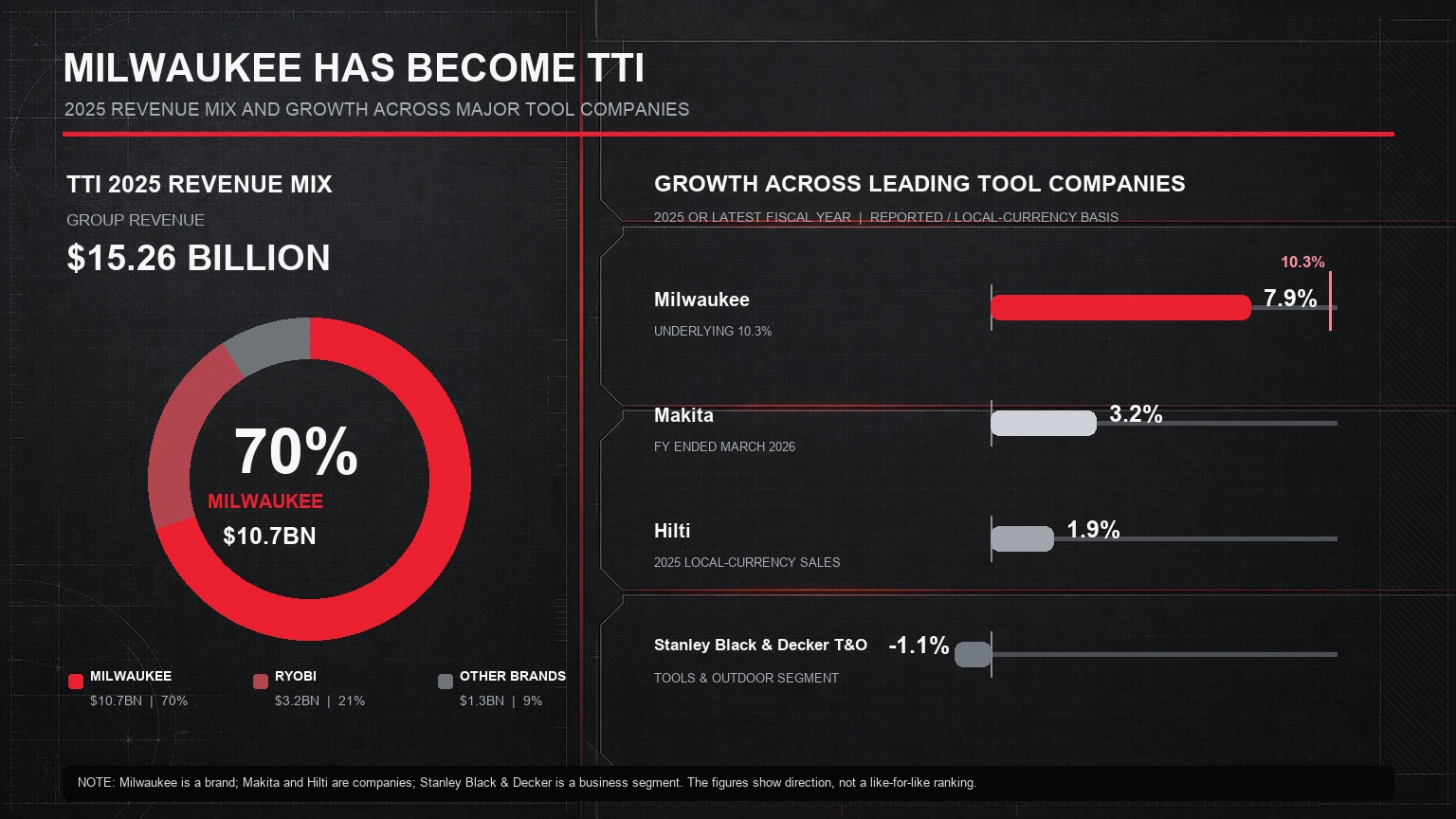
TTI's latest investor materials put group revenue at $15.26 billion in 2025. Milwaukee contributed $10.7 billion, or 70%. RYOBI generated $3.2 billion, or 21%, while every other brand combined accounted for the remaining 9%. Based on the reported brand revenue and growth rate, Milwaukee added roughly $800 million in sales that year—more than TTI's $638 million net increase. Contraction elsewhere in the group absorbed part of Milwaukee's growth.
When TTI acquired Milwaukee in 2005, the brand was still known for its Sawzall reciprocating saw and its reputation for durability. Milwaukee later acknowledged that it had lost focus and was trying to become a tool brand for everyone. After the acquisition, it returned to professional trades such as mechanical, electrical and plumbing, and made lithium-ion batteries the foundation of its next generation of tools.
The change came just before the power-tool industry's technology roadmap shifted. Milwaukee became the first company to use lithium-ion batteries in power tools in 2005, followed by REDLITHIUM batteries in 2010 and the M18 FUEL line in 2012. It developed the battery pack, motor and electronic controls as one system, allowing cordless products to approach the power and sustained performance of corded tools.
Milwaukee also promised that technology upgrades would not strand the installed base. New batteries continued to work with tools already in the market, while new tools remained compatible with batteries users already owned. Professional users worry about the value of an entire fleet when a platform stops evolving. Long-term compatibility turned a single tool purchase into an ongoing investment in M12 or M18.
The early opportunities were broad. Improvements in batteries, motors and electronics allowed cordless drills, circular saws and reciprocating saws to replace corded tools. M12 handled compact and portable applications. M18 covered the core professional range. MX FUEL moved into light equipment previously dominated by gasoline engines and corded machines. By 2023, the three platforms supported 460 products.
Each platform has a different job. M12 had more than 150 products by 2024 and converted tasks that had never been electrified into power-tool applications. Early cable cutters and copper tubing cutters gave electricians and plumbers a reason to build a separate platform around a 12-volt battery. Drain inspection cameras and compact ratchets later pushed into confined spaces, allowing M12 to avoid a direct contest based only on torque and power.
M18 is Milwaukee's main revenue platform. It had more than 300 products by 2025. The system must keep renewing drills and impact wrenches while using the same battery to run conduit benders and wet/dry vacuums. Core tools bring users onto the platform; a much larger range of trade-specific products raises spending per user.
MX FUEL applies the same logic to equipment. The platform had more than 25 solutions by 2025, spanning demolition and outdoor work. These applications traditionally relied on gasoline engines or an external power supply, and the machines carry higher unit prices as well as greater repair and downtime costs. Milwaukee is now competing for revenue that once belonged to traditional light-equipment companies.
Once the rest of the industry began sharing the first wave of cordless growth, Milwaukee divided the professional market into increasingly narrow slices.
Traditional tool companies tend to organize products around drills, saws and sanders. Milwaukee first looks at plumbers, electricians or automotive technicians, then follows individual tasks within each trade. The M18 FUEL RINGER Roll Groover serves pipe-grooving work, while the new 16-gauge scroll shear targets curved sheet-metal cuts in HVAC installation. Neither product needs to sell tens of millions of units. Each one can take a portion of a task previously handled by manual, hydraulic or corded equipment.
The individual markets are small. In aggregate, they form another growth curve.
The M18 FUEL Branch Conduit Bender introduced in 2025 is another example. Electrical work on large buildings requires crews to bend large volumes of conduit repeatedly. Conventional machines are difficult to move, and the conduit has to be carried to a fixed processing point. Milwaukee brings the bender to the installation area and uses electronic controls to deliver repeatable angles. Its value also includes the hauling and rework it removes from the job.
Professional users will pay more for products like this because the tool represents only a small share of the total project cost. A shutdown, a bad cut or hours of repetitive labor can cost more than the tool. Milwaukee keeps looking for applications that mean little to a consumer but offer a return that a professional trade can calculate directly.
M12, M18 and MX FUEL make the model easier to scale. A new tool does not require a new battery, charger or distribution system, and the user does not have to choose another platform. Once a plumber already owns several M18 batteries, the barrier to buying one more specialized tool drops sharply. More tools drive more battery sales; more batteries raise the cost of leaving the system.
Milwaukee then extended the relationship beyond power tools. PACKOUT began as a system for storing and transporting tools before expanding into lighting, power and audio. Safety gear, hand tools and workwear entered the same brand. The lunch warmer brings the M18 battery into the lunch break.
PACKOUT had more than 125 interchangeable products by 2025. The toolbox is only the entry point. Vehicle and shop storage allow the system to follow users across jobsites. PACKOUT has no mechanical connection to the battery platform, but it plays the same commercial role: the more components a user owns, the more expensive it becomes to switch brands.
Milwaukee wants a larger share of the professional user's working day. The next drill is only one part of that plan.
Behind the products sits a substantial field organization. Milwaukee repeatedly sends development and product teams onto jobsites to work alongside specific trades. Problems found in the field move to the development team. The existing battery platforms shorten the route to market, and salespeople return to the same professional users to commercialize the finished product.
TTI calls this capability “vertical penetration”: moving deeper into a professional industry. Mechanical, electrical and plumbing are divided again into smaller specialties, each with a different workflow. A product manager does not need to prove that a need applies to every construction worker. A clear productivity gain within one sub-trade can be enough to win development resources.
Once a product is ready, Milwaukee still needs a commercial team capable of explaining its value. A retail shelf can display the price and torque of a drill. It cannot easily show a contractor how much setup time a roll groover removes. TTI continues to add field marketing staff, store coverage and professional-channel investment so that problems discovered by product teams in the field are eventually carried back to users by salespeople who understand the trade.
The cycle requires sustained investment. TTI spent $757 million on research and development in 2025, an increase of 16.8%, far ahead of the group's 4.4% revenue growth. Milwaukee's higher-margin launches and replacement battery sales improve the group's profit mix, creating more funding for the next round of R&D and field expansion. TTI's gross margin reached 41.2% in 2025, its 17th consecutive annual improvement.
This cycle cannot be recreated by changing a quarterly budget. New products improve the mix and gross margin. The added profit goes back into R&D and field teams, which find the needs behind the next product cycle. When a tool company cuts one part of that system during a downturn, the damage often appears several years later in its launch pipeline and channel execution.
Competitors have seen the model. Stanley Black & Decker's Tools & Outdoor business still generated $13.158 billion in 2025, more than Milwaukee as a single brand, but that figure includes DeWalt, Craftsman, Stanley and Black+Decker. One of management's priorities over the past three years has been completing a $2.1 billion cost-reduction program. While Milwaukee continues to add R&D and field resources, Stanley Black & Decker has also had to repair its balance sheet, supply chain and the profitability of multiple brands.
Makita has taken a different route. It has an exceptionally broad product range and a global sales and service network, while 40Vmax XGT is filling out its high-power tools, outdoor equipment and cleaning products. Revenue rose 3.2% in the fiscal year ended March 2026, but North American sales fell by about 6%. Makita can manufacture a huge number of reliable products. It has not been as aggressive as Milwaukee in product definition or market execution.
Hilti has its own defenses in large construction accounts, direct sales and fleet-management services, but its local-currency revenue grew only 1.9% in 2025. Bosch plans to introduce roughly 2,000 new products by 2027 and is accelerating the expansion of its professional 18V platform. Every major company is adding products. Milwaukee's advantage is that its trade-by-trade development system has already been running for more than a decade.
Copying a sheet-metal shear is not especially difficult. Managing hundreds of products at once, continuing to find small problems across multiple trades that users will pay to solve, and maintaining development speed, channel inventory and service support is far harder.
Milwaukee's competitive advantage is shifting away from any single battery or motor technology. It now lies in an organization built to produce new products continuously.
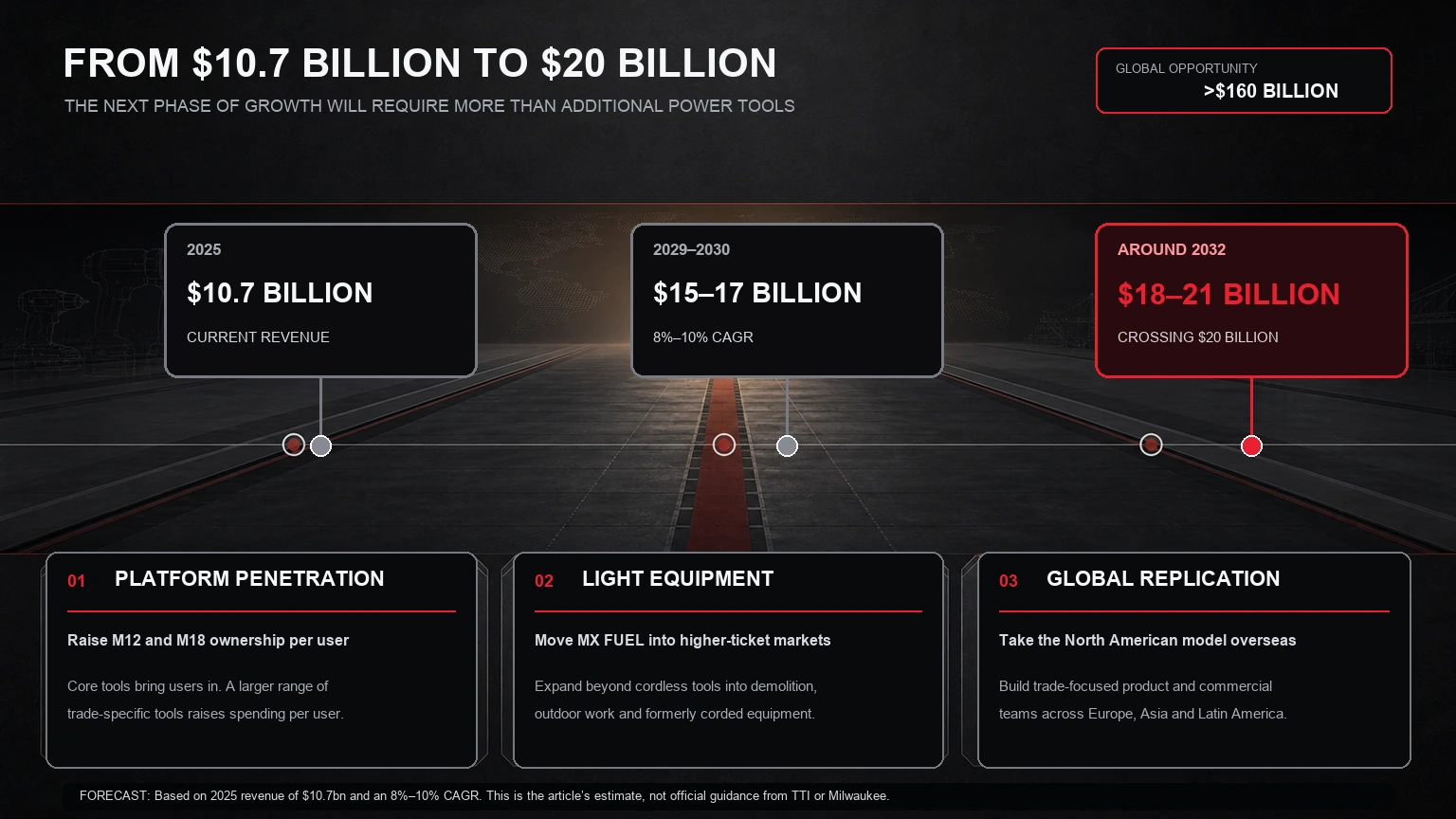
Milwaukee currently generates $10.7 billion in revenue. At an 8% to 10% compound annual growth rate, it would reach $15 billion to $17 billion by 2029 or 2030, and $18 billion to $21 billion around 2032. TTI defines Milwaukee's global opportunity at more than $160 billion. Current revenue equals only 6% to 7% of that figure, leaving room in Europe, Asia and additional professional-equipment categories.
Its growth is also not entirely tied to residential construction. TTI's latest investor materials show technology, energy and manufacturing accounting for 47% of Milwaukee's end demand, with service and maintenance at 32%. Residential remodeling and new home construction together represent only 16%. Investment in data centers, power grids and advanced manufacturing translates directly into demand for electrical, plumbing and maintenance tools. That is one reason Milwaukee continues to outperform while the US housing market remains weak.
Moving from $10.7 billion to $20 billion requires three sources of growth. M12 and M18 must continue to raise product ownership among existing professional users. MX FUEL and outdoor equipment must enter higher-priced categories. Europe, Asia and Latin America must replicate the trade-focused product and commercial organization Milwaukee built in North America. No single path is enough. All three have to move together to support 8% to 10% medium-term growth.
On that path, $20 billion is not an aggressive target. Milwaukee will hit a ceiling on its growth rate first.
At $15 billion in revenue, 10% growth requires another $1.5 billion every year. At $20 billion, the annual increase rises to $2 billion. Milwaukee can keep finding specialized tasks, but those markets are narrower than drills, saws and impact wrenches. The number of launches can continue to rise even as the revenue available to each product falls.
Platform expansion also creates complexity. More products require more inventory, spare parts and service training, while specialized tools turn more slowly than core drills. In a region that cannot support a full field organization, Milwaukee's development and commercialization model becomes difficult to reproduce. PACKOUT and products such as the lunch warmer can deepen loyalty, but they cannot replace the revenue contribution of major tools and equipment indefinitely.
Under its current brand, platform and distribution structure, I believe roughly $25 billion is a more realistic medium- to long-term ceiling for Milwaukee. Beyond that point, continued growth will depend on larger overseas markets, more light equipment, or acquisitions that take the company into new professional categories.
Milwaukee has a credible path from $10.7 billion to $20 billion using the product machine it already has. Moving from $20 billion to more than $25 billion requires entry into markets that have not traditionally belonged to a power-tool company.
Milwaukee will not remain just a power-tool brand. It will keep expanding around the professional user's entire day, moving from tools, light equipment and storage into safety, workwear and more jobsite applications. The lunch warmer looks like a peripheral product, but it already points to the company's next move: as long as the professional user is still at work, Milwaukee wants to remain within reach.