- US power-tool demand returned to growth in Q2 2026, lifting Tools & Outdoor organic sales by 3%.
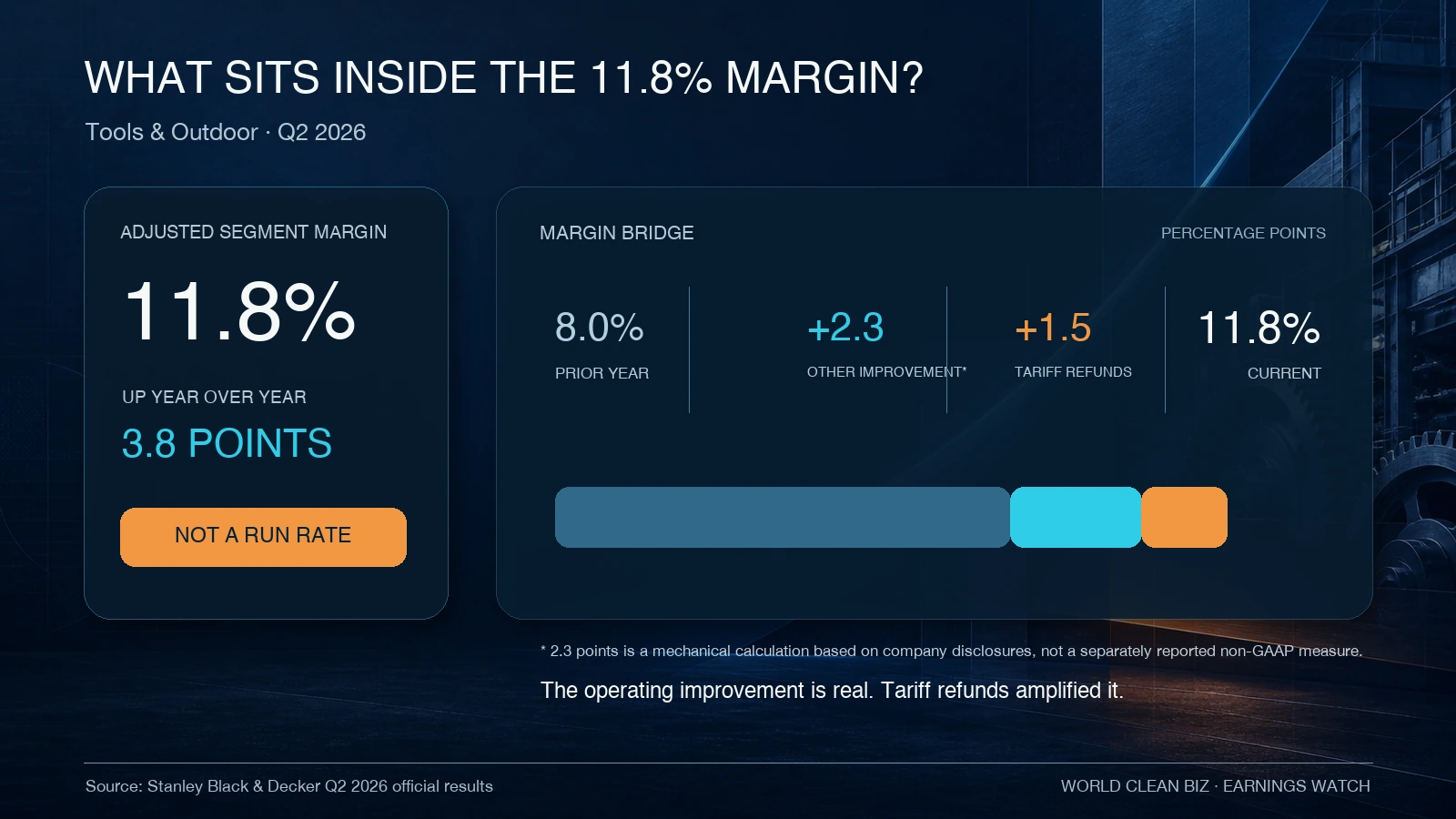
- Tools & Outdoor's 11.8% adjusted margin included about 150 basis points from tariff refunds; roughly 10.3% is the mechanical margin after removing that disclosed benefit.
- The CAM sale and cost transformation made Stanley Black & Decker leaner, but renewed growth now depends on brands, channels and product investment.
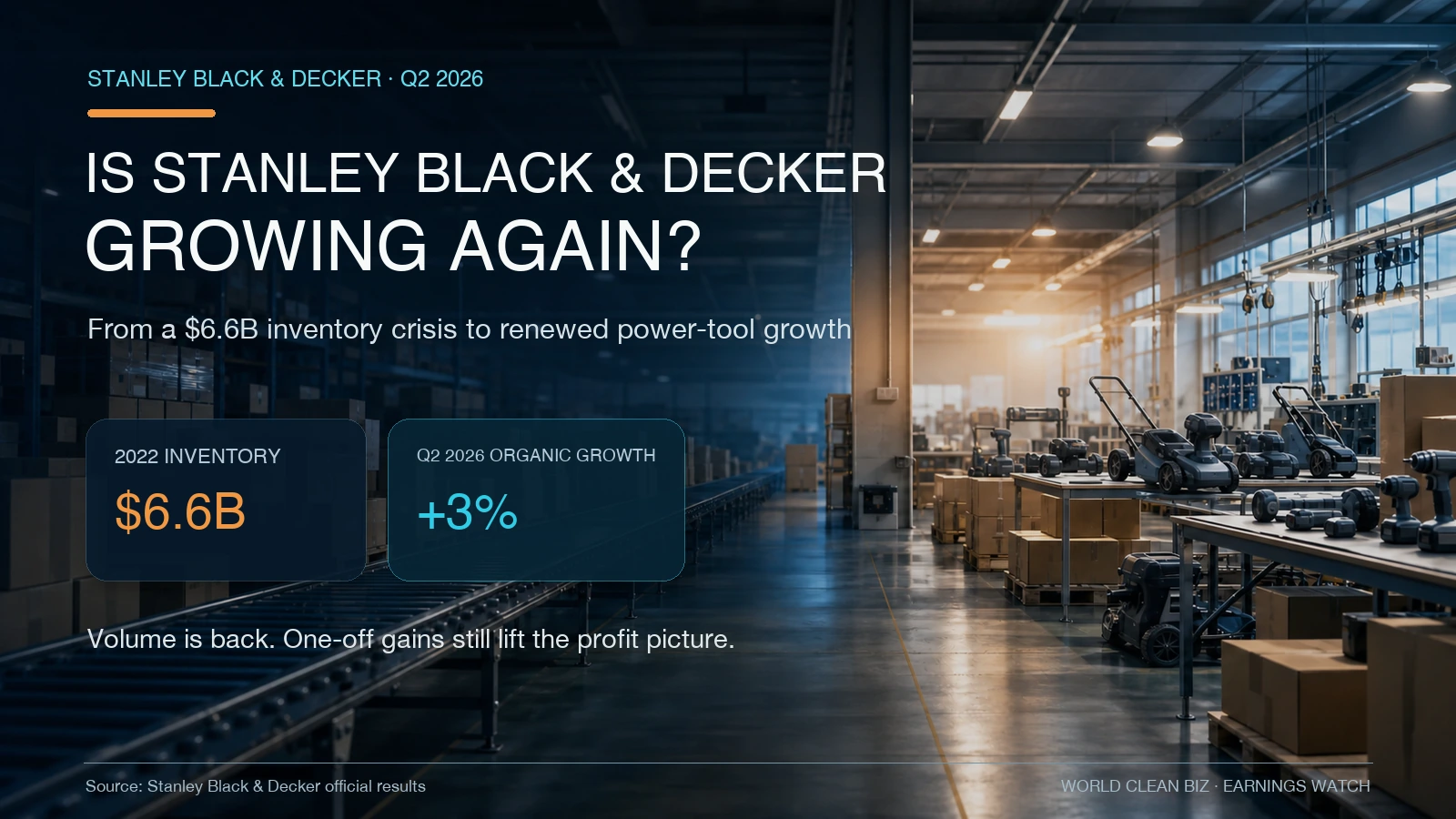
In December 2021, Stanley Black & Decker spent $1.9 billion to acquire the remaining stake in MTD and Excel Industries.
Americans were still spending on home improvement and yard care. Stanley Black & Decker described the newly combined lawn mower, snow blower and outdoor-equipment operations as a $4 billion growth engine. MTD brought brands including Cub Cadet and Troy-Bilt, along with more than 2,500 independent equipment dealers. The company believed the battery platforms behind DEWALT, CRAFTSMAN and BLACK+DECKER could help drive the electrification of outdoor power equipment.
Seven months later, that growth engine began to stall.
In the second quarter of 2022, Stanley Black & Decker's inventory climbed to $6.6 billion. As stay-at-home spending receded and retailers cut orders, the company pulled its second-half demand assumption back toward 2019 levels. It reduced its 2022 adjusted earnings guidance from $9.50–$10.50 per share to $5.00–$6.00, cut production and prepared to release $1 billion to $1.5 billion of working capital.
A tool group that had just completed an expansion moved rapidly into contraction.
Stanley Black & Decker then launched an aggressive transformation plan: reduce a network of roughly 120 manufacturing facilities by more than 30%, cut SKUs by more than 40% and generate about $2 billion of pretax savings over three years. Factories, inventory and organizational layers were compressed together. Proceeds from the sales of Security, Oil & Gas and Infrastructure were directed toward debt reduction and share repurchases.
By the end of 2025, the program had produced approximately $2.1 billion in pretax run-rate savings. The inventory crisis had eased and gross margin had recovered from its low, but full-year Tools & Outdoor revenue was still only $13.158 billion and continued to decline. North American power-tool demand remained weak in the fourth quarter.
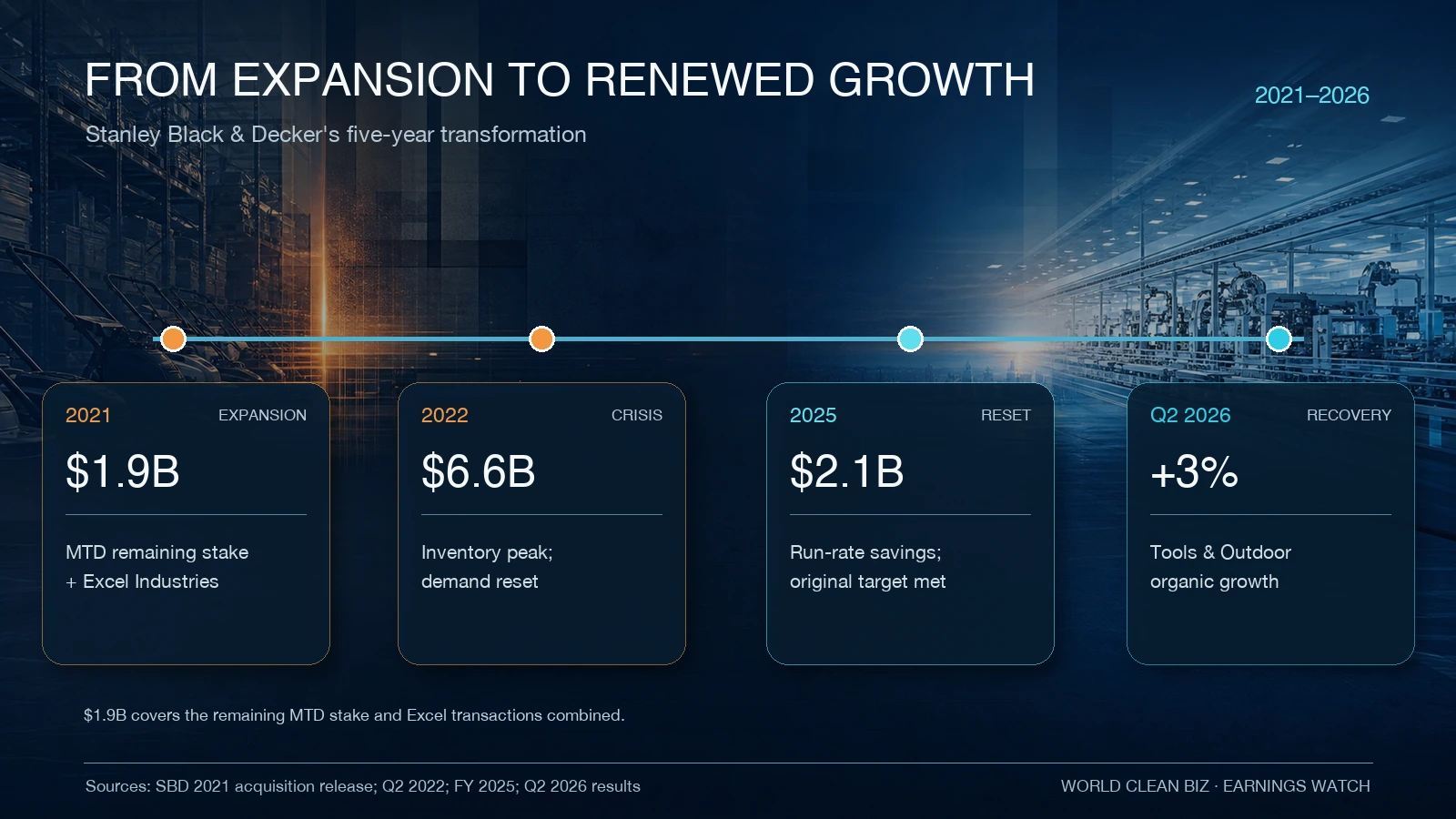
In the second quarter of 2026, Stanley Black & Decker finally reported a set of numbers moving in the opposite direction.
Group revenue was $3.961 billion, with organic growth of 3%. Adjusted earnings were $1.57 per share, compared with $0.63 a year earlier. Adjusted gross margin reached 33.7%, up 620 basis points.
Tools & Outdoor, which accounts for roughly 90% of group revenue, generated $3.564 billion of sales. Reported and organic growth were both 3%. Volume contributed three percentage points while price contributed nothing, with the main momentum coming from power tools sold through US retail as well as commercial and industrial channels.
This growth did not depend on another round of price increases. After channel destocking and weak demand, the US market began buying more tools again. Organic revenue rose 4% in North America, fell 2% in Europe and grew 3% in the rest of the world. Global tool demand has not recovered in unison; Stanley Black & Decker's most important market moved first.
Profit recovered faster.
Tools & Outdoor's adjusted segment margin reached 11.8%, an increase of 380 basis points. Productivity and product-mix improvements brought three years of factory consolidation and cost reduction into the income statement.
Tariff refunds pushed profit another step higher. The company disclosed that these refunds added approximately 250 basis points to group adjusted gross margin, about 150 basis points to Tools & Outdoor's segment margin and roughly $0.17 to adjusted earnings per share.
Removing those 150 basis points puts Tools & Outdoor's adjusted segment margin at approximately 10.3%, still above roughly 8.0% a year earlier. That figure is a simple calculation based on the impact disclosed by the company, not a separate adjusted metric reported by Stanley Black & Decker. The underlying cost and mix improvement is real, but the 11.8% margin should not be treated as a normal run rate.
Another gain came from the CAM aerospace fasteners business. Stanley Black & Decker sold it to Howmet Aerospace for approximately $1.8 billion in cash in April and recognized a $273.7 million gain on business disposals in the second quarter, lifting GAAP earnings to $2.33 per share.
Following the CAM sale, the company used most of the proceeds to reduce debt by $1.7 billion and spent another $250 million repurchasing shares. It then raised its 2026 adjusted earnings guidance to $5.20–$5.80 per share.
Stanley Black & Decker once described itself as a diversified global industrial company. After selling Security, Oil & Gas, Infrastructure and CAM, it increasingly resembles a focused tools and outdoor-equipment group. The business is simpler, but its risk is more concentrated: DEWALT, CRAFTSMAN, STANLEY, BLACK+DECKER and several outdoor brands must return the company to growth.
Competitors did not wait while it repaired itself.
Milwaukee generated $10.7 billion of brand revenue in 2025 and still grew 7.9%. Stanley Black & Decker's Tools & Outdoor business was larger at $13.158 billion, but that figure combines multiple tool and outdoor brands. The reporting bases are different, yet the comparison still shows the pressure Stanley Black & Decker faces. It spent three years repairing inventory, profit and the balance sheet while Milwaukee continued adding battery-platform products and frontline commercial investment.
Cost reduction can restore margin. It cannot automatically bring back growth captured by competitors.
Chris Nelson joined Stanley Black & Decker in 2023, initially leading Tools & Outdoor, and became CEO in October 2025. By the time he took over, the $2 billion cost program was close to completion and the CAM sale was entering its final stage. The previous management team's primary task had been repair. Nelson now has to return a leaner company to growth.
Stanley Black & Decker's 2028 objective is to deliver mid-single-digit organic growth in markets growing at a low-single-digit rate and raise adjusted gross margin to 35%–37%. The second quarter's 33.7% adjusted gross margin appears close to that range, but approximately 250 basis points came from tariff refunds. Once the refunds disappear, the company still has to close the gap through its brands, products and supply chain.
Outdoor power equipment offers another window into the transition. When Stanley Black & Decker acquired MTD in 2021, it said the deal would position the company to lead the electrification of outdoor products. It has since moved its gasoline walk-behind mower business to a licensed model, a change that reduced second-quarter Tools & Outdoor revenue growth by approximately one percentage point.
MTD's product portfolio had also included residential robotic mowers. Stanley Black & Decker did not separately disclose the performance of robotic mowers, battery-powered outdoor equipment or individual brands in this earnings report. The operating boundary around traditional gasoline equipment is shrinking, but there is not yet an answer to whether the resources released will flow into battery platforms and automated outdoor products.
Cleaning-related products are also housed inside the same segment. BLACK+DECKER sells handheld vacuums and outdoor pressure washers, while DEWALT and CRAFTSMAN sell cleaning equipment through tool channels. A 3% increase in Tools & Outdoor cannot be rewritten as a DEWALT recovery, nor does it prove that these cleaning and outdoor categories grew.
The second quarter established at least two things. US power-tool demand has begun to recover, and Stanley Black & Decker's three-year cost transformation produced genuine operating profit. Tariff refunds and the CAM sale made the reported quarter look better than the underlying operation alone.
The next questions are whether volume can keep growing, whether margins can hold after the refunds disappear and, after reducing debt, whether Stanley Black & Decker will continue returning cash to shareholders or reinvest in brands, channels and new products.
The 183-year-old tool company has become lighter. Whether it can become faster again is the story left by its second-quarter results.