- Define a household floor washer as a controlled clean-water, roller, squeegee, suction and dirty-water system—not a suction-power specification.
- Lay-flat use, edge cleaning, hot washing and hot-air drying change structure, thermal design, hygiene, testing and service requirements.
- Approve mass production only after representative soil, residue, leak, odor, durability, packaging, pilot-yield and spare-parts evidence passes.
In this article 16 sections
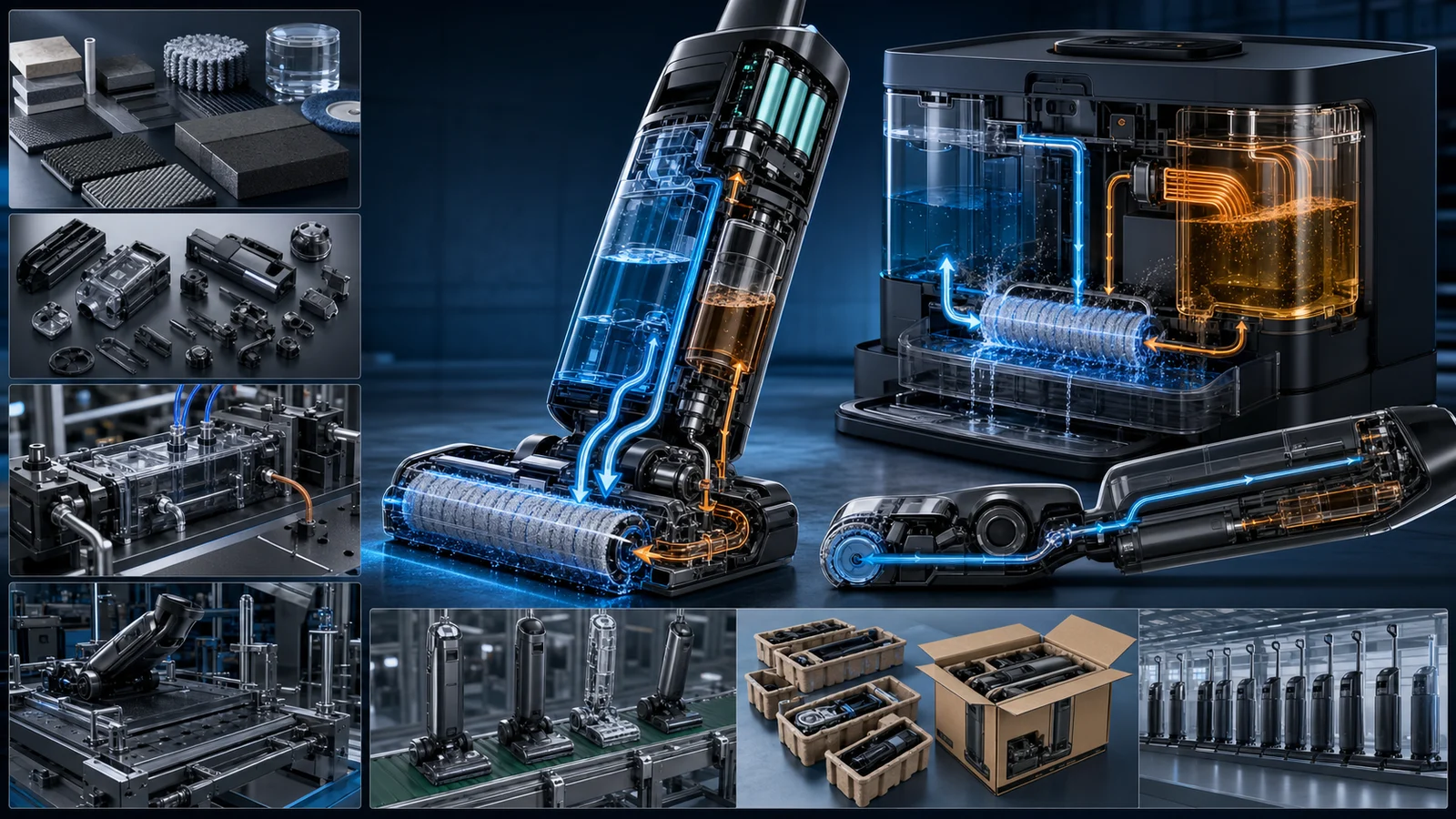
A floor washer OEM/ODM project should begin with the complete liquid-and-soil path: clean water, dosing, roller contact, squeegee, suction inlet, separator, dirty-water tank, filter and post-use drying. A strong motor cannot rescue poor water distribution, weak squeegee contact, blocked air paths or a roller that remains contaminated after self-cleaning.
The supplier should be able to trace every product claim to a requirement, drawing, component, test method, production control and service procedure.
Define the Household Floor-Washer Category
This guide covers upright household machines that vacuum dry and wet debris while washing sealed hard floors. They typically use:
- a clean-water tank;
- pump or gravity-fed liquid distribution;
- a powered roller;
- a squeegee or scraper;
- suction and recovery duct;
- dirty-water tank and separator;
- battery and charger or dock;
- self-cleaning and, on some models, heated washing or drying.
It does not assume the product is suitable for unsealed wood, every laminate, carpet, commercial duty or disinfecting. Intended surfaces, cleaning solution and use conditions must be written into the product definition.
For the category's development and competitive map, see The Story of Hard Floor Washers and Hard Floor Washer Market, Brands and OEM Opportunities.
OEM, ODM, Existing Platform or Joint Development
| Route | Typical scope | Buyer concern |
|---|---|---|
| Private label | Existing unit, approved configuration, logo and packaging | Differentiation, channel conflict and true certificate coverage |
| Light ODM | CMF, accessories, display, selected tank or firmware changes | Small changes can affect balance, leakage, radio, noise or validation |
| Deep ODM | New head, water path, tanks, dock, structure or electronics | Tooling, integration, schedule and field maturity |
| Joint development | Buyer and supplier divide product and engineering work | Deliverables, IP, change authority and failure responsibility |
List ownership for requirements, CAD, tooling, firmware, display/voice assets, App, test fixtures, reports, patents, spare parts and corrective action.
Map the Clean-Water and Dirty-Water Paths
Create two flow diagrams before approving industrial design.
Clean-water path
Tank → cap and seal → valve → tube → pump or gravity control → optional detergent mixing → manifold → roller or floor.
Dirty-water path
Floor and roller → squeegee/scraper → suction inlet → duct → separator → dirty-water tank → dry filter → fan exhaust.
At every interface, identify:
- sealing method;
- tolerance and compression;
- blockage risk;
- cleaning access;
- residual liquid;
- sensor or error detection;
- replacement procedure.
Color the test units' water paths or use trace fluid during engineering validation. Hidden residual water and cross-leaks are easier to correct before tooling freezes.
Suction, Roller Pressure, Drive Assist and Edge Cleaning
Pickup depends on contact and airflow together.
The roller must loosen soil and move it toward recovery. The squeegee must maintain contact without producing excessive push force, streaks or wear. The suction inlet and duct must carry mixed liquid, hair and solids without losing separation.
Measure:
- dry and wet debris pickup;
- residual moisture by floor type;
- edge distance on both sides and front;
- streaking after turns;
- roller loading and hair accumulation;
- push and pull force with full and empty tanks;
- pickup as the dirty-water tank approaches its stop level;
- performance with an aged roller and filter.
Self-propulsion can reduce operator force but may make tight maneuvering less predictable. Specify assistance on forward, reverse and turning movement.
Lay-Flat Design, Steering and Center of Gravity
A 180-degree or near-flat body can reach under furniture, but it changes water-tank orientation, separation, airflow, leak control, handle loads and dirty-water usable capacity.
Validate:
- liquid behavior at the declared angle;
- reduced dirty-tank stop level in lay-flat mode;
- air-water separation under turns;
- hose and wire bending;
- handle torsion and repeated recline cycles;
- clearance under representative furniture;
- recovery when the user returns upright;
- stability on the dock.
Do not publish a body height without defining the measurement point. A low head may still be blocked by the handle joint or tank.
Tanks, Filtration, Hair and Solid-Liquid Separation
Tank volume affects runtime, weight and hygiene.
A large clean tank may extend cleaning but moves the center of gravity. A large dirty tank can retain more contaminated liquid and increase lift weight. Sensors and floats must stop operation before water reaches the dry filter or motor.
Test the separator with:
- long hair and pet hair;
- cereal and crumbs;
- mud and sand;
- fibrous dust;
- high-foam detergent misuse;
- tank overfill;
- tilted and lay-flat operation;
- dirty sensor surfaces.
Solid-liquid separation can make disposal cleaner, but it adds baskets, screens and small passages. Every part the user must touch should be assessed for mess, odor and cleaning time.
Self-Cleaning, Hot Wash, Drying and Odor
Self-cleaning means the machine runs a controlled wash cycle. It does not mean the complete product becomes maintenance-free.
Define:
- required clean-water level;
- whether dirty water must be emptied first;
- roller rotation pattern and cycle time;
- water volume and temperature;
- whether ducts and squeegee are included;
- tray drainage;
- drying airflow, temperature and duration;
- user cleaning after the cycle.
If the product claims hot wash or hot-air drying, record temperature at the heater, delivered fluid or air, roller surface and accessible parts. Validate thermal controls, plastics, seals, energy and abnormal conditions.
Run odor studies after representative soils and idle times. Evaluate the roller core, end bearings, head cavities, squeegee, duct, filter, dirty tank, dock tray and drain—not only the visible roller surface.
Battery, Charging, Noise and Thermal Management
Specify the cell, pack, BMS, charger, contacts, temperature sensors and firmware limits. Measure runtime in defined modes with pumps, roller, fan, drive assist, display and heaters active as applicable.
High-load tests include:
- roller stall;
- blocked suction;
- maximum liquid flow;
- maximum drive assistance;
- repeated self-clean cycles;
- drying and charging overlap;
- hot and cold ambient conditions;
- aged battery margin.
Measure noise by mode: normal, maximum, suction-only if supported, self-cleaning and drying. A quiet cleaning mode does not describe a high-speed centrifugal dry cycle.
Lithium-battery shipping requires the exact configured pack and applicable transport evidence, including the UNECE subsection 38.3 framework.
Sensors, Algorithms, Display and Voice
Common sensing functions include dirty-water level, clean-water level, roller load, dirt or turbidity, tilt, temperature and battery state.
Validate each sensor against contamination and drift. A dirty sensor can create false “tank full,” incorrect automatic dosing or continuous high-power operation.
The automatic algorithm should have defined inputs, output ranges and fallback behavior. Preserve engineering logs for:
- flow setting;
- fan and roller speed;
- drive assistance;
- soil indicator;
- tank and blockage errors;
- thermal limits.
Display and voice assets require language control and update procedures. Do not let a decorative “smart” feature make basic operation dependent on an App.
Common Field Failures
Leaks
Check tank caps, valves, welds, tube joints, pump, manifold, head, dock and tilted storage.
Residual water
Inspect tanks, tubes, head cavities, squeegee, duct, separator and dock tray after normal emptying.
Odor
Use real mixed soil and realistic idle periods. Water-only lab cycles are insufficient.
Hair wrapping
Inspect roller ends, bearings, scraper teeth, separator and fan-protection filter.
Poor recovery
Measure squeegee wear, floor contact, duct obstruction, filter loading, tank sealing and fan performance.
Edge gaps
Check both sides, front, baseboards, corners and turns with an aged roller.
Treat these as design and process risks, not only user-maintenance issues.
Floor Compatibility, Detergent and Materials
Define compatible surfaces and exclusions with the legal and marketing teams.
Evaluate:
- sealed wood, tile, vinyl, laminate and stone;
- joints, textured surfaces and transitions;
- water-sensitive edges and damaged coatings;
- approved solution concentration;
- foam, pH and chemical compatibility;
- residue, slip and appearance;
- seals, tubes, tanks, roller adhesives and plastics.
Third-party chemicals and hot water can create foam, swelling, stress cracking or seal damage. Instructions should be supported by material and misuse testing.
Prototype, Durability, Drop and Transport Validation
Create staged gates:
- concept rigs for water distribution and recovery;
- engineering samples for architecture;
- design-validation units from intended parts;
- production-validation units from final tools and line;
- pilot units for yield and packaging;
- controlled field trials.
Cycle pumps, valves, rollers, bearings, scrapers, tanks, latches, joints, wheels, charging contacts, docks and heaters. Include detergent scale, hard water, hair, sediment and drying residue.
Validate the packaged product for drop, vibration, compression, humidity and temperature. A floor washer can arrive with hidden tank, hose or joint damage even when the carton looks acceptable.
Compliance, Tooling, MOQ and Project Cost
IEC's current 60335-2-10:2021 covers household and similar floor-treatment and wet-scrubbing machines, including battery-operated floor scrubbers, and is used with IEC 60335-1:2020. The applicable national adoption, amendments and certification route must be confirmed for the target market and final product.
Market access can also include EMC, radio for connected models, battery, transport, restricted substances, recycling, labeling and packaging obligations. See Cleaning-Appliance Compliance and Certification.
Separate project cost into:
- platform and unit cost;
- tooling and fixtures;
- engineering and firmware NRE;
- tests and certification;
- packaging;
- consumables and spare parts;
- warranty and returns.
MOQ should be attached to the exact configuration and component commitments. A low assembly MOQ can still hide large purchases for custom motors, batteries, displays, tanks or packaging.
Supplier Audit and RFQ
Audit the factory by tracing the water path and one field failure through:
- drawings and BOM;
- incoming pump, valve, seal, roller and tank controls;
- tube routing and fastening;
- leak and flow tests;
- end-of-line pickup and error checks;
- software version;
- serial traceability;
- rework;
- field-return analysis and corrective action.
Use the following RFQ:
- target markets, price and channel;
- exact base platform and production history;
- full clean/dirty water-path diagram;
- roller, scraper, suction and edge architecture;
- tank capacities and usable limits by angle;
- lay-flat, drive-assist and steering design;
- self-cleaning, hot wash and drying conditions;
- battery, charger and mode-specific runtime;
- sensor and control logic;
- floor and solution compatibility;
- compliance plan;
- tooling and IP ownership;
- prototype, durability and field-validation plan;
- pilot yield and change control;
- spare parts and service method;
- MOQ, NRE, unit-cost ladder and payment gates.
For supplier discovery, see Floor Washer Manufacturers in China. Use the list to identify candidates, then apply the architecture and audit method in this guide.
FAQ
What is the most important floor-washer specification?
There is no single number. The critical result is controlled soil removal with low residual water across representative floors, followed by a practical cleaning and drying workflow.
Is stronger suction always better?
No. Recovery depends on fan, sealing, duct, squeegee contact, separator, filter condition, roller and floor together.
Does self-cleaning eliminate manual cleaning?
No. The operator may still need to empty tanks, remove hair and solids, rinse filters, clean trays and allow parts to dry according to instructions.
Is hot-air drying worth the extra cost?
It can reduce wet-roller holding time if airflow and temperature are effective. It also adds heater, fan, thermal, noise, energy and service requirements that must be validated.
Which certification does a floor washer need?
It depends on destination market and configuration. Start with the applicable appliance-safety standard and add EMC, radio, battery, materials, environmental, labeling and transport obligations.
Final Procurement Rule
Approve a floor washer only when the complete water, soil, air and drying system works with representative floors and debris—not when a clean sample completes one water-only demonstration. The best OEM/ODM partner can show how design, testing, production and service keep that result consistent at scale.