- Hard floor washers now compete on water-path hygiene, edge and low-angle access, propulsion, sensing and dock maintenance—not only wet-and-dry pickup.
- The durable architecture remains a controlled clean-water path, roller wash zone and efficient dirty-water recovery system.
- OEM opportunities favor reliable, testable platforms with clear service economics rather than feature stacking without evidence.
In this article 11 sections
The hard floor washer market has moved beyond the original promise of vacuuming and washing in one pass. In 2026, leading platforms compete on fresh-water delivery, dirty-water recovery, roller hygiene, edge access, low-angle reach, propulsion, sensing, drying and serviceability. The OEM opportunity is no longer another look-alike machine; it is a platform whose cleaning result and maintenance burden can be verified.
This article maps the category without inventing a market size or ranking brands by unsupported sales estimates. “Leading” refers to brands with established, visible product systems and channel presence, not a precise share table.
What Counts as a Hard Floor Washer?
The core product is an upright cleaner that applies clean water or solution to a powered roller, agitates a sealed hard floor and recovers dirty liquid into a separate tank. It may also collect dry debris during the same pass.
This scope excludes steam mops that do not recover dirty water, robot vacuum-mops, conventional dry stick vacuums and commercial walk-behind scrubbers. Multi-surface models that refresh area rugs sit at the category edge and need explicit claims and tests.
The history of hard floor washers explains how the category developed. The 2026 competitive question is which architecture delivers a repeatable clean floor without creating an unpleasant machine to clean afterward.
Why the Category Expanded
The product compresses three household tasks: loose-debris pickup, wet scrubbing and dirty-water collection. Cordless designs remove the bucket and cord, while two-tank systems keep the outgoing solution separate from recovered water.
That convenience created a second problem: the appliance now carries hair, food soil and warm moisture through a roller, scraper, duct and dirty tank. Odor and residue became product-design issues. Brands responded with self-cleaning cycles, roller drying, removable parts and stronger maintenance guidance.
Competition then moved into access. Dual-edge heads reduce the gap along baseboards. Low-angle designs reach under furniture. Powered wheels reduce push force. Sensors adjust suction or water. Displays and voice prompts guide maintenance.
A Brand Strategy Map
BISSELL: multi-surface category continuity
BISSELL’s CrossWave range spans corded and cordless products and emphasizes vacuuming and washing hard floors, with selected models also refreshing area rugs. Its strength is category recognition, cleaning formula and a broad floor-care channel.
Tineco: smart floor-washer platform depth
Tineco built a wide FLOOR ONE ladder around two tanks, sensors, displays and self-cleaning. The FLOOR ONE S5 publishes clean- and dirty-tank capacities, sensor-controlled suction and flow, edge cleaning and a self-cleaning cycle. The S6 adds dual-edge cleaning and centrifugal roller drying.
Roborock: robot-cleaning technology moves into upright washers
The Roborock Flexi combines wet/dry pickup with low-angle reach, edge cleaning, assisted wheels, dirt sensing, hot-water self-cleaning, drying and app functions. It illustrates how robot-vacuum brands use navigation-adjacent sensing, motors and software to enter manual floor care.
Other brands—including Shark, Dreame, Kärcher and regional appliance players—expand the map further. A useful market analysis should compare verified platforms by architecture and service model rather than turning a long brand list into a ranking.
Price and Feature Tiers
| Tier | Typical architecture | Buyer expectation | Main OEM risk |
|---|---|---|---|
| Entry | Basic cordless or corded wash-and-recover, manual controls | Reliable pickup and simple maintenance | Weak recovery, leaks, low-cost latches and poor parts supply |
| Mainstream | Two tanks, self-clean, edge cleaning, display | Better convenience and acceptable hygiene | Self-clean claims exceed actual water-path cleaning |
| Premium | Sensors, propulsion, low-angle reach, hot wash or drying | Lower effort, cleaner roller and stronger guidance | Thermal, software and dock complexity increase warranty cost |
| Convertible | Floor washer plus detachable dry vacuum or tools | One platform replaces multiple appliances | Weight, sealing, attachment performance and confusing use cases |
Retail price moves constantly by market and promotion, so the tier should be defined by architecture and current channel quotations rather than a permanent dollar boundary.
The Product Architecture
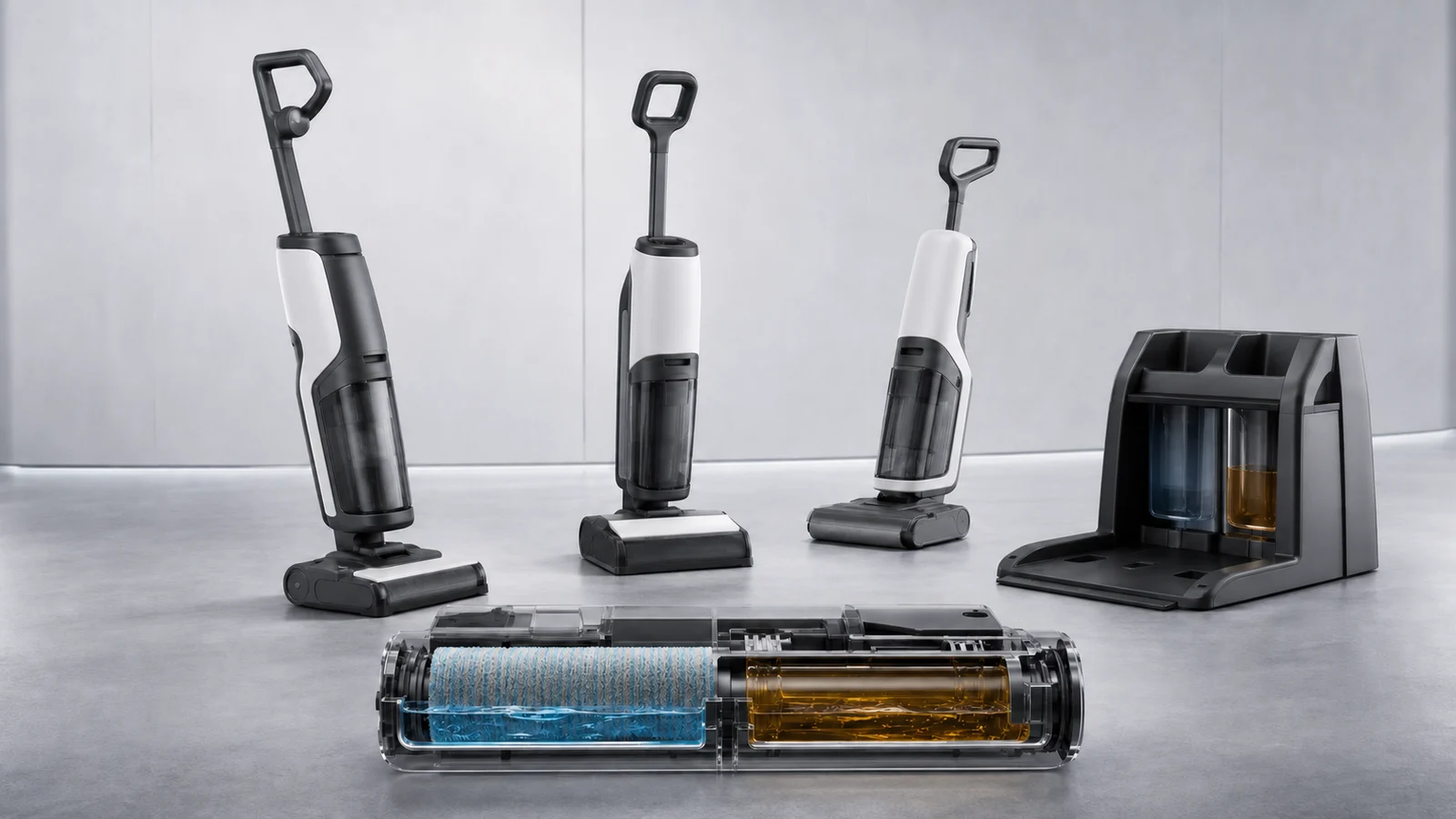
A floor washer is a controlled fluid and debris loop:
- clean-water tank and solution dosing;
- pump, valve and tubing;
- distribution bar or spray points;
- powered roller and floor contact;
- scraper and suction opening;
- air/liquid/debris separation;
- dirty-water tank, float and filter;
- motor/fan and exhaust;
- battery, control board and sensors;
- charging and self-cleaning dock.
Performance depends on balance. Too much water leaves streaks and reduces runtime. Too little limits soil suspension. High suction can improve recovery but increase noise, energy use and separation demand. A soft roller must clean without damaging the declared surfaces and must release hair and soil during maintenance.
Where Brands Compete
Cleaning and recovery
Test dry debris, sticky soil, liquid pickup, edge strips and repeated passes. Measure remaining soil and residual water separately.
Roller and water-path hygiene
A button labeled “self-clean” does not prove that the roller, scraper, duct and tank dry without odor. Inspect after controlled soil cycles, storage and warm conditioning.
Access and handling
Measure edge gap, under-furniture height, turning radius, push/pull force and wet weight. Assisted wheels help only when control remains predictable.
Runtime and usable capacity
Published runtime must be matched to mode, water capacity and cleaning area. A long battery run has little value if the tank needs frequent attention.
Service system
Rollers, filters, solution, tanks, caps, seals, scrapers, batteries and docks need part numbers and availability. Consumables can support repeat revenue, but incompatibility creates returns.
Failure Modes That Drive Returns
Common development risks include tank or cap leakage, dirty-tank mis-seating, float shutdown, excessive foam, hair around roller ends, clogged ducts, streaks, poor edge pickup, wet rollers stored too long, cracked latches, battery degradation and dock-heater faults.
The supplier should provide a failure-mode matrix and production tests for water flow, suction, leakage, electrical safety, charging and sensors. Returned units should be coded by cause, not grouped under “no clean.”
Channel Differences
Mass retail favors an understandable value step and simple consumables. E-commerce rewards feature comparison but exposes confusing claims and shipping damage. Specialty floor-care dealers can explain surfaces and maintenance, yet need parts and repair information. Premium direct-to-consumer brands must support app, firmware and responsive replacement logistics.
An OEM brief should therefore name the channel before freezing the platform. The same machine, accessory bundle and warranty plan will not fit every route.
Where the OEM Opportunities Are
1. Reliable mainstream platform
A well-recovered, low-odor machine with simple tanks and affordable rollers can outperform a specification-heavy model in return economics.
2. Hygiene with evidence
Design drainable low points, removable dirty parts, effective roller washing and measured drying. Substantiate temperature and odor-related claims.
3. Regional adaptation
Adjust voltage, plugs, labels, floor types, formula, language, repair and compliance files without fragmenting the core BOM.
4. Modular feature ladder
Build one controlled platform that supports edge, display, sensor, propulsion or drying variants without uncontrolled component combinations.
5. Service-ready private label
Provide exploded views, part numbers, diagnostics, golden samples and change control. Many private-label programs discover the service bill only after launch.
Supplier Capabilities to Audit
The factory should control the pump, motor/fan, roller, scraper, tanks, valves, seals, battery, dock and software versions. Audit leak testing, water-flow measurement, suction checks, battery traceability, roller balance, final self-clean verification and returned-unit analysis.
Ask who owns the platform and molds, which parts are shared with other customers, how component changes are approved, and whether the compliance reports match the offered model. The floor washer manufacturers guide provides the supplier landscape; this market map explains what a capable platform must now deliver.
Market Direction
The next phase will emphasize lower maintenance, better under-furniture access, controlled heat, faster roller drying and modular product families. More features will not automatically produce better economics. Each heater, sensor, wheel drive and connected function adds parts, software and failure modes.
The strongest OEM proposal will show the buyer a measured cleaning and recovery result, a hygienic post-use state, a controlled BOM and a credible service plan. That is a more durable advantage than another unverified suction number or “AI” label.
For a brand-specific product example, see the Miele DuoFlex HX2 floor washer analysis. Buyers seeking supplier qualification can also use World Clean Biz’s sourcing service.