- The Duoflex HX2 adds a self-contained wet roller head to a dry cordless vacuum rather than redesigning the entire machine around wet floor cleaning.
- Its product route resembles Dyson's Nautik attachment while Tineco and Dreame have already completed several generations of integrated floor-washer systems.
- Miele's brand and durability can support premium pricing, but the company needs a product-development process that is closer to the supply chain, retail channels and current consumer use.
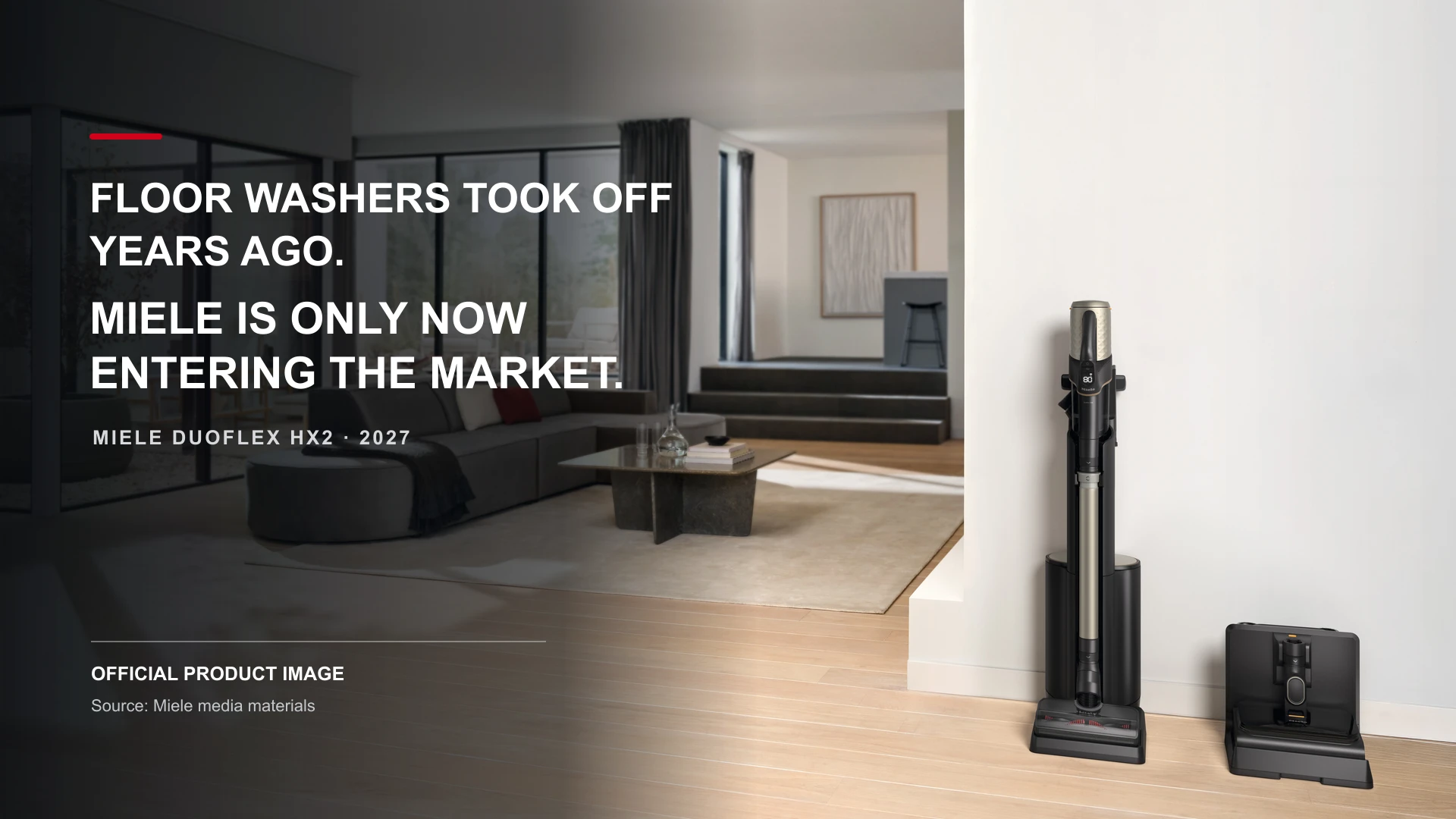
On June 30, 2026, Miele unveiled the Duoflex HX2, its new-generation cordless vacuum cleaner. It vacuums, handles both dry debris and liquid spills through an AquaTurbo wet-cleaning head, and, on selected models, comes with a dock that automatically empties the dustbin and cleans the rollers. The product will not go on sale in Europe until spring 2027.
The AquaTurbo head uses two counter-rotating rollers to collect debris and liquid from the floor. The main unit can also be converted into a handheld vacuum for cleaning sofas and furniture.
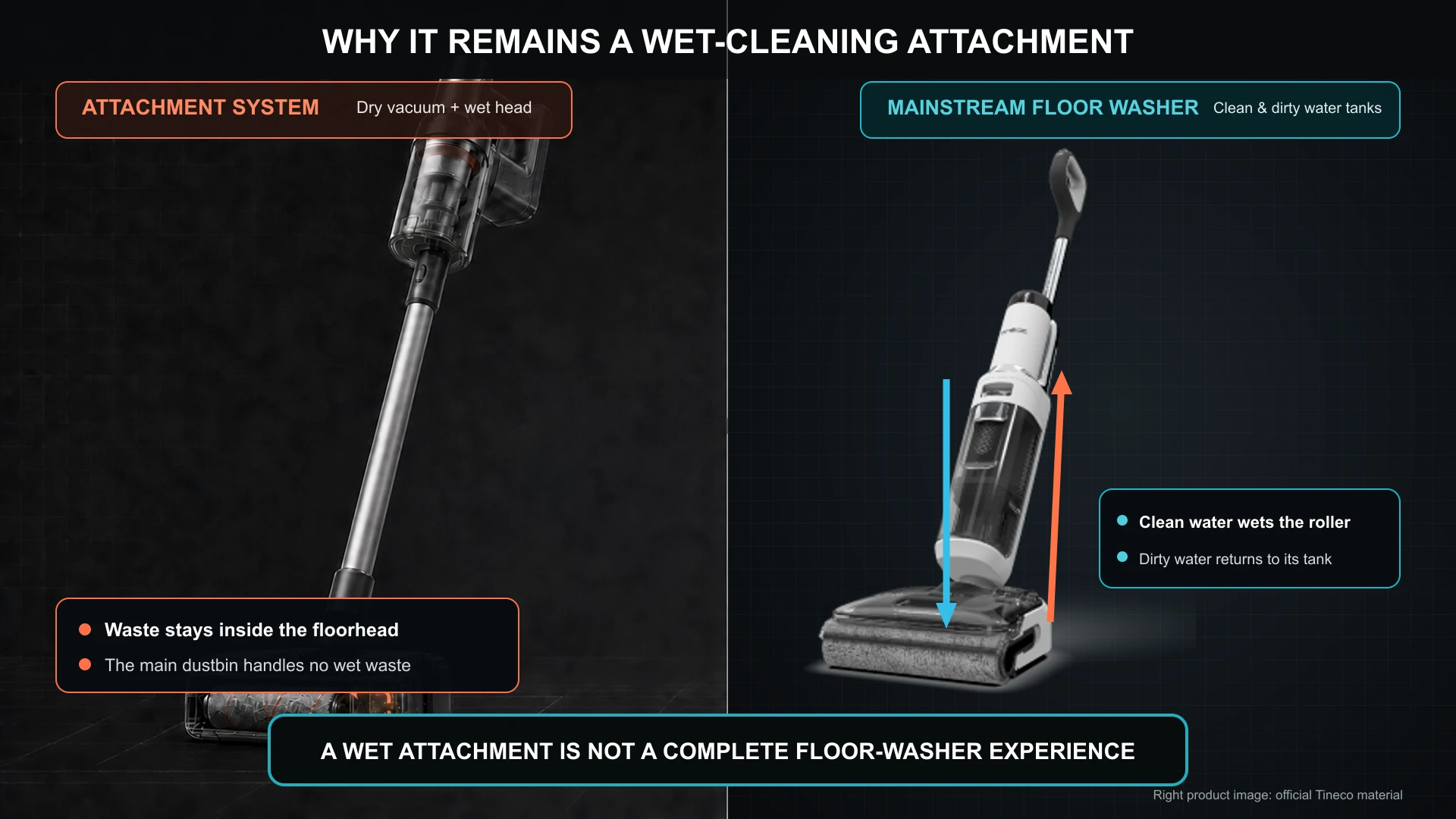
Judging from the images released by Miele, the main change to the Duoflex HX2 is the addition of a floor-washer-style roller head to an existing cordless vacuum. With the AquaTurbo attached, debris and dirty water are collected inside a chamber in the floorhead rather than entering the vacuum’s original dustbin.
The wet-cleaning head has its own rollers, water circuit and debris chamber. The main unit remains a dry cordless vacuum. Miele has not redesigned the entire machine around wet floor cleaning. Instead, it has added a wet-cleaning attachment to an existing vacuum platform.
That is still an improvement over the twin rotating mop pads used by the Triflex HX3 Plus Aqua.
Launched in May 2026, the Triflex HX3 Plus Aqua uses two rotating pads for wet mopping. It has a 300-milliliter water tank, and users still need to remove dry debris from the floor before mopping. In Germany, it sells for approximately RMB 6,900 (€889).
The Duoflex HX2 can at least collect dry debris and liquid instead of merely spinning two damp pads across the floor. But the waste remains inside the floorhead, and users still have to empty its debris chamber separately after cleaning. The experience is fundamentally different from the mainstream floor washers made by Tineco and Dreame.
The product definition is closer to the Nautik wet roller head used on the Dyson V15s Detect Submarine.
Dyson also places the water tank, wet roller and waste collection system inside a replaceable floorhead while retaining the vacuum’s existing dry main unit. Dyson even advises users to vacuum dry debris with the Fluffy head before fitting the Nautik for mopping, and acknowledges that the Nautik does not pick up debris as effectively as the dry floorhead.
The Nautik has not performed well in the market. Concentrating wet cleaning inside a floorhead attachment adds functionality quickly, but it does not deliver the experience of a mainstream floor washer. The Duoflex HX2 adds dry-and-wet debris collection and roller self-cleaning, making it more complete than the Nautik, although the underlying product route is essentially the same.
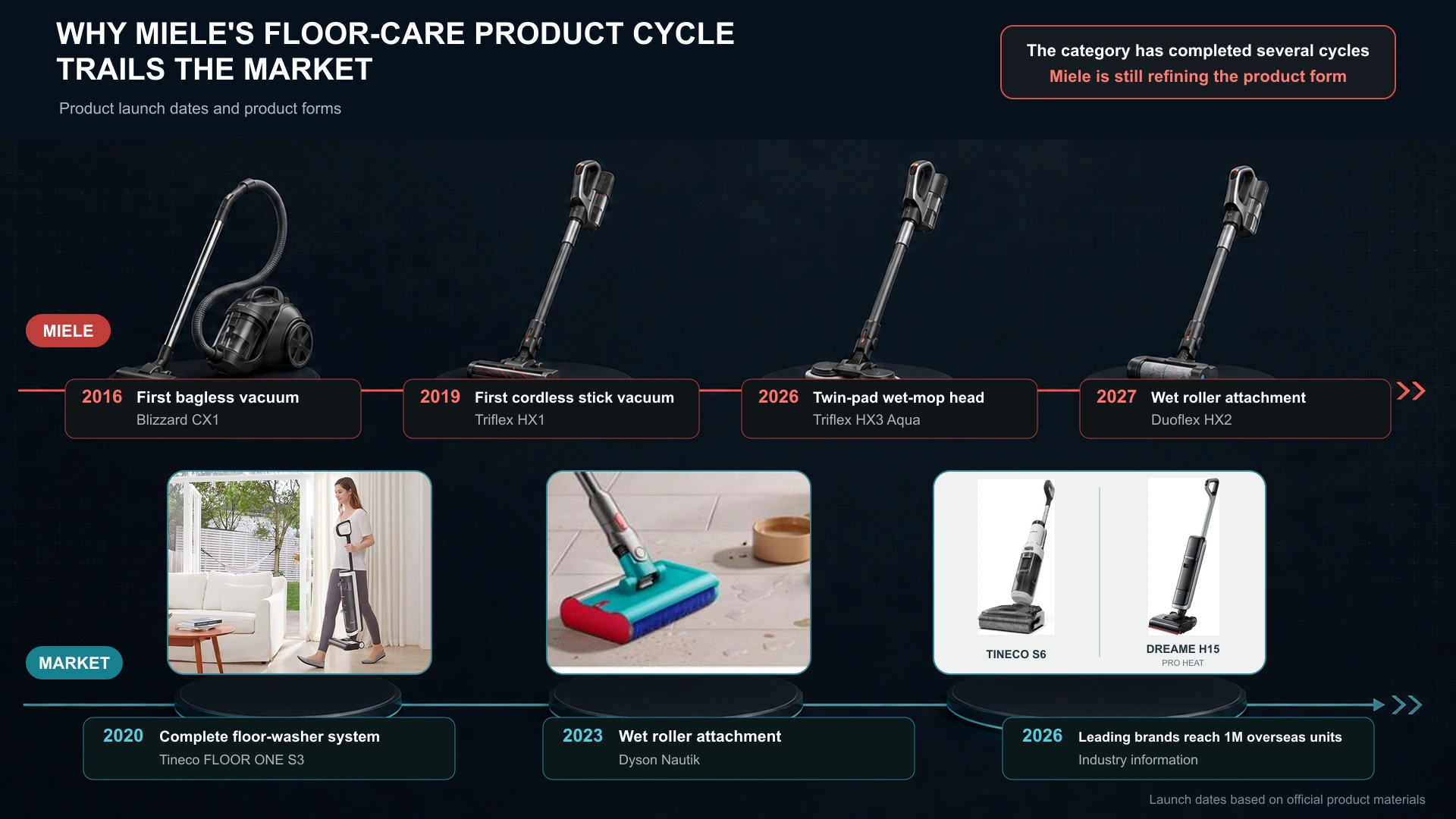
In product form, the Duoflex HX2 follows a route that appeared in the market roughly five years ago. Tineco and Dreame built complete clean- and dirty-water systems around floor washing years ago and have already completed several generations of product development. According to industry information, each company’s overseas floor-washer sales will reach one million units this year.
Miele has not announced the official price of the Duoflex HX2, saying only that it will offer an “attractive entry-level price.” Based on its existing product range, the version with the AquaTurbo head is expected to cost approximately RMB 4,600 to RMB 5,400 (€599 to €699). The premium version with a self-cleaning dock could reach approximately RMB 6,200 to RMB 6,900 (€799 to €899).
Today, even a relatively small factory in Suzhou’s supply chain can produce a floor washer with a complete clean- and dirty-water system and self-cleaning capability. Yet Miele is preparing to sell a “cordless vacuum plus wet-cleaning head” for RMB 6,000 to RMB 7,000 in 2027. Brand and build quality alone will not make it easy to explain a premium of several hundred euros.
Miele can maintain those prices because it has spent more than a century building a premium home appliance brand.
Engineer Carl Miele and businessman Reinhard Zinkann founded Miele in Germany in 1899. The company remains controlled by the two founding families. In 2025, Miele generated approximately RMB 39.8 billion (€5.16 billion) in revenue and remained one of Europe’s most important premium appliance companies.
Long product life has always supported Miele’s pricing. Many European consumers buy Miele not to get the newest features, but because they expect the machine to last longer.
Miele also has a long history in floor care. It introduced the Model L vacuum cleaner in 1931 and went on to hold an important position in Europe’s corded vacuum market. Bagged vacuum cleaners became one of its most recognizable product categories.
But Miele has never moved quickly into new categories.
Dyson’s cyclonic vacuums had already reshaped the market for years when Miele introduced its first bagless vacuum, the Blizzard CX1, in 2016. Cordless vacuums were rapidly replacing corded models before Miele launched its first cordless stick vacuum, the Triflex HX1, in 2019. By then, nearly one in three vacuum buyers in Europe was already choosing a cordless model.
When we wrote about the shift toward cordless products among German vacuum brands in 2019, we said: “Product innovation and keeping pace with the market have never been Miele’s strong suits.”
Seven years later, the Duoflex HX2 shows that this problem has not been fully resolved.
Based on the product form, I am inclined to believe that the Duoflex HX2 was defined primarily by Miele’s European team. Miele has not confirmed this internally; it is a judgment based on the product itself. A team that had genuinely developed floor washers and understood the category would not readily choose this product form for a 2027 launch.
Miele is still approaching floor washers through the logic of a dry vacuum cleaner. The result is a replaceable floorhead for wet cleaning. What it most needs to address now is product definition, not manufacturing capability.
Dyson has already begun to change. According to industry information, it is bringing Chinese supply-chain teams into complete product development and product definition. A brand that previously refused to use Chinese suppliers for complete machines is now relying on Chinese teams to accelerate its product development.
When even Dyson is reconsidering how it develops products, it is becoming increasingly difficult for Miele’s European team to keep pace with the cleaning appliance market while maintaining its old development rhythm.
The Duoflex HX2 suggests that Miele’s floor-care team has not kept pace with the development of the floor-washer category. Miele’s premium customers do not mind paying a high price for a vacuum cleaner. What they do mind is paying that price for a product whose form and user experience already trail mainstream alternatives.
That is the risk facing the Duoflex HX2. Its product form is dated, its user experience remains some distance behind mainstream floor washers, and its price will sit at the premium end of the market. In my view, this combination will make it difficult for the product to succeed. More than a century of brand equity can support a premium, but it cannot fully compensate for a flawed product definition.
Miele can, of course, retain its own quality standards. But it needs to change the way it defines products. Its product team cannot continue sitting in a European office and reading the market through past experience alone. It needs to work more closely with the supply chain, spend time in sales channels and real consumer-use environments, and study the products that Tineco and Dreame have already refined across several generations.
If the team behind the Duoflex HX2 had a deeper understanding of the floor-washer supply chain, consumer needs and competing products, it might well have arrived at a different product definition. Miele’s main challenge is not whether it can manufacture the product, but how it can understand the market again.
Large appliances have long replacement cycles, and consumers sometimes interpret slow iteration as caution and reliability. Floor-care appliances move much faster. Over the past five years, Chinese brands have taken floor washers from product definition to sales at scale. A brand can arrive late, but it still needs to understand how far the market has moved.
A premium brand with more than a century of history can afford to move somewhat more slowly than the market. But decades of brand equity cannot keep paying indefinitely for errors in product definition.
Explore 2026 new models