- Miele is privately owned by its two founding families: the Miele family holds 51% and the Zinkann family 49%, according to Miele's current official facts page.
- Miele & Cie. KG is the principal German legal entity, while Miele Professional is a business unit rather than a separate parent company.
- Miele manufactures through a multi-country network, including vacuum-cleaner production in both Bielefeld, Germany, and its wholly owned Dongguan plant in China, so model-level documents are required to verify origin and responsibility.
In this article 13 sections
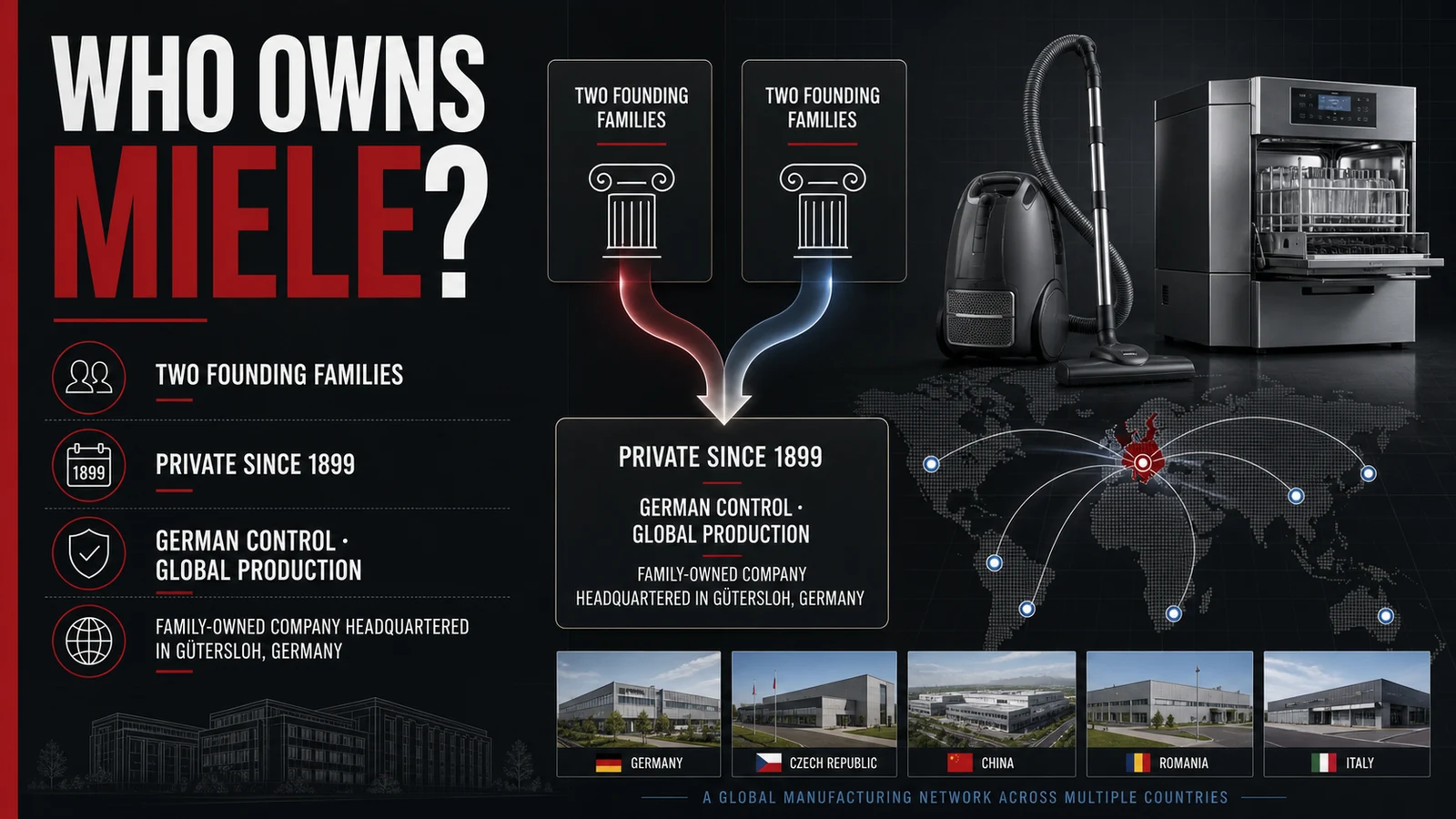
Miele is privately owned by the Miele and Zinkann families, with the Miele family holding 51% and the Zinkann family 49%. Miele's current official facts page states that this two-family ownership has existed since 1899. The group also says that roughly 80 family stakeholders are direct descendants of founders Carl Miele and Reinhard Zinkann. It is not a subsidiary of another appliance conglomerate, and it is not publicly traded.
The main German legal entity is Miele & Cie. KG, headquartered in Gütersloh. Two management companies—Miele Verwaltungs-GmbH and Zinkann Verwaltungs-GmbH—serve as its personally liable partners. The group is managed by two family co-proprietors and four non-family executive directors who are officially described as being on an equal footing.
That ownership answer is straightforward. The operating network is more layered. Miele Professional is a business unit, regional companies can be the seller or warranty provider, and products are made across Germany and several other countries. A distributor or supplier therefore needs more than the Miele name to identify the relevant contract party, factory or compliance owner.
Miele Ownership at a Glance
| Entity or operating layer | Verified role | What it does not automatically establish |
|---|---|---|
| Miele and Zinkann families | Founding families that have owned Miele since 1899; current official split is 51% Miele family and 49% Zinkann family | The percentage held by each individual family member |
| Around 80 family stakeholders | Direct descendants of Carl Miele or Reinhard Zinkann | Equal ownership or equal voting rights for all stakeholders |
| Miele & Cie. KG | Principal German group entity headquartered in Gütersloh | The seller, importer or warranty provider in every country |
| Miele Verwaltungs-GmbH and Zinkann Verwaltungs-GmbH | Personally liable partners of Miele & Cie. KG | A complete public cap table for the two families |
| Executive directors | Two family co-proprietors plus four non-family executives | That every executive is a shareholder |
| Miele Professional | Commercial-appliance and service business unit | A separate ultimate owner of the Miele brand |
| Regional companies | Local sales, service, import or warranty entities | Ownership of the entire global group |
| Production plants | Facilities in Germany and other countries | The factory for a specific model without product-level evidence |
Which Families Own Miele?
Engineer Carl Miele and businessman Reinhard Zinkann founded the company in 1899. Miele's current management page says the business has remained in the ownership of their two families since its inception.
The same page gives an unusually useful current detail for a private company: all of the approximately 80 family stakeholders are direct descendants of one of the two founders. This rules out several common assumptions. Miele has not been sold to Bosch, Electrolux, Whirlpool, a private-equity fund or a public holding company. Its ownership remains with the two founding families.
It does not mean the 80 stakeholders each own the same percentage. Miele publishes the current split between the two family groups, but not a current individual shareholder table. The family population, individual economic rights, voting arrangements and partnership interests are different questions.
The safest current description is therefore precise but limited: Miele is owned by the Miele and Zinkann families through a private family-company structure, with around 80 direct descendants participating as family stakeholders.
Do the Miele and Zinkann Families Own 51% and 49%?
Miele's current German facts and figures page states that Miele & Cie. KG has been owned since 1899 by the Miele family at 51% and the Zinkann family at 49%. This is current first-party evidence, not merely a historical percentage carried forward from an old report.
The percentage describes the split between the two founding-family groups. It does not disclose the interest held by each of the roughly 80 individual family stakeholders, nor does it replace formal beneficial-ownership documentation for a legal transaction.
For a general company profile, the current official 51/49 split is the most direct answer. For legal due diligence, financing, a distribution agreement or an ownership declaration, the counterparty should still provide current registry extracts, partnership documentation or a signed beneficial-ownership statement.
This distinction matters because a founding-family split can remain economically stable while the number of descendants, holding vehicles, voting arrangements and legal interests changes over time.
What Is Miele & Cie. KG?
Miele's German legal notice identifies Miele & Cie. KG at Carl-Miele-Straße 29 in Gütersloh. It is registered as a Kommanditgesellschaft, a German limited partnership, under HRA 3268.
The notice names two personally liable partners:
- Miele Verwaltungs-GmbH, registered in Gütersloh under HRB 1325.
- Zinkann Verwaltungs-GmbH, registered in Gütersloh under HRB 1324.
The presence of a management company for each founding family makes the legal structure easier to understand. Miele & Cie. KG is the operating partnership. The two GmbH entities perform the personally liable partner role. The family ownership sits above and around this structure through private interests that are not fully mapped on the public corporate website.
The letters `KG` do not indicate a stock-market listing. Miele calls itself an independent family-owned company, and no publicly traded Miele share or ticker was identified in the official materials reviewed.
The group, brand and legal entity should also remain separate in contracts. “Miele” can refer to the brand or global group. Miele & Cie. KG is a specific German legal entity. A regional subsidiary may appear on a purchase order, invoice, import declaration, privacy notice or warranty instead.
Who Runs Miele Today?
Family ownership has not prevented Miele from using professional management.
Miele's current management page lists six equal-ranking executive directors:
- Dr Markus Miele, Executive Director and Co-Proprietor.
- Dr Reinhard Zinkann, Executive Director and Co-Proprietor.
- Dr Axel Kniehl, Marketing and Sales.
- Rebecca Steinhage, Human Resources and Corporate Affairs.
- Dr Stefan Breit, Technology.
- Stefan Koss, Finance and Administration.
The two founding families therefore remain represented in operating management, while four non-family executives lead defined portfolios. This supports a more accurate description than either “run entirely by the family” or “controlled by outside managers.” Miele combines family ownership and family executive representation with a broader professional management team.
Management titles still do not answer every ownership question. A non-family executive should not be assumed to own shares. A family co-proprietor's title does not disclose that person's exact economic interest. The official statement that all six directors are on an equal footing describes executive governance, not equal share ownership.
Is Miele Professional a Separate Company or Owner?
Miele Professional is not the ultimate owner of Miele. It is a major commercial business within the family-owned group.
Miele's 2025 sustainability report describes eight independently operating business units: Laundry, Dishwashing, Cooking, Refrigeration, Professional, Customer Service, Small Domestic Appliances and the New Growth Factory. The Professional unit serves hotels, care facilities, medical practices, laboratories and other commercial users with laundry, dishwashing, cleaning, disinfection and related service solutions.
The Professional name can appear on products, websites, dealer programs and service documents. That does not place it above Miele & Cie. KG in the ownership chain. Buyers still need to identify the specific company issuing the quotation, accepting the order or providing the warranty.
Miele has also expanded professional medical processing through SteelcoBelimed, a joint venture formed with Metall Zug in 2024. The venture provides cleaning, disinfection and sterilisation solutions for medical and surgical instruments. Its relationship with Miele Professional does not make Metall Zug an owner of the Miele Group.
Another relevant company is Eurofilters, a wholly owned Miele subsidiary in Belgium that produces vacuum-cleaner bags, medical-care products and filter materials. It is part of Miele's production network, but it is not the manufacturer of every Miele vacuum cleaner.
These examples show why a group logo cannot replace an entity check. A domestic vacuum, a commercial dishwasher, a washer-disinfector and a vacuum bag can all carry a Miele connection while involving different business units, factories and legal entities.
How Large Is Miele?
Miele's current company page reports turnover of €5.16 billion in the 2025 business year and approximately 23,000 employees.
The current business-development page says the global network comprised 19 production plants and 49 service and sales subsidiaries as of March 2026. It also describes Miele as owned by the two founding families and headquartered in Gütersloh, North Rhine-Westphalia.
The production count needs a scope note. Miele's 2025 sustainability report separately identifies 14 of its own production sites, eight in Germany and six in Austria, Poland, Romania, the Czech Republic, China and the United States. The report also lists four SteelcoBelimed joint-venture manufacturing locations in Italy, Slovenia and Switzerland, plus the Eurofilters site in Belgium.
The 14-site and 19-plant figures are therefore not necessarily contradictory. One describes Miele's own production locations; the wider network can include joint-venture and subsidiary operations. They should not be presented as the same measurement.
Are Miele Products Made in Germany?
Many Miele products and components are made in Germany, but the brand does not operate only German factories.
Miele's official production-site directory lists eight German locations: Arnsberg, Bielefeld, Bünde, Euskirchen, Gütersloh, Lehrte, Oelde and Warendorf. It also lists facilities in Austria, Romania, the Czech Republic, Poland, China and the United States, along with Steelco locations in Italy.
Those factories have different roles. Gütersloh produces front-loading washing machines and washer-dryers and develops electronics and smart-home systems. Bielefeld produces vacuum cleaners, dishwashers and Professional cleaning and disinfection equipment. Euskirchen develops and manufactures motors and other components. The U.S. plant in Opelika, Alabama, started production at the end of 2024 and currently makes 30-inch ovens and range cookers for North America.
The country list establishes a global manufacturing network. It cannot identify the factory for a particular washing machine, vacuum cleaner, dishwasher or accessory. Product allocation changes over time, and components can cross borders before final assembly.
For an exact model, use the rating plate, country-of-origin marking, declaration of conformity, safety certificate, importer record, technical file and packaging. Marketing references to German engineering or a German headquarters are not substitutes for those documents.
Where Are Miele Vacuum Cleaners Made?
Miele's own factory pages confirm vacuum-cleaner production in both Germany and China.
The Bielefeld factory, founded in 1916, produces vacuum cleaners as well as domestic and commercial dishwashers and washer-disinfectors. Miele describes Bielefeld as the home of its Professional Technology business unit and says the site coordinates additional product production across the wider network.
The Dongguan factory began in 1996 as a joint venture with Melitta and has been wholly owned by the Miele Group since 2009. Miele's current page says the plant produces the Swing H1, Compact C1, Compact C2 and Complete C2 vacuum-cleaner ranges. It reports approximately 380 employees and annual production of around 500,000 vacuum cleaners.
The Dongguan page adds an important supply-chain detail: the motors used there come from Miele's Euskirchen operation in Germany. A vacuum can therefore be assembled in China using a Miele motor made in Germany. That does not make the complete appliance German-made, and Chinese assembly does not mean the product is an unauthorised third-party private-label machine. Dongguan is a Miele-owned factory.
Model assignments can change. The factory pages establish the current ranges and capabilities reviewed in July 2026, not a permanent origin rule for every Miele vacuum sold worldwide.
Is a Regional Miele Company the Global Parent?
No. Regional companies perform local operating roles within the family-owned group.
Miele says it has company-owned sales organisations in 50 countries and works through importers in about 50 more. A local Miele company may be the seller, importer, service provider, warranty issuer or data controller for a connected product. An independent importer may perform some of those functions in another market.
For example, the U.S. domestic-appliance warranty is issued by Miele, Incorporated, a Delaware corporation. That makes Miele, Incorporated highly relevant to a U.S. customer's warranty claim. It does not make the U.S. company the owner of the global group.
The same discipline applies to digital services. A Miele@home notice may name Miele & Cie. KG and a local group company as data controllers or service parties. Data responsibility, product manufacturing and ultimate family ownership are related but separate layers.
What Distributors and Suppliers Should Verify
Before relying on a Miele-branded agreement or factory claim, verify the following:
- Contracting entity: Is the agreement with Miele & Cie. KG, a regional subsidiary, SteelcoBelimed, Eurofilters, an importer or an authorised dealer?
- Brand and product scope: Does the authorization cover domestic appliances, Miele Professional, medical technology, spare parts or only named categories?
- Territory and channel: Which countries, customer types and online or offline channels are included?
- Manufacturer of record: Which company appears on the exact model's label, declaration, certificate and technical documentation?
- Factory scope: Does a factory audit cover the relevant site, line, model and production period?
- Component origin: Is a German component being confused with the origin of the finished appliance?
- Importer and compliance owner: Who files documents, manages incidents and coordinates recalls in the target market?
- Warranty and service: Which entity funds claims, supplies parts and authorises repair centres?
- Connected-product data: Who operates the account, app, cloud service and data-access process in the relevant region?
- Change control: Who must approve changes to the factory, supplier, component, software or certification?
This framework is especially important for suppliers. Miele's procurement organisation uses a global matrix with central material-group management and decentralised plant purchasing. Approval by one factory or material group should not be marketed as approval for the entire Miele Group unless the documents explicitly say so.
Frequently Asked Questions
Who owns Miele today?
Miele is owned by the Miele and Zinkann founding families. The company's current management page says around 80 family stakeholders are direct descendants of founders Carl Miele and Reinhard Zinkann.
Is Miele still family-owned?
Yes. Miele describes itself as an independent family-owned company and says the two founding families have owned it since 1899.
Is Miele publicly traded?
No publicly traded Miele share or ticker was identified in the official sources reviewed. Miele & Cie. KG is a private German limited partnership.
What country is Miele from?
Miele is a German company founded in 1899 and headquartered in Gütersloh. Its ownership and headquarters remain German, but its current manufacturing network includes plants in Germany and several other countries.
Do the Miele and Zinkann families own 51% and 49%?
Yes. Miele's current official facts page states that the Miele family holds 51% and the Zinkann family 49%. The company does not publish the percentage held by each individual family stakeholder.
Who is the CEO of Miele?
Miele uses a team of six equal-ranking executive directors rather than presenting one global CEO on its current management page. Dr Markus Miele and Dr Reinhard Zinkann are family co-proprietors; four non-family executives lead sales, people and corporate affairs, technology, and finance.
Is Miele Professional a separate company?
Miele Professional is one of the group's major business units and commercial product ranges. Specific transactions may involve distinct legal entities, but Miele Professional is not the ultimate owner of the Miele Group.
Are all Miele products made in Germany?
No. Miele maintains eight production locations in Germany and additional facilities in Austria, Poland, Romania, the Czech Republic, China and the United States, plus joint-venture and subsidiary sites elsewhere.
Are Miele vacuum cleaners made in China?
Some are. Miele's wholly owned Dongguan factory currently lists several vacuum ranges, while its Bielefeld factory in Germany also produces vacuum cleaners. The exact origin of a model should be checked on product-level documents.
Is the Dongguan plant an independent OEM?
No. It began as a joint venture in 1996 but has been fully owned by the Miele Group since 2009, according to Miele's official factory page.
Final Answer
Miele remains a private German family business owned by the two founding families: the Miele family holds 51% and the Zinkann family 49%. Around 80 descendants participate as family stakeholders. Miele & Cie. KG is the principal German legal entity, supported by separate Miele and Zinkann management companies as personally liable partners. Two family co-proprietors and four non-family executives run the group together.
The ownership layer should not be confused with Miele Professional, regional companies or factories. Miele manufactures through a global network, including vacuum production in Bielefeld and its wholly owned Dongguan plant. For a sourcing, distribution or compliance decision, verify the exact legal entity, territory, product range, model, factory, importer and warranty provider.
For the product history behind Miele's position in floor care, see German Vacuum Brands in the Cordless Wave. For comparable family-company structures, see Who Owns Kärcher? and Who Owns Dyson?.
Explore 2026 new models