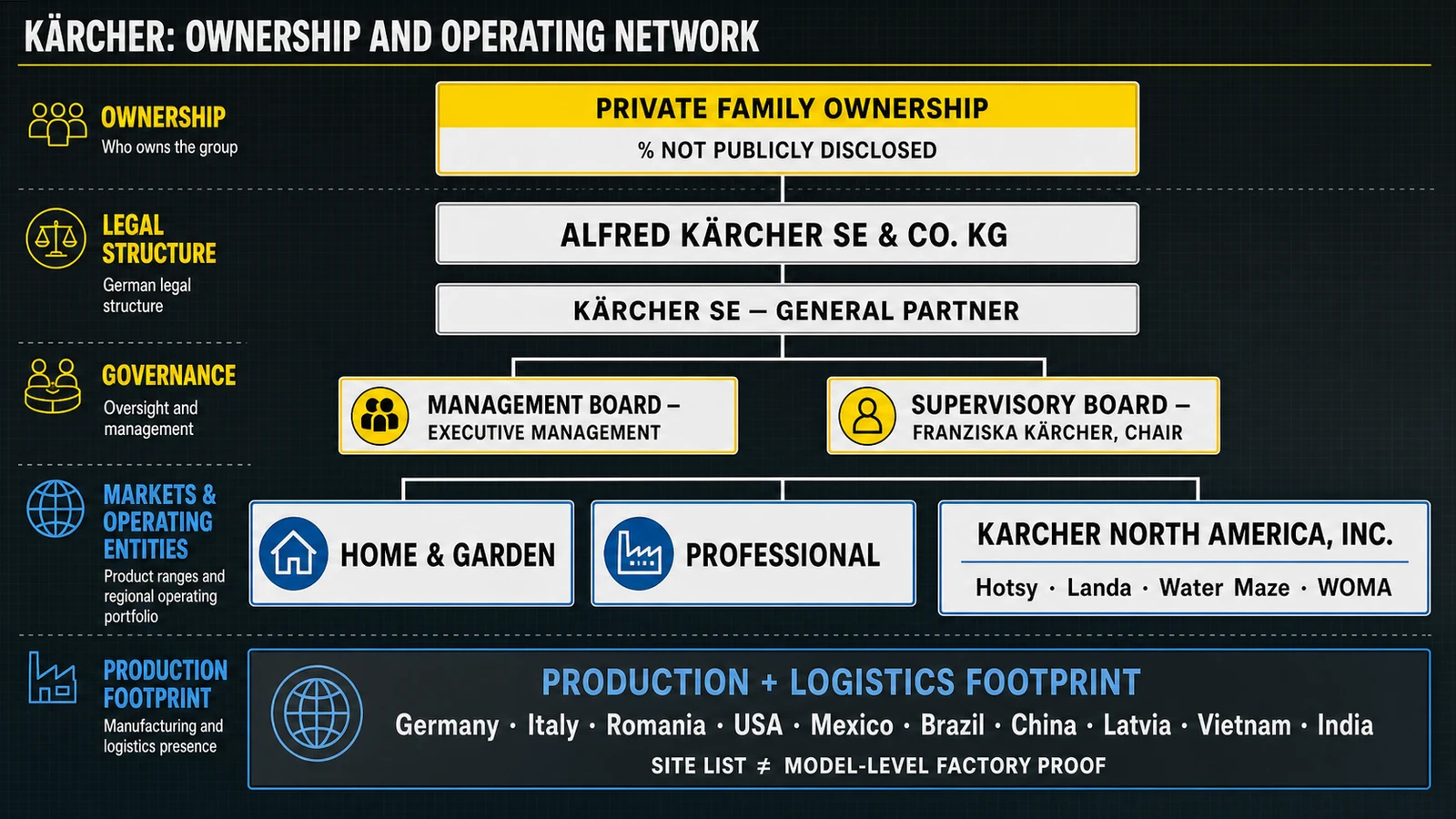
- Kärcher is a privately held German family business; the official sources reviewed do not publish a current shareholder-percentage table.
- Alfred Kärcher SE & Co. KG is the principal German entity, with Kärcher SE as its general partner, a professional management board and Franziska Kärcher chairing the supervisory board.
- Regional companies, product ranges, group brands and production sites have different responsibilities, so ownership alone does not identify the contract party, warranty provider or factory for a specific product.
In this article 12 sections
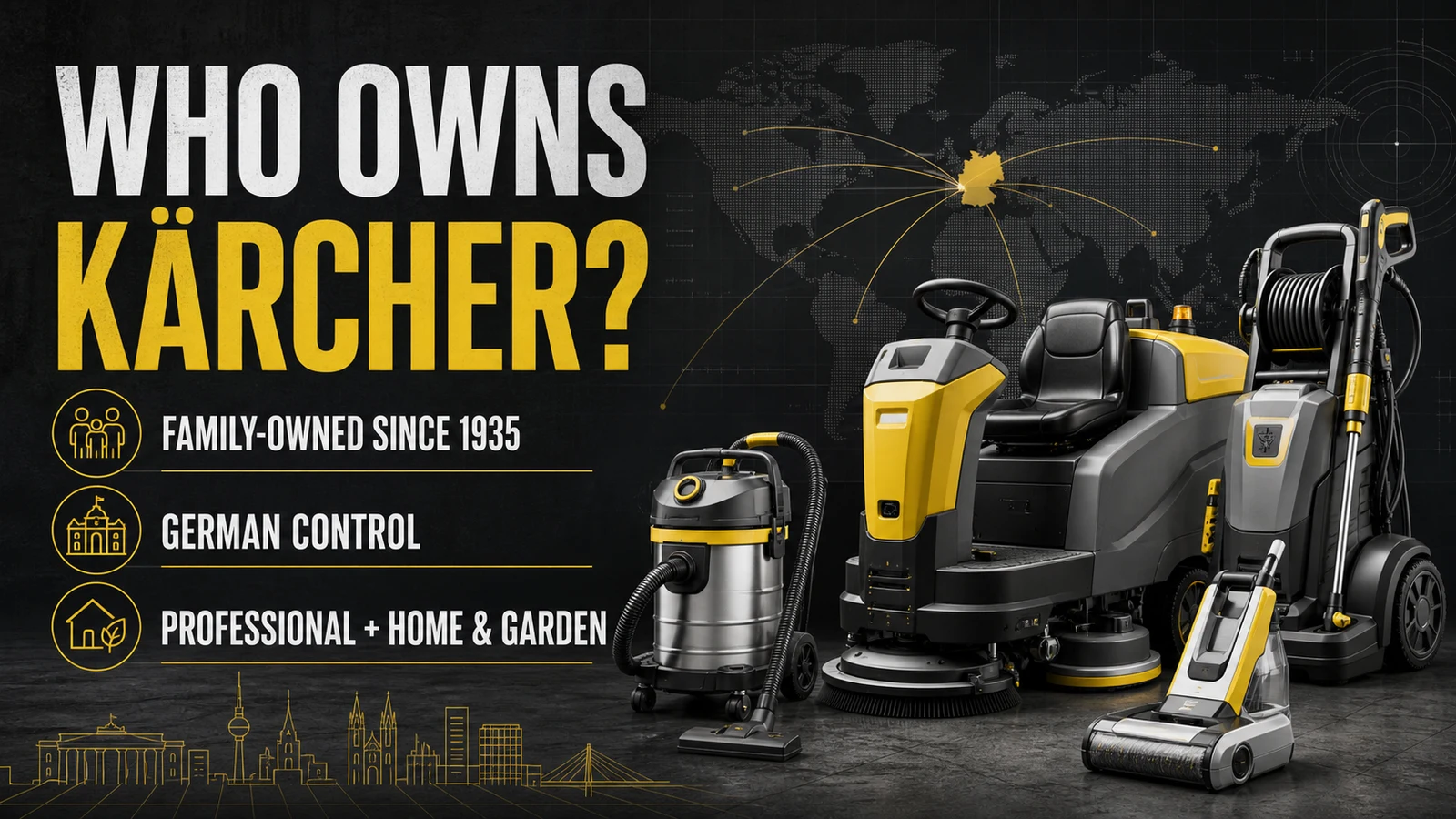
Kärcher is owned and controlled as a private German family business. The company was founded by Alfred Kärcher in 1935, remained under the Kärcher family after Irene Kärcher took over in 1959, and still describes itself as family-owned and family-run today.
Who makes Kärcher cleaning equipment? Kärcher manufactures through its own international group and production network, with factories in Germany and several other countries. That network-level answer does not identify one factory for every pressure washer, vacuum, floor machine or accessory, so the responsible manufacturer, assembly site and country of origin must still be verified for the exact model and market.
The main German operating entity is Alfred Kärcher SE & Co. KG. A separate company, Kärcher SE, serves as its general partner. Day-to-day management is led by a professional management board, while Franziska Kärcher chairs the supervisory board. Kärcher does not publish a current shareholder-percentage table in the official materials reviewed for this article, so claims about exact family stakes should be treated cautiously.
Kärcher Ownership at a Glance
| Entity, range or brand | Verified current role | What it does not automatically mean |
|---|---|---|
| Kärcher family ownership | Private, long-term control of the Kärcher group | Public sources reviewed do not establish each family member's percentage |
| Alfred Kärcher SE & Co. KG | Principal German operating entity headquartered in Winnenden | It is not a publicly traded company simply because `SE` appears in its name |
| Kärcher SE | General partner of Alfred Kärcher SE & Co. KG | General-partner status is not a public breakdown of ultimate economic ownership |
| Management Board | Executive management led by CEO Hartmut Jenner | Management positions do not by themselves establish share ownership |
| Supervisory Board | Oversight body chaired by Franziska Kärcher | A supervisory role does not disclose a personal equity percentage |
| Karcher North America, Inc. | Kärcher Group subsidiary and North American operating company | It is not the global parent of the entire Kärcher group |
| Home & Garden / Professional | Two major product and market ranges | They are not two separate ultimate owners |
| Hotsy, Landa, WOMA and other brands | Brands or specialist businesses within the wider operating network | They may have different dealer, contract, warranty and manufacturing arrangements |
This distinction matters to distributors and suppliers. The family owner, the German group entity, a regional subsidiary, a brand business, the seller on an invoice and the manufacturer named on a product can all be different parties.
How Did Kärcher Remain a Family Business?
Alfred Kärcher founded the company in Stuttgart-Bad Cannstatt in 1935. It initially worked in heating technology and later moved into cleaning equipment. Kärcher's own company history identifies the 1950 development of Europe's first hot-water high-pressure cleaner as the foundation of its modern cleaning business.
When Alfred Kärcher died in 1959, his wife Irene took over and led the company for three decades. That succession is more than a biographical detail: it explains how the business stayed under family control during the period in which Kärcher expanded internationally.
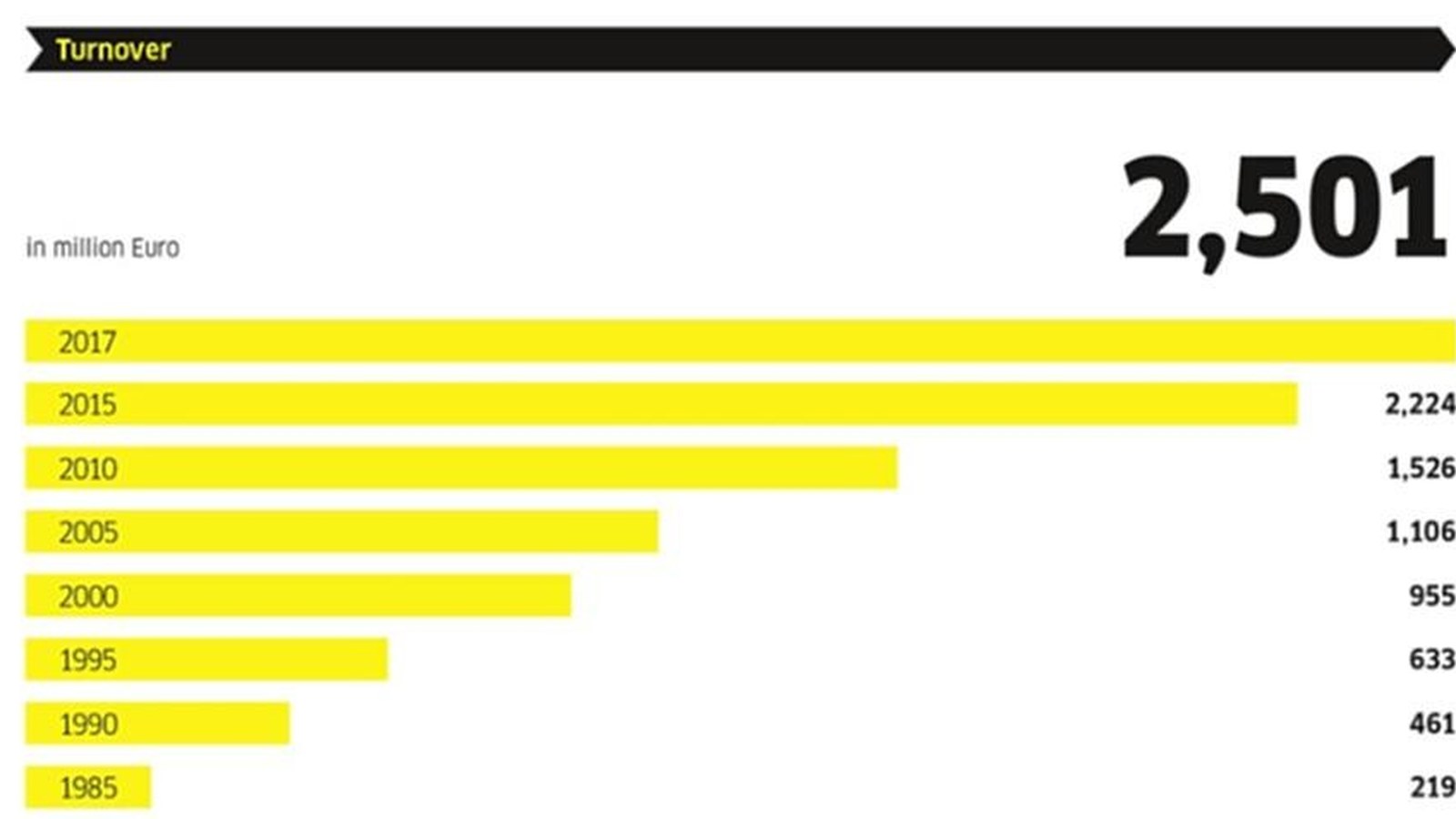
The company still makes the ownership position explicit. Its official corporate principles say that shareholders identify with the company and that Kärcher will remain family-run. Its current About Kärcher page calls it a family business and reports that the group generated €3.483 billion in sales in 2025, employing 17,000 people across 170 companies in 87 countries.
Those statements support a clear conclusion: Kärcher is not owned by a listed appliance conglomerate, private-equity fund or outside industrial group. It remains a privately controlled family enterprise.
They do not disclose a complete current cap table. Some older regional Kärcher pages name second-generation family members, but that does not provide a current, audited allocation of voting rights or economic interests. For ownership due diligence, “family-owned” is verified; a precise percentage for an individual is not.
What Is Alfred Kärcher SE & Co. KG?
Kärcher's legal name can look like a chain of separate companies. The official Kärcher International imprint provides the essential structure.
Alfred Kärcher SE & Co. KG is registered in Winnenden as a Kommanditgesellschaft, a German limited partnership. It is recorded at the Stuttgart registration court under HRA 260 169. The imprint identifies Kärcher SE as the general partner, registered under HRB 765 434.
In an `SE & Co. KG` structure, the operating partnership has a corporate entity—in this case Kärcher SE—serving as its general partner. This is a legal and governance arrangement. It does not mean that the operating group is publicly traded, and it does not reveal the family partnership's internal ownership percentages.
The `SE` designation refers to a European company legal form. An SE can be privately held. The important evidence is whether shares are listed on a public market, not the letters in the company name. Kärcher's own materials consistently describe the business as family-owned and emphasize financial independence and decision-making freedom.
Who Runs Kärcher Today?
Family ownership and executive management are not the same function.
Kärcher's current imprint lists Hartmut Jenner as CEO and chairman of the management board, Christian May as deputy CEO, and Stefan Patzke, Marco Cardinale and Markus Limberger as other management-board members. The same page identifies Franziska Kärcher as chairwoman of the supervisory board.
That creates a more accurate description than simply calling the company “family-managed.” Kärcher is family-owned and professionally managed, with a Kärcher family representative chairing the supervisory body. The management board handles executive responsibilities; the supervisory board oversees management; the ownership layer provides long-term control.
This separation also prevents two common errors. First, a non-family CEO is not evidence that the family sold the business. Second, a Kärcher family member's board position is not sufficient evidence for a claimed personal share percentage.
Is Karcher North America the Same Company?
No. It is a regional company inside the wider group.
The official U.S. imprint names Karcher North America, Inc. at 6398 N. Karcher Way in Aurora, Colorado. Kärcher's U.S. privacy policy describes it as a subsidiary of the Kärcher Group and a North American manufacturer of commercial, industrial and consumer cleaning equipment.
For a U.S. customer or supplier, Karcher North America may be the relevant sales, support, purchasing or contractual entity. But its role should not be enlarged into global ownership. The parent-level family and German legal structure still sits above the regional operation.
There is another practical complication: the official North American portfolio includes several established professional brands. Kärcher's Our Brands page lists Hotsy and Landa in industrial pressure washing, the Windsor floor-care legacy, WOMA in ultra-high-pressure systems, Spraymart in parts, and Water Maze in wash-water treatment.
These relationships create a broad professional-cleaning network, but not one universal commercial identity. A Hotsy dealer appointment does not automatically establish rights to sell every Kärcher Professional product. A Landa warranty arrangement may not cover Water Maze equipment. A supplier approved for one North American product family should not market itself as an approved global Kärcher supplier unless the authorization says so.
What Is the Difference Between Home & Garden and Professional?
Kärcher's global site organizes its products into two major ranges: Home & Garden and Professional.
Home & Garden includes consumer-oriented pressure washers, wet/dry vacuums, steam cleaners, window vacuums, floor cleaners, pumps, watering products and selected robotic products. Professional covers high-pressure cleaners, scrubber dryers, sweepers, commercial vacuums, autonomous cleaning systems, vehicle wash, industrial cleaning, water treatment and related services.
The ranges are useful for product positioning, dealer networks, service processes and channel strategy. They are not separate ultimate owners. Both sit within the Kärcher group, while the exact seller, importer or service provider can vary by market.
For distributors, this means the word “Kärcher” on an authorization letter is not enough. The document should identify whether it covers Home & Garden, Professional or both; which territory and channel it covers; and which legal entity grants the rights.
Which Specialist Companies Sit Inside the Kärcher Group?
Kärcher is wider than its yellow pressure washers and floor-care machines. Its official corporate-group page identifies several specialist businesses with distinct roles.
- WOMA GmbH in Duisburg develops high-pressure plunger pumps, ultra-high-pressure machines and water-jet tools for industrial applications.
- Ringler GmbH in Waldstetten supplies industrial vacuums, stationary suction installations and dust-extraction systems.
- Kärcher Municipal GmbH serves municipalities, landscaping businesses and service providers with sweepers and multifunctional municipal equipment.
- Kärcher Futuretech GmbH develops mobile water-supply, catering, camp and CBRN-protection systems for disaster and crisis operations.
A WOMA pump, a Ringler extraction system, a Kärcher Home & Garden floor cleaner and a North American Hotsy pressure washer can all connect to the family-controlled group while following different engineering, sales and compliance paths. Group membership establishes corporate connection; product responsibility still depends on the company, model, market and documentation.
Who Makes Kärcher Products and Where Are They Made?
Kärcher makes cleaning equipment through a global group production network. Germany remains its headquarters and a major manufacturing and engineering base, but not every Kärcher product is made there.
Kärcher's current sustainability data lists production and logistics locations across Germany, Italy, Romania, the United States, Mexico, Brazil, China, Latvia, Vietnam and India. German locations include Winnenden, Obersontheim, Bühlertal, Schwaikheim, Waldstetten, Duisburg, Reutlingen and Stadthagen. Other listed sites include Aurora, Monterrey, Vinhedo, Changshu, Quang Nam and Coimbatore.
This official footprint proves that Kärcher manufactures and operates across multiple regions. It does not allocate every product to a site. A country list cannot tell a buyer whether a particular pressure washer, scrubber dryer, vacuum, floor cleaner or accessory came from a specific factory.
Kärcher also reports that 75% of its factories' purchasing volume in 2025 came from regional suppliers located within 1,000 kilometers of the production site, and that it conducted more than 151 supplier audits that year. Those figures show a structured regional supply network. They are not a measure of in-house manufacturing, nor do they identify the supplier for a particular model.
To verify production responsibility, buyers should use model-level evidence: the rating label, country-of-origin marking, declaration of conformity, safety certificate, technical file, importer record and factory audit. A “Made in Germany” claim on one machine should never be expanded to the whole brand; neither should a “Made in China” label on one consumer product.
What Kärcher's Private Ownership Means for Industry Partners
Private family ownership can support long investment horizons and continuity across market cycles. Kärcher's corporate principles prioritize decision-making freedom and internally generated growth, helping explain continued investment in specialist companies and service networks.
But ownership does not simplify every transaction. A large private group can contain many subsidiaries, brands, factories, distributors and contracting entities. The 170-company scale reported for 2025 makes entity verification more important, not less.
A supplier may be approved by one factory but not another. A regional dealer may carry Home & Garden but not Professional. A brand acquired into the North American portfolio may retain its own distribution logic. A service center may be authorized for repairs without holding distribution rights.
The practical lesson is simple: the family owns the group, but the contract determines responsibility.
For a compact reference to the group and its product scope, see the Kärcher brand profile. When comparing professional floor-care suppliers, the Nilfisk ownership guide covers another group structure, while the commercial floor scrubber buying guide helps turn that company research into a machine and service specification.
What Distributors and Suppliers Should Verify
Before signing or promoting a Kärcher-related agreement, verify the following:
- Contracting entity: Is the agreement with Alfred Kärcher SE & Co. KG, Karcher North America, another regional subsidiary, a specialist group company or an independent distributor?
- Brand and territory: Does the authorization cover Kärcher, Hotsy, Landa, WOMA, Water Maze or another name, and in which countries and channels?
- Product range: Does it cover Home & Garden, Professional or only named product categories?
- Manufacturer of record: Which company appears on the exact model's label, declaration and safety documentation?
- Factory approval: Does the audit cover the relevant site, production line and model rather than another group facility?
- Importer and compliance role: Who holds the technical file, signs declarations, reports incidents and manages recalls?
- Warranty and service: Which company funds warranty claims, supplies parts and authorizes service centers?
- Change control: Who must approve changes to factories, suppliers, key components, software or certifications?
This checklist is more reliable than treating every yellow machine, Kärcher-branded document or group-company website as evidence of one universal legal relationship.
Frequently Asked Questions
Who owns Kärcher today?
Kärcher remains a privately held German family business. Its official materials describe it as family-owned and say it will remain family-run.
Is Kärcher a public company?
Kärcher is not presented as a publicly traded operating group in the official sources reviewed. The `SE` in Alfred Kärcher SE & Co. KG refers to the legal form of its general partner, Kärcher SE; it is not evidence of a stock-market listing.
What country is Kärcher from?
Kärcher is a German company founded in Stuttgart and headquartered in Winnenden. It remains family-owned in Germany, while its current production and logistics network extends across Europe, the Americas and Asia.
Does the Kärcher family still control the company?
Yes, according to Kärcher's own current company statements. However, the sources reviewed do not publish a complete current shareholder list or individual percentage breakdown.
Who is the CEO of Kärcher?
Kärcher's current international imprint lists Hartmut Jenner as CEO and chairman of the management board. Franziska Kärcher is listed as chairwoman of the supervisory board.
Is Karcher North America the owner of Kärcher?
No. Karcher North America, Inc. is a North American subsidiary and operating company within the family-controlled Kärcher Group.
Does Kärcher own Hotsy and Landa?
Kärcher North America lists Hotsy and Landa in its official brand portfolio. Commercial rights, dealer status, warranty and product responsibility should still be verified for the specific brand, market and agreement.
Are Kärcher Professional and Home & Garden separate companies?
They are major product and market ranges, not separate ultimate owners. Regional sellers, service arrangements and channel authorizations can still differ.
Are all Kärcher products made in Germany?
No. Kärcher has production and logistics sites in Germany and multiple other countries across Europe, the Americas and Asia. The factory for a specific model must be verified from product-level documentation.
Final Answer
Kärcher is a private, family-owned German cleaning-equipment group. Alfred Kärcher SE & Co. KG is its principal German operating entity, and Kärcher SE is the general partner. Professional executives led by Hartmut Jenner manage the business, while Franziska Kärcher chairs the supervisory board.
The ownership answer is therefore straightforward, but the operating network is not. Karcher North America, Home & Garden, Professional, Hotsy, Landa, WOMA, Ringler and the group's global factories occupy different legal or commercial layers. For any distribution, sourcing or compliance decision, verify the exact company, brand, territory, product range and model-level factory instead of relying on the group name alone.
For the broader history and competitive strategy behind the company, see Kärcher: The Hidden Champion of Cleaning.