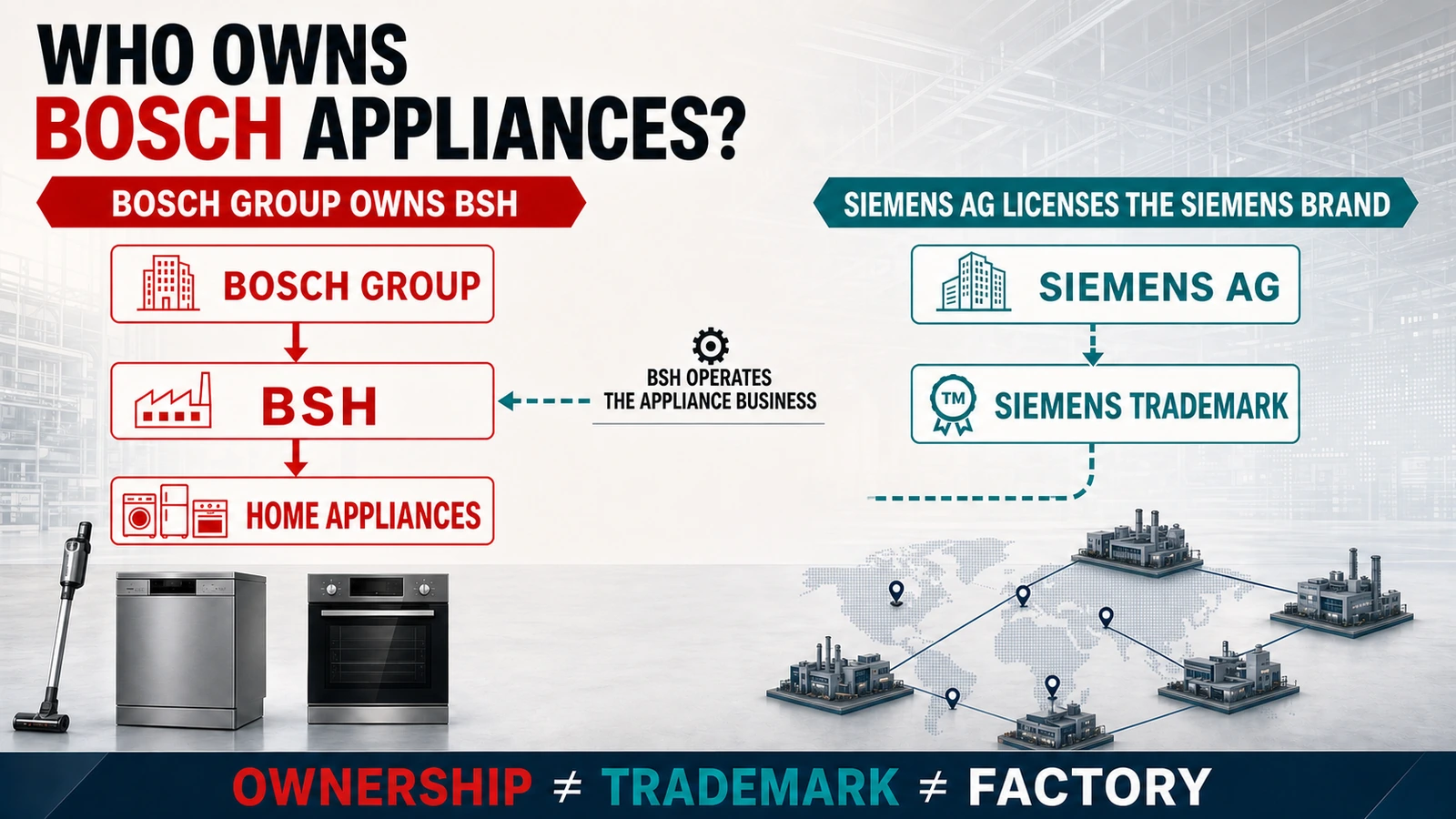
- Bosch-branded home appliances are operated by BSH Hausgeräte GmbH, which has been wholly owned by the Bosch Group since January 2015.
- Siemens AG no longer owns BSH, but it still owns the Siemens trademark and licenses BSH to produce and market Siemens home appliances.
- BSH operates a multi-brand, multi-country network, so buyers must verify the local seller, importer, factory and warranty party at model level.
In this article 13 sections
Bosch-branded home appliances are operated by BSH Hausgeräte GmbH, a company wholly owned by the Bosch Group. BSH became a 100%-owned Bosch Group company in January 2015, after Robert Bosch GmbH acquired Siemens AG's 50% stake in their former home-appliance joint venture.
Who manufactures Bosch appliances? BSH is the operating manufacturer behind Bosch home appliances and currently produces through 37 factories across Europe, North America, Africa and Asia. That group network does not identify the plant or legal manufacturer for every refrigerator, dishwasher, vacuum or other model, so the rating plate, declaration of conformity, importer label and current product documents remain decisive for a specific SKU.
That transaction did not mean Bosch bought Siemens AG or the Siemens trademark. Siemens AG no longer owns shares in BSH, but BSH remains a trademark licensee of Siemens AG and continues to produce and market Siemens home appliances. BSH also licenses the Bosch trademark from Robert Bosch GmbH.
This distinction explains why Bosch and Siemens appliances can come from the same operating group while remaining separate brands. It also explains why a buyer should not use a logo alone to identify the legal seller, factory, importer or warranty provider.
Bosch Appliance Ownership at a Glance
| Name or layer | Verified role | What it does not automatically mean |
|---|---|---|
| Bosch Group | Ultimate corporate owner of BSH | Every Bosch-branded business is operated by BSH |
| Robert Bosch GmbH | Parent company of the Bosch Group and licensor of the Bosch trademark to BSH | The named seller on every appliance invoice |
| BSH Hausgeräte GmbH | Bosch Group company that operates the home-appliance business | Owner of the Siemens trademark |
| Bosch Home Appliances | Global appliance brand operated within BSH | The same company as Bosch Power Tools or Bosch Mobility |
| Siemens AG | Owner and licensor of the Siemens trademark | A current shareholder of BSH |
| Siemens Home Appliances | Appliance brand produced and marketed by BSH under license | Siemens AG's current home-appliance subsidiary |
| Gaggenau, Neff and Thermador | Brands within BSH's appliance portfolio | The same market positioning, factory or local seller |
| Regional BSH companies | Local sales, import, service or distribution entities | The parent of the entire Bosch Group |
| BSH factories | Production sites across four continents | The origin of a specific model without product documents |
What Company Actually Runs Bosch Home Appliances?
The operating company is BSH Hausgeräte GmbH, headquartered in Munich. Its current legal notice identifies it as a German limited-liability company registered under HRB 75534 and describes it as a Bosch Group company.
BSH covers major appliances such as cooking, refrigeration, dishwashing and laundry, as well as small appliances including vacuum cleaners, coffee machines and kitchen machines. This is the business behind Bosch Home Appliances. Bosch power tools, automotive components, building technology and other Bosch businesses sit elsewhere in the wider group.
The distinction matters in commercial work. A supplier approaching “Bosch” needs to establish whether the relevant counterparty is BSH, another Bosch entity or a regional distributor. The shared Bosch name is not a substitute for a legal-entity check.
How Did BSH Become Fully Owned by Bosch?
Robert Bosch GmbH and Siemens AG founded the appliance joint venture in Germany in 1967. For decades, the company name—Bosch und Siemens Hausgeräte—made the two-parent structure visible.
In September 2014, Bosch and Siemens announced that Bosch would acquire Siemens' 50% stake in BSH. The agreed purchase price was €3 billion, alongside a pre-completion distribution to both shareholders. The joint announcement said BSH would become a wholly owned Bosch Group subsidiary and would be permitted to continue using the Siemens brand over the long term.
The sale was completed on January 5, 2015. BSH's corporate name was subsequently shortened to BSH Hausgeräte GmbH.
The accurate description is therefore:
- Bosch acquired Siemens AG's stake in BSH.
- Bosch did not acquire Siemens AG.
- Siemens AG exited BSH ownership.
- BSH retained a long-term route to use the Siemens brand for home appliances.
That wording prevents the common but material error of turning a joint-venture buyout into a takeover of Siemens itself.
Does Bosch Own Siemens Appliances?
The answer depends on what “own” means.
At the company level, Bosch Group owns BSH, and BSH runs the Siemens home-appliance business. At the trademark level, Siemens AG remains the licensor of the Siemens brand. BSH's current corporate pages explicitly state that it is a trademark licensee of Robert Bosch GmbH for the Bosch brand and of Siemens AG for the Siemens brand.
So it is reasonable to say that Bosch Group owns the company operating Siemens home appliances, but misleading to say that Bosch owns Siemens AG or the Siemens trademark.
This arrangement is not just historical wording. BSH continues to list Bosch and Siemens among its global appliance brands, while its legal notice preserves the two separate trademark licensors.
Who Owns the Bosch Group?
Following the chain above BSH leads to Robert Bosch GmbH and a less conventional ownership structure.
Bosch's current company page says that roughly 94% of Robert Bosch GmbH's share capital is held by Robert Bosch Stiftung GmbH, a charitable foundation. A Bosch-family-owned company holds roughly 5%, and Robert Bosch GmbH holds roughly 1% itself.
Economic ownership and voting control are separated. Around 93% of the voting rights are held by Robert Bosch Industrietreuhand KG, while descendants of the founder hold roughly 7%. Bosch also says the foundation does not influence the group's strategic or business direction.
| Bosch ownership layer | Approximate share | Role boundary |
|---|---|---|
| Robert Bosch Stiftung GmbH | 94% of share capital | Receives the economic interest but does not direct Bosch strategy or operations |
| Bosch family company | 5% of share capital | Family economic interest |
| Robert Bosch GmbH | 1% of share capital | Treasury or self-held interest |
| Robert Bosch Industrietreuhand KG | 93% of voting rights | Safeguards long-term corporate direction and independence |
| Bosch founder's descendants | 7% of voting rights | Remaining family voting rights |
This structure sits above BSH. It should not be confused with BSH's own brand licensing, management or regional operating companies.
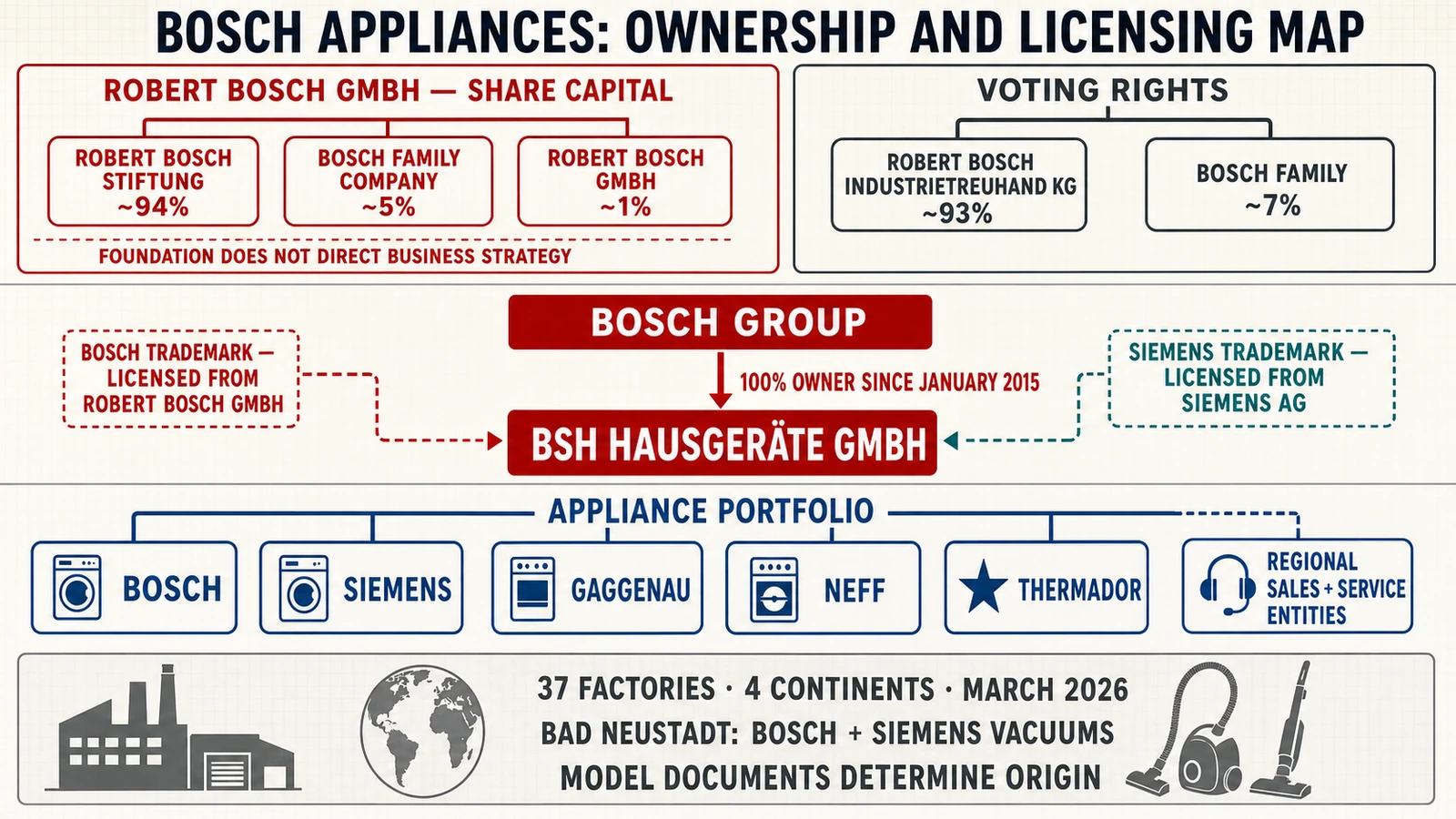
*Capital ownership, voting rights, corporate ownership, trademark licensing and manufacturing are separate layers.*
Which Appliance Brands Are Part of BSH?
BSH describes Bosch, Siemens and Gaggenau as global appliance brands and Neff and Thermador as major regional brands. Its wider portfolio also contains local brands serving particular countries.
Bosch
Bosch Home Appliances is the largest identity link between BSH and its parent group. BSH uses the Bosch trademark under license from Robert Bosch GmbH. A Bosch appliance is therefore a BSH appliance business product, but the Bosch name also appears across many non-appliance Bosch sectors that BSH does not run.
Siemens
Siemens Home Appliances is operated by BSH under a trademark license from Siemens AG. Siemens AG's withdrawal as a shareholder did not remove Siemens-branded appliances from BSH's portfolio.
Gaggenau
BSH says Gaggenau became its subsidiary in 1995. The brand occupies the luxury built-in-appliance segment and is represented internationally.
Neff
Neff became part of BSH in 1982 and is currently presented as a regional appliance brand focused on cooking and the kitchen. The existence of a Neff legal entity or factory does not make Neff the parent of BSH.
Thermador
BSH acquired the U.S. appliance company Thermador in 1998. Today the brand is central to BSH's North American luxury portfolio alongside Bosch and Gaggenau.
Regional and service brands
BSH's country and customer-service pages also identify brands such as Balay, Constructa, Pitsos and Profilo, while Home Connect is positioned as an ecosystem brand. Availability varies by market. A group-level brand list does not prove that every brand is sold by the same entity in every country.
Who Manufactures Bosch Appliances?
Some are produced within the same BSH manufacturing network, but that is not enough to conclude that all Bosch and Siemens products are identical or come from the same plant.
BSH reported 37 factories across Europe, North America, Africa and Asia as of March 2026, with sales, production and service companies in around 50 countries. Its 2025 turnover was approximately €15 billion, and it employed more than 56,000 people.
The clearest floor-care example is Bad Neustadt in Germany. A July 2026 BSH release says the plant has produced vacuum cleaners for the Bosch and Siemens brands for 30 years and has made more than 80 million units. In March 2026, the plant produced its two-millionth Bosch Unlimited 7, four years after that model family entered production there.
This confirms that one BSH site can support more than one brand. It does not prove that two specific models have the same motor, battery, tooling, software, performance or country of origin.
The same caution applies to component claims. BSH's 2026 U.S. launch material says the brushless motor in the Bosch Unlimited 9 and 10 was developed and built in Germany. That is evidence for the motor, not automatic evidence that every finished appliance was assembled in Germany.
Why the Local Legal Entity Still Matters
BSH operates through regional sales, production and service companies. The company shown on a local website or invoice can therefore differ from BSH Hausgeräte GmbH in Munich.
For a distributor, retailer, supplier or institutional buyer, five separate questions must be answered:
- Brand authority: Who licenses or authorizes use of the Bosch or Siemens name in the territory?
- Contract party: Which legal entity signs the supply, distribution or service agreement?
- Product responsibility: Which entity is listed as manufacturer, importer or responsible economic operator?
- Manufacturing origin: Which factory and country apply to the exact model and production batch?
- After-sales responsibility: Which entity provides warranty, spare parts, software support and recalls?
The correct evidence is normally found in the contract, invoice, product rating plate, declaration of conformity, importer label, warranty terms and local legal notice—not in the global brand hierarchy alone.
Keep appliance and power-tool research separate: the Bosch power-tool ownership guide covers that business, while the Philips and Versuni guide explains another home-appliance licensing structure. For a private-label vacuum project, the cordless vacuum OEM/ODM guide sets out the product-development questions that a brand ownership chart cannot answer.
B2B Verification Checklist
| Document or check | What it should establish |
|---|---|
| Local website legal notice | Website operator and local BSH or distributor entity |
| Distribution agreement | Territory, brands, channels, exclusivity and termination rights |
| Product rating plate | Model, manufacturer and stated origin information |
| Declaration of conformity | Responsible entity, applicable standards and product identity |
| Importer label | Market-entry responsibility in the destination country |
| Factory or supplier record | Actual production site for the model or component |
| Warranty terms | Local warranty provider, term, exclusions and service process |
| Trademark authorization | Right to use Bosch or Siemens branding in the stated context |
| Home Connect terms | Connected-service provider, data responsibility and regional availability |
Frequently Asked Questions
Who owns Bosch appliances?
Bosch-branded home appliances are operated by BSH Hausgeräte GmbH. BSH has been wholly owned by the Bosch Group since January 2015.
What does BSH stand for?
BSH originated as Bosch-Siemens Hausgeräte, the home-appliance joint venture founded by Robert Bosch GmbH and Siemens AG in 1967. The legal company is now named BSH Hausgeräte GmbH.
Does Siemens still own BSH?
No. Siemens AG sold its 50% BSH stake to Robert Bosch GmbH, and the transaction was completed in January 2015.
Why does BSH still sell Siemens appliances?
Siemens AG licenses the Siemens trademark to BSH. The 2014 transaction provided for BSH to continue producing and marketing Siemens home appliances over the long term.
Are Bosch and Siemens appliances the same?
They are separate brands operated within BSH and may share technologies, factories or platforms. That does not prove that two models have identical specifications, components or service terms.
Does Bosch own Gaggenau, Neff and Thermador?
They sit within the BSH appliance portfolio, and BSH is owned by Bosch Group. Their precise brand and subsidiary histories differ: Gaggenau became a BSH subsidiary in 1995, Neff joined BSH in 1982, and BSH acquired Thermador in 1998.
Are Bosch vacuum cleaners made in Germany?
Some Bosch vacuum cleaners are produced at BSH's Bad Neustadt plant in Germany. The site produces Bosch and Siemens floor-care appliances, including the Bosch Unlimited 7. Model documents are still required before making a country-of-origin claim for a specific vacuum.
Is Bosch owned by a charitable foundation?
Robert Bosch Stiftung holds roughly 94% of Robert Bosch GmbH's share capital, but Bosch states that the foundation does not direct group strategy or business operations. Most voting rights are held by Robert Bosch Industrietreuhand KG.
Final Answer
Bosch appliances are operated by BSH Hausgeräte GmbH, a wholly owned Bosch Group company. Siemens AG is no longer a BSH shareholder, but it remains the owner and licensor of the Siemens trademark used for Siemens home appliances. BSH's other brands, regional companies and factories form an operating network beneath that ownership structure.
For industry buyers, the useful conclusion is not simply that Bosch “owns” the appliance group. Ownership, trademark rights, regional contracting and model-level manufacturing are different layers, and each requires its own evidence.
Related World Clean Biz Analysis
- Who Owns Miele? The Families, Company Structure and Global Manufacturing Network
- Who Owns Dyson? James Dyson, Its UK–Singapore Structure and Manufacturing Network Explained
- Who Owns Hoover? TTI, Haier and the Brand's Regional Split Explained
Primary Sources
Explore 2026 new models