- Choose OEM, ODM or a platform program by ownership, engineering change and validation responsibility—not by the label in a quotation.
- Freeze the complete performance system: motor, air path, battery, filtration, floorhead, seals and firmware must be verified together under defined test conditions.
- Approve production only after tooling, compliance evidence, pilot capability, change control, spare parts and the supplier's real manufacturing boundary have been audited.
In this article 23 sections
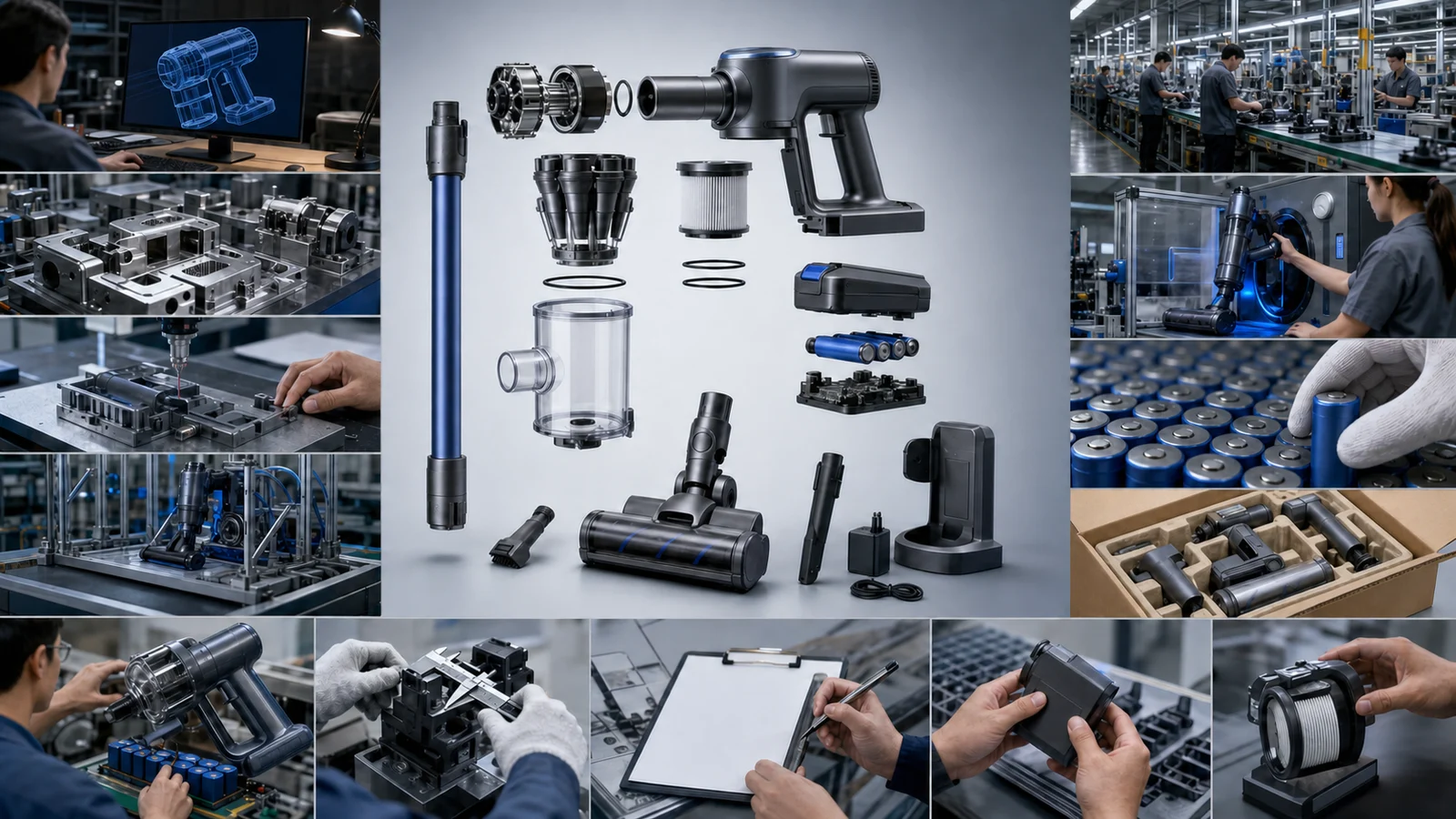
A successful cordless-vacuum OEM/ODM project is not a motor plus a plastic shell. It is a controlled system linking airflow, battery energy, filtration resistance, floorhead agitation, thermal limits, ergonomics, tooling, compliance and after-sales parts.
Start with a product requirements document and a market-specific compliance matrix. Select the development model only after you understand who owns the design, who can change it, who pays for tooling and revalidation, and which factory actually controls the critical components.
The Cordless Vacuum Development Map
| Stage | Core decision | Evidence before approval |
|---|---|---|
| 1. Business brief | Segment, channel, price architecture, claims | Signed product requirements document |
| 2. Platform | OEM, ODM, shared platform or new design | IP, change rights, tooling and exclusivity map |
| 3. Architecture | Motor, air path, cyclone, battery, floorhead | Engineering sample and complete test method |
| 4. Detailed design | Materials, seals, UI, charger, accessories | Design review and risk analysis |
| 5. Tooling | Mold ownership, steel, cavities, tolerances | Tooling contract and first-off inspection |
| 6. Verification | Performance, safety, reliability, compliance | Controlled reports tied to exact BOM |
| 7. Pilot | Process capability, work instructions, traceability | Pilot yield and closed corrective actions |
| 8. Production | Incoming, in-process and outgoing control | Approved golden sample and quality plan |
| 9. After-sales | Filters, batteries, floorhead, charger, repair | Spare-parts and warranty-support plan |
1. Define the Product Before Contacting Factories
A weak RFQ asks for “a powerful cordless vacuum at a competitive price.” A usable RFQ defines the user, surfaces, debris, cleaning time, channel and destination market.
Specify:
- stick, handheld, upright-like or multifunction platform;
- hard-floor, carpet, pet-hair and above-floor priorities;
- target total weight and hand weight;
- runtime by mode and powered-tool configuration;
- dust-cup usable capacity and emptying behavior;
- filtration and whole-machine leakage claim;
- floorhead type, brush diameter, edge reach and anti-tangle target;
- noise test method and tonal requirements;
- charging, dock and storage concept;
- attachment list;
- target warranty and service model;
- sales countries, voltage and plug variants;
- carton, drop, pallet and e-commerce requirements;
- regulatory claims and restricted-substance plan.
Do not start from a competitor photo alone. It encourages visual copying while leaving the expensive performance and ownership questions unresolved.
2. OEM, ODM and Platform Customization
These terms are used inconsistently, so define the commercial reality in the contract.
OEM build-to-print
The brand supplies a controlled design and the manufacturer builds it. The brand may own:
- industrial design;
- mechanical drawings;
- electronics and firmware;
- tooling;
- specifications and test methods;
- BOM and approved suppliers.
This offers control but requires a capable internal engineering team and disciplined configuration management.
ODM
The manufacturer provides most of the existing design and engineering. The brand selects a platform and may change colors, tools, firmware, plastics or packaging.
Advantages can include shorter timing and lower development cost. Risks include:
- similar products sold to multiple brands;
- unclear ownership of molds and firmware;
- limited ability to change core architecture;
- shared component changes without brand approval;
- dependence on the ODM for replacement parts.
Shared platform or JDM
Many real projects sit between OEM and ODM. A factory platform supplies the motor-air-path skeleton, while the buyer funds a unique floorhead, battery, dock or industrial design.
Write down:
- which modules are standard;
- which are exclusive;
- who owns each mold;
- who owns new drawings and firmware;
- whether the supplier may reuse modifications;
- how engineering changes are approved;
- what happens if the relationship ends.
The name “OEM” in a quotation does not answer any of these questions.
3. Build a Segment and Cost Architecture
Cordless-vacuum cost is not one BOM number. Create a feature ladder:
- entry: basic handheld/stick, simple filter and passive floorhead;
- mainstream: BLDC motor, powered floorhead, multi-cyclone, removable pack;
- premium: higher airflow, improved sealing, anti-tangle brush, display, dock;
- flagship: dirt sensing, automatic power control, advanced filtration, multifunction station.
For each level, define:
- must-have functions;
- differentiators;
- optional accessories;
- country variants;
- claims requiring verification;
- expected warranty burden.
Avoid adding features until the product meets a target factory price. Uncontrolled feature accumulation creates a product that is heavy, complex and difficult to validate.
4. Motor and Fan Module
The motor-fan unit converts electrical energy into airflow and pressure. A supplier may quote rpm, input watts, Pa or AW, but none should be approved without a test condition.
Require:
- motor type and control method;
- nominal and maximum input;
- pressure-flow curve;
- efficiency across operating points;
- temperature rise;
- speed tolerance;
- bearing specification and life evidence;
- rotor balance and vibration;
- acoustic spectrum;
- supplier and production location;
- change-notification rules.
BLDC motors can offer high power density and controllability, but add the controller, firmware, sensors and electromagnetic-compatibility interfaces. A high-speed motor may also create a sharp tonal signature that users perceive as louder than a similar dB(A) result.
Test the motor separately for incoming control, then test the complete vacuum. Housing restriction, filters, cyclones, seals and tools determine delivered performance.
See our analysis of brushless motors in cleaning appliances.
5. Air Path, Cyclone and Dust Separation
Map pressure loss from the floor to the exhaust:
- floorhead inlet;
- neck and wand;
- main duct;
- cyclone or separator;
- mesh and pre-filter;
- motor fan;
- final filter;
- exhaust silencing path.
Common failures include:
- undersized bends;
- abrupt transitions;
- wand or hose collapse;
- cyclone carryover;
- filter loading too quickly;
- cup-gasket leakage;
- exhaust recirculating dust toward the floor.
Use computational work as a design aid, not final proof. Instrument prototypes with pressure taps and airflow measurement. Compare clean-filter and loaded-filter states.
The published performance claim must specify:
- measurement point;
- supplied tool or open inlet;
- battery state of charge;
- power mode;
- filter condition;
- ambient temperature;
- duration after startup.
6. Filtration and Sealing
Filtration performance has three layers:
- separation of large debris and hair;
- fine-particle capture by filter media;
- prevention of bypass around the cup, filter and housing.
A high-efficiency filter does not create a sealed vacuum. Verify whole-machine exhaust, not only a filter-material certificate.
Design for:
- gasket compression over life;
- foolproof filter installation;
- pressure-drop margin;
- filter-washing instructions;
- complete drying;
- tool-free replacement;
- replacement availability;
- protection from users operating without a filter.
If a claim uses HEPA or a particle percentage, agree on the applicable method, aerosol, particle size, loading and leakage boundary with the test laboratory before freezing packaging.
7. Battery Pack, BMS and Charger
The battery is a safety-critical subsystem and a major warranty-cost driver.
Freeze:
- cell manufacturer, chemistry and exact model;
- series/parallel configuration;
- nominal voltage and watt-hours;
- cell matching and incoming inspection;
- pack enclosure and venting;
- temperature-sensor locations;
- overcharge, over-discharge, over-current and short-circuit protection;
- balancing strategy;
- charge curve;
- charger supplier and output;
- connector life and polarity protection;
- firmware cutoff and state-of-charge behavior;
- traceability from cells to finished product.
IEC 62133-2 addresses safety requirements and tests for portable sealed lithium cells and batteries under intended use and reasonably foreseeable misuse. It does not replace complete-appliance safety, destination-market requirements or transport testing.
UNECE’s UN Manual of Tests and Criteria includes subsection 38.3 for lithium-cell and battery transport design tests. The supplier must provide a traceable test summary tied to the actual cell/pack model. If the cell, configuration or construction changes, determine whether re-evaluation is required before shipment.
The EU Battery Regulation 2023/1542 also affects battery obligations over staged dates. Build an applicability plan for the exact role, battery category and market instead of copying an old checklist.
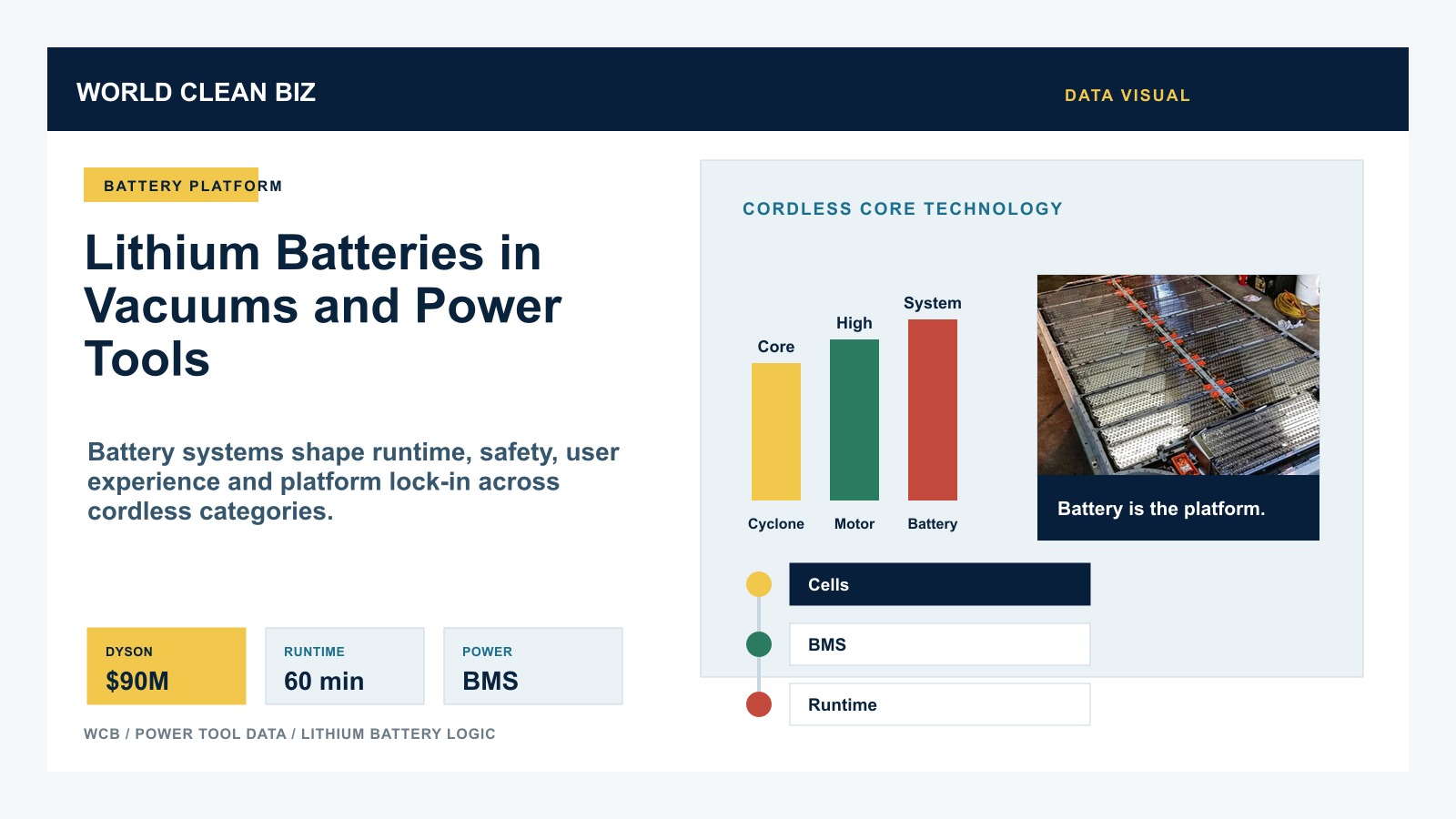
Read our overview of lithium batteries in vacuums and power tools and hidden risks in cordless vacuum development.
8. Runtime, Power Modes and Thermal Control
Runtime is a system result:
`runtime ≈ usable battery Wh ÷ average system W`
This simplified relationship does not include cutoff, temperature, cell aging or changing load. Require measured runtime:
- in each power mode;
- with and without powered floorhead;
- at controlled ambient temperature;
- from a defined state of charge;
- to the specified cutoff;
- on new and aged packs.
Also record suction throughout the run. A product can claim long runtime by reducing power aggressively.
Thermal validation should cover:
- motor winding and controller;
- cells and pack contacts;
- BMS components;
- charger;
- floorhead motor;
- blocked-inlet and partially loaded-filter states;
- repeated short cleaning cycles;
- hot and cold ambient operation permitted by the specification.
Do not hide overheating behind an early firmware cutoff without fixing the underlying thermal path.
9. Floorhead, Brush Roll and Anti-Tangle Design
The floorhead often determines perceived cleaning more than the headline motor.
Define:
- hard-floor, carpet or dual-surface target;
- brush material and pattern;
- diameter and rpm;
- motor power and gearbox;
- neck articulation;
- front and side sealing;
- debris-gate geometry;
- edge-cleaning distance;
- wheel marks and scratching;
- hair-tangle target;
- tool-free brush removal;
- bearing and end-cap protection;
- illumination and current draw if used.
Anti-tangle claims must define hair length, mass, textile, number of passes and acceptable retained hair. Test human hair, pet hair and thread separately.
Run ingestion tests for coins, cable ties, rug fringe and hard objects. A floorhead that cleans a laboratory carpet may jam immediately in a real home.
10. Dust Cup and User Maintenance
Key questions:
- can the user empty without touching debris?
- does hair bridge above the maximum line?
- can the cup be removed without dropping seals?
- are washable parts obvious?
- can wet parts be mistakenly reinstalled?
- will the latch survive thousands of cycles?
- does the cup leak after drop and aging?
Test emptying with fine dust, long hair and mixed debris. Record airborne release and contamination of the user’s hand.
Filters, cyclones and shrouds should be keyed so they cannot be assembled incorrectly. Maintenance videos and diagrams must match the final production configuration.
11. Ergonomics, Weight and Acoustic Quality
Measure:
- total product weight;
- hand weight at common angles;
- center of gravity with different tools;
- grip circumference and trigger force;
- wrist moment during above-floor use;
- wand length and user-height range;
- storage stability;
- release-button forces;
- vibration and hot surfaces.
A light product can still feel heavy if the center of gravity is far from the grip.
For noise, capture:
- dB(A) under a defined method;
- frequency spectrum;
- tonal peaks;
- structure-borne vibration;
- changes with loaded filter and floorhead;
- abnormal sounds at startup and cutoff.
Acoustic foam can reduce noise but also restrict airflow or retain heat. Validate changes as part of the whole system.
12. Dock, Charger and Accessories
The dock is a frequent source of user complaints. Verify:
- positive charging alignment;
- contact life and contamination;
- wall anchors and pull-out loads;
- freestanding stability;
- cable routing;
- compatibility with all tools;
- battery temperature before charging;
- standby power;
- behavior after power interruption.
Accessory decisions should reflect actual use:
- crevice tool;
- combination dusting/upholstery brush;
- flexible hose;
- mini motorized tool;
- soft roller;
- mop attachment;
- spare battery;
- filter kit.
Every powered accessory changes current draw, runtime, EMC and safety verification.
13. Materials, Mold Design and Cosmetic Quality
Plastic selection must consider:
- drop impact at high and low temperatures;
- creep at latch and screw bosses;
- chemical resistance to household cleaners;
- flame performance where required;
- color stability;
- recycled-content requirements;
- odor and volatile substances;
- cosmetic texture and scratch visibility.
Tooling agreements should list:
- mold owner;
- tool location and asset number;
- steel grade;
- cavity count;
- guaranteed life;
- maintenance responsibility;
- approved sub-molder;
- spare inserts and wear parts;
- access and transfer rights;
- conditions for modification or destruction.
Inspect first-off parts dimensionally. A beautiful T1 cosmetic sample can still have unstable critical fits.
14. Compliance Planning by Destination Market
Do not ask, “Does it have CE?” Ask for an applicability matrix.
For a typical cordless vacuum, the plan may need to consider:
- appliance safety;
- battery-cell and pack safety;
- charger or external power-supply safety;
- electromagnetic compatibility;
- radio requirements if Bluetooth/Wi-Fi is present;
- restricted substances and chemicals;
- battery and packaging obligations;
- energy or standby rules where applicable;
- labeling, manual and language requirements;
- waste electrical and battery responsibilities;
- transport classification and documents.
IEC 60335-2-2:2026 covers household vacuum cleaners, battery-operated appliances, motorized cleaning heads and related functions within its scope. Which edition and national or regional adoption applies depends on the destination and transition schedule.
For the EU, examples that may enter the matrix include the EMC Directive 2014/30/EU, RoHS Directive 2011/65/EU and Battery Regulation 2023/1542. Connected features can add radio and data obligations. Engage an accredited laboratory and qualified compliance advisor for the exact configuration.
Never reuse a report after changing the motor, controller, battery, charger, filter restriction or floorhead without a documented impact review.
15. Reliability and Abuse Test Plan
Build tests from real failure modes:
- repeated drop in handheld and stick configurations;
- wand bending and joint cycling;
- dust-cup latch and door cycling;
- filter insertion errors;
- blocked inlet;
- loaded filter;
- brush jam;
- hair ingestion;
- charger misalignment;
- battery removal and connector cycling;
- dock pull and tip stability;
- cord and plug flexing on charger;
- button and display cycling;
- hot/cold storage;
- vibration and carton drop;
- motor and floorhead endurance;
- cleaning-chemical exposure;
- ESD and power disturbances.
For each test, define sample size, condition, acceptance criteria, failure classification and responsible owner. “Pass 500 hours” is not useful without load, duty cycle, maintenance and environment.
16. Pilot Run and Production Quality Control
Do not move directly from hand-built engineering samples to a commercial order.
A pilot should verify:
- line balance and takt time;
- work instructions;
- torque controls;
- adhesive and welding processes;
- battery-pack controls;
- filter and gasket installation;
- leak testing;
- motor and final-performance test stations;
- firmware version control;
- serial-number traceability;
- inspection fixtures and calibration;
- rework limits;
- yield, defects and corrective actions.
The golden sample must include hardware, firmware, accessories, labels, manual and packaging. Keep a sealed reference at the brand, factory and inspection agency.
Incoming quality should target critical components; in-process control should target assembly risks; outgoing control should confirm safety, function, appearance and package completeness.
17. Supplier Audit: Verify the Real Factory
A polished showroom is not a capability audit.
Trace the real manufacturing boundary:
- motor: designed and produced where?
- cells: maker, distributor and incoming traceability?
- battery pack: assembled in-house or subcontracted?
- BMS/PCB: design owner and production site?
- injection molding: in-house or external?
- floorhead motor and gearbox: supplier?
- filters: media, pleating and sealing source?
- final assembly and test: which line?
Audit:
- business licenses and site identity;
- quality-system scope;
- engineering headcount and project records;
- document and drawing control;
- approved supplier list;
- incoming inspection;
- nonconforming-material control;
- calibration;
- battery storage and traceability;
- process validation;
- change management;
- complaint and corrective-action records;
- social and environmental requirements;
- capacity evidence;
- disaster and continuity planning.
Follow a purchase order backward from finished goods to batch records and component lots. Ask the supplier to demonstrate a recent engineering change from request through approval and implementation.
Our factory-audit guide for cleaning-appliance suppliers provides a deeper checklist.
18. IP, Exclusivity and Change Control
Before paying tooling:
- complete a design and patent-risk review;
- identify pre-existing supplier IP;
- define ownership of new industrial design, mechanics, electronics and firmware;
- document background versus project IP;
- list exclusive markets, customers and time period;
- control mold use and sample distribution;
- define confidentiality and subcontractor obligations;
- require written approval for component and process changes;
- specify access to source files and test data;
- establish transition rights for spare parts and tools.
An exclusivity promise is only as strong as its defined product, geography, customer scope and remedy.
19. MOQ, NRE, Tooling and Cost
There is no honest universal MOQ or tooling price. The number depends on:
- platform maturity;
- mold count and complexity;
- unique floorhead or dock;
- battery and motor minimums;
- color and material purchases;
- carton and accessory variants;
- certification samples;
- production-line setup;
- forecast credibility;
- payment terms.
Separate quotations into:
- unit BOM and conversion cost;
- tooling;
- engineering/NRE;
- compliance and laboratory testing;
- packaging development;
- fixtures;
- pilot run;
- spare parts;
- freight, duty and local obligations.
Ask which costs repeat after a component or regulatory change.
Evaluate total landed and warranty cost—not only FOB.
20. RFQ Checklist
Send each candidate supplier the same controlled package:
Commercial
- forecast by country and quarter;
- target channel and launch date;
- Incoterm and destination;
- warranty assumption;
- tooling and exclusivity request;
- payment and audit expectations.
Product
- requirements document;
- target surfaces and debris;
- architecture and accessories;
- dimensions, weight and ergonomics;
- performance methods;
- runtime and charge;
- filtration;
- noise;
- materials and cosmetics;
- packaging.
Quality and compliance
- destination-market matrix;
- required reports and declarations;
- reliability plan;
- critical-component list;
- traceability;
- inspection level;
- change control;
- spare-parts term.
Supplier response
- factory and subcontractor map;
- platform ownership;
- gap analysis;
- project timing;
- mold list;
- sample plan;
- unit-cost breakdown;
- NRE and tooling;
- MOQ by variant;
- risk register;
- comparable production references.
Compare answers field by field. A fast low quotation with blank test methods and unclear battery sourcing is not the lowest-risk offer.
Frequently Asked Questions
What is the difference between cordless vacuum OEM and ODM?
In build-to-print OEM, the buyer typically controls more of the design and specifications. In ODM, the supplier supplies an existing design or platform. Actual ownership and responsibility must be defined contractually because the labels are used inconsistently.
How long does a cordless vacuum project take?
It depends on platform maturity, custom tooling, electronics, compliance, failure correction and pilot readiness. A color-and-logo platform change is fundamentally different from a new motor-air-path, battery, floorhead and dock.
What is the most important specification?
There is no single one. The complete system must meet pickup, runtime, filtration, thermal, noise, ergonomics, reliability and safety requirements simultaneously.
Should the brand choose the motor?
The brand should approve the exact motor-fan module, supplier, performance curve, life evidence and change controls. Selection still has to be validated in the complete air path.
Is UN 38.3 enough for the battery?
No. UN 38.3 is a transport design-test requirement. It does not replace cell/pack safety standards, appliance safety, charger requirements or production quality controls.
Can one compliance report cover multiple models?
Only after a documented assessment confirms the variants and critical differences fit the report and certification scheme. Motor, battery, charger, controller, filters and powered tools can all affect scope.
How do I verify a cordless vacuum factory?
Audit the site, people, processes, test equipment, records and subcontractors. Trace a real product from finished serial number to component lots and engineering changes.
What spare parts should be planned?
At minimum consider filters, brush rolls, floorhead wear parts, battery packs, chargers, dust cups, seals, wands, hoses and commonly lost tools.
Bottom Line
The best cordless-vacuum OEM/ODM partner is not the factory with the largest showroom or lowest sample price. It is the supplier that can show control of the motor-air-path system, battery and charger, filtration and seals, floorhead, tooling, compliance evidence, pilot process, component changes and after-sales parts.
Freeze measurable requirements, assign ownership, audit the real manufacturing boundary and release production only when the exact BOM and process—not a hand-built sample—have passed the agreed gates.
For supplier discovery, start with our cordless vacuum cleaner manufacturers in China, then use this guide to qualify and compare candidates.