- Roborock and Dreame both sell multiple navigation, mopping and dock architectures, so compare matched models rather than brand slogans.
- Current flagships converge on low profiles, adaptive chassis, anti-tangle brushes, automated docks and carpet protection, but implement them differently.
- The better choice depends on the home, exact regional SKU, maintenance burden, consumables, warranty route and local parts support.
In this article 15 sections
Roborock and Dreame are both strong choices for premium robot vacuum buyers, but neither brand is automatically better. Roborock is often attractive to buyers who prioritize a mature product range, map control and several distinct mopping architectures. Dreame is especially competitive where low-clearance access, obstacle systems, rotating-mop coverage and aggressive flagship feature packages matter. The correct decision still depends on the exact models, home and local support.
This is a platform comparison, not a laboratory ranking. Current 2026 flagships such as the Roborock Saros 20 family and Dreame X60 Ultra illustrate where the brands are going, while lower-priced and older products can use different sensors, brushes, mops and docks.
Roborock vs Dreame at a Glance
| Decision | Roborock direction | Dreame direction | What the buyer should verify |
|---|---|---|---|
| Navigation | LDS, structured-light/camera and StarSight families | LDS, retractable LDS, cameras and structured-light combinations | Sensor package on the exact SKU |
| Low furniture | Slim StarSight designs and low-profile flagships | Retractable-LDS and low-profile flagships | Measured furniture clearance and transition behavior |
| Thresholds | Adaptive lifting chassis on selected Saros products | Motorized climbing mechanisms on selected X-series products | Threshold shape, gap and manufacturer test conditions |
| Hair | Split or dual anti-tangle brush systems on selected models | DuoBrush and anti-tangle systems on selected models | Hair length, carpet and brush maintenance |
| Mopping | Sonic/vibrating or rotating systems, depending on family | Mainly rotating mop systems in premium combo models | Floor type, stain task, edge reach and carpet strategy |
| Dock | Dust emptying, mop washing/drying and optional plumbing | Dust emptying, mop washing/drying and high automation | Tray cleaning, tanks, detergent, plumbing and parts |
| App and support | Mature mapping and broad installed product base | Extensive automation and model-level controls | Region, privacy settings, warranty and local service |
Compare Models, Not Just Brands
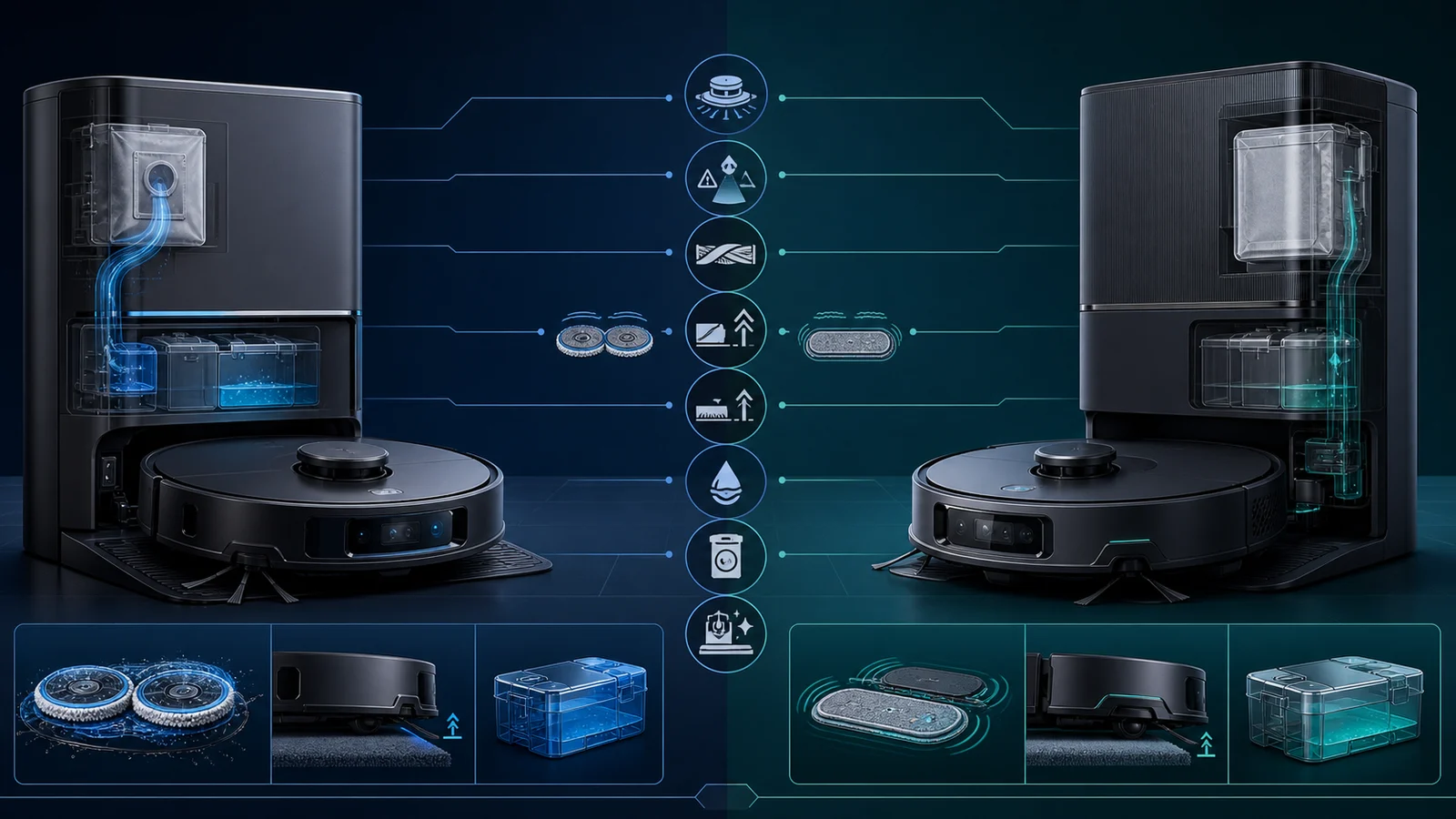
Roborock does not use one universal architecture. Its current catalog includes LDS-based Q-series products, camera and structured-light combinations, StarSight products without a traditional raised LDS turret, rotating mops and VibraRise sonic mops.
Dreame also spans different platforms. Some models use a fixed LDS turret; newer flagships can retract the turret under low furniture. Dock functions, brush systems, mop extension and threshold mechanisms vary by tier.
That creates a common comparison error: taking a feature from each brand’s flagship and assuming every model includes it. Build a matched shortlist by:
- retail price in the same market;
- release generation;
- dock type;
- navigation hardware;
- mop architecture;
- warranty and sales channel.
The broader Roborock vs Dreame global strategy comparison explains their business positioning. This article stays with the product and ownership decision.
Navigation and Obstacle Avoidance
Navigation has three separate jobs: localization, route planning and near-field obstacle handling.
Traditional LDS gives a robot a stable rotating scan above the body. It supports fast mapping but creates a turret that can limit access under furniture. Cameras and structured light can add object information, while side sensors help the robot follow furniture and walls.
Roborock’s current flagship examples show two routes. Saros 20 uses the StarSight Autonomous System 2.0 with vision and 3D sensing in a low-profile body. Saros 20 Sonic uses a different Reactive AI sensor package. That difference matters: the brand name does not tell the buyer which system is installed.
Dreame’s X60 Ultra keeps an LDS system for open-area mapping but retracts it when entering low spaces. It combines that with dual cameras, lateral structured light and active illumination. This is an engineering compromise: retain 360-degree turret scanning where clearance allows it, then lower the profile when needed.
Do not compare “recognizes 280 objects” with “recognizes 300 objects” as if the larger number proves safer navigation. Those are manufacturer claims under their own definitions. Test:
- cables, socks, toys and pet bowls;
- dark and reflective objects;
- table legs and low crossbars;
- curtains and floor mirrors;
- night operation;
- clutter at the edge of the robot’s field of view.
Record contact, avoidance distance, missed cleaning and recovery. Avoidance that leaves a wide dirty halo around every chair is not automatically better.
Low Furniture and Thresholds
Both brands are pushing premium robots below the height of a conventional fixed-LDS design.
Roborock lists the Saros 20 body at about 7.98 cm and describes access down to 7.95 cm under specified conditions. Dreame lists the X60 Ultra at about 7.95 cm with its retractable LDS. Those numbers are close enough that the real home matters more than the catalog difference.
Measure:
- the lowest point under the sofa or bed;
- sagging fabric and crossbars;
- rug edges near the opening;
- whether the robot can turn after entering;
- whether dust or camera covers scrape the furniture.
Threshold claims also need geometry. A rounded single threshold, two separated levels and a vertical step are different tests. Roborock and Dreame publish conditions and footnotes for their highest flagship claims. Buyers should reproduce the real threshold rather than rely on the headline height.
For homes with ordinary transitions, extreme climbing hardware may add little value. For split levels, metal tracks or thick carpet edges, it can determine whether the robot completes a schedule.
Vacuuming, Brushes and Hair
Peak Pa is measured at a defined point under brand-controlled conditions. It does not describe airflow through a loaded filter, brush agitation, carpet pickup or seal leakage.
Current Roborock flagships combine high stated suction with DuoDivide or other anti-tangle brush systems. Current Dreame flagships use DuoBrush 2.0 or related dual-brush designs. Both brands also use extending side brushes on selected models.
For pet hair, test:
- long hair on hard floor;
- embedded hair on low- and medium-pile carpet;
- wrapping at brush ends and bearings;
- hair around the side brush and caster;
- transfer through the dust inlet;
- dock evacuation with a partly full bag.
A brush that resists visible tangles can still pack hair into an end cap. A dock can also clog even when the main roller stays clean.
Retailers should stock the exact main brush, side brush, filter and dust bag for each platform. Similar-looking parts may not be interchangeable across generations.
Mopping: Roborock Has More Than One Route
Roborock’s lineup includes both sonic/vibrating and rotating mop architectures.
Saros 20 uses dual rotating mops. Saros 20 Sonic uses the VibraRise 5.0 vibrating system with an extending mop section. Other Roborock families use earlier versions of these concepts.
Dreame’s premium combo robots generally emphasize dual rotating mop pads, mop extension and automated washing. The X60 Ultra adds heated mopping and active pressure claims under its stated test conditions.
The practical questions are:
- Does the mop remove the target dried stain?
- Does it reach edges without striking furniture?
- How much dirty water is carried between dock washes?
- Does the robot re-mop when needed?
- Are water flow and cleaning solution controlled?
- What remains in grout lines or textured tile?
Rotating pads can provide visible scrubbing movement. Sonic systems create a different contact pattern and may simplify the robot underside. Neither result can be predicted from movement alone.
Wood-floor owners should verify water settings and flooring instructions. More water and more heat are not universally better.
Carpet Protection
Premium Roborock and Dreame models can lift or detach mop components in selected modes. The exact lift height, carpet detection and user setting matter.
Check the home’s:
- carpet pile height;
- dark or patterned rugs;
- tassels and fringes;
- thin mats that move;
- transitions between hard floor and carpet;
- requirement to vacuum carpet during a mopping run.
If the pad still touches a thick rug, use a no-mop zone or a vacuum-first routine. Automatic mop detachment can reduce moisture transfer, but it adds dock mechanisms and depends on the selected program.
Carpet owners should prioritize repeatable dry-floor behavior over the largest suction number.
Automated Docks
Both brands now offer docks that can empty dust, wash mops, dry components, refill the robot and dispense detergent on selected products. Premium versions may add hot-water processes, dock self-cleaning or fixed water connections.
The dock is a second appliance. Evaluate:
- clean- and dirty-water tank access;
- tray removal and residue traps;
- hair in drains and wash structures;
- dust-bag availability;
- detergent restrictions;
- odor after several days;
- drying path and noise;
- refill and drain installation;
- leak detection;
- repair access.
Roborock’s Saros 20 has manual-tank and refill/drain versions in selected markets. Its official installation conditions include space, water pressure, drainage height and pipe distance. A plumbed dock is not a drop-in feature.
Dreame’s X60 Ultra PowerDock combines dust emptying, mop care and water handling. Buyers should still check whether the regional package includes the same functions shown on a global page.
For a small apartment, a simpler dock may be easier to place and clean. For a large hard-floor home, automated washing can reduce daily intervention enough to justify the footprint.
Apps, Maps and Privacy
Both ecosystems offer room maps, no-go zones, schedules, cleaning preferences and model-specific automation.
Test the app before the return period ends:
- first map creation;
- room splitting and merging;
- multi-floor handling;
- furniture and carpet editing;
- cleaning sequence;
- saved settings after an update;
- notification usefulness;
- account region;
- smart-home integrations;
- camera and remote-view controls, if fitted.
Camera-equipped robots deserve a deliberate privacy review. Check whether image capture, pet photos, remote viewing or obstacle images are enabled, where controls are located and how accounts are secured. Do not assume every camera feature is active by default or available in every country.
An app cannot compensate for missing consumables or slow repair. Software and service belong in the same ownership decision.
Maintenance and Consumables
Even an “hands-free” dock needs work.
Weekly or condition-based tasks can include:
- emptying and rinsing water tanks;
- cleaning the dock tray;
- removing hair from brushes and wheels;
- checking the filter;
- wiping sensors and charging contacts;
- inspecting mop pads;
- checking dust-bag fill and evacuation path.
Compare official prices and local stock for bags, filters, brushes, mop pads, cleaning solution and dock parts. Ask whether the battery, pump, wheel module and water system can be repaired locally.
The robot vacuum OEM/ODM guide shows why the robot, dock, app, cloud and spare-parts program must be treated as one platform.
Warranty and Regional Support
Roborock and Dreame products are sold through brand stores, major retailers, marketplaces and distributors. The seller can determine returns and the first support route.
Before buying, verify:
- exact regional model code;
- authorized seller status;
- warranty term and exclusions;
- return window;
- repair or replacement process;
- shipping responsibility;
- local consumable stock;
- support for imported products;
- availability of batteries and dock components;
- app and cloud compatibility in the destination.
A cheaper parallel-import model can lose its advantage if warranty service requires international freight.
Which Brand Fits Which Home?
Consider Roborock when
- the matched model’s navigation and map controls fit the home;
- you prefer a particular Roborock mopping route;
- the local Roborock channel has stronger parts or support;
- a StarSight low-profile product fits the furniture;
- the selected dock is easier to maintain or install.
Consider Dreame when
- a retractable-LDS model solves a real clearance problem;
- rotating-mop coverage fits a hard-floor-heavy home;
- the selected threshold system solves a measured obstacle;
- the regional package provides the desired dock automation;
- the Dreame seller offers a better return and service route.
Choose neither flagship when
- the home is simple and a mid-range model covers it;
- the dock cannot be placed safely;
- the required consumables are unavailable;
- privacy controls or cloud dependence do not fit the household;
- no local service route exists.
Retailer and Distributor Checklist
Retailers should compare more than feature cards.
- regional SKU and included accessories;
- map and app localization;
- return reasons by home type;
- obstacle and threshold demo conditions;
- consumable attachment rate;
- repair turnaround and dead-on-arrival policy;
- battery and dock-parts supply;
- firmware support period;
- promotional price protection;
- old-generation inventory risk.
The robot vacuum manufacturing cost guide explains why navigation, mopping and dock automation create different cost and failure structures.
Frequently Asked Questions
Is Roborock better than Dreame?
Not across every model and home. Compare matched products by navigation, cleaning system, dock, app, maintenance and local support.
Which is better for pet hair?
Choose from controlled hair pickup, brush-end wrapping and dock evacuation tests. Both brands sell anti-tangle systems, but performance varies by brush, carpet and hair length.
Which brand has better mopping?
The answer depends on the models. Roborock sells sonic and rotating systems; Dreame premium combos generally use rotating pads. Test the target stains, edges and carpet routine.
Which is better under low furniture?
Measure the furniture. Roborock has low-profile StarSight products; Dreame has retractable-LDS flagships. Entry and turning clearance matter as much as body height.
Do both brands offer self-cleaning docks?
Yes, on selected models. Functions vary by tier and region. Confirm dust emptying, mop washing, drying, water handling, detergent and tray cleaning on the exact SKU.
Can Roborock and Dreame parts be shared?
No general interchangeability should be assumed. Buy filters, brushes, bags and mop pads by exact model and platform.
Which brand has the better app?
Both provide advanced maps and schedules. The better app is the one that performs reliably with the selected regional model, home layout and required privacy controls.
The Bottom Line
Roborock and Dreame are converging on the same premium promise: fewer obstacles, better edge cleaning, less hair, more capable mopping and a dock that removes routine work. They reach that promise through several architectures, not one brand-wide design.
Measure the home, match the model generation, test the difficult cleaning tasks and confirm local service. That process produces a better answer than declaring one logo the permanent winner.
Explore 2026 new models
From brand to model
Specifications, versions & buying considerations
Robot vacuumsDreame X60 Ultra ↗Specifications, versions & buying considerations
Robot vacuumsRoborock Saros 20 Sonic ↗Specifications, versions & buying considerations
Robot vacuumsRoborock Qrevo Curv 2 Flow ↗Specifications, versions & buying considerations
Robot vacuumsDreame Aqua20 Pro Ultra Roller X Complete ↗Specifications, versions & buying considerations
Robot vacuumsMOVA V70 Ultra Complete ↗Specifications, versions & buying considerations
Robot vacuumsMOVA Z70 Ultra Roller Complete ↗Specifications, versions & buying considerations
Robot vacuumsMOVA P70 Pro Ultra ↗Specifications, versions & buying considerations
Robot vacuumsMOVA S70 Ultra Roller ↗Specifications, versions & buying considerations
Robot vacuumsDreame L60 Pro Ultra ↗Specifications, versions & buying considerations
Robot vacuumsDreame L60 Ultra ↗Specifications, versions & buying considerations
Robot vacuumsDreame L60 Ultra PE ↗Specifications, versions & buying considerations
Robot vacuumsDreame L60 Ultra FE ↗Specifications, versions & buying considerations