- Dreame is strongest for buyers comparing retractable LiDAR, mechanical threshold systems and a broad choice between spinning-pad and roller-mop platforms.
- Ecovacs is strongest where OZMO roller mopping, AIVI/dToF navigation and the X11 bagless OmniCyclone station solve the buyer's specific maintenance priorities.
- Do not rank incompatible suction and hair claims; compare the matched model, dock cleaning path, consumables, warranty channel and local parts.
In this article 16 sections
Choose Dreame when retractable LiDAR, mechanical threshold-crossing and a wide choice of spinning-pad or roller-mop systems are the main priorities. Choose Ecovacs when OZMO roller mopping, AIVI/dToF navigation and an optional bagless auto-empty station better match the home. At this level, the dock, app, service terms and replacement-parts path matter as much as the robot.
Both companies release many models and retailer bundles. Compare matched systems—not one brand’s newest flagship with the other brand’s midrange sale model.
Dreame vs Ecovacs: The Short Answer
| Decision | Dreame | Ecovacs |
|---|---|---|
| High-end navigation | VersaLift retractable LDS plus camera/structured-light systems on selected models | dToF plus AIVI RGBD/structured-light systems on selected DEEBOTs |
| Threshold focus | ProLeap retractable legs on X50; higher mechanical crossing architecture on Aqua10 | TruePass adaptive four-wheel system on X11 |
| Mopping range | Large spinning-pad lineup plus newer Aqua roller platform | OZMO spinning history plus strong current OZMO roller direction |
| Hair | HyperStream DuoBrush or anti-tangle brush packages by model | ZeroTangle 3.0 main and side-brush system on premium models |
| Dock | Bagged auto-empty is common; hot wash, dry, refill and solution functions vary | OMNI wash/dry stations; X11 OmniCyclone removes disposable dust bags |
| Warranty headline | Current authorized-channel US policy lists three years for robot body/base, one year battery | Current US limited warranty lists 12 months for new products |
| Best fit | Buyers optimizing mobility, low-furniture access and platform choice | Buyers prioritizing roller mopping, bagless disposal or DEEBOT ecosystem |
This table is a selection framework, not a cross-brand cleaning test. Pa, airflow, hair, stain and coverage claims use different manufacturer conditions.
Compare the Right Product Platforms
Dreame examples
- X50 Ultra: premium spinning-mop system with VersaLift retractable LDS, ProLeap retractable legs and a full-service base.
- Aqua10 Ultra Roller: newer roller-mop platform with retractable LDS, dual AI cameras, lateral 3D structured light, HyperStream detangling dual brush and full wash/dry base.
- L-series Ultra models: broad spinning-pad range; obstacle sensing, edge reach, brush system, detergent and dock temperatures vary by suffix.
Ecovacs examples
- DEEBOT X9 Pro OMNI: OZMO roller, ZeroTangle 3.0, AIVI 3D 3.0, Triple Lift and temperature-controlled OMNI station.
- DEEBOT X11 OmniCyclone: OZMO Roller 2.0, dToF/RGBD navigation, TruePass chassis, PowerBoost top-up charging and bagless cyclone station.
- T-series OMNI models: value-to-premium roles with varying roller or pad, navigation and station features.
- N-series: accessible vacuum, auto-empty and OMNI roles with fewer flagship mechanisms.
Record the full suffix, region, dock and box contents. “Ultra,” “OMNI” and “Complete” do not create a standard feature set across the brands.
Navigation and Obstacle Avoidance
Dreame’s premium story combines retractable top sensing with front and lateral perception. VersaLift lowers the LDS to reduce height under furniture and raises it in open space. Aqua10 adds dual cameras, lateral 3D structured light and LEDs. X50 pairs its sensing stack with ProLeap legs for physical obstacles.
Ecovacs uses dToF navigation on X11 and combines it with RGBD/AIVI obstacle recognition. X9’s AIVI 3D 3.0 uses vision and 3D sensing, while its edge system is designed to approach recognized boundaries closely.
Judge navigation by household risks:
- cables and socks in dim rooms;
- chrome chair bases and mirrors;
- dark mats and drop-offs;
- low furniture clearance;
- narrow passages;
- moving pets;
- map recovery after furniture changes;
- room division, no-go zones and multi-floor maps.
An object-recognition count does not prove safe pet-accident avoidance. Vision can add semantic understanding, while 3D depth sensing adds contour information; both remain dependent on size, lighting, reflectivity and software.
Thresholds and Mobility
Mobility has become a major premium battleground.
Dreame X50 uses retractable legs to lift the chassis over selected obstacles. Aqua10 publishes a higher double-layer threshold capability under defined conditions. Ecovacs X11 uses a mechanically triggered TruePass adaptive four-wheel system.
Do not translate the maximum number into a universal doorway guarantee. Measure:
- single versus double-layer threshold;
- height, width and edge shape;
- approach angle;
- available traction;
- whether the mop is attached;
- nearby wall clearance;
- risk of scraping wood or metal tracks.
A ramp may be safer than repeated chassis impacts. Retailers should ask for threshold photos and dimensions before promising compatibility.
Mopping: Spinning Pads vs Self-Washing Rollers
Dreame has a mature dual-spinning-pad portfolio. Pads can extend toward edges, lift over carpet and be left at the dock on selected models. Aqua10 adds a roller path.
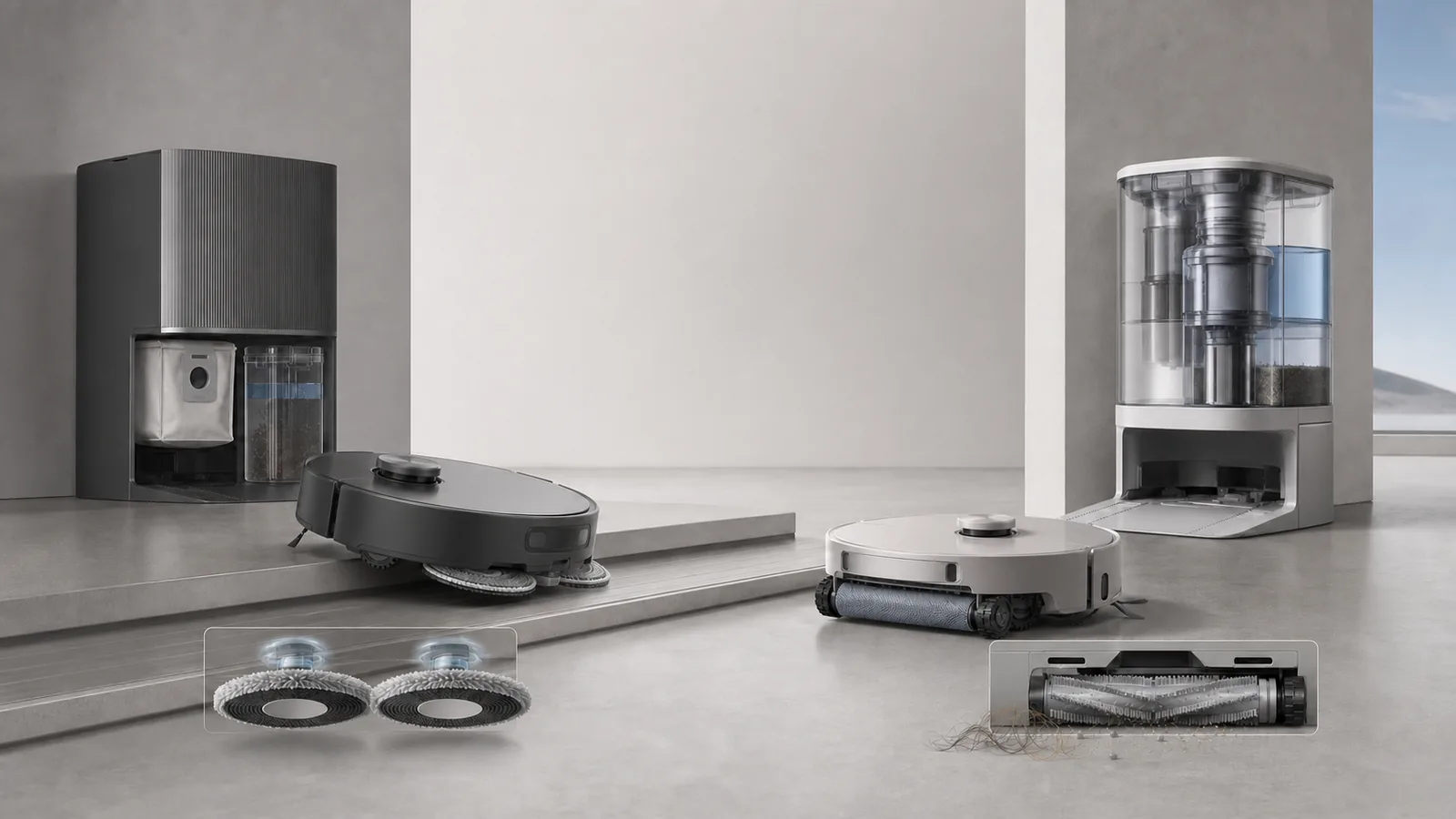
Ecovacs has made OZMO Roller central to X9 and X11. The roller receives water and is scraped or washed during operation, aiming to keep a refreshed surface against the floor. The X11 station then hot-soaks, washes and dries the roller.
Spinning-pad advantages
- proven, widely available architecture;
- two contact zones with visible scrubbing;
- pads are simple to remove and replace;
- established dock-wash ecosystem.
Roller advantages
- continuous contact strip;
- dirty-water separation during the pass;
- strong directional scrubbing;
- controlled edge extension on selected models.
Roller trade-offs
- scraper and water channels can trap hair or sludge;
- a long wet roller needs effective drying;
- replacement cost and model compatibility matter;
- the roller cover and carpet-lift clearance add mechanisms.
Compare dried-stain removal, remaining floor moisture, edge distance, dirty-water recovery and cleaning-path access. Manufacturer pressure and rpm figures are not a shared test.
Hair and Main-Brush Design
Dreame’s HyperStream detangling DuoBrush uses two rollers and a managed hair path on selected models. Ecovacs ZeroTangle 3.0 combines an anti-tangle side brush with a shaped main-brush and airflow route.
Hair failures occur at more than the visible bristles:
- side-brush hub;
- roller end caps;
- gear and bearing cavities;
- narrow inlet to the dustbin;
- dock emptying path;
- roller-mop scraper.
Test long human hair, soft pet undercoat and thread separately. A brush that resists wrapping may still pack hair in an axle. Check whether end caps can be opened, whether the complete brush or only a cartridge is sold, and how often the dock can empty a hair-filled bin without clogging.
Carpet and Dry-Wet Separation
Premium models increasingly lift multiple components:
- mop or roller;
- main brush;
- side brush;
- chassis.
Ecovacs calls this Triple Lift on X9/X11. Dreame platforms combine mop lift or removal, brush lift and chassis features by model.
The purpose is not only carpet protection. Dry-wet separation can stop the main brush from dragging through a spill and prevent wet mop hardware from contacting rugs. Verify lift height on thick, soft and uneven carpets. A no-mop zone remains the safer choice where clearance is marginal.
Docks: Bagged vs Bagless
Most full-service docks automate dust emptying, mop washing, hot-air drying, robot water refill and some tray cleaning. The largest structural difference is X11 OmniCyclone’s bagless dust collection.
Bagged dock
- sealed disposal can reduce dust exposure;
- the bag is a recurring consumable;
- availability and platform-specific fit matter;
- damp debris can still create odor or blockage.
Bagless cyclone dock
- removes disposable-bag cost and stock dependence;
- transparent or reusable chambers make fill visible;
- filters and cyclone passages require cleaning;
- emptying can release dust;
- “bagless” does not mean consumable-free.
For either type, inspect the wash tray, wastewater intake, clean-water lid, detergent route, dock filter, heater airflow and access to a blocked dust tube.
Battery and Large-Home Coverage
Large-home coverage depends on productive cleaning per charge, not only battery capacity. Ecovacs X11’s PowerBoost adds short battery top-ups while the robot is already at the dock for roller washing. Dreame uses return-to-charge and resume, with dock and battery behavior varying by model.
Ask:
- how often the robot returns to wash the mop;
- whether top-up charging changes the total mission time;
- coverage in standard vacuum-and-mop mode;
- battery replacement availability;
- whether high suction, obstacle mechanisms and heated dock cycles increase energy use.
“Continuous” or “perpetual” operation still includes station time. It does not mean uninterrupted floor contact.
App, Voice and Privacy
Dreamehome and ECOVACS HOME both support maps, rooms, routines, carpet behavior and device settings on compatible products. Ecovacs also promotes YIKO voice and agent functions; Dreame offers built-in and third-party voice on selected models.
Compare:
- map editing and backup;
- multi-floor behavior;
- camera permissions and remote-view controls;
- account sharing;
- cleaning-history retention;
- voice recognition language;
- firmware-update support;
- behavior during internet outage.
For camera-equipped robots, review the current privacy and security policies. Retail demo units and customer returns should be reset, maps deleted and accounts removed.
Parts, Warranty and Support
Dreame’s current US after-sales policy lists three years for authorized-channel robot bodies and bases, one year for battery packs and one month for listed consumables. The policy limits channels and geography; marketplace and unauthorized-seller terms can differ.
Ecovacs’ current US limited warranty lists 12 months for new products purchased from the company or its dealers. Consumables, normal wear, incompatible third-party parts and unauthorized repairs are excluded. Optional extended coverage is separate.
The longer headline is useful only if service is reachable. Before purchase, verify:
- authorized seller status;
- who pays shipping;
- whether the dock can be serviced separately;
- battery and wheel-module availability;
- expected repair turnaround;
- loan or replacement policy;
- parts stock after the model leaves retail.
Ecovacs’ official accessories store lists model-specific roller mops, filters, brushes, solutions and quarterly or half-year kits. Dreame also sells platform kits. Never assume a similar-looking pad, roller or dust bag is compatible.
Total Cost of Ownership
Use:
`robot and dock + bags or cyclone-filter care + brushes + filters + mop/roller + detergent + battery allowance + repair shipping + downtime`
Then add labor for wastewater, tray cleaning, hair removal and software recovery.
Dreame may create value through mechanical mobility and feature choice, but more moving systems create more service questions. Ecovacs’ roller and bagless X11 architecture can reduce pad contamination or bag purchases, but introduces roller, scraper, cyclone and filter maintenance.
Which Brand Fits?
Choose Dreame if:
- low furniture and thresholds are the hardest environmental constraints;
- you want to choose between mature spinning pads and a newer roller platform;
- the local authorized channel supports the stated warranty and parts;
- detailed model comparison is acceptable.
Choose Ecovacs if:
- OZMO roller mopping is the main cleaning priority;
- a bagless auto-empty station solves a recurring-consumable concern;
- AIVI/YIKO and the DEEBOT ecosystem fit the household;
- local ECOVACS accessories and service are stronger.
Delay purchase if:
- thresholds and carpet heights are unmeasured;
- no retailer can identify the exact accessories;
- the dock cannot be opened and cleaned easily;
- camera/cloud permissions are unacceptable;
- professional use is expected under a household warranty.
Retail and Product-Team Implications
Retailers should stock by architecture:
- accessible auto-empty robot;
- spinning-pad full-dock model;
- roller-mop full-dock model;
- high-mobility threshold model;
- bagless-station alternative;
- matching consumables and service kit.
Demonstrate tank removal, dock-tray access, brush end caps and app reset. Those ownership tasks reduce more returns than another suction-number placard.
For platform development, see our robot vacuum OEM and ODM guide and robot vacuum manufacturing cost. For adjacent competitive context, read Roborock vs Dreame robot vacuums.
FAQ
Is Dreame better than Ecovacs?
Dreame offers strong mobility and platform variety. Ecovacs offers a mature current roller-mop direction and a bagless-station option. The matched model, home and service channel decide.
Which is better for mopping?
Compare spinning pads with roller systems and test the actual stain, edge and carpet conditions. Both brands now offer roller platforms; Dreame also has a large spinning-pad range.
Which is better for pet hair?
HyperStream and ZeroTangle use different brush and airflow designs. Check end caps, side-brush hubs, the dock tube and replacement-stock availability rather than relying on a hair percentage.
Does bagless mean no maintenance?
No. A bagless station removes disposable bags but requires chamber, cyclone and filter care and can release dust during emptying.
Which has the better warranty?
Dreame’s current authorized-channel US policy has a longer robot/base headline than Ecovacs’ standard US warranty. Battery, consumable, seller, geography and service-process differences still require checking.
Can either robot cross every threshold?
No. Published maxima depend on threshold shape, layers, approach, traction and model configuration. Measure the home and use a ramp when repeated impact would be risky.
Bottom Line
Dreame leads with mechanical mobility and a wide technology menu. Ecovacs leads with a focused roller-mop story and an unusual bagless premium dock. The sound decision comes from opening the dock, measuring the thresholds, pricing the parts and confirming the service route—not comparing two headline suction numbers.
Explore 2026 new models