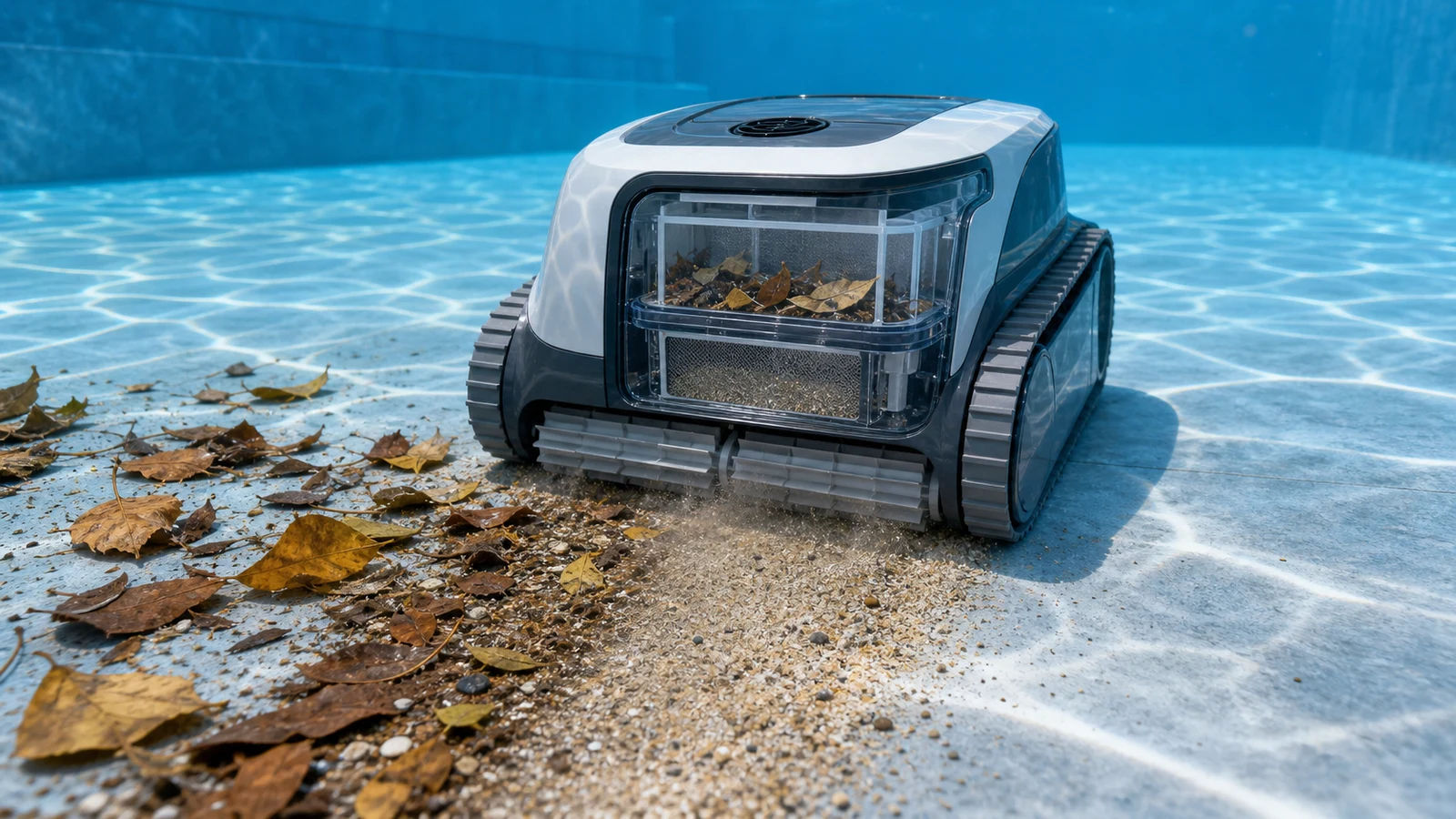
- Leaves and fine debris are different pickup tasks: large material needs an open intake and usable basket volume, while fine material needs suitable media and enough flow after loading.
- Do not choose from micron, flow or suction claims in isolation. Test the complete intake, brush, filter and navigation system with the pool’s real debris.
- Ultra-fine filtration increases cleaning and service work; buyers should compare rinse time, replacement media, capacity and local parts before purchase.
In this article 15 sections
Choose a robotic pool cleaner for the debris your pool actually produces. Broad leaves and twigs need a usable intake, strong transport flow and enough basket volume. Sand, silt and dust need suitable fine media that still allows the robot to move water after the filter begins loading. One headline “suction” or micron number cannot prove both jobs.
This guide is for buying and product selection. If an existing cleaner has suddenly stopped collecting debris, use our separate pool-robot pickup troubleshooting guide.
Define the Debris Before Choosing the Robot
“Dirty pool” can mean:
| Debris | Pickup challenge |
|---|---|
| Broad leaves | Intake width, basket volume and blockage |
| Twigs and seed pods | Rigid shape can bridge the intake |
| Hair and fibrous material | Wraps around brushes and axles |
| Coarse sand | Weight and transport into the basket |
| Fine sand or silt | Passes through coarse media or loads fine media |
| Pollen and dust | Very small material and high filter loading |
| Detached algae fragments | Filtration plus separate water-treatment problem |
| Surface leaves and insects | May require a surface skimmer rather than a floor robot |
Collect a sample after a typical dirty week. Photograph it beside a ruler and separate large debris from fine sediment. The product brief should state which fraction matters most.
Intake Width Is Only the Beginning
A large front opening can admit broad leaves, but pickup also depends on:
- water flow at the floor;
- brush location;
- distance between brush and intake;
- internal turns;
- guards or ribs;
- filter entrance;
- what happens when the basket is partly full.
Look beneath the robot. A marketing image of a wide opening does not show the narrowest point inside the debris path.
Test several wet leaves together. One leaf may pass while a folded group bridges the opening. Add small twigs only if the manufacturer allows that debris.
For heavy leaves, ask:
- Does the brush push leaves forward or guide them inward?
- Can the user reach a blockage without tools?
- Is there a non-return feature that keeps debris from escaping?
- Does a full basket change weight balance or climbing?
- How many real leaves fit before flow falls?
Basket liters do not equal usable leaf capacity. Internal frames and filter panels occupy volume.
Fine Debris Is a Flow-and-Media Problem
Filter grade matters, but finer is not automatically better.
A finer medium can retain smaller particles. It also creates resistance and loads more quickly. Once coated, the robot may lose transport flow even though the pump is still running.
Current official product pages show the range of approaches. WYBOT’s C2 describes a 180-micron primary cartridge combined with a 10-micron fine filter. Aiper’s Scuba X1 Pro describes a separate 3-micron MicroMesh filter and tells users to rinse it after each use. Maytronics sells distinct fine and ultra-fine Dolphin filter products. These are brand-specific examples, not a universal ranking.
Ask for:
- nominal or tested filter grade;
- test method;
- media area;
- clean and loaded flow;
- recommended debris type;
- whether filters work alone or together;
- cleaning method;
- drying requirement;
- replacement interval and price.
Do not treat a micron label as a whole-machine result. Particles must first reach the intake and remain in the filter.
Dual-Stage Filtration
A staged system can use a coarse basket or screen before fine media.
Potential advantages:
- large leaves do not cover the fine media immediately;
- the user can separate debris;
- fine media receives less physical damage;
- different filters can suit different cleaning cycles.
Potential costs:
- more parts to clean;
- reduced flow when both stages load;
- incorrect assembly;
- recurring replacement media;
- smaller effective basket volume.
Some pools benefit from two passes: first collect storm leaves with the coarse setup, then use the approved fine stage for remaining sediment. Follow the exact manufacturer configuration; do not remove a required support or seal.
Leaves and Sand Need Different Tests
Run separate tests so one task does not hide the other.
Large-debris test
- Prepare a counted mix of the pool’s wet leaves.
- Place it in a defined floor area.
- Run the normal recommended mode.
- Count material collected and left.
- Inspect the intake and basket entrance.
- Repeat with the basket partly loaded.
Fine-debris test
- Use a safe, repeatable sample similar to the pool’s sediment.
- Spread it over a measured hard-floor zone.
- Photograph the starting condition.
- Run one standard cycle.
- Inspect visible residue.
- Check whether material remains retained after removal.
- Record filter cleaning time.
Do not pour uncontrolled foreign material into a customer pool. A dealer demonstration should use an approved test tank or follow the facility’s water-management rules.
Floor Material Changes Pickup
Sediment behaves differently on:
- smooth tile;
- fiberglass;
- vinyl;
- plaster;
- pebble or textured finishes.
Fine material can sit inside texture where the intake cannot create enough local movement. A brush may help release it, but brush type and surface approval matter.
Test the actual finish. A clean showroom pool with smooth tile is weak evidence for a rough plaster pool.
For vinyl liners, confirm that the cleaner, brush and tracks are approved and that no sharp debris is present. The robot should not be used to grind damaging material across the surface.
Navigation Controls How Often Debris Is Reached
Pickup performance does not matter if the robot misses the dirty zone.
Observe:
- floor coverage;
- wall transition;
- bowl or hopper shape;
- drains and raised fittings;
- steps and ledges;
- beach entries;
- time spent repeating easy areas;
- parking and retrieval behavior.
Fine sediment often collects in low points. Leaves may gather along circulation patterns. Put the test debris where the pool actually collects it, not only in the center.
The general robotic pool cleaner buying guide covers coverage and pool-shape selection in more detail.
Surface Debris Is a Different Category
A floor-and-wall robot works underwater. Leaves floating at the surface may sink before it reaches them.
If the main problem is fresh leaves, insects or pollen on the water, consider a robotic pool skimmer or the pool’s built-in skimming system. Our robotic pool skimmer buying guide explains solar charging, water flow, baskets and obstacle behavior.
Some products claim multiple cleaning zones, but buyers should verify exactly what “surface,” “waterline” and “skimming” mean. Waterline scrubbing is not the same as collecting floating leaves across the pool.
Algae Needs a Clear Boundary
A robot can scrub surfaces and collect some detached material. It is not a substitute for diagnosing and correcting the water condition that allowed algae growth.
Do not use a product page’s “algae” icon as proof that the machine sanitizes water or removes every live organism. Pool treatment involves chemistry, circulation and filtration beyond the robot.
When algae is present:
- follow qualified local water-treatment guidance;
- use only approved cleaning modes and filters;
- expect rapid filter loading;
- clean the robot as instructed;
- avoid moving contamination between pools;
- do not make health claims from visual clarity.
The buyer’s question is whether the robot can support physical removal after the water-treatment plan—not whether it replaces that plan.
Capacity and Cleaning Frequency
Large baskets reduce emptying events only if the debris path remains open and the robot can carry the load.
Estimate:
Required service frequency = weekly debris volume ÷ usable basket volume per successful cycle
Then adjust for fine-filter cleaning. A pool with little large debris but constant silt can require more user work than the basket size suggests.
Ask the owner:
- How often are trees shedding?
- Does wind concentrate debris?
- Is the pool covered?
- How often can the robot be removed and rinsed?
- Is the user willing to clean fine media after every cycle?
- Is there safe shaded storage and charging?
An ultra-fine system creates limited value if the owner will not maintain it.
Maintenance and Parts
After each appropriate cycle:
- power down according to the manual;
- remove the robot using the approved method;
- empty the basket;
- rinse approved filter parts;
- clear the intake and brushes;
- inspect tracks and wheels;
- allow parts to dry where required;
- store the charger safely.
Fine filter media can be damaged by harsh pressure, tools or chemicals. Use the exact cleaning instruction.
Before purchase, price:
- coarse basket;
- fine or ultra-fine media;
- brush;
- track or wheel;
- charger or power supply;
- battery service for cordless products;
- local repair labor.
Our robotic pool cleaner replacement-parts guide explains compatibility and dealer stock planning.
Dealer Product-Ladder Strategy
A retailer does not need every model. It needs clear task coverage.
Entry: routine floor debris
Simple operation, accessible basket and reliable pickup of common leaves and sand.
Mid-tier: mixed debris and full-pool coverage
Larger basket, active brushing, wall or waterline coverage and optional fine filtration.
Premium: fine-debris or complex-pool specialist
Higher media performance, better navigation, more service support and verified parts.
Do not sell the premium tier only through suction and micron numbers. Demonstrate cleaning work and maintenance burden.
Buying Checklist
- Identify the pool’s real debris mix.
- Separate floor debris from surface debris.
- Inspect the narrowest intake path.
- Verify filter grade and configuration.
- Test with the actual pool finish.
- Test a partly loaded basket.
- Record cleaning and rinse time.
- Check steps, drains and low points.
- Confirm replacement media and local parts.
- Keep algae and sanitation claims within their proper boundary.
FAQ
What micron filter is best for a robotic pool cleaner?
There is no universal best number. Choose approved media that retains the target debris while maintaining enough flow and reasonable cleaning frequency in that robot.
Can one pool robot collect both leaves and fine sand?
Yes, some systems are designed for mixed debris or staged filtration. Verify the intake, basket, media and performance after the filter begins loading.
Why do leaves remain even with high advertised suction?
The intake may be too narrow, leaves may bridge internally, the brush may push them away or the basket may already restrict flow. The whole debris path matters.
Will an ultra-fine filter remove algae?
It can capture some detached fine material when used as approved. It does not replace water diagnosis, circulation, sanitation or treatment.
Is a pool skimmer better for leaves?
For floating leaves before they sink, a surface skimmer can be the better first tool. A floor robot handles material after it reaches submerged surfaces.
Final Decision
Choose the robot around the debris chain: reach it, release it, move it, retain it and clean the filter afterward. A machine that succeeds at only one link will not solve a mixed leaf-and-silt pool.
Explore 2026 new models
From brand to model
Specifications, versions & buying considerations
Pool robotsECOVACS ULTRAMARINE P1 ↗Specifications, versions & buying considerations
Pool robotsBeatbot Sora 70 ↗Specifications, versions & buying considerations
Pool robotsBeatbot Sora 10 ↗Specifications, versions & buying considerations
Pool robotsBeatbot Sora 30 ↗Specifications, versions & buying considerations
Pool robotsBeatbot iSkim ↗Specifications, versions & buying considerations