- Buy a robotic pool skimmer only when floating debris is the real workload; it does not replace floor, wall, circulation or water-care equipment.
- Pool fit depends more on direct sunlight, return-jet flow, fixed-skimmer suction, shallow features and actual debris than on one runtime or micron headline.
- For retail and distribution, verify spare baskets, propulsion parts, chargers, batteries, wet-product returns, software support and written warranty responsibility before ordering.
In this article 17 sections
Choose a robotic pool skimmer when leaves, pollen, insects and other floating debris are the daily problem. Do not buy one expecting it to scrub the floor, climb walls, replace the pool pump or manage water chemistry.
The right model is the one that can keep moving in your pool’s sunlight, currents and shallow areas, accept your real debris, and remain serviceable after the first season. Runtime, filter microns and sensor counts are useful specifications, but they are not substitutes for a pool-fit trial.
What Is a Robotic Pool Skimmer?
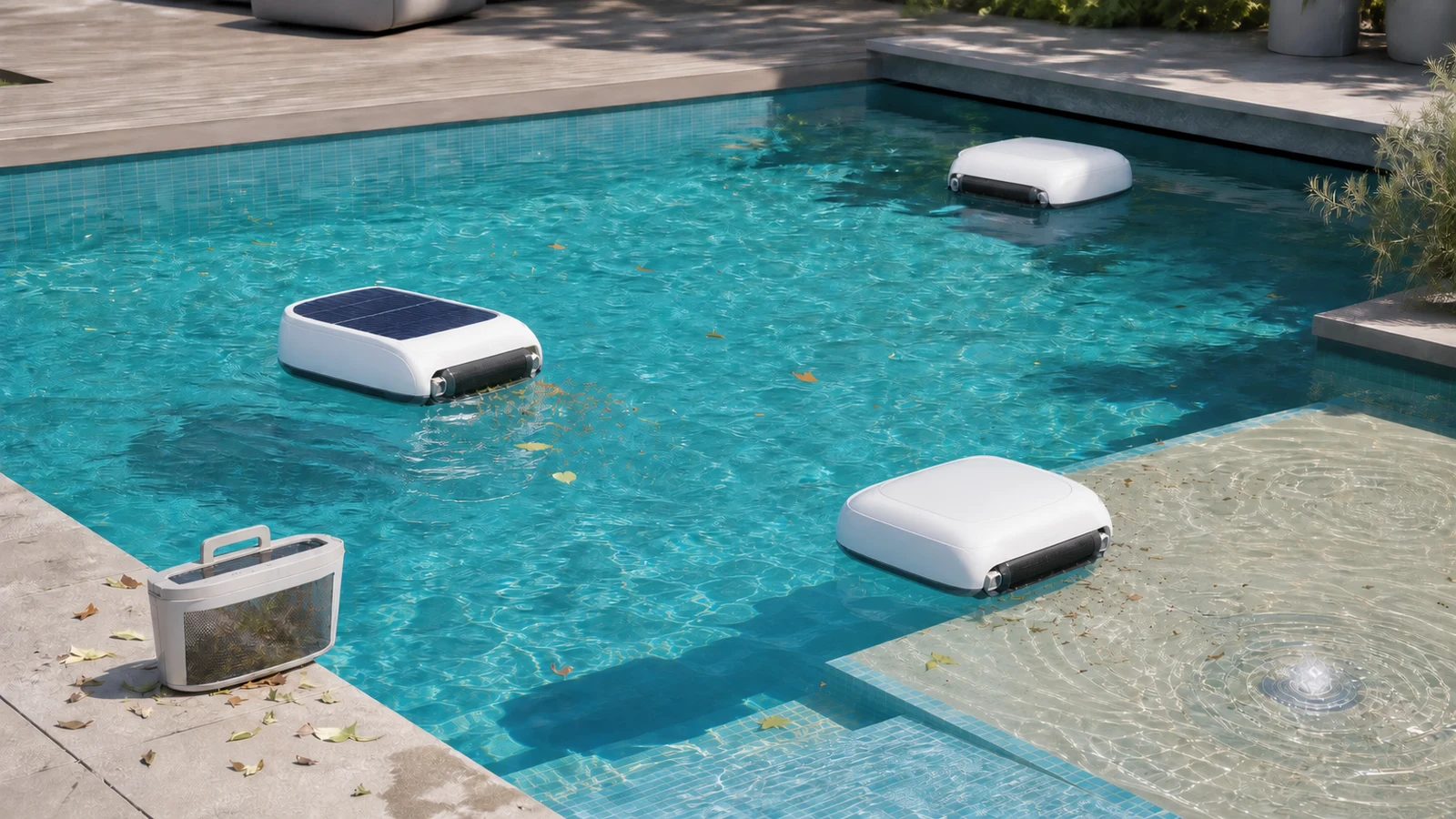
A robotic pool skimmer is a self-propelled floating machine that patrols the water surface and carries debris into an onboard basket. Typical targets include:
- leaves, flower petals and grass clippings;
- pollen, insects and seed pods;
- pet hair and other light floating material;
- some fine surface particles, depending on the intake and filter.
It is not the same as the fixed skimmer connected to the pool’s circulation system. It is also different from a robotic pool cleaner, which travels under water to vacuum the floor and, on some models, scrub walls or the waterline.
Many pools can benefit from both. The surface unit intercepts debris before it sinks, while the underwater robot handles material that has already reached submerged surfaces. Maytronics presents its Dolphin Skimmi and underwater Dolphin cleaner as a complementary combination, which is a more accurate task model than treating one robot as a complete replacement for the other.
What a Surface Robot Does Not Replace
A robotic skimmer does not replace:
- circulation through the pump, fixed skimmer and main filter;
- sanitizer measurement, pH control or water testing;
- brushing, vacuuming and periodic deep cleaning;
- manual removal of oversized branches, toys or unsafe objects;
- inspection by a pool professional when water or equipment problems persist.
This boundary matters for consumers and dealers. A product sold as “total pool cleaning” will create returns if the customer still finds sand on the floor or algae on the wall.
Start with the Pool, Not the Product
Before comparing brands, make a one-page pool profile.
| Pool factor | What to record | Why it matters |
|---|---|---|
| Floating debris | Type, size and daily volume | Determines inlet, basket and emptying needs |
| Direct sunlight | Hours on the water surface by season | Determines whether solar input can cover motor use |
| Return jets | Direction and normal pump speed | Strong flow can hold or redirect the robot |
| Fixed skimmer | Opening, suction and location | A robot may repeatedly approach or become held near it |
| Shallow features | Ledges, steps and attached spa openings | Draft and turning space affect stranding risk |
| Obstacles | Ladders, hoses, floats and covers | Sensors do not guarantee escape from every object |
| Water type | Fresh, chlorine or salt, with measured levels | Compatibility and warranty limits vary |
| Connectivity | Wi-Fi/Bluetooth conditions at poolside | App features may depend on local or cloud connection |
This profile is more useful than choosing the model with the largest published battery.
Solar Power, Battery and Adapter Charging
Most current premium surface robots use a solar panel to recover energy while they work. Some are solar-only; others add a wired or magnetic charging route.
Solar-only designs
A solar-only model can reduce handling in a sunny pool. The trade-off is dependence on actual light reaching the panel. Tree shade, walls, roof overhangs, low winter sun, cloudy days and residue on the panel all reduce energy input.
“Solar powered” does not mean unlimited operation. The robot has an energy budget: propulsion, debris intake, sensors, communications and any brushes consume power, while the panel replaces only what available light can generate.
Dual-charging designs
An adapter provides a recovery path during several cloudy days or in a heavily shaded pool. For example, Betta publishes both solar and adapter charging for SE Plus, while Aiper publishes solar plus DC charging for EcoSurfer S2.
Dual charging is useful, but it adds handling and a charger that must be stored and supported. Follow the manual’s dry-charging procedure and inspect the port, seals or magnetic interface before every connection.
How to test the energy budget
Run the candidate for at least two normal debris days:
- start with a documented charge level;
- use the pool’s normal pump schedule;
- record morning, midday and afternoon shade;
- note every low-power pause or manual charge;
- check whether the robot is ready for the next required cleaning window.
A published “24/7” claim should be read as a design objective under suitable conditions, not a guarantee for every pool and season.
Debris, Intake and Basket Capacity
Basket capacity matters only in relation to the debris entering it.
A tree-lined pool may need space for broad leaves and seed pods. A pool affected by pollen may need a finer filter and more frequent rinsing. A large basket can still perform poorly if leaves bridge across the inlet, while a small basket may be acceptable in a low-debris pool that is checked daily.
Current products illustrate the range. Aiper publishes a 4 L basket and 150-micron filtration for EcoSurfer S2. Betta publishes a 200-micron mesh for SE Plus. Beatbot publishes a 9 L basket for iSkim Ultra. These are manufacturer specifications, not results from one controlled test.
Do not rank them from the numbers alone. Evaluate:
- effective inlet width and height;
- whether broad leaves bridge at the mouth;
- fine-particle capture before the mesh loads;
- debris escape during reversing and turning;
- ease of bringing the robot to the edge;
- lifting, opening and emptying a wet basket;
- availability and price of replacement baskets.
Use the pool’s own leaves, pollen and insects during a trial. Artificial demonstration debris can hide the failure mode that matters most.
Filtration: Why Lower Microns Are Not Always Better
A lower micron rating suggests a finer mesh, but total capture also depends on sealing, flow, surface area and loading.
Very fine material can block a small filter quickly and reduce water flow. Larger leaves may cover the intake before the basket is full. Gaps around the basket can bypass an otherwise fine mesh.
Ask suppliers to define:
- whether the rating describes nominal or absolute filtration;
- the usable filter surface area;
- the recommended rinse interval;
- whether fine and standard baskets are interchangeable;
- how the basket is tested after repeated UV and chemical exposure.
Retailers should avoid translating a micron number into a blanket claim such as “removes all algae.” Surface robots are debris collectors, not water-treatment systems.
Navigation, Return Jets and Fixed-Skimmer Suction
Surface navigation is strongly affected by water movement. A robot can have sophisticated sensors and still spend too much time in one area if the circulation system creates a dominant current.
Test the machine with:
- the pump at the customer’s normal speed;
- every active return jet in its normal direction;
- the fixed skimmer operating normally;
- the pool cover, hose and ladder in their usual positions.
Watch whether it repeatedly approaches the same corner, stalls near a suction opening or crosses the high-debris zones often enough.
Coverage is not a marketing path graphic. It is the repeated ability to reach, collect and leave debris zones during the intended operating window.
Shallow Ledges, Steps and Complex Pool Shapes
Robotic skimmers need water depth under their hull and room to turn. Tanning ledges, beach entries, stools, attached spas and narrow passages can create stranding points.
Betta’s current FAQ lists a minimum operating water depth of 3.5 inches for SE Plus, but that number should not be applied to other models. A minimum depth also does not prove the robot can turn beside every step geometry.
For each candidate:
- measure the shallowest route it must cross;
- observe the front and rear draft when the basket is loaded;
- test approach from more than one angle;
- count self-recovery attempts and human interventions;
- confirm whether anti-stranding bars or guards require adjustment.
An irregular pool is not automatically unsuitable. It simply requires a trial that includes the difficult features.
Saltwater, Chlorine and Material Limits
“Saltwater compatible” must be tied to a numerical range and written warranty.
Betta’s SE Plus manual states use in fresh water or salty water up to 5,000 ppm and says seawater-pool use voids the warranty. That is a useful example of why the detail matters: a salt-chlorinated residential pool is not the same exposure as seawater.
For any model, request:
- permitted salt and chlorine range;
- permitted pH and temperature range;
- guidance after shock treatment;
- corrosion-sensitive parts and rinse requirements;
- warranty exclusions for water chemistry.
Do not infer compatibility from a stainless-looking fastener or a “chlorine tolerant” marketing phrase. Use the exact regional manual for the exact SKU.
App Control, Remote Control and Software Risk
App features can add scheduling, battery status, manual steering, cleaning history, temperature information and notifications. A dedicated remote can offer simpler local control without an account.
The choice is not simply “smart versus basic.” App-dependent products add questions:
- Does setup require 2.4 GHz Wi-Fi, Bluetooth or both?
- Can the owner steer the robot without internet access?
- Which functions depend on a cloud account?
- Is the app available in the sales country?
- Who handles firmware, privacy and account-support tickets?
- What happens if the product is resold or the owner changes phones?
Maytronics lists app steering for Dolphin Skimmi. Aiper lists app scheduling and remote functions for EcoSurfer S2. Betta SE Plus uses a handheld remote. Match the control system to the owner’s workflow and the dealer’s support capacity.
Safety and Simultaneous Equipment
Never assume swimmers, cords, floating devices and multiple robots can share the pool.
Betta’s SE Plus manual says not to swim while the unit is working and not to operate it while another pool-cleaning device is in the pool. Other models may have different instructions, but the exact manual takes priority over general advice.
Before operation:
- remove toys, loose lines and unsuitable floats;
- confirm the retrieval method;
- keep children away from the device;
- inspect moving parts and the basket latch;
- take the robot out when required by the manual or pool-use plan.
For commercial pools, add the facility’s operating procedures and local rules. A residential product claim does not establish suitability for an unattended public facility.
Maintenance, Storage and Expected Wear
The robot lives in UV, warm water and chemically treated conditions. Organic debris also restricts flow and creates odor.
A practical routine is:
- empty the basket before debris compacts;
- rinse it with normal low-pressure fresh water;
- remove hair and string from impellers or propellers;
- wipe the solar panel and sensor windows;
- inspect seals, ports, brushes and guards;
- dry the required surfaces before adapter charging;
- follow the battery instructions for off-season storage.
Betta specifically warns against pressure washing. Its FAQ recommends cleaning the panel, body, propellers, impeller and basket, then storing the cleaned and dried unit indoors with power off during long periods.
Maintenance quality matters more than a cosmetic “self-cleaning” label. Ask which parts the owner can remove without opening a sealed housing.
Service, Parts and Warranty
A surface robot is a wet, battery-powered product with motors, sensors and exposed collection parts. A good purchase therefore includes a service route.
Consumers should confirm:
- warranty term for the exact seller and country;
- who pays freight for a wet or failed unit;
- whether repair or replacement is the normal remedy;
- availability of baskets, chargers, remotes, brushes and propulsion parts;
- battery policy after the warranty period;
- response time during peak pool season.
Dealers and distributors need more detail:
| Commercial issue | Evidence to request |
|---|---|
| DOA handling | Written allowance, evidence standard and replacement timing |
| Wet returns | Packaging, freight and hazardous-battery procedure |
| Spare parts | SKU list, price, MOQ and replenishment lead time |
| Repair authority | Replaceable modules and warranty reimbursement |
| Software | Regional app, firmware ownership and escalation route |
| Seasonality | Forecast, safety stock and off-season battery storage |
| Margin | Net margin after demos, returns, freight and support labor |
A visible parts page is a positive signal, but stock and delivery time still need verification. The wider robotic pool cleaner distributor guide provides a channel due-diligence framework that also applies here.
A Practical Buying Checklist
Score each candidate only after a pool-fit demonstration.
- Task fit: Does it collect the actual leaves, pollen and insects?
- Energy fit: Does the pool provide enough direct sunlight, and is backup charging acceptable?
- Current fit: Can it leave return-jet and fixed-skimmer zones?
- Shallow fit: Can it turn and recover around ledges, steps and spa openings?
- Basket fit: Is emptying safe and frequent enough for the debris load?
- Water fit: Are salt, chlorine, pH and temperature limits documented?
- Control fit: Is the app or remote usable by the owner and supportable by the seller?
- Service fit: Are common parts, warranty responsibility and freight rules written?
If any one of these is unknown, treat the product as a sample candidate, not a finished purchasing decision.
How Retailers Should Build the Category
Avoid stocking several models that differ only in headline runtime. Build a small assortment around distinct use cases:
- a simple solar model for sunny, low-complexity pools;
- a dual-charging model for shade or variable weather;
- a high-capacity model for tree-lined, high-debris properties;
- an app-led premium model for scheduling and remote status.
Every displayed unit should have a task card explaining what it does not clean. Pair the surface-skimmer sale with the right floor-and-wall solution, not with a claim that one machine handles the entire pool.
For suppliers, ask for a sample test protocol, regional manuals, service-parts list and return-cost model before discussing a large first order.
FAQ
Is a robotic pool skimmer worth it?
It can be valuable when floating debris is frequent and manual skimming is a recurring workload. It is less compelling for a covered, low-debris pool or when currents and shallow features prevent reliable operation.
Does a robotic pool skimmer clean the bottom?
No. A surface skimmer collects floating debris. A separate floor-and-wall cleaner handles submerged dirt and surfaces.
Can a solar pool skimmer run at night?
Some models store enough battery energy to continue after dark, but runtime depends on the previous solar input and the machine’s load. Check the exact model specification and test the intended pool.
Is a larger basket always better?
No. Capacity is only one factor. Inlet design, filter loading, debris escape, retrieval and replacement-part availability also affect real performance.
Can I use a robotic skimmer in a saltwater pool?
Only when the exact model’s manual permits the pool’s measured salt level. “Saltwater compatible” may have a numerical limit and warranty exclusions.
Can I use a pool skimmer robot with another robot?
Do not assume simultaneous operation is allowed. Betta’s SE Plus manual, for example, says not to use the unit while another pool-cleaning device is in the pool. Follow each exact manual and avoid interference from cords or floating equipment.
How often should I empty the basket?
Empty it before debris compacts or restricts flow. The interval may range from part of a day in a tree-lined pool to several days in a low-debris pool. Establish the schedule from actual loading.
What should a distributor request before ordering?
Request regional manuals, sample-test criteria, parts and price lists, warranty and DOA rules, wet-return freight responsibility, software-support ownership, battery storage instructions and realistic net-margin calculations.