- Choose the pool, surfaces, cleaning zones and debris before comparing brands or headline specifications.
- Corded and cordless robots trade continuous power and cable management against charging, runtime, battery aging and retrieval.
- Validate the exact model's filtration, wall and waterline coverage, handling, spare parts, warranty route and local service before buying.
In this article 16 sections
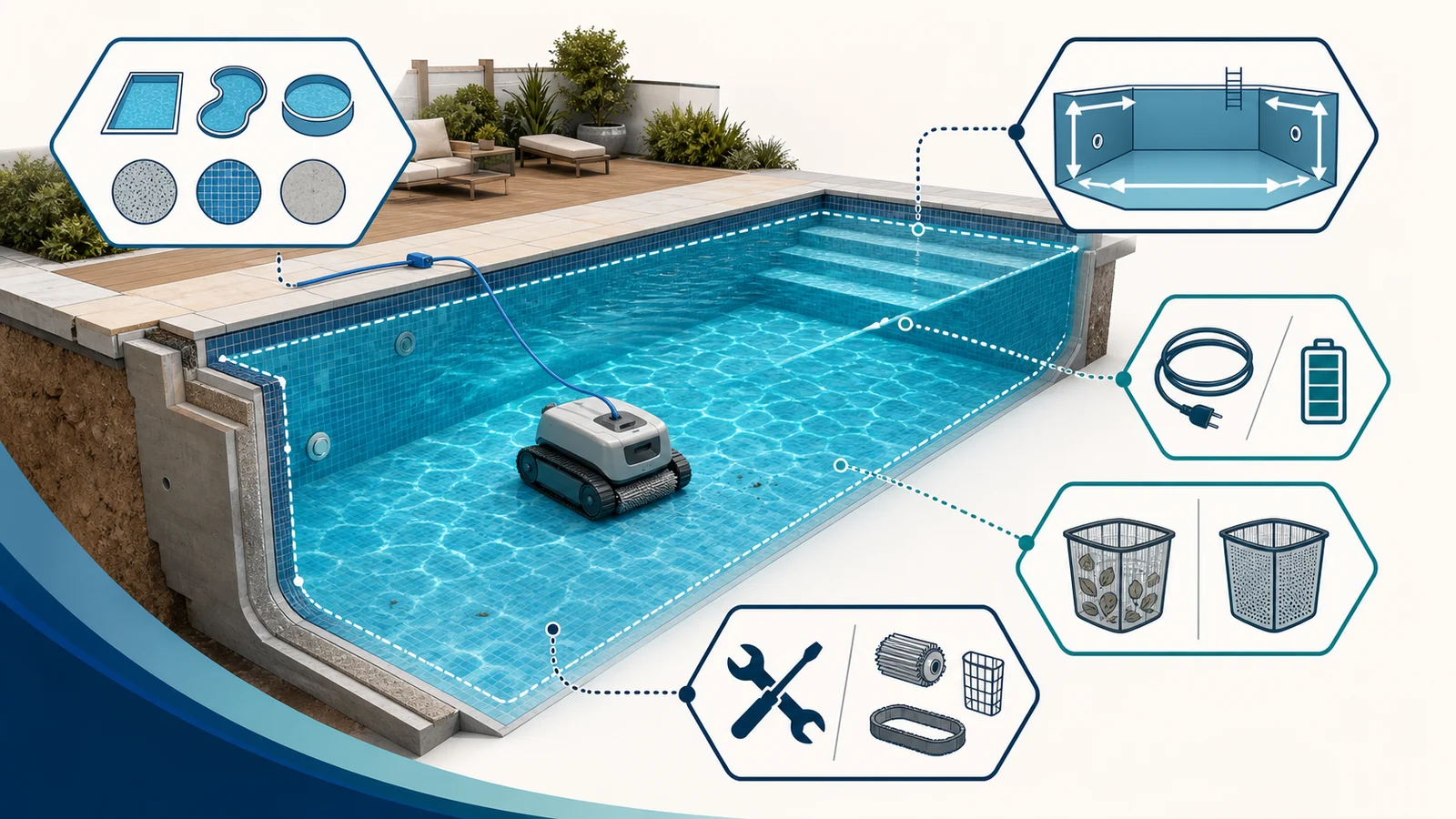
The right robotic pool cleaner is the model that matches your pool type, dimensions, surface, cleaning zones and debris—and has a service system you can actually use. Decide whether you need floor, wall, waterline, step, ledge or surface cleaning before comparing corded and cordless designs. Then verify filtration, navigation, handling, maintenance, warranty and spare parts on the exact model.
A higher suction claim, longer feature list or more expensive dock does not prove that a robot will clean a particular pool better. Pool geometry can defeat a capable machine, an ultra-fine filter can clog in a leaf-heavy pool, and a convenient cordless robot can become costly if the battery or charger has no practical service route.
Robotic Pool Cleaner Buying Checklist
| Decision | What to confirm | Common mistake |
|---|---|---|
| Pool | In-ground or above-ground, length, area, depth, shape and surface | Buying from a generic maximum-area claim |
| Cleaning coverage | Floor, walls, waterline, steps, ledges or surface | Assuming every robot cleans every zone |
| Power | Corded or cordless, outlet location, runtime and charging | Treating cordless as automatically more powerful or easier to own |
| Debris | Leaves, sand, silt, algae, hair or mixed debris | Choosing the finest filter without checking clogging |
| Navigation | Slopes, transitions, drains, corners and obstacles | Treating a navigation name as proof of full coverage |
| Handling | Wet lifting weight, retrieval, draining and storage | Comparing dry machine weight only |
| Ownership | Filters, brushes, tracks, cable, battery and charger | Looking only at the initial purchase price |
| Support | Seller, warranty term, repair location and parts | Assuming the brand website will handle every dealer purchase |
Start With the Pool, Not the Robot
Record the pool before opening a product comparison.
- Is it in-ground or above-ground?
- What are its maximum length, width, depth and approximate surface area?
- Is the floor flat, sloped, bowl-shaped or divided into zones?
- What surface does the robot touch: plaster, pebble, tile, fiberglass or vinyl?
- Are there sharp wall transitions, large main drains, steps, benches, sun shelves or safety ledges?
- Is there an automatic cover, ladder, handrail or other permanent obstruction?
- Which debris dominates during the season?
Manufacturer compatibility statements are model-specific. Maytronics, for example, lists pool length, pool classification, surface type and cleaning coverage separately on its product pages. A label such as “for pools up to 50 feet” says little about a difficult sun shelf or a smooth tiled wall.
Above-ground and in-ground products also occupy different mechanical envelopes. A lightweight floor cleaner for a flat above-ground pool should not be expected to perform like a tracked full-pool machine. The above-ground versus in-ground robotic pool cleaner guide explains that category boundary in more detail.
For an irregular pool, ask the dealer for a written compatibility answer and a return or trial policy. A specification sheet cannot describe every transition radius, drain cover or step geometry.
Define the Cleaning Coverage
“Robotic pool cleaner” describes the product category, not a universal cleaning scope.
Floor
Every underwater vacuuming robot is expected to work on the floor, but the real question is coverage. Check whether the robot can cross the deepest transition, pass the main drain, reverse out of corners and complete the cycle before its filter or battery becomes the limiting factor.
Walls
Wall climbing depends on traction, water flow, brush condition, filter restriction, surface friction and the floor-to-wall transition. Maytronics support material notes that a loaded filter can weaken suction and wall climbing. A machine that climbs clean plaster in a demonstration may behave differently on smooth tile or a wall coated with algae.
Waterline
Waterline cleaning is a separate feature. Confirm that the exact model is designed to reach and scrub the waterline, and ask whether it travels laterally or only touches the upper wall during a cycle.
Steps, benches and sun shelves
These are difficult zones. A robot may climb onto a ledge but fail to remain there, or it may cross a step without cleaning its horizontal surface. Some current premium products explicitly list ledge and step coverage. That makes the claim testable; it does not make the capability universal.
Pool surface
Surface compatibility affects brush material and traction. Do not approve a product merely because the brand sells another model for the same surface. Check the exact model page and manual, especially for vinyl liners, fiberglass and smooth tile.
Corded vs Cordless Pool Robots
Neither architecture is automatically better. They move the inconvenience and the service risk to different parts of the system.
| Question | Corded robot | Cordless robot |
|---|---|---|
| Energy during a cycle | Continuous low-voltage supply | Limited by the installed battery and control strategy |
| Setup burden | Floating cable and power-supply placement | Charging, carrying and launch routine |
| Cycle limit | Usually not constrained by traction-battery capacity | Runtime must cover the real pool and cleaning mode |
| Main aging item | Cable, swivel, power supply and connectors | Battery, seals, charger and charge interface |
| Retrieval | Cable must not be used as an improper lifting rope | Hook, return-to-edge or assisted retrieval matters |
| Storage | Cable coiling and caddy space | Battery storage temperature and state of charge matter |
Corded machines can support repeatable cycles without waiting for a traction battery to charge. The buyer must manage cable length, twists, the power supply and a correctly located outlet.
Cordless machines remove the floating operating cable. They still require a charger, protected charging location and enough usable runtime after battery aging. Aiper’s official Scuba S1 example lists up to 150 minutes of battery life, a three-to-four-hour charge and a retrieval hook. Those are model specifications, not a category standard.
For a detailed architecture comparison, see Cordless vs Corded Robotic Pool Cleaners.
Ask cordless suppliers for:
- runtime by cleaning mode, not one maximum figure;
- charge time and permitted charging temperature;
- battery chemistry, pack replacement policy and expected availability;
- storage instructions for the off-season;
- behavior at low charge;
- charger, connector and seal warranty;
- retrieval method after an incomplete cycle.
Ask corded suppliers for:
- usable cable length;
- swivel design, if fitted;
- replacement cable and power-supply price;
- connector and strain-relief serviceability;
- recommended cable layout and storage;
- outlet and power-supply placement requirements.
Filtration Must Match the Debris
A filter is a system of opening size, area, sealing, water flow, access and cleaning—not one micron number.
Large leaves and twigs need open area and a basket that does not bridge or block immediately. Fine sand and silt need tighter media and good perimeter sealing. Pet hair, pollen and algae can behave differently again.
Maytronics guidance recommends coarser filtration for an initial heavy-debris clean and finer filtration for smaller particles. Its manuals also warn that ultra-fine media can clog more quickly. A current Aiper model example combines a 180-micron basket with an optional finer stage, showing how brands use more than one layer for different debris.
Compare:
- basket or cartridge access;
- coarse and fine filter options;
- effective filter area;
- seal design;
- pressure or flow loss as the filter loads;
- full-basket indication, if available;
- rinse time and trapped dirt;
- replacement-filter price and availability.
Test the robot with the debris that actually enters the pool. A leaf-heavy test and a fine-sand test answer different questions. Do not infer pickup from a bare-pump flow or suction claim.
Brushes, Tracks and Water Flow
The pump creates flow through the robot. Brushes loosen attached dirt, while wheels or tracks position the machine. Performance declines if one part of the chain is weak.
Inspect:
- active versus passive brushing;
- brush material for the declared pool surface;
- brush contact at the floor, wall and waterline;
- track or wheel traction;
- hair and leaf accumulation around the impeller;
- access for routine cleaning;
- replacement brush, track and impeller availability.
A robot can collect loose sand while leaving an attached waterline film. It can also scrub well but lose pickup when the filter loads. Ask for both cleaning and filtration evidence.
Navigation Is a Coverage Problem
Pool robots may use timers, inertial sensors, pressure, motor-current feedback, wall detection, gyroscopes, sonar, cameras or other sensing. Marketing names do not create a common test method across brands.
Evaluate the result:
- How much of the target zone is cleaned?
- Does the robot repeat one section while missing another?
- Can it leave a drain cover or corner?
- Does it cope with a sloped floor?
- Can it handle a freeform pool and narrow passage?
- What happens when the filter is partly loaded?
- Does a selected floor, wall or waterline mode change coverage?
Use a repeatable test with visible marker debris or a documented observation grid. Run more than one cycle. Random or adaptive paths can produce different results, and a single showroom demonstration is not a reliability test.
For a commercial or dealer evaluation, record cycle completion, intervention count, missed zones and recovery after obstruction. “AI navigation” should not replace those observations.
Runtime, Pool Size and Cleaning Modes
A stated maximum pool length is not the same as cleaning capacity. Pool width, shape, mode, debris, water temperature and filter loading also affect the task.
Cordless runtime should be tested after:
- a full charge;
- repeated cycles;
- partial filter loading;
- cold and warm storage within the manual limits;
- battery aging or an agreed cycle-life condition.
For corded machines, check the default cycle time and whether weekly scheduling or remote start is useful for the operating routine. App control can help select a mode or see status, but it cannot correct an incompatible pool geometry.
Retrieval and Wet Handling
The listed dry weight understates the moment of removal. The robot carries water until its drain path clears, and the user may be reaching over a pool edge.
Check:
- wet lifting effort;
- handle position;
- drainage speed;
- return-to-edge, hook or assisted retrieval;
- whether the cable is explicitly prohibited as a lifting method;
- carrying distance to the rinse and storage area;
- caddy or stand requirements.
Maytronics instructs users not to pull a Dolphin by its cable. Cordless products often include a hook, but the buyer should confirm that it reaches the deepest practical retrieval point.
For hotels, clubs or users with limited lifting ability, handling may be a more important purchase criterion than an app feature.
Electrical and Battery Safety
Follow the exact model manual and local electrical rules.
For representative corded products, Maytronics manuals require a GFCI/GFI-protected outlet, the original power supply, separation between the power supply and pool, and no swimming while the robot operates. The company also advises against extension cords.
Cordless does not remove electrical risk. Charging systems must stay within their declared environmental and temperature limits. A damaged charger, battery enclosure or charge interface requires the response defined by the manufacturer.
Before purchase, confirm:
- destination-market plug and voltage;
- applicable product and radio documents;
- charger and battery identification;
- water-ingress and charging instructions;
- cable or battery replacement route;
- safety warnings in the local language;
- seller responsibility for recalls and field failures.
Maintenance and Storage
Routine care influences performance more than many buyers expect.
After a cycle:
- switch off or disconnect the system as instructed;
- remove and drain the robot correctly;
- empty and rinse the filter;
- inspect brushes, tracks, inlets and impeller area;
- rinse chemical residue where the manual recommends it;
- dry and store the machine away from damaging sun or weather.
Maytronics recommends cleaning the filter after use and protecting the robot from prolonged sun, rain and frost. Battery-powered models also need the off-season charge and temperature procedure in their manual.
Ask whether filters, brushes, tracks, wheels, cables, batteries, chargers and seals are user-replaceable, dealer-replaceable or factory-service items. That classification changes downtime and shipping cost.
Warranty, Parts and Local Service
A long warranty headline can hide a difficult claim route.
Verify:
- who issued the invoice;
- whether the seller is authorized;
- warranty term for the robot, battery, cable and accessories;
- exclusions for commercial use or pool chemistry;
- whether service is repair, replacement or return-to-depot;
- freight responsibility;
- diagnostic process;
- local stock of common parts;
- expected turnaround during peak season;
- support after the model is discontinued.
For dealers, request exploded parts information, service training, diagnostic tools, dead-on-arrival policy and seasonal inventory protection. A robot that cannot be repaired before the swimming season ends has a high practical cost even if the failed part is covered.
The robotic pool cleaner cost guide provides a price and total-cost framework.
Consumer and Dealer Acceptance Test
Run the test in the real pool or a representative pool before committing to a large order.
Record the baseline
- pool dimensions, surface, geometry and water condition;
- target zones;
- water temperature;
- debris type and amount;
- filter configuration;
- selected mode;
- starting battery state or cable setup.
Observe the cycle
- launch and sinking behavior;
- floor coverage;
- wall and waterline performance;
- drain, corner and step interactions;
- interventions and stalls;
- cycle duration;
- pickup and visible missed debris;
- filter loading;
- retrieval and drainage.
Inspect after the cycle
- debris retained in the basket;
- fine-particle leakage;
- hair at the brush or impeller;
- track, wheel and cable condition;
- rinse and cleanout time;
- errors in the app or power supply;
- time until the next usable cycle.
For procurement, repeat the method on several production-intent samples. One engineering sample does not establish consistency.
Buying Questions to Send the Seller
- What exact pool types, surfaces and maximum dimensions are approved?
- Which zones does this exact SKU clean?
- Which steps, ledges or drains are known limitations?
- What filter stages are included, and which debris is each intended to capture?
- What is the runtime or cycle duration by mode?
- What charger, power supply, cable, caddy or retrieval tool is included?
- What is the wet lifting and drainage procedure?
- Which parts are stocked locally?
- Who performs warranty diagnosis and repair?
- What happens if the robot is incompatible with the declared pool?
- Are battery, cable and power supply covered for the same term as the robot?
- Can the seller provide current manual, declaration and serial traceability before shipment?
Private-label buyers should extend this list into a complete development and factory review. See the robotic pool cleaner OEM/ODM guide and Chinese robotic pool cleaner manufacturer guide.
Frequently Asked Questions
Is a cordless pool robot better than a corded model?
Not universally. Cordless removes the operating cable but adds charging, runtime, battery aging and retrieval constraints. Corded supplies continuous energy but requires safe power-supply and cable management.
Do all robotic pool cleaners climb walls?
No. Coverage is model-specific. Some clean only the floor; others add walls and waterline. Surface, transition shape, filter loading and brush condition also affect climbing.
Will a pool robot clean steps and sun shelves?
Only if the exact product is designed and validated for those zones. Many robots cannot remain on shallow ledges or clean every step geometry.
What filter is best for a robotic pool cleaner?
The filter should match the debris. Coarser media can handle leaves with less restriction, while finer media helps with sand or silt but may clog faster. Interchangeable or multi-stage systems offer more flexibility.
Can I leave a robotic pool cleaner in the water?
Follow the exact manual. Continuous storage in the pool can expose the machine to chemicals, weather and unnecessary wear. Many manufacturers instruct users to remove, rinse and store the robot after use.
How often should I clean the filter?
Inspect and rinse it after each cycle unless the manual states otherwise. A loaded filter can reduce flow, pickup and wall-climbing performance.
Does a robotic pool cleaner replace the pool filter?
No. A robot has its own debris filter, but the pool still needs appropriate circulation, filtration, water chemistry and manual attention to zones the robot cannot reach.
What parts usually need replacement?
Filters, brushes, tracks or wheels are common wear items. Depending on architecture and age, cables, power supplies, batteries, chargers, seals and motors may also require service.
The Bottom Line
Choose a robotic pool cleaner in this order: pool, cleaning zones, debris, power architecture, filtration, navigation result, handling and service. Brand and price matter after the job is defined.
The safest purchase is not the machine with the longest feature list. It is the exact model that has been shown to cover the real pool, collect its debris, remain manageable after a cycle and receive parts and service in the buyer’s market.